1514: György Dózsa, Transylvanian Braveheart

On this date in 1514, the leader of a Hungarian peasant uprising that scared the ermine robes off the feudal nobles met a punishment from the unspeakable depths of their medieval imaginations.

While Marki Sandor’s 1913 biographical treatment of this character — also rendered Georghe Doja or Dosa, or as György Székely for his native soil — is available online, it seems to be available only in Hungarian.

Since readily-accessible non-Magyar sources such as Dozsa’s Wikipedia page all appear to spring root and branch from the public domain edition of the 1911 Encyclopedia Britannica … well, who is Executed Today to buck the trend? (Some paragraph breaks added for readability.)

GYORGY DOZSA (d. 1514), Hungarian revolutionist, was a Szekler squire and soldier of fortune, who won such a reputation for valour in the Turkish wars that the Hungarian chancellor, Tamas Bakocz, on his return from Rome in 1514 with a papal bull preaching a holy war in Hungary against the Moslems, appointed him to organize and direct the movement.

In a few weeks he collected thousands of so-called Kuruczok (a corruption of Cruciati), consisting for the most part of small yeomen, peasants, wandering students, friars and parish priests, the humblest and most oppressed portion of the community, to whom alone a crusade against the Turk could have the slightest attraction.

They assembled in their counties, and by the time Dozsa had drilled them into some sort of discipline and self-confidence, they began to air the grievances of their class. No measures had been taken to supply these voluntary crusaders with food or clothing; as harvest-time approached, the landlords commanded them to return to reap the fields, and on their refusing to do so, proceeded to maltreat their wives and families and set their armed retainers upon the half-starved multitudes. Instantly the movement was diverted from its original object, and the peasants and their leaders began a war of extermination against the landlords.

By this time Dozsa was losing control of the rabble, which had fallen under the influence of the socialist parson of Czegled, Lorincz Meszaros. The rebellion was the more dangerous as the town rabble was on the side of the peasants, and in Buda and other places the cavalry sent against the Kuruczok were unhorsed as they passed through the gates. The rebellion spread like lightning, principally in the central or purely Magyar provinces, where hundreds of manor-houses and castles were burnt and thousands of the gentry done to death by impalement, crucifixion and other unspeakable methods.

Dozsa’s camp at Czegled was the centre of the jacquerie, and from thence he sent out his bands in every direction, pillaging and burning. In vain the papal bull was revoked, in vain the king issued a proclamation commanding the peasantry to return to their homes under pain of death. By this time the rising had attained the dimensions of a revolution; all the feudal levies of the kingdom were called out against it; and mercenaries were hired in haste from Venice, Bohemia and the emperor.

Meanwhile Dozsa had captured the city and fortress of Csanad, and signalized his victory by impaling the bishop and the castellan. Subsequently, at Arad, the lord treasurer, Istvan Telegdy, was seized and tortured to death with satanic ingenuity. It should, however, in fairness be added that only notorious bloodsuckers, or obstinately resisting noblemen, were destroyed in this way. Those who freely submitted were always released on parole, and Dozsa not only never broke his given word, but frequently assisted the escape of fugitives. But he could not always control his followers when their blood was up, and infinite damage was done before he could stop it.

At first, too, it seemed as if the government were incapable of coping with him.

In the course of the summer he took the fortresses of Arad, Lippa and Vilagos; provided himself with guns and trained gunners; and one of his bands advanced to within five leagues of the capital. But his halfnaked, ill-armed ploughboys were at last overmatched by the mailclad chivalry of the nobles. Dozsa, too, had become demoralized by success. After Csánad, he issued proclamations which can only be described as nihilistic. His suppression had become a political necessity.

He was finally routed at Temesvar* by the combined forces of Janos Zapolya and Istvan Bathory.

The radicalism of this revolt is not to be downplayed; Friedrich Engels’ The Peasant War in Germany, reports that Dozsa declared a republic and abolished nobility.

As with his French predecessor Guillaume Cale, his punishment would demarcate the feudal order by horrifically mocking its victim’s pretension to political authority. This description of Dozsa’s unenviable end comes from The History of Hungary and the Magyars, a 19th century text available free at Google Books, beginning with :

[After hearing his sentence, Dozsa] exclaimed — addressing the crowd whom he saw shuddering at his approaching doom — “Come back tomorrow, you miserable slaves, and see if I shrink in the midst of my sufferings! If a single groan escapes my lips, may my name be covered with eternal infamy!”

On the following day, he was placed almost naked on a burning throne, and his head was encircled by a crown of red-hot iron. Fourteen of his followers had been kept without food for several days, and were then brought into his presence, and while he was yet living the flesh was torn from his bones and cast to them that they might satiate their hunger. “To it hounds!” was his bitter exclamation, “ye are of my own rearing!”

This insurrectionist’s confrontation with backward power structures would offer plentiful fodder for those lands’ now-fallen Communist regimes; his name adorns many streets and monuments in Hungary and Romania.

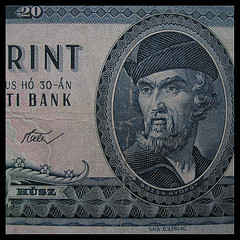
However, Dozsa was well on his way into the nationalist pantheon before Communist ascendancy. Nineteenth-century composer Ferenc Erkel, for instance,** wrote an opera about him, and poet/nationalist revolutionary Petofi Sandor saluted him in verse in 1847.

The latter text is available in Hungarian on Dozsa’s Hungarian Wikipedia page, which also attributes at least two plays about him to the Interwar period.

* aka Timisoara — in modern-day Romania, where the execution actually took place.

** Dozsa was actually captured in a fortress constructed by John Hunyadi, whose executed son is a fellow nationalist martyr (playing for the traditional-authority team), and the subject of one of Erkel’s more famous operas.
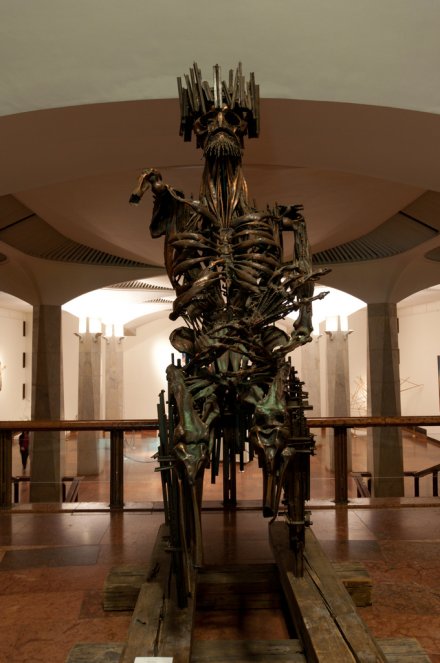

Sculpture of Gyorgy Dozsa burned on his throne, from Budapest’s Hungarian National Museum. (cc) image from redteam.

On this day..

1594: Rodrigo Lopez, Shylock inspiration?

On this date in 1594, a 70-year-old Portuguese physician was torn apart at Tyburn before a jeering London mob for attempting to poison Queen Elizabeth I.

Born around 1525 to a family of conversos — Jewish converts forcibly converted to Christianity — Rodrigo Lopez (alternatively, Lopes) went abroad because the Spanish Inquisition menacingly suspected him of secretly maintaining the faith of Abraham.*

For us, the man’s true doctrines might be a matter for his god. In the 16th century, Lopez never could outrun his Jewishness.

Establishing himself in London in 1559, nearly the precise midpoint of his life, Lopez built a thriving medical practice, eventually rising in 1586 to the attendance of Her Majesty herself. England in those days was scrapping with the mighty Spanish empire, one front of which was endlessly byzantine diplomatic intrigue. It happened that Elizabeth gave harbor to a Portuguese pretender (Lopez had attended him, too), whose circles the Spanish were naturally endeavoring to infiltrate.

Some nefarious machinations in this ambit that came to light in 1593 opened an investigation characteristically heavy on the torture, and Lopez’s name came up. Allegedly, the doctor was negotiating to take Spanish gold for slipping the Queen a mickey.

Lopez doesn’t seem to be any less capable of greed or intrigue than anyone else at court, but poison? It was doubted at the time, the prosecution itself a product of the courtly rivalry between Essex and Cecil.** Despite a confession (extracted by torture, like the accusations), even Elizabeth never seems to have really bought the charge: she held Lopez more than three months after his sentence before finally permitting the punishment to go forward, and pensioned his family when the treason conviction entitled her to confiscate their property.

The London mob entertained no such nuance. When Lopez was hauled to the scaffold this day for his public butchery — still protesting that he “loved the Queen as he loved Jesus Christ,” derisively taken as a backhanded confession by spectators who didn’t doubt the practicing Protestant was really a Jew — it elevated popular anti-Semitism to fever pitch.

Hath not a Jew eyes?

Lopez, or at least the popular mood of Jew-baiting current after his trial, is thought to have helped inspire William Shakespeare’s use of the Shylock character in The Merchant of Venice — one of the most controversial and captivating of all the Bard’s creations, a villain far more compelling (and sympathetic) than the play’s lightweight good guys and one whose place in the Shakespeare canon and the fabric of Elizabethan England is still vigorously debated.

Is Shylock a vicious caricature? A sublimely three-dimensional human? Both? Wherever the “real” William Shakespeare stood on the matter of religious equality, he put one of literature’s great apologias for it in Shylock’s mouth:

* Insincerely converted Muslims and Jews were a choice target of the Inquisition in the 16th century; many thousands were driven to emigrate. For the fate of some other crypto-Jews who fled to Spain’s possessions in the New World, see here.

** Lopez’s Javert, the Earl of Essex, lost the power struggle a few years later … and with it, his own head.

On this day..

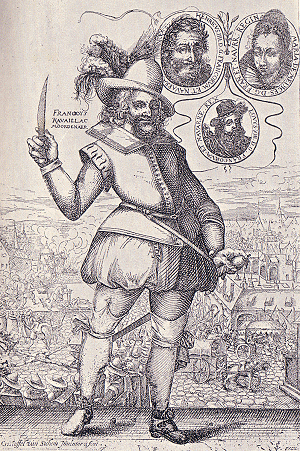
1610: Francois Ravaillac, because Paris was worth more than a mass

On this date in 1610, the fanatical Catholic who assassinated Henri IV of France was ripped apart on the Place de Greve.

The road to this man’s calvary begins long before his infamous crime, even long before the birth of his illustrious victim.

The Protestant Reformation — so richly represented in the executioner’s annals — had fractured France in the 16th century.

After decades of voluptuously indecisive Catholic-versus-Hugeunot slaughter, matters had finally been settled by the man upon whom French absolutism would erect its (ill-fated) edifice.

Henri IV, the first Bourbon monarch and a Huguenot, had unified the country by the sword, capped by his memorably politic conversion to Catholicism in 1593 to win over the holdout capital of Paris — the occasion of his understated declaration that “Paris is worth a mass”.

Let us tarry here to appreciate “the good king Henri” in a kaleidoscope of flattering artwork to the tune of Vive Henri IV, the monarchy’s unofficial anthem after its subject’s passing:

Did you catch that last image?

Henri’s fine gesture of sectarian triangulation and the reign of relative calm it inaugurated were naturally resented by godly partisans of both camps who either considered his conversion a betrayal or considered the king a closet Protestant.

At the crazed end of this latter spectrum, we meet our day’s principal, Francois Ravaillac.

Readers unconstrained by time may enjoy this Tolstoyan trek into the regicide’s mind and milieu, but it will suffice us to say that the modern shotgun-wielding postal clerk who just seemed like a quiet, harmless type to all his coworkers might like the cut of Ravaillac’s jib. A bit of a loner, a bit of a professional washout, with a penchant for religious visions and a passel of ill-arranged grievances … by this point in the movie, that’s about what you expect the police profiler to be reciting.*

It is only right that such a contemporary-sounding lone nut story ought to have a vigorous conspiratorial counternarrative.

There has always been a strong suspicion that behind Ravaillac’s hand was the work of the scheming Catholic Duc d’Epernon, perhaps even with the complicity of Henri’s wife Marie de’ Medici, who had conveniently been crowned as queen the day before the murder** and promptly teamed up with Epernon to cement an alliance with a traditional French rival, the ultra-Catholic Habsburgs.

Balzac, for one, had no doubt about it:

all of [her] actions were prejudicial to France … Marie de’ Medici wasted the wealth amassed by Henri IV.; she never purged herself of the charge of having known of the king’s assassination; her ‘intimate’ was d’Epernon, who did not ward off Ravaillac’s blow, and who was proved to have known the murderer personally for a long time. … [T]he victory Richelieu at last won over her (on the Day of the Dupes) was due solely to the discovery the cardinal made, and imparted to Louis XIII, of secret documents relating to the death of Henri IV.

The historical jury is out on that question, presumably for good.

If Ravaillac was a conspirator, he proved to be a damned good one, denying under repeated torture that he had any accomplices. On this date, the tortures reached their crescendo and conclusion — to the horrible delight of the Parisian mob, as reported by Alistair Horne (via The Corner):

On 27 May, still protesting that he had acted as a free agent on a divinely inspired mission, Ravaillac was put to death. Before being drawn and quartered, the lot of the regicide, on the Place de Grève scaffold he was scalded with burning sulphur, molten lead and boiling oil and resin, his flesh then torn by pincers. Then his arms and legs were attached to horses which pulled in opposite directions. One of the horses “foundered,” so a zealous chevalier offered his mount; “the animal was full of vigour and pulled away a thigh.” After an hour and a half of this horrendous cruelty, Ravaillac died, as the mob tried to prevent him receiving last rites. When he finally expired,

“…the entire populace, no matter what their rank, hurled themselves on the body with their swords, knives, sticks or anything else to hand and began beating, hacking and tearing at it. They snatched the limbs from the executioner, savagely chopping them up and dragging the pieces through the streets.”

Children made a bonfire and flung remains of Ravaillac’s body on it. According to one witness, Nicholas Pasquier, one woman actually ate some of the flesh. The executioner, supposed to have the body of the regicide reduced to ashes to complete the ritual demanded by the law, could find nothing but his shirt.

Ravaillac was the last Frenchman drawn and quartered for a century and a half — but his punishment as a regicide formed the precedent for that handed down in 1757 to Damiens.

* No need, though, as Francois wasn’t hard to catch: he stepped up to Henri’s carriage when it was caught in a traffic jam on May 14, 1610, and stabbed the king to death plain as can be. He was lucky (sort of) to avoid a lynching.

** Rubens later painted a gaudy celebration of this event.

On this day..

1916: Jesse Washington lynched after conviction

Lynching is such a vile word. Likely taken from the name of Captain William Lynch of Virginia (circa 1780), the term for administering justice while dispensing with a trial had, by 1916, long since taken on its more common meaning of a white-on-black public killing.

But Jesse Washington‘s case defies this simple definition, straddling the line between state execution and an unrestrained populace. Washington’s brutal lynching at the hands of a white mob in Waco, Texas, on May 15, 1916, clearly fits the definition, and the particularly grisly details of his demise conjure all-too-familiar images of violent racism in the pre-Civil Rights South; but in another more disturbing way, Washington was effectively executed, his punishment carried out not by the state of Texas, but by the people themselves.

Jesse Washington’s charred corpse after the lynching.

Washington was born in 1899, a black farmhand who may or may not have been mentally retarded.* While his life is not well-documented, his death most certainly is. Washington was arrested on May 8 of that year for the rape and murder of Lucy Fryer, the 53-year old wife of a well-to-do cotton farmer. Fryer was found bludgeoned to death. Washington was spared for a week by the Waco sheriff, who successfully took him into custody before a pre-trial mob got their hands on him; Washington was then sent to Dallas for holding to prevent a local incident. To appease the mob, he was transferred back to Waco and tried for the crime just one week later.

It’s unclear whether Washington was guilty — evidence is scant and the trial lasted just one hour, but Washington appears to have had ample opportunity to perpetrate the act and is purported to have confessed — but his guilt or innocence in the matter was not on the mob’s mind. On May 15, the well-attended trial ended, and in four minutes, the jury reached its guilty verdict. Before the 17-year old could be sentenced, and with little or no resistance offered by any of the various legal entities in the courthouse, several hundred of the onlookers (some brandishing weapons) rushed Washington and carried him out the doors. Outside, a larger crowd waited to beat and castrate him. A chain was thrown around Washington’s neck, and he was dragged to the town square, where he met an immense crowd as well as the pile of dry goods boxes that was to be his end.

A Fred Gildersleeve image of the lynching of Jesse Washington.

By some estimates, up to 15,000 (mostly white, though not exclusively white) people watched the horrible events unfold; without question, Waco’s mayor as well as several other public officials watched from their second-story perch at town hall on one side of the square. Washington was tossed onto the boxes and coal oil was poured over him. The other end of the chain was thrown over what has become known as the Hanging Tree, and the fuel below Washington’s feet was set ablaze. Immersed in the flames, he attempted to climb the blisteringly hot chain multiple times, each time to be lowered back into the cauldron. It’s unclear how long Washington was alive, but the event lasted more than an hour, after which his fingers and teeth were claimed as souvenirs, his body parts were separated from the torso, and the remains of Washington were dumped in a bag so they might be dragged once more through the Waco streets.

Also watching from the mayor’s position was a cameraman who wanted to sell photographs of Washington’s charred corpse as postcards. Fred Gildersleeve snapped a series of images which would briefly make Waco the most shamefully famous city in the nation. Gildersleeve’s work paints a portrait of a town possessed by spite and uncontrolled rage: thousands of white spectators standing about the burning body of Washington from above, then hundreds of blacks gathered around his burned and brutalized remains from ground level. Others took pictures as well,
some more disturbing than others.

A complete and startlingly brutal account of this murder is given by Patricia Bernstein in her 2005 book The First Waco Horror: The Lynching of Jesse Washington and the Rise of the NAACP, which also tracks the increased viability of the NAACP in the wake of the slaying. What makes this case noteworthy for this column, though, is that Washington was found guilty prior to his lynching, and he would doubtless have received a state-supported death sentence. At the time, Texas law would have allowed for a public hanging; presumably, the spectacle surrounding Washington’s execution would have been just as significant (though not nearly as gruesome). Instead, vigilante justice was administered on the young farmhand, and his case because a linchpin for the Civil Rights movement. As with other lynchings of the time, no persons were charged in the incident, though it was obvious that there was significant planning involved and, from some of the images, that some form of self-appointed executioner actively participated in the deed.

Unlike a state-sponsored execution, though, Washington’s death raised the ire of the jury foreman, who harshly criticized the court for not protecting him. And because he was lynched, his cause was also taken up by several Northern papers, pushed into the national spotlight by NAACP secretary Royal Freeman Nash and Elisabeth Freeman.** Over 90 years later, the town of Waco is still dealing with the Waco Horror. The lynching has reared its head multiple times as many residents have pushed for a plaque to be erected on the site of the lynching, as one was for a distressingly large number of prior lynchings in Waco. Some in the town continue to resist, asserting that Washington’s guilt absolved the mob of responsibility for its act.

A postcard commemorating the lynching; written on the back: “This is the barbecue we had last night. My picture is to the left with a cross over it. Your son, Joe [Myers].”

Washington’s case raises two of the critical issues in the modern death penalty debate: culpability of the executioner (and witnesses), and cruelty of punishment. Nobody in the mob was prosecuted for the crime, and in the Waco of that day, it would have been unusual if someone had; today, we take little interest in the state executioner but would vociferously condemn such mob action. On a similar note, Washington’s death was barbaric and brutal, and few would argue that such an execution should be undertaken through legal channels, but recent Supreme Court cases have found it difficult to identify the meaning of “cruel and unusual punishment”. The debate continues in the United States, but these are two arguments, posed by Cesare Beccaria, that caused Leopold II to outlaw capital punishment in the Grand Duchy of Tuscany in 1789, and cases like Washington’s suggest they should continue at the very least to give us pause today.

* Some accounts state simply that he was illiterate, and if this is the litmus test for mental retardation in the early 1900s, around 6 percent of the population fell into that category.

** Freeman worked tirelessly to drag information from Waco’s inhabitants, her actions likely sparking papers like the local Waco Times-Herald to quickly shut the door on the case; that paper officially apologized 90 years later for its and other newspapers’ roles in venerating the lynch mob.

On this day..

1792: Tiradentes, for a Brazilian republic

On this date in 1792, Joaquim José da Silva Xavier — better known to Brazilian history as Tiradentes — was hanged in Rio de Janeiro and his body quartered for public exposition.

Pedro Americo’s 1893 Tiradentes Esquartejado delivers what it promises.

Tiradentes — “tooth-puller,” a scornful nickname its owner has made glorious, alluding to the span of his itinerant career spent in dentistry — had participated in a conspiracy to detach the province of Minas Gerais from the Portuguese empire.

The Inconfidência Mineira featured the unpromising combination of a large number (the conspiracy was betrayed from within) of middle-class intellectuals (Tiradentes was of an unusually low social strata) without a common programme or a practical notion of what to do once they had seized power. That the Portuguese monarch felt at liberty to commute every other death sentence seems a measure of the plotters’ — if one may put it this way — toothlessness.

Tiradentes was obstinate in maintaining responsibility for the plot, although he wasn’t the leader in particular; for his resulting pains on the scaffold, he traded dentistry for immortality. Now officially recognized as a hero of Brazil, his name adorns the square where he was dismembered and (like Zumbi dos Palmares) his execution date is a public holiday.

When the tides of national fervor made such a rehabilitation politic, the would-be free state of Minas Gerais likewise adopted the conspirators’ banner as its own flag: the motto reads “Liberty, although overdue”.

On this day..

1905: Fou Tchou-Li, by a thousand cuts

On this date in 1905, Fou Tchou-Li suffered the last execution by lingchi in Beijing, for the murder of a Mongolian prince.

Lingchi, or slow slicing, involved the public dismemberment of the victim. As such, it became iconic to westerners as an image of exotic Chinese cruelty — albeit iconic in a mythicized form, the accounts conflicting, undependable, Orientalist. (Many different ones are collected at the Wikipedia page.)

Lingchi is especially notable — apart from fathering the phrase “death by a thousand cuts” in the English lexicology — for its overlap with the era of photography.

Fou Tchou-Li’s death was captured on film, and the images famously captivated Georges Bataille for the expression of seeming ecstasy on the face of the dying (or dead) man.

Bataille was said to meditate daily upon the image below in particular — “I never stopped being obsessed by this image of pain, at the same time ecstatic and intolerable.”

Agony and ecstasy? A sequence of images, strong stuff in spite of their low quality, describing Fou Tchou-Li’s execution can be viewed here. Notice, however, that it’s not the one pictured here — the scholar who maintains this page claims the man’s identity became confused by western interlocutors. The different, unnamed man who as “Fou Tchou-Li” riveted Bataille is pictured here.

In Regarding the Pain of Others, Susan Sontag explained the mystical nexus of pleasure and pain Fou Tchou-Li’s torture suggested to the French theorist, aptly comparing it to graphic but pre-photographic exaltations of torture in the western artistic tradition, such as Saint Sebastian:

To contemplate this image, according to Bataille, is both a mortification of the feelings and a liberation of tabooed erotic knowledge — a complex response that many people must find hard to credit. … Bataille is not saying that he takes pleasure in the sight of this excruciation. But he is saying that he can imagine extreme suffering as a kind of transfiguration. It is a view of suffering, of the pain of others, that is rooted in religious thinking, which links pain to sacrifice, sacrifice to exaltation — a view that could not be more alien to a modern sensibility.

It’s no idle point to say that all this reads quite a lot into a single frame that may not be all that representative of the moment, though that wouldn’t necessarily diminish Bataille’s gist. More, these are western interpretations of — projections upon — an image marked as fundamentally outside in a tableau irresistibly blending the colonizer and the colonized.

The execution was ordered in the last days of the Qing Dynasty, which had long been substantially beholden to European states, especially the British; the prisoner was apparently administered opium to numb the pain, the very product Britain had gone to war to force China to accept.

Taiwanese video artist Chen Chieh-jen interpreted the photography that so captivated Bataille, and its colonial context, in Lingchi: Echoes of a Historical Photograph (review).

Two weeks after this date, China abolished the punishment for good.

On this day..

2007: Du’a Khalil Aswad, honor killing victim

On or about this date one year ago, a 17-year-old Kurdish Yazidi (alternatively, Yezidi) girl was stoned to death by her own community for falling in love with a Muslim boy.

Details on exactly how Du’a Khalil Aswad came to her end are slightly unclear: whether or not she converted to Islam, for instance, and whether she was lured to her death or simply taken by force.

What is blood-chillingly plain is the end itself — a mob “honor killing,” carried out publicly by (at least in part) men of her family, and anachronistically filmed with cell phones and therefore soon to rocket around the Internet. The existence of this video is what makes this incident notable to the wider world.


Caution: This video contains graphic footage. We have issued this warning before in these pages, but what follows here is of a different character: this is a powerless child, communally beaten to death while she pleads for help, recorded from a couple meters’ distance by someone (one of many, one can see) who felt filming was the most pressing possible occupation of his time at this moment. It’s exceedingly violent, exceedingly personal and exceedingly recent. Even at that, this is only an excerpt of a half-hour ordeal.

The fact that this video is hosted by Spiked Humor and comes with the associated teaser link adds an unwanted layer of perversity, but YouTube has repeatedly censored it; it takes some digging (this clip turned up here; a longer one can be downloaded here) to find any extended clip.

So, to repeat: This video contains extraordinarily graphic footage.

This is, to be sure, borderline as an execution — although it is one community’s ritual slaying in judgment, which is an uncomfortably close definition. Whatever one calls it, it apparently prompted a retaliatory massacre of Yazidis by Sunni gunmen,* and some months later, the deadliest suicide bombing of the American occupation.

It has also prompted at least some agitation for addressing the continued existence of honor killings especially in northern Iraq. Arrests for carrying out this killing were reported last spring, but I have been unable to find any subsequent report indicating a trial, conviction, acquittal or release.

** Although the existence of that context for the latter massacre was immediately reported, the video itself didn’t reach a worldwide audience until some days afterwards.

Update: Honor killing activists remember Aswad on the anniversary of her death here.

On this day..

1582: John Payne, snitched out

On this date in 1582, the Jesuit priest John Payne suffered drawing and quartering at Chelmsford for his forbidden faith.

This blog tips its cap to any fellow who prefers that awful punishment to a timely change of doctrine. Payne (or Paine) is accordingly one of the Forty Martyrs of England and Wales recognized by the Catholic church.

But at our present distance, Payne hardly stands out from the slew of 16th century Catholic martyrs in the way an Edmund Campion does.

We pause instead to take note of a small continuity between Payne and Campion, a secondary character whose shadow we observe but fleetingly, but whose presence suggests the condition of a community under siege — and whose character seems not unknown to our time.

Campion was apprehended by a police informant named George Eliot (“Judas Eliot”, Protestants as well as Catholics would call him).* A Catholic himself, Eliot took to collecting bounties on fugitive priests — to relieve himself, the Catholics said, of a murder charge pending against him. Eliot attended Campion’s last service, excused himself, and returned with a posse.

Later, he would meet his prize in prison:

“If I had thought that you would have had to suffer aught but imprisonment through my accusing of you, I would never have done it,” [Eliot] said, “however I might have lost by it.”

“If that is the case,” replied Campion, “I beseech you, in God’s name, to do penance, and confess your crime, to God’s glory and your own salvation.”

But it was fear for his life rather than for his soul that had brought the informer to the Tower; ever since the journey from Lyford,** when the people had called him “Judas,” he had been haunted by the specter of Catholic reprisal.

“You are much deceived,” said Campion, “if you think the Catholics push their detestation and wrath as far as revenge; yet to make you quite safe, I will, if you please, recommend you to a Catholic duke in Germany, where you may live in perfect security.”

But it was another man who was saved by the offer. Eliot went back to his trade of spy; Delahays, Campion’s jailer, who was present at the interview, was so moved by Campion’s generosity that he became a Catholic.

In fact, not long after Campion met his death, Eliot testified against Payne:

The said priest Payne went about once to persuade me to kill (Jesus preserve her) the Queen’s Majesty, and said that there were divers matters from the Pope published against her, that it was lawful to kill her Highness without any offence to Godward … the Pope would yield as much allowance of money as would fully furnish fifty men, to every man a good horse, an arming sword, a privy coat, and a pocket-dagge.

Which Payne answered:

For Eliot I forgive his monstrous wickedness and defy his malicious inventions; wishing that his former behaviour towards others being well known, as hereafter it will, were not a sufficient reproof of these devised slanders.

Reviled to posterity — to the extent he is not utterly obscure — Eliot enjoyed the material rewards of his labors. The Catholic source we have been citing reports that “he had been made a yeoman of her Majesty’s guard, and had come flaunting into court with his red coat.”

On this date, when John Payne was hanged, drawn and quartered still professing his innocence of treason and adherence to the Roman church, Eliot pocketed £4 for his service.

* The informants themselves became public figures who not only had to defend their integrity from the impeachments of their victims but contend with one another for pride of place. Eliot and fellow-informant Anthony Munday, later to make himself a name less blackened as a minor playwright, wrote competing pamphlets each asserting (and justifying) their own contributions to Campion’s arrest. (Source)

** Eliot arrested Campion at Lyford; on the journey to prison, Catholic tradition has it that Campion was supported by the crowd and Eliot openly jeered.

On this day..

1757: Robert-Francois Damiens, disciplined and punished

On this date in 1757, Robert-Francois Damiens became the last Frenchman to suffer the dreadful punishment of drawing and quartering.

Damiens attempted to assassinate King Louis XV, inflicting, however, only a slight dagger wound.

He may be best-known today as the subject of the jarring opening passage of Foucault’s Discipline and Punish, in which the full flower of this medieval torture* is described in detail by way of contrasting it with the regimented penal institutions that would sprout up in a few decades’ time. Here’s Foucault’s rendering of the scene:

On 1 March 1757 Damiens the regicide was condemned “to make the amende honorable before the main door of the Church of Paris”, where he was to be “taken and conveyed in a cart, wearing nothing but a shirt, holding a torch of burning wax weighing two pounds”; then, “in the said cart, to the Place de Grève, where, on a scaffold that will be erected there, the flesh will be torn from his breasts, arms, thighs and claves with red-hot pincers, his right hand, holding the knife with which he committed the said parricide, burnt with sulphur, and, on those places where the flesh will be torn away, poured molten lead, boiling oil, burning resin, wax and sulphur melted together and then his body drawn and quartered by four horses and his limbs and body consumed by fire, reduced to ashes and his ashes thrown to the winds” (Pièces originales…, 372-4).

“Finally, he was quartered,” recounts the Gazette d’Amsterdam of 1 April 1757. “This last operation was very long, because the horses used were not accustomed to drawing; consequently, instead of four, six were needed; and when that did not suffice, they were forced, in order to cut off the wretch’s thighs, to sever the sinews and hack at the joints…

“It is said that, though he was always a great swearer, no blashemy escaped his lips; but the excessive pain made him utter horrible cries, and he often repeated: ‘My God, have pity on me! Jesus, help me!’ The spectators were all edified by the solicitude of the parish priest of St Paul’s who despite his great age did not spare himself in offering consolation to the patient.”

Bouton, an officer of the watch, left us his account: “The sulphur was lit, but the flame was so poor that only the top skin of the hand was burnt, and that only slightly. Then the executioner, his sleeves rolled up, took the steel pincers, which had been especially made for the occasion, and which were about a foot and a half long, and pulled first at the calf of the right leg, then at the thigh, and from there at the two fleshy parts of the right arm; then at the breasts. Though a strong, sturdy fellow, this executioner found it so difficult to tear away the pieces of flesh that he set about the same spot two or three times, twisting the pincers as he did so, and what he took away formed at each part a wound about the size of a six-pound crown piece.

“After these tearings with the pincers, Damiens, who cried out profusely, though without swearing, raised his head and looked at himself; the same executioner dipped an iron spoon in the pot containing the boiling potion, which he poured liberally over each wound. Then the ropes that were to be harnessed to the horses were attached with cords to the patient’s body; the horses were then harnessed and placed alongside the arms and legs, one at each limb.

“Monsieur Le Breton, the clerk of the court, went up to the patient several times and asked him if he had anything to say. He said he had not; at each torment, he cried out, as the damned in hell are supposed to cry out, ‘Pardon, my God! Pardon, my Lord.’ Despite all this pain, he raised his head from time to time and looked at himself boldly. The cords had been tied so tightly by the men who pulled the ends that they caused him indescribable pain. Monsieur le [sic] Breton went up to him again and asked him if he had anything to say; he said no. Several confessors went up to him and spoke to him at length; he willingly kissed the crucifix that was held out to him; he opened his lips and repeated: ‘Pardon, Lord.’

“The horses tugged hard, each pulling straight on a limb, each horse held by an executioner. After a quarter of an hour, the same ceremony was repeated and finally, after several attempts, the direction of the horses had to be changed, thus: those at the arms were made to pull towards the head, those at the thighs towards the arms, which broke the arms at the joints. This was repeated several times without success. He raised his head and looked at himself. Two more horses had to be added to those harnessed to the thighs, which made six horses in all. Without success.

“Finally, the executioner, Samson, said to Monsieur Le Breton that there was no way or hope of succeeding, and told him to ask their Lordships if they wished him to have the prisoner cut into pieces. Monsieur Le Breton, who had come down from the town, ordered that renewed efforts be made, and this was done; but the horses gave up and one of those harnessed to the thighs fell to the ground. The confessors returned and spoke to him again. He said to them (I heard him): ‘Kiss me, gentlemen.’ The parish priest of St Paul’s did not dare to, so Monsieur de Marsilly slipped under the rope holding the left arm and kissed him on the forehead. The executioners gathered round and Damiens told them not to swear, to carry out their task and that he did not think ill of them; he begged them to pray to God for him, and asked the parish priest of St Paul’s to pray for him at the first mass.

“After two or three attempts, the executioner Samson and he who had used the pincers each drew out a knife from his pocket and cut the body at the thighs instead of severing the legs at the joints; the four horses gave a tug and carried off the two thighs after them, namely, that of the right side first, the other following; then the same was done to the arms, the shoulders, the arm-pits and the four limbs; the flesh had to be cut almost to the bone, the horses pulling hard carried off the right arm first and the other afterwards.

“When the four limbs had been pulled away, the confessors came to speak to him; but his executioner told them that he was dead, though the truth was that I saw the man move, his lower jaw moving from side to side as if he were talking. One of the executioners even said shortly afterwards that when they had lifted the trunk to throw it on the stake, he was still alive. The four limbs were untied from the ropes and thrown on the stake set up in the enclosure in line with the scaffold, then the trunk and the rest were covered with logs and faggots, and fire was put to the straw mixed with this wood.

“…In accordance with the decree, the whole was reduced to ashes. The last piece to be found in the embers was still burning at half-past ten in the evening. The pieces of flesh and the trunk had taken about four hours to burn. The officers of whom I was one, as also was my son, and a detachment of archers remained in the square until nearly eleven o’clock.

“There were those who made something of the fact that a dog had lain the day before on the grass where the fire had been, had been chased away several times, and had always returned. But it is not difficult to understand that an animal found this place warmer than elsewhere” (quoted in Zevaes, 201-14).

Among the throngs in attendance that day was Casanova who, according to his memoirs, rented out a windowed flat to watch that stomach-churning torture for four hours with some male friends and female companions.

One of the legendary libertine’s friends found this moment, serenaded by the prisoner’s “piercing shrieks”, opportune for an altogether different adventure of the flesh:

The three ladies packing themselves together as tightly as possible took up their positions at the window, leaning forward on their elbows, so as to prevent us seeing from behind. The window had two steps to it, and they stood on the second; and in order to see we had to stand on the same step, for if we had stood on the first we should not have been able to see over their heads. I have my reasons for giving these minutiae, as otherwise the reader would have some difficulty in guessing at the details which I am obliged to pass over in silence.

Tiretta kept the pious aunt curiously engaged during the whole time of the execution, and this, perhaps, was what prevented the virtuous lady from moving or even turning her head round.

Finding himself behind her, he had taken the precaution to lift up her dress to avoid treading on it. That, no doubt, was according to the rule; but soon after, on giving an involuntary glance in their direction, I found that Tiretta had carried his precautions rather far, and, not wishing to interrupt my friend or to make the lady feel awkward, I turned my head and stood in such a way that my sweetheart could see nothing of what was going on; this put the good lady at her ease. For two hours after I heard a continuous rustling, and relishing the joke I kept quiet the whole time. I admired Tiretta’s hearty appetite still more than his courage, but what pleased me most was the touching resignation with which the pious aunt bore it all.

Casanova’s Complete Memoires are available free online; this episode is recounted in the first chapter of “Paris and Holland”.

* Damiens’ punishment was in fact already archaic at the point when it was inflicted. Somewhat unsure of itself, the court sought precedent in the last regicide executed — Francois Ravaillac, who in 1610 was also the most recent person to suffer this horrific penalty. The clumsiness of the Damiens’ execution can surely be attributed to the art being a century and a half out of practice.

On this day..

922: Mansur al-Hallaj, Sufi mystic

On this date in 922, Sufi Mansur al-Hallaj was put to a torturous end in Baghdad — either crucifixion, dismembering, or both — for “theological error threatening the security of the state.”

Born in Persia, al-Hallaj traveled widely from India to Mecca, eventually settling in Baghdad, the capital of the Abassid Empire.

Ana al-Haqq

Al-Hallaj espoused the mystical Islamic school of Sufism and produced gorgeous poetry.

But he ran afoul of the authorities for his unusual willingness to speak publicly about Sufi concepts which were held to require mystic initiation in order to grasp.

Most particularly, saying “ana al-Haqq” — “I am God” — and poems directly identifying himself with divinity were thought by the state theologians to have mystical wisdom for initiates, but to be exceedingly dangerous sentiments to set loose among the hoi polloi, especially given popular devotion to the Abassid government that was less than ironclad.

In truth, al-Hallaj’s condemnation seems to have been rooted in contemporary imperial politics, his demise representing the (momentary) upper hand of the more autocratic elements against potentially more sympathetic parties.

He spent eleven years in a Baghdad jail, reportedly enduring torture with placidity. Accounts of his execution speak of him greeting a horrific death with joy.

Mansur al-Hallaj remains revered today among mystically inclined followers of many faiths and admired by many westerners, factors which do not quite resolve the dispute over his place within Islam. Ultimately, the rightness of his choices remains very much in the eye of the beholder.

On this day..