1798: The Carnew executions

The Carnew Massacre blackened this date in 1798, in the Irish village of the same name.

It was the morrow of the outbreak of Ireland’s 1798 rebellion against British rule. This rising commenced on May 24 and foundered within weeks leaving a harvest of patriotic martyrs in its wake but those in the moment had not the advantage of hindsight — so as news of the fighting reached County Wicklow, adjacent to the rebel epicenter of Wexford, loyalists there authored a couple of notable summary atrocities by way of pre-emption.

On May 25, the British garrison at Carnew took 28 United Irishmen prisoners already being held in Carnew Castle and had them shot out of hand in an alley.

A similar mass execution of 36 nationalist prisoners occurred on the following day, May 26, at Dunlavin Green.

On this day..

1918: A day in the death penalty around the U.S.

From the Pueblo Chieftain (May 25, 1918):

Salt Lake City, May 24. — Howard H. Deweese, who was shot here today for the murder of his wife, Fannie Fisher Deweese, left a grim legacy for his wife’s former husband. It is a silk handkerchief and the bullets which passed thru the heart of Deweese, first passed thru the bit of silk which he had pinned over his chest.

Before his execution Deweese secured the promise of the warden of the state prison to forward the handkerchief, together with a note to Fisher in New York. The letter, dated at the Utah state penitentiary last Monday, reads:

Mr. H.W. Fisher, 150 Second avenue, New York:

Greetings:

In accordance with customs observed by certain people, I herewith conform with precedents and law governing the conduct of aforesaid people. I have rigidly adhered to my vows. You have violated yours. Therefore, put your house in order. The allotted time customary in such cases is yours. The souvenir enclosed herewith (by the warden of this institution) will doubtless serve to convince you that time, distance, political influence or money cannot change the inexorable workings of things decreed by men who do not hesitate in risking all, even life, for things they have sworn to uphold.

The U.B.C. thru one who has proven loyal, bids you ‘prepare.’ It is written.

(Signed)
J.E.W.

The initials affixed at the bottom of the note stand for Deweese’s alias — J.E. Warren. The “U.B.C.” Deweese explained just before his execution, was the initials of the “Universal Brotherhood Club of New York.”


From the Kansas City Star (May 24, 1918):

DALLAS, TEX. May 23. — A claim that the idea for the Red Cross poster, “The Greatest Mother in the World,” originated in the mind of Leonard Dodd, who with Walter Stevenson is sentenced to hang here tomorrow for murder, was placed here today before the state board of pardons at Austin as part of a plea for commutation of sentence.

Council for Dodd informed the board a draft of the poster had been sent by him to the Red Cross headquarters at Washington and that it was later drawn by an Eastern artist. Dodd, Stevenson, and Emmett Vestal, also convicted of murder, will be hanged tomorrow unless Governor Hobby commutes their sentences. [Dodd and Stevenson hanged; as for Vestal’s … read on. -ed.]


From the Arizona Republic, Jan. 1, 1955:

Evangelist Emmett T. (Texas Slim) Vestal, a man twice condemned to die in the electric chair, is in Phoenix conducting a revival, and illustrating that “no matter how low a man can get, he still can be saved by following Christ.”

For more than 20 years, Mr. Vestal has been preaching in churches throughout the country, and recounting his experiences as bank robber, drug addict, and gang member.

Services will be conducted every night through next Friday at 7:30 p.m. at the Revival Center, 902 N. 24th St.

In 1917 he shot a rival gang leader who tried to ambush him near Victoria, Tex. and was sentenced to die May 24, 1918. Five minutes before the hanging, he was granted a reprieve by the late Governor W.P. Hobby.

He returned to prison, contracted tuberculosis and was sent to a state hospital from which he escaped. Law officials found him in 1926 in St. Louis and took him back to Texas for a new trial because the state had changed his sentence from hanging to electrocution.

He was again convicted and sentenced to die, this time in the electric chair. Three days before the electrocution, his sentence was commuted to life imprisonment by the late Governor Miriam (Ma) Ferguson. Three days after that she granted him a full pardon.

Methodist church workers taught him to read and write and gave him Christian education while he was in prison. After his release he began his evangelic career. He was ordained a baptist minister.

On this day..

1872: Matias Salazar

Venezuelan caudillo Matias Salazar was shot on this date in 1872.

A commander who had adhered himself to Antonio Guzman Blanco‘s 1870 “April Revolution”, Salazar gradually became alienated from his chief and in 1871 orchestrated an unsuccessful assassination attempt on Guzman.

The resulting exile Salazar used as an opportunity to mount an invasion — but he was intercepted trying to march into Venezuela through Colombia’s bordering Arauca region and given over to a war council for his fate.

There’s a Spanish-language public domain biography of Salazar here.

On this day..

1903: Victoriano Lorenzo, cholo

Panamanian indigenous leader Victoriano Lorenzo was shot on this date in 1903.

He was a cholo (mixed-race; Lorenzo had both African and Amerindian ancestry) peasant who in the 1890s rose to become the most prominent indigenous leader in Cocle, a Pacific-facing province on the isthmus back when Panama was still a part of Colombia.

Lorenzo (English Wikipedia entry | Spanish) would lead indigenous forces in the Thousand Days’ War — a civil war between Colombia’s Conservative and Liberal Parties. Lorenzo fought in alliance with the Liberals; they lost the war, and with it the native land rights that Lorenzo fought for.

While the war was settled by the last days of 1902, the now-ascendant Conservative government accused Lorenzo and followers of continuing to fight and put him to a rial on grounds of murder and robbery that culminated in his public shooting in Panama City. The affair was so irregular that it’s commonly maligned as an “assassination”.

Scholars have interpreted the strange circumstances of his death as Conservative vengeance, the destruction of a hero and powerful symbol for impoverished people, the establishment of oligarchy, and as the forgetting of indigenous people as emblematic in the new Republic of Panama. Lorenzo has been interpreted as a martyr and the first victim of North American imperialism related to the Canal because he was held aboard the United States ship Bogota before his assassination. Seven days before his assassination, Esteban Huertas publicly announced that there was nothing more dangerous for the Canal construction than “guerrillas” and their activities in the mountains of Cocle …

The Conservative narrative of Lorenzo as “guerrilla” fighter permeated Panamanian national history, and schoolchildren learned to see Lorenzo negatively. National Panamanian history depicted Lorenzo shamefully as a “dirty cholo” …

In contrast, northern Cocle oral history memorializes, in cyclical time, Lorenzo as a cultural hero who continues to live, and understands his fight for land rights and political autonomy as the same fight of Urraca that is still ongoing today. People identify strongly with a liberation theology quote attributed to Lorenzo shortly before his death, “I forgive all. I die like Jesus Christ died,” wherein the cultural hero continued the cycle of death to defend land in this epoch. Rufino Peres J., born in 1941, recalls:

My people were illiterate, when he lived. They wore plant fiber loincloth (pampanillas) to go to Penonome … Why did they kill Victoriano Lorenzo? He died fighting for our land, and they formed a war, and that Victoriano Lorenzo, a cholo, won that war! It was not the president who won the war; it was Victoriano Lorenzo. They could never kill him: they used machetes, sticks, smoke, and they didn’t kill him. How was that? Then Victoriano Lorenzo went to the Presidency, and there they killed him. But Victoriano Lorenzo has stayed in History. So, now, whenever a campesino starts any kind of movement, they are scared because because we are the blood of Victoriano Lorenzo.

He uses the word blood (sangre) to mean how much someone is dedicated to the land and lineages in struggle, and adds, “Now youth don’t have blood like before, they have to be ready to die.” (from The Blood of Victoriano Lorenzo: An Ethnography of the Cholos of Northern Cocle Province, Panama)

Panama broke away from Colombia later that same year of 1903, and its new constitution abolished the death penalty outright. Independent Panama has never conducted an execution — so Lorenzo’s appears to be the isthmus’s last.

On this day..

1948: Johannes Rasmussen, Danish Resistance betrayer

Anti-Nazi Danish Resistance turncoat Johannes Rasmussen was shot at Viborg on this date in 1948.

Arrested by the Gestapo in December 1943, Rasmussen (Danish link) broke under torture and informed on his former comrades, but he also extended his collaboration far beyond (more Danish) mere capitulation and became their henchman and collaborator. Rasmussen befriended his captors and working as an interpreter and interrogator until someone from the Resistance shot him in February 1945 and left him bedridden.

Arrested on the day after the German occupation ended, he unsurprisingly got no mercy from the countrymen he had betrayed.

On this day..

1949: Li Bai, PLA spy

Red spy Li Bai was executed in the Pudong district of Shanghai on this date in 1949.

Li Bai and his circuitry immortalized in stone in Shanghai’s Century Park. (cc) image from (checks notes) “Kgbkgbkgb”

A survivor of the Party’s epic Long March Li Bai (English Wikipedia entry | Chinese) was a Party-trained wireless operator who was detailed to Shanghai with the 1937 outbreak of the Sino-Japanese War.

He was fortunate to survive arrest by the Japanese while transmitting from occupied Shanghai in 1942. (The Japanese took him for a mere enthusiast.) Even more fortunate from his handlers’ standpoint was the interest his radio skills subsequently attracted from the nationalist Kuomintang, which recruited him into service that Li Bai was only too happy to accept.

For the next several years, he sent to the Communists voluminous inside information about the disposition of their opponents in the endgame stage of the Chinese Civil War. He was detected in the last days of 1948, sending to the People’s Liberation Army the troop dispositions that would enable it to overrun the capitals in the subsequent months. Not three weeks after Li Bai’s execution in Shanghai that city fell to the Communists; by year’s end, the Kuomintang had evacuated the mainland for its so-far permanent Formosan redoubt.

There’s a 1958 Chinese biopic about him, titled The Unfailing Radio Wave; the embed below is one of many subsequent readaptations:

On this day..

1919: Seven Thule Society hostages

A century ago today, seven hostages taken from the German pre-Nazi Thule Society were executed by the short-lived Munich Soviet just before it was crushed by right-wing militias.

The Thule Society (logo at right) was a Bavarian volkisch club with a profound interest in stuff like crackpot race theory and Teutonic mythology; its very name alludes to a legendary territory hypothesized since antiquity to lie at the fringes of the world, often associated with Scandinavia and with the origins of the Aryan race.*

Society members figured in the founding of the German Workers’ Party (DAP), the party which became the National Socialist German Workers’ Party (NSDAP), better known as the Nazis. Former Thuler Hans Frank was among those eventually hanged via the postwar Nuremberg trial.

One will readily imagine where this lot stood in relation to the Soviet Republic that was declared in Bavaria in early April, and the sentiment was fully returned. As right-wing Freikorps paramilitaries intent on destroying the Red Bavarian statelet surrounded Munich, the Communists seized seven Thule Society members — notably Countess Haila (or Hella) von Westarp and Gustav Franz Maria, Prince of Thurn and Taxis and held them in the basement of the Luitpold Gymnasium.

On April 30, 1919, all these seven were executed by order of the Communist sailor Rudolf Egelhofer, together with either two or three captured Freikorps prisoners, an affair known as the Münchner Geiselmorde (“Munich hostage-murder”).


Countess Haila von Westarp

The very next day, the Freikorps broke through Munich’s defenses and commenced the bloody rout that destroyed the Munich Soviet.

The Thule Society as a body survived and briefly prospered after its brush with the revolutionaries’ muzzles — the eventual Nazi party newspaper Völkischer Beobachter was previously a Thule Society-owned periodical called the Münchener Beobachter — but it fizzled out into a memory during the 1920s.

Still, this esoteric nursemaid to the infancy of national socialism features prominently in histories of Third Reich occultism; aficionados might wish to browse some of its iconography in this Pinterest gallery, or just punch their distinctive name into your search environment of choice and feel that third eye opening.

* The element Thulium is named for Thule, because it was discovered by a Scandinavian chemist; the U.S.’s Thule Air Base in Greenland developed from an Arctic Circle trading post established and named by a Scandinavian explorer. (From which he launched a series of early 20th century “Thule Expeditions”.)

More recently, the word made the news when astronomers controversially christened the most distant observed trans-Neptunian object “Ultima Thule”.

On this day..

1831: Atanasio, shot for some buttons

This episode from Mexican Alta California comes from the short-lived administration of Manuel Victoria, who proved himself such a martinet in his few months as governor of that territory that a rebellion that December forced Victoria’s resignation.

Our source is Hubert Howe Bancroft, a historian of the American West, in this volume of his chronicle of California:

The administration of justice was a subject which early claimed the new ruler’s attention. It had been much neglected by the easy-going Echeandia, and crime had gone unpunished. Criminal proceedings had been often instituted, as we have seen in the local presidial annals of the last six years, but penalties had been rarely inflicted with fitting severity. Victoria had strict ideas of discipline, and no doubt of his ability to enforce the laws. He is said to have boasted soon after his arrival at Monterey that before long he would make it safe for any man to leave his handkerchief or his watch lying in the plaza until he might choose to come for it. How he carried out his ideas in this direction will be apparent from a few causas celebres of the year.

The case of Atanasio was pending when Victoria came. Atanasio was an Indian boy less than eighteen years of age, a servant in sub-comisario Jimeno’s office, who had in 1830 stolen from the warehouse property to the extent of something over $200. The prosecution was conducted by Fernandez del Campo, Padres, and Ibarra as fiscales; and the last-named demanded, in consideration of the youth and ignorance of the culprit, as well as on account of the carelessness with which the goods had been exposed, a sentence of only two years in the public works. The asesor, Rafael Gomez, after having sent the case back to the fiscal for the correction of certain irregularities, rendered an opinion April 18th, in favor of the death penalty; and by order of the comandante general Atanasio was shot at 11 a.m. on the 26th. Gomez was an able lawyer, and I suppose was technically correct in his advice, though the penalty seems a severe one. Naturally the Californians were shocked; and though an example of severity was doubtless needed, Victoria was not fortunate in his selection. The circumstance that led to the culprit’s detection seems to have been his using some military buttons for gambling with his comrades; and the popular version of the whole affair has been that an Indian boy was shot by Victoria for stealing a few buttons.

On this day..

1939: Jose Aranguren, Civil Guard general

Spanish general Jose Aranguren was shot on this date in 1939 by Franco’s Spain.

A brigadier general of the Civil Guard — an internal-to-Spain paramilitary/law enforcement force that remained predominantly loyal to the Republic during the Spanish Civil War — Aranguren (the very cursory English Wikipedia entry | the more detailed Spanish) at the outset of hostilities efficaciously suppressed the Nationalist rebels in Barcelona and even gave evidence that contributed to the execution of his mutinous opposite numbers.

From 1937, he served as the Republican military governor of Valencia.

He eschewed the opportunity to flee Spain at the end of the war, counting on his faithful adherence to his plain duty to vindicate himself against the fascists.

On this day..

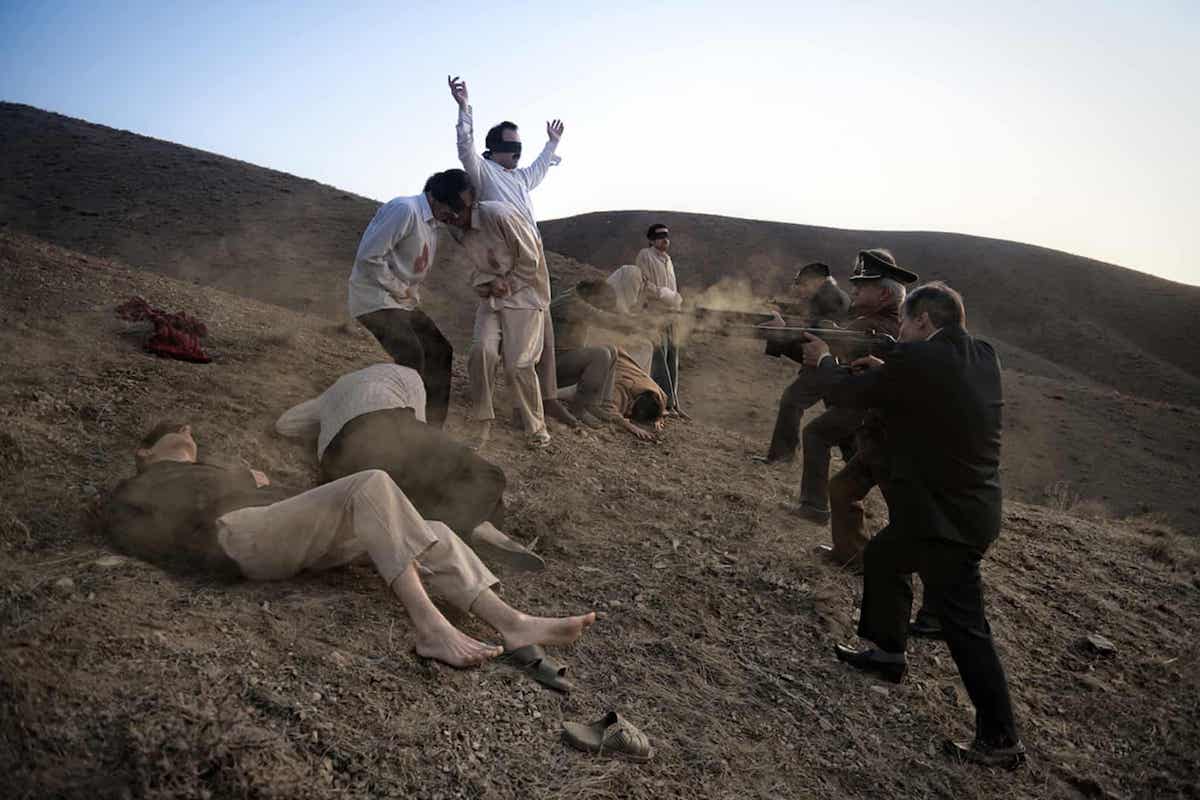
1975: Nine Iranian communists

On this date in 1975,* Iran extrajudicially executed nine political prisoners.


This photo is a dramatic re-staging — evocative of a famous photo of executions in revolutionary Iran a few years later, or perhaps in the white-clad central prisoner’s raised arms, the Goya painting that forms this very blog‘s frontispiece. (Contrary to the reconstruction, the executioners had just one Uzi and took turns spraying it at their victims.) It’s part of a fascinating project by Azadeh Akhlaghi to portray 17 pivotal deaths in Iran’s history.
We took the prisoners to the high hills above Evin. They were blind-folded and their hands were tied. We got them off the minibus and had them sit on the ground. Then, [SAVAK agent Reza] Attarpour told them that, just as your friends have killed our comrades, we have decided to execute you — he was the brain behind those executions. Jazani and the others began protesting. I do not know whether it was Attarpour or Colonel Vaziri who first pulled out a machine gun and started shooting them. I do not remember whether I was the 4th or 5th person to whom they gave the machine gun. I had never done that before. At the end, Sa’di Jalil Esfahani [another SAVAK agent, known as Babak] shot them in their heads [to make sure that they were dead].

Account of a former Savak agent, Bahman Naderipour, who was executed after the Iranian Revolution. The New York Times report of Naderipour’s public trial has him recounting:

“We took them out of the jail and put them in a minibus and drove them to the hills. We had only one submachine gun, an Uzi, among us, so we took turns shooting them … we didn’t give them a chance to make a last declaration. We blindfolded them and handcuffed them and then shot them. I think was the fourth to shoot. We took the bodies back to the prison. and we had the newspapers print that they were killed during a jailbreak. We had the coroner confirm this version.”

The victims were Ahmad Jalil-Afshar, Mohammad Choupanzadeh, Bijan Jazani, Mash’oof (Saeed) Kalantari (Jazani’s maternal uncle), Aziz Sarmadi, Abbas Sourki, Hassan Zia Zarifi, Mostafa Javan Khoshdel and Kazem Zolanvar.\
The last two named were members of the People’s Mujahedin of Iran, the still-extant MEK back when it was still a standard Marxist revolutionary movement and not a cult.

The first seven named were members of the Organization of Iranian People’s Fedai Guerrillas, a proscribed Communist guerrilla organization.

One of those seven, Bijan Jazani, was a co-founder of that organ and one of the greatest Communist intellectuals Iran ever produced. (For a flavor of his thought kick back with the Jazani collection in Capitalism and Revolution in Iran.) With him was Hassan Zia-Zarifi, long a collaborator in leftist circles.

The proceedings that had landed them in prison in the first place had already put them in the global spotlight especially given the horrific torture applied to the defendants. (Among other things, these seven were adopted by Amnesty International as watchlist political prisoners.) International pressure had staved off juridical death sentences … so the matter was handled extra-juridically instead, with the standard insulting cover story, “shot trying to escape.”

Iran reaped a considerable diplomatic fallout from these murders. Its embassies around the world were rocked by protests of emigres and human rights campaigners in the ensuing weeks; that May, a team of communist assassins gunned down two American Air Force officers stationed in Tehran to train the Shah’s security forces — claiming responsibility “in retaliation for the murder of nine of our members.” (UPI dispatch from Boston (US) Globe, May 21, 1975)

There’s a lengthy lecture on Jazani et al by Communist historian Doug Greene.

* Some sources give April 19 instead. I have not been able to resolve the discrepancy to my satisfaction.

On this day..