1743: The Black Watch mutineers

On this date in 1743, three leaders of the Scottish “Black Watch” were shot in the Tower of London for mutiny.

The recruits of the 43rd Highland Regiment of Foot* had been assured that their service would remain in-country only, and given that there was continental war raging at the time this was valuable assurance indeed — or would have been, if not for the propensity of military recruiters to lie wantonly.

The Black Watch were inveigled to London on the premise that they were to be reviewed by His Majesty King George II.

Once there, they caught wind of an actual or rumored plan to ship them on to the continent … or worse, to swelter in the West Indies. About a hundred of their number upped sticks and set off back for native hearth and heather. Alas for them, they were intercepted by General George Wade** and returned to London for court-martial as mutineers. Save for three perceived ringleaders, Corporals Malcolm McPherson and Samuel McPherson, and private Farqhuar Shaw, who were shot in the Tower, the rest had sentences commuted … to punitive overseas deployments from Gibraltar to the aforementioned dreaded West Indies.
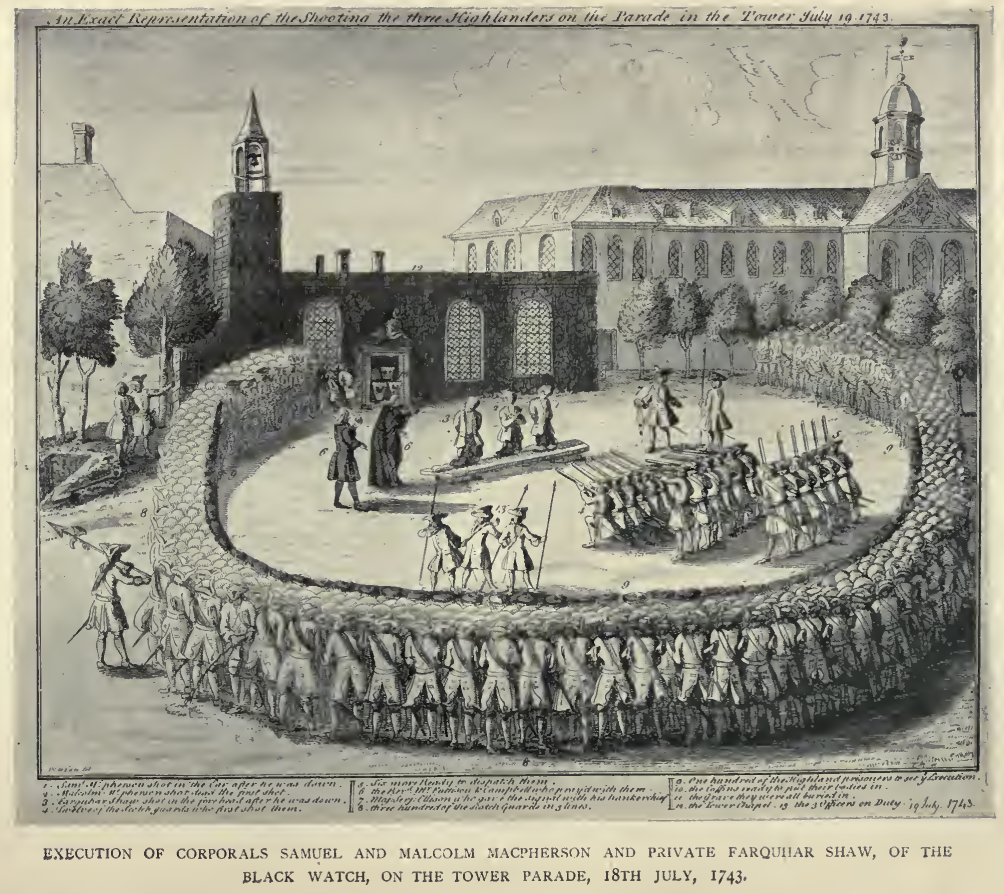
As for the remaining, un-deserted corps of the regiment? It got shipped off to Flanders, just as it feared.

* Later renumbered as the 42nd Regiment — hence this musical tribute to the “Forty Twa'”:

** Wade’s renown in defeating the imminent Jacobite rebellion of 1745 would earn him tribute in an impolitic stanza of “God Save the King” that is rarely performed.

Lord, grant that Marshal Wade
May, by thy mighty aid,
Victory bring.
May he sedition hush
And, like a torrent, rush
Rebellious Scots to crush.
God save the King.

On this day..

1958: Nuri al-Said

On this date in 1958, Nuri al-Said, the Prime Minister of Iraq’s deposed Hashemite monarchy, was captured trying to flee Iraq in disguise, and immediately slaughtered

A onetime Ottoman officer turned veteran of the Arab Revolt under the eventual King Faisal I, Nuri al-Said (or as-Said) was a preeminent politician for much of the Kingdom of Iraq era and practically the personification of Baghdad’s pro-British posture.

A figure of wide popular loathing — crowds chanted for his death at the funeral of King Ghazi in 1939, attributing the young ruler’s untimely death to Nuri’s hand — he had managed to escape the 14 July Revolution‘s initial hours and had one last night on the lam to contemplate the terrible fate of the royal family that he served.

He was not destined to avoid it.

Captured in disguise the next day and put to summary death, after which the mob vented its fury upon him.

On this day..

1958: King Faisal II of Iraq and his family

On this date in 1958, Iraq’s Hashemite dynasty got the Romanov treatment from coup-making nationalist officers.

Having already overstayed their welcome as agents of British-American control in the oil-rich Gulf State, the Hashemites were doubly burdened to be led by the inexperienced King Faisal II, who was all of 23 years old.

For much of the recent past, while this underaged grandson of the Arab Revolt hero matriculated at an English boarding school, his sovereignty had been exercised by his uncle and regent ‘Abd al-Ilah — a practitioner, like all of Iraq’s leadership, of a staunchly pro-British and -American policy that increasingly rankled Iraqis.

On July 14, 1958, a swift coup d’etat led by Abd al-Karim Qasim — and explicitly modeled on the Free Officers Movement that had raised the Arab nationalist Gamal Abdel Nasser to power in Egypt — overturned the Hashemites, and made sure that it was for good.

Captured royal family members — including not only King Faisal but the aforementioned ‘Abd al-Ilah and al-Ilah’s wife and mother, plus a number of royal servants — were all summarily machine-gunned in the palace courtyard, after which the royal corpse was given over to public abuse.

“His legs and arms were decapitated, stomach disemboweled with his intestine gushing outside” recalled one of the king’s helpless royal guards of the late king. “His corpse was later suspended from a building until one came with a dagger in his hand to try to divide it into two pieces. The corpse was burned, cut many times until it was thrown in the Tigris river when night came.”

Today there’s an honorable tomb in Baghdad where Faisal reposes, and considering the many terrors that have befallen Iraq in the intervening decades, one can even find pockets of nostalgia for the monarchy.

Cold comfort that Faisal II lives immortally in the classic Belgian comic series The Adventures of Tintin as the inspiration for the puckish and spoiled Prince Abdullah of Khemed.

On this day..

1941: Alexandru Bessarab, fascist artist

On this date in 1941, the fascist artist Alexandru Bassarab was killed in World War II — generally believed to be among captured Romanian prisoners of war summarily executed by Soviet troops.

A woodcut/linocut specialist — as evidenced by his gaunt self-portrait to the right — Bassarab was an early adherent of the Iron Guard and became one of its outstanding propagandists.

His very Deus Vult-vibing work Arhangel, for example, was used by the Guard as a banner at the 1940 state funeral it threw for far-right martyr Corneliu Codreanu. (The Iron Guard was shorthand nomenclature for an organ formally named the Legion of the Archangel Michael — and its members hence known as Legionnaires.)

But the Iron Guard’s moment at the political apex was a brief one, and when it was sidelined by a different right-wing strongman, Ian Antonescu, Bessarab found himself arrested and forced into a front-line army unit recapturing (appropriately) Bessarabia. He disappeared into presumed Soviet custody and execution near Tiganca, in present-day Moldova.

His work, including apolitical pieces, was taboo in postwar Communist Romania, but has enjoyed a bit of rediscovery since the end of the Cold War

On this day..

2010: Akram al-Samawi

AFP dispatches reported that on this date in 2010, Akram al-Samawi

was executed in the presence of the family of the victim, Nassiba al-Aghwani, and his own family, Nader al-Aghwani told AFP. Journalists and the public were kept outside the prison in Taiz, south of Sanaa.

The 32-year-old unemployed man was convicted in November for the rape of his neighbour’s daughter on the roof of his family home last August, after which he smashed her head and threw her corpse off the roof.

Samawi was also ordered to pay 300,000 riyals (about R10 000) in fines and court costs.

Aghwani protested outside the prison, saying the execution should have taken place in public, as in previous executions in Yemen.

He also told AFP he rejected an offer from Samawi’s family to pay up to 15 million riyals in blood money in return for sparing his life, in line with the Islamic sharia laws on which Yemen’s penal code is based.

On this day..

1978: Salim Rubai Ali, President of South Yemen

On this date in 1978, the South Yemen president Salim Rubai Ali was executed after an attempted self-coup.

The very first president of the short-lived (1967-1990) polity, Salim had been an anti-colonial fighter in the National Liberation Front but had his reservations about his coalition partner’s tilt towards the Soviet model and figured he wouldn’t mind being solely in charge.

He attempted in June 1978 to seize power against other top coalition officials; Ali Nasir Muhammad, who is still an important political figure in unified Yemen to this day, overthrew the short-lived putsch and executed the former boss.

On this day..

1915: Carl Frederick Muller, fluent in languages but not in espionage

57 year old Carl Frederick Muller was a fluent linguist, able to speak English, Russian, German, Dutch and Flemish. In October of 1914 he was living in Antwerp in Holland and had German soldiers billeted in his house. He was recruited into the German Secret Service in late 1914.

-From the June 23, 2019 Facebook post of the Capital Punishment UK Facebook page. Click through to find out how Muller’s abortive attempt to put his gifts to use for spycraft saw him standing in front of a British firing squad by June 23, 1915. He was the second of 11 German spies to meet that fate during the Great War.

On this day..

1839: Domingo Cullen, Santa Fe governor

Domingo Cullen, the governor of the Argentine province of Santa Fe, was extrajudicially executed on this date in 1839.

Cullen (English Wikipedia entry | Spanish) succumbed to Argentina’s lethal rolling civil conflict between political Unitarians (strong central state) and Federales (distributed federal power).

The reader will be unsurprised to find a provincial governor to be an exponent of federalism, and this put him at loggerheads with the ferocious Buenos Aires dictator General Juan Manuel de Rosas.

He logged a more specific head about a year before his death by attempting to negotiate a province-level arrangement with the French fleet blockading Argentina,* for which extravagance of federalism Rosas forced him to vacate his office and conceal himself in internal exile. Eventually Cullen was betrayed, and his arrestors putatively escorting him to the capital for trial rudely informed him once they reached the soil of Buenos Aires province that they were in fact licensed to shoot him out of hand.

Cullen’s son, Patricio, served as Santa Fe governor from 1862 to 1865, and also met a violent death.

* In response to a law that permitted the Argentine armed forces to conscript foreign nationals, including Frenchmen.

On this day..

1861: Melchor Ocampo, liberal statesman

On this date in 1861, the Mexican statesman Melchor Ocampo was summarily executed by right-wing guerrillas.

Once a seminarian, Ocampo (English Wikipedia entry | Spanish) turned his face towards public life, becoming a most eloquent exponent of the era’s movement of liberalism and anticlericalism.

He was among the faction who rebelled in 1854 against recurrent strongman Santa Anna; he served in the ensuing epochal presidency of Benito Juarez and helped to draft the liberal constitution that governed Mexico until 1917. Secular, egalitarian marriage vows promulgated in 1859 by Ocampo are still used in many marriage ceremonies to this day.

The revolutionary social reordering of these years was achieved only by civil war, a conflict remembered as the Reform War which ended only when the conservatives surrendered Mexico City on New Year’s Day of 1861.* Ocampo, who had the stature to stand for president himself, preferred to consolidate the victory by throwing his support to Benito Juarez in the ensuing elections.

Retiring thereafter to private life, he was targeted by one of the numerous remnant right-wing militias that still persisted in the countryside months after the putative conclusion of the Reform War. These abducted him from his home in Michoacan on May 30 and held him for some days, permitting him to write his last letters, before having him shot and strung up on June 3. His remains currently repose in honor at Mexico City’s Rotunda of the Illustrious … as do those of Ocampo’s longtime comrade Santos Degollado, who undertook to hunt down and revenge himself upon his friend’s killers but instead became their prey.

The town of Melchor Ocampo is, quite obviously, named for the man; his surname has been attached as an honorific to his home region of Michoacan, one of Mexico’s 32 states (officially called Michoacan de Ocampo) and to Tepeji del Rio de Ocampo, the place where he was executed.

On this day..

1919: Frank Willis, but not by Bill Fisk

The futile last appeal of Australia-born artillerist Frank Willis — before his execution at La Havre a century ago today for killing a British policeman — ran thus:

I am 20 years of age. I joined the Australian Army in 1915 when I was 16 years of age. I went to Egypt and the Dardanelles. I have been in a considerable number of engagements there, & in France. I joined the British Army in April 1918 and came to France in June 1918. I was discharged from the Australian Army on account of fever which affected my head contracted in Egypt. I was persuaded to leave my unit by my friends and got into bad company. I began to drink and gamble heavily. I had no intention whatever of committing the offences for which I am now before the Court. I ask the Court to take into consideration my youth and to give me a chance of leading an upright and straightforward life in the future.

This young man’s shooting detail was to have been commanded by Second Lieutenant Bill Fisk of the King’s Liverpool Regiment the father of the great Middle East correspondent Robert Fisk. Fisk has written frequently about his father’s refusal to conduct the execution, which the son says cost his father his military career and was also “the noblest act of his life” although it made no difference at all to the fate of Frank Willis.

Thanks to the investigatory exertions of the Great War Forum, it appears that “Frank Willis” was a pseudonym, and the true name under which this man joined and deserted the Australian army before his British enlistment was Richard Mellor. Mellor’s mother spent the rest of her life vainly petitioning authorities for information about her son’s fate.

On this day..