1561: Sehzade Beyazit, inevitably

On this date in 1561, the Persian Shah abandoned Ottoman prince Sehzade Beyazit to the vengeance of his “magnificent” father.

A late and sad casualty of Istanbul’s pivotal family tragedy, Beyazit was actually a son of Suleiman the Magnificent‘s favorite wife, the freed Ukrainian slave Hurrem Sultan or Roxelana.

Unfortunately, he wasn’t the first son.

After Roxelana engineered the execution of heir apparent Mustafa on spurious grounds, Beyazit and his brother Selim were the last princes standing.

The natural rivalry between the two for eventual power was surely colored by the clear portent Mustafa’s execution had sent that the succession game was rigged for Selim. After several years of growing estrangement, Beyazit finally revolted outright only to be defeated in battle by Selim in 1559.

The loser found refuge in Persia, but only long enough for the Safavids to negotiate the price of his surrender to the hands of Suleiman … whose executioner went on the road to the Persian city of Qazvin to strangle not only Sehzade Beyazit but his four sons, too.

Extirpating the treasonable branch of the family tree cleared the succession for Selim, whose eight-year turn in power would be remembered as moment the hitherto-all-vanquishing Ottomans began their long, slow slide to Sick Man of Europe status. Particularly given that coda, Suleiman’s own

long reign is flawed by tragedy more subtle than the hubris which had overcome his ancestor Bayezit the Thunderbolt; more consequential than the gilded misery reserved for later sultans. The higher men rose in the empire, the closer they got to the bowstring; and the reign of Suleyman seems in retrospect coiled round with a silken garotte …

When the Austrian ambassador took leave of Suleyman in his old age, it was scarcely a living being he described, but a sort of metaphor of empire, rotting and majestic, fat, made up, and suffering from an ulcerous leg.

There’s more about this misfortunate lesser son in Turkish here, and a Turkish poem he wrote beseeching his father’s forgiveness here.

On this day..

897: Pope Stephen VII, Cadaver Synod convener

“The papacy is no other than the ghost of the deceased Roman Empire, sitting crowned upon the grave thereof.”

-Thomas Hobbes, Leviathan

In August 897 or so, the deposed Pope Stephen VII (or VI*) was executed (or just murdered) in prison by strangulation.

Details, you see, are thin on the ground here in the so-called Dark Ages. Rome has come down a bit in the world.

“The ruins of Rome,” quoth Gibbon,

presented the sad image of depopulation and decay: her slavery was a habit, her liberty an accident; the effect of superstition, and the object of her own amazement and terror. The last vestige of the substance, or even the forms, of the constitution, was obliterated from the practice and memory of the Romans; and they were devoid of knowledge, or virtue, again to build the fabric of a commonwealth. Their scanty remnant, the offspring of slaves and strangers, was despicable in the eyes of the victorious Barbarians. As often as the Franks or Lombards expressed their most bitter contempt of a foe, they called him a Roman;

“and in this name,” says the bishop Liutprand, “we include whatever is base, whatever is cowardly, whatever is perfidious, the extremes of avarice and luxury, and every vice that can prostitute the dignity of human nature.”

While the popes of the 10th century would really set that prostituted standard with the period known as the “pornocracy”, Stephen VI(I) makes everybody’s bad popes lists with one of the papacy’s all-time embarrassing events: the Cadaver Synod.

The pontiff at this point is no global media celebrity but an ensemble character captive to the the disreputable politics of a shrunken, malarial borough. Stephen’s predecessor Formosus had been one of the city’s “Carolingian” faction backing the withering remains of Charlemagne’s once-great line.

At loggerheads with the Italian Spoleto family claiming the Holy Roman Emperor title for the anti-Carolingians, Formosus had invited an illegitimate Frankish scion to roll down the Italian peninsula and take it from them — which is exactly what happened.

Two months after Formosus crowned this Carolingian, Arnulf by name, as “Augustus” in Rome, Formosus died while Arnulf was on his way back to Bavaria … putting the Spoletos back in charge. After a brief interregnum papacy, the Spoleto-backed anti-Carolingian prelate Stephen ascended St. Peter‘s throne.

The factional conflict was approaching civil war. Stephen’s Cadaver Synod (or in the equally evocative Latin, Synod horrenda) was a singular show of power against the Carolingians.

About January of 897, the pope had Formosus’s corpse exhumed and creepily propped up in its vestments on a throne at the Basilica of St. John Lateran. There, before a reluctant clerical conclave, the rotting remains of Formosus** were subjected to a kangaroo prosecution personally conducted by Pope Stephen. As Robert Browning described it in a digressive passage of The Ring and the Book,

And at the word the great door of the church
Flew wide, and in they brought Formosus’ self,
The body of him, dead, even as embalmed
And buried duly in the Vatican
Eight months before, exhumed thus for the nonce.
They set it, that dead body of a Pope,
Clothed in pontific vesture now again,
Upright on Peter’s chair as if alive.

For frightful was the corpse-face to behold,—
How nowise lacked there precedent for this.


Pope Formosus and Stephen VII (aka Stephen VI), by Jean-Paul Laurens, 1870

After the possibly-nuts Stephen had his fill of ranting at the mortal remains, he declared his foe “convicted” and condemned the body to the dissevering of its three right-hand blessing-fingers — symbolic of the damnatio memoriae the synod would pass upon the ex-pope, revoking the decrees and undoing the ordinations that hand had wrought in life. Formosus in his various parts was tossed into the Tiber.

While this macabre spectacle lives forever in the papal annals, Stephen didn’t live out the year: his enemies overthrew him that summer and had him summarily put to death, declaring the Synod horrenda‘s judgment reversed in the process.

In the event, the matter would be settled the old-fashioned Roman way: in the streets.

Despite the loss of their leader, [Stephen’s] party remained active and elected a certain Cardinal Sergius as pope, simultaneously with the election of a candidate by the opposite faction.

But, in a sudden burst of violence, Sergius and most of his followers were chased out of the city … Over the next twelve months, four more popes scrambled onto the bloodstained throne, maintained themselves precariously for a few weeks — or even days — before being hurled themselves into their graves.

* Between VI and VII, it depends on whether you count a short-lived 8th century Stephen in the list of Stephens; the popes at this time weren’t using regnal numbering themselves. Since the Catholic Encyclopedia’s roster of popes goes with VII, we will as well.

** Ironically, “Formosus” is Latin for “handsome”. It’s too bad he wasn’t “Pope Mephitis“.

On this day..

1561: Cardinal Carlo Carafa, papal nephew

On this date* in 1561, the once-powerful Cardinal Carlo Carafa was put to death by strangulation in Rome’s Castel Sant’Angelo — victim of deadly Vatican politics.

Fruit of a powerful Neapolitan noble house — it was a Carafa who stuck fig leafs on Michelangelo nudes — Carlo Carafa went out on campaign in the dynastic wars chewing up the peninsula in the 16th century. In some outlandish vindictive pique, he elevated an offense from a Spaniard into not only a reason to switch sides to the French, but a reason to do stuff like massacre Spaniards in a captured hospital. Class act all the way.

When the boy’s (similarly pro-French) Carafa clansman ascended St. Peter‘s throne as Pope Paul IV in 1555, Carlo Carafa beat his sword into a galero as the Catholic Church’s newest cardinal-nephew.**

In this capacity, he had the whip hand in Vatican foreign policy in the late 1550’s … until the growing reports of his reprobate lifestyle led Paul IV to demote him. Virulently anti-Protestant, the obnoxiously upright Paul had been preoccupied intensifying the Inquisition. He took personal umbrage once convinced of his relative’s unworthiness: “He had planned to make his reign the period of great reforms,” writes Kenneth Meyer Setton. “The corruption of Cardinal Carlo Carafa had made a travesty of his efforts.”

These travesties included rumors of the love that dare not speak its name. Poet Joachim du Bellay, according to Who’s Who in Gay and Lesbian History, made sport of ecclesiastical buggery in Les Regrets:

now you should mourn
handsome Ascanio himself, Ascanio, O pity!
Ascanio, whom Carafa loved more than his own eyes:
Ascanio, whose face was handsomer
than that of the Trojan cupbearer, who pours for the gods

(Carafa had a plentiful menu of heterosexual scandals attributed, too. And other good stuff like starting an idiotic war of choice — with Spain, of course — that despoiled Church coffers and reversed the Vatican’s strategic interests.)

In such a state of disgrace — and more importantly, having been stymied in their anti-Spanish foreign policy — the Carafa house and faction was in line for something more serious than public humiliation when the disappointed octogenarian pontiff passed away later in 1559.

Upon the succession of a rival Medici pope, Pius IV, Carlo Carafa was hailed before a kangaroo court with his brother and partner-in-dissipation Giovanni on a rap sheet with every real and imagined indiscretion of their wild years.† Carlo was strangled and Giovanni Carafa beheaded.

Despite the nephews’ undoubted viciousness, their executions were basically about power and policy.

And though they had also screwed up policy, the next pope decided to look forward-backward, not backward-backward. In 1567, Pius V posthumously rehabilitated the naughty dead Carlo; today, you’ll find his now-vindicated remains interred at the family chapel in Rome’s Santa Maria sopra Minerva cathedral.

“The people wish to be deceived; let them be deceived.”

Carafa

* Seems like the best-sourced date, albeit uncertain — as discussed in this biography.

** Cardinal-nephews are the etymological source of the word nepotism.

† Carafa’s defense attorney was the noble Marc’ Antonio Borghese, father of a then-prepubescent kid named Camillo who would grow up to be Pope Paul V.

On this day..

1799: Constantine Hangerli, tax man

On this date* in 1799, Constantine Hangerli was deposed from his post as Prince of Wallachia by a Moorish executioner.

A veritable watchword for bad times, Hangerli was one of a clutch of disposable puppet rulers situated on the Wallachian throne by the Ottomans around the turn of the 19th century.

As had often before been the case, Wallachia was sorely pressed at this time by the cumulative exactions of its native boyars, the Ottoman Porte, and the plunder taken by the expeditions of rising Bosnian warlord Osman Pasvan Oglu.

Our man is famous, in particular, for the “Hangerli winter” of 1798, just after his elevation — when a confiscatory tax regime seized most of the countryside’s lifestock. Hangerli had a message for the generally currency-poor common man who objected to the much-despised per-head duty on cattle.

Pay the taxes, and you won’t be killed.

Hangerli’s real problem this year wasn’t the unmourned misery of his overtaxed serfs, but the Ottoman commander sent to rein in the Bosnians. Pasvan Oglu whipped that expedition, and its general Hussein Kucuk turned up at Hangerli’s doorstep late in 1798.**

Since it was dangerous for Ottoman generals to lose, Kucuk evidently arrived intending to put some blame on Hangerli — or at least, Hangerli thought that was the case. Secret dispatches from both parties to Istanbul ensued.

Whoever it was who schemed first, Kucuk schemed best. Selim III (later to die of palace scheming himself) decreed Hangerli’s immediate execution and dispatched a kapucu, one of the frightening envoy-executioners (two different men, in this case) who carried such decrees to their victims.

* I believe this may be per the Old Style/Julian date still in use in the Orthodox world.

** Having executed Rigas Feraios in Belgrade en route.

On this day..

1938: Corneliu Codreanu, Romanian fascist martyr

“In place of the weak and beaten man who bends with every breeze, a man who is all too common in politics and other fields, we must create for this nation a man who does not bend, who is inflexible.”

-Corneliu Codreanu

On this date in 1938, 14 political prisoners of the Romanian Legionary movement were extrajudicially executed — including Corneliu Codreanu, one of the Romanian right’s leading spirits.

The son of a Bukovina schoolteacher in what was then Austria-Hungary, Codreanu came to political maturity in the interwar heyday of Greater Romania. It was a moment of national aspiration — the Romanian state had never before grown so large — but it was abutted by the great threats of Germany and Russia, and haunted by nationalism, economic crisis, shaken political authority, and all the other spooks conjured by the first World War.

For Codreanu as for many at that time it was the stage for a blood-and-soil death struggle against Communist agitators and sinister Jewish financiers.

But his vision was an intensely positive one as well: a valiant new Romania founded by a courageous new man, honorable and true to the virtues of the nation’s noble peasant stock. “We shall create,” Codreanu declared, “a spiritual atmosphere, a moral atmosphere, in which the heroic man may be born and on which he can thrive.”

Codreanu’s vehicle for stamping out these heroic countrymen was the Legion of the Archangel Michael* which our principal founded in 1927. Named for God’s ass-kickingest enforcer, this movement/militia was not above creating its spiritual atmosphere with political assassinations by adherents widely noted for a willingness to die for the cause.

Later known as the Iron Guard, the Legion, in the view of German historian Ernst Nolte, “plainly appears to be the most interesting and the most complex fascist movement, because like geological formations of superimposed layers it presents at once both prefascist and radically fascist characteristics.” (Qutoed here.)

As his Legion’s name suggested, Codreanu was intently religious — virtually a mystic, and a messianic Romanian Orthodox Christianity was essential to his new Romania. His movement took root in a peasant society, not an industrial state with a revolutionary working class to crush or co-opt. Rather, it organized in opposition to a mediocre king and a feckless, heavily non-Romanian oligarchy which maintained its enervating grip on the nation with “endless appeals to the Fatherland which it does not love, to God in whom it does not believe, to the Church where it never sets foot, to the Army which it sends to war with empty hands.”*

And also to the police, which clapped Codreanu and his confederates in prison after the revolutionaries declined the elite incumbents’ offer of political collaboration.

In 1938, Codreanu was hit with a long prison sentence for sedition. Uncowed, the Legion grew ever more overtly aggressive when Nazi Germany successfully dismembered Czechoslovakia; Berlin made the Legions plainly aware that it saw their movement as Romania’s future, German-allied government. Futilely maneuvering for his own scope of action, Carol attempted to decapitate the Iron Guard by having its imprisoned leadership “shot while trying to escape” on this date.

This did not turn out to help the king. Codreanu’s movement traded stripe for stripe with its foes; within two years, Carol had been forced to abdicate and the Iron Guard helped govern (albeit with tension) a fascist state.

The contemporary Romanian right aggressively reclaimed Capitanul, “the Captain”, after the fall of communism. Codreanu is now revered among not only among Romanian nationalists but in fascism’s wider populist Strasserite tradition. (Gregor Strasser, who liked the socialist part of national socialism too much for Hitler’s taste, was among those murdered on Nazi Germany’s Night of the Long Knives.)

* Eugen Weber in Varieties of Fascism, quoted by Anthony James Joes in “Fascism: The Past and the Future,” Comparative Political Studies, April 1974

On this day..

1635: Domingos Fernandes Calabar, traitor?

On this date in 1635, Domingos Fernandes Calabar was garroted at Porto Calvo.

A mulatto plantation owner, Calabar (Portuguese Wikipedia page) did his patriotic duty according to the dictates of Brazil’s Portuguese colonizers when an expansionist Netherlands showed up hungry for a bite of Brazil.

But after rounding up a volunteer militia and helping repel Dutch incursions in 1630 and 1632, Calabar switched sides and joined Holland.

Why he switched sides remains permanently obscure. Popular explanations include: the seductions of Netherlander lucre (Calabar’s detractors like this one); a politically mature calculation that the Dutch would make more progressive colonizers than the Portuguese (this was Calabar’s own defense: “I spilled my blood for … the slavery of my homeland … With its actions, the Dutch have proven better than the Portuguese and Spanish”);* or … somewhere in between

He was rewarded for his devotion [to the Portuguese] by the contempt of his countrymen, who were envious of his prowess. Wounded by this conduct, he left the Portuguese and joined the Dutch.

Whatever the reason(s) for it, Calabar’s switch was efficacious: he knew the lay of the land, and he was vigorous in helping the Dutch foothold of “New Holland” expand. The Dutch commissioned him a Major, and he gained a reputation for his ambushes.

I never met a man so well-adapted to our purposes … the greatest damage he could cause to his countrymen, was his greatest joy.

-English mercenary in the Dutch service

The Portuguese official Matias de Albuquerque eventually turned the tables and captured Calabar in a Portuguese ambush. He not only had the disloyal subject strangled, but quartered the body for public display.

This gruesome warning against collaboration did not prevent New Holland from growing to around half the Brazilian territory … but since Brazilians don’t speak Dutch today, you might have an idea how this is going to end.

After “New Holland” was re-conquered and re-re-conquered, the Dutch Republic under Johan de Witt — preferring a commercial empire to a territorial one — gave up its untenable position in exchange for 63 tons of gold.

As the (eventual) winners of this imperial affray, the Portuguese wrote a distinctly unflattering history of Domingos Fernandes Calabar, the disreputable traitor. He’s a sort of Benedict Arnold character synonymous with disloyalty for any Brazilian schoolchild.

But other interpretations are available.

During Brazil’s Cold War military dictatorship, when traitorousness might seem downright reputable after all, the “official version” was slyly subverted in several different stage productions, the best-known of which is a musical called Calabar: In Praise of Treason.**

Most of the information about Calabar online is in Portuguese; for instance, biographies here and here.

* Let it not be implied that the Dutch were out for anything other than the plunder of empire themselves: Calabar’s own home region of Pernambuco was desirable precisely because of its sugar cane cultivation.

Incidentally, the vicissitudes of war enabled many African slaves to escape to Maroon communities like Palmares — just a few miles away from Porto Calvo.

** See Severino Jaão Albuquerque, “In Praise of Treason: Three Contemporary Versions of Calabar,” Hispania, Sept. 1991. “Less interested in settling the issue of Calabar’s martyrdom than in provoking serious debate about the meaning of loyalty and national identity in times of political repression and in the context of a dependent culture, these plays … bring to the fore the manifold ambiguities the colonized face reacting to the hegemonic rule of the colonizer.”

On this day..

1536: Pargali Ibrahim Pasha, Suleiman the Magnificent’s friend and grand vizier

On this date in 1536,* the Ottoman Empire’s mightiest Grand Vizier was strangled at the order of the Sultan Suleiman the Magnificent.

Say what you will about the Grand Vizier, the man knew how to enjoy the fruits of his transitory power. This, his Istanbul palace, is today the Museum of Islamic and Turkish Arts. (cc) image from docman

An Albanian [update: and/or Greek] Christian, Ibrahim Pasha — not to be confused with several other historical figures of that name, notably an Egyptian general — found his way into the Ottoman slave quarters and became a boyhood friend of the young Suleiman.

Thereafter the two would rise together: as Sultan, Suleiman rapidly promoted his trusted friend, and even married a sister to him.

So absolute was Ibrahim’s power that Italian diplomats** called him “Ibrahim the Magnificent”. At the Ottomans’ acme, his word was law as surely as his distinguished master’s. Ibrahim’s achievements in war, diplomacy, and as a patron of the arts attested his worthiness of the honors.

Unfortunately, he may have taken those honorifics a little too much to heart.

We do not know the precise cause of Ibrahim Pasha’s fall: only that it was precipitous. Two months after returning from a campaign against the Safavids that reconquered Baghdad, he was put to death, reputedly spurning an opportunity to flee and loyally submitting himself to the Sultan’s punishment. Much as this smacks of poetic amplification, Ibrahim’s last meal was said to be taken dining alone with Suleiman.

It’s impossible that in 13 years as Grand Vizier, this Islamic convert and upstart slave had not won himself powerful enemies — but he lived in Suleiman’s favor, and was destroyed when that favor reversed. One theory of Ibrahim’s fall has it that his self-awarded titles started getting a little bit, er, “magnificent” and Suleiman jealously snuffed out any potential for actual political rivalry. Another looks towards the Ukrainian slave girl who was taking over Suleiman’s harem — Roxelana, who would ruthlessly destroy all the political obstacles to her son’s eventual succession.

Between those two, or other palace machinations, or factors yet un-guessed, Suleiman was induced to destroy his boyhood companion and right-hand man. And in the thirty years the sultan had to outlive his vizier, who knows what pangs conscience held in store.

Dear Lord! Shower me with your grace
Whether there is any remedy other than You I do not know.
Help me, forgive my sins,
Please, help me, forgive my sins.

poetry by Suleiman the Magnificent, writing as “Muhibbi”

* There are some other March 1536 dates out there, but the Ides seems like the strongest.

** Very tight with the Ottomans.

On this day..

1808: Sultan Mustafa IV, by his brother

On this date in 1808, the former, and now deposed, Ottoman Sultan Mustafa IV was strangled at the command of his successor and brother.

The Ottoman Empire, once the very terror of western Christendom, entered the 19th century in a stagnation that had it well on its way to its way to “sick man of Europe” status.

Its fate would be defined by the political — and sometimes literal — battle between its entrenched interests and forward-looking reformers who struggled to restructure the empire for the challenges that lay ahead.

And at this point, it wasn’t only the Ottoman polity that had to fret for its survival. Its very namesake dynasty was in danger of extinguishing itself. There hadn’t been a male born to the House of Osman in twenty years, and in the events herein narrated, internecine conflict would winnow the Osmans down to their very last man.

Aggressive Progressive

Reform was the project of our principal’s predecessor, Selim. In the years around the turn of the century, Selim endeavored to get Turkey out of its wasteful foreign conflicts to gain maneuvering room for more urgent domestic projects.*

Chief among the many oxes Selim proposed to gore were the Janissaries, the Ottomans’ powerful and increasingly archaic military elite, much given to destructive use of their martial prowess in various factional conflicts within the Empire.

Possessive Regressive

The Janissaries deposed Selim in 1807, elevating his cousin — our man, Mustafa, a mere handmaiden of the hidebound. (His contemporaries in Europe more commonly transliterated the name “Mustapha”)

They didn’t kill Selim … just left him alive within the palace where armed men could find him in a pinch.

That pinch arrived in June in the form of Mustafa Bayrakdar, a reformist official who marched on Istanbul to overthrow the reactionary elements. As Bayrakdar took the city in hand, Mustafa desperately ordered the executions of Selim and of Mustafa’s own brother, Mahmud.

Selim was disposed of. Mahmud got tipped off, and the servants — most famously, a Georgian harem girl named Cevri Kalfa — helped him escape to the roof. Mustafa Bayrakdar ousted the ousters before anyone who meant Mahmud ill could find him.

Impressive Successive

That left Mahmud the only choice for Sultan, and he followed his brother’s own questionable policy of consanguinary clemency. Mustafa’s demotion back to crown prince after having once ordered the now-sultan’s death must have made for some awkward chit-chat around the family table.

It didn’t last long. The London Times of January 16, 1809 reported** that

[o]n the 14th of November, at day-break, the Janissaries were seen assembling from all quarters, and being reinforced by those who were in the vicinity of Constantinople, they … massacred all the partisans of the Grand Vizier that came in their way. The contest spread to eveyr street in Constantinople … On the 15th, the Janissaries assaulted the high walls of the Seraglio; and it was at this moment that the Grand Vizier, after causing the unfortunate Mustapha IV, who was a prisoner there, to be strangled, blew himself up in his own Palace with gunpowder, of which he purposely provided a large quantity before-hand, to prevent his falling alive into the hands of his enemies.

Sauce for the goose was sauce for Mustafa, and on this same desperate day when he lost Bayrakdar to a vault of gunpowder, Mahmud had his brother put to death. This maneuver left Mahmud the last surviving male Osman.

Passive Aggressive?

The legacies of this date were varied and ambiguous.

Mahmud II remained on the Ottoman throne for the next three decades, ample time to secure the Osman line.

The Janissaries returned to their barracks, chastened; Mahmud would destroy them after an attempted revolt in 1826.

But Mahmud too was chastened by the experience — or else, too encumbered by the apparatus of the state, or too cautious of his legacy before that heir appeared (it took years), or simply too unskillful — and his reformist vision proceeded haltingly until the very end of his life, even as breakaway nations continued to erode the Porte’s influence.

In his The Decline and Fall of the Ottoman Empire, Alan Palmer says of Mahmud,

Over a century and a half after his death, Mahmud II remains the most puzzling of the thirty-six Ottoman Sultans … Was he a despot or a reformer, a capricious betrayer of trust or a dedicated ruler of a vision, a muddler who plunged into disastrous wars or a shrewd statesman who preserved his Empire from rapacious neighbors? Should we think of him as the ‘Infidel Sultan’ who imposed European ways on the Islamic faithful, or as Mahmud Adli (‘Mahmud the Just’), like Turks today? The contrasts seem endless. Mahmud is one of history’s most enigmatic figures …

* Selim was sucked back into armed conflict by the Napoleonic wars.

** Though two months after the fact, the report is in media res, since it was transcribing German papers from mail dispatched out of the Ottoman capital on Nov. 16 when “the utmost confusion still prevailed there.”

On this day..

1553: Prince Mustafa, heir to Suleiman the Magnificent

On this date in 1553, the capable heir apparent to Ottoman Emperor Suleiman the Magnificent was strangled at dad’s order — casualty of the the realm’s lethal harem politics.

If ’tis state thou seekest like the world-adorning sun’s array,
Lowly e’en as water rub thy face in earth’s dust every day.
Fair to see, but short enduring is this picture bright, the world;
‘Tis a proverb: Fleeting like the realm of dreams is earth’s display.
Through the needle of its eyelash never hath the heart’s thread past;
Like unto the Lord Messiah bide I half-road on the way.
Athlete of the Universe through self-reliance grows the Heart,
With the ball, the Sphere—Time, Fortune—like an apple doth it play.
Mukhlisi, thy frame was formed from but one drop, yet, wonder great!
When thou verses sing’st, thy spirit like the ocean swells, they say.

-Prince Mustafa, about himself

Suleiman’s first-born son by his first concubine, Mustafa seemed well-positioned to emerge in the Ottomans’ fratricidal succession.

The racket: when the current sultan dies, all his sons by his various concubines make a rush from their provincial outposts for the capital and fight it out, the winner killing off his half-brothers to consolidate his rule.

This disorderly ascension made, while dad still lived, for fraught internal politicking among the sons for the inside track: the most prestigious positions, and the assignments closest to Istanbul. The various mothers of the contenders jockeyed just as aggressively on behalf of their various entrants in the imperial sweepstakes.

Mustafa was the capable eldest son in a kingdom at its very acme,* but to his misfortune, and the empire’s too, he found himself pitted against one of the ablest women ever to call the Ottoman harem home: Hürrem Sultan, also known as Roxelana (or Roxolana).

A Ukrainian woman kidnapped to the harem by Tartar slavers, Roxelana enchanted Suleiman and soon became his favorite. Therefore, Roxelana also became the rival, with her son and her own potential heir, to Mustafa and his mother.

As the story is told, Roxelana at length contrived to convince Suleiman that Mustafa was in cahoots with the rival Safavid Empire to supplant Suleiman on the throne; Suleiman had his firstborn summoned to his tent on campaign in Anatolia, and straightaway put to death. He’s supposed to have sat by the body in grief for days afterwards, and barely averted a revolt by his elite Janissaries, who much favored the talented Mustafa.

“This terrible tragedy exercised an effect on Ottoman affairs resembling that which the Massacre of St. Bartholomew had on the history of France,” according to The Cambridge Modern History (vol. 3). Roxelana’s unimpressive son “Prince Selim, in whose favour the crime was committed, was the first of a series of degenerate Sultans, sunk in pleasure-seeking or stricken with Imperial mania, under whose sway the Empire went to ruin.”

Consequently, Mustafa is still mourned in Turkey as a tragic turning-point; visitors pay homage to his tomb at Bursa.

Westerners had word of this fascinating palace intrigue through diplomatic correspondents who were not privy to the actual harem, and adopted the story themselves while imaginatively filling in the orientalizing details. Inevitably these imaginings have helped shape the story as it comes to us.

The scenario blending the familiar and the exotic — a European in the court of the Turk; a slave woman dominating the conqueror; fratricidal princes and the alluring seraglio — all set in the heart of the feared Muslim state proved irresistible to literary interlocutors. These made of Suleiman, Mustafa (Mustapha), and Roxelana moral fables, theater (endorsed by Samuel Pepys!), symphony

… and opera (many librettos, this by Hasse):

Not to mention, of course, more titillating fare.

* The PBS documentary Islam, The Empire of Faith does engrossing coverage of Suleiman (including his relationship with Roxelana and the execution of Mustafa) in these video segments: 3, 4, 5.

On this day..

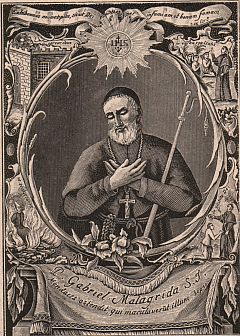
1761: Gabriel Malagrida, Jesuit nutter

On this date in 1761,* the Jesuit Gabriel Malagrida became a late casualty of the Tavora Affair and the Lisbon earthquake when he was garroted for heresy.

Malagrida (English Wikipedia entry | Portuguese) was a 72-year-old Italian with decades of missionary service to the Portuguese New World colonies under his belt.

He had, in his time, been a prominent exponent of the Jesuits missions’ policy in the Amazon, which amounted to asserting their own jurisdiction against the secular government’s attempt to order its overseas territories. (There’s more on that conflict here.)

And this only exacerbated his principal sin of being a Jesuit — an order whose diminution was eagerly sought by the rising statesman of Enlightenment Portugal, the Marquis of Pombal.

The shock of the 1755 Lisbon earthquake would deal Pombal the trump hand he needed to start reshaping both city and society to his liking.

Malagrida, meanwhile, carped that the earthquake’s causes

“are not comets, are not stars, are not vapors or exhalations,** are not phenomena, they are not natural contingencies or causes; but they are solely our intolerable sins … I do not know how a Catholic subject dares to attribute the present calamity of this tragic earthquake to causes and natural contingencies. Do not these Catholics understand this world is not a house without an owner?”

This published pamphlet merely echoed what many of the order were saying in the pulpits, and Pombal was not about to let the backwards, superstitious crowd** own the catastrophe.

Malagrida was banished from Lisbon: and, when the Tavora family was implicated in an attempt to assassinate the Portuguese king, Malagrida, their confessor, found himself clapped in prison.

Though the now-septuagenarian priest did not share the Tavoras’ grisly public butchery, he was left to molder. A couple years in a dungeon saw him go a bit strange, and supposedly he published treatises with such eccentric features as God’s personal instructions to Malagrida, and Malagrida’s fascination with St. Anne’s uterus. Catholic sources, which consider Malagrida a martyr, doubt that he ever published any such thing; if he did, it seems apparent that it was dementia rather than heresy that afflicted the old man.

But Pombal had installed his own brother as judge of the tribunal, so the matter was prearranged. The execution itself was

staged in a dramatic way, even to the point of Malagrida’s appearing on the scaffold in Jesuit habit, to impress upon the Portuguese and the world at large that an old order had come to an end and a new one was to be established … one might say that … symbolism at the cost of one human life was a relatively humane procedure in comparison with the symbolic elimination of whole classes of society in the twentieth century.


Detail view (click for the full image) of Malagrida executed at a Lisbon auto de fe. CC image from Ricardo Mealha, original provenance unknown.

Pitying the superstitious Jesuit at the stake, Enlightenment secularist Voltaire inveighed against Enlightenment secularist Pombal for conducting the execution … just part of Voltaire’s queer ideas about not killing people over their religious beliefs.

“It is all pity and horror,” Voltaire wrote in a private correspondence. “The Inquisition has found the secret to inspire compassion for the Jesuits.”

Voltaire’s appraisal in Candide (already published by this time) of a country in the grip of religious superstition unjustly stands as one of the lasting literary monuments to an event that actually rolled back clerical influence: “the sages of [Portugal] could think of no means more effectual to prevent utter ruin than to give the people a beautiful auto-da-fé; for … the burning of a few people alive by a slow fire, and with great ceremony, is an infallible secret to hinder the earth from quaking.” That the philosophe who penned those words waxed so immoderately outraged at the demonstrative chastisement of a man who preached precisely all that hocus-pocus — that Voltaire ascribed his execution to “the Inquisition” — plants the cherry on the irony sundae.‡

But Pombal’s expedient use of the Inquisition’s medieval machinery to make an example of Father Malagrida would not be the start of a pattern; the Pombaline reforms of the years to come brought the Inquisition sharply to heel, and it was Malagrida himself who was its last victim (pdf) in Portugal in its classical ecclesiastic form.


The house where Malagrida was born in Menaggio, Italy is marked with a plaque. Image (c) kallipyg and used with permission.

* Some sources give September 20 as the date.

** The “God is pissed” hypothesis was posited against theories of earth’s vapors promulgated by the Pombal-sponsored scientist Ribeiro Sanches.

† Anti-Jesuit sentiment was widely abroad in Europe at this time; increasingly resented as political manipulators, the Society would be suppressed by papal order in 1773, only to revive during the post-Napoleonic reaction.

‡ Malagrida was well-known to contemporaries in Europe, but that does not mean sympathy for him was universal. The British pol Lord Shelburne was satirized as “Malagrida” for his putative duplicity.

On this day..