1570: Ivan Viskovaty among hundreds on Red Square during the Oprichnina

On this date in 1570, Russian tsar Ivan IV GroznyIvan the Terrible — carried out one of his most infamous and horrible atrocities with hundreds executed on Red Square.

Ivan the Terrible, by Viktor Vasnetsov. (Cropped image; click for the full painting.)

We find ourselves in 1570 almost a quarter-century into the reign of this complicated, frightening figure. It is the oprichnina, the bloodiest spell of Ivan’s authority: years of torture, purges, and political violence vividly symbolized by the tsar’s black-clad personal Gestapo, the oprichniki.

“Children of darkness,” the exiled noble Kurbsky called these dreadful Praetorians. “Hundreds and thousands of times worse than hangmen.”

A dangerous time to draw breath, but a particularly dangerous time for any boyar, men of the feudal nobility whom Ivan set his iron hand to mastering. This, after all, was the historical task of monarchs at this time, and it was everywhere accomplished with bloodshed.

For Ivan, having come of age an orphan at the mercy of rival boyars, it was a vengeful personal obsession.

Already stung by the defection — and subsequent nasty correspondence — of one such noble, Andrei Kurbsky, Ivan was downright paranoid about disloyalty during the long-running Livonian War against Muscovy’s western neighbors, Poland, Lithuania and Sweden.

Ivan became ever readier to equate dissent with treason and to ascribe his military reverses to conspiracies on the part of his aristocratic commanders, rather than to the shortcomings of his war-machine in general. A vicious circle thus emerged – of military failures; suspected treachery; the suspects’ fear of condemnation and liquidation, and flight abroad.*


The innocent have nothing to fear!

Taking it into his head that the ancient, rival city of Novgorod — one of the cradles of Russian civilization — was scheming to deliver itself to the newly-formed Polish-Lithuanian Commonwealth, Ivan led an army there that in early 1570 massacred thousands of Novgorodians.**

He wasn’t done yet.

Returning to Moscow with his blood up, Ivan subjected his numerous Novgorodian prisoners to a savage regimen meant to uncover the extent of their nefarious doings. And it wasn’t long before the locals (who were, after all, just as suspect in Ivan’s eyes) got swept up in it, too. Politically-motivated magistrates with torture-induced confessions and denunciations did the dreadful things they always do.

This date in 1570 turned out to be the affair’s crowning carnival of barbarism.

“The Russian capital had seen many horrors in its time,” wrote Soviet-era historian A.A. Zimin (cited in this biography of Ivan IV). “But what happened in Moscow on 25 July, in all its cruelty and sadistic refinement, outdid all that had gone before and can perhaps be explained only by the cruel temperament and the sick imagination of Ivan the Terrible.”

Ivan Viskovaty (English Wikipedia link | French) had been one of Russia’s leading men on foreign affairs for a generation, as well as a longstanding ally of the tsar.

Nevertheless, he would be the first and most prominent victim on Red Square this date. Viskovaty’s rival Andrei Shchelkalov, who succeeded Viskovaty as the foreign affairs minister, neatly stitched up the senior diplomat for being in on the Novgorod “plot” as well as more exotic schemes to hand over southern cities to Turkey and the Khanate.

Historian Nikolai Karamzin related the scene (quoted here):

On July 25, in the middle of the market-place, eighteen scaffolds were erected, a number of instruments of torture were fixed in position, a large stack of wood was lighted, and over it an enormous cauldron of water was placed. Seeing these terrible preparations, the people hurried away and hid themselves wherever they could, abandoning their opened shops, their goods and their money. Soon the place was void but for the band of opritchniks gathered round the gibbets, and the blazing fire. Then was heard the sound of drums: the Tsar appeared on horseback, accompanied by his dutiful son, the boyards, some princes, and quite a legion of hangmen. Behind these came some hundreds of the condemned, many like spectres; others torn, bleeding, and so feeble they scarce could walk. Ivan halted near the scaffolds and looked around, then at once commanded the opritchniks to find where the people were and drag them into the light of day. In his impatience he even himself ran about here and there, calling the Muscovites to come forward and see the spectacle he had prepared for them, promising all who came safety and pardon. The inhabitants, fearing to disobey, crept out of their hiding-place, and, trembling with fright, stood round the scaffold. Some having climbed on to the walls, and even showing themselves on the roofs, Ivan shouted: “People, ye are about to witness executions and a massacre, but these are traitors whom I thus punish. Answer me: Is this just?” And on all sides the people shouted approval. “Long live our glorious King! Down with traitors! Goiesi, Goida!”

Ivan separated 180 of the prisoners from the crowd and pardoned them. Then the first Clerk of the Council unrolled a scroll and called upon the condemned to answer. The first to be brought before him was Viskovati, and to him he read out: “Ivan Mikhailovich, formerly a Counsellor of State, thou hast been found faithless to his Imperial Highness. Thou has written to the King Sigismund offering him Novgorod; there thy first crime!” He paused to strike Viskovati on the head, then continued reading: “And this thy second crime, not less heinous than thy first, O ungrateful and perfidious one! Thou hast written to the Sultan of Turkey, that he may take Astrakhan and Kazan,” whereupon he struck the condemned wretch twice, and continued: “Also thou hast called upon the Khan of the Krim Tartars to enter and devastate Russia:† this thy third crime.” Viskovati called God to witness that he was innocent, that he had always served faithfully his Tsar and his country: “My earthly judges will not recognize the truth; but the Heavenly Judge knows my innocence! Thou also, O Prince, thou wilt recognise it before that tribunal on high!” Here the executioners interrupted, gagging him. He was then suspended, head downwards, his clothes torn off, and, Maluta Skutarov, the first to dismount from his horse and lead the attack, cut off an ear, then, little by little, his body was hacked to pieces.

The next victim was the treasurer, Funikov-Kartsef, a friend of Viskovati, accused with him of the same treason, and as unjustly. He in his turn said to Ivan, “I pray God will give thee in eternity a fitting reward for thy actions here!” He was drenched with boiling and cold water alternately, until he expired after enduring the most horrible torments. Then others were hanged, strangled, tortured, cut to pieces, killed slowly, quickly, by whatever means fancy suggested. Ivan himself took a part, stabbing and slaying without dismounting from his horse. In four hours two hundred and been put to death, and then, the carnage over, the hangmen, their clothes covered with blood, and their gory, steaming knives in their hands, surrounded the Tsar and shouted huzzah. “Goida! Goida! Long live the Tsar! Ivan for ever! Goida! Goida!” and so shouting they went round the market-place that Ivan might examine the mutilated remains, the piled-up corpses, the actual evidences of the slaughter. Enough of bloodshed for the one day? Not a bit of it. Ivan, satiated for the moment with the slaughter, would gloat over the grief of the survivors. Wishing to see the unhapy wives of Funikov-Kartsef and of Viskovati, he forced a way into their apartments and made merry over their grief! The wife of Funikov-Kartsef he put to the torture, that he might have from her whatever treasures she possessed. Equally he wished to torture her fifteen-year-old daughter, who was groaning and lamenting at their ill fortune, but contented himself with handing her over to the by no means tender mercies of the Tsarevich Ivan. Taken afterwards to a convent, these unhappy beings shortly died of grief — it is said.

Thanks to this sort of wholesale purging, Ivan the Terrible became in the 20th century something of an allegorical shorthand for Joseph Stalin, whose own reign of terror was a touchier subject for direct commentary. By that same token, and capturing the multifaceted meaning of the word Grozny, (both awful and awe-inspiring) Soviet patriotic mythology co-opted Ivan and his allegedly farsighted cruelty as a state- and nation-builder.

Sergei Eisenstein’s Ivan the Terrible — a planned trilogy of films of which only two were completed, due to Stalin’s distaste for his greatest director’s interpretation — captures a view of Ivan IV Grozny from the shadow of wartime Stalinist Russia. (The two extant films can be seen in their entirety on YouTube, and are well worth the watching.)

The more conventional take is that, especially by his later years, the guy’s tyrannical paranoia had metastasized enough to send him plum off his rocker. In 1581, that favorite son who had accompanied Tsar Ivan to Novgorod, and to Red Square on this date, piqued his father’s rage during an argument — and in a fury, Ivan struck him dead.


Detail view (click for the full, gorgeous canvas) of Ilya Repin‘s emotional painting of Ivan the moment after he has mortally wounded his son. Incited to his own act of lunacy by the tsar’s riveting madman expression, iconographer and Old Believer Abram Balashov slashed these faces with a knife (image) in the Tretyakov Gallery in 1913.

The capable young heir’s senseless death effectively spelled the end for Russia’s Rurikid Dynasty descended from the half-mythical Norse founder of Rus’, Rurik. That argument from order and progress in favor of Ivan’s ferocity inconveniently runs up against the fact that what he actually bequeathed to the next generations of Russians was the rudderless, war-torn Time of Troubles, when rival claimants struggled for the throne.

Ivan IV is sure to remain a controversial, compelling figure for many a year to come. Released just a few months ago as of this writing, and in a time when Ivan comparisons are coming back into vogue for the ominous contemporary Russian state, Pavel Lungin’s Tsar (review) mounts a gory critique of its subject.

* Jonathan Shepard, book review in The Historical Journal, vol. 25, no. 2 (June 1982).

** Novgorod by 1570 was not as important as it had once been, but Ivan’s sack massively depopulated the city, essentially destroying its remaining strength as an independent commercial center.

† The allied Ottoman Turks and Crimean Khanate did in fact devastate Russia (and pillage Moscow) the very next year.

On this day..

1538: Diego de Almagro, explorer of Chile

On this date in 1538, Spanish conquistador Diego de Almagro was executed* at Cuzco by his vengeful rivals, the Pizarro brothers.

Conquistadoring with the rapacious Pizarros was a good way to get rich, get dead, or possibly both.

Almagro, a soldier, got to the New World in 1514 and soon fell in with alpha male Pizarro Francisco.** He’d become an adjunct to the latter’s conquest of the Incan Empire in the 1520s and 1530s; sent to capture the Incan city of Quito, Almagro found it razed by its defenders, and he sycophantically re-founded it as San Francisco de Quito.†

Things weren’t buddy-buddy for long.

The Iberian mothership divided Spain’s putative New World possessions north and south, putting Almagro in command of the southern cone. Great news … now all he had to do was actually take control of it.

Personally financing an expedition on the expectation of fabulous riches to be seized, Almagro instead foundered in Chile’s northern valleys in a frustrating environment of natives equally hostile and impecunious. After a couple years, he gave up and returned to Peru, angrier and poorer for his trouble — and there found that he could exploit the Spanish preoccupation with intransigent Incan chief Manco Inca to nick the capital city of Cuzco for himself.

Almagro actually had the lesser Pizarros — Gonzalo and Hernando — prisoner for a while, but he bartered them away to Francisco for a hill of beans (that is, a promise not to attack), and the Pizarros took their city back by routing Almagro at the Battle of Las Salinas.

The sentence of death against as august a personage as the appointed ruler of Nueva Toledo shocked many, and it was carried out against Almagro’s own entreaties for an appeal to the crown.


Detail view of a print of Almagro’s capture and execution. (Click for the full image.)

Francisco Pizarro would redeem his want of clemency towards his former partner in his own blood: in 1541, Almagro’s son, Diego de Almagro II or el Mozo, murdered Pizarro in an attempted coup d’etat. (Almagro the Younger, too, would be executed for his trouble.)

Although he was an important conquistador who spent most of his time at points further north, Almagro is best remembered today not in Peru but in Chile — for his abortive and disappointing expedition made him that land’s first European “discoverer”.

* Either beheaded or garroted.

** Almagro also rubbed shoulders with Vasco Nunez de Balboa.

† He pulled a similar trick with Trujillo, naming it after Francisco Pizarro’s birthplace.

On this day..

1441: Corrado Trinci, Lord of Foligno

On this date in 1441, Corrado Trinci was executed in Foligno.

Once the hereditary lord of that venerable town,* Trinci (English Wikipedia page | Italian), had turned tetchy with his Guelph family’s onetime papal patrons and suffered the consequences.

As the proper captain of an Italian city-state in the 15th century, Trinci had taken a few spins around the wheel of fortune in battle with his neighbors. He kicked off his reign in operatically sanguinary style when a neighboring town‘s castellan murdered Trinci’s brothers, suspecting one of them of adultery with his wife. Trinci revenged himself by sacking Nocera Umbra, which still holds a civic relay race (Italian link) commemorating the occasion.

Trinci didn’t fare as well when it came to picking on someone his own size.

For the next generation, Trinci would do the Machiavellian dance characteristic of his time and station — by turns allied with, at war with, or plotting with the papacy, Condottiero Francesco Sforza, the archbishop of Florence, and miscellaneous other peninsular neighbors and rivals. He was down. He was back up. He was beaten. He fought back. Etc.

Trinci pushed the wheel of fortune one turn too far by rebelling (again) against papal authority in the mid-1430s. His march on the Vatican-controlled Duchy of Spoleto was an initial success —

Corrado brought to Foligno four hundred youths of Spoleto, the standard of Spoleto, the chains, the locks from the city gates, the seal, and the clapper from the great bell of the commune.

Durante Dorio, as quoted and translated by Sergio Bertelli

That was in 1436. By 1439, Foligno itself (with Trinci inside it) had capitulated to a papal siege. Spoleto really wanted its clapper back.

Trinci was imprisoned with his family, and after a couple years’ languishing, put to death on this date. While both the English and Italian Wikipedia entries currently assert that he was strangled, the principal source for this gentleman’s biography, the freely-available Istoria della Famiglia Trinci by Durante Dorio, flatly asserts that the washed-up brawler was dispatched by decapitato.

By whatever method Corrado laid down his life, he retired with it not only the fame of his family but its Lordship of Foligno. The title fell extinct: Foligno became part of the Papal States and remain so right up to Italy’s 19th century unification.

* When next in central Italy, be sure to visit the lovely Palazzo Trinci. Corrado commissioned the Ottaviano Nelli frescoes in the chapel.

On this day..

37: Some poor wretches, despite the death of Tiberius

The Roman Emperor Tiberius expired at Misenum on this date in 37 A.D.


The Death of Tiberius, by Jean-Paul Laurens. Tacitus records that the aged princeps was thought to have expired, to the great relief of all, when word came that he was reviving. “[Praetorian prefect] Macro, nothing daunted, ordered the old emperor to be smothered under a huge heap of clothes.”

As Tiberius had been spending his last years terrifyingly purging Rome of alleged “traitors,” his death was met with some considerable relief. Great news: charismatic young prince Caligula is in charge now!

Anyway, despite the old man’s unpopularity and the manifest injustice of his treason trials, Tiberius’s death did not quite halt momentum of political butchery. Ever thus with bureaucracies.

According to Suetonius,

The people were so glad of his death, that at the first news of it some ran about shouting, “Tiberius to the Tiber,” while others prayed to Mother Earth and the Manes to allow the dead man no abode except among the damned. Still others threatened his body with the hook and the Stairs of Mourning, especially embittered by a recent outrage, added to the memory of his former cruelty. It had been provided by decree of the senate that the execution of the condemned should in all cases be put off for ten days, and it chanced that the punishment of some fell due on the day when the news came about Tiberius. The poor wretches begged the public for protection; but since in the continued absence of Gaius [Caligula] there was no one who could be approached and appealed to, the jailers, fearing to act contrary to the law, strangled them and cast out their bodies on the Stairs of Mourning. Therefore hatred of the tyrant waxed greater, since his cruelty endured even after his death.

But Tiberius’s cruelty didn’t endure too long after his death. Pretty soon, Caligula’s cruelty would have the stage all to itself and Tiberius survivors would be yearning for the good old days.

The History of Rome podcast covers Tiberius’s crazy years and the transition to Caligula here.

* It’s not completely explicit that it was on this same March 16 that news of the emperor’s death hit Rome; therefore, it’s conceivable that the drama described here played out on a subsequent date.

On this day..

1974: Salvador Puig Antich and Heinz Ches, the last garroted in Spain

On this date in 1974, in the face of an international controversy, Spain executed anarchist Salvador Puig Antich — the very last execution by garrote.

Handsome young Salvador radicalized as a youth in the 1960s under the oppressive semi-fascist Franco dictatorship.

As was the style at the time, the Catalan nationalist’s philosophy soon migrated to anarchism, and he brought his army experience to the Movimiento Ibérico de Liberación (MIL), whose direction-action credo entailed bank robberies branded as “expropriation.”

Puig Antich was caught in a police ambush that also claimed the life of a police officer — at least some of the bullets seemingly delivered by police friendly fire.

But his defense that his own gun discharged only as he was beaten senseless by the gendarmes never had a chance, since between arrest and trial, another set of proscribed leftists assassinated Prime Minister Luis Carrero Blanco.

Blanco’s successor went by the handle “Butcher of Malaga” for his depredations as a nationalist prosecutor during the Spanish Civil War.

So there was no quarter forthcoming from the Spanish regime, notwithstanding domestic general strikes and worldwide gnashing of teeth.

Salvador Puig Antich went on to a post-mortem existence as anarchist martyr. To help take the political edge off the scene, a non-political murderer, Heinz Ches (Spanish link), was garroted at almost the same time, in a different prison.

Spain soon did away with the discomfiting garrote; its very last executions were carried out by firing squad.

Salvador Puig Antich was the subject of a 2006 film, Salvador. (Here is a hostile anarchist review.)

The junior partner in the day’s twin killing, Heinz Ches, was himself the subject of a documentary, Nobody’s Death: The Enigma of Heinz Ches, exploring the weird near-total obscurity of the man who shared the headlines with Salvador Puig Antich. (A clip can be viewed here.)

On this day..

1872: Gomburza

On this date in 1872, reformist Filipino priests Mariano Gomez, Jose Burgos and Jacinto Zamora (together, the first syllables of their surname formed the acronym “Gomburza”) were garroted in Manila for their alleged support of an anti-Spanish mutiny.

These three clerics were leading exponents of liberalization; they notably pressed the rights of the native-born clergy as against the powerful religious hierarchy of imported Spanish priests.

While that critique had a somewhat receptive ear under the forward-thinking governorship of Gen. Carlos-Maria de la Torre, a more reactionary successor did not look as kindly on such agitation.

When naval shipyard workers rebelled in the 1872 Cavite Mutiny — over higher taxes, including a surcharge to avoid forced labor, not over the Gomburza priests’ agenda as such — the colonial administration used it as a pretext to seized the priests and condemn them for subversion.

Alas, Spain couldn’t manage to garrote away its subject peoples’ aspirations.

A bad end for Gomez, Burgos and Zamora was just the start for reform and independence agitation in the Philippines.

On this day..

1852: Martin Merino, Jesuit assassin

On this date in 1852, a 63-year-old Jesuit priest was garroted outside Madrid’s Toledo Gate for attempting to assassinate Queen Isabella II.

Only five days before, Martin Merino y Gomez (Spanish Wikipedia link) had slipped into the palace wearing his clerical robes, and planted a dagger in the Queen’s side. (Non-fatally; her corset partly shielded the blow.)

Despite some speculation that he might have been connected to some more elaborate plot, investigation found him to be a lone nut, “crazed with Liberal doctrines, disordered vanity, and bilious disease.”

Neither a clear motive nor a real link to any other actor was ever established. Merino died as a lone nut, and then his parricidal remains were burned to ashes and scattered to the winds.

On this day..

104 B.C.E.: Jugurtha

(Thanks to Daily Kos diarist “emperorhadrian” for licensing this guest post, originally published on that site June 24, 2007. -ed.)

The Jugurthine War was a key war in the final century of the Roman Republic.

Like the Americans in Iraq, Rome assumed that their war against Jugurtha, King of Numidia (a nation in north Africa), would be a cakewalk. They believed that Numidia was a nation of savages with a bizarre religion. They assumed that their own “shock and awe” attacks by the superior legions would decapitate and destroy the “evil doer” Jugurtha. They believed that in order to liberate the Numidians of their primitive ways, they had to impose the civilized will of the Roman state on this backward nation. Rome never expected that the Numidians would wage an insurgent war against their Roman occupiers. This war ended up dragging on for almost a decade. And in the end, it showed the depravity of the ruling party (the ultra-conservative republican Optimate party), which was sending the Roman Republic on its way to tyranny, empire and ruin.

In 148 BC, the King of Numidia, Masinissa, died. The Roman proconsul, Publius Cornelius Scipio Aemilianus, had been given authority by Masinissa to divide Masinissa’s estate. He divided it between Masinissa’s three sons, Micipsa, Gulussa, and Mastarnable. Soon after, Gulussa and Mastarnable died, leaving Micipsa as the sole King of Numidia. Around the year 134 BC, Micipsa sent Jugurtha (who was Masinissa’s grandson, but the son of another Numidian) to Spain with Scipio Aemilianius. Scipio was fighting the Celtiberians, who lived in a part of what is now Spain. Jugurtha was able to raise an army to help Scipio. Because of the valor of Jugurtha and his army at the Siege of Numantia, Scipio was able to win his war against the Celtiberians.

While fighting for Rome, Jugurtha worked alongside his future enemy, Gaius Marius. Jugurtha not only learned the superior Roman style of fighting, but he also learned of Rome’s weakness for money and thus bribery. Jugurtha described Rome as “urbem venalem et mature perituram, si emptorem invenerit” (“a city for sale and doomed to quick destruction, if it should ever find a buyer”). When Jugurtha returned to Numidia, Micipsa adopted Jugurtha, and decided to include Jugurtha in his will.

After the fall of Numantia, Jugurtha returned home with a letter from Scipio addressed to his uncle; in it, the commander praised Jugurtha’s exploits and congratulated Micipsa for having “a kinsman worthy of yourself, and of his grandfather Masinissa” (Sallust Iug. 9). On this recommendation the king formally adopted Jugurtha and made him co-heir with his own children

In 118, Micipsa died. He left his kingdom to Jugurtha and his two natural sons, Hiempsal and Adherbal. Shortly after Micipsa’s death, Jugurtha had Hiempsal killed. Adherbal fled to Rome. The Roman Senate sent a commission to Numidia to make peace. Jugurtha bribed the Romans on the commission, and thus the commission gave the better regions of the kingdom to Jugurtha.

In 113 BC, Jugurtha took his army and cornered Adherbal in his capital city of Citra. According to Sallust, Adherbal had the support of the people, but Jugurtha had the support of the best soldiers. A Roman Commission was sent to Numidia to forge a new peace. Jugurtha then bribed the Romans on this commission. The Romans thus allowed Jugurtha to storm Citra, and slaughter Adherbal and his supporters. Because Jugurtha slaughtered a number of Italian business people (including Roman Equites, or “Knights“), the Roman senate declared war on Jugurtha.

The Roman Senate sent an army under the command of the consul Lucius Calpurnius Bestia to fight Jugurtha. Bestia decisively defeated Jugurtha. But Jugurtha bribed Bestia, and thus was given unusually favorable terms. The Roman Senate viewed the favorable terms with suspicion, so it summoned Jugurtha to Rome. When Jugurtha arrived in Rome, he bribed two Tribunes, who thus prevented him from testifying. While in Rome, Jugurtha attempted to have his cousin and rival Massiva assassinated. Because of this, he was expelled from the city and returned to Numidia.

In 110 BC, the Roman Senate sent the praetor Aulus Postumus Albinus (who was the cousin of a consul for that year) to defeat Jugurtha. Because Jugurtha bribed key Romans involved in Albinus’ army (who then betrayed Albinus), Albinus was defeated.

The Roman Senate then sent the consul Quintus Caecilius Metellus to fight Jugurtha. At the Battle of the Muthul, a young Roman officer named Gaius Marius helped to reorganize Metellus’ legions, which then defeated Jugurtha. But Jugurtha was defeated because he forced his army to retreat before it could suffer heavy losses. The Romans did suffer their own heavy losses. Jugurtha disbanded his army, and had his soliders mount an insurgency to fight the Roman occupiers.

Marius returned to Rome. Dissatisfied with the slow pace of the war under Metellus, the Roman Military Assembly (one of the two Roman legislative assemblies, similar to the US Senate) appointed Marius consul (the Military Assembly, not the senate, appointed consuls). The Roman consuls had similar powers as the US President. The consulship was the highest constitutional office, and the consuls had imperium powers, which allowed them to command armies and conduct wars. The senate didn’t want Marius to be consul, because at this time it was dominated by an ultra-conservative republican party of aristocratic elites known as the Optimates. Marius belonged to the party that opposed the Optimates, the Populares. Partly because the senate didn’t like Marius, and partly because of the increasing difficulty Rome was having in recruiting armies, Marius was forced to raise his own army.

The capture of Jugurtha, from this French history of the Jugurthine War.

Marius took his army to Numidia to fight Jugurtha. But while Marius had been raising his army, Jugurtha allied with his father-in-law, Bocchus, the King of Mauretania. Marius defeated Jugurtha and Bocchus in several key battles. But much like with the American occupation in Iraq, Jugurtha’s strategy of insurgency warfare against the occupiers rendered all conventional victories irrelevant. Marius was playing a game of whack-a-mole. No matter how many times the Numidians were defeated, Jugurtha’s insurgents would regroup and keep fighting. It became clear that because of this, Rome could not defeat Jugurtha.

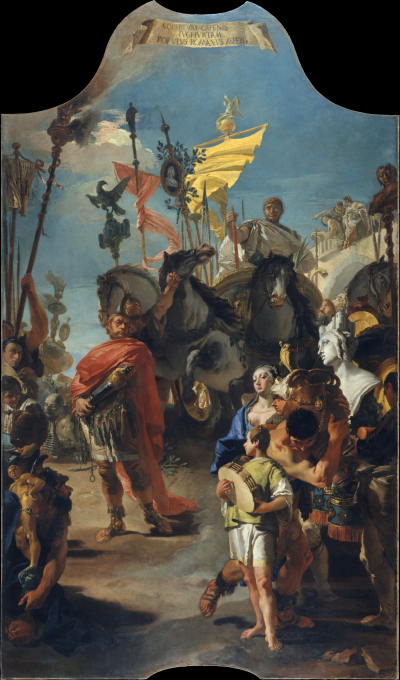
Marius sent his young Quaestor, Lucius Cornelius Sulla, to Bocchus. Sulla bribed Bocchus, and told him that Bocchus would be given a part of Numidia if he would betray Jugurtha. Bocchus then decided to give Jugurtha to Sulla. Sulla took Jugurtha to Rome, where Jugurtha was strangled in the Tullianum in Rome after marching in Marius’ January 1, 104 B.C. Triumph.


The Triumph of Marius (1729) by Giovanni Battista Tiepolo. The inscription in Latin reads “The Roman people behold Jugurtha laden with chains”.

The Jugurthine War was over. But in the process, several problems were exposed that would cause Rome serious pain in the future. Republicans in this country love to tell us that money in politics is harmless free speech. But as we saw in the Roman Republic during the Jugurthine War, money can be very corrupting. Rome almost lost the war because of money in politics, and the susceptibility of public officials to bribery.

In addition, this war saw the rise of two Romans who would play a key role in the events that directly preceded the fall of the Roman Republic. The first Roman made famous through this war was Gaius Marius. Gaius Marius would later hold the Roman Consulship an unconstitutional 7 times in 21 years (constitutionally, a Roman had to wait 10 years before being reelected consul).

The second Roman made famous through this war was Lucius Cornelius Sulla. Sulla and Marius would fight an unconstitutional civil war with each other several years after this war had ended. Sulla would illegally march his troops on Rome, and unconstitutionally legalize the mass killing of Marius’ supporters. Marius’ supporters in the senate would unconstitutionally prevent Sulla from fighting a war during one of Sulla’s consulships. Sulla would eventually seize absolute power for himself. Sulla would be the first Roman to be Dictator in almost 150 years. He would also be the first Roman in history to hold the dictatorship without the traditional six month term limit.

As dictator, Sulla would illegally change the Roman constitution to make himself and his party (the ultra-conservative republican Optimates) even more powerful. And most importantly, Sulla would set the example (of civil war on Romans, and then the seizing of absolute power) that the future tyrant Gaius Julius Caesar would follow.

In the end, the actions taken by key players in the war against Jugurtha would be repeated in the final destruction of the Roman Republic. The future triumvir Pompey would unconstitutionally hold multiple consulships in a short period of time. Crassus, another future triumvir, would illegally bribe politicians to get his way. And the future tyrant Julius Caesar would bribe, unconstitutionally hold the consulship, and become dictator for life (as Sulla had done). It was Caesar’s actions in this regard, as well as the similar actions of his adopted son and heir, Gaius Octavius (later Gaius Julius Caesar Octavianus, the Emperor Augustus) that would once and for all destroy the Roman Republic, and create the Roman Empire.

1. When when, and whenever death closes our eyelids,
2. Moving naked over Acheron
3. Upon the one raft, victor and conquered together,
4. Marius and Jugurtha together,
5. one tangle of shadows.

6. Caesar plots against India,
7. Tigris and Euphrates shall, from now on, flow at his bidding,
8. Tibet shall be full of Roman policemen,
9. And the Parthians shall get used to our statuary
10. and acquire a Roman religion;

11. One raft on the veiled flood of Acheron,
12. Marius and Jagurtha together.
13. Nor at my funeral either will there be any long trail,
14. bearing ancestral lares and images;
15. No trumpets filled with my emptiness,
16. Nor shall it be on an Atalic bed;
17. The perfumed cloths shall be absent.
18. A small plebeian procession.
19. Enough, enough and in plenty
20. There will be three books at my obsequies
21. Which I take, my not unworthy gift, to Persephone.

From Homage to Sextus Propertius, Canto VI by Ezra Pound

On this day..

1683: Merzifonlu Kara Mustafa Pasha, for the Battle of Vienna

On this date in 1683, the commander who just months before had brought the Turkish army to the gates of Vienna was executed in Belgrade for losing one of the pivotal battles in European history.

The Battle of Vienna saw the Ottoman Empire’s high tide and its last great bid to capture control of the strategic Danube city.

Despite an army of well over 100,000 that had besieged a frightened garrison numbering fewer than 20,000 soldiers and civilians, Kara Mustafa Pasha had been unable to reduce the city, and then decisively beaten after the timely arrival of a 70,000-strong relief force under the command of the Polish monarch Jan Sobieski. Here’s a great Italian map of the battle, with Mustafa himself hanging out in the lower corner; apparently, you can buy the original.

For both contemporaries and posterity, the “miraculous” defeat of an overwhelming Turkish threat by a coalition of Christian forces — a sort of earthbound equivalent to the previous century’s Battle of Lepanto — has appeared as a signal clash-of-civilizations event. In the right audience, a knowing 1683 reference is a sort of dominionist gang handshake.

So, anyway: big win.

If the blame for the defeat — Sobieski’s intervention apart — lay at Kara Mustafa’s door, it was due less to his decision to march straight for Vienna than to a number of technical miscalculations on his part, such as failing to bring heavy artillery to the siege but relying instead on light guns … inadequate to breach Vienna’s strongly fortified walls …

Merzifonlu Kara Mustafa Pasha had long been a close adviser of the Sultan, but any doubts Mehmed IV might have harboured about him were given substance during his absence on campaign as plotters fabricated reports of disorder in the empire. On hearing of the defeat at Vienna, one of the plotters … announced, in the words of Silahdar Findiklih Mehmed Agha, that ‘our enemy is finished with; the time is ripe for revenge’ …

Mehmed succumbed to the pressure from Kara Mustafa’s detractors, and the Grand Vezir was executed in Belgrade on Christmas Day 1683 while engaged in planning a new advance for the following spring … a skull in Vienna’s city museum is commonly believed to be his.

The Austrian victory at Vienna cost the Turks more than Mustafa’s service, which was quite a lot in itself. (Twelve different viziers held the post in the two decades after Kara Mustafa Pasha was strangled.)

The empire’s longstanding (and to Christendom, terrifying) expansionist posture towards Europe was at an end; in the future, the Musulman would have to ward off the Christian.

Ensuing Holy League victories wrested central Europe away from Constantinople, inaugurating a long Ottoman stagnation that would culminate in the empire’s destruction after World War I.

The Hapsburgs — though likewise marked for calamity in the War to End All Wars — for their part won hegemony in central Europe … and, it is said, the literal coffee beans captured as war booty with which to brew the famous Viennese cafe scene.

On this day..

1851: Narciso Lopez, filibuster

On this date in 1851, Venezuelan-born adventurer Narciso Lopez was garroted in Havana for his repeated expeditions to overturn Spanish dominion in Cuba.

Narciso Lopez had fought for the Spanish against Simon Bolivar, and migrated to Cuba when Bolivar carried the day.

Initially a loyal government functionary, Lopez gradually became sweet on the anti-Spanish cause, and fled Cuba for the United States (pursued by a death sentence in absentia) when a treasonable conspiracy of his was discovered.

Like MacArthur, he meant to return — and did.

Lopez crisscrossed the United States, drumming up support for filibustering raids on Cuba meant to detach it from Spain and make it an American slave state.

In this proposed enterprise, wedded alike to both national expansionism and southern sectionalism, Lopez rubbed shoulders with the likes of Jefferson Davis and Robert E. Lee, even helping precipitate criminal charges against a former U.S. Senator who backed him.

But the five expeditions went from bad to worse, until Lopez was captured in August 1851.

Tom Chaffin’s Fatal Glory: Narciso Lopez and the First Clandestine U.S. War Against Cuba, describes the scene of his death, just days after capture.

Between the wide Gulf sky and the waters of Havana harbor, the Gothic Morro Castle’s high tabby walls gleamed in the Sunday morning light on September 1, 1851. Though it was barely seven o’clock, a noisy crowd of four thousand already had gathered in a public plaza just across the harbor from the Morro. The plaza spread below the walls of the Punta, a small citadel guarding the western side of Havana’s finger-shaped harbor. At the center of the crowd’s attention on the cloudless dawn was a ten-foot high wooden scaffold that rose from the plaza. At its top was a garrote, an iron chair with a pair of clasps on its back. The mechanics of this grim machine were simple: just below its clasps, designed to grip the condemned man’s head, was a metal collar for his throat. With a turn of the screw on the garrote’s back, the collar tightens, strangling the prisoner.

Lopez was brought out at seven o’clock. At age fifty-four, with his mustache, white hair, and dark piercing eyes, he remained a handsome man. Accompanied by a line of Spanish soldiers, he wore a long white gown and a white cap. His wrists were tied in front. Another rope, binding his elbows, was knotted from behind, its strands held by guards. With two friends who had been allowed to join him, Lopez climbed the steps of the wooden tower. At the top he knelt in prayer for a moment, then rose and faced the crowd. “Countrymen,” he said in a steady voice that observers would recall as one of remarkable composure, “I most solemnly, in this last awful moment of my life, ask your pardon for any injury I have caused you. It was not my wish to injure anyone, my object was your freedom and happiness.” When an officer interrupted, Lopez quickly concluded, “My intention was good, and my hope is in God.”

He bowed, took his seat in the iron chair, and eased his head back. The executioner, a black man, placed the iron clamps around Lopez’s throat. His feet were then tied to bolts on the sides of the chair. He exchanged a few words with his friends and kissed a small cross. Then, with a turn of a screw, Narciso Lopez’s three-year campaign to vanquish Spain’s dominion over Cuba came to an end.

This forbidding example put a real damper on American plans to annex Cuba (for a while), but hardly stanched the North American appetite for filibustering.

Despite the bad end of his own project, Lopez managed to bequeath the eventually independent Cuba the flag (Spanish link) which it still flies today.

On this day..