1798: The Carnew executions

The Carnew Massacre blackened this date in 1798, in the Irish village of the same name.

It was the morrow of the outbreak of Ireland’s 1798 rebellion against British rule. This rising commenced on May 24 and foundered within weeks leaving a harvest of patriotic martyrs in its wake but those in the moment had not the advantage of hindsight — so as news of the fighting reached County Wicklow, adjacent to the rebel epicenter of Wexford, loyalists there authored a couple of notable summary atrocities by way of pre-emption.

On May 25, the British garrison at Carnew took 28 United Irishmen prisoners already being held in Carnew Castle and had them shot out of hand in an alley.

A similar mass execution of 36 nationalist prisoners occurred on the following day, May 26, at Dunlavin Green.

On this day..

1538: John Forest and the image of Saint Derfel Gadarn

English Franciscan John Forest was burned at Smithfield on this date in 1538 … the undercard to the simultaneous “execution” of a downthrown idol of Saint Derfel Gadarn.

The latter had been ripped from its shrine at Llandderfel in Gwynedd, Wales: the place gets its name from Derfel himself and its devotion to its Celtic patron had not waned in the centuries since but fostered a thriving pilgrimage site where the icon received the offerings of devotees in trust of the saint’s supernatural protection.

Such rituals really infuriated the iconoclastic, monastery-shuttering reformers abroad in England in Henrician England post-Anne Boleyn and in 1538 Derfel G. came in for special “punishment.”

“There is an image of Derfel Gadarn within the said diocese, in whom the people have so great confidence, hope, and trust, that they come daily on pilgrimage unto him, some with kyne, other with oxen or horses, and the rest with money,” fumed the king’s own scaffold-bound Lord Chancellor, Thomas Cromwell. “In so much that there was five or six hundred pilgrims, to a man’s estimation, that offered to the said Image the fifth day of this present month of April.”

Cromwell and team were very keen to show up the superstition, hypocrisy, and money-grubbing wrapped up in these quaint old idols, to expose to the public gaze the contraptions that allowed statues to weep or the priests that dined hearty on the victuals sacrificed by poor pilgrims … and so it came to pass that the May 22, 1538 death of John Forest at the stake was also a great demystifying of old Saint Derfel. Hauled to London from its native haunts, this image was railed at in a showboating sermon by the scaffold-bound Bishop of Worcester, Hugh Latimer.

In this spectacle designed for the cheap seats, Latimer spent hours ceremonially exhorting the patiently trussed John Forest to abjure his heresies. Forest predictably declining, the image of Saint Derfel was then produced and challenged to intervene for his spiritual bannerman, even engaged in a stagey grappling match — until finally the discredited simulacrum was tossed as mere fuel into the pyre that swallowed John Forest. (Forest has the distinction of being the only Catholic martyr burned at the stake during the English Reformation.)

The always enjoyable History of England podcast delves into the frightful fate of Saint Derfel’s icon and Blessed John Forest’s living flesh in episode 236.

On this day..

1952: Jan Bula, Czechoslovakian priest

Catholic priest Jan Bula was hanged on this date in 1952 at Jihlava

A Rokytnice pastor, Bula (English Wikipedia entry | the more detailed Czech and German) put himself in the gunsights of the postwar Communist state by defying its strictures on proselytization and commenting publicly against them.

Although perhaps a gadfly from the state’s perspective he was by no means a dissident consequential enough to have merited his eventual treatment; however, he was cruelly rolled into a notorious 1951 show trial called the Babice Case. Occasioned by a fatal raid launched by anti-Communist terrorists, the Babice trials targeted a huge number of ideological enemies and eventually resulted in 107 convictions and 11 death sentences.* Bula was among them, speciously condemned a traitor for complicity in the attack — a move that also opportunistically accelerated a case that state agents had for some time been attempting with little success to construct by means of entrapment.

“We human beings do not love God enough,” he wrote in a letter to his parents before his hanging. “That is the only thing for which we must ask forgiveness.”

The Catholic Church is currently considering this modern martyr for beatification.

* After the Cold War these sentences were retrospectively overturned or reduced, and a judge in the Babice case, Pavel Vitek, was prosecuted for his role in it.

On this day..

1903: Victoriano Lorenzo, cholo

Panamanian indigenous leader Victoriano Lorenzo was shot on this date in 1903.

He was a cholo (mixed-race; Lorenzo had both African and Amerindian ancestry) peasant who in the 1890s rose to become the most prominent indigenous leader in Cocle, a Pacific-facing province on the isthmus back when Panama was still a part of Colombia.

Lorenzo (English Wikipedia entry | Spanish) would lead indigenous forces in the Thousand Days’ War — a civil war between Colombia’s Conservative and Liberal Parties. Lorenzo fought in alliance with the Liberals; they lost the war, and with it the native land rights that Lorenzo fought for.

While the war was settled by the last days of 1902, the now-ascendant Conservative government accused Lorenzo and followers of continuing to fight and put him to a rial on grounds of murder and robbery that culminated in his public shooting in Panama City. The affair was so irregular that it’s commonly maligned as an “assassination”.

Scholars have interpreted the strange circumstances of his death as Conservative vengeance, the destruction of a hero and powerful symbol for impoverished people, the establishment of oligarchy, and as the forgetting of indigenous people as emblematic in the new Republic of Panama. Lorenzo has been interpreted as a martyr and the first victim of North American imperialism related to the Canal because he was held aboard the United States ship Bogota before his assassination. Seven days before his assassination, Esteban Huertas publicly announced that there was nothing more dangerous for the Canal construction than “guerrillas” and their activities in the mountains of Cocle …

The Conservative narrative of Lorenzo as “guerrilla” fighter permeated Panamanian national history, and schoolchildren learned to see Lorenzo negatively. National Panamanian history depicted Lorenzo shamefully as a “dirty cholo” …

In contrast, northern Cocle oral history memorializes, in cyclical time, Lorenzo as a cultural hero who continues to live, and understands his fight for land rights and political autonomy as the same fight of Urraca that is still ongoing today. People identify strongly with a liberation theology quote attributed to Lorenzo shortly before his death, “I forgive all. I die like Jesus Christ died,” wherein the cultural hero continued the cycle of death to defend land in this epoch. Rufino Peres J., born in 1941, recalls:

My people were illiterate, when he lived. They wore plant fiber loincloth (pampanillas) to go to Penonome … Why did they kill Victoriano Lorenzo? He died fighting for our land, and they formed a war, and that Victoriano Lorenzo, a cholo, won that war! It was not the president who won the war; it was Victoriano Lorenzo. They could never kill him: they used machetes, sticks, smoke, and they didn’t kill him. How was that? Then Victoriano Lorenzo went to the Presidency, and there they killed him. But Victoriano Lorenzo has stayed in History. So, now, whenever a campesino starts any kind of movement, they are scared because because we are the blood of Victoriano Lorenzo.

He uses the word blood (sangre) to mean how much someone is dedicated to the land and lineages in struggle, and adds, “Now youth don’t have blood like before, they have to be ready to die.” (from The Blood of Victoriano Lorenzo: An Ethnography of the Cholos of Northern Cocle Province, Panama)

Panama broke away from Colombia later that same year of 1903, and its new constitution abolished the death penalty outright. Independent Panama has never conducted an execution — so Lorenzo’s appears to be the isthmus’s last.

On this day..

Feast Day of Saint Mocius

May 11 is the feast date in the Orthodox confession* of Saint Mocius or Mucius, Hieromartyr of Amphipolis, Macedonia.

Mosaic image of Mocius from the Greek monastery of Hosios Loukas. (cc) image from Hans A. Rosbach.

A hieromartyr is someone who was clergy when he died for the faith; Mocius, as a Christian presbyter, rallied his flock against a public festival for the wine-god Bacchus, allegedly destroying an icon of that hedonic deity.

Since this occurred during the anti-Christian crackdown under the Emperor Diocletian, Mocius got what what was coming to him from this behavior although not until they were able to take him to Byzantium for beheading: attempts to punish him by fire and by throwing him to wild animals were divinely interdicted.

He’s not to be confused with the quasi-mythical Gaius Mucius Scaevola, a hero of Rome’s Etruscan Wars whose legendary steel in the face of execution in the Etruscan camp — “Watch so that you know how cheap the body is to men who have their eye on great glory,” he declared as he thrust his right hand into a brazier without flinching in pain — led his astonished enemies to release him instead. “Scaevola”, meaning “lefty”, is the honorary cognomen his countrymen bestowed upon him thereafter; the feat has inspired later harm-seeking imitators ranging from Jean-Jacques Rousseau to Friedrich Nietzsche to Paul Atreides.

* Catholics mark the feast on May 13.

On this day..

2010: Four Kurdish political prisoners

On this date in 2010, Iran hanged five political prisoners — four of them Kurdish — in Evin Prison.

The non-Kurd was Mehdi Eslamian, condemned a terrorist for complicity in a notorious 2008 terrorist bombing in Shiraz, an incident for which his younger brother had already been hanged a year previous.

With him died Farzad Kamangar, Ali Heydarian, Farhad Vakili, and Shirin Alam Holi, all of them Kurdish dissidents of various descriptions.

Farzad Kamangar was a popular 32-year-old teacher, who might have been the most publicly visible member of this quintet to judge by media hits and tributary pop music.

Shirin Alam Holi, a woman from the area of “Kurdistan” reaching into western Iran’s Azerbaijan province, was condemned for affiliation with the PKK front Kurdistan Free Life Party. A letter allegedly written by her a few months before execution detailed the abuse she endured in custody:

I was arrested in April 2008 in Tehran. The arrest was made by uniformed and plain clothed members of Sepah who started beating me as soon as we arrived at their headquarters without even asking one question. In total I spent twenty five days at Sepah. I was on hunger strike for twenty two of those days during which time I endured all forms of physical and psychological torture. My interrogators were men and I was tied to the bed with handcuffs. They would hit and kick my face and head, my body and the soles of my feet and use electric batons and cables in their beatings. At the time I didn’t even speak or understand Farsi properly. When their questions were left unanswered they would hit me until I pass out. They would stop as soon as they would hear the call for prayers and would give me time until their return for as they said to come to my senses only to start their beatings as soon as they returned – again beatings, passing out, iced water …

When they realised I was insistent on my hunger strike, they tried to break it by inserting tubes through my nose to my stomach and intravenous feeding; they tried to break my [hunger] strike by force. I would resist and pull out the tubes which resulted in bleeding and a great deal of pain and now after two years I’m still suffering the consequences and am in pain.

One day while interrogating me they kicked me so hard in the stomach that it resulted in immediate haemorrhaging. Another day, one of the interrogators came to me – the only one whose face I saw, I was blindfolded all other times – and asked irrelevant questions. When he heard no reply he slapped me and took out his pistol from his belt and put it to my head, “You will answer the questions I ask of you. I already know you are a member of PJAK, that you are a terrorist. See girl, talking or not talking makes no difference. We’re happy to have a member of PJAK in our captivity”.

On one of the occasions that the doctor was brought to see to my injuries I was only half conscious because of all the beatings. The doctor asked my interrogator to transfer me to the hospital. The interrogator asked, “why should she be treated in hospital, can’t she be treated here?” The doctor said, “I don’t mean for treatment. In hospital I will do something for you to make her sing like a canary.” The next day they took me to hospital in handcuffs and blindfold. The doctor put me on a bed and injected me. I lost my will and answered everything they asked in the manner they wanted and they filmed the whole thing. When I came to I asked them where I was and realised I was still on a hospital bed and then they transferred me back to my cell.

But it was as if this was not enough for my interrogators and they wanted me to suffer more. They kept me standing up on my injured feet until they would swell completely and then they would give me ice. From night till morning I would hear screams, moans, people crying out loud and these voices upset me and me nervous. Later, I realised these were recordings played to make me suffer. Or for hours on end cold water would be dripped slowly on my head and they would return me to the cell at night.

One day I was sitting blindfold and was being interrogated. The interrogator put out his cigarette on my hand; or one day he pressed and stood on my toes for so long that my nails turned black and fell off; or they would make me stand all day in the interrogation room without asking me any questions while they filled in crossword puzzles. In short they did everything possible.

When they returned me from hospital they decided I should be transferred to 209. But because of my physical condition and that I couldn’t even walk 209 refused to accept me. They kept me for a whole day in that condition by the door of 209 until I was transferred to the clinic.

What else? I couldn’t tell night from day anymore. I don’t know how many days I was kept at Evin Clinic until my wounds were a little improved and was transferred to 209 and interrogations started. The interrogators at 209 had their own methods and techniques – what they called hot and cold policy. First of all, the brutal interrogator would come in. He would intimidate me threaten and torture me. he would tell me that he cared for no law and that he would do what he wanted with me and … then the kind interrogator would come in and ask him to stop treating me in this way. He would offer me a cigarette and then the questions would be repeated and the futile cycle would start all over again.

While I was at 209 especially at the beginning when I was interrogated, when I wasn’t well or had a nose bleed they would inject me with a pain killer and keep me in the cell. I would sleep the whole day. They wouldn’t take me out of the cell or take me to the clinic…

Shirin Alam Hoolo?Nesvan Wing, Evin?28/10/88 (18 January 2010)

On this day..

1949: Li Bai, PLA spy

Red spy Li Bai was executed in the Pudong district of Shanghai on this date in 1949.

Li Bai and his circuitry immortalized in stone in Shanghai’s Century Park. (cc) image from (checks notes) “Kgbkgbkgb”

A survivor of the Party’s epic Long March Li Bai (English Wikipedia entry | Chinese) was a Party-trained wireless operator who was detailed to Shanghai with the 1937 outbreak of the Sino-Japanese War.

He was fortunate to survive arrest by the Japanese while transmitting from occupied Shanghai in 1942. (The Japanese took him for a mere enthusiast.) Even more fortunate from his handlers’ standpoint was the interest his radio skills subsequently attracted from the nationalist Kuomintang, which recruited him into service that Li Bai was only too happy to accept.

For the next several years, he sent to the Communists voluminous inside information about the disposition of their opponents in the endgame stage of the Chinese Civil War. He was detected in the last days of 1948, sending to the People’s Liberation Army the troop dispositions that would enable it to overrun the capitals in the subsequent months. Not three weeks after Li Bai’s execution in Shanghai that city fell to the Communists; by year’s end, the Kuomintang had evacuated the mainland for its so-far permanent Formosan redoubt.

There’s a 1958 Chinese biopic about him, titled The Unfailing Radio Wave; the embed below is one of many subsequent readaptations:

On this day..

1766: Edmund Sheehy, James Buxton, and Buck Farrell, Whiteboys

This account from the London Chronicle, June 5, 1766 refers to the disappearance and alleged murder of the informer John Bridge. We’ve visited this case previously, in the form of Father Nicholas Sheehy, who had also been drawn and quartered a few months previous for the Bridge affair; collectively, these cases are pretext for state reprisal against the Irish Whiteboys movement, which opposed large landholders’ moves to consolidate estates, expel tenants, and let people starve while the land that once fed them was shifted towards commercial agriculture.


The Trials of Mr. Edmund Sheehy, Mr. James Buxton, and Mr. John Farrell, at Clonmel Assizes in Ireland, for the Murder of John Bridge, on the Night of the 18th of October, 1764

Mr. Edmund Sheehy being put to the bar, the lawyers for the crown first called upon John Toohy, who declared, that the prisoner was within two or three yards of John Bridge, when he received the fatal blow from John Mechan.

Mary Brady swore that she came up immediately after the murder, and that the prisoner was present, together with the Rev. Mr. Sheehy, and Edmund Mechan, and that the latter held in his hand a bill hook all bloody, and that the Priest commended the action.

Mr. James Herbert, Farmer, declared, that on Sunday Oct. 28, 1764, he was called upon by Roger Sheehy, then on horseback, behind whom he rode to a meeting of twenty or thirty persons, on the lands of Shanbally, near Clogheen, where they were sworn by Father Sheehy to murder John Bridge, John Bagwell, Esq; William Bagnell, Esq; the Rev. Dr. Hewetson, and every other person who should oppose them; that they would be faithful to the French King, and conquer Ireland.

After having thus sworn, they came to the house of one English, on the lands of Shanbatly, where Bridge was; they took him to a field, where was another party of about a hundred and thirty; here they accused him of giving information against the White Boys, and insisted that he should by oath contradict whatever he had given information of, which he refused to do; hereupon one Byrne made a stroke at him with a turf-slane, which he kept off with his arm; then Edmond Meehan took a bill hook from under his coat, with which he struck Bridge on the back part of his head, which so cleft his scull, that he instantly expired; that the Priest was then within the distance of two yards, with a hook in his hands. After this (being first sworn not to divulge what had been done) they put the body in a blanket, which they conveyed to a ploughed field, where they buried it; but in about eight days after, lest the plough should turn up the body, it was taken up and carried to a church-yard about two miles off.

John Lenorgan swore, that being sent by his uncle, Guynan, to the house of English, where the Bridge had been, between ten and twelve at night, he heard the noise of a number of people; that not caring to be seen, he concealed himself in a ditch, where he was discovered by Thomas McGrath, who put him on horseback behind the Priest, with whom he rode some time, and on the way discovered the body of a dead man, wrapt up in a blanket, before a person on horseback, and through a hole in the blanket, saw the head bloody, and that there was a number of persons attending it, both on foot and horseback, of whom he knew Father Sheehy, Edmond Meehan, Buck Sheehy, Thomas McGrath, Bartholomew Kenneley, and John Toohy; and that when they came to the turn of the road, the Priest let him down, directing him the shortest way home, and gave him three half crowns, charging him not to mention to any one what he had seen; and that he understood the dead body was that of John Bridge.

Here was closed the evidence for the crown. James Prendergast, Esq, attempted to prove an alibi, by swearing that, on the 28th of October, 1764, he and the prisoner, with their wives, dined at the house of Mr. Joseph Tennison, near Ardfinan, in the county of Tipperary; where they continued until after supper, and that it was about eleven o’clock when he and the prisoner left the house of Mr. Tennison, and rode a considerable way together on their return to their respective homes, and that the prisoner had his wife behind him; that when they parted, he (Mr. Prendergast) rode directly home, where, on his arrival, he looked at the clock, and found it to be the hour of twelve exactly, and as to the day he was positive, the 29th being the fair day of Clogheen; that he had desired the prisoner to sell some bullocks for him at the fair, not being able to give his attendance; and that Paul Webber, of Cork, Butcher, was in treaty for the said bullocks with the prisoner, on the 29th.

Mr. Tennison declared he remembered the prisoner and Mr. Prendergast dining with him some time in the month of October, 1764, but was inclined to believe it was earlier in the month than the 28th, for that on the 29th he dined with the Corporation of Clonmell; that on the Wednesday following he dined with the prisoner and Mr. Prendergast, at the prisoner’s house, and that day he invited the prisoner and his wife, with Mr. Prendergast and his wife, to dine with him the Sunday following, and was positive that company did not dine with him on any other day in October.

Paul Webber, of Cork, Butcher, swore, that he was at the fair of Clogheen on the 29th of October, 1764, where he saw the prisoner, but was not in treaty with him for any bullocks belonging to Mr. Prendergast, but the prisoner told him, that Mr. Prendergast had some bullocks on his hands to dispose of, on which he sent a person to Mr. Prendergast’s house, who bought them for him.

Thomas Mason, Shepherd to the prisoner, swore to the night and hour of the prisoner’s return abovementioned, and that he took him from his master his horse, and turned him out to the field. The following persons were also produced to discredit the testimony of John Toohy: viz. Bartholomew Griffith, Surgeon, Daniel Griffith, and John Day, servants to Brooke Brasier, Esq.

The purport of the evidence given by Bartholomew Griffith was to confront Toohy, who, being asked by the prisoner, who gave him the new cloaths he then had on, answered they were given him by his uncle Bartholomew Griffith, who being examined, denied it. Daniel Griffith declared, that Toohy was, on the 28th and 29th of October, 1764, at his house at Cullen.

John Day swore, that Toohy lived for six weeks with his master Brooke Brasier, Esq, when he behaved very ill, and was a person of bad characer; but Mr. Brasier declared he did not know the said Toohy, but that a person was in his family, for that time, of a very bad character, but that he did not know him.

The evidence of James Herbert, for the Crown, was not attempted to be invalidated. Mr. Herbert came to the Assizes, in order to give evidence in favour of Father Sheehy; the Grand Jury, who before had found bills of high treason against him, sent for Toohy, who said he knew him very well, and would assist to take him; upon this William Bagnell, Esq, attended Toohy, with some of the light-horse, went and took him; when being told on what occasion he was secured, he said he would discover the rise and meeting of the White Boys, and their intentions; and acknowledged himself guilty of what he was accused.

Mr. James Buxton, commonly called Capt. Buxton, on account of the power he had over the people he commanded, was the next person put to the bar to be tried. The testimony, which has been already related, was in every particular supported by the additional evidence of Mr. Thomas Bier, who was an accomplice, and acknowledged being present when they all swore allegiance to the French King, and to murder John Bridge, &c. and that too in consequence of a letter he received from Father Sheehy. Mr. Bier declared, that, at the time Bridge was murdered, the Priest was within two or three yards of the unfortunate man, holding the book, on which he a little before pressed and exhorted him to swear for the purpose, as has been mentioned.

Mr. James Farrell, commonly called Buck Farrell, a young man of a genteel appearance, was the last convicted, and on the joint evidence of the prosecutors.

Tuesday, the 15th of April, they received sentence to be executed the 3d of May, at Clogheen.

The general characters of the prisoners, until this unfortunate affair, were very respectable. Their influence must have been considerable, otherwise they could not have brought after them, and inlisted, the number of people they did, who were subject to martial law, by which they were tried on misbehaviour. It was in resentment of a whipping, which was inflicted on John Bridge with remarkable severity, to which he was sentenced by one of the Court-martials, that he was led to give evidence against them, by which he lost his life.

On this day..

1494: Joan Boughton, “old cankered heretic”

Lollard heretic Joan Boughton was burned on this date in 1494 — purportedly England’s first female Christian martyr.

Followers of pre-Luther English church reformer John Wyclif(fe) had been thick on the ground in the early 15th century, terrifying the English state into a violent suppression.

But these years of headline repression did not suffice to drive Lollardy into the grave … only underground. The Lollard heresy continued to persist, quietly, its trajectory and dimensions largely undocumented, barely surfacing here and there with the odd arrest. “Between 1450-1517, Lollardy was almost wholly restricted to the rural districts, and little mention is made of it in contemporary records,” notes this history. “How extensively Wyclif’s views continued to be secretly held and his writings read is a matter of conjecture.”

Its adherents still had the stuff of martyrdom, for on this occasion decades on from the heyday of Lollardy and into the reign of Henry VII,

an old cankered heretic, weak-minded for age, named Joan Boughton, widow, and mother unto the wife of Sir John Young — which daughter, as some reported, had a great smell of an heretic after the mother — burnt in Smithfield. This woman was four score years of age or more, and held eight opinions of heresy which I pass over, for the hearing of them is neither pleasant nor fruitful. She was a disciple of Wycliffe, whom she accounted for a saint, and held so fast and firmly eight of his twelve opinions that all the doctors of London could not turn her from one of them. When it was told to her that she should be burnt for her obstinacy and false belief, she set nought at their words but defied them, for she said she was so beloved with God and His holy angels that all the fire in London should not hurt her. But on the morrow a bundle of faggots and a few reeds consumed her in a little while; and while she might cry she spoke often of God and Our Lady, but no man could cause her to name Jesus, and so she died. But it appeared that she left some of her disciples behind her, for the night following, the more part of the ashes of that fire that she was burnt in were had away and kept for a precise relic in an earthen pot.

On this day..

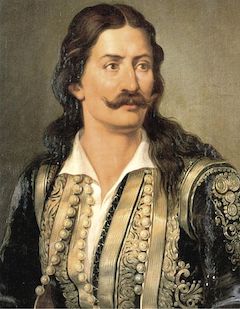
1821: Athanasios Diakos, Greek War of Independence hero

Greek independence hero Athanasios Diakos died by Ottoman impalement on this date in 1821.*

Though he acquired his nickname Diakos (“deacon”) from a youthful spell in a monastery, this fellow Athanasios (English Wikipedia entry | Greek) while the Turks still governed Greece made his way as a klepht — Greece’s version of the Balkan hybrid outlaw/guerrilla archetype, similar to the hajduk figures among the South Slavs. All of these outlaw types took to the mountains where they could subsist as brigands and mercenaries beyond the reach of the Porte, and seek opportunities where they might to strike at Ottomans. Many of the Greek persuasion, Diakos included, adhered to the Filiki Eteria secret society that aspired to liberate Greece.

With the onset of the Greek War of Independence in early 1821, Diakos jumped right into the fight. Picturesquely, he met a much larger Turkish detachment in battle at Thermopylae where he made like Leonidas and with a handful of companions heroically held out against impossible odds at the Alamana Bridge.

Captured wounded, Diakos spurned the temptation of an officer’s commission in the Turkish army should he but switch sides with words that remain legendary in his homeland to this day: “I was born a Greek, I shall die a Greek.” He was impaled at the city of Lamia, fearlessly musing, “Look at the time Charon chose to take me, now that the branches are flowering, and the earth sends forth grass.”

He’s a very famous and beloved figure in Greece, albeit much less so in parts beyond. The village where Diakos was allegedly born has been renamed for him full stop.

* The narratives I’ve seen run a bit hinkie between the Battle of Alamana on April 22 and the great klepht’s death on April 24 since there’s a two-day gap and everyone seems to agree that he was ordered for execution “the next day”. I’m sticking to the agreed death date here, which is universal, but as best I can discern the timeline alternatives for accounting the missing day appear to break down between the notion that Diakos was impaled on the 23rd and lingered on his spike overnight before death, and that it was not until the 23rd that the Ottoman commander had the opportunity to interrogate him and decide his fate and thus “the next day” was the 24th. I haven’t located a source that appears dispositive on this issue.

On this day..