1857: Return Ward, dismemberer

Headline: Shocking Murder of a Female - The Body Burned: Arrest of her husband!

On this date in 1857, a “hulking lout” with the unusual handle of Return Jonathan Meigs Ward was hanged in Toledo for Sylvania, Ohio’s most shocking murder.

Ward makes his notorious entry in the annals of Ohio crime by killing his wife after which, in the words of a wire story, he “sits up nights, with his door locked, cuts her into small pieces, and burns up her remains in the stove. This process occupied several days, in which time he drew largely on the shops around for shavings, and the unsavory scent went forth from the chimney, and filled the nostrils of those who happened to be in that vicinity.”

That’s from the April 2, 1857 Lowell (Mass.) Daily Citizen and News, and indicates that this itinerant character had become a national story. Ward, indeed, appears to have perpetrated a couple of theretofore unsolved homicides in his past, and the experience of dislimbing a previous murder victim to box him in a crate is just the sort of thing to give a man the sang-froid to dice up and incinerate his late spouse.

Anyway, the neighbors being unsatisfied with Ward’s accounts of his wife’s absence, they started poking around his place and turned up the bone fragments he hadn’t been able to completely burn away. Though the evidence against him was circumstantial, it was pretty overwhelming — and a jury took less than a half-hour in a standing-room-only courtroom to convict.

Ward went with the old “accidentally killed her during a domestic fight and cut her all to pieces in my panic” story. You know, the classic. In a post-conviction quasi-confession to the Toledo Blade, he took that tack while giving a stomach-churning description of how he annihilated the corpse (here reprinted by the Newark Advocate, April 15, 1857). Warning: Skip this if detailed descriptions of human dismemberment aren’t your thing.

I tore the clothes open, from the throat down. I then took a small pocket knife and opened the body, took out the bowels first, and then put them on the stove, upon the wood; they being filled with air would make a noise in exploding, so I took my knife and pricked holes through them to prevent the noise; then took out the liver and heart, and put them in the stove; found it very difficult to burn them; had to take the poker and frequently stir them before they could be destroyed; found the lungs very much decayed. I then took out the blood remaining in the cavity of the body, by placing a copper kettle close to the same and scooping it out with my hands. I then dipped portions of her clothing in the same, and burnt it together, fearing if I put the blood in the stove alone, that it might be discovered. I then made an incision through the flesh, along down each side, broke off the ribs and took out the breast bone, and throwing it into a large boiler, unjointed the arms at the shoulders, doubled them up and placed them in the boiler; then severed the remaining portions of the body, by placing a stick of wood under the back and breaking the back bone over the same, cutting away the flesh and ligament with a knife. Then tried to sever the head from the body; it proving ineffectual, I put the whole upper portion of the body into the boiler. Then took a large carving knife and severed the lower portion of the body, unjointed the legs at the knee, and again at the hip joint; cut the thighs open and took out the bones and burnt them up; they burned very rapidly.

On Thursday night, I commenced burning the body, by placing the upper and back portions of the same, together with the head, in the stove. On Friday morning, finding it had not been consumed, I built a large fire by placing wood around and under it, and in a short time it was wholly consumed, except some small portions of the larger bones and of the skull. The remaining portions of the body were kept in the boiler and in tubs, under the bed, covered up with a corded petticoat, and were there at the time the first search was made on Saturday, by Constable Curtis. — Hearing on Saturday evening that the citizens were not satisfied with the search made by Mr. Curtis, I proceeded on Sunday morning to destroy the remainder of the body by burning the same in the stove, cutting the fleshy parts of the thighs in small strips, the more readily to dispose of them. On Monday morning I took up the ashes in a small bag, sifting out the larger pieces of bone with my hands, placing the same in my overcoat pockets, which I scattered in various places in the fields, at different time. Also took the major portion of the trunk nails, together with the hinges, and scattered them in different places. I then burned her trunk and every vestige of her clothing, disposing of small portions at a time, to prevent their creating too much smoke.

Though the hanging itself occurred behind prison walls — and just as well, since the jittery Ward was unmanned and incoherent — Toledo was reportedly thronged with curiosity-seekers on the day of the execution.

That curiosity hasn’t disappeared in the intervening years.

Just in time for the 150th death-iversary of Return Ward in 2007, Gaye Gindy recaptured the case for these latter days in her Murder in Sylvania, Ohio: As Told in 1857.

Part of the Themed Set: Ohio.

On this day..

1918: Aloïs Walput, grenadier

On this date in 1918, 21-year-old Aloïs Walput of the 2nd Belgian Grenadiers was shot at the Belgian North Sea town of Oostduinkerke, during the First World War.


Image from here.

He had killed his corporal two weeks before, and was one of “only” 13 Belgian soldiers executed during the Great War, either for military offenses such as desertion, or regular criminal ones such as Walput’s homicide.

On this day..

1998: Wissam Issa and Hassan Abu Jabal

On this date in 1998,* Wissam Issa and Hassan Jabal were shockingly hanged in public in Tabarja, Lebanon.

Executions hadn’t seen the outside of prison walls in that country for 15 years at that time — back when there was a civil war on.

But Issa and Jabal were condemned for a home burgling attempt gone wrong(er): when the owners unexpectedly returned, Issa fled — but Jabal gunned them down. They both answered for the murders.

Marched out onto a somewhat jerry-built hanging platform (Issa was stoic; Jabal, unmanned), the two died at dawn before a crowd of 1,500 to 2,000 spectators … and plenty of cameras. The grisly proceedings made the nightly news, of course.

“It was horrible,” one Tabarja woman remembered. “The kids were playing at hanging each other afterwards at school.”

Oddly enough, it was also the last hanging (private or public) for over five more years to come. Later in 1998, a staunch death penalty foe became Prime Minister, and refused to approve any execution warrants.

* Reports of May 25 instead of May 19 are out there, but that’s easily disproven by, e.g., this Robert Fisk dispatch on the hanging which saw print on May 21, 1998.

On this day..

1945: German soldiers for cowardice

Throughout the last days of the Third Reich, it ruthlessly forced its desperate conscripts by threat of summary execution into service to slow the overwhelming Soviet army.

Borrowing a page from Gen. Ferdinand Schoerner‘s no-mercy demonstrative hangings of any “straggler” found behind front lines without orders, Goebbels

issued a radio proclamation to the trapped troops [of Berlin]: “Any man found not doing his duty will be hanged from a lamp post after a summary judgment. Moreover, placards will be attached to the corpses stating: ‘I have been hanged here because I am too cowardly to defend the capital of the Reich. I have been hanged because I did not believe in the Fuhrer. I am a deserter and for this reason I shall not see this turning point in history.

SS members, aware that they would be in for the worst of it after the war (and that their mandatory blood-type tattoos would make them easy to identify) were the ones sufficiently motivated to impose this policy. One German in the city at the time recalled the horror of seeing

boys who were found hiding were hanged as traitors by the SS as a warning that, ‘he who was not brave enough to fight had to die.’ When trees were not available, people were strung up on lamp posts. They were hanging everywhere, military and civilian, men and women, ordinary citizens who had been executed by a small group of fanatics.

Although it’s not specifically an execution story, the horrifying consequences of this lethal paranoia under siege are the theme of the West German film Die Brücke, in which a rare veteran sergeant looking after some child-conscripts is shot by a patrol when he can’t produce orders … leaving the children alone to be butchered pointlessly defending a bridge.

“This event occurred on April 27, 1945,” the film concludes about its (fictional) plot. “It was so unimportant that it was never mentioned in any war communique.”

From the Themed Set: The Death Rattle of the Third Reich.

On this day..

2011: Three in Shiraz

A year ago this date, three young men identified as Abolfazl Faraei, Reza Roshanfekr and Seyed Rokneddin Karimi were executed by hanging from cranes in Shiraz, Iran, on charges of kidnapping, armed robbery, and murder.

Disturbing images of the public hangings follow; click on any save the last to zoom to a larger disturbing.

Update: Shiraz marked the anniversary date by hanging eight more the day this post was published, April 16, 2012.

Another man was reported hanged the same date for murder in nearby Takhteh Kenar.

On this day..

1946: Laszlo Baky and Laszlo Endre, Hungarian Holocaust authors

On this date in 1946, fascist Hungarian politicians Laszlo Baky and Laszlo Endre were executed by hanging in Budapest for their role in the decimation of Hungarian Jewry.

These two charmers were major figures in Hungary’s horrible final months of World War II.

Post-Stalingrad, the Hungarians had realized they were yoked to the losing side and started looking for an exit strategy; instead, early in 1944, they got a German occupation.

This occupation lifted the virulent anti-semites Baky and Endre into national power, because along with keeping Hungary in the Axis coalition, the Nazis also forcibly overcame its junior partner’s former reticence about Jewish genocide.

Adolf Eichmann arrived into Nazified Hungary and used our day’s two principals (along with another executed collaborator, Andor Jaross, they’re known as the “deportation trio”) as his instruments. Within months, hundreds of thousands of Hungarian Jews were being shipped to the gas chambers. This period is one of the waypoints of pernicious Nazi race theory, when the collapsing German regime spent military resources urgently needed at the front to organize the mass slaughter of Jews.*

And they had to work fast, because by that next winter the Red Army was seizing Budapest. These enthusiastic fascist operators did not fare well by the postwar government.

Most photos from Kuruc.info (the garishly branded ones) and the Yad Vashem database (the not garishly branded).


Laszlo Endre under arrest.


Both men, just prior to their execution.

* To do justice to the breadth of the human capacity, this is also the time and place where we find Raoul Wallenberg minting lifesaving Swedish passports by the thousands.

On this day..

1905: Two murderers beheaded in French Indochina

On this date in 1905, this happened in French Indochina:

“Annamites” — a term that will not get you a warm welcome in Southeast Asia today — were residents of the French protectorate of Annam. It, along with Tonkin to its north and Cochinchina to its south, comprise present-day Vietnam: “Annamite” was also sometimes generalized as a colonialist synonym for all Vietnamese. (Here’s a 1947 Life magazine article by William Bullitt that does just that in its warning about the burgeoning war wherein “Annamites — half starved and weakened by malaria, gentle by nature but courageous” had started “kill[ing] every Frenchman they can.”)

Postcard pictures on this post via BeheadedArt.com, which delivers what it promises. (Clicker beware.)

On this day..

2002: Daniel Pearl

“I decapitated with my blessed right hand the head of the American Jew, Daniel Pearl, in the city of Karachi, Pakistan. For those who would like to confirm, there are pictures of me on the Internet holding his head.”

-9/11 mastermind Khalid Sheikh Muhammad, in a claim made after torture in Guantanamo but nonetheless considered accurate according to a detailed 2011 report on Pearl’s death*

Warning: Although the filming was botched, this execution video still has plenty of gore and a severed head.

On this date in 2002, American hostage Daniel Pearl was executed by his captors in Karachi, Pakistan.

The 38-year-old Wall Street Journal reporter had been abducted January 23 by Islamic radicals while pursuing an interview with a (mistakenly) suspected handler of shoe bomber Richard Reid. Instead of being taken to the interview, Pearl was disappeared and held hostage for a variety of implausible demands targeting the United States’ relationship with Pakistan’s military government.

The reporter’s death this day was not confirmed until late February, when his killers released a video on the Internet interspersing images of American and Israeli violence with footage of Pearl speaking — and then, horrifically, of Pearl being beheaded with a knife.** It was the first of several hostagebeheading videos various militants would release in the next few years.

Pearl’s captors drew a direct line from his Jewishness to his murder in the statements they forced him to make:

My name is Daniel Pearl. I am a Jewish American from Encino, California USA … I come from, uh, on my father’s side the family is Zionist … My father’s Jewish, my mother’s Jewish, I’m Jewish … My family follows Judaism. We’ve made numerous family visits to Israel … Back in the town of B’nei Braq there is a street named after my great grandfather Chayim Pearl who is one of the founders of the town.

It was the more startling because Pearl himself was a very secular Jew. Pearl did not set out to be a martyr for his cultural or religious heritage: that identity as the identity was thrust upon him.

And it’s been suggested that it was thrust upon Pearl’s captors as well, whose object in kidnapping an American reporter might have been a much more parochial kidnapping commonplace — publicity, cash — but who became politically boxed in when their hostage was publicized by the media as a “Jewish-American reporter”. One of the emails the captors had pre-drafted actually announced Pearl’s release. It was edited after the kidnapping … to announce Pearl’s execution within 24 hours, as a Mossad agent. Al-Qaeda’s Khalid Sheikh Mohammed seems to have been summoned from outside the abductors’ circle as a ringer with the captors unsure of how to dispose of their prey.

As an investigative reporter, Pearl’s own work had in some notable instances countered the preferred narratives of American hegemony. For instance, his reporting rubbished American charges that the Khartoum pharmaceutical factory Bill Clinton ordered bombed in 1998 was actually a chemical weapons plant. His work in Kosovo led him to contradict the most bellicose “genocide” allegations from that region’s dirty ethnic war.

He was a star reporter in the prime of his life, a man who poured out words that defined a career and a public persona. From February 1, 2002, suddenly and without justice, that text was torn from his hands. In its place, during the charged months after September 11 and the American invasion of Afghanistan, came a silent Rorschach blot.

Pearl, the Jewish martyr. Pearl, the victim of blowback. Pearl, the journalistic icon. Pearl, the naive liberal in the heart of darkness. Pearl, the mandate for waterboarding and Iraq.

Pearl, the object lesson.

Pearl, the axe for others’ grinding.

Omar Sheikh, a Pakistani militant reportedly linked to Britain’s MI6 and the author of the kidnapping, was arrested within days of Pearl’s murder. He remains imprisoned under sentence of death in Pakistan for the crime.

* Mohammed also claimed that he wanted to kill Pearl personally to “make sure I got the death penalty” if he were eventually arrested.

** Among the many bone-chilling details to emerge from the subsequent investigation, it became clear that the actual murder was not shown — only some quick flashes of re-enacted throat-cutting — because the cameraman missed the shot of the kill.

On this day..

1971: Ousmane Balde, Barry III, Magassouba Moriba, Loffo Camara, Keita Kara Soufiana, and many others in Conakry

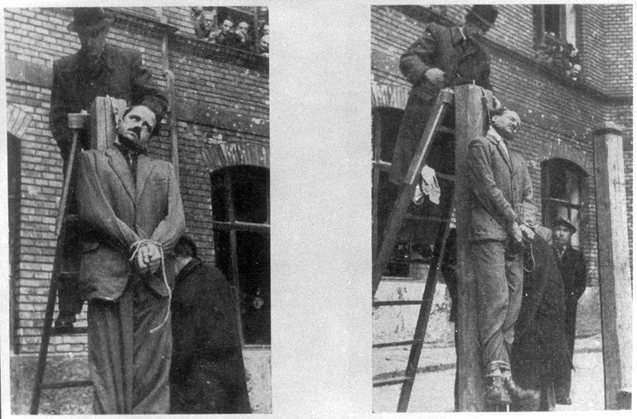
On this date in 1971, at least four former members of Guinea’s government were publicly hanged for supposed complicity in the previous year’s Portuguese invasion from neighboring Guinea-Bissau.*

The coup-threatened government of Sekou Toure was trying to send a message:

It did not scruple to make examples of men and women in very high places. Ousmane Balde (or Baldet) was Guinea’s former Finance Minister, Magassouba Moriba an Interior Minister, Barry III (also known as Ibrahima Barry; the link is French) the former Secretary of State. Keita Kara Soufiana had been Chief of Police. Loffo Camara was a National Assembly member.

Besides the quality of its reprisal victims, Conakry went in for quantity, too. Somewhere close to 100 death sentences were handed down with the barest of legal pretense, and the majority of them actually carried out on and around this date.

Personally arranging the grisly tableau for our hanged ex-ministers was a captain, Diarra Traore, who would one day help to overthrow the Guinean government, become Prime Minister … and wind up executed himself for his trouble.

* Guinea-Bissau was at that time still a Portuguese possession, known as Portuguese Guinea.

On this day..

1902: Gideon Scheepers, Boer guerrilla

Scheepers lives because they shot him.”

-Hermi Baartman, Graaf-Reinet Museum

On this date in 1902, Kommandant Gideon Jacobus Scheepers was shot by the British for his exploits in the Boer War.

The young Dutch-descended Scheepers (here’s his Afrikaans Wikipedia page) was a soldier from the still-independent Boer states which were being reduced in this war to British dependencies.

In 1901, late in the proceedings, Scheepers took a column of irregulars into the British Eastern Cape Province and wrought havoc behind the lines. Some exploits are the stuff of legend, like the time he rode into a town, released all the Boer prisoners, locked up the British magistrate, and hauled down the Union Jack — to the delight of the Boer locals.

He would spend that year giving the British much better than he got, but the war was also infamously dirty.

According to David Harrison’s The White Tribe of Africa: South Africa in Perspective, “Scheeepers’ men also flogged and shot natives who helped the British, looted as well as burned farms, and executed Boer ‘traitors’.”

Was any of that criminal?

Since Scheepers was over enemy lines, the Boers who joined him could be held liable for treason … but that didn’t hold for Scheepers himself. His execution turned on holding these unsavory acts as war crimes: his 30-count charge sheet included seven arsons, seven murders, and various and sundry abuses of prisoners and blacks. Scheepers was really sore about the last; natives were supposed to be kept out of the fighting, but the prisoner very credibly insisted that the ones he “murdered” were under arms as scouts for the British.

“We Afrikaners will never find justice under the English,” Scheepers wrote as a prisoner. “Everything is for the kaffirs.”

(There’s a vociferous defense of Scheepers from a pro-Boer history here, and a more sober one by a London press correspondent here.)


Scheepers is read the death warrant on January 17, 1902 — before Graaf-Reinet townspeople assembled by British orders.

For non-Loyalist Boers and for many throughout the world — the U.S. House of Representatives even moved a resolution calling for Scheepers to be accorded POW status according to the Geneva Convention — it smacked of a setup.


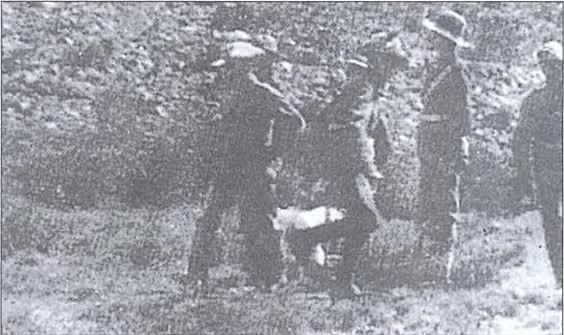
Gideon Scheepers (mostly obscured by his guards) tied to a chair for execution.


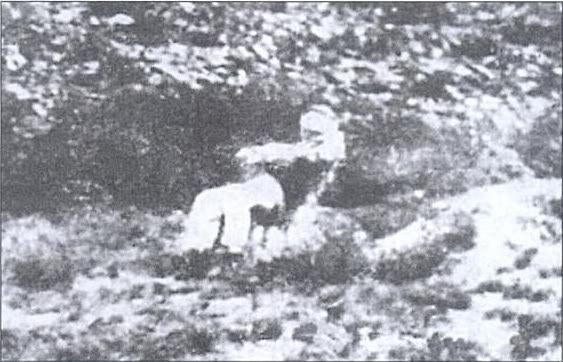
Just shot, Gideon Scheepers slumps backward in his chair.

While martyrdom guaranteed Scheepers a lasting legacy, bizarre posthumous turns helped elevate it into legend. When the dead man’s family turned up after hostilities to retrieve his bones, the grave turned out empty, leading to a years-long saga with colorful frauds presenting bogus remains, a mentally ill man doing the Grand Duchess Anastasia act and claiming to be Scheepers, and the actual corpse remaining stubbornly elusive.

The bereaved mother’s ultimately fruitless search for her son’s final resting place inspired the poem “Gebed om die Gebeente”(“Prayer for the Bones”), by D.J. Opperman. (Here’s a translated version.) That verse was recently set to music as a cantata by composer Hendrik Hofmeyr.

Scheepers’ allies, however, had simply been beaten in the field. On May 31, 1902 they capitulated to the British.

If we are asked why in 1978 a memorial should be erected for a man who died in 1902, then the answer is simple. The life and work of this man was such that history placed him in the heroes’ gallery and nothing and no one can deprive him of that place.

-Nationalist Prime Minister John Vorster upon the unveiling of a Scheepers monument

This interesting “On the Trail of Gideon Scheepers” series has a detailed and richly illustrated narrative of the man’s final year.

On this day..