Unspecified date: British soldiers by urophagia

Today is the 10th anniversary of America’s post-9/11 invasion of Afghanistan, two short decades after the Soviets tried the same thing with disastrous results.


Never get involved in a land war in Asia …

In honor of this impressive anniversary, we travel back in time and into the twilit frontier between fact and legend to another century’s intervention in that Graveyard of Empires — the Second Anglo-Afghan War, 1878-1880. Dr. Watson was there; maybe even his literary compatriot Sherlock Holmes, too.

It’s too bad we don’t have the services of those excellent detectives in this matter. We can’t date this particular method, or attribute any specific victim to it, or even substantiate the actuality of the practice to our liking (though there are several books by British soldiers of that war which traffick in the report). Frankly, everything about it smells. But we think you’ll agree that execution by urophagia is a story that needs to be told.

The following is an account from a biography of English officer and novelist John Masters. We’ll label it Mature Content both for what it describes and the manner of its description, just to make you really want to savor every word.

War for the Pathans [Pashtuns] was an honourable, exciting and manly exercise, in which each succeeding generation needed to prove itself, but war was also ruthless; no mercy was shown and none was expected. Neither side aimed to take prisoners. The Pathans customarily mutilated and then beheaded any wounded or dead who fell into their hands. Women often carried out these operations. A well-known torture was called the Thousand Cuts, whereby flesh woulds were newly made and grass and thorns pushed into them so that they would hurt horribly. A prisoner might be pegged out on the ground and his jaw forcibly opened with a stick so that he could not swallow, then women would urinate in his mouth until he drowned. Frank Baines, who served on the North-West Frontier and later with Masters in Burma, put it more crudely:* ‘If you got captured, you were not only killed in a lively and imaginative manner, you were carved up and quartered and had your cock cut off and stuffed in your mouth for good measure.’

-John Clay in John Masters: A Regimented Life

* Baines penned this memorable line for his book Officer Boy

On this day..

2010: Two Afghan adulterers stoned

On this date last year, the Taliban carried out the public stoning of an adulterous couple who had attempted to elope in northern Afghanistan.

“Even family members were involved,” the New York Times reported, “both in the stoning and in tricking the couple into returning after they had fled.”

as a Taliban mullah prepared to read the judgment of a religious court, the lovers, a 25-year-old man named Khayyam and a 19-year-old woman named Siddiqa, defiantly confessed in public to their relationship. “They said, ‘We love each other no matter what happens,'” [local farmer Nadir] Khan said.

The executions were the latest in a series of cases where the Taliban have imposed their harsh version of Shariah law for social crimes, reminiscent of their behavior during their decade of ruling the country. In recent years, Taliban officials have sought to play down their bloody punishments of the past, as they concentrated on building up popular support.

“We see it as a sign of a new confidence on the part of the Taliban in the application of their rules, like they did in the ’90s,” said Nader Nadery, a senior commissioner on the Afghanistan Independent Human Rights Commission. “We do see it as a trend. They’re showing more strength in recent months, not just in attacks, but including their own way of implementing laws, arbitrary and extrajudicial killings.”

Apparent cell phone video of the execution later surfaced.

Warning: Mature Content. It’s two filmed stonings, after all.

On this day..

1930: Thomas Shipp and Abram Smith, strange fruit

On this date in 1930, two black youths were lynched in Marion, Indiana for murdering a white man and raping his girlfriend.

(The rape allegation — although it, and not the homicide, seems to have been the thing that triggered the lynching — was subsequently withdrawn, and there were even rumors that the white girlfriend was a lover and confederate of one of the lynched men. It’s just one strand in the very human tapestry around the “last classic lynching north of the Mason-Dixon line” explored by Cynthia Carr in Our Town: A Heartland Lynching, a Haunted Town, and the Hidden History of White America.)

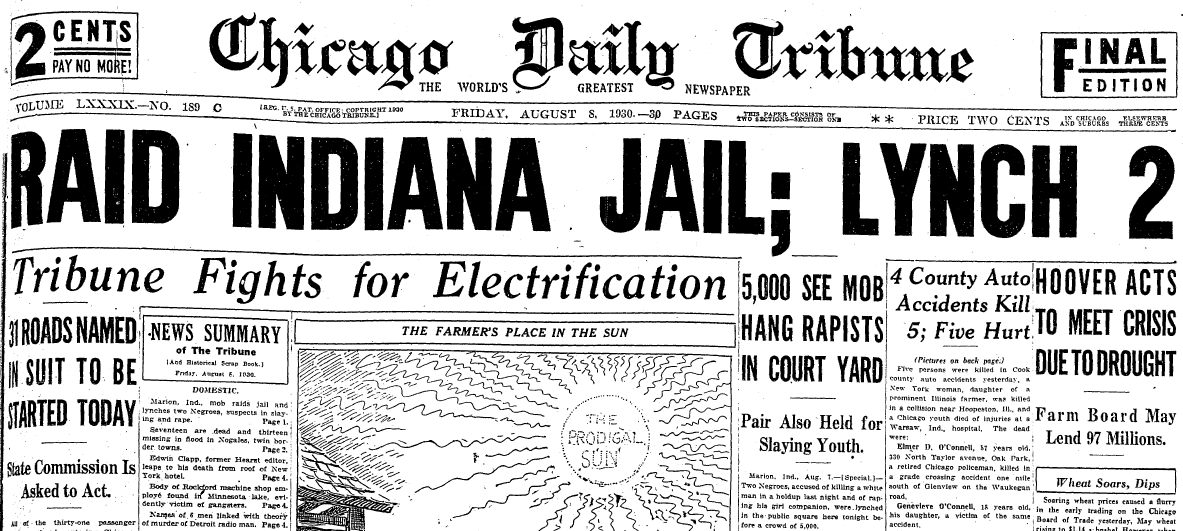
Thomas Shipp and Abram (or Abraham) Smith had been taken just the day before. The Chicago Daily Tribune (Aug. 8, 1930), for whom this event was banner news, reported that

Shipp, who is said to have confessed killing the white man, Claude Deeter, 23, of Fairmount, Ind., was hanged from an elm tree in the courthouse yard. Smith, whom the girl identified as her assailant, was thrown from a third floor window of the jail with a noose around his neck and strangled.

Reports of the crimes and confessions, published in Marion newspapers this afternoon, stirred this quiet community of 23,000 to intense excitement. There was no hint of the impending violence, however, until 8:30 p.m., when a motorcade of Deeter’s fellow townsmen arrived from Fairmount.

The Fairmount delegation, numbering about 100, gathered in the public square, openly displaying their guns and shouting for a lynching … The sheriff led his deputies to the front door, argued a moment with the leaders of the mob and then ordered the tear bombs thrown. Blinded, the lynchers fell back for a few minutes, but returned and began the sledge hammer siege which forced the jail doors within ten minutes. No shots were fired on either side.

Following the lynching the mob gathered in the square for an hour, some proposing to drive the 2,000 members of the Negro colony from the city and burn their dwellings. Peace officers from Indianapolis, Kokomo, Fort Wayne, and other towns were arriving however, and gradually the mob broke up.

The corpses hung in the square for hours, attracting throngs of gawkers — including a photographer able to snap this picture:


Teacher/poet Abel Meeropol ran across this photo of the Shipp-Smith lynching a few years later in a magazine, and it so “haunted” him — his word — that he penned the anti-lynching poem “Strange Fruit”. You know it from Billie Holiday‘s arresting vocal rendition.

Southern trees bear strange fruit
Blood on the leaves
Blood at the root
Black bodies swinging in the southern breeze
Strange fruit hanging from the poplar trees

Pastoral scene of the gallant south
The bulging eyes and the twisted mouth
The scent of magnolia sweet and fresh
Then the sudden smell of burning flesh

Here is a fruit for the crows to pluck
for the rain to gather
for the wind to suck
for the sun to rot
for the tree to drop
Here is a strange and bitter crop

Abel Meeropol was no passing sentimentalist himself, but a prolific left-wing activist. During the McCarthy years, he adopted the children of the Rosenbergs when the latter were electrocuted as Soviet spies. As faithfully as those two orphaned boys have carried the torch for their lost birth parents, they also still carry an adoptive surname: Michael Meeropol and Robert Meeropol.


A third person was almost lynched in the same Marion, Ind., incident, but 16-year-old James Cameron (sometimes called “Herbert” or “Robert” in the 1930 news reports) managed to convince the mob that he wasn’t involved. Just how he managed this feat and what he’d really been up to is another strand of Carr’s tapestry: many of the Marion blacks as well as whites she interviewed overtly mistrusted Cameron.

At any rate, the crowd let him off with a beating, and Cameron served time as an accessory to the crime.

After release, he became an anti-lynching activist in Indiana and, later, Wisconsin — where he founded a (since-shuttered) Black Holocaust Museum. He started several NAACP chapters.

Cameron was pardoned by Indiana Gov. Evan Bayh in 1993, and authored a memoir titled A Time of Terror: A Survivor’s Story.

In the more immediate aftermath, it was far from a given that this date’s effusion of summary justice wouldn’t cascade into a generalized racial pogrom.

As the Tribune article notes, the lynch mob mulled attacking the black community, ultimately dissuaded by the gradual arrival of lawmen. By the next day, the Indiana national guard had occupied Marion. The Tribune on Aug. 10 reported the town “peaceful to all outward appearances but acutely aware of an undercurrent of racial antagonism that it feared might flame into open warfare at any moment.”

Lest this seem a bit over-the-top, recall that all this went down just a few years since a lynch mob in Tulsa had metastasized into one of America’s most notorious race riots. The prospect of wholesale bloodletting was very real.

When the local attorney general and grand jury waved away the small matter of punishing mob leaders, several of whom were publicly known by name, Indianapolis attorney general (and Marion native) James M. Ogden drove up to town and personally filed indictments, to the fury of white residents.

“It was astonishing to see and feel the mob atmosphere that still prevailed nearly seven months after the murder,” wrote a correspondent for The Nation. Ogden’s deputies were “looked upon as enemies of the community, not only by the mob, but also by most of the court officials.” After all-white juries acquitted the first two people tried, the state dropped its remaining indictments.


The maelstrom of race and politics and history that emerged from that first fatal transaction — a brutal but banal Lover’s Lane heist — grew so far beyond the original cast of criminal and victim that they practically became secondary to the story.

On August 8, 1930, a wire story datelined Fairmount, Ind., ran in the Indianapolis Star (but not the Marion papers):

Deep regret that the negro slayers of their son Claude, were lynched in Marion last night by a mob, was expressed today by Mr. and Mrs. William Deeter, members of the Apostolic faith, a sect similar to the Quakers.

“God should have been the judge,” said the elderly Deeter. “They had no right to do it,” his wife assented.

Both are opposed to capital punishment and did not want to see the negroes put to death for their crime.

On this day..

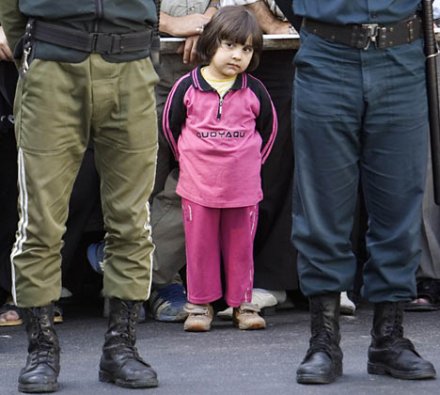
2007: Majid and Hossein Kavousifar

On this date in 2007, cousins Majid and Hossein Kavousifar (or Kavoosifar, or Kavoosi-far) were publicly hanged in Tehran for murdering a judge.

The judge in question had been noted for clapping some democracy activists in jail, but the authorities insisted that the case wasn’t political — that Majid admitted targeting Hassan Moghaddas (whose outsized portrait grotesquely decorated the scene) in a personal vendetta, as well as killing a couple of other people in a string of robberies.

The first public executions in the capital in five years, these hangings attracted an ample crowd, amply armed with the ubiquitous digital media equipment that characterizes our age.


Age-appropriate entertainment? A spectator at the hanging.

And while the 24-year-old Hossein died in fright, 28-year-old Majid played to those onlookers in the most insouciant execution pictures you’ll ever want to see.

Warning: Graphic images (and video) follow. (Many more can be searched up around the web.)

… and the inevitable video.

On this day..

1655: Massacre of Waldensians

On this date in 1655, Catholic forces under the Duke of Savoy carried out a notorious massacre of Waldensians* in the Piedmont.

This interesting, excommunicate sect had persisted for centuries in those hard-to-reach places in Alpine foothills, intermittently ignored and hunted. After Martin Luther, many Protestants inclined to see them as a proto-Reformation movement, or even a counter-papal apostolic succession reaching back to ancient Christianity.

At any rate, they sure weren’t Catholic.

And our friend the Duke decided — perhaps piqued by the murder of a missionary Catholic priest, or for whatever other reason — to mount one of those heresy-extirpating sorties and make them Catholic in 1655.

On April 17, the Marquis of Pianezza appeared with an overwhelming force of mixed Piedmontese, French, and Irish** troops. They conducted a few skirmishes, then made nice with the Waldensian civic leaders and induced them to quartering their troops temporarily further to some expedient pretext.

Alas! alas! these poor people were undone. They had received under their roof the executioners of themselves and their families. The first two days, the 22d and 23d of April, passed in peace, the soldiers sitting at the same table, sleeping under the same roof, and conversing freely with their destined victims …

At last the blow fell like a thunderbolt. At four of the clock on the morning of the 24th April the signal was given from the Castle of La Torre. But who shall describe the scenes that followed? On the instant a thousand assassins began the work of death …

Little children were torn from the arms of their mothers, and dashed against the rocks; or, more horrible still, they were held betwixt two soldiers, who, unmoved by their piteous cries and the sight of their quivering limbs, tore them up into two halves. Their bodies were then thrown on the highways and the fields. Sick persons and old people, men and women, were burned alive in their own houses; some were hacked in pieces; some were bound up in the form of a ball, and precipitated over the rocks or rolled down the mountains … Some were slowly dismembered, and fire applied to the wounds to staunch the bleeding and prolong their sufferings; some were flayed alive; some roasted alive; others were disembowelled; some were horribly and shamefully mutilated, and of others the flesh and brains were boiled and actually eaten by these cannibals.

Source, whose atrocity accounts channel those in this French tome

Without doubting the capacity of man’s inhumanity to man, the cannibalism charge reminds that we’re dealing with propaganda alongside historiography. And what great propaganda — like, babies-torn-from-incubators great.

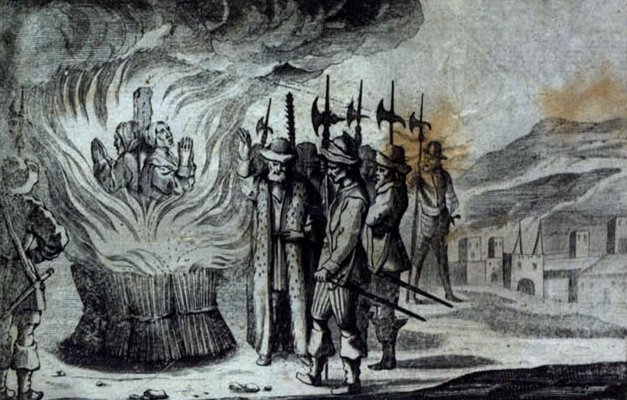
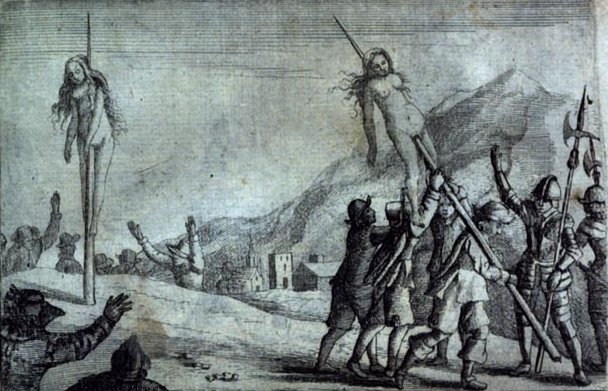
Thumbnails (click for a larger, disturbing view) of selected images of this date’s atrocities from Samuel Morland’s The History of the Evangelical Churches of the Valleys of Piedmont

And there’s little doubt as to the overall savagery of the affair, which could well have become the opening salvo in a full-scale sectarian cleansing campaign. (A later addendum to Foxe’s Book of Martyrs narrates the ensuing Piedmontese armed struggle, petering out before any definitive resolution in the field.)

Outrage at this hecatomb spread in Protestant Europe — which would also refer to the day’s doings as the “Bloody Easter,” since it corresponded with the eve of that celebration as reckoned by the Julian Calendar (source).

It was felt especially in Protectorate England, which intervened diplomatically.

A “day of solemn fasting and humiliation” was promulgated in Albion, along with collections for the relief of the survivors. Oliver Cromwell personally put £2,000 into the kitty.

More importantly, he dispatched diplomat Samuel Morland† to force the House of Savoy to lay off the persecution; in fact, he threatened to disrupt high statecraft between England and France unless the French twisted arms on behalf of the Waldensians.

Written correspondence for Morland’s diplomatic tour addressed to Louis XIV of France and various other continental potentates, as well as a fiery bit of oratory that Morland delivered to Savoy, all seem to have originated from the pen of Republican scribbler John Milton — the future author of Paradise Lost.‡

Milton, for whom the whole thing was more than just a day job, was further moved to put his umbrage at the slaughter into sonnet form:

Avenge O Lord thy slaughter’d Saints, whose bones
Lie scatter’d on the Alpine mountains cold,
Ev’n them who kept thy truth so pure of old
When all our Fathers worship’t Stocks and Stones,

Forget not: in thy book record their groanes
Who were thy Sheep and in their antient Fold
Slayn by the bloody Piemontese that roll’d
Mother with Infant down the Rocks. Their moans

The Vales redoubl’d to the Hills, and they
To Heav’n. Their martyr’d blood and ashes sow
O’re all th’ Italian fields where still doth sway

The triple Tyrant: that from these may grow
A hunder’d-fold, who having learnt thy way
Early may fly the Babylonian wo.

* The Waldensians in question here are interchangeably known as the Vaudois for their geographic region, actually above the Piedmont and abutting the Swiss region also known as Vaud. (These pages have visited the latter.)

** Fresh from being on the receiving end of another infamous massacre.

† Morland is more regarded for his post-Restoration labors as an inventor; he created an early calculator and internal combustion engine.

‡ The speech in particular is not definitively attributed; see Robert Fallon, “Milton in Government: Denmark and Savoy,” Milton Quarterly, May 1989.

On this day..

1916: Three in the Mexican Revolution

On an uncertain date — approximated only to “about the time of the Columbus affair,” which was Pancho Villa‘s famous (and otherwise unrelated) raid on Columbus, N.M. March 8-9, 1916 — a triple execution took place in Juarez, Mexico.

The who, why, and wherefore appear to be completely lost. Only the image remains:

These images were captured by C. Tucker Barrett, a lawyer and amateur photographer serving with the U.S. Army’s 16th Infantry Regiment then stationed right across the border from Juarez, in El Paso, Texas. (This regiment would be detailed for a punitive expedition into Mexico, which Barrett also photographed.)

The Mexican Revolution may be ancient history, but Juarez and extrajudicial executions are still very much in the news.

On this day..

1554: David van der Leyen and Levina Ghyselius, Anabaptist martyrs

On this date in 1554, Anabaptists David van der Leyen and Levina Ghyselius were burned at the stake in Ghent.*

Looks like it hurt.


In the year 1554, there was imprisoned at Ghent, in Flanders, for following Christ and living according to God’s commandments, a young brother named David, who, when examined, freely confessed his faith. Being asked what he thought of the sacrament, David said, that he considered it nothing else than idolatry. Then a priest said to him, “Friend, you err greatly, that you so readily confess your faith, for it will cost you your life, if you do not change your mind in time.” Thereupon David sweetly replied, “I am ready to shed my blood for the name of Christ, even though it should be here in this place; for God is my salvation, who will keep me, and preserve me from all evil.” The priest said, “It will not be as good as though you were put to death secretly here in this place; but you will be burnt publicly at the stake, for an everlasting reproach.” He was then brought into the court, where he was condemned to death, and his sentence was read, namely, that he had fallen from the true faith into heresy, and was therefore, according to the imperial edict, sentenced to be strangled and burned. David said, “No one will ever be able to prove by the Scriptures, that the faith for which I must now die is heresy.”

There was also sentenced to death with him a woman named Levina, who rather forsook, not only her six dear children, but also her temporal life, than her dear Lord and Bridegroom Jesus Christ. Arriving on the scaffold, David attempted to kneel down in order to offer up his prayer to God, but he was prevented, and they were immediately driven away to the stakes, standing at which, David said to Levina, “Rejoice, dear sister; for what we suffer here is not to be compared with the eternal good that awaits us.” (Rom. 8:18) When about to offer up their sacrifice, both exclaimed, “Father, into thy hands do we commend our spirits.” A little bag of gunpowder was tied to each of them, whereupon they were strangled and burned. But there happened a manifest miracle of God; for though they were completely burned, and the fire was as good as extinguished, David was seen to move his head, so that the people exclaimed, “He still lives.” The executioner seized the fork, and thrust it three times into his bowels, so that the blood flowed out; yet even after this he was still seen to move, hence, the executioner threw a chain around his neck, and bound him to the stake, and thus broke his neck.

Thus these two valiantly fought their way through, firmly trusting in God, who did not let them be confounded, since they had firmly built their building upon the only foundation; wherefore they shall never perish, but abide forever.

Martyrs Mirror

* The very birthplace of the then-sitting Holy Roman Emperor, Charles V.

On this day..

Themed Set: The Medical Gaze

“Open up a few corpses: you will dissipate at once the darkness that observation alone could not dissipate.”

Marie Francois Xavier Bichat

The condemned — those their fellows have marked for deliberate elimination — have always had a place as our emissaries into the darkness of that final, mysterious passage.

We gaze through that dead man walking — a ferocious criminal once upon a time, maybe, but now pinioned and defenseless, meat for sacrificial theater — we gaze through him into the abyss, and the abyss gazes also into us.

He does not merely confront us with our mortality, but with our still more terrifying duality. Awaiting the chop, his self has already been sundered from a corporeal form now appropriated — even by mere chance — to the edification of some foreign entity’s own purposes.


“The Reward of Cruelty,” the last plate of William Hogarth‘s Four Stages of Cruelty, depicts the cycle’s subject dissected in an anatomical theater (pdf) following hanging (note the noose) at Tyburn.
“His Heart expos’d to prying Eyes,
To Pity has no claim;
But, dreadful! from his Bones shall rise,
His Monument of Shame.”

The operation of the apparatus upon his form is his concern, the account he will make of himself on that stage (Henry VIII’s adulterous fifth wife, Catherine Howard, asked for the headsman’s block in her cell so she could practice how best to address it); the disposal of his flesh, yet living, may be reckoned in thus-and-such many hours. It was once not so rare to travel to the killing scene upon one’s very coffin — in fact, this was recent enough to be photographed. And more to the point, all this is our concern, we scaffold-ministers, for the doomed.

Everyone must grapple with the mysterious inevitability of death, but to be reduced to a cadaver while yet alive — that is a special form of horror. No wonder the undead make such spellbinding literature.

To another epoch, the line could as well blur in the other direction, the deceased remains be made to suffer for their former soul’s transgressions. Charles II could not best Oliver Cromwell in life, but finally made Cromwell’s bones suffer for regicide. As an object lesson, what difference whether the bones came to the halter breathing or no?

“A dead body,” writes William Bogard, “is not necessarily a corpse. It only becomes one in virtue of a social machine that needs dead bodies, and the flows of organs, tissues, and fluids they generate, to function.”


This Goya sketch, “Out Hunting For Teeth”, finds a woman prying out the dead criminal’s teeth for use as dentures.

In time that social machine evolved uses of tissue and fluid beyond bloodbath spectacle.

In the 18th and 19th century, Foucault contends, the “medical gaze” — a searching, scientific inquiry into the true foundations of bodily decay by following Bichat’s counsel to rip away the exterior and investigate the true form within. This is the literal definition and intent of autopsy: to see with one’s own eyes.

The medical gaze, “that absolute eye that cadaverizes life,” is likewise in Foucault’s reckoning a piece of the intellectual and ideological program that made the post-Enlightenment world.


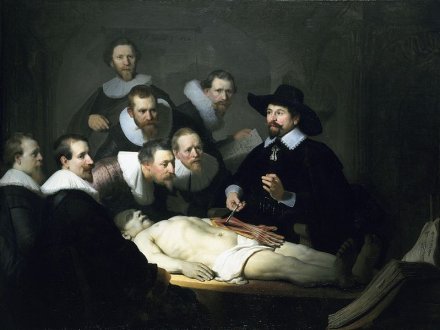
Rembrandt’s The Anatomy Lesson of Dr. Nicolaes Tulp (1632), whose subject was a prosperous surgeon later to become mayor of Amsterdam. The anatomized man is robber Aris Kindt, who had been executed earlier that same day.

No surprise that this revolutionary social machine found grist for its mill — commodified corpse-objects, the workers most literally alienated from their produce — at the foot of the scaffold.

That which hides and envelops, the curtain of night over truth, is, paradoxically, life; and death, on the contrary, opens up to the light of day the black coffer of the body: obscure life, limpid death, the oldest imaginary values of the Western world are crossed here in a strange misconstruction that is the very meaning of pathological anatomy.

Herewith, four who expired to open up their living fellows’ shambling carrion to that life-breathing medical gaze.

Highly recommended additional reading: Jai Virdi’s “The Criminalized Body” series: I, II, III, IV, V.

On this day..

1999: Zarmeena

On this date in 1999,* a burka-clad woman known only as Zarmeena (alternatively, Zarmina … or in some early reports, Zareena) was executed by gunshot in Kabul’s Ghazi Sports Stadium.

This first public execution of a woman under the Taliban — ordered because she had supposedly killed her husband** — was secretly filmed by a Revolutionary Association of the Woman of Afghanistan activist smuggling a camera under her own burka.

Caution: This video is (in)famous enough, thanks to its inclusion in the documentary Beneath the Veil, that you’ve probably already seen it. But it’s still a graphic image of a woman shot through the head at point-blank range. (From around 2:20)

The book With All Our Strength: The Revolutionary Association of the Women of Afghanistan expands somewhat on RAWA’s calculations on this occasion, on the young activist who pulled off the risky filming, and on the purportedly hostile-to-the-Taliban crowd reaction.

* Some web resources give Nov. 17 as the date, but all the (admittedly limited) primary documentation available appears to me to point definitively to Nov. 16. RAWA, which shot the video, posts it with this date; wire copy that ran in western papers on Nov. 16 (here) and Nov. 17 (here) attributed the execution to Nov. 16.

** It’s not clear to me how dependable the information about the executee is; it’s said that she had been in prison well over a year but was rather suddenly executed for the Taliban’s exigent reasons of public intimidation. It’s also said that her husband’s family forgave her — which, under sharia as practiced by, e.g., Saudi Arabia, ought to have spared her life — and that Zarmeena herself may not have understood or believed that she was actually going to be executed until the very last moment.

On this day..

Executed Today’s Third Annual Report: Third Time Lucky

Of executions, hangings, murders, and bombs people now write and speak as they used to speak about the weather. Children play at hangings. …

Yes, this executioner at first hand knows that he is an executioner, and that he does wrong, and is, therefore, hated, and he is afraid of men, and I think this consciousness and this fear before men atone for at least a part of his guilt.


His guilt? CG art (c) Eugene Fokin, used with permission.

But you all … you indirect participators in the iniquities perpetrated every day — do not seem to feel your guilt, nor the shame your participation in those horrors would evoke. It is true that, like the executioner, you fear men … You are all afraid; but, unlike that executioner, you are afraid, not because you know you are doing evil, but because you think other people do evil. …

for me the horrible work goes on of these hangmen, at first enlisted with difficulty, but now no longer so loathing their work; for me exist these gallows, with well-soaped cords, from which hang women, children, and peasants; for me exists this terrible embitterment of man against his fellow-man.

Tolstoy

Somehow, since our Halloween 2007 launch, the grim furies have scourged this blog along for three full years of fresh ghoulish content every single one of 1,096 straight days. Talk about rigor mortis.

Like the executioner, we’re usually all business here. But Halloween is a special occasion, and even we can let our hair down on our anniversary.

Embiggening

The blog traffic stats go up and to the right, just like they’re supposed to, now averaging well over 5,000 pageviews daily, with more than 700 feed subscribers. (Pageviews are up more than 50% since last year’s annual report, even though advertising rates haven’t budged. What a bargain!) Residents of 187 different countries have visited Executed Today in the past year.

In all, there were nearly 1.6 million pageviews from last Nov. 1 to the present — as against 1.1 million pageviews cumulative for the first two years of this site’s existence. (For all that growth, the single-day traffic record is still held by a day in the site’s penurious first year: that one time Andrew Sullivan linked me. If Sully doesn’t come through with another link, however, traffic growth trajectory suggests he won’t hold that distinction much longer.)

The site’s Twitter feed has grown more than 150%, to 470-some followers … although given the meteoric growth of Twitter itself, I’m not sure how much weight to put on that. If you do follow me on Twitter, you’ll get about 6-12 tweets daily about executions and connected subjects of crime, violence, and history, and no tweets about how drunk I am or that the circle line is running late or the last time I moved my bowels. Like I said: proper executioners are all business.

Where Are You?

The top 20 countries in terms of traffic are basically the usual suspects; the shuffling on this list is pretty minor year to year. The U.S. was over half the pie last year, and lost some of that ground; Poland and New Zealand both had disproportionate increases in their traffic.

United States
United Kingdom
Canada
Germany
Australia
France
Philippines
Netherlands
Poland
Italy
Spain
New Zealand
India
Ireland
Sweden
Belgium
Malaysia
Finland
Brazil
Norway

There was some sort of Slavic renaissance on the site in Year III; in addition to Poland, visits from Russia, the Czech Republic, Slovakia, Serbia, Macedonia, Croatia, and Ukraine also surged far above the baseline traffic growth metrics.

The average for pages viewed per visit (2.1), time spent on site (2:29) and “bounce rate” (69% of visitors who leave without clicking a second page) all remained essentially level; given that one might expect the many new visitors to the site to be more casually engaged than returning regular readers, I take that as a positive.

How’d You Get Here?

The site’s historic 60-30-10 ratio of search traffic-referral links-direct lookups stayed pretty much the same, with image searches specifically accounting for over 8% of the overall traffic.

Day by day, much of the daily surge and undertow in traffic is noticeably (to me) accounted for by search hits, and these often tip me to some bit of breaking news. The most popular search remains “executed today”; “executedtoday.com” is also in the top 10, and I’ve also filtered out a couple of site searches explicitly invoking this domain’s Ted Bundy discussion (more on that in a moment). As can be readily observed, there are a couple of searches for specific methods of execution (specifically: nasty methods of execution), but most of the leading search terms are lookups on specific individuals. (Executed individuals … except for one search on an executioner’s name, that of English hangman Albert Pierrepoint.)

thomas cromwell execution botched
samuel doe execution video
soraya manutchehri
thomas cromwell
michael x
samuel doe
albert pierrepoint
ling chi
zhang minsheng
john albert taylor
lingchi
ruth snyder
botak chin
karl hermann frank
drawn and quartered
botched executions
hamida djandoubi
charles starkweather
broken on the wheel
jenny wanda barkmann
masha bruskina
maggie dela riva
lois nadean smith
du’a khalil aswad video
hannah ocuish
mohammed bijeh
karl hermann frank execution video
khristian oliver
samuel doe execution
peter stubbe

What’d You See When You Got Here?

This has become one of my favorite parts of the annual report. With nearly 1,100 daily entries now posted along with meta-content, I’m going to extend it from last year’s top 25 to the top 40 all-time posts.

1. Jan. 24, 1989: Ted Bundy, psycho killer

Now with more traffic than the next three posts combined, this 3,000-plus comment living thread on one of America’s most infamous serial killers just keeps going strong.

It’s not the #1 post every single day; news-driven search hits or traffic to the day’s anniversary posts not infrequently surpass it. But it’s almost always one of the top two or three, and it’s the default number one when nothing else is cooking.

Many thanks to author Kevin M. Sullivan and the many other posters on this thread for making it one of the site’s most captivating pages.

2. Sep. 9, 1990: Samuel K. Doe

The former Liberian dictator, famously captured and tortured to death on video, which many an Internet denizen comes a-searchin’. (I have only a truncated and relatively PG version of that video.)

3. July 21, 1944: Col. Claus Schenk Graf von Stauffenberg

He tried to kill Hitler. More importantly for his search prominence, he was cinematically portrayed by Tom Cruise.

4. Aug. 14, 1936: Rainey Bethea, America’s last public hanging

Holding steady from fourth place last year, this post’s traffic is almost unnaturally consistent: 20 to 60 hits a day from people who mostly run searches trying to find out when America’s last public hanging took place.

(Also of note: the execution was overseen by a female sheriff, although she ended up delegating the actual execution to male hangmen while she remained off the scaffold.)

5. July 4, 1946: Eleven from the Stutthoff concentration camp

The “Jenny Wanda Barkmann” from the top search hits list above was a comely Nazi guard, publicly strangled to death on the gallows on this date.

6. July 28, 1540: Thomas Cromwell

As noted above, “thomas cromwell execution botched” is your search term winner for the year.

7. May 15, 1916: Jesse Washington lynched after conviction

Not a literal execution, though the connection between lynching and the death penalty as varietals of communal violence is uncomfortably close — especially when, as in this case, the outrages of the Negro upon the virtues of southern white women are at issue.

This post’s images of Jesse Washington’s blackened remains are among the more unpleasant illustrations on the site.

8. May 22, 1946: Karl Hermann Frank

Again, the appeal of multimedia. Frank’s hanging in Prague, by the old Austro-Hungarian “pole hanging” method, was filmed. He earned his death in part for one of the war’s most notorious atrocities, the Lidice massacre.

9. Dec. 23, 1948: Hideki Tojo and six other Japanese war criminals

The wartime Prime Minister of Imperial Japan.

10. Apr. 10, 1905: Fou Tchou-Li, by a thousand cuts

People come here looking for the ghastly photos of China’s old “slow slicing” execution method, that so exalted the likes of Bataille.

11. June 19, 1953: Julius and Ethel Rosenberg – Cold War cause celebre
12. June 6, 1997: Henry Francis Hays – White supremacist whose lynching of a random black youth cost the Klan its headquarters
13. Apr. 7, 2007: Du’a Khalil Aswad – Her “honor killing” stoning to death was filmed
14. Sep. 10, 1977: Hamida Djandoubi – The last drop for the French guillotine
15. July 8, 1999: Allen Lee “Tiny” Davis – So rotund, Florida built him a new electric chair
16. Dec. 11, 1962: Arthur Lucas and Ronald Turpin – These guys knew there was a good chance they’d be the last men hanged in Canada.
17. Nov. 28, 1950: James Corbitt, the hangman’s mate – Those search hits on “Albert Pierrepoint” find this story of the famed executioner hanging a former customer of Pierrepoint’s pub
18. Oct. 9, 1967: Ernesto “Che” Guevara – You might have heard of him.
19. Jan. 31, 1945: Private Eddie Slovik – The last U.S. soldier executed for desertion
20. Nov. 29, 1941: Zoya Kosmodemyanskaya – Famed teenage anti-Nazi partisan
21. Feb. 17, 2004: Cameron Todd Willingham – He’s the reason Texas Gov. Rick Perry will never be president.
22. July 19, 2005: Mahmoud Asgari and Ayaz Marhoni – Photographs of these two youths going fearfully to their deaths focused attention on the plight of homosexuals in Iran.
23. June 25, 1959: Charles Starkweather – This seminal heartland spree killer has his own Springsteen song.
24. Dec. 13, 1945: The Belsen war criminals – Another in the continuing “hot Nazi prison babes hanged” series
25. Sep. 13, 1946: Amon Goeth – The villainous concentration camp commandant in Schindler’s List
26. November, 1942: Partisans by the Sonderbataillon Dirlewanger – A graphic photo (with no specific known attribution date) of German units executing prisoners on the bloody eastern front
27. May 25, 1948: Witold Pilecki – Polish Home Guard agent who had once infiltrated Auschwitz, but ran afoul of the Communists after World War II
28. Jan. 12, 1928: Ruth Snyder and Judd Gray – The inspirations for Double Indemnity, doubly notable because a reporter secretly snapped a blurry picture of Ruth Snyder in the electric chair.
29. Jan. 9, 1923: Edith Thompson and Frederick Bywaters – An English love triangle; Thompson’s controversial, and botched, hanging was said to have contributed to the suicide of her executioner.
30. Aug. 8, 1944: Eight July 20 plotters – The aforementioned Stauffenberg was actually executed on the night of the coup by another German officer trying to cover his own complicity. These eight co-conspirators met a more official end: tortured by the Gestapo, abused in the People’s Court, and strangled on piano wire.
31. May 16, 1975: Michael X – Black nationalist hanged in Trinidad for burning to death a Tory M.P.’s daughter.
32. May 17, 1972: The rapists of Maggie dela Riva – Callow sons of the elite electrocuted for raping a well-known Filipina actress.
33. Oct. 26, 1941: Masha Bruskina, Kiril Trus and Voldia Shcherbatshevich – This post has graphic photos of partisans publicly executed by the Wehrmacht in Minsk
34. Feb. 1, 1968: Nguyen Van Lem – The prisoner summarily shot through the head by South Vietnamese Gen. Nguyen Ngoc Loan, in one of the Vietnam War’s most unforgettable images
35. Sep. 27, 1996: Dr. Mohammad Najibullah – The Soviet-sponsored former Afghan head of state, strung up on a traffic pylon when the Taliban took power.
36. July 15, 1977: Princess Misha’al bint Fahd al Saud – Nineteen-year-old Saudi royal adulteress
37. May 10, 1994: John Wayne Gacy – Democratic machine operative, amateur harlequin, serial killer
38. Aug. 14, 2004: Dhananjoy Chatterjee – The only person hanged in India in the past generation … though he doesn’t seem destined to be the last.
39. Apr. 28, 1945: Benito Mussolini, his mistress, and his aides – Afterwards, their bodies were strung up for public abuse in Milan
40. Mar. 28, 1757: Robert Francois Damiens – You’ll read a ghastly description of his quartering in Foucault’s Discipline and Punish. Appropriately for Foucault (though not mentioned by him) Casanova also helped his friend get busy while watching the execution.

I mention this every year, because it bears mentioning every year: there’s a striking traffic advantage for executions of a more recent vintage. I have fortuitous search placement on Tudor politician Thomas Cromwell — that fact surprises me somewhat — and since he’s recently been one of the main characters on a hit TV show, he gets plenty of search love.

After that, you need to get all the way down to #40 to find the next post about someone who was executed before the 20th century … even though just a bit over half the site’s content concerns pre-20th century executions. By my count, World War II alone accounts for 13 posts in the top 40, and 20 more of those entries are postwar executions. The same effect is also visible in the search terms.


The Stefaneschi Triptych: Christ, flanked by the executions of St. Peter and St. Paul.

Guest Content

Again, guest content to the tune of nearly a month was generously supplied by various friends of the site. Copious thanks to all of the following:

Anthony Vaver

Caitlin GD Hopkins

David Carson

dogboy

Elizabeth M. Hull

emperorhadrian

Jeffrey Fisher

John Temple

Jonathan Shipley

Meaghan Good

Melabesq

Robert Elder

Sarah Chan

I’m also grateful for these expert interviews:


This poster of the triangular Tyburn gallows is available from Madame Talbot’s Victorian & Gothic Lowbrow.

Other Highlights

Random. This little innovation actually got introduced last year and remains one of the most popular bits on the site. Every thirtieth pageview or so is from someone just dialing up a random execution — about 53,000 for the year.


Okay, this was pretty cool.

Legibility. If the text on the site is a bit easier on the eyes lately, it’s thanks to Ramon Garcia‘s pro bono CSS work.

Milestone. There’s no shortage of material, but I’m a little surprised my constitution has held out long enough to make it to 1,000-plus consecutive days. We take it one day at a time, coach.

Killed the Radio Star. My post on Arkadi Berdichevsky, a Soviet economist purged in the 1930s who also happened to be the father of conservative intellectual Jon Utley, actually prompted Mr. Utley to get in touch with me and led to an appearance on Antiwar Radio.

Metadeath. This post to mark the odometer rolling over to 2010 actually has more clicks than any posts save Bundy and Doe. Given three years of content in the reservoir and the way list posts are catnip to clickthroughs … there may be a few more of these in the offing.

Editor’s Picks. These posts aren’t necessarily big traffic-earners or major award-winners. But — to me, at least — they stood out somewhat from the everyday, as unusually interesting.

  • Ali Resti and Sayyid Husain, to placate America Great moments in American foreign policy: “When you are dealing with a government like Persia … if you ask them to execute a Moslem for the death of a Christian … if they do it, you accomplish more for the prestige of your country than if they paid a million.”
  • Four for the oil of Chad. Natural resource politics: scary.
  • The time when America went to war to protect the P.O.W. status of foreign terrorists. Or the time when trying unlawful combatants outside the Geneva Conventions outraged Britain and the U.S.
  • The Slaves of the Zong: cold-blooded summary “executions” of slaves when they became more profitable dead than alive.
  • Robert Kett, rebelling against the landlords’ enclosures of common lands that marked the dawn of capitalism. There’s more on enclosures in the hanging of these 19th century poachers
  • Aesop, of the fables. He’s supposed to have been executed by Delphians by hurling off a rock … for stinginess.
  • Young Goethe’s family was involved in the case of Susanna Margaretha Brandt, an infanticide who might have inspired the Gretchen character in his Faust
  • Joshua Tefft, the only person drawn and quartered in (what is now) the U.S.A. … for being too friendly with the neighboring Indians.
  • Mary Carleton, a 17th century adventuress whose manipulation of identity and celebrity is downright postmodern.
  • William Williams, the last hanged in Minnesota — a story also bound up in the move from public to secretive executions late at night and behind prison walls.
  • The Amboyna Massacre, in which Dutch colonial authorities in Indonesia waterboarded English prisoners into confessing to a fantastical terrorist plot, then executed them en masse
  • Jacques de Molay, the last Templar Grand Master, historical conspiracy theory nexus
  • Mehmed Kemal, executed by defeated Ottoman Turkey for the Armenian genocide, as it tried to make enough amends for the recent First World War to survive. (It didn’t.)
  • The Tour de Nesle affair saw princesses and knights with an excessive investment in romantic love set up the Hundred Years War.
  • Caryl Chessman, death row author and lightning rod for death penalty proponents and opponents alike.
  • Italian national heroes Cesare Battisti and Fabio Filzi — lavishly photographed martyring themselves to Austria-Hungary.
  • The first major war crimes trials of World War II took place in 1943, in the USSR … and those hanged as a result of the Krasnodar trials were not German soldiers, but alleged Soviet collaborators.
  • A mass execution Ivan the Terrible carried out at the height of his oprichnina terror.
  • Valery Sablin, the misunderstood inspiration for The Hunt for Red October.
  • Maharajah Nandakumar, a nasty little judicial assassination in colonial India that helped set the scene for a more orderly Empire.
  • Elizabeth Martha Brown, a disturbingly sexy hanging witnessed by young go-getter Thomas Hardy — and arguably an inspiration for his novel Tess of the D’Urbervilles.
  • Neptune, an African in Suriname whose butchery was vividly recorded by John Gabriel Stedman.
  • Roux de Marsilly, a hook to the Man in the Iron Mask
  • Gasim, the character Peter O’Toole executes just before taking Aqaba in Lawrence of Arabia
  • Thomas Nash, controversially renditioned to the British by the Federalists in 1799
  • A montage of cultural artifacts generated by Sacco and Vanzetti
  • A notorious mass impaling by Vlad the Impaler
  • All the entries in the Executions by Effigy themed set, a truly strange old practice
  • The Babington Plot, busted by Queen Elizabeth’s spymaster Walsingham
  • Mehdi Hashemi, who exposed the Iran-Contra scandal
  • “The Rand … never again saw a significant white mineworkers’ strike” after South Africa hanged C.C. Stassen in 1922

… topical for year three, we are obliged to mention

And, because third time lucky is scarcely guaranteed — more like a guideline, or wishful thinking — we might also direct you to an older post noting Thomas Egan: 3 tries, 2 ropes, 1 innocent man.

On this day..