1864: Three Idaho robbers, choked on gold

On this date in 1864, Doc Howard, Christopher Lowery and James Romaine hanged at Lewiston for “the strangest and darkest chapter in north Idaho’s criminal annals.”

Lured west by prospecting’s siren song, explorers struck gold in Idaho in the 1860s and poured in, dragging in their wake the lawlessness characteristic of boom towns.

Idaho and eastern Washington, a correspondent wrote to the Baltimore Sun by way of summing-up the bonanza year of 1863,* “is exceedingly rich in deposits of gold” to the delight of “thousands of sturdy miners from California and Oregon.”

“It is estimated that the mines situated in Washington and Idaho Territories yielded for the year 1863 some $20,000,000, and it is thought that next year this amount will be doubled … coin is almost unknown in the various mining towns, and even the ost trivial transaction of business has to be paid for in gold dust.”

As usual in these cases precious few of the miners hit the mother lode; it was the contractors who supplied them best positioned to make out. In August 1863 Lloyd Magruder, a prosperous and respected pack train operator who had once sat in the California legislature, embarked one of his mule convoys heavy with mining goods from Lewiston, over the imposing Bitterroot Range, and bound for the burgeoning mining colony of Virginia City.**


The Bitterroot Mountains. (cc) image by Eric Gross.

But the hills held other treasures than merely retail markups.

A day after Magruder’s slow pack train set out, three rough frontiersman — our three men, Howard, Low(e)ry and Romaine — left Lewiston, too. Overtaking Magruder on the road, they joined his traveling party on an amiable basis; by the time they reached Virginia City, Magruder trusted them to help sell off his mining supplies. Business complete, Magruder was ready to return to Lewiston, he had $25,000 in gold revenue in his pockets and not an inkling that the boon companions he now hired as his guards meant to take it from him. That’s the gold … that’s what it makes us.

Deep in the mountains one night, the wicked trio — joined by a trapper, Billy Page, who was inducted into the plot (so he said) by means of the sure understanding that to refuse was death — murdered Magruder and four other men traveling in the party.

A night was chosen when they were encamped on a ridge which broke off on one side almost perpendicular for several hundred feet into a canyon or mountain gorge. Near the summit was a spring which furnished men and animals water. From a confession made by Page, the trapper, it appears that on the night selected for the massacre, Page was put on guard and told what was going to happen, and ordered to keep still under penalty of death. Magruder and Lowry were also on guard away from the camp in an opposite direction, while Phillips, Allan and the other men were fast asleep in their blankets near the fire. During the first watch of the night, Lowry, who was on guard with Magruder, approached within striking distance, and dealing him a powerful blow with an axe which he had concealed under his coat, awaiting the fatal moment, knocked him senseless to the ground, where he was speedily dispatched. The killing of the sleeping men in camp was then quickly accomplished. Page, the trapper, who was watching the mules near by, claimed that he saw the murders committed. As soon as daylight arrived, the mules were brought up and five of the best were selected, four for saddle mules for the men to ride and one to pack their plunder. The other animals were then driven into a deep canyon and they, too, were murdered. They tied the murdered men in blankets and dropped them over the bluff near camp, into the bottom of the canyon, several hundred feet below, after which, having secured the gold dust, they made a bonfire and burned all the camp equipage, including the aparejos and other paraphernalia of a pack train. (Early History of Idaho)

The murderers made for the coast, slipping quietly back into Lewiston and grabbing the first stagecoach out in the morning, en route to Portland, Ore. But a friend of Magruder’s, sensing in their furtive and ill-favored manner — buying tickets in disguise; heedlessly abandoning valuable mules and camp supplies — something of their villainous design, set a Javert-like pursuit upon their booted heels.

He would pursue them at his own expense, leaving behind the inn he operated in Lewiston, all the way to San Francisco whence they journeyed to have their gold shavings coined by the mint. Page earned his freedom for giving evidence against the others; the remaining three attained the distinction of suffering the first legal executions in the history of the Idaho Territory.

* Letter dated Jan. 1, 1864; it was published Mar. 24.

** Today a hamlet (Wikipedia pegs its population under 200) in the state of Montana; at the time, a Wild West boom town in the Idaho Territory whose tenuous order was maintained by a vigilance committee.

On this day..

1874: Christopher Rafferty, the first executed for killing a Chicago cop

(Thanks to Meaghan Good of the Charley Project for the guest post. -ed.)

On this date in 1874, Christopher Rafferty was hanged for the murder of Chicago Patrolman Patrick O’Meara, who was shot to death on August 4, 1872.

A fourteen­-year veteran of the force, O’Meara was not the first officer of the Chicago Police Department to die in the line of duty — but he appears to be the first whose death brought about a legal execution.

The murder went down like this: Rafferty, a bricklayer by trade and a bit of a hard case despite his youth (he was 25), had participated in a riot the week before the shooting. Rafferty and two other men, one of them his brother, were arrested and then released on bail. Rafferty swore he was innocent and claimed a man named Donovan would support his story, but Donovan refused to provide him with an alibi. To pay him back, Rafferty tracked Donovan down and beat him with a brick. Donovan staggered to the police station, reported the crime and swore out a warrant against his assailant.

At a little after midnight, when O’Meara and his partner, James Scanlan, tracked Rafferty down at Daniel O’Brien’s Saloon at Halsted Street and 35th Place, the thug seemed to be in a good mood and even offered O’Meara a cigar. He seemed to cooperate when the two officers told him they had to arrest him, but then bolted for the door while simultaneously pulling a gun from his pocket and firing at the two policemen, hitting O’Meara in the chest.

O’Meara collapsed and bled out on the saloon floor. His last words were, “Stay, Chris, don’t shoot.” But Rafferty shot again, barely missing Scanlan’s head. After a struggle with Scanlan, he escaped into the night.

Edward Burke and Thomas O’Gorman’s book End of Watch — Chicago Police Killed in the Line of Duty, 1853­-2006 noted,

[O’Meara’s] cold­blooded murder outraged Chicagoans. It was an atrocity further deepened by the fact that the killer had escaped. Local neighborhood folks took to the streets frantic with excitement following his murder, forming small posses that headed out to the prairie grass to hunt for the killer. Local police officials soon persuaded people to permit Chicago detectives to track Officer O’Meara’s murderer down themselves.

O’Meara

They caught him just a few hours later, walking in the fields on his way to Joliet. Rafferty was tried and convicted of the murder a month later, but his conviction was overturned twice on procedural grounds. His three separate trials and convictions are responsible for the long (for those days) wait between his arrest and his execution.

He met his death calmly and without a struggle, sleeping “as peacefully as a child” in the hours before his predawn hanging. His father was permitted to visit him shortly before the execution, and two priests accompanied him to the scaffold. His was the last public hanging in Lake County.

Just before he was hanged, Rafferty (or someone using his byline) penned the following ballad, which looks a shameless rip-off of one already floating about for the years-ago execution of James Rodgers*:

Come all you tender Christians, I hope you will draw near,
And likewise pay attention to a few lines I have here.
For the murder of O’Meara, I am condemned to die,
On the 28th** of February, all on the gallows high.

My name is Chris Rafferty, that name I never denied,
I left my aged parents in sorrow for to cry.
Oh little did they think in my youth and bloom
That I would come to Chicago to meet with my sad doom

My parents reared me tenderly as plainly you may see
Constantly good advice they always gave to me.
They told me: quit night­walking and shun bad company
Or State’s Prison or the gallows my doom would surely be.

Scanlan and O’Meara, they came in a saloon.
They said to me, “Chris Rafferty, we want you right soon.”
It was then I pulled that fatal pop and shot him through the heart
Which leaves a loving wife and husband for to part.

On the day of my trial it would pierce your heart to see
My companions and associates they were all standing by.
I bid them take a warning by my sad fate,
And to leave out their night­walking before it was too late.

O’Meara left behind a wife and five children. As for Rafferty’s family, the Chicago Tribune claimed they were left “in destitute circumstances: that the father is aged, the mother blind, the sister insane, the brother has fled, that the family were supported by the labor of the two sons, and, deprived of this, are now in distress.”

Killer and victim both rest in Calvary Cemetery.

* It must have been a hit, since the same ballad also got re-used for President James Garfield’s assassin.

** Despite what the verse says the execution was on the 27th, not the 28th.

On this day..

1688: James Renwick, to end the Killing Time

Though none of the crowd that thronged Edinburgh’s Grassmarket this day in 1688 could know it, that date’s execution of minister James Renwick would make an end to the Killing Time, the great 1680s persecutions that scattered martyrs’ bones across Highland and Lowland.

Renwick, at any rate, was the last of many Covenanters who submitted to the public executioner; only a few months yet remained when officers in the field were empowered to force an oath of abjuration upon suspected dissidents, on pain of summary death in the field. By year’s end, the absolutist Catholic King James II — with whose brother and predecessor the movement had such a tortured history — fled to exile as the Glorious Revolution brought the Protestant William of Orange to power: royal recognition of Scottish Presbyterianism ensued.*


Monument to Renwick at his native Moniaive. (cc) image by Scott Hill.

The son of a village weaver, Renwick manifested a martyr’s uncommon zeal for the faith early in life and matriculated at the University of Edinburgh. There in 1681 he witnessed the hanging of Covenanter preacher Donald Cargill. Here, muses the hagiography, “the mantle of Elijah fell upon young Elisha.”

After studying — and ordination — abroad in the Netherlands Renwick returned to his native soil in 1683. He managed some five years of secret ministering in hidden homes and conventicles, and all the while the law sought him ever closer. By the time it finally hunted him to ground in 1688, so many of the faith’s august champions had already taken their martyrs’ crowns that at age 25** Renwick was among the biggest game remaining.

How often cowled on ghostly moors by torchlight had the young reverend rehearsed the steadfast refusal he might one day deliver to his persecutors? Had he prayed that the weakness of flesh would not betray his spirit with an unbecoming attachment to his own life? “I cannot own this usurper as the lawful king, seeing both by the word of God such an one is incapable to bear rule, and likewise by the ancient laws of the kingdom which admit none to the crown of Scotland until he swear to defend the Protestant religion, which a man of his profession cannot do,” he declared to his captors when pressed for the formula of abjuration.

Renwick passed this test but little could even he have imagined how speedily would be fulfilled his gallows prayer:

Lord, I die in the faith that Thou wilt not leave Scotland, but that Thou wilt make the blood of Thy witnesses the seed of Thy church, and return again and be glorious in our land. And now, Lord, I am ready.


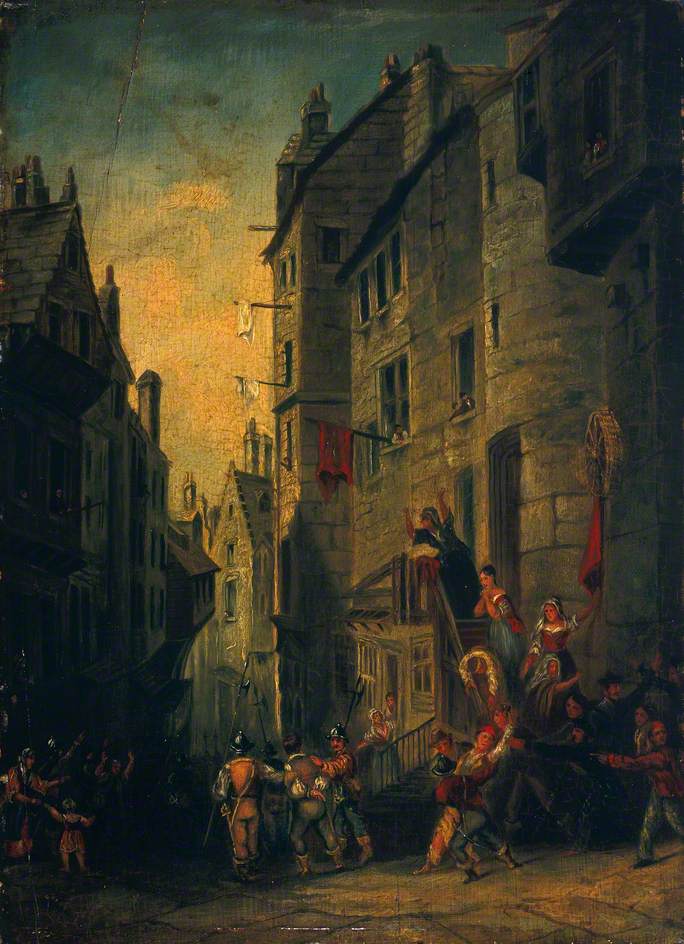
Condemned Covenanters on Their Way to Execution in the West Bow, Edinburgh. Artist unknown. (Source)

James Renwick has enjoyed tender biographical treatment from posterity; see here and here for some longer-form examples.

* While good news for the Presbyterians, this put many an Episcopal and Catholic in a tight spot of their own, setting up decades of bloody tragedy for Jacobite loyalists … but this is a subject for other posts.

** The captain who finally caught Renwick is supposed to have exclaimed at seeing his youth, “Is this the boy Renwick that the nation has been so much troubled with?” The outlaw minister turned 26 two days before his execution.

On this day..

1854: John Tapner, the last hanged on Guernsey

(Thanks to guest writer Victor Hugo, who having haunted these pages in many a post kindly permits us to republish the open letter he wrote on February 11, 1854 to Home Secretary (and future Prime Minister) Lord Palmerston. This is the English version as published by London’s Daily News on February 17 of that year; here is a French version of the same. Hugo at the time was living as an exile from the French Empire in the British-controlled Channel Island of Jersey; the case concerned was the highly controversial hanging of John Tapner on the nearby island of Guernsey for the murder of an aged Frenchwoman. Nobody ever hanged again on Guernsey after this possible wrongful execution.

The footnote appears in the original. -ed.)

Sir, —

I lay before you a series of facts which have transpired in Jersey within the last few years:

Fifteen years ago Caliot, a murderer, was condemned to death, and pardoned. Eight years ago Thomas Nicolle, a murderer, was condemned to death, and pardoned. Three years ago, in 1851, Jacques Fouquet, a murderer, was condemned to death, and pardoned.* In each of these cases the penalty of death was commuted for transportation.

In each case, to obtain a commutation of the sentence, a petition signed by the inhabitants of the island was sufficient.

In 1851 transportation was thought a sufficient punishment for Edward Carlton, who murdered his wife under circumstances of the most horrible description.

All this has taken place within fifteen years in the island from which I now address you.

Let us shift the scene from Jersey to Guernsey.

Tapner, a murderer, an incendiary, and a robber, is condemned to death.

At present, and the facts above stated prove the truth of the assertion, the penalty of death is virtually abolished in the opinion of every sane, well thinking man.

No sooner is Tapner condemned than a cry is heard, petitions are multiplied; one, energetically establishing itself on the principle of the inviolability of human life, was signed by 600 of the most enlightened of the inhabitants of the island.

And it is worthy of notice that not one minister of any Christian sect has deigned to affix his signature to either of these petitions. These men are probably ignorant that the cross is a gallows. — The people cried: “Mercy!” The priest cried: “Death!” — Let us pity the priest and resume our subject.

These petitions have been forwarded to you — a repsite has been granted. In similar cases a respite was equal to a commutation of the sentence — the island draws breath — the gallows is not to be erected — cruel error! the gallows is erected — Tapner is hung! and this after mature consideration.

Why?

Why should Guernsey be refused that which has been so often granted to Jersey?

Why deal to one concession and to the other affront? — Why should pardon be sent here and the executioner there?

Why this difference where all things else are equal? — What use was the respite but to aggravate the torture? — Was some mystery involved? To what purpose has been consideration?

Things are whispered, sir, to which I dare not listen. No! it cannot be true. What! a voice, and that of the most obscure, if it be the voice of an exile, cannot ask pardon from an insignificant corner of Europe for a man about to die without being heard by M. Bonaparte, without M. Bonaparte’s interference. What, M. Bonaparte, who has the guillotine of Bellay, the guillotine of Draguignan and the guillotine of Montpellier, not satisfied with all these! Has he still an appetite left for a gallows in Guernsey.

What — in such a case could you have refused justice to the proscribed for fear of giving umbrage to the proscriber. If so, the man was hung to accommodate, and the gallows erected as an act of courtesy, and could you have done all this to strengthen your alliance. No, no; I do not, I cannot believe it. I cannot even admit the idea, although I shudder at it.

Before the great and generous English nation can your Queen have the right of pardon, and M. Bonaparte that of a veto. At the same time that there is an omnipotent in heaven, can there be an omnipotent on earth? No.

I merely say that it was not possible for the French journals to speak of Tapner. I state the fact, but I draw no conclusion from it. However this may be, you have determined to use the terms of the despatch, that justice should take its course, and all is over.

However this may be, Tapner, after having been three times respited, and had his case three times under consideration, was hung yesterday, the 10th of February, and if there be any truth in the conjectures, which for myself I utterly reject, I present you, sir, with the bulletin of the day. you may, if such be the case, transmit it to the Tuileries. These details cannot be offensive to the Empire of the 2nd of December. The Eagle will hover with delight over the field of this victory! He is a gallows Eagle!

A garden joined the prison. In this garden the scaffold was erected. A breach was made in the wall for the prisoner to pass through. At 8 o’clock in the morning the neighbouring streets were crowded with spectators, of whom 200 of the privileged were admitted into the garden. The man appeared in the breach. He walked erect and with a firm step; he was pale, the red circle caused by anxious wakefulness surrounded his eyes.

The month just passed had added twenty years to his age — a man thirty years of age appeared fifty.

“A cotton night-cap was drawn over his head and turned up in front (says an eye-witness); he was dressed in a brown coat, which he wore during the trial, and an old pair of slippers.”

He walked partly round the garden, in a walk gravelled expressly for the occasion. The javelin men, the sheriff, the under-sheriff, and the Queen’s solicitor surrounded him. His hands were tied loosely, as we shall presently see.

According to English custom, while the hands were crossed upon the breast, a cord bound the elbows behind the back.

Behind him, the chaplains, who had refused to sign the petition for mercy, followed weeping.

The gravel walk led to the ladder — the cord was swinging — Tapner ascended the ladder — the executioner trembled: inferior executioners are at times susceptible of pity. Tapner placed himself under the noose, and pressed it over his head, and his hands not being firmly tied, he desired the executioner, who seemed quite confused, to arrange the rope. Then, “as if he had had a presentiment of what was to follow,” says the same eye-witness, “he said, ‘Tie my hands tighter.’ ‘That is unnecessary,’ replied the executioner.” Tapner standing thus with the rope round his neck, and his feet on the trap, the executioner drew the night-cap over his eyes, and nothing more could be seen of that pale face but the mouth moving as in prayer.

After some moments, the man destined to this high office pressed a spring — the drop fell, and the body fell abruptly through — the cord tightened, the body turned, and the man was considered dead.

“It was thought (says the eye-witness) that Tapner was killed at once by the rupture of the spinal marrow, he having fallen 4 feet,” but the witness further adds, “the relief of our oppressed hearts did not last two minutes.” Suddenly the man not yet a corpse, but already a spectre, moved.

The legs were thrown convulsively about, as if seeking some stay in the empty space; what could be discovered of the face was horribly disfigured; and the hands, which had become loose, were clasped and relaxed, as if to implore assistance. The cord around the elbows had snapped in the fall. Amidst these convulsions the rope began to swing, the elbows of the poor wretch came in contact with the edge of the trap, he clung to it with his hands, rested his right knee upon it, raised his body, and seemed to lean towards the crowd. Again he fell; and twice, says the eye witness, was the same scene repeated. He then raised his cap, and the crowd gained a sight of his face. This, it seemed, was too much. It was necessary to close the scene. The executioner reascended the scaffold, and caused the sufferer (I still quote the eyewitness) to let go his hold. The executioner and the victim struggled for a moment; the executioner triumphed. Then this wretch, himself like one condemned, threw himself into the aperture where Tapner was hanging, straightened his knees, and hung to his feet. The rope oscillated for a moment, bearing the victim and the executioner, the crime and the law. At last the executioner himself relaxed his hold; all was over; the man was dead.


Also a prolific drawer, Victor Hugo produced this Ecce in 1854, and several other depictions of the gallows in the ensuing years — possibly inspired by his horror at Tapner’s fate. Ecce is also known as John Brown, although that American slavery abolitionist was not executed until 1859.

You see, sir, how things were managed; the effect was completed; for the town, being built as an amphitheatre, everything was seen from the windows, all eyes were fixed on the garden. If it were the object to excite a feeling of horror, it was done: the crowd cried “Shame, shame,” and several females fainted.

During this time, Fouquet, who had been pardoned in 1851, is repeating. The executioner has converted Tapner into a corpse; Mercy, Fouquet into a man!

Between the time when Tapner fell into the trap, and that in which the executioner, no longer perceiving any motion, let go his feet, 12 minutes elapsed. Twelve minutes! Let that time be calculated, if any one knows by what clock to number the moments of suffering. Such, sir, was the mode of Tapner’s death.

The theory of example is satisfied; the philosopher alone mourns, and asks himself if this be what is called allowing justice to take its course? We must believe the philosopher to be wrong. The punishment has been frightful, but the crime was hideous. Must not society be defended? What will become of us if, &c. &c. The audacity of criminals would meet with no restraint. There would be nothing but atrocities and murders. A check is absolutely necessary. At least, it seems your opinion, Sir, that Tapners should be hung unless they be emperors. Let the will of statesmen be done!

Theorists, dreamers, those visionary spirits who have formed some notion of good and evil, cannot sound, without difficulty, certain depths of the problem of destiny.

Had Tapner, instead of killing one woman, destroyed 300, adding to the heap some hundreds of old men and children — had he instead of breaking a door, violated an oath — had he, instead of purloining a few shillings, stolen 25 millions — had he, instead of burning the house Saujon, overawed Paris by force of arms, he would have an ambassador at London.

It might, however, be as well to define a little more precisely the point at which Tapner ceases to be a robber, and Schinderhannes commences politician. Sir, this is horrible! We are members, you and I, of the infinitely small. I am only a refugee, you are only a minister — I am ashes, you are dust — Atom may surely speak freely to atom — where each is nothing, truth may be spoken. Well then, be assured, whatever may be the actual success of your policy, however glorious the alliance of M. Bonaparte, however honourable it may be for you to act in strict union with him, however far famed and magnificently may be your common triumph in Turkish affairs, this rope, which was fastened round a human sack, the trap which opened under his feet, the hope that, in falling, he would break his spine, the face become livid beneath the deep shadow of the gallows, the bloodshot eyes bursting from their sockets, the tongue lolling from the throat, that groan of anguish only stifled by the knot, the terrified soul which still clings to its tenement, the convulsed knees which seek some support, those bound hands mutely clasped and asking help — and that other man, that man of darkness, who throws himself upon these last struggles, who clings to the knees of the dying wretch, and himself hangs upon the hanging — Sir, these things are frightful!


Victor Hugo, The Hanged Man, c. 1855-1860.

And if haply the conjectures which I disavow be true, if the man who hung to the feet of Tapner were indeed M. Bonaparte, it would be monstrous. But, I repeat, I do not believe this. You have yielded to no influence; you simply said — let justice take its course; you gave this order, as you would have done any other, the prolonged discussions concerning capital punishment do not interest you. To hang a man, and to drink a glass of water are the same things in your estimation — you did not comprehend the importance of the act; it was the oversight of a statesman, nothing more. Sir, keep your blinders for earth, and do not offer them to eternity! Do not trifle with such deep interests, mix nothing of your own with them; it would be impudent. I can see more deeply into those interests than you — Beware! Exul sicul mortuus. I speak as from the tomb.

Bah! what matters it? A man is hung; and what more? a coil of rope to be wound up; some timber work to be taken to pieces a corpse to be buried. Certainly these are great matters! We will fire the cannon, a little smoke in the East, and all will be over. A microscope will be required to detect Guernsey and Tapner. Gentlemen, this rope, this beam, this corpse, this dreadful though invisible gallows, this suffering, carry us into immensity. They involve the social question, which is more important than the political; they do more — they carry us beyond earth. That, which is of little consequence, is your cannon, your politics, and your smoke. The assassin who to-morrow becomes the victim, as a soul which takes its flight holding the end of the gallows-rope — it is this which is frightful. Statesmen, who between two protocols, two dinners, and two smiles, carelessly press with white-gloved hand the spring of the gibbet, and the trap falls under the feet of the victim. Know you what you do? The infinite appears; the unfathomable and the unknown; the mighty shade which rises suddenly and terribly beneath your littleness.

Proceed! Let us observe the men of the old world at their work. Since the past still struggles let us examine it. Let us observe its successive phases.

At Tunis it is impaling; with the Czar the knout; with the Pope it is the garrot; in France the guillotine; in England the gallows; in Asia and America the slave market. All this will be swept away. We, the anarchists, the demagogues, the blood-drinkers, tell you, the protectors and saviours of the world, that human liberty is to be respected, human intelligence is holy, human life is sacred, and the human soul divine. Now go on hanging! But beware! The future opens. You think that living which is dead, and that dead which is living. The ancient form of society, but it is dead. You are deceived. You have stretched out your hand to the spectre of darkness, and chosen her for your bride. You turn your back upon life: it will soon arise behind you. When we pronounce the words Progress, Revolution, Liberty, Humanity, you smile, unhappy man, and point to the darkness in which we both are involved. Do you indeed know what that night is? Learn the truth; ere long the ideas will burst forth in all their strength and glory. Democracy yesterday took the name of France; to-morrow it will take that of Europe. The eclipse does but conceal the increasing magnitude of the star.

I am, sir, your obedient servant,

VICTOR HUGO.
Marine-terrace, Feb. 11

* We read in the Jersey newspapers, of January 7, 1851:

James Fouquet — We are informed that James Fouquet, condemned to death by our Royal Court, for the murder of Derbyshire, and whose punishment was commuted by her Majesty into transportation for life, was removed, about six months ago, from the prison at Milbank, where he had hitherto remained, to Dartmoor. He is nearly cured of the wound in his neck, and his conduct has been such, while at Millbank, that the governor of that prison thinks it extremely possible, there will be a further commutation of his sentence into banishment from the English territories.

On this day..

1863: William Ockold, the last hanged at Worcester

This date in 1863 saw the last hanging ever at Worcester — that of a decrepit old drunk, William Ockold, either 69 or 70 years of age, who had beaten his wife to death in one of the brutal thrashings that had been a mainstay of their half-century of married life.

We’ll let the period’s press tell the tale.

Birmingham Daily Post November 10, 1862

On Saturday morning a shocking murder was committed at Hales Owen Street, Oldbury, and as might be expected, the inhabitants of that locality manifested no small interest in the matter.

The facts, so far as we have been enabled to ascertain at present are as follow: — William Ockold, tailor, in his 70th year, and his wife, Sophia Ockold, aged seventy-three, lived together in the above-named street. They lived in a very poor way, and were known to indulge together in intoxicating drinks.

For a few days prior to Saturday last Mrs. Ockold was unwell, but not confined to her bed; and at about a quarter past nine on the morning in question a young woman, named Maria Glazebrook, aged about nineteen or twenty years, went into the house to enquire as to Mrs. Ockold’s health. The young woman was very intimate with the Ockolds, and though not related to them, she called them respectively “grandfather” and “grandmother.” She is a domestic servant at the George and Dragon public house, in Hales Owen Street.

When she went to Ockold’s house she asked him how “grandmother” was.

He replied, “I don’t know.”

The girl then said, “Where is she? Is she in bed?”

Ockold made answer, “I suppose she is.”

The girl then noticed that there was some blood upon Ockold, and she said to him “Laws, grandfather, how did that come there?” and he said, “I have given the old woman a punch or two.”

The girl then went to the foot of the stairs, and called out “grandmother,” and, receiving no answer, she asked Ockold if his wife was asleep. She again called at the foot of the stairs two or three times, and still receiving no answer, she said she would go upstairs. Ockold told her she must not; but he did not get up to prevent her doing so, but continued as he had been during the time of the ialogue given above, working on the board. She, however, said “I will go up,” and went upstairs accordingly.

Here a shocking spectacle presented itself to the view of the affrighted girl. The body of Mrs. Ockold was stretched upon the floor, covered with blood, life being quite extinct.

The girl screamed out, and ran down stairs, exclaiming, “Why, grandfather, you have killed her.”

He said “Her ain’t dead, is her?” and the girl replied “She is, though.”

She then ran out of the house, and fetched in some neighbours, Mr. Weston, butcher, who lives next door, with his wife, being the first to come into the house. In the meantime Ockold went upstairs, took up the body of his murdered wife, and laid it upon the bed.

The police were then communicated with, and Sergeant Simmons was speedily in attendance.

By the time he arrived the news of the sad affair had spread rapidly through the town, and a crowd of from 200 to 300 persons had assembled. Mr. Simmons went into the house, and saw the old man standing in the chimney corner apparently careless of what was going on around.

The officer went upstairs, and briefly examined the body of deceased, observing that the face was covered with blood, and that one of the eyes presented the appearance of having been battered in. He came downstairs, and then observed that there was blood all the way down …

No one saw the murder committed, yet the facts are so concise and significant that there exists not the slightest doubt as to how and when it was done. When the body was found life had not been extinct more than an hour or two, and the heart was still warm. It is supposed that Ockold had been at work al night, that he had been disagreeing with his wife, and that in a moment of passion he committed the awful crime.

There are rumours abroad that deceased and his wife were heard having high words at four o’clock on the morning of the murder, and the police-constable on duty heard him cursing her at about that time. Another rumour is that the old woman was heard begging for mercy at about the hour named. A broken mopstick was found in the pantry by Sergeant Simmons, and this leads to the suggestion that the prisoner broke it over the head of his victim. Deceased and her husband were well known in the parish, the latter for certain peculiarities of conduct in working all night and playing all day. They frequently went out together drinking, and used to return home arm in arm, the worse for what they had taken.

The prisoner had half-a-pint of beer at six o’clock on the morning of the murder. There is some pretence that he was very much vexed at his wife for having been drinking with another man; but this seems to be too ridiculous a notion to be entertained seriously, especially as deceased had been very unwell for two or three days prior to her death …


Birmingham Daily Post, December 15, 1862

WORCESTER WINTER ASSIZES

Mr. Benson proceeded to the task of defending the prisoner. The learned counsel, in a powerful speech, contended, first that there could not have been any motive on the part of the prisoner to murder his wife. It had been shown that for almost half a century the deceased had shared the humble bed and board of the prisoner, and in the manner of the rough part of the country in which they lived, they lived in terms of conjugal love and fellowship …

That the wife fell by the hand of her husband he would at once concede, but arguing upon the absence of motive, of malice, or forethought, the learned counsel, contended that the crime of the prisoner was not greater than the crime of manslaughter, and asked the Jury to spare the prisoner the few short years which Providence might still allot to him, and not send his tottering feet to the gallows, and leave a gibbet over the prison gate as a legacy of their labours that day.

There was no doubt that on the night when the woman met her fearful death, the husband and wife were quarrelling, and the man made use of passionate words, which would in all probability be met with taunting words by his wife … The man had gone upstairs to get his wife from bed, and used the violence which had caused her death in a moment of passion; he appeared indifferent the next morning when asked where his wife was, for the simple reason that he in ungoverned anger had thrown his wife down without knowing that he had hurt her. He was callous, harsh, brutal if they would, but not guilty of murder and malice aforethought. The learned counsel went into a careful and searching analysis of the evidence offered on behalf of the prosecution, and concluded by an eloquent appeal to the Jury for the life of the old man at the bar.

The learned Judge then proceeded to sum up to the Jury, and charged them to disabuse their minds of all compassion and indignation, and return a verdict which would be a just one. He carefully stated to the Jury the facts which had been brought before them, and fully explained the law of the case.

The Jury then retired, and after an absence of an hour returned into Court. The prisoner was brought up from the cell and again placed at the bar. The indifferent look which he had borne during the trial was now passed away, and his twitching lips and moistening eye showed the state of his feelings.

Amid solemn silence the Foreman of the Jury said that they had found the prisoner guilty, but desired to recommend him to mercy, on the ground that nothing had transpired during the trial which was adverse to his previous good character, and also on account of his extreme age.

The Clerk of Arraigns called upon the prisoner whether he had anything to say why sentence should not be pronounced upon him, and his lips moved as though he would have spoken, but the words died in his throat, and he stood calm and silent.

The learned Judge then assumed the black cap, and in a tremulous voice addressed the prisoner and said: William Ockold, you have been found guilty of this dreadful crime, the murder of your wife, to whom you had been married, by your own statement made to your son, near upon fifty years.

It is a most painful thing indeed to see a man at your advanced period of life, convicted of such a crime, and a crime committed against the wife whom you had sworn to love and cherish.

The Jury have recommended you to mercy. That recommendation I shall take care to transmit to the proper quarter. I have no power whatever to hold out any hopes to you; the power is entirely vested in the breast of the Sovereign, and it is only from her clemency that any possible mitigation of your sentence can proceed. What may be the course taken is not for me to say, and I should be deceiving you if I were to hold out hopes of any remission of the sentence.

I beseech you, therefore, by penitence and prayer to apply yourself to the Throne of Mercy, that you may obtain that mercy which you denied your poor ailing unfortunate wife, and that the short remainder of your days may be spent in preparation for the doom which awaits you, and the other Judge, before whom you will have to stand; and may God in his infinite mercy have mercy upon your soul.

His Lordship then passed sentence of death in the usual form, and the prisoner was removed from the dock.


Birmingham Daily Post, December 16, 1862

In the name of humanity as well as of justice, we feel bound to call attention to the case of William Ockold, found guilty and sentenced to death, on Saturday, at Worcester Assizes, for the murder of his wife.

The facts of the sad history may be very briefly told. Ockold, who is in his seventieth year, was a tailor at Oldbury, his wife, who was about the same age, assisting him in his business. They seem to have been very poor, and their means were still further reduced by their addiction to drinking. Drink led to its natural result, — frequent quarrels, accompanied by violence; and, indeed, the wretched pair seem to have led a sadly dissipated, wrangling, miserable kind of life — tolerably good-tempered when sober, but when drunk perpetually quarrelling. Several witnesses deposed to this — one of them adding that “the people round there [the place where Ockold lived] are very rough people.”

On the 7th of November Mrs. Ockold was ill — as one of the witnesses stated, “she was groaning very much and seemed in great pain.” Ockold, evidently disbelieving his wife’s illness, expressed great annoyance at having been kept awake by her groans during the previous night, and declared that she should not keep him awake again — evidently meaning that he would give her a beating.

In the night a policeman heard the wife groaning and the prisoner cursing her from the bottom of the stairs; but such noises being frequently heard upon his beat the officer took no further notice of them. On the morning of the 8th Mrs. Ockold was found dead in her bedroom, death having evidently resulted from blows inflicted on the head with a mopstick.

Ockold who was seated at work downstairs admitted at once that he had beaten his wife, but was evidently unconscious that the poor woman was dead. Dead, however, she was, manifestly killed by the blows inflicted by her husband.

On this evidence the Jury returned a verdict of wilful murder, coupled with a recommendation to mercy; but the Judge while promising to send the recommendation to the Home Office, held out no hope that it would be complied with.

We call attention to this case because while entirely assenting to the recommendation of the Jury, we dissent from the grounds on which their merciful conclusion was arrived at. The Jury endeavoured to save the life of the unhappy convict “because nothing had transpired during the trial which was adverse to his previous good character, and also on account of his great age.”

The latter reason is a good ground for abstaining from hanging this wretched old man, but the former, if acted upon, would free from punishment half the murderers who are arraigned at the bar of justice.

The strongest ground in favour of a remission of sentence is, we think, that urged by Mr. Benson, the prisoner’s counsel — that the prisoner was deeply irritated in a quarrel with his wife, that the blows were given in a moment of uncontrollable passion, without premeditation, and with no design to cause death; and therefore, that the offence was not murder but manslaughter.

With all respect for the Jury, we submit that the whole probabilities of the case favour this view, and that it is very hard to reconcile the incidents narrated by the witnesses with any other. The girl Glazebrook proved that Ockold did not believe in the reality of his wife’s illness, the policeman and a neighbour deposed to the occurrence of a quarrel in the night, and the demeanour of the prisoner next morning was perfectly consistent with the supposition that he meant to beat his wife, but did not mean to kill her. There was plenty of evidence to support this view of the case; but none at all to indicate the malicious motive and design which the law regards as the very essence of murder.

If we felt sure that the recommendation of the Jury would produce its effect we should not trouble our readers with these remarks. But we are inclined to think that some further effort may be needed to induce a reconsideration of the case; and as there is no time to spare, we urge some benevolent persons to take the matter in hand at once.

To hang a gray-headed man, who has nearly run out the period allotted to human life, would be bad enough under any circumstances; but it would be infinitely worse in a case like this where so much doubt hangs over the nature of the offence.

Even if he were guilty of murder, what would justice gain by hanging this wretched old man, already tottering on the brink of the grave, and so sunk in ignorance, so debased by constant association with scenes of violence that he scarcely knows the character or the consequences of his acts? In the “rough neighbourhoods” of the black country blows and curses are unhappily the commonest arguments of domestic life, and a passionate man living within constant sight and hearing of such teaching might easily carry his violence to a fatal issue, without the least intention either to kill his victim or to bring himself within the grasp of the law.

We have no doubt that this was Ockold’s case, and therefore we feel that, despite the serious nature of his crime, it would be a grievous perversion of justice to hang an old man, with the snows of seventy winters upon his head, for an offence which substantially does not amount at the utmost to more than aggravated manslaughter.


Aris’s Birmingham Gazette, December 27, 1862

THE CONDEMNED CONVICT, W. OCKOLD

Unless the sentence of death passed upon this old man at the late Worcestershire Assize, for the murder of his wife, is commuted, the dreadful spectacle of an execution will be witnessed in Worcester city on Friday next. A memorial to the Home Secretary, praying for a commutation of the sentence, has been got up, and there is a strong feeling that it will meet with success, and that the prisoner will not be hanged.


The Morning Post, January 01, 1863

THE CONDEMNED CONVICT OCKOLD

This wretched old man, now lying in Worcester county gaol, condemned to death for the murder of his wife at Oldbury, will, it seems, be executed.

Friday next is the day fixed for the execution, and workmen are already engaged in erecting the drop.

On Tuesday the following communication was received from the Home-office, in answer to a memorial sent up by the city magistrates, praying for some commutation of the sentence: —

Whitehall, Dec. 27, 1862.

Sir, — I am directed by Secretary Sir George Grey to acknowledge the receipt of a memorial presented by you from the mayor and magistrates of Worcester, on behalf of William Ockold, now under sentence of death for the murder of his wife.

Sir George Grey would have been very glad if he could have satisfied himself that there were sufficient grounds for complying with the prayer of this memorial, and of another which he had previously received, which prayed for the commutation of the sentence on the ground that the prisoner was not of sound mind when he killed his wife.

Of the latter allegation — which, indeed, is rather suggested as probable than affirmed as a fact — there is no evidence whatever.

He has, therefore, only to consider the evidence given at trial, which he has carefully read, and the recommendation to mercy with which the verdict was accompanied.

The attack by the prisoner on his wife appears from the evidence to have been wanton and unprovoked. She was so weak and ill as to be unable to make any effectual resistance, and the violence used and the repeated blows which must have been struck were such as, under such circumstances, would not fail to produce death.

She was heard crying out to him “not to kill her,” or “that he would kill her;” and the state of her body, as proved by the medical witness, afforded ample evidence of the determination with which the prisoner acted in the commission of the crime.

The jury recommended the prisoner to mercy on account of his extreme age, and nothing having transpired detrimental to his previous character. Character may be entitled to much weight where doubt exists as to the facts, but not so where the crime is clearly proved to have been committed; but were it otherwise, the recommendation on the ground of character seems in this case scarcely consistent with the evidence of the bad feeling of the prisoner towards his wife, and of the language used by him to her.

The age of the prisoner, Sir George Grey is informed, is 69. He cannot agree in the opinion that a murder committed by a person of this age is on that account only to be exempt from the penalty attached to it by law. He fears that if he yielded to the consideration, he should be establishing a precedent which would be detrimental to the due administration of the criminal law.

Under these circumstances, he much regrets that he oes not feel it consistent with his duty to advise any interference in this case with the ordinary course of law.

–I am, sir, your obedient servant,
H. Waddington
Sir E. Lechmere, High Sheriff of Worcestershire


Birmingham Daily Post, January 3, 1863

THE OLDBURY MURDER.
EXECUTION OF OCKOLD, YESTERDAY.
(From our own Reporter.)

Within the calm old city of Worcester, yesterday — in the early light of the second morning of this new year — while we were yet keeping high festival in honour of Christmas — and while the departing echoes of that angel-song of peace and goodwill, sung eighteen centuries ago, still lingered on the confines of thes eason — William Ockold, a hale old man of seventy, white-headed, rosy-faced, and kindly-looking, was publicly hanged, in the presence of gaping thousands, for the wilful murder of his wife, at Oldbury.

It was a harrowing spectacle — a sight to make the heart sick.

Hard upon threescore and ten years had the old man journeyed through time, and for nearly half a century had the old woman, who was older than he by some three or four years, borne him company. They had children; and, on the whole, seem to have lived as happily as people in their class of life and of their tastes do in the Black Country.

When the old man — who was a tailor — worked, the old woman helped him; when he went out drinking — which was often — she went with him, and they generally staggered home in company.

They mostly lived upon the parish, and spent their scant earnings in drink.

Occasionally the old man best his wife, but not very often and not very badly — perhaps not oftener than he conscientiously thought she deserved it, for he does not look like a cruel man, and report speaks somewhat kindly of him for a drunkard.

And thus they travelled on through life — loving each other very much, in their rude way, at times, and falling out now and then when provisions or money ran short. It was a long journey in married life — fifty years; and they had nearly completed it. A peaceful grave lay before them, and a few more tottering paces would have brought them to it. The old woman, indeed, was well nigh there, for she was very infirm and sorely diseased.

But they were never destined to reach it.

In the last stage, just before the final step was to be taken, the old man either unwittingly or wilfully — a Jury of his countrymen say wilfully — hurled the old woman into eternity before her time, and followed her, red-handed, to the presence of their common Maker, by way of the gallows, yesterday.

It is a fearful story.

Instead of waiting a few brief moments, till Death came, the hoary patriarch dragged his seventy years through blood to meet him, and while earning for himself a murderer’s grave, leaves nothing to his children but the bitter legacy of shame and sorrow.

And what is more dreadful is the fact that he never seems to have realised to the full the enormity of his crime.

Utterly ignorant, accustomed no doubt in his younger day to constant scenes of brutality, his mental acuteness blunted by the wear of drunk and years, and his dim notions of right and wrong almost entirely obliterated, he has shown hardly any symptom either of sorrow for what he has done, of pity for his victim or of fear regarding his own fate. He seems indeed to have been a man, not brutal by nature, but one who overcome by the stupor of ignorance, mingled blindly with the class amongst whom he fell; never dreaming, even, that there was anything nobler in life than eating and drinking, and sleeping and dying.

And to this besotted callousness rather than to any actual, premeditated guilt perhaps his violent death yesterday was owing.

Imminent death upon the scaffold seemed to have no terrors for him, and as to that mystic other world, he did not comprehend it. The chaplain of the gaol (the Rev. J. Adlington) was unremitting in his endeavours to impress the old man with a due sense of his position, but without any apparent effect.

Sometimes he would sit and listen as to a strange story that had pleased him, and at others as to a dreary narration that wearied him, but at no time did he seem to grasp hold of and understand the truths laid before him.

With what he occupied his mind during the long night watches in the silence of the condemned cell is a secret that none mortal may know, for he revealed his mind to no one … when he displayed any emotion of the mind at all it was generally of a cheerful character; as, for instance, when on one occasion he congratulated himself that the prison apartments were like those of a palace when compared with his wretched home at Oldbury.

[F]rom first to last, his conduct was that of an old, old man, whose uneducated faculties were dimmed by age, who had no very refined ideas of right and wrong, who thought beating a righteous correction for a wife who displeased him, and who, in an untoward moment of passion, under-rated his own strength, over-rated his poor old wife’s powers of endurance, and dealt her a blow that unhappily proved fatal to both of them.

And so the old man of seventy, half unconscious of having committed any crime at all, utterly incapable of comprehending the enormity of it, and too sunken in ignorance to lay hold on the comforts of religion, was publicly and judicially strangled in front of the County Gaol at Worcester, yesterday.

And thousands came as witnesses. Not many thousands — four or five perhaps — of whom several hundreds were strangers in the city. The mere anticipation of the sickening sight had proved sufficiently attractive to bring crowds from their warm beds miles away, and that on a miserably windy stormy night.

Early on the previous evening the wind blew up briskly, and brought with it some sharp sprinklings; and as the night wore on the breese [sic] broke up into cold gusts, and bore upon its wings still heavier loads of rain. It whistled dismally through the streets all night long, and sung mournfully through the gallows which had been put up ere midnight.

Some few hundreds of citizens ventured out in the storm to see it, but after gazing at it, and finding no signs of early crows, they shivered drearily, and betook themselves homewards. As time went on, and three and four o’clock came, a pedestrian party or two from the black country, drenched but hilarious, tramped up to the gaol front, and finding all still clear, sauntered off to neighbouring public-houses. Five came, and with it a continual plashing of footsteps along the sloppy streets. More people had come in from the country, some in traps and some on foot, and there were two continual streams of them passing each other to and from the gallows; for few cared to take their places even yet.

At six, however, the wind came unladen with rain, and from that time onward sunk to a low soft breeze. And then the crowd began to assemble in Infirmary Walk, a road running straight out in front of that part of the gaol on which the drop had been erected. Some few had come from Birmingham overnight.

Seventy years ago it seems the old man was born there, and six and fifty years ago he was apprenticed by his mother, who carried on business as a pawnbroker, to a tailor in Steelhouse Lane … From the villages and hamlets immediately around Worcester, too, there came a large sprinkling of agricultural labourers. But what was most revolting was the fact that women and children formed a very large part of the crowd. There were mothers there — not one or two, but many — with infants in their arms, and there were old men with their grandchildren.

There were people of all ages, from the man well stricken in years to the baby in arms; there were people of all classes, from the well-to-do tradesman to the pauper; and there were hundreds of little boys and girls mingling with them everywhere.

And by half-past seven in the gray morning they had crowded up the three avenues to the gaol. And there they stood gazing upon the gallows fixed high up on the castellated gaol, and looking more like some ghastly remnant of feudal barbarity than an engine of modern punishment in a Christian land.

As the morning light intensified, and the sky cleared, the crowd thickened, and then some three or our Scripture-readers made their appearance to “improve the occasion” — some by distributing tracts, and two by preaching extempore sermons. And so the crowd waited on, very orderly in its conduct, more than usually so, for the harrowing scene to follow.

A strong body of the county police, under the charge of Superintendent Phillips, were the duty inside the gaol railings, and a strong body of the city police, under the charge of Chief-superintendent Power, were on duty outside. But their services were not required.

Meanwhile, the old man inside the gaol was being made ready for death.

He went to bed on the previous night at nine, fell asleep directly, and woke at two. During the remainder of the night he only slept at intervals, and seemed restless but still indifferent. The warder who was with him thought proper to remind him that he was spending his last morning on earth, to which the old man replied, almost jocularly, “That’s a pretty thing to tell a fellow, that is.”

The whole of his conversation during the night was of a similarly cheerful character. Between six and seven he got up and dressed himself, and had breakfast — tea and bread and butter, of which he ate and drank as heartily as usual. At half-past seven he was visited by the chaplain, who remained and prayed with him, the old man remaining to all appearance indifferent the while, until the hour fixed for the execution.

He would have been hanged at eight, but the Governor had deferred the execution till after the arrival of the morning post, hoping to the last that a reprieve would arrive. Shortly before half-past eight Mr. Hyde, the Under-Sheriff, accompanied by his javelin men — for the ceremony was performed in the ancient manner — arrived. The morning post was in, and no reprieve had come, so the usual procession was formed, and the old man was led out of the condemned cell in the east wing, to death.

The chapel bell clanged out three weird notes — and three more — and three more.

And while that awful funeral cortege moved slowly on to the gallows, and that hoar old man was listening to the reading of his own burial service, a dreadful hush ran through the crowd without.

Then followed a brief low murmur of excitement and a gentle surging down upon the gaol railings. And then there were a few brief moments of eager expectancy. The procession had halted in the porter’s tower in order that the old man might be bound. Arrived there he calmly sat down upon a seat provided for him, and was pinioned without displaying the least sign of fear or emotion of any kind until he was told to set forward again.

Then, and not till then, a tear stealing out of his eye rolled down his cheek, and he paled and began to tremble violently. The bell again clanged out three dismal notes, and there was another hush in the crowd without. And then, one by one, the execution[er]s and their victim glided out upon the scaffold.

First came six javelin men, who ranged themselves in front of the scaffold, then six warders, who ranged themselves behind it. Then came the Governor of the Gaol and the Under Sheriff, and then Calcraft — for he had been engaged to end the ceremony — leading along the old man, at sight of whom, bare-headed, pale and trembling, his long white hair fluttering in the morning breeze, the very crowd who came to see him hanged sent up, with one consent, a long low utterance of pity.

Still he was led on, along the scaffold, up the rude steps, beneath the gallows, on to the drop. Once there, while the burial-service was being ended, he looked calmly down upon the thousands of upturned faces before him. The Chaplain, who, though not seen could be distinctly heard, then paused, and Calcraft came forward — with some difficulty drew a too small cap over the white flowing hair, over the furrowed face, down to the thin gaunt neck of the old man — quietly dropped the noose upon his shoulders, while the victim trembled in every joint — drew it tight around the throat — adjusted the knot with deadly nicety upon the blue scaly prominent vein — fillipped the other end of the rope over the cross-beam, looped it into a knot around it — grasped the shrivelled hand in token of farewell — buckled a strap around the thin weak legs — grasped the hand again — and was about to retire, when the old man questioned him.

“I suppose I’m goin now, aint I?” he asked.

“I’ll let you know that,” replied the hangman, and retired.

Then there was one moment in which the chaplain’s voice rose up in the midst of the surrounding silence, and the old man’s weaker voice joined with it, in the antiphon, “Lord have mercy upon us; Christ have mercy upon us; Lord have mercy upon us.”

The words were scarcely ended ere there was a rattling of bolts. The drop fell with a horrible clatter; a wild wail, acute, heart-piercing, arose from the crow, and the body of William Ockold, after a few brief nervous contortions, swung lifeless in the breeze.

In that one moment the pains, many, and the pleasures, few, of a long, sad life were ended — the memories of seventy years driven rudely from their storehouse. In that one moment the soul of the old man had learned more than seventy years could teach it, and appallingly ignorant as he was, that one “leap in the dark” made him wiser than all living.

In one instant the clutch of man had released him from the clutch of man, and had rendered him up to the hand of that All Wise One who will try him truly, judge him righteously, and temper mercy with justice, in a way of which we blind mortals know little and perhaps guess hardly.

As soon as the body had ceased to move the greater part of the crowd dispersed, but large numbers still remained to see it cut own. After it had hung an hour it was removed. It was then found that the neck had been broken and the jugular vein burst in the fall. Cessation of sensation must, therefore, have been instantaneous, and the convulsions after the fall the result of unconscious vitality. The body was at once buried beside those of two other murderers, under the western wall of the prison, hard by the debtors’ promenade.

This makes the seventh execution at Worcester since 1832. In that year two brothers, James and Joseph Carter, were executed the highway robbery near Bewdley; in 1834, Robert Lilley was executed for the murder of Jonathan Wall, at Bromagrove; in 1837, William Lighthand was executed for the murder of Joseph Hawkins, at Areley Kings; in 1849, Robert Pulley was executed for the murder of Mary Ann Staight, at Broughton; in 1855, Joseph Meadows was executed for the murder of his sweetheart, Mary Ann Mason, at Kate’s Hill, near dudley; and now, in the first week of 1863, William Ockold, an old man of seventy, has been executed for the murder of his wife, at Oldbury.

On this day..

1897: John Morgan, the last public hanging in West Virginia

This date in 1897 marked the last public hanging in the history of West Virginia.

The chief character in the dramatic milestone was a fellow named John Morgan,* condemned for murdering an aged widow named Chloe Greene and her two children near Ripley, W. Va. It was a mean trick indeed, as Mrs. Greene had taken in Morgan when the latter was an orphan, and raised him to manhood; Morgan had married and moved out of the house, but was on good terms with his adoptive family.

On the morning of November 3, as Mrs. Greene’s children James Greene and (by a previous husband) Alice and Matilda Pfost puttered around with their routine chores, Morgan — having spent the night at the house — suddenly took up a hatchet and started slashing. Matilda and James were slain, along with the 70-year-old Mrs. Greene; Alice survived a skulll-fracturing bash from the hatchet and managed to escape when her assailant turned his attention to her sister. Were it not for Alice’s eventual testimony, the author of this ghastly and seemingly purposeless carnage might never have been known. As best one could determine, he butchered his lifelong benefactors for no better reason than to steal the $56 they had in the house thanks to the recent sale of some horses.


Wheeling Register, Nov. 6, 1897.

In a triumph of the “speedy trial” system, Morgan was condemned a mere two days after the murder — “one meting out the swiftest justice to a murderer ever known in the annals of criminal history in West Virginia,” the admiring Wheeling Register reported on Nov. 6. (Not neglecting to note that a greater delay might have invited the verdict of Judge Lynch.)

He hanged just six weeks after that, but proved himself a cool customer in that short time. He sold a confession of the crime for $25, so that he could afford a suit to wear on the gallows … and then made a brave bid to balk gibbet and suit alike of its big occasion.


Boston Journal, Dec. 4, 1897.

It seems that one evening about two weeks before his scheduled (and, since we already know how this ends, his actual) death, Morgan was playing checkers in the jail corridor with one of his guards. He made a great show of exhaustion, and when the guard ducked out to pick up Morgan’s supper, Morgan stuffed a dummy into his bed in a posture of deep sleep, then climbed himself on top of the cell while the guard quietly left the meal for his “sleeping” captive. Once the cell was locked up for the night, Morgan just slipped right out.

The escape was not discovered until morning, but Morgan was recaptured after only a couple of days abroad — not nearly enough to interfere with the execution. His bravado cracked at the end; press reports have him in a state of collapse on that morning. “The scene in the jail this morning beggars description,” the Baltimore Sun reported on Dec. 17. “His spiritual advisers were praying, singing and pleading with the doomed man to surrender his soul to its Maker, while Morgan was a pitching, crying, agonizing man.” He managed to pull himself together well enough to die game.

If only Morgan’s avarice could have abided a little patience! December 16 would have been an excellent day to rob the good citizens of Jackson county, since practically all of them — a reported 5,000 souls at least — turned out for the first hanging in that locale for 47 years. (Ripley had only 700 residents and not nearly enough rooms to handle the swell, so impromptu campings sprang up all around the outskirts of town.)


Baltimore Sun, Dec. 17, 1897.

The uncouth scene, with the usual horror of drinking and carousing even compassing 2,000 women unladylike enough to present themselves led West Virginia to abolish public executions in 1898.

* His actual name by birth was John Raines. Perversely, he used the surname of a man whom his father, Andy Raines, had murdered when Raines was a tot; it was because his father was subsequently killed resisting capture that Raines/Morgan was an orphan.

On this day..

1859: Thomas Ferguson, but not on a Sunday

The first judicial execution of a white man* in the history of the Utah Territory took place on this date in 1859.

One Thomas Ferguson earned the distinction by getting roaring drunk and shooting dead the shopkeeper who employed and boarded him. Allegedly, Alexander Carpenter’s provocation had been to accuse Ferguson of being party to the unknown burglars who had lately raided his Salt Lake City shop, which obviously got way under Ferguson’s skin.

This was frontier America, being newly-settled by Brigham Young‘s upstart Latter-Day Saints sect, though not only by them. The capital’s population was perhaps 14,000 — the kind of place where dubious refugees could wash up from parts unknown, trusting their fortunes to their native wit and Colt’s Manufacturing Company.

“Crime has run riot in this city since the assassination of McNeill and Sergeant Pike” a hostile, non-Mormon correspondent wrote to the San Francisco Bulletin (letter dated Oct. 5, 1859, and published Oct. 27).

Till lately, no one has been arrested. Ferguson, a “Gentile,” murdered Carpenter, a Mormon, and for such an outrage “this people” will permit the sentence of death to be carried into effect; but the murderers of McNeill, of Pike, of Drown, of Arnold — the first two “Gentiles,” the last “apostates” — run at large to hold the community in terror and carry out other sentences.* An apostate committed suicide a few nights since by shooting himself twice in the back of the head!

Carpenter murdered his partner named Turner near Fort Laramie, Nebraska, brought their goods to this city, where, he said, (and convinced his associates,) he was tried and acquitted. Tried and acquitted in Utah for murder in Nebraska!

Both men were New Yorkers — and per a less strident observer writing to the New York Herald (datelined Oct. 7; published Nov. 7) neither of the two was Mormon. They had been allured to the West by the usual siren songs: wealth, fortune, fame. As young men do, these may have pictured themselves forever getting the drop on their enemies and never the other way around … and always with a dashing jailbreak at the ready if it came to that.

Unfortunately for Ferguson, he wasn’t the only Old West stock character in this tableau; a hanging-judge of dubious character named Charles Sinclair officiated the trial, so deep into his cups that he initially set Ferguson’s execution date for a Sunday. (It was changed to a Friday.) Ferguson himself gave the judge a right scorching from his scaffold rostrum on his way off this mortal coil:

I was tried by the statutes of Utah Territory, which give a man the privilege of being shot, beheaded or hanged. But was it given to me? No, it was not. All Judge Sinclair wanted was to sentence some one to be hanged, then he was willing to leave the Territory; and he had too much whiskey in his head to know the day he sentenced me to be executed on, and would not have known, if it had not been for the people of Utah laughing at him … A nice Judge to send to any country! (Source)

* The Espy file credits earlier executions of Native Americans, two Goshutes named Longhair and Antelope who hanged for slaying two whites during settler bush wars. (I would not venture to assert the judicial propriety, even by antebellum standards, of these proceedings.) And of course, Ferguson’s distinction excludes extrajudicial killings like the Mountain Meadows Massacre.

** The unpunished killings the correspondent names in this piece took place in the immediate aftermath of the 1857-1858 war between Mormon settlers in Utah and the federal government asserting its jurisdiction — a period when Brigham Young’s martial law had just been rescinded. Utah Gentiles inclined to read these incidents as emblematic of a lawless atmosphere in which reluctance to prosecute gave Mormons virtual impunity in their conduct towards the rest of the population.

On this day..

1990: Charles Coleman, the first lethal injection in Oklahoma

Despite our occasional predilection for the odd “literally executed today” post, this macabre chronicle has never really aspired to focus on our subject matter’s breaking-news beat.

Nonetheless, the landscape of the death penalty has evolved noticeably in the years since we launched on Halloween 2007. Executions are down in China, but up in Saudi Arabia and Iran; India has ended a long death penalty hiatus; Pakistan began, sustained, and dramatically repudiated a death penalty moratorium.

And in the United States, the prevailing execution method, lethal injection, has fallen under a barrage of legal and political challenges.

Like the guillotine, the electric chair, the gas chamber, and weirder contraptions, the prick of the needle had once been sold as a Solomonic compromise between the executioner and his critics: you still get to kill a guy, but now he doesn’t feel a thing. This time we really mean it!

Lethal injection got some run in the Nazi T-4 euthanasia program but was first approved for regular judicial executions by Oklahoma in 1977, and first used by Texas in 1982. Where gas and electricity transferred industrial technology to the death chamber, with great metal chairs and huge switches like Dr. Frankenstein’s lab, injection analogized medicine: silent and light, and so sterile that the technicians would hygienically swab the skin before they pushed in the death-dealing needle.

Most of all it was sterile for the viewers, who had occasionally been subjected under the other processes to nauseating botches: men who were supposed to be dying instantly instead thrashing wildly away, catching fire, gushing blood, or requiring jolt after jolt to finish off. The electric chair surely owes its iconic cultural position in part to its reputation for spectacular failures.

When capital punishment got its 1970s reboot, it only seemed natural to think about cleaning up the how along with the why. Nearly everyone now had the experience of anaesthetic; it was natural to think that you could just put a man down like the family dog and not have any mess to clean up afterwards.

“Being a former farmer and horse raiser, I know what it’s like to try to eliminate an injured horse by shooting him,” future president Ronald Reagan had said in proposing the technology while he was still governor of California in 1973. “Now you call the veterinarian and the vet gives it a shot and the horse goes to sleep. That’s it.”

As executions surged in the 1990s, lethal injection was thoroughly displacing America’s previous humane technologies to become the overwhelmingly predominant method.


Data via the Death Penalty Information Center’s executions database.

And the state of Oklahoma, which had been first with a lethal injection law back in ’77, finally started rolling out gurneys — when it put murder Charles Troy Coleman to death with the needle on September 10, 1990. It was Oklahoma’s first execution in 24 years.*

It was Oklahoma’s medical examiner Jay Chapman who had formulated the three-drug cocktail that for a long time comprised the definitive lethal injection protocol: the short-acting barbiturate sodium thiopental, followed by the paralytic drug pancuronium bromide, capped with potassium chloride to stop the heart. Why three drugs, Human Rights Watch later asked him? “Why not?” Chapman was not a pharmacologist and had little expertise with the drugs in question.

Nevertheless, his process “could not be construed as cruel and unusual punishment since it is merely the extreme of procedures done daily around the world for surgical procedures,” Chapman insisted when he proposed it. “It’s simply an extreme form of anesthesia.”

Extreme anaesthesia. Was it really?

Even at Coleman’s death, observers saw it differently.

“I saw him choke and gasp and struggle for air,” said Joe Ward, an investigator in the public defender’s office. “It looked like he was choking to death. He looked over … and mouthed the words, ‘I love you.’ Then he looked straight back up and started choking.” Reporter Art Cox, by contrast, viewed it as “a very easy death … a very cold death, very antiseptic.”

Oklahoma has executed well over 100 people since Charles Coleman but if anything the uncertainty about that “easy” and “antiseptic” death has only grown — in the Sooner state and elsewhere.

And the question has become quite urgent during the lifetime of this blog as political pressure on manufacturers has dried up the supply of sodium thiopental, forcing the many states using lethal injection to scramble for a variety of new drug sequences that are basically being invented on the fly and sussed out with live experimentation on the next death row prisoner in the queue.

Oklahoma’s version was to switch from sodium thiopental to pentobarbital; in January 2014, a man being executed with pentobarbital exclaimed, “I feel my whole body burning.”. Months later, the manufacturer of that drug also cut off the supply, unwilling to be party to the executions it facilitated.

So Oklahoma switched to a third anaesthetic, midazolam, a drug whose execution debut took place in Florida in 2013. The state has also tried to shield its suppliers from anti-death penalty campaigners with a secrecy law.

Proceeding on a mad catch-as-can basis, Oklahoma proceeded to horribly botch its midazolam executions, throwing its new procedure right back to the courts. Just this past June, a divided U.S. Supreme Court narrowly approved the continued use of its midazolam cocktail, which a dissenting justice savaged as “the chemical equivalent of being burned alive.”

It’s a story still being written before our eyes — a long quarter-century after Charles Coleman premiered Oklahoma’s modern era of executions on this date in 1990.

* The last previous execution in Oklahoma was that of James French in 1966.

On this day..

1292: Johann de Wettre, medieval Europe’s first documented sodomy execution

On this date in 1292, Johann de Wettre, “a maker of small knives,” was condemned to die at Ghent for sodomy.

De Wettre was consequently (whether on September 8 or subsequently) “burned at the pillory next to St. Peter’s” in what appears to be the earliest documented execution of homosexuality in Christian Europe. Whether he was a habitual or a one-time offender, how he was detected and prosecuted, and the fate of his male partner — all of these are obscure.

One can safely suppose that de Wettre was not the first European executed for sodomy; perhaps the scanty lines we have of his death are only fortuitously preserved because he suffered his very public fate in one of Europe’s largest and most prosperous cities.

However accidental, de Wettre’s stake is a landmark for Christendom’s emerging conception of same-sex desire as not only a capital crime, but a downright existential threat.*

No matter what Leviticus might say on the subject, the late Middle Ages furnish no documented examples of official persecutions but a rich corpus of same-sex literary amour, often penned by monks — a class of men whose debauchery (real or alleged) would come to invite violent attacks in the coming centuries.

O would that I had been my own messenger
Or been that letter which your hand softly touched;
And tht I had had then the same power to feel I have now,
And that you could ot recognize me until I wanted you to.
Then I would have explored your face and spirit as you read,
That is, if I could have restrained myself long enough.
The rest we would have left to nature and the gracious gods.
For God is readier than man to grant indulgence.

Baudri of Bourgueil, the eventual bishop of Dol-en-Bretagne (via Rictor Norton)

Horace composed an ode about a certain boy
Whose face was so lovely he could easily have been a girl,
Whose hair fell in waves against his ivory neck,
Whose forehead was white as snow and his eyes black as pitch,
Whose soft cheeks were full of delicious sweetness
When they bloomed in the brightness of a blush of beauty,
His nose was perfect, his lips flame red, lovely his teeth —
An exterior formed in measure to match his mind.

Marbodius, bishop of Rennes (via Scott Bidstrup)

Now, the Church was still issuing plenty of edicts proscribing same-sex activity around this period, so whether or not the ability of these men and many others to produce overtly homoerotic verse while still prospering within the holy orders constitutes “toleration” is a lively scholarly debate. Suffice it to say that around the 12th and 13th centuries there was a social and legal shift underway from treating sodomy predominantly as a vice for personal penance, to treating it as, well …

If a sodomite had been executed, and subsequently several times back to life, each time he should be punished even more severely if this were possible: hence those who practice this vice are seen to be enemies of God and nature, because in the sight of God such a sin is deemed graver than murder, for the reason that the murderer is seen as destroying only one human being, but the sodomite as destroying the whole human race.

-Neapolitan jurist Lucas de Penna, Commentaria in Tres Libros Codicis (c. 1360) (via Johansson and Percy)

For this diabolical new construction of homosexuality Warren Johansson coined the term “the sodomy delusion”:** “a complex of paranoid beliefs … to the effect that non-procreative sexuality in general, and sexual acts between males in particular, are contrary to the law of Nature, to the exercise of right reason, and to the will of God and that sodomy is practiced by individuals whose wills have been enslaved by demonic powers.” It was a conception that would find its way into law and popular prejudice in the centuries following our Ghent knifemaker’s immolation — and would continue thereafter, evolving across revolutions† religious, political, and economic to shape public discourse about homosexuality down to the present day.

* And also a potent political weapon. Same-sex deviance featured prominently in the charges used to destroy the Knights Templar in 1307.

** Johansson explicitly sets “the sodomy delusion” alongside “the witchcraft delusion” and “the Judeophobic delusion” as analogous phenomena.

† A piquant coincidence: Thomas Cromwell, the great Henrician minister of state, when he fell shared the scaffold with the first man executed under England’s new (in the 16th century) Buggery Act.

On this day..

1811: Barbara Zdunk, the last witch (sort of)

Barbara Zdunk was executed on this date in 1811 in the Prussian city Rößel (today the Polish city Reszel).

Zdunk is the chronologically latest candidate for the elusive distinction of “the last witch execution in Europe”. Devastating fires that hit Reszel in 1806 and 1807 activated her neighbors’ suspicions of Zdunk witchery; however, enlightened Prussia had dispensed with its witch-burning laws long before the 19th century so Zdunk must have been formally prosecuted simply as an arsonist — whatever the superstitions animating that charge. The idea was that she caused the conflagration by torching the house of her faithless fiance.

Reszel Castle, the 14th century citadel whose dungeon entombed Ms. Zdunk for a couple of years prior to her execution, is today an atmospheric hotel, allegedly haunted by spirit of its famous former inhabitant.


Reszel Castle. (cc) image by Leszek Kozlowski.

On this day..