1723: The first London executions under the Waltham Black Act

“The law of England has displayed no unnecessary nicety, in apportioning the punishments of death …. Kill your father, or catch a rabbit in a warren — the penalty is the same! Destroy three kingdoms, or destroy a hop-bine — the penalty is the same!”

Sir Thomas Buxton, commenting on the “Bloody Code” in 1821

E.P. Thompson’s classic Whigs and Hunters: The Origins of the Black Act, has its titular legislation as “an expression of the ascendancy of a Whig oligarchy, which created new laws and bent old legal forms in order to legitimize its own property and status”

On this date in 1723, seven Waltham Blacks were hanged at Tyburn.

These poachers were the impressive first salvo of the Black Act, a new-minted statute early in the landmark government of Robert Walpole.

This law had been enacted to combat the rise of game poaching. As we’ve noted before, poaching was a longtime conflict zone in a Great Britain emerging as distinctly capitalist.

The Black Act would not merely sharpen those conflicts — it would intentionally define them, helping to enclose a labor marketplace enforced with hemp.* The Black Act added nearly 50 capital offenses to the rolls; it was a seminal statute for the 18th century’s notorious “Bloody Code”.

“The Black Act had a much wider sweep than a statute intended merely to protect the royal forests,” Frank McLynn notes. Poaching gangs “provided the occasion for draconian legislation; they were not its cause.”

These huntsmen were, early in the 18th century, increasingly bold taking game on forest preserves in defiance of hunting restrictions that made an absurd mishmash of feudal anachronisms and latter-day statues all of which contrived to limit the hunt only to a handful of wealthy landed aristocrats. It was, per Blackstone, “a bastard slip, known by the name of the game laws … wantoning in the highest vigour.”

This vigourous wantoning actually made for a multilateral class conflict. The rural poor, being displaced by enclosures, were barred from opting out of proletarianization for a life on the forage. (Nobody was allowed to sell game meat.) Sportsmen had the run of the land, but only the very richly landed could be “sportsmen”: small farmers were forbidden to take game even on their own property, whereas those whose huge estates licensed them to hunt were entitled to tramp through neighboring crops in pursuit of their quarry.

Poaching followed these un-neighborly injuries to traditional commons rights as vigorously as hounds follow hares. The state answered with the Black Act, and did not scruple to accuse known companies of “Blacks” of being Jacobite catspaws.

So named because it targeted poachers’ practice of “blackening” their faces, the 1722 law made it a hanging crime to go on the hunt in disguise, as well as a hanging crime to poach deer, rabbits, conies, or fish. Formerly, “deer-stealing” and the like had been mere misdemeanors.

The act also mandated death for a broad range of other rustic crimes such as damaging orchards, gardens, or cattle, with like penalties attached to conspiring to commit any of these crimes or rescuing anyone imprisoned for these crimes.**

The seven hanged this date were “Blacks” who happened to be captured shortly after the Black Act took effect in mid-1723 — from Windsor forest, and elsewhere. As a show of resolve in enforcing its grim new decrees, the crown had all these men shipped to London, far from their own communities where jurymen themselves aggrieved by game laws were known to acquit.

* Lest one doubt this red-tinged historiography of the Act, its apologists were no less clear on its objectives.

“No man, however successful in the profession, can expect to get as much profit by deer-stealing, as by following his lawful business,” intoned the Newgate Calendar about today’s hangings. “[Y]oung persons cannot learn a more important maxim than that in the scripture; ‘the hand of the diligent maketh rich.’

“In this place it may not be improper to make a single remark on the game laws. These are supposed to be, possibly not without reason, severe: it is contended that those animals which are wild by nature are equally the property of every man. Perhaps this is the truth: but persons in the lower ranks of life should remember, that when laws are once enacted, THEY MUST BE OBEYED. Safety lies in acquiescence with, not in opposition to, legal institutions.” (emphasis added)

** Just for good measure, it also prescribed the noose for just about every form of arson, and for anyone who “shall wilfully and maliciously shoot at any person in any dwelling-house, or other place” regardless of injury.

On this day..

1721: Jean-Pierre Balagny, Cartouche lieutenant

On this day in 1721, Jean-Pierre Balagny, alias Capuchin, was broken on the wheel in Paris. He was one of the lieutenants and boon companions of legendary French outlaws Cartouche.

We have noted that that renowned bandit crowned his fame at the last by enduring all tortures, only to voluntarily give up the names of his companions as he approached the scaffold and perceived that they had failed to arrange a rescue.

“Capuchin”, who was with Cartouche when he was captured and subject to much the same interrogation, proved as good as his captain. He, too, endured the boot without breaking. And he, with two companions, likewise reached the scaffold and only there coughed it up.

They gave information as to their accomplices, and made, at the foot of the scaffold, confessions which torture had failed to elicit from them.

They implicated so many persons, that another series of trials began, which lasted as long as the declarations of convicted prisoners compromised other persons, and threw new light on the immense ramifications of an association of miscreants which had for many years defied the police. More than sixty persons were under lock and key at the time of the execution of Cartouche and Balagny. This number increased every day in consequence of the confession of those who hoped to save their lives by denouncing their accomplices, and in June of the following year it rose to one hundred and fifty … all this blood, instead of washing the affair away, seemed rather to make it more serious. Every day brought to light some new discovery; and this shows how profoundly mistaken were those who denied that Cartouche, the centre and wire-puller of this horrible association, possessed the organising spirit without which he could not have extended this immense net over the Parisian society.

One is left to infer from this entry in the memoirs of the Parisian hereditary executioner-family Sanson that Balagny likewise did in his friends over some ornate notion of honor … although if the anecdote is true, one could as easily suppose any number of less “creditable” reasons.

At any rate, Balagny’s evidence added to that of Cartouche’s snowballed into a bloody cycle of tortures and executions and fresh denunciations over the year to come.

Of course, getting rid of all the criminals did not get rid of crime.

“In spite of the executions at La Greve, there are more thieves than ever in Paris,” lamented one observer (quoted here). “Cartouche has died on the wheel; but his name and memory engender robbers.”

On this day..

1868: Sam Dugan lynched in Denver

Like San Francisco and other western cities dissatisfied with the half-lawless frontier atmosphere, the city of Denver formed a “Vigilance Committee” — ominously known as “The Stranglers” — to maintain rough quasi-justice, “meted out innocent and guilty alike.”

This date in 1868 marks the end of one of the guilty.

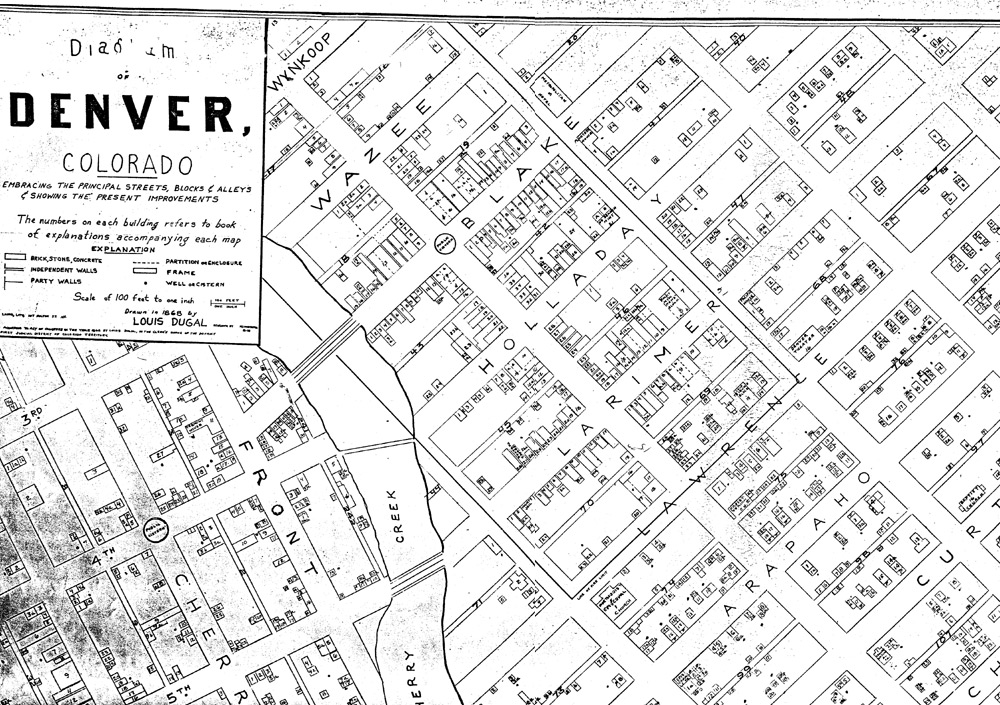
Sam Dugan, aka Sanfourd Dougan, is seen here lynched to a cottonwood tree at Cherry Street, midway between 4th and 5th streets, in Denver.

(Denver’s city plan has changed quite a bit since those days, but I believe the present-day location of this lynching would be approximately Speer Blvd. in a knot of paving the edge of the downtown University of Colorado campus.)

The photo, snapped by the morning light of Dec. 2, 1868, showed the previous night’s work of the Vigilance Committee.

Dug(g)an was a young (23 years old) knockabout in the territories with a blackhearted reputation, having been thought to have killed a man at a camp the year before.

In 1868, he and buddy Ed Franklin robbed a justice of the peace, one Orson Brooks, at gunpoint. As one can imagine, Brooks was one of the little town’s more prominent citizens and the crime outraged residents.

Denver lawmen chased Brooks’s assailants to nearby Golden, Colo., where Dugan’s accomplice Franklin — blind drunk — was shot dead resisting arrest. An innocent Golden citizen named Miles Hill also died when he was caught up in the the shootout to take Dugan … but Dugan himself escaped.

Public fury over this bloodshed (on Nov. 22) precipiated the Nov. 23 lynching of already-jailed outlaw L.H. Musgrove from a Cherry Creek bridge, not far from where Dugan would soon stretch hemp. (Musgrove had ridden in a murderous gang with the late unlamented Ed Franklin.)

Our surviving fugitive Dugan, meanwhile, made a run for Wyoming but was picked up within a few more days at Fort Russell after he stole a mail carrier’s horse. Marshal David Cook, whose public-domain Hands Up! or Twenty Years of Detective Work in the Mountains and on the Plains is a major source for this post, went to retrieve him.

Given the Musgrove lynching, Cook must have had an idea of the danger Dugan would face in Denver. Denver papers anticipating the party’s arrival said that Cook’s team “will bring the prisoners dead or alive. The former condition would be preferred by many.”

About 90 to 100 vigilantes made that preference into fact after dark on Tuesday, Dec. 1, stopping a police wagon moving Dugan between lockups, just as it was crossing a bridge over Cherry Creek.

The hijackers redirected the wagon around the corner to a copse of trees and “in a moment a rope was thrown over the limb, and in another moment, Dugan was standing in the wagon immediately under the fatal noose.”

That’s from a newspaper report that appeared in several publications; our cite is from the Milwaukee Daily Sentinel on December 21, 1868.

Dugan, “completely unmanned, crying and sobbing like a baby,” wheedled and stalled, begging for a Catholic priest and making various professions of innocence or mitigation that would cut no ice with his judges.

After he had said all that he had to say, the order was heard, “Drive on,” and the wagon which had served as his frail bulwark between life and eternity moved from under, and the spirit of Sanford S.C. Dugan took its flight into the presence of Him who shall judge us all according to the deeds done in the body. The fall, about eighteen inches, broke his neck. He was a man six feet two inches in height, and weighed 205 pounds.

Cook, in Hands Up!, says he “would gladly have prevented” the lynchings, “but it was useless for [lawmen] to fly in the face of an entire community, which had been outraged and which was aroused, not so much to vengeance as to the necessity of protecting itself against the rough element of the plains.”

On this day..

1828: James “Little Jim” Guild

(Thanks to Meaghan Good of the Charley Project for the guest post. -ed.)

On this day in 1828, a black slave named James Guild, also known as Little Jim, was hanged in Farmington, New Jersey.

His crime, though brutal, was commonplace enough. But his case was extraordinary for another reason: at the time of his offense, Little Jim was twelve years, five months and thirteen days old.

On September 24, 1827, Little Jim took a break from his work in his master’s cornfield and went to the home of Catherine Beakes, a white woman in her sixties who lived with her son and grandson. She was home alone at the time, and Jim wanted to borrow her rifle to go fowling.

Some time prior to this, someone had tampered with Mrs. Beakes’s livestock, releasing the pigs from their pen during the night and letting the chickens out of their coop. She believed the culprit was Little Jim and, though he denied this, she had told him to stay off her property or she would tell his master, Mr. Bunn.

So when he knocked on the door and asked for the gun, she refused to give it to him.

Jim was angry, he said later, that the “damned old bitch” had been “saucy” to him for no reason.

So, after Mrs. Beakes had her back turned and thought he was gone, he took up a metal horse yoke and sneaked up on her from behind. He bludgeoned her to death in her own house as she was tending the fire, crushing her skull, shattering her jaw and gouging out one of her eyes.

He left the gore-caked weapon next to her corpse.

Little Jim came under suspicion and confessed to the murder after someone told him liars went to hell. At his trial, he said he’d killed Mrs. Beakes because he was afraid she would inform on him to Mr. Bunn and get him in trouble.

“The trial became more of a debate over whether a 12-year-old killer should be punished like an adult,” Daniel Hearn writes in Legal Executions in New Jersey: A Comprehensive Registry, 1691-1963. “The presiding judge placed great emphasis on that issue, especially during his instructions to the jury.”

It is an issue that remains highly controversial even now, nearly 200 years later.

The jury convicted James Guild of first-degree murder, which meant an automatic death sentence … but the judge was reluctant to execute a preteen. He referred the case to the New Jersey Supreme Court for sentencing, as Hearn records:

Special hearings were held to probe all aspects of Jim’s mentality. It was found that he knew right from wrong as well as the consequences of murder. He knew about the sanctity of an oath. It was also clear that Jim had had the wherewithal to confess what he had done based on his own rationale. Moreover, the appellate judges found what they considered to be ample precedent for condoning the execution of preteen felons — especially those of precocious acumen … The use of his tender age alone as a pretext for sparing his life under such circumstances would “be of dangerous consequence to the public … by propagating a notion that children might commit atrocious crimes with impunity. So the New Jersey Supreme Court ruled that Jim Guild was “a proper subject of capital punishment.”

Jim Guild’s manner was of “stoic indifference” when he was hanged before a large crowd fourteen months after his crime, the last execution in Hunterdon County history. He was thirteen years old when he died.

On this day..

1835: John Smith and James Pratt, the last hanged for sodomy in Great Britain

On this date in 1835, John Smith and James Pratt (sometimes reported as John Pratt) were hanged outside Newgate Prison for (in the exhausting fulminations of the Old Bailey trial records) “feloniously, wickedly, diabolically, and against the order of nature, carnally … commit[ted] and perpetrate[d] the detestable, horrid, and abominable crime (among Christians not to be named) called buggery.”


Generic gallows image from this Smith and Pratt hanging-day broadside.

These men were the last put to death anywhere in the realm under the ghastly Tudor-era Buggery Act,* and indeed among the last to die at Newgate for any crime other than murder or attempted murder.

“The grave will soon close over me,” Smith allegedly wrote to a friend before his hanging, “and my name [be] entirely forgotten.”

But that’s not altogether true.

Unbeknownst to the sufferers, they were destined for literary preservation by a young writer on the make, one Charles Dickens: Smith and Pratt make an appearance in Dickens’ Sketches by Boz, an 1836 compilation of London scenes of which “A Visit to Newgate” is perhaps the best-known.

This piece narrates a visit Dickens paid, according to William Carlton’s “The Third Man at Newgate” (The Review of English Studies, Nov., 1957), on November 5, 1835. Dickens would write in subsequent correspondence that the experience left him “intensely interested in everything I saw.”

Prisons and the threat or reality of execution would loom large in that redoubtable author’s canon. “You cannot throw the interest over a year’s imprisonment, however severe, that you can cast around the punishment of death,” the perspicacious 23-year-old told his publisher.

So too did the still-living apparitions of the condemned Smith and Pratt occupy Dickens’s reflections in “A Visit to Newgate”; they comprise a good third of the essay.

In the press-room below, were three men, the nature of whose offence rendered it necessary to separate them, even from their companions in guilt. It is a long, sombre room, with two windows sunk into the stone wall, and here the wretched men are pinioned on the morning of their execution, before moving towards the scaffold. The fate of one of these prisoners was uncertain; some mitigatory circumstances having come to light since his trial, which had been humanely represented in the proper quarter. The other two had nothing to expect from the mercy of the crown; their doom was sealed; no plea could be urged in extenuation of their crime, and they well knew that for them there was no hope in this world. ‘The two short ones,’ the turnkey whispered, ‘were dead men.’

Smith and Pratt, of course, were the “dead men.”

Their third companion, otherwise unconnected with them, was a soldier named Robert Swan, convicted of robbery. Swan was indeed reprieved, a few days before the execution. “Boz” sketched the aspect of these men as he observed them:

The man to whom we have alluded as entertaining some hopes of escape, was lounging, at the greatest distance he could place between himself and his companions, in the window nearest to the door. He was probably aware of our approach, and had assumed an air of courageous indifference; his face was purposely averted towards the window, and he stirred not an inch while we were present. The other two men were at the upper end of the room. One of them, who was imperfectly seen in the dim light, had his back towards us, and was stooping over the fire, with his right arm on the mantel-piece, and his head sunk upon it. The other was leaning on the sill of the farthest window. The light fell full upon him, and communicated to his pale, haggard face, and disordered hair, an appearance which, at that distance, was ghastly. His cheek rested upon his hand; and, with his face a little raised, and his eyes wildly staring before him, he seemed to be unconsciously intent on counting the chinks in the opposite wall. We passed this room again afterwards. The first man was pacing up and down the court with a firm military step – he had been a soldier in the foot-guards – and a cloth cap jauntily thrown on one side of his head. He bowed respectfully to our conductor, and the salute was returned. The other two still remained in the positions we have described, and were as motionless as statues.

If we have Dickens to thank in part for this unexpected glimpse of these poor fellows in the shadow of death, we also can hardly help but notice that — and this is in keeping with Smith’s forecast of posthumous anonymity — he does not name them, nor breathe a word about their scandalous crime. Only the man destined for the reprieve has animation; Smith and Pratt, immobile and affectless, are … but are little else besides. “Dead men,” like that turnkey said. This is not necessarily implausible, but it is also very pat for the literary construction of “A Visit to Newgate,” and we might be entitled to wonder how close to journalistic accuracy the writer has really come here, or regret the details Dickens has discarded that might have salvaged their humanity for a later readership.

Dickens’ party proceeded from these characters to a tour of the physical cells in which these doomed “statues” passed their last sleepless nights.

A few paces up the yard, and forming a continuation of the building, in which are the two rooms we have just quitted, lie the condemned cells. The entrance is by a narrow and obscure stair-case leading to a dark passage, in which a charcoal stove casts a lurid tint over the objects in its immediate vicinity, and diffuses something like warmth around. From the left-hand side of this passage, the massive door of every cell on the story opens; and from it alone can they be approached. There are three of these passages, and three of these ranges of cells, one above the other; but in size, furniture and appearance, they are all precisely alike. Prior to the recorder’s report being made, all the prisoners under sentence of death are removed from the day-room at five o’clock in the afternoon, and locked up in these cells, where they are allowed a candle until ten o’clock; and here they remain until seven next morning. When the warrant for a prisoner’s execution arrives, he is removed to the cells and confined in one of them until he leaves it for the scaffold. He is at liberty to walk in the yard; but, both in his walks and in his cell, he is constantly attended by a turnkey who never leaves him on any pretence.

We entered the first cell. It was a stone dungeon, eight feet long by six wide, with a bench at the upper end, under which were a common rug, a bible, and prayer-book. An iron candlestick was fixed into the wall at the side; and a small high window in the back admitted as much air and light as could struggle in between a double row of heavy, crossed iron bars. It contained no other furniture of any description.

(Later in the 19th century, this dank vault was improved by conjoining two adjacent chambers to comprise the condemned cell.)

A year after Sketches‘ February 1836 publication, Dickens’ serialized novel of the London underclass Oliver Twist began its run. That story’s heart-wrenching denouement of the thief Fagin awaiting execution in Newgate seems to owe a debt to Dickens’ meditation in Sketches on the dolorous condition of Smith, Pratt, or any doomed prisoner facing death in these awful cells.

“A Visit to Newgate” concludes:

Conceive the situation of a man, spending his last night on earth in this cell. Buoyed up with some vague and undefined hope of reprieve, he knew not why – indulging in some wild and visionary idea of escaping, he knew not how – hour after hour of the three preceding days allowed him for preparation, has fled with a speed which no man living would deem possible, for none but this dying man can know. He has wearied his friends with entreaties, exhausted the attendants with importunities, neglected in his feverish restlessness the timely warnings of his spiritual Fagin in Newgate – Cruikshank consoler; and, now that the illusion is at last dispelled, now that eternity is before him and guilt behind, now that his fears of death amount almost to madness, and an overwhelming sense of his helpless, hopeless state rushes upon him, he is lost and stupefied, and has neither thoughts to turn to, nor power to call upon, the Almighty Being, from whom alone he can seek mercy and forgiveness, and before whom his repentance can alone avail.

Hours have glided by, and still he sits upon the same stone bench with folded arms, heedless alike of the fast decreasing time before him, and the urgent entreaties of the good man at his side. The feeble light is wasting gradually, and the deathlike stillness of the street without, broken only by the rumbling of some passing vehicle which echoes mournfully through the empty yards, warns him that the night is waning fast away. The deep bell of St. Paul’s strikes – one! He heard it; it has roused him. Seven hours left! He paces the narrow limits of his cell with rapid strides, cold drops of terror starting on his forehead, and every muscle of his frame quivering with agony. Seven hours! He suffers himself to be led to his seat, mechanically takes the bible which is placed in his hand, and tries to read and listen. No: his thoughts will wander. The book is torn and soiled by use – and like the book he read his lessons in, at school, just forty years ago! He has never bestowed a thought upon it, perhaps, since he left it as a child: and yet the place, the time, the room – nay, the very boys he played with, crowd as vividly before him as if they were scenes of yesterday; and some forgotten phrase, some childish word, rings in his ears like the echo of one uttered but a minute since. The voice of the clergyman recalls him to himself. He is reading from the sacred book its solemn promises of pardon for repentance, and its awful denunciation of obdurate men. He falls upon his knees and clasps his hands to pray. Hush! what sound was that? He starts upon his feet. It cannot be two yet. Hark! Two quarters have struck; – the third – the fourth. It is! Six hours left. Tell him not of repentance! Six hours’ repentance for eight times six years of guilt and sin! He buries his face in his hands, and throws himself on the bench.

Worn with watching and excitement, he sleeps, and the same unsettled state of mind pursues him in his dreams. An insupportable load is taken from his breast; he is walking with his wife in a pleasant field, with the bright sky above them, and a fresh and boundless prospect on every side – how different from the stone walls of Newgate! She is looking – not as she did when he saw her for the last time in that dreadful place, but as she used when he loved her – long, long ago, before misery and ill-treatment had altered her looks, and vice had changed his nature, and she is leaning upon his arm, and looking up into his face with tenderness and affection – and he does NOT strike her now, nor rudely shake her from him. And oh! how glad he is to tell her all he had forgotten in that last hurried interview, and to fall on his knees before her and fervently beseech her pardon for all the unkindness and cruelty that wasted her form and broke her heart! The scene suddenly changes. He is on his trial again: there are the judge and jury, and prosecutors, and witnesses, just as they were before. How full the court is – what a sea of heads – with a gallows, too, and a scaffold – and how all those people stare at HIM! Verdict, ‘Guilty.’ No matter; he will escape.

The night is dark and cold, the gates have been left open, and in an instant he is in the street, flying from the scene of his imprisonment like the wind. The streets are cleared, the open fields are gained and the broad, wide country lies before him. Onward he dashes in the midst of darkness, over hedge and ditch, through mud and pool, bounding from spot to spot with a speed and lightness, astonishing even to himself. At length he pauses; he must be safe from pursuit now; he will stretch himself on that bank and sleep till sunrise.

A period of unconsciousness succeeds. He wakes, cold and wretched. The dull, gray light of morning is stealing into the cell, and falls upon the form of the attendant turnkey. Confused by his dreams, he starts from his uneasy bed in momentary uncertainty. It is but momentary. Every object in the narrow cell is too frightfully real to admit of doubt or mistake. He is the condemned felon again, guilty and despairing; and in two hours more will be dead.

Lotta books about Dickens

A magistrate with the Dickensian name of Hesney Wedg(e)wood appealed vigorously for clemency for Smith and Pratt — pointing out that the only reason these two had been doomed among the rather many enthusiasts** for this victimless offense was that they were penurious enough to have to pursue their desires in a lodging-house rented by a friend where they were easily spied-upon.

(The testimony lodged against them in court came from the nosy landlord who got suspicious, and with his wife peeped through the keyhole on “Pratt laying on his back with his trowsers below his knees, and with his body curled up—his knees were up—Smith was upon him—Pratt’s knees were nearly up to Smith’s shoulders—Smith’s clothes were below his knees … and a great deal of fondness and kissing.” The landlord burst in on the sodomites and put a stop to the fondness right away.)

“There is a shocking inequality in this law in its operation upon the rich and the poor,” wrote Wedgwood.

It is the only crime where there is no injury done to any individual and in consequence it requires a very small expense to commit it in so private a manner and to take such precautions as shall render conviction impossible. It is also the only capital crime that is committed by rich men but owing to the circumstances I have mentioned they are never convicted. The detection of these degraded creatures was owing entirely to their poverty, they were unable to pay for privacy, and the room was so poor that what was going on inside was easily visible from without. (Quoted here)

* The first executed under the Buggery Act shared his scaffold with Thomas Cromwell almost 300 years before. Although there were no further executions for sodomy after Smith and Pratt in 1835, that penalty remained theoretically available for the “crime” until 1861.

** See this book-length pdf.

On this day..

1678: William Staley, “the prologue to the bloody tragedy”

David’s mildness managed it so well,
The bad found no occasion to rebel.
But when to sin our biassed nature leans,
The careful devil is still at hand with means, [80]
And providently pimps for ill desires;
The good old cause, revived, a plot requires.
Plots, true or false, are necessary things,
To raise up commonwealths, and ruin kings.

-John Dryden’s Absalom and Achitophel, a Biblical allegory of the English political/religious scene in which the Popish Plot (“plots, true or false”) took place

On this date in 1678, a Catholic goldsmith was hanged and quartered for treason … a preposterous case that would preview the tragic main acts of the “Popish Plot”.

This 17th century anti-Catholic witch hunt traced to weird and unprincipled Anglican divine Titus Oates.

With his friend Israel Tonge, Oates in 1678 ginned up a fantastical Jesuit plot against the life of Charles II — which supposed conspiracy played insidiously to the realm’s age-old religious divisions, in a moment when a Catholic royal sibling stood next in line to the throne.

Indeed, Oates’s “revelations” would trigger the Exclusion Crisis, an unsuccessful parliamentary bid to balk the heir presumptive James (eventually James II) of his throne. Parliament, argued Henry Capell, “must quiet the minds of the people, as to their fears of Popery and the Succession.”

In Queen Elizabeth’s time there were conspiracies against her, when Mary Queen of Scots was taken off. In King James’s time, the Gunpowder-Treason. In the last King’s time, a horrid Rebellion, that ended in his murder; but here the Crown is under such a character as is more dangerous than all those; and from Popery came the notion of a standing Army and arbitrary power.

Oh, and London had just burned down within everyone’s living memory, an event popularly ascribed to a French Catholic conspiracy even into the 19th century.

There was an awful lot of latent (and not-so-latent) anti-Popery around for Oates to stir up, and he proved to have a gift for this demagoguery. (pdf) In late 1678, a magistrate investigating Oates’s claims, Edmund Berry Godfrey, was mysteriously murdered, and all hell broke loose: a political assassination could now be hung on the alleged Catholic conspiracy. In short order, alleged Catholic conspirators would themselves hang for it.

It was a full 9/12 mentality: people going about armed, loyalty oaths, rumors of French invasion or Guy Fawkes tunneling.

Oates, when feeling his, would have the juice to put peers of the realm on the scaffold … so what chance did poor William Staley have?

This patsy, no great ornament of the “plot”, was more an incidental (and expedient) casualty of the swelling paranoia. Overheard at a tavern chatting about the Protestant freak-out, in French (quelle horreur!), a couple of unscrupulous eavesdroppers shopped for treason when they couldn’t blackmail him.

The sovereign was supposed to have been characterized in this chat as “a great Persecutor or Tormentor of the people of God … And ([Staley] stretching forth his Arm, and then clapping his Hand on his Breast), speaking of His Sacred Majesty, said, I my self will kill him.” (Source) Whether a frustrated Catholic into his cups incautiously popping off, an innocent naif set up by reprobates, or a case of lost in translation, it seems safe to say that William Staley was no danger to the monarchy.

Staley, at any rate, denied having said anything of the sort all the few hours that remained to draw breath, which wasn’t many. It was a mere 12 days from the “treasonable” conversation on Nov. 14 to Staley’s execution.


Image from William Faithorne‘s 1681 (misdated) engraving depicting William Staley being drawn to execution.

With this hanging, and another (that of Edward Coleman) a week later, the Popish Plot persecutions were into full swing … three years of Stuart England McCarthyism that would claim at least 15 lives and end with Titus Oates imprisoned, whipped, and pilloried.

After the Orange Revolution chased the Catholic monarch out of England, Oates was released and pensioned: the incident long remained an ideological litmus test between proto-Whigs (pro-Oates, as he was a club wielded against the absolutist aspirations of Charles II and James II) and Tories (anti-Oates, for the same reason). Centuries later, one commenter could still remark, “There are three events in our history that may be regarded as the touchstone of party men: an English whig who asserts the reality of the Popish plot, an Irish Catholic who denies the massacre of 1641, a Scotch Jacobite who maintains the innocence of Queen Mary, must be considered as men beyond the reach of argument or reason.”

On this day..

1868: Giuseppe Monti and Gaetano Tognetti, by the Papal guillotine

On this date in 1868, Italian revolutionaries Giuseppe Monti and Gaetano Tognetti were guillotined in Rome.

Theirs was a passion of the Risorgimento, the 19th century drive to unify as a single nation the peninsula’s quiltwork of minor kingdoms, duchies, and city-states.

Following the Third Italian War of Independence, this had largely been accomplished … with the notable exception of the Papal States surrounding Rome. You can hardly have Italy without the Eternal City.

So national liberator Giuseppe Garibaldi gathered a force under the slogan Roma o morte and prepared to march … while Pope Pius IX began receiving reinforcements from the sympathetic French emperor Napoleon III.

Inside Rome, Monti and Tognetti prepared a little morte of their own. Intending to mount a fifth-column uprising to coincide with the arrival of Garibaldi’s army, the two detonated a couple barrels of gunpowder under the Serristori barracks, killing 23 French zouaves and four Roman civilians. (All links in this paragraph are Italian.)

Unfortunately for the bombers, no general rising ensued, and the Papal and French armies subsequently repulsed Garibaldi at the Battle of Mentana on Nov. 3, 1867 — extending the papal enclave’s lease on life only slightly, but just enough to deal with Monti and Tognetti.

Their fate at the hands of the civil and religious authorities (one and the same, at this time), is dramatized in the 1977 Italian film In Nome Del Pap Re. (This Google books freebie purports to relate their final days.)

The triumph, such as it was, was short-lived for the Papal States: these were the very last executions by guillotine in Rome; the Papal States polity as a whole had time for only two more executions in its history before the Italian nationalist army completed the risorgimento by capturing Rome in 1870.

The two are memorialized in a celebratory ode by Giosue Carducci.

PER GIUSEPPE MONTI E GAETANO TOGNETTI
MARTIRI DEL DIRITTO ITALIANO

I
Torpido fra la nebbia ed increscioso
Esce su Roma il giorno:
Fiochi i suon de la vita, un pauroso
Silenzio è d’ogn’intorno.

Novembre sta del Vatican su gli orti
Come di piombo un velo:
Senza canti gli augei da’ tronchi morti
Fuggon pe ‘l morto cielo.

Fioccano d’un cader lento le fronde
Gialle, cineree, bianche;
E sotto il fioccar tristo che le asconde
Paion di vita stanche

Fin quelle, che d’etadi e genti sparte
Mirar tanta ruina
In calma gioventù, forme de l’arte
Argolica e latina.

Il gran prete quel dì svegliossi allegro,
Guardò pe’ vaticani
Vetri dorati il cielo umido e negro,
E si fregò le mani.

Natura par che di deforme orrore
Tremi innanzi a la morte:
Ei sente de le piume anco il tepore
E dice – Ecco, io son forte.

Antecessor mio santo, anni parecchi
Corser da la tua gesta:
A te, Piero, bastarono gli orecchi;
Io taglierò la testa.

A questa volta son con noi le squadre,
Né Gesù ci scompiglia:
Egli è in collegio al Sacro Cuore, e il padre
Curci lo tiene in briglia.

Un forte vecchio io son; l’ardor de i belli
Anni in cuor mi ritrovo:
La scure che aprì ‘l cielo al Locatelli
Arrotatela a novo.

Sottil, lucida, acuta, in alto splenda
Ella come un’idea:
Bello il patibol sia: l’oro si spenda
Che mandò Il Menabrea.

I francesi, posato il Maometto
Del Voltèr da l’un canto,
Diano una man, per compiere il gibetto,
Al tribunal mio santo.

Si esponga il sacramento a San Niccola
Con le indulgenze usate,
Ed in faccia a l’Italia mia figliuola
Due teste insanguinate. –

II
E pur tu sei canuto: e pur la vita
Ti rifugge dal corpo inerte al cuor,
E dal cuore al cervel, come smarrita
Nube per l’alpi solvesi in vapor.

Deh, perdona a la vita! A l’un vent’anni
Schiudon, superbi araldi, l’avvenir;
E in sen, del carcer tuo pur tra gli affanni.
La speme gli fiorisce et il desir.

Crescean tre fanciulletti a l’altro intorno,
Come novelli del castagno al piè;
Or giaccion tristi, e nel morente giorno
La madre lor pensa tremando a te.

Oh, allor che del Giordano a i freschi rivi
Traea le turbe una gentil virtù
E ascese a le città liete d’ulivi
Giovin messia del popolo Gesù,

Non tremavan le madri; e Naim in festa
Vide la morte a un suo cenno fuggir
E la piangente vedovella onesta
Tra il figlio e Cristo i baci suoi partir.

Sorridean da i cilestri occhi profondi
I pargoletti al bel profeta umìl;
Ei lacrimando entro i lor ricci biondi
La mano ravvolgea pura e sottil.

Ma tu co ‘l pugno di peccati onusto
Calchi a terra quei capi, empio signor,
E sotto al sangue del paterno busto
De le tenere vite affoghi il fior.

Tu su gli occhi de i miseri parenti
(E son tremuli vegli al par di te)
Scavi le fosse a i figli ancor viventi,
Chierico sanguinoso e imbelle re.

Deh, prete, non sia ver che dal tuo nero
Antro niun salvo a l’aure pure uscì;
Polifemo cristian, deh non sia vero
Che tu nudri la morte in trenta dì.

Stringili al petto, grida – Io del ciel messo
Sono a portar la pace, a benedir –
E sentirai dal giovanile amplesso
Nuovo sangue a le tue vene fluir…

In sua mente crudel (volgonsi inani
Le lacrime ed i prieghi) egli si sta:
Come un fallo gittò gli affetti umani
Ei solitario ne l’antica età.

III
Meglio così! Sangue dei morti, affretta
I rivi tuoi vermigli
E i fati; al ciel vapora, e di vendetta
Inebria i nostri figli.

Essi, nati a l’amore, a cui l’aurora
De l’avvenir sorride
Ne le limpide fronti, odiino ancora,
Come chi molto vide.

Mirate, udite, o avversi continenti.
O monti al ciel ribelli,
Isole e voi ne l’oceàn fiorenti
Di boschi e di vascelli;

E tu che inciampi, faticosa ancella,
Europa, in su la via;
E tu che segui pe’ i gran mar la stella
Che al Penn si discovria;

E voi che sotto i furiosi raggi
Serpenti e re nutrite,
Africa ed Asia, immani, e voi selvaggi,
Voi, pelli colorite;

E tu, sole divino: ecco l’onesto
Veglio, rosso le mani
Di sangue e ‘l viso di salute: è questo
L’angel de gli Sciuani.

Ei, prima che il fatale esecutore
Lo spazzo abbia lavato,
Esce raggiante a delibar l’orrore
Del popolo indignato.

Ei, di demenza orribile percosso,
Com’ebbro il capo scuote,
E vorria pur vedere un po’ di rosso
Ne l’òr de le sue ruote.

Veglio! son pompe di ferocie vane
In che il tuo cor si esala,
E in van t’afforza a troncar teste umane
Quei che salvò i La Gala.

Due tu spegnesti; e a la chiamata pronti
Son mille, ancor più mille.
I nostri padiglion splendon su i monti,
Ne’ piani e per le ville,

Dovunque s’apre un’alta vita umana
A la luce a l’amore:
Noi siam la sacra legion tebana,
Veglio, che mai non muore.

Sparsa è la via di tombe, ma com’ara
Ogni tomba si mostra:
La memoria de i morti arde e rischiara
La grande opera nostra.

Savi, guerrier, poeti ed operai,
Tutti ci diam la mano:
Duro lavor ne gli anni, e lieve omai
Minammo il Vaticano.

Splende la face, e il sangue pio l’avviva;
Splende siccome un sole:
Sospiri il vento, e su l’antica riva
Cadrà l’orrenda mole.

E tra i ruderi in fior la tiberina
Vergin di nere chiome
Al peregrin dirà: Son la ruina
D’un’onta senza nome.

On this day..

1739: Seven of nine Williamsburg malefactors

No, not that Seven of Nine. We have no further details on offer about these poor souls, but we thought the assortment of crimes — a mother for murdering her bastard child; a highwayman; an overseer for whipping a slave to death — and the editorial rant about the governor‘s abus’d Clemency, made for a colorful slice of life.

Image: Account of a Williamsburg, Va. mass hanging on Nov. 23, 1739

(Virginia Gazette, Nov. 23, 1739.)

On this day..

2010: Mohsen bin Faisal Al Barik Al-Dossary, Saudi cop-killer

On this date in 2010, a Saudi Arabian man named Mohsen al-Dossary or al-Dussari was beheaded in Riyadh for having shot dead a police officer in nearby Kharj who tried to stop him driving the wrong way on a street.

That’s some costly road rage.

Islamic sharia law provides the victim’s family the right to pardon an offender and stop an execution; implicit in that right is the need for the offended family to make a legally supportable determination to withhold pardon in order for an execution to proceed. In an interesting twist on that jurisprudence, the Saudi Press Agency reported that al-Dossary had to wait several years in prison while the policeman’s sons grew to majority and could legally consent to having the murderer put to death.

On this day..

1646: Twelve at an Evora auto da fe

This date in 1646, the city of Evora, Portugal, celebrated an auto-da-fe — one of those festivals of Catholic orthodoxy in which penitents were paraded and the most wicked amongst them burnt to death.

They were also fine times for the Inquisitors who prosecuted them, and a burden on the public treasury only made sustainable by the contemporary looting of the New World. We turn for this account of profligacy to The Marrano Factory, a book whose thesis is that the alleged “Judaizers” these displays were meant to showcase were mostly just regular Catholics caught up by the chance factors of torture-adduced accusations or the presence of some remote Jewish ancestor on the family tree.

It’s not hard to see from what follows why the guys running them might have been convinced they were doing God’s work. It’s difficult, after all, to get a man to understand something when his sweetmeats and rabbit feast depend on his not understanding it.

With time and experience, the auto-da-fe publico and its minutely regulated ceremonial grew into a grand and pompous pageant. It was attended by the top brass, often by the king and the royal family and, much as a carnival, it galvanized the whole city into communal bustle …

All defendants appearing at autos-da-fe, public or private, had to wear a sanbenito. At the Evora public auto-da-fe of November 18, 1646, 165 covados (one covado = 0.66 meters) of red and yellow cloth were used, i.e., about 87 meters of cloth for 115 penitents and persons to be executed, costing a total of 62,700 reals at 380 per covado. On the two sides were painted the insignia corresponding to the offenses. In the case of those on death row, painters called in by the Inquisition had — seeing but unseen — to sketch their features and then paint on one side of the sanbenito their portrait, head engulfed by flames.

The day on which a forthcoming auto-da-fe publico was announced in the palace of the Holy Office was a festive one, as we can ascertain from the quantity of compotes and various pastries, procured from neighboring convents and delivered on that day to the secret chambers of the Inquisition. According to the List of Expenses for the Evora auto of November 18, 1646, 64,820 reals were spent on these dainties, hence more than on the 87 meters of cloth for the sanbenitos … and more than triple the cost of feeding a prisoner during an entire year (20,000 reals). It is worth noting that prison fare included meat, in order to test whether the prisoners were observing Jewish dietary laws. This fabulous quantity and variety of foodstuffs was destined exclusively for higher echelons of lawyers and clergy, i.e., three Inquisitors, four deputies, four notaries and a prosecutor, besides the six Jesuit fathers who confessed the six persons sentenced to death …

The feasting did not stop there. Since Friday was a “fast” day on which Catholics abstain from meat, six varieties of fish (sole, mullet, eel, pollock, snapper and sardines) as well as flour and olive oil to cook them in and seasonings for fish-cakes, to the tune of 27,546 reals, were delivered at the Palace of the Inquisition, to be eaten on that day and the left overs [sic] on the Saturday preceding the auto. This fish was distributed to everyone, including the guards who received also rations of bread, meat, wine and fruit, for a total value of 760 reals. The day of the ceremony proper saw the “auto-da-fe supper,” which we are coming to, by and by.

When they were done killing, it was time for the “auto-da-fe supper,” served at the estaus. In the Evora account of November 18, 1646 it comprised about 14 kilos of lamb, 20 young chickens and pullets, 12 roasting chickens, 4 ducks, 4 rabbits, 3 turkeys (each one cost more than what was paid to the painter for one portrait of a prisoner condemned to death); one sow “which was divided by the Gentlemen Inquisitors and the notaries” and one large fruit basket, containing Bosc pears, bergamots, chapel apples and rennets. Like the sweatmeats and compotes which had arrived at the palace of the Holy Office a fortnight before the auto, this repast was meant for the higher officials … it is a curious thing that there were as many turkeys as Inquisitors, as many duck and rabbits as deputies and notaries. This evokes both the idea of an alimentary hierarchy and a kind of remuneration in commodities. However that may be, the total expense of these men in food on the occasion of the auto came to about 110,000 reals (not to mention the porcelain and cutlery), or more than half of the total expense of the auto-da-fe.

The count of 12 executed people comes from a footnote in the text attributing a 3,600-real bill to the painter Miguel Fernandes for sanbenitos of hellfire made for the condemned. However, “executed” people “could refer to live people (‘executed in the flesh’) and to dead or otherwise unavailable people (‘executed in effigy’ or ‘executed in statue’) and in the latter case their effigies (‘statues’) were to be decked out and then ‘executed’.” So, call it a total of 12 flesh-and-bones people and effigies, in some combination; if there’s a firm accounting of who was executed (and whether they were alive, dead, or absent at the time) at this particular auto, I have not yet been able to locate it.


Unrelated: Evora’s Bone Chapel.

On this day..