1637: William Schooler and John Williams

(Thanks for the guest post to Robert Wilhelm, author of the Murder By Gaslight historic crime blog, and of the book Murder And Mayhem in Essex County. Executed Today readers are sure to enjoy Wilhelm’s detailed investigations into long-lost historic crime. -ed.)

On September 28, 1637, two men convicted on separate counts of murder in the Puritan colony north of Boston — in what is now Essex County — were executed on the same gallows. The first was William Schooler, convicted a year earlier of killing Mary Scholy on the path to Pascataquack; the second was John Williams convicted of killing John Hoddy near Great Pond in Wenham.


Original (c) image from Murder And Mayhem in Essex County, used with permission.

In the autumn of 1636, an Agawam Indian walking through the Winnacunnet woods, north of the town of Newbury, found the body of a young white woman, lying in a thick swamp about three miles north of the Merrimack river. From the condition of the body, he could tell that the woman had been dead for several months. She lay naked, with her clothing still in a pile not far from the body. The Indian took the news to Newbury, and led the Englishmen to the spot so they could see for themselves.

The woman’s name was Mary Sholy. She was identified more by the circumstance than by appearance, since the flesh had begun to rot. Mary had left Newbury several months earlier, traveling north to her home at the English settlement at Pascataquack. The people of Newbury were also fairly certain who had killed her; they believed she had been ravished and murdered by the man she had hired to guide her journey home, an outsider named William Schooler.

In London, England, William Schooler had been a vintner with intemperate habits. Schooler was, by his own admission, a common adulterer. After wounding a man in a duel he fled to Holland to escape the law; then, leaving his wife behind, he traveled to New England. In 1636 he was living in a shack by the Merrimack River within the limits of Newbury but outside the boundaries of sanctioned Christian behavior.

Mary Sholy, a servant girl, was looking for someone to guide her to Pascataquack, to return to her master. Pascataquack — now Portsmouth, New Hampshire — was a small settlement, about twenty-three miles north of Newbury. It is not known why Mary Sholy had come to Newbury; it is unlikely that her master would have sent her there without providing a guide back. The journey from Newbury to Pascataquack would have been too perilous for a young woman to take alone, first crossing the Merrimack River in a canoe, then following the route to Pascataquack, which was described as little more than a path through the woods. In 1636, even the well-traveled path between Ipswich and Newbury was too narrow for a horse cart. In addition to the possibility of losing her way and becoming hopelessly lost in the woods between the two settlements, there was a very real danger of being attacked by wild animals or hostile Indians.

Seeing an opportunity to make a little money, William Schooler sought out Mary and offered to guide her home for fifteen shillings. He did not tell her that he himself had never made the trip to Pascataquack before. Two days after their departure, William Schooler was back in Newbury alone. When asked why he had returned so soon Schooler replied that he had guided Mary to within two or three miles of Pascataquack, where she stopped, saying she would go no further. Schooler left her there and returned to Newbury.

The people of Newbury remained suspicious and Schooler was questioned by the magistrates in Ipswich. When he returned from the trip he had blood on his hat and a scratch on his nose the “breadth of a small nail.” He explained that the blood was from a pigeon he had killed and the scratch on his nose was from walking into some brambles. He was released, as there was no evidence then that a crime had been committed.

The following year the Pequod tribe took up arms against the English colonists and Schooler was drafted to serve in the militia. He deemed this service to be an oppression and publicly spoke out against it. His outspoken opposition was considered “mutinous and disorderly,” and the governor issued a warrant against him. When he was arrested, Schooler assumed it was about Mary Sholy and began to vehemently defend himself against the charge of her murder. Schooler;s behavior made the magistrates suspicious and, since they now knew Mary Sholy had been murdered, they decided to reopen the case.

Newbury residents who knew him came forward to volunteer information on Schooler’s character. In a Puritan court the character of the accused was as important as the physical evidence against him.

Schooler denied that he murdered Mary Sholy but the jury found him guilty and he was sentenced to hang. The court and the clergy tried desperately to persuade Schooler to confess but he would not. Schooler was contrite, saying he had told many lies to excuse himself, but vehemently denied that he had killed or ravished Mary Sholy. Some ministers argued that the evidence against him was not sufficient to take away his life, but Governor Winthrop denied Scholler a reprieve, saying: “but the court held him worthy of death, in undertaking the charge of a shiftless maid, and leaving her (when he might have done otherwise) in such a place, as he knew she must needs parish, if not preserved by means unknown.”


John Williams was a ship carpenter who had recently come to America from England. In 1637, he was in prison in Boston for theft. Williams and another prisoner, John Hoddy, escaped from the jail and traveled north. They had gone beyond Salem and were on the road to Ipswich, on the east end of the Wenham Great Pond when they had a falling out. The two men had a fight that ended with the death of John Hoddy.

There are two versions of what happened next. In one story John Hoddy’s dog held Williams at bay until the noise drew the attention of enough residents of Wenham to apprehend Williams and take him to jail in Ipswich. The more likely story says that Williams took everything belonging to Hoddy, including his clothes, and buried his body under a pile of stones. Williams proceeded to Ipswich where he was apprehended, after having been recognized as a criminal. Though his clothes were bloody when arrested, he would confess to nothing until a week later, when the body of John Hoddy was found. Cows at a farm near Great Pond smelled the blood and made such a “roaring” that they got the attention of the cow keeper, who on investigation found Hoddy’s naked body under a heap of stones.

Around the same time the justice of the peace in Ipswich learned that both Williams and Hoddy were escaped prisoners. Williams was indicted for the murder of John Hoddy and tried by the Court of Assistants in Boston. Though he confessed to the murder, the court insisted on enforcing Williams’s right to due process, and tried the case before a jury. Williams was, of course, found guilty and sentenced to death.

The double hanging, on September 28, 1637, took place on Boston Common, where all executions in the Massachusetts Bay Colony were held.

Get Murder and Mayhem in Essex County here.

On this day..

1830: Stephen Simmons, the last executed by Michigan

On this date in 1830, Stephen Simmons was publicly hanged in Detroit, Michigan: the very last time that state has conducted an execution.*

Michigan was the first English-speaking jurisdiction in the world to abolish the death penalty for ordinary crimes. Death penalty foes celebrate March 1 as “International Death Penalty Abolition Day” (pdf) after the date Michigan’s law took effect.

Simmons himself was a minor malefactor in the scheme of things but amply detested in the day of his crime.

A tavern-keeper by trade, he had a habit of getting into the whiskey himself, to violent effect. One night at home, a sodden Simmons picked a fight with his wife Livana and killed her with a vicious blow to the abdomen. The main trouble in this noteworthy trial (pdf) was seating a jury not completely biased against him.

An estimated two thousand people turned up to watch him pay for his crime, and for their “comfort and entertainment” the authorities had “wooden grandstands erected on three sides of the scaffolding, uniformed militia to be deployed around the scaffolding as a guard of honor, a military band to serenade the crowd while it waited for the main event, and vendors to patrol the grounds hawking food, whiskey, and rum.”

Sounds like a place about to abolish the death penalty, right?

Executed Today was pleased to speak with David Chardavoyne, law professor at Wayne State University and the University of Detroit-Michigan, about this case and its place in Michigan’s early path to abolition. Chardavoyne is the author of the award-winning book A Hanging In Detroit: Stephen Wayne Simmons and the Last Execution Under Michigan Law

Book CoverET: To set the scene, what is Detroit like in 1830?

DC: In 1830 Detroit was the capital of the Michigan Territory, but it had only about 2,000 inhabitants. It was, though, a bustling community because it was the entryway for the tens of thousands of settlers heading into the wilderness west and north of Detroit. Most buildings were on a narrow strip of land between the river and Jefferson Avenue, although the capitol, jail, and Simmons’s execution site were further north, about a half mile from the river.

This was the last execution in Michigan, but to what extent can we really say that it led to the end of the death penalty there? It strikes me that support must have been pretty soft to start with if that’s the case.

To be precise, the last execution under Michigan law — there were 2 executions under federal law a short time later and the Chebatoris execution in the 1930s.

I conclude in my book that there is no real evidence that the Simmons case caused the abolition of capital punishment. Most people living in Michigan in the 1840s, and almost all of the legislators who voted for abolition, arrived in Michigan after 1830 and there was no mention of that case in the extensive debates in the constitutional conventions in 1835-36 or in the legislature in the 1840s.

However, incidents surrounding the Simmons execution show that unease about capital punishment existed in 1830. First, the fact that most killers before and after 1830 were convicted of manslaughter whatever the facts. Second, the alleged mob that tore down the city whipping post right after Simmons’s execution. Third, Governor Cass, in his annual address a couple of months later stated that he was sorry that the law did not allow him to reduce Simmons’s sentence to time in prison.

Why was it that this one hanging, of a guy who had clearly killed his wife even if not intentionally, so powerfully affected people? And how troubled were Michiganders by the case itself, before the specific events of execution day?

Whatever effect the Simmons execution had on the spectators had little to do with Simmons but rather their exposure to a gruesome death. The people seem to have been genuinely outraged by the crime and the fact that the victim was his wife, so that it was very difficult to seat a fair jury. There is little to no evidence of any sympathy for Simmons.

What about the accounts of attendees stunned and shamed by Simmons’ last-minute plea for mercy in the midst of the public-festival environment.

In the book, I explain that my research puts this whole story very much in doubt. It first appeared almost 50 years later in a speech at the state historical convention, but it is not clear that the speaker was even in town that day. It was picked up and repeated by subsequent writers, but the Detroit newspaper at the time made no mention of it, nor did the very few other witness accounts.

When Michigan did abolish the death penalty, how were people talking about the Simmons case? Did it swing any votes?

Again, the Simmons case seems to have been forgotten by then, or at least neither side thought that it would help their arguments.

We’re accustomed now to think of clemency decisions as highly political. How did Lewis Cass’s political aspirations affect his handling of Simmons, if they did at all? And for that matter, did he or anyone else end up suffering any political fallout for the way events ultimately transpired?

As noted above, under territorial law Cass’s only option was to pardon Simmons — he could not just reduce the sentence. It may or may not have been relevant that he left town early on the day of the execution to visit his mother in Ohio and did not attend the execution.

What’s really amazing is that Michigan has kept the death penalty off the books for nearing two centuries. That can’t all be about Stephen Simmons. What is it about Michigan’s culture, politics, or demographics that has kept it so staunchly anti-death penalty?

This is a question that writers have been asking for decades. Remember that abolition was a close-run thing. Religion, political party, and other divisions do not appear to have been a factor in the voting.

My guess is that it had to do with personality. The legislators in 1846 were mostly young men who were adventurous and optimistic enough to leave their friends and families in the east for the frontier. Such people, according to my psychologist friends tend to be against capital punishment. Why capital punishment was never reinstated is a tribute, I think, to the fact that the system works. Every so often a particularly bad killing starts politicians shouting about bringing it back, but it never goes anywhere. Since 1963, of course, the ban has been in our state constitution, and removing it would be very difficult.

* As Prof. Chardavoyne mentions, a few executions have been conducted in Michigan under federal (not state) law since 1830.

On this day..

1783: Mutinous prisoners of the Swift

On this date in 1783, six men were hanged at Tyburn for “returning before expiry” from convict transportation.

This was a neat little euphemism covering a very desperate act at the sundering of the American colonies from their mother country.

We’ve previously covered in these pages the underappreciated extent of convict transportation from the British Isles in populating the future United States. Anthony Vaver, who blogs at Early American Crime, in his recent book Bound With An Iron Chain pegs convicts as the second-largest bloc of American “immigrants,” (after African slaves) to the tune of 50,000 souls in the 18th century.

The American Revolution put a halt to that human traffic.

In time, London would transition to dumping its criminal cargo on Australia.

But at the moment the colonies broke free, the Down Under wasn’t yet fulfilling that role, and policymakers faced a conundrum. The judicial machinery continued to sentence thieves to transportation; without an outlet, those unfortunates accumulated cheek to jowl aboard stinking prison hulks on the Thames.

What to do? In 1785, a Parliamentary committee looked back wistfully on the good old days:

That the old system of transporting to America answered every good purpose that could be expected from it; that it tended directly to reclaim the objects on which it was inflicted, and to render them good citizens; that the climate being temperate, and the means of gaining a livelihood easy, it was safe to entrust country magistrates with the discretionary power of inflicting it … that it tended to break, in their infancy, those gangs and combinations which have since proved so injurious to the community; that it was not attended with much expense to the public …

(cited in Botany Bay: The Real Story)

Well, it so happened that this effective and affordable solution, though interrupted by war, was not legally barred in the new United States.

So Britain did what any cost-conscious imperial power would do: sent out a ship with some convicts to see if they couldn’t still be gifted to labor-hungry America. “Perhaps a greater insult to any Nation could hardly have been offered,” griped one Founding Father afterwards.

The gallows held little terror for some prisoners sentenced to convict transportation, who might even have preferred execution. London’s Public Advertiser reported this never-implemented threat on March 24, 1785:

We hear that one of the respited capital convicts, who received sentence of transportation at the adjourned session at the Old Bailey, told the Recorder, in his own name and those of his companions, that they did not esteem the being pardoned, on condition of transportation to Africa, as an act of mercy, but had much rather be hanged at home; and that they were determined to endeavour to sink either the lighter which is to convey them to Gravesend (to which place they are to be guarded by 30 of the militia) or the ship which is to carry them over.

Alright, America. You don’t have to be that way about it.

The ship detailed for this insulting mission was the Swift, and its passage was troubled long before it sighted the Chesapeake. The “cargo” of the Swift mutinied and ran the ship aground in England.

Thirty-nine escapees were recaptured and most sentenced once again to transportation, but six swung at Tyburn on this date. They really were at the end of an era, and not only of North American convict transportation: Tyburn itself hosted its last public execution just a few weeks later.

Nothing daunted, the owners of the Swift reassembled a slate of captives and made another run, reaching Annapolis, Md. on Christmas eve: fortuitous timing, because irritated state legislators weren’t in session and therefore couldn’t block the ship’s unwanted merchandising. The problem was, it was little better wanted by its intended market. According to Vaver, “[o]nly 30 of those on board were sold by mid-January … [the shippers] managed to sell most of the convicts by the spring, but they incurred serious losses after having to provide food, clothing, and medicine for those who languished on board the ship until they could be unloaded.”

They were the last British convicts sold in her rebellious colonies. One last ship made another voyage in 1784 and was turned away flat by every U.S. port, finally managing to offload in British Honduras.

Ere the decade was out, London had established a new penal colony at Botany Bay and set about transferring this particular “special relationship” from the United States to Australia.

On this day..

2011: Abdul Hamid Bin Hussain Bin Moustafa al-Fakki, sorcerer

On this date last year, a Sudanese man who “practised witchcraft and sorcery” was beheaded in a Medina carpark.

This being the 21st century — whatever the Saudi statutes might say — it was caught on film.

Warning: Mature Content It’s filmed from too far away to be gory per se, but this video clearly captures the severing of a man’s head.

“Abdul Hamid is understood to have been arrested in 2005 after he was entrapped by a man working for the Mutawa’een (religious police),” according to the Daily Mail.

He was asked to concoct a spell that would cause the officer’s father to leave his second wife.

According to the officer’s account Abdul Hamid agreed to carry out the curse in exchange for 6,000 Saudi Arabian riyals (approximately £1,000).

He was beaten after his arrest and thought to have been forced to admit to acts of sorcery.

In a secret trial, where he was not allowed legal representation, he was sentenced to death by the General Court in Medina in March 2007.

Few details are available about his trial but he is reported to have been tried behind closed doors and without legal representation.

At the time of his arrest, English language Saudi daily The Saudi Gazette ran an article entitled Magic Maids which said that ‘we must face up to the threats from some maids and servants and their satanic games of witchcraft and sorcery, their robbery, murder, entrapment of husbands, corruption of children and other countless stories of crime that have been highlighted by both experts and victims of these crimes’.

On this day..

1895: The Vegetarian perpetrators of the Kucheng Massacre

On the morning of September 17, 1895, in the presence of the British and American consuls, seven perpetrators of a Chinese massacre of western Christian missionaries were beheaded at Foochow.

Anticipating the better-known Boxer Rebellion by four years, the Kucheng Massacre (there are many other transliterations of “Kucheng”) was likewise a response to the Celestial Empire’s frustrating second-class status as against European interlopers.

Christian missionaries had been a point of friction in China for decades. Though their rights to proselytize had been guaranteed in a hated treaty dictated to China by force of arms, they often met resentment or worse on the ground.

“You bring incense in one hand, a spear in the other;” one evangelist reported being told: that is, however honorable the immediate intentions of many individual missionaries, their presence looked like a stalking horse for less reputable western interventions like the opium trade. (That’s how it looked to many Chinese. Professional western diplomats themselves found the impolitic preachers a hindrance to their statecraft, according to Ian Welch’s 2006 paper “Missionaries, Murder and Diplomacy in Late 19th Century China: A Case Study” (pdf).*)

On August 1, 1895, these frustrations unleashed a river of blood at the village of Huashan in Gutian County, where a Buddhist secret society — known as “Vegetarians” in the western press for their characteristic dietary vow — fell upon a group of vacationing British Anglican missionaries still abed at dawn and ruthlessly slaughtered eleven of them. (There are some 1890s books paying tribute to the fallen available online: Robert and Louisa Stewart: In Life and in Death, and The sister martyrs of Ku Cheng : Memoir and Letters of Eleanor and Elizabeth Saunders (“Nellie” and “Topsie”) of Melbourne.)

“The attack came,” said a physician from a nearby town who was summoned to the bloody scene, “like a thunderbolt from a clear sky, not one of the victims having received the slightest intimation of the intended assault.”

Word of the carnage struck western powers with similar force.

Incensed newspaper-readers literally demanded** gunboat diplomacy, and literally got it, especially when Chinese authorities drug their feet on the condign punishment the missionaries’ countrymen were clamoring for.

All this put British diplomacy on a sticky wicket, which Welch (pdf) deals with in detail. To satisfy the domestic audience, the government had to be seen to be taking a hard line on avenging the outrages; at the same time, London was wise to the Chinese state’s shakiness and wary that a “barbarous holocaust” perpetrated against the Vegetarians would trigger a mass backlash and bring the whole thing down.

An obdurate Chinese viceroy impeded the quick resolution everyone was after by making inflammatory public proclamations against Christians, and releasing without explanation six of the thirteen men who had initially been condemned to death in the month of August. The seven who were executed on this date were therefore only the vanguard of 26 humans ultimately put to death for their involvement in the atrocity.

Some of the execution photographs that follow are Mature Content. They’re obtained via Visual Cultures in East Asia; some also available at USC Digital Library.


Raids and investigations to bring the Vegetarian movement to heel continued for several months thereafter, and the whole affair ultimately was quelled without doing any of the wider damage that might have been feared — not even to missionaries who continued pouring into China.

And that, effectively, kicked the can down the road on the anti-foreigner sentiments afoot in the land … sentiments that would find much costlier expression a few years later when another secret society kicked off the Boxer Rebellion.

* I’ve relied heavily on Welch for this post. He’s also collected a massive trove (over 1,200 pages) of primary documents from this incident available in a series of pdfs (some quite large) from the Australian National University website:

** This was not universally so. The wife of missionary Stephen Livingston Baldwin, who knew some of the victims of the attack, urged a “charitable” response and sensitivity that “the Chinese feel that all the world is against them, and they are not far from right.” (New York Times, Aug. 10, 1895) In letters responding to intemperate coverage elsewhere, she acidly compared (pdf) western editorialists’ high dudgeon to their look-forward-not-back dismissal of recent stateside anti-Chinese violence.

It was ten years yesterday since more Chinese were killed, and burned alive and left to die wounded, in one hour, at Rock Springs, Wyoming (the very same Territory in which the recent massacre occurred) than have been Americans and English in China in the thirty-four years I have personally known that land, being a resident there twenty years and closely connected with it ever since. Ten years yesterday since that awful Rock Springs massacre, and up to date no one arrested, much less punished! The anti-Chinese papers of the town and neighbourhood gloating over the awful details and assuring all that there would be “no Congressional investigation,” and no waste of “enterprising newspaper eloquence” over the woes of the Chinese, “though their blood flow like rivers, as they had no votes and no friends.” In less than four weeks after the Ku-Cheng massacre, arrest, investigation and execution have all taken place for the Ku-Cheng massacre. Would that our colored, red and yellow brethren, so helpless in our so-called civilized and Christian land, had some power behind them to bestir Ministers Plenipotentiary, wave flags, and run gunboats to the front, to bully, if necessary, our pusillanimous Government into some sort of civilization — I will not say Christian justice!

On this day..

Feast Day of St. Euphemia

This is the feast date of early Christian martyr St. Euphemia.

Euphemia the “All-Praised” (that’s an Eastern construction; both east and west honor her martyrdom on September 16) died in the Asia Minor city of Chalcedon around 307. That would place her at the tail end of the Diocletianic persecutions, the part that actually came after said Diocletian retired to his cabbages and left the care and feeding of the eastern empire to Galerius.

Euphemia is said to have been the daughter of a senator, but went off and took vows of chastity and avoided sacrificing to Ares. Like many early martyrs, she is supposed to have survived various creative Roman execution attempts thanks to angelic protection, before the pagans just gave up and pitched her into the arena for the classic Christians-vs.-Lions showdown.

Euphemia would be credited with a supernatural intervention of her own a century and a half after her death.

The 451 Council of Chalcedon, meeting at a cathedral consecrated to St. Euphemia in her native city, featured orthodox Christianity attempting to bring to heel the “heresies” disputing the eminently disputable nature of Christ.

God + man? How does that work?

Monophysites, a substantial minority in the east at that time, took the position that Christ had only one single nature, rather than the view still mainstream to Christianity that Christ had both divine and human natures simultaneously. Among well-educated people sensitive to historicity, it’s the sign of a gross prejudice towards the secular and the modern to consider it absurd that humans spent decades at one another’s throats over this sort of hairsplitting, but seriously … humans spent decades at one another’s throats over this sort of hairsplitting.

But memo to Monophysites: do not get Saint Euphemia involved unless you’re ready for a faceful of hypostasis all up in your christology.

The story goes that at Chalcedon, two quarrelsome prelates representing the orthodox and Monophysite positions submitted the matter to the holy martyr’s adjudication by each leaving an apologia in her tomb. Three days of fasting and praying later, they opened the tomb and found the orthodox manifesto in Euphemia’s right hand, and the heretical manifesto at her feet. As the synod gloated to the (very orthodox) Pope Leo I,

it was God who worked, and the triumphant Euphemia who crowned the meeting as for a bridal, and who, taking our definition of the Faith as her own confession, presented it to her Bridegroom by our most religious Emperor and Christ-loving Empress, appeasing all the tumult of opponents and establishing our confession of the Truth as acceptable to Him, and with hand and tongue setting her seal to the votes of us all in proclamation thereof.

Euphemia’s relics today rest in Rovinj, Croatia, and are not available for settling metaphysical debates.

On this day..

1866: Dmitry Karakozov

On this date in 1866 (September 3 O.S.; September 15 N.S.), Russian revolutionary Dmitry Karakozov was hanged in Peter and Paul Fortress for attempting to assassinate Tsar Alexander II.

Karakozov was a son of noble stock — the self-hating variety, obviously, and suicidally disturbed into the bargain. He supposedly hailed from a terrorism cell branding itself “Hell”, although this was bandied about by the police afterwards and conveniently supported a hunt for radicals.

Karakozov, at least, considered the state of tsarist Russia positively infernal, and on April 4, 1866, he went to scourge it — firing a shot at the monarch at St. Petersburg’s Summer Garden. He missed.

The tsar’s guards tackled him as he fled, and the unharmed Alexander walked up to the gunman and asked him, “What do you want?” He may have been genuinely bewildered: Alexander was the guy trying to liberalize Russia. Just a few years before, he had freed the serfs.

“Nothing,” Karakazov replied. “Nothing.”

A statement of implacability: no progress would be bargained with even the most progressive despot. The despotism itself must go. A manifesto addressed to “Friends-Workers” was found in his pocket underscoring the point; it read in part (translated from p. 21 of this Russian pdf):

I have decided to destroy the wicked Tsar, and to die for my beloved people…

If I accomplish this deed, I will die with the thought that in death I did something good for my dear friend, the Russian peasant.

If I do not accomplish it, then others will follow my path. Where I fail, they will succeed, and my death will be their example and inspiration.

Others would follow him, and in time successfully murder Alexander II after all.

Karakozov himself, the first Russian revolutionary to attempt regicide, didn’t seem to have revolutionary satisfaction on his mind at the end. He converted to Orthodox Christianity in prison, sought “as a Christian, of a Christian” his prospective victim’s clemency … and multiple newspaper accounts report him kneeling to kiss a cross presented to him on the scaffold by the priest. (All via Odd Man Karakozov, which argues that all this need not imply such a reversal of conscience as it might appear.)

What certainly did happen — more immediately than those copycat assassinations — was a reactionary wave of national chauvinism, whose more wretched manifestations will not be unfamiliar to the present day. The patriotic Glinka opera Ivan Susanin was staged a few days later at the Bolshoi in Moscow. According to an eyewitness account of Tchaikovsky quoted in Romanov Riches: Russian Writers and Artists Under the Tsars, this salute to a Russian peasant’s sacrifice for the Romanov dynasty went a little bit off-script.

I think the Moscow audience went beyond the bounds of sense in their outburst of enthusiasm. The opera was not really performed, for as soon as the Poles appeared onstage, the whole theater shouted, “Down with the Poles!” and so on. In the last scene of Act 4, when the Poles are supposed to kill Susanin …

… the actor playing him started fighting the chorus members who played Poles, and being very strong, knocked down several of them, while the rest of the extras, seeing that the audience approved this mockery of art, truth, and decency, fell down, and the triumphant Susanin left unharmed, brandishing his arms, to the deafening applause of the Muscovites.

If true, that is little short of fantastic.

The apparatus of state went so far as to build up a new Susanin for the occasion at hand, hyping a questionable story that a young peasant named Osip Komissarov — who was from Susanin’s own province of Kostroma — had jostled Karakozov just as he took the shot, causing it to go awry. The good-natured bumpkin was rewarded with summary ennoblement as “Komissarov-Kostromskoy” and eye-rollingly terrible poetic tributes from the likes of Vyazemsky and Nekrasov. However, Komissarov’s embarrassing stupidity and want of manners would eventually necessitate Komissarov-Kostromskoy’s being packed out of polite society to country estates on a generous pension to bankroll his ample appetite for liquor.

So Dmitry Karakozov did do something for the Russian peasant after all.

On this day..

1767: Elizabeth Brownrigg

On this date in 1767, a jeering mob damning her to hell* saw Elizabeth Brownrigg hang at Tyburn.

“The long and excruciating torture in which this inhuman woman kept the innocent object of her remorseless cruelty, before she finished the long-premeditated murder,” says the Newgate Calendar, “more engaged the attention and roused the indignation of all ranks, than any criminal in the whole course of our melancholy narratives.” Hers is a very rich text.

As a middle-class midwife, Brownrigg mined the Foundling Hospital for young girls whom she would take on as apprentice domestic servants.

Brownrigg was far from the only one exploiting this ready pool of virtual slave labor, but it was her home’s marked sexualized sadism that really moved copy (pdf pamphlet). And Chateau Roissy it was not.

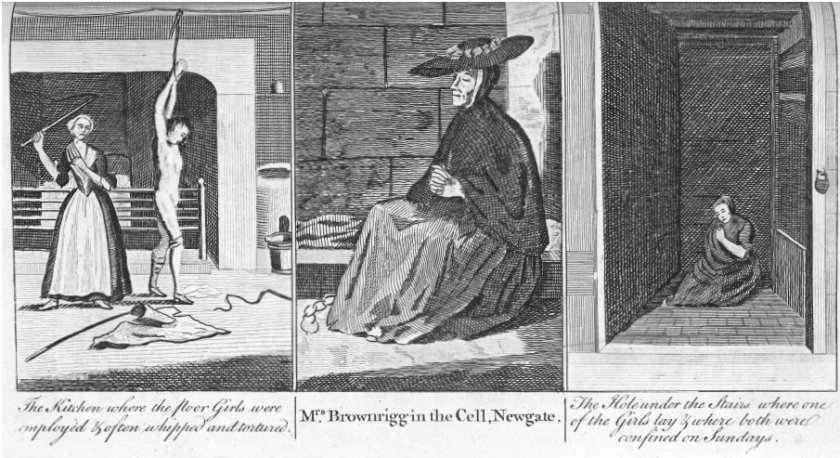
Elizabeth liked to keep the servants locked up, starving, usually naked, and would pinion their hands and inflict merciless corporal punishment for the least transgression against rules like “having any more bread”. The Old Bailey Online preserves one servant’s trial testimony:

Q. In what manner did she use to beat her?

M. Mitchel. She used to tie her up in the kitchen; when first she began to be at her, she used to tie her up to the water-pipe, with her two hands drawed up above her head.

Q. Describe that water-pipe.

M. Mitchel. That goes across the kitchen; the hooks that hold it are fastened into a beam.

Q. Had she used to have her clothes on when your mistress tied her up in this manner to beat her?

M. Mitchel. No, no clothes at all.

Q. How came that?

M. Mitchel. It was my mistress’s pleasure that she should take her clothes off.

Q. What had she used to beat her with?

M. Mitchel. She beat her most commonly with a horse-whip.

Q. How long did she use to beat her in this manner?

M. Mitchel. I cannot justly say, but she seldom left off till she had fetched blood.

This witness Mary Mitchel(l) was the lucky one of the Brownriggs’ last two Foundling Hospital charges: both girls had been stripped and horsewhipped so regularly that ulcerating, infectious sores — never able to heal before the next thrashing — pocked their bodies.

But Mary Mitchell at least survived. Her fellow-sufferer Mary Clifford was flat beaten to death, the body stuffed in the family coal-hole like so much rubbish. (In life, Mary Clifford was sometimes made to sleep there, too.)**


Detail view (click for a larger, three-panel image) of Elizabeth Brownrigg and her crimes illustrated in the Newgate Calendar.

For working-class Londoners struggling to navigate the dislocations of the Industrial Revolution, here was a villainess indeed. London was swelling, urbanizing, bustling with vulnerable orphans and abandoned children like our foundling Marys; all its working classes, for that matter, had reason to feel endangered in the face of fights for their lives against emerging commercial powers working hand in glove with the state — not excluding the ubiquitous threat of the gallows for pitiable property crimes.

And as Peter Linebaugh observes, “apprenticeship” by the 18th century “was less likely to involve the development of highly qualified, skilled labour power than to be the means of organizing the exploitation of young labour power.”† Like it’s not enough working your crappy dead-end unpaid internship; now, it comes with flogging?

Somehow, Brownrigg’s husband and son were convicted only of a misdemeanor and got off with a few months in prison, but Elizabeth bore all the hatred of Londoners more used to seeing apprentices swing than even the vilest master. The Murder Act which had appropriated even the corpses of London’s marginal people was applied to anatomize our former midwife; her skeletal remains were long displayed in a niche at the Royal College of Surgeons.

Oh, and the Foundling Hospital — which had cautioned the Brownriggs before about their excessive abuse of servants but not actually stopped sending them young girls to abuse — started finally instituting some oversight.


There’s a vicious and unsigned satire, “Elizabeth Brownrigge”, published in the September 1832 Fraser’s magazine. Over the years, it has occasioned a great deal of dispute among Thackeray scholars as to whether it might not have been an early creation of that master satirist’s pen. (Thackeray would have just turned 21 when it published.)

We’re not qualified to render judgment on the literary forensics, but the skewering of a murderess through the author’s mock-sympathy has a deliciously Thackerian flavor about it: the world was “incapable of understanding the height of her virtue.” It also underscores the continuing resonance of Elizabeth Brownrigg to Londoners 65 years after her execution.

The magnanimity of her soul, like Mr. Smeaton‘s pharos on the Eddystone, was firmly fixed upon the rock of the soundest principles, and diffused a light around it, for the guidance of those who were beating the waves upon the dark and troubled ocean of adversity, but was itself unshaken by the storm … [in prison] the fair and excellent Elizabeth adopted, as nearly as circumstances would allow, the same admirable disposition of her time to which she had been accustomed when inhabiting her own romantic bower in the village of Islington. She completed a large stock of baby-linen for the poor; she perused new publications of the day; and she composed an elaborate parallel between the characters of Socrates and Lady Jane Grey, after the manner of Plutarch. These are the two distinguished personages, in the whole range of authentic history, who in their strength of mind, purity of life, and extensive accomplishments, bore the strongest resemblance to herself; and to them, perchance, the attention of our heroine was more particularly directed in the quiet and retirement of her cell by the many points of similarity which subsisted between their destiny and her own.

Later, the fictional Elizabeth mounts a defense of such oblivious loathsomeness that it naturally impresses the judge:

“… punishment is a moral medicine. I may, perchance, actuated by too eager a desire for the rapid cure of my little and much-cherished patient, have dispensed my alternatives too liberally, and produced and untoward, an unexpected, and a most deeply-lamented consequence; but am I, therefore, to be condemned as guilty? In the analogous case of the physician, whose too-abundant anodynes may have lulled the sufferer to endless slumbers, or whose too copious phlebotomy may have let out the fever and the life at one and the same moment from the veins, would this most harsh and unmerciful measure be applied? … I demand from the justice of your lordship and a jury of my countrymen — as a matter not of mercy, but of right — the same impunity in my case which would be accorded, freely an unasked, under parallel circumstances, to the medical practitioner.”

Thackeray or whomever lay behind this pasquinade had a wider literary target in mind than simply Elizabeth Brownrigg(e)’s class. The short story is prefaced with a dedication to “the author of Eugene Aram“, meaning the popular novel published earlier in 1832 by Edward Bulwer-Lytton — a lifelong Thackeray bete noir. That novel concerned another renowned 18th century murderer, and it’s safe to say from the dedication that our satirist considered Bulwer-Lytton’s empathetic portrayal of the titular homicide a little, er, soft on crime.

I have been taught by Eugene Aram to mix vice and virtue up together in such an inextricable confusion as to render it impossible that any preference should be given to either, or that the one, indeed, should be at all distinguishable from the other … I had, indeed, in my dramatic piece, been guilty of an egregious and unpardonable error: I had attempted to excite the sympathies of the audience in favour of the murdered apprentices, but your novel has disabused me of so vulgar a prejudice, and, in my present version of her case, all the interest of the reader and all the pathetic powers of the author will be engaged on the side of the murderess.

* The Newgate Calendar: “On her way to the place of execution the people expressed their abhorrence of her crime in terms which, though not proper for the occasion, testified their astonishment that such a wretch could have existed: they even prayed for her damnation instead of her salvation: they doubted not but that ‘the devil would fetch her,’ and hoped that ‘she would go to hell.’ Such were the sentiments of the mob.”

** Elizabeth Brownrigg admitted to the Ordinary of Newgate the truth of Mary Mitchell’s horror testimony.

† Conversely, rogues who took to the highway and became working-class heroes were very often men who had absconded from their apprenticeship — for instance, Jack Sheppard and Dick Turpin.

On this day..

1642: Henri Coiffier de Ruze, Marquis of Cinq-Mars

On this date in 1642, with the last words “Mon Dieu! Qu’est-ce que ce monde?”, 22-year-old former royal favorite Cinq-Mars was beheaded at Lyon’s Place des Terreaux.

Henri Coiffier de Ruze (English Wikipedia page | French) had been under Cardinal Richelieu’s protection since the boy’s father died in 1632; in 1639, the Red Eminence introduced the then-19-year-old whippersnapper to Louis XIII as a prospective royal favorite (read: lover).

Though the king did indeed take to the youth, Cinq-Mars, in the age-old custom of sullen teenagers everywhere, soon found the luxurious profligacy of the favorite’s life rather overbalanced by irritation at both of his sickly, aging patrons.

Tart talk to intimates graduated to something more serious after Richelieu rudely put the kibosh on Cinq-Mars’s (unrealistic) designs on a wealthy noblewoman — which was also a bid to parlay his tenuous favorite gig into some lasting power.

Now considering himself personally begrudged of the Cardinal, Cinq-Mars fell into the conspiracies (French link) to depose, assassinate, or otherwise replace him.

Eventually Cinq-Mars would go so far as a real blockbuster (French again): he signed a secret pact with the Spanish king to support a noble revolt in exchange for handing over French possessions, a seditious plan also backed by perennial plotter Gaston d’Orleans, the king’s scheming brother.

Our angry moppet had more than met his match in Richelieu, however: the cardinal’s agents intercepted (more French) the treasonable correspondence and had Cinq-Mars dispatched this date along with his confederate de Thou.


Execution of Cinq-Mars and De Thou in Paris (1642), engraving by Johann Luyken, Paris, Bibliothèque nationale de France (via)

Richelieu himself was already dying as he undid this last conspiracy against him. The cardinal succumbed on December 4, 1642 … with Louis following him into the grave the next May.

While Richelieu’s name is fixed in the firmament of history and literature, Cinq-Mars has to make do as the namesake of a rarely-seen Gounod opera, based on the 1826 historical novel Cinq-Mars by Alfred de Vigny.

On this day..

1536: Skipper Clement, rebel

On this date in 1536, the Danish rebel Skipper Clement was put to death at Viborg.

Clement (English Wikipedia entry | Danish) was a naval officer for the Danish king Christian II.

When said heavyhanded monarch was deposed by his own uncle Frederick, Clement turned privateer … and when said deposing-uncle Frederick died in 1533, Clement entered the ensuing civil war between supporters of the still-imprisoned ex-king Christian II and those who backed Frederick’s own son Christian III. This was also a social and political war over the Reformation.

Clement went to war for his former boss, Christian II, instigating a 1534 North Jutland uprising of the Catholic peasantry that in October of that year trounced the Protestant noble army sent to suppress it at the Battle of Svenstrope Mose (Svenstrop Bog or Moor).

That battle clinched Clement’s reputation as one of the great peasant-rising leaders, and also clinched for Clement the fate that usually befalls such characters. Shortly after, Clement’s aristocratic ally cut his own deal with Christian III and abandoned the rabble to a vicious counterattack. In December 1534, General Johan Rantzau stormed the rebel strongholdof Aalborg, slaughtering two thousand peasants, reducing freeholding farmers to tenants, and bringing Clement home in chains for a grand finale.

The captured commander languished in his dungeon awaiting the conclusion of the civil war. It took a good year under siege for Rantzau to bring Copenhagen to heel, but once that city capitulated in August 1536, Clement was brought out of storage for use as a victory cigar. (Danish link)

On September 9, 1536, wearing a lead crown to mock his ambition, Clement had his head chopped off, and his remains were dismembered and set up for public display.

Danish speakers may enjoy these short audio narrations of the Svenstrope Mose and Aalborg engagements. Aalborg parents may enjoy sending their children to Skipper Clement International School.

On this day..