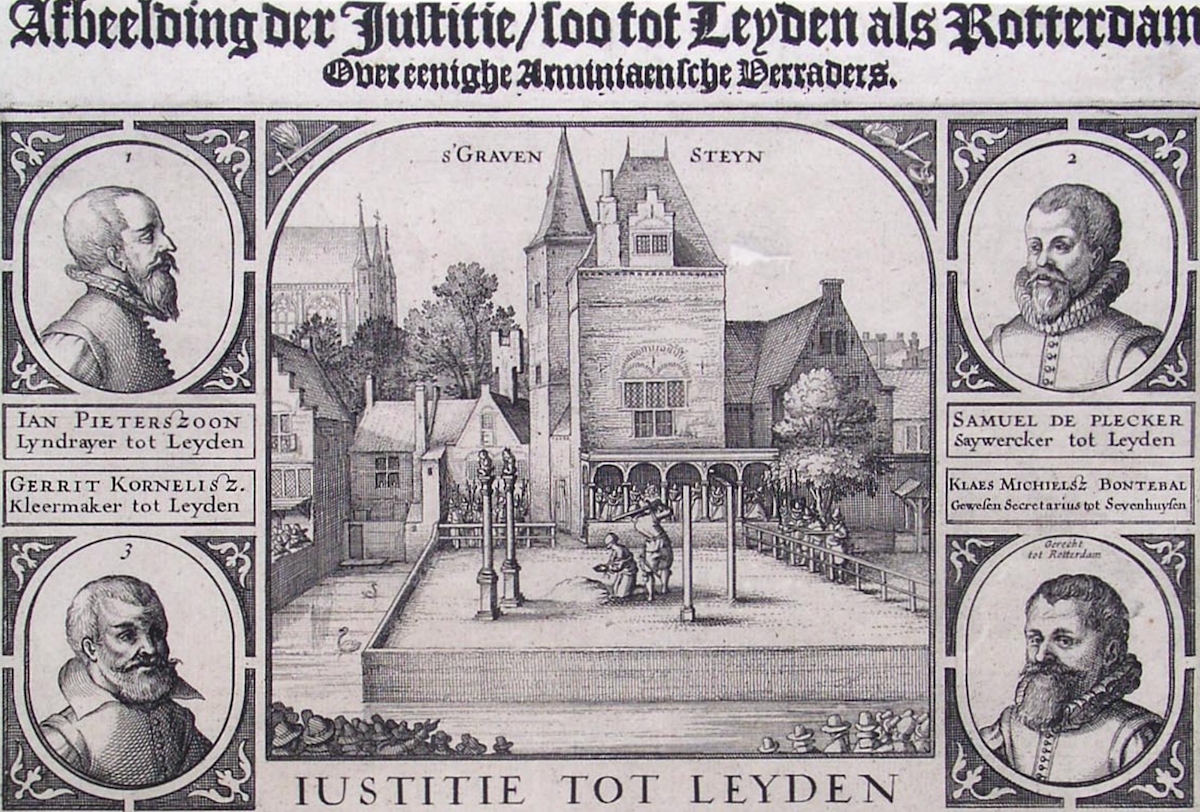
1623: Claes Michielsz Bontebal, Maurice murder moneybags

We’ve previously addressed in these pages the 1623 execution of Reinier van Oldenbarnevelt for attempting to assassinate Maurice, Prince of Orange in revenge for his, Maurice’s, 1619 execution of Oldenbarnevelt’s father.

Well, the scheme here was to hire a number of assassins for the attack, a plan which guaranteed that someone would blab and blow the whole deal. But before the blabbing and the blowing, the hiring required a vast cash outlay — 6,000 guilders to be precise.

Claes Michielsz Bontebal (English Wikipedia entry | Dutch) was one of the financiers who did the hiring, and got caught in the blowback after the blabbing. He was executed with three other conspirators


Detail view of a 1623 print reporting the beheading (click for a larger view with portraits of Bontebal and his collaborators).

On this day..

1350: Tidericus the organist

On or very near this date in 1350,* the plague-ravaged city of Visby burned a man remembered as Tidericus (Diderik) the organist.

The Gotland capital at this point stood at the fore of the Hanseatic league; the medieval maritime Laws of Wisbuy reflect its influence. The arrival in this year of the Black Death would begin Visby’s passage from merchant power to its present-day station as the “City of Ruins”. (The beautiful remains of its medieval grandeur make Visby a UNESCO heritage site.)

Small wonder that the city took its abrupt fall from greatness as an infernal conspiracy, the dimensions of which posterity decodes from a few surviving bits of correspondence.

In the midst of the plague, Gotland arrested nine itinerants as well-poisoners. For people struggling to cope with the sudden, inexplicable ravages of Pesta the inference of a malevolent hand ruining the water supply was a natural one; it emerges frequently during pandemics.

Tidericus the organista — either an organ-builder or an organ-player or both — is the only one of the Visby nine whose name we know; it seems that “with no prior coercion, [he] clearly admitted how he would poison all the wells in the cities of Stockholm, Vasteras and Arboga, and every lake, fresh water source, and various wells as he travelled around Sweden, everywhere poisoning away with his concoctions.” See, all they had to do was ask him.

What’s more, at the same time he [Tidericus] admitted that there are many who belong to a certain society which consisted of rich merchants and all the kinds of people who hold office all over the world, as many people know they do, and each of them goes around with silver belts, and they are all half mad or crazed in some other way. Also, they are all marked with a letter written in Greek or Hebrew. In his last moment he said “Need I say more? All Christendom has been poisoned by us villains and the Jews.”

It seems the well-poisoning mission had been funded by merchant-Jews in Germany named Aaron and Moses. A few different letters between Hanseatic cities around this time attest to a similar fear of Semitic contagion, possibly hinting at a wider panic outside the scanty lines of primary documentation. One letter from Lübeck (cited here) mentions a person named Keyenort who burned at the stake after confessing to pocketing three solidi from Jewish agents who wanted him to poison wells across northern Germany and Prussia; another from Torun has a more ambiguous reference to an apparent mass arrest of “baptized Jews”.

A few years after this organist’s coda, the Danes defeated Visby on the battlefield; Danish control would persist until the 17th century and consigned the once-proud Hanseatic port to a distinctly lesser stature. By century’s end, Visby would be the haunt of the Victual Brothers pirates.

* Citations are split between July 1 and 2; the sources are few, indirect, and barely dated so even the outline of events in this post is somewhat inferential.

On this day..

1896: The Rufus Buck Gang, heaven-dream’t

On this date in 1896, the Rufus Buck Gang was hanged at Fort Smith, Arkansas for a two-week spree of violence against white Oklahoma settlers.

More about this novelization is available on this companion website.

After doing a 90-day turn in Judge Isaac Parker‘s jail for selling liquor, the half-Creek, half-Black teenager Rufus Buck emerged violently politicized — “enraged by what he considered the theft of Indian lands. He decided it was his duty to rid the land of those who, in his eyes, did not belong”

If his theory of resistance was naive, the grievance was real enough. Earlier that century the Creeks of the American Southeast had been made to quaff humiliation by the emerging United States, and expelled with many other indigenous peoples from their ancestral lands to present-day Oklahoma; in Buck’s own lifetime, this remnant Indian Territory was itself being positioned for takeover by white settlement.

Buck gathered four other youngsters to his banner and from July 28, 1895 — when they slew a U.S. marshal — until their capture on August 10 they gave vent to rage and despair in a spree of robberies, murders, and rapes consciously directed at white settlers. This hopeless paroxysm of violence, almost precisely contemporary with suppression of the Ghost Dance movement and the official closing of the American frontier, marks the passage of an era; even the famous Judge Parker was in his dotage and would pass away a few months after the Buck gang’s own execution.

After the young men went to the gallows for rape on July 1, 1896, a poem was discovered in Buck’s cell, scribbled on the back of a photograph of his mother.

Mi dreAM —
i, dremP’T i, wAs, in, HeAven,
Among, THe Angels, FAir:
i, d, neAr, seen, none, so HAndsome,
THAT TWine, in goLden, HAir:
TheY, Looked, so, neAT,
And; sAng, so, sweeT
And, Play, d, THe, THe, golden, harp
i, was, ABouT, To, Pick, An Angel ouT,
And, TAke, Her, To, mY HeaRT:
BuT, THe, momenT, i, BegAn
To PLea,
i, THougHT, oF, You, mY, Love,
THere, Was, none, I, d seen
so, BeAuTiFul,
On, eArTH, or, HeAven, ABove.
gooD! By, My Dear, Wife..anD MoTHer
All. so. My SisTers.
Rufus, Buck
Youse Truley

On this day..

1685: Archibald Campbell

On this date in 1685, the 9th Earl of Argyll went the same way as the 8th.

We’ve addressed in these pages the travails borne by Archibald Campbell, 8th Earl of Argyll, whose once considerable power was overwhelmed by the Wars of the Three Kingdoms and came to an end under the blade of the Edinburgh maiden.

While imprisoned awaiting the chop, the 8th Earl composed for his much-reduced heir, also named Archibald Campbell, composed a volume titled Instructions to a son with a variety of foreshadowing maxims.

You have a great task to do, you must from the bottome climb up to the mount of Honour, a very abrupt and difficult ascent; which yet, nevertheless by observing the sure footings of some of your progenitors, and the slips of others, particu?larly those recent slidings of mine own, (for other they are not) you may at last attain the top, and by your own merit and your Princes favour, your House may be Culminant again.

If it shall so happen … have a care then of that Precipice; let no revenge or ambition blind you into destruction; you may poise your self with your wings of Honour and Greatness, but venture not, nor presume to fly.

Covet not with immoderate hast Lands, Riches, Honour, for it is seldom that men whose rash desires and designs are laid out that way, compass their full content, and for the most part meet with a destiny far other then they expected; and when they are once so disappointed, Fortune or rather Providence so much amazeth the judgment even of wise men, as in time of danger they know not what resolution is best to be taken. You will not be necessitated through the want of these three, so as to reach at them unlawfully, and endanger what you have in possession, and your self together

‘Tis folly to complain of life, more to be troubled at the end of it, by the reason we ought more to complain of our birth, that made and produced us mortal, then of our death, which will render us immortal.
To be long or short lived is no more then this, we come either sooner or later (no great choice) to our grave. He is very desirous of life, who is un?willing to dye when all the world is weary of him.

The kid did his late dad proud in the 1660s, regaining the attainted earldom and re-establishing the rank and wealth of their house. Argyll — and by this name henceforth we refer to Argyll fils — nurtured Presbyterian sympathies which told strongly against him when a failed Presbyterian rebellion touched off the fruitful-for-this-site era of the Killing Time.

From this point his position speedily eroded and his evasion of an oath of loyalty to Protestantism — when he finally took it he added his own unauthorized disclaimer, “only in as far as it is consistent with itself” — got him arrested, and a dubious charge of libeling the king was questionably stretched to compass a death sentence. That was around the end of 1681; on December 20 of that year, his daughter Sophia Lindsay visited him, accompanied by their page. When secluded in the dungeon, the page and the doomed man swapped clothes, and Argyll clattered away in servants’ livery to hiding in London safehouses and continental refuges.

Having already been taken for a traitor, this Argyll on the lam went all-in for unambiguous sedition. Ciphered communications of his were among the papers seized from Baillie of Jerviswood after the exposure of the Rye House Plot.

With the passing of King Charles II in 1685 and the long-feared succession of his Catholic brother James II, Scots in Holland mounted an invasion of their home country in an attempt to topple the government. Our man lent it both leadership and title: it’s known as Argyll’s Rising and was intended to complement/support the English Whig rising under the Duke of Monmouth.

Argyll’s expedition turned up in Scotland in May 1685 and instantly went sideways. Amid leadership conflicts and lukewarm recruitment, the rebellion collapsed. Argyll was captured by a militia who “would fain have concealed his rank, as they durst not release him; but he was recognised by their officer. He was led to Edinburgh, where he was treated with the same indignities as had formerly been the lot of Montrose. As the king had ordered him if taken to be put to death within three days, he was executed on his former iniquitous sentence (30th). He met his fate with piety and fortitude; embracing the instrument of death, he called it (in allusion to its name) the sweetest maiden he had ever kissed.”


The Last Sleep of Argyle (1860s) by Edward Matthew Ward: the man was reported to have slept so serenely on his last night on earth that he had to be awakened for execution.

The next generation of Campbell chiefs finally got the political calibration right, supporting the invasion of William and Mary to overthrow James II which elevated the Argylls to the dukedom which their heirs maintain to this day.

On this day..

1393: Karsten Sarnow, Stralsund mayor

On this date in 1393 the mayor of Stralsund was beheaded.

From the perspective of that Hanseatic city‘s hereditary patricianate, Karsten Sarnow was a chancer — a burgher who championed the political reforms that enabled his own self to enter the city council.

He cinched his municipal preeminence by taking leadership of the naval campaign against some Baltic pirates and successfully suppressing them, marching a hundred or more of them through town for execution.

With this prestige he attained the mayoralty and attempted to implement an ambitious constitutional reform that chased the leading grandee family from the city.

This house, the Wulflams,* successfully intrigued against Sarnow from the Hanse sister-city of Lübeck and eventually Wulfhard Wulflam had the pleasure of revenging the slights against his station by ordering the decapitation of both Sarnow’s person and his constitutional innovations.

This coup scarcely resolved the simmering class and faction conflicts in Stralsund, as discussed by F.L. Carstein in Essays in German History, which notes that “from the beginning of the 14th century the patrician rule was attacked time and again by movements and revolts of the urban Commons, especially in the most important town of Pomerania, Stralsund.”

The popular movement, however, was not stifled. The council was forced to declare the memory of the executed Sarnow untarnished; his body was exhumed and given a solemn funeral. The populist party triumphed once more, helped by battles against the pirates. Yet after only a short time the rule of the old council was restored; the leaders of the rebellion were executed and 48 burghers were expelled …

The 15th century brought new unrest to Stralsund, of a clearly anticlerical character. The ecclesiastical superintendent of the town was a nobleman, Kurt von Bonow. In 1407 he complained about the low offerings the burghers gave to him, quit the town, assembled his noble friends and appeared with 300 horsemen outside the walls. They cut off the hands and feet of burghers whom they found outside, burnt down the farms beyond the walls and departed triumphantly with cattle and other booty; burning villages marked their path. When the priests in Stralsund added their insults and the rumour spread that they supported their leader with arms and money, the burghers, led by the porters’ guild, rose against the clergy, imprisoned sixteen of them and then attempted to burn the house where they were confined. The council tried to protect the priests, but the enraged crowd shouted they were all knaves and evildoers, they had helped to fan the fires and therefore they must burn. The master of the porters’ guild demanded the death of the three senior priests who were burned in the market place; the others were saved by the council. The news of ‘the priests burning at the Sund’ (i.e. Stralsund) spread throughout Germany. Then the burghers marched out of the town and pillaged the houses and estates of noblemen who had participated in Bonow’s enterprise. The feud between them and the nobility allied with the duke lasted seven years, and several other Pomeranian towns supported Stralsund. All trade languished …

About this time the social conflicts in the Hanseatic towns, especially in Lübeck, became so strong that the League — which meant the ruling merchant aristocracies — at a Diet held in Lübeck stipulated the death penalty for burghers who summoned the Commons to take action or agitated otherwise against the council; any member town in which the council was forcibly deposed by the burghers was to lose the Hanseatic privileges and liberties and was not to receive any help from the other towns. Fear had grown to such an extent that it was further ordained no burgher was to appear in front of the council with more than six companions.

Wulfhard Wulflam himself was murdered in 1409 in a revenge killing by the son of a noble knight whom he, Wulflam, had slain several years prior.

* The family’s Wulflamhaus, an outstanding exemplar of the late Gothic style, is still to be seen in Stralsund.

On this day..

1497: Nicholas II of Niemodlin

On this date in 1497, the Polish Duke Nicholas II of Niemodlin was executed in Nysa.

During a summit to dispel tensions with Casimir II, Duke of Cieszyn, our Nicholas tried to murder both Casimir and a mediator bishop.

After a failed attempt to claim sanctuary, the grandees in attendance decided to have him speedily beheaded rather than accept his large gold bribe in settlement.

This very nearly triggered a wider war when Nicholas’s brother, also a duke, began preparing for a retaliatory military expedition; deft diplomacy by the king of Bohemia defused the crisis.


(cc) image from Jacek Halicki.

On this day..

1567: Captain William Blackadder, Darnley patsy

On this date in 1567, the Scottish soldier Captain William Blackadder (or “Blacketer”) died a scapegoat at Edinburgh.

Being dragged on a hurdle to Mercat Cross where he was hanged and quartered, and his remains nailed up in Scotland’s principal cities, was undoubtedly the worst thing that ever happened to Captain Blackadder but posterity finds his severed tendons and ruined viscera only a lesser subplot in the psychodrama of that august future Executed Today fixture Mary, Queen of Scots.

Mary’s famously terrible marriage to the monstrous Lord Darnley produced the eventual King James VI and I, at the cost of utterly ruining Mary’s reign. Please reference the great many more learned and erudite sources that will dwell on the innumerable faults of this grasping English lord who immediately upon achieving wedlock began maneuvering against his wife for power in Scotland. He’s notorious as a drunk, a lech, a murderer, and in general an obnoxious and arrogant shit.

Until, 18 months and change into the marriage, a huge explosion rocked Kirk o’ Field, Edinburgh … and when the debris cleared, there lay the bodies of the obnoxious consort and his servant. Strangely they were dead in a nearby orchard, suspiciously unsinged by the Gunpowder Plot-like pyrotechnics.


Drawing of the crime scene made for the English Secretary of State William Cecil

The particulars of Darnley’s murder have puzzled posterity for the ensuing 450 years, precipitating as it did Mary’s own fall from her throne — a moment manifested by Mary’s humiliating surrender when her dwindling and dispirited supporters melted away instead of fighting at the “Battle” of Carberry Hill. Mary had the humiliation in that June of 1567 of being led through Edinburgh by rebel lords to imprisonment, under the jeers of a hostile crowd.

But since these rebels were rising against Mary’s post-Darnley fling, putatively in the name of Mary herself, they also proceeded to conduct a disingenuous search for Darnley’s assassins in these days, landing on this luckless son of a declining house who had presented himself under Mary’s colors at Carberry Hill. Nobody since and probably nobody then really thought he had “art and part” in Darnley’s death; nevertheless, the diarist Birrel noted, “the 24 day of Junij Captane Villiam Blacketer was drawn backward, in ane cairte, from ie Tolbuith to the Crosse, and ther wes hangit and quartred, for being on the King’s Murther.”

We could not in good conscience miss the opportunity afforded by this distinctive name to cite topical-to-us content from the BBC sitcom Blackadder.

On this day..

1568: Weyn Ockers, slipper slinger

On this date in 1568 the Dutch Protestant Weyn Ockers was drowned with her maid Trijn Hendricks.

Both were condemned for having taken part in the paroxysm of Calvinist anti-icon riots known as the Beeldenstorm (“icon-fury”) — specifically the 1566 sack of the then-Catholic Oude Kerk in Amsterdam. The Netherlands’ Spanish Catholic overlords were in these months of 1568 busily meting out revenge for the sacrilege.

In a somewhat iconic event of the iconoclasm, Ockers was alleged to have chucked her slipper* at an image of the Virgin Mary perched on the altar — one particularly resented by the reform-minded since the priest encouraged lucrative offerings of parishioners’ valuables to be presented to this icon. One might well doubt the fact of it; Ockers had not been arrested for this offense, but the accusation emerged from the interrogation under torture of other Protestants. Ockers copped to it under torture herself; Hendricks, made of tougher stuff, withstood torture twice and never admitted anything, but still shared her mistress’s fate.

* Not the worst missile that Marian statuary has endured.

On this day..

2013: The Hawalli monster

On this date in 2013, Egyptian Hajjaj Saadi was hanged with countryman Ahmad Abdulsalam al-Baili at a car park in Kuwait.

Photographers were on hand to record the public execution, just the second in Kuwait since breaking a six-year moratorium on hangings. Saadi in particular was a reviled criminal, dubbed the “Hawalli monster” for the expat district of Kuwait City where he lived — and where, his prosecutors alleged, Saadi lured some 17 or 18 young children, both boy and girls, to rape.

Saadi strenuously denied the charges at trial, insisting that his confession was extracted by torture. No doubt it was. He also said he got no aid from the Egyptian embassy.

Ahmad Abdulsalam al-Baili murdered an Asian couple by torching their flat, and unsuccessfully tried to do the same to an Egyptian couple.

Caution: Mature content. The video in particular shows the actual hanging moment itself; it’s evident that Saadi, a muscular bodybuilder, survived the drop, and in the video he struggles against the rope.


Ahmad Abdulsalam al-Baili


Hajjaj Saadi

On this day..

1492: Jan van Coppenolle

On this date in 1492 the Flemish rebel Jan van Coppenolle was beheaded at the Vrijdagmarkt in Ghent.

When the formerly doughty duchy of Burgundy faltered as an independent polity after the death of Charles the Bold in 1477, Ghent and its sister Low Countries trading cities had forced upon Charles’s heir Mary an expansive recognition of those cities’ rights.

It was known as the Great Privilege, and it was greatly dependent on the political weakness of the recognizing authority.

Mary expressed this weakness in another way as well: with her marriage to the Habsburg heir Maximilian I of Austria — tying her patrimony to the Austrian empire. Upon this marriage did the House of Habsburg found a redoubling of its already expansive holdings, for Mary herself brought the wealthy Low Countries into the fold while the couple’s son Philip married a Spanish infanta and founded the line of Habsburg Spanish monarchs.* Apt indeed was the House Habsburg motto: “Leave the waging of wars to others! But you, happy Austria, marry; for the realms which Mars awards to others, Venus transfers to you”

Mary, unfortunately, was not around to enjoy the triumph of her matrimonial arrangements, for in early 1482 a horse threw her while out on a ride, breaking her back. Philip might have had a bright future ahead, but he was only four years old.

It was Maximilian’s flex on direct power in the Low Countries — and in particular his ambition to raise taxes to fund expansionist wars — that brought to the stage our man van Coppenolle (German Wikipedia entry | Dutch). He became a preeminent popular leader of a decade-long Flemish rebellion against the future Holy Roman Emperor that verged towards a war of independence.

Briefly forced to flee to exile in France after Maximilian quelled the initial resistance in 1485, van Coppenolle returned with French backing and controlled Ghent from 1487 when the rebellion re-emerged. This second installment had some legs, especially since Maximilian was imprisoned several months by the city of Bruges, allowing van Coppenolle leave enough to even mint his own coinage, the Coppenollen … before the Habsburgs finally suppressed the risings.

* The present Spanish king, Felipe VI, is a descendant of Philip I.

On this day..