1697: Three at Tyburn, multiply sinning

An account by the Ordinary of Newgate Samuel Smith … in fact,

A True Account of the Behaviour, Confessions, and last Dying Speeches of the Condemned Criminals, that were Executed at Tyburn on Wednesday the 15th of this Instant Sep. 1697.

On the Lords-Day, after the Condemnation of the Condemned Criminals, a Sermon was Preached on this Text, Reve. 2. 21. I gave her a Space for Repentance; yet she Repented not.

In these Words are three Observations

  1. THE Lord gives the worst of Sinners a suffficient Time for Repentance. I gave her, even Jesabel who seduced others to commit Spiritual Fornication, in grose Idoaitry.
  2. The Lord doth not only afford a sufficient Time for Repentance, but adds many advantageous Opportunities, and the assistance of his Spirit to compleat it.
  3. To Sin against all the advantageous Encouragements, which might promote Repentance, by persisting in Impenitency, deeply aggrevates the Sinners Condemnation.

The necessary Ingredients which constitute and compleat the nature of Repentance; without which it cannot be available to Salvation, in.

1st. A strict search into the frame of the Heart; to find out the mistery of Iniquity in our most secret and indulged Lusts. There must be a deep Humiliation for the universal Corruption of the Sinners nature, and the peculiar Sins of every Age of his Life.

2ly. An universal hatred of the least Sin, because it offends God, as contrary to his Holy Nature; and for Ingratitude against all the endearing Obligations of divine Mercies, which should soften the Sinners Heart; yet usually these extinguish all good resolutions of Amendment, and the flood of Afflictions more inflame and irritate Men’s Lusts.

3ly. Sincere Repentance includes not only an universal forsaking every evil Way, but also a watchful Circumspection and fixt Resolution to avoid all the occasions of Sinning.

4ly. A turning to God with the whole Heart, in the constant practice of all those Christian Duties which the Lord requires of us.

The second Query.

What are the fittest and most advantageous Opportunities, wherein to promote the work of Repentance?

1st. Whilst clear and strong Convictions are imprest upon the Conscience, before these be stifled or made ineffectual by the Sinners Corrupting or bribing the sentiments of right Reason; yet many Sinners strive to wear out the Convictions of their Consciences, so that they do no execution on their Lusts.

2ly. When the fond Love of the World is imbittered by sharp Afflictions, now turn the Stream of this Worldly sorrow into the Channel of Sincere Repentance: I affirm that a gracious Person prefers the sharpest and longest Afflictions Sanctify’d, in impressing the divine nature deeper on the Heart, than if the Lord should heap the confluence of worldly injoyments, which usually are abused to Pride, Wantonness, or Slothfulness in his Duty.

3ly. When by an Eye of Faith we behold our Redeemer Crucify’d a fresh in the Sacrament of the Lord’s Supper, as a memorial of his dying Love, to make Sin more bitter to us; now let thine Heart be contrite with Godly sorrow, and pour out the blood of every Lust at the foot of the Altar, as an acceptable Sacrifice to the mortifying Spirit of Christ.

4ly. Comply with the Lord’s design, when he sets out other Sinners as the Monuments and Examples of his severity: The Lord will take this very ill when he writes our Duty in the blood and Destruction of other Sinners Less peccant. and yet such who are spared, have no Impression of an Holy Ingenuity to learn Righteousness in the amendment of their Lives.

5ly. When the Lord makes deep Wounds in thine own Conscience, do not presume to heal them by a few slight Formalities in Relenting, neither let the fountanel of Godly sorrow dry up, which should drain out the malignant Humors of thy defiled Heart.

6ly. When thou undertakest any great Service for God, attended with difficulties and discouragements, now is a Time to renew Godly Sorrow, for offending a gracious Lord who puts an eminent Honour on thee, in that he will employ thee in his Service.
Also when thou desirest success in entring upon any new state of Life, thou can’st not expect any blessing from God unless thou cleanse thy self from all filthiness of Flesh and Spirit, contracted before in any part of thy Conversation.

7ly. When thou observest the wickedness of other Men, mourn by a sad Reflection on thine own corrupt Nature: This is alike if the Lord had not renewed it by his Regenerating Spirit: Mourn that you have not been faithful in reproving Sinners; because hereby you have Adopted their Sins to become your own.

8ly. When good Resolutions are formed up within us in any Duty of Religion, let us step presently into the Pool of Repentance, for our former not Compliance with the blessed motions of God’s Spirit.

Here a Case may offer it self to be stated. It is thus.

Considering that God gives a fit space of time to the worst of Sinners, to accommodate their Repentance; What Time is requisit for the Magistrate to afford Condemned Criminals to prepare them for their Death?

This cannot be stated Absolutely, so as to limit the Power of the Magistrate in this Case. Neither ought any Minister to repine or grudg at the length of Time, as being sparing of his utmost endeavours to save Souls: Yet some think that a compleat Weeks time at least is fit to be granted, if Criminals do not abuse it by being ungovernable, in attempting to break Prison. But much longer Time may make Condemned Persons more secure in presuming that they shall be Pardoned: Hereupon the means of Grace work not so effectually upon them: For when they have no hopes of Respiting their Death, their Convictions are usually the more strengthned, their Prayers more fervent, and their Resolutions to Repent the more settled and confirmed. It is an honourable remark of Piety, and Clemency in the Magistrates of England, that they allow a convenient Time for Reconciling the Souls of Condemned Persons unto God. Yet how strange and deplorable is this, that tho’ a sufficient respiting the execution of the Sentence be indulged; Criminals draw on themselves deeper security in Sinning; a stroke far worse than Death, because not felt.

Hopes of Life, Dead praying, and Men’s promises of Improving the Space for Repentance, are blown away, when the fears of Death are abated. Impenitent Sinners abuse God’s sparing Mercy; and as I have observed, are not so fit to dye upon a long Reprieve: They are more Solicitous in employing their Friends to make intercession for their Pardon, than themselves are careful to set forward their Repentance thereby, to be Reconciled to God, by whose Smiles or Frownes Men’s Souls are disposed of in Happiness or Misery, throw all the Ages of Eternity.

The conclusion was thus Directed to the Condemned.

You have heard discrib’d unto you the fittest and most advantageous Opportunities to set Repentance on Work, that it may be compleated unto Salvation; also the dreadful pernicious Effects of willful Impenitency. Yet you have Presumptuously adventured to multiply Sinning, tho’ this hath sharpned stinging reflections in your guilty Consciences. Your Ears have been very attentive to the Councils of ungodly Associates: But you have out done the deaf Adder, in stoping your Ears against all God’s counter-charmings of your sensual Lusts, by the instructions of Heavenly Wisdom. Do not dare any longer to elude or frustrate the main design of God, in exhibiting the offers of Salvation. How durst any of you cast your Repentance into your last Accounts, which ought to have been the first and choicest Work of your whole Life.

Oh! That you would duly consider that all Supernatural Probationary Acts of Grace, such as Repentance, and the severity of mortifying your corrupt Nature, ought to be swiftest toward the end of your Lives, because it is not possible, and cannot be Available to renew them after Death in the rectifying, of any mistake. Consider that there is great difference ‘twixt a Conscience legally wounded for the dreadful Shameful Punishments of Sinning, and a Conscience Evangelically contrite, out of an Holy ingenuity for offending a gracious God, who hath long waited to overcome the Sinners Stubornness with his Clemency. Fear, least after some short Anguish in your Consciences, you should perish in your delay to compleat Repentance.

Consider the Spiritual benefits which sweeten the difficulties, and austerities of sincere Repentance: Tho’ sensual Sinners despise a contrite Heart, as effeminacy and baseness of Spirit; yet it is the best Demonstration of love to God, and a genuine fear of his long suffering; not to Sin against it by vile ingratitude. It doth not dispirit Men’s Courage in dying, but contemn Life when it cannot be prolonged with the safety of the the Souls integrity and loyalty to Christ’s Laws; it casts forth the oppressing load of sensual Surfeits, which defiled the Souls heavenly Purity. In the midst of National amazing Confusions, penitential Converts to God shall be as safe as Salvation it self can make them: Yet consider how difficult it will be to unravel the Web of Sinning, when Men never Communed with their own Hearts, to search out those Iniquities which are confirmed by a long Custom in Sinning. Familiarize therefore to your selves the severities of sincere Repentance: Justify God in his sharpest Corrections of you, to reduce you from wandring in the Bewildring devices of Sinning, and condemn your selves for the minutest Errors of your Lives. Be not slow and slight in so solemn a work; your whole Life ought to have been a continual exercise of Repentance, and of mortifying your Lusts, as a meet disposition for Eternal Life.

Take heed of dying in an obstinate contempt of God and Godliness, least the Lord harden his Heart against you, so that when you cry for Mercy, under the anguish of your Consciences, the least glance of it should be denied you.

I proceed to give an Account of the Behaviour and Confessions of the Condemned Criminals.

I. John Dewin, Condemned for Counterfeiting the Coin of this Kingdom: Aged thirty four Years. He was born in Norfolk: Was Prentice to a Shoemaker in the Northern parts. He kept Shop four or five Years; but left that Employment to deal in Cheese and Bacon at Waltham-Abby. He confest that tho’ he had not wronged any Man in his Trading; yet, that he had not led a Religious Life towards God: For he neglected the Duty of Praying to him; kept the Sabbath very slightly; that he was guilty of Swearing; but seldom Drunk in excess. He wept and said, That it now grieves him that he hath in many things sinned against the Holy Trinity: And yet that he doth not Repent as he ought, for his being so negligent of his Duty to God. But he begs of him earnestly to change his Heart, and not only to pardon his Sins; and hopes that if he might be spared he should never return to any Customary provoking his most holy Creator, but become a reformed Man.

II. Isaac Blount, Condemned for Stealing a Gelding: Aged twenty three Years. He was born in Gray’s-Inn-lane. He was an Hackny Coach-man , and drove as a Journy-man for some time, till he wrought for himself. He confest that he had many ways offended God, in prophaning the Lord’s Day; in omitting often the Duty of praying that he might be kept from bad Company; that he had kept Company with bad Women, but not lately; that he was not addicted to Swearing nor Drunkenness, yet had at times committed these Sins. He said, that he now is sensible of his evil Courses, and mourns for offending God by them, and hopes that he will so soften his Heart, that the Convictions which are in his Conscience may work to a thorough Repentance.

III. John Chamberlain, Condemned for Felony and Robbery: Aged twenty six Years: Born in Herefordshire. He was Journyman to a Butcher. He left that Employment about three Weeks since; but was joyned to bad Company before. He denied not the Crime. He confest that he did not performe the Duties of the Lord’s Sabbath, but walkt in the Fields with idle and vain Persons; that he was no much given to Swearing, and had somtimes been overcome with excessive drinking; yet he hopes that being now penitent for all his Sins, that God will pardon them. I stated for several days the nature of true and false sorrow for Sinning, also the nature of true saving Faith; wherein it differs from a presumptuous reliance on God’s Mercy and Christ’s Merits, and the danger of Sinning in hopes of future Repentance; so that they desired me to pray for them, that they might not deceive themselves with false hopes of Heaven.

IV. Mary Taylor, Condemned for a Burglary. She was born in Chancery-Lane. Was a Servant for eight Years to several Persons of Quality. She said, That altho’ she knew her Duty to God, yet she had Sinned against the Convictions of her Conscience; whereby she had much wounded it. She confest that she had not taken former warning, altho’ she had been punished for an evil practice, and that therefore God had justly inflicted this dreadful Scourge upon her, to bring her as she hoped to Repentance. She said, That now the chief trouble of her mind is for offending God her Creator and great Redeemer. She said, That she heartily desires that she may be cleansed with the Blood of Christ. O how merciful said she, is God! that he thus Corrects me, and moderates his Justice toward me, in this, that I am Respited from dying, for the space of six Months, till I am delivered of the Child I am quick with; hereby I have time to Repent of my Sins of Presumption, for I knew God’s Will, but obeyed it not; such deserve a more terrible Condemnation.

The other Women Condemned, were also found with Child, as the Jury of Women affirmed; therefore they are reserved for a longer time before they suffer. I am sorry that they make so ill an use of it, that they grow secure; yea, obstinate, in refusing to come on the last Lord’s Day, and at other times to receive Instruction, in order to bring them to a sensibleness of their evil Courses. Callow especially was obstinate, who is Condemned on two Indictments, for picking of Pockets.

On Wednesday the 15th of September, 1697. John Dewin, John Chamberlain, and Isaac Blunt, were convey’d to Tyburn; the first on a Sledge, and the other two in a Cart. But Flora alias Flower, he died in Prison the 12th of September. The Prisoners being brought to the Tree, were tied up. Dewin would not own his Crime, but desired all good People to take warning by him, how they led their Lives, least by their sinful Courses they should come to such untimely ends. Isaac Blunt would not own his Crime, but said, he had been guilty of divers such Crimes; he did not shew any outward appearance of Repentance. John Chamberlain said, That he was a great Sinner, and had been drawn in by evil Company to do the Fact for which he now suffers; he desired all good Christian People to pray for him, and to take warning by him, and eschew evil Company, and have regard to the Sabbath; he said, That he was bred a labouring Man, and one that did use to work hard for his living; but forgetting God and following Idleness brought him to this untimely end. The Ordinary prayed with them for some considerable Time, and sung a Penitential Psalme. And afterwards they were turned off.

This is all the Account that I can give of this Sessions.

Dated Sept. 15.

Sam. Smith, Ordinary .

LONDON, Printed for E. Mallet, in Nevil’s-Court in Fetter-lane, 1697

On this day..

1996: Roberto Giron and Pedro Castillo, televised shootings

Roberto Giron and Pedro Castillo, peasants who raped and murdered a four-year-old girl, were shot at the Guatemalan town of Escuintla on September 13, 1996.

The executions — Guatemala’s first juridical shootings since 1983, although civil war death squads had ravaged the country in the meanwhile — were filmed by the press and televised, and the tape told an troubling tale: both men survived the initial volley and after paunchy doctors hastily conferred by the gasping doomed men, were icily finished off by the squad commander’s pistol.

Warning: Mature Content. This is a snuff film. A slightly longer cut of the same reel can be found here.

Thanks to this ghastly debacle, Guatemala changed its execution method to lethal injection — an application of which was also televised in 2000.

On this day..

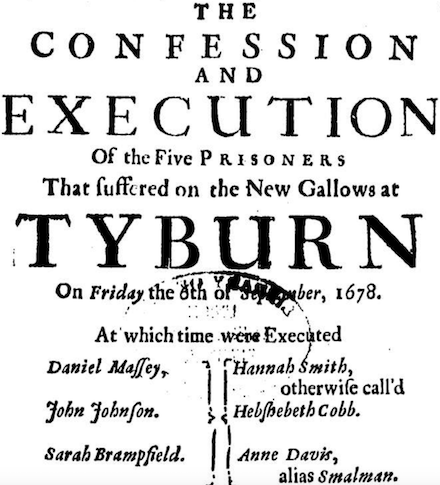
1678: Five at Tyburn

Three men and two women hanged at Tyburn on this date in 1678.

Our text here is one of the earliest of the Ordinary’s Accounts, a far shorter and less ostentatious affair than examples of the genre even a few years later from the hand of a clergyman who has scarcely begun to grasp his true calling, moving copy.


THE CONFESSION AND EXECUTION Of the Five PRISONERS That suffered on the New Gallows at TYBURN On Friday the 6th of September 1678.

At which time were Executed

Daniel Massey. John Johnson. Sarah Brampfield. Hannah Smith, otherwise call'd Hebshebeth Cobb. Anne Davis, alias Smalman.

With Brief Notes of Two SERMONS Preached before them after Condemnation, their Carriage in Prison, and last Speeches at the place of Execution.

The Confession & Execution of the several Prisoners that suffered on the New Gallows at Tyburn, on Friday the 6th of September 1678.

AT the last Sessions there were in all Ten persons Condemned to die; Four menf or Robberies on the Highway, and Six women for Felonies here in Town, either Lifting (as they call it) of Goods out of Shops, or else Robbing those whom they pretended to serve: both which wicked Practises are become so common, and more than once followed by these incorrigible Prisoners, that it was highly necessary to make them Exemplary. Two of the before-mentioned men, viz. those concerned in that barbarous Assault and Robbery, whereof a particular Narrative hath been made publick by the unexpected Mediation of some generous Friends; and the women whose Crimes had not been so great and obstinately continued in as the others, obtained his Majesties gracious Reprieve: and another woman, immediately after she stood attainted, was reprieved by the Court, in reguard she was found by a Female Jury to be quick with Childe.

The Rest came this day to suffer, being charitably indulged in pity to their Souls, so long time to sit and prepare themselves for their great and terrible Change. In order to which, on the Lords-day before, there were two Sermons on most suitable Texts preached before them in the Chappel of Newgate. That in the Forenoon on the fifth verse of the 38 Psalm — My wounds stink and are corrupt, because of my foolishness: Wherein the Minister very pathetically laid open the deplorable Condition such sinners are in by Nature, wallowing not onely in their original Depravity and Corruption, but in continued actual Transgressions against the holy Laws of God; whereby they become abominable, and as a loathsome stench in the Nostrils of that pure Majesty and all good men; and all this occasioned by their own foolishness, that is, their wilful rebellion and obstinacy against all the dictates of Reason, offers of Grace, and impulses of the Holy Spirit upon their Consciences. Which having, like a true Bonaerges, hereby endeavoured to awaken, and put them into a serious sense and apprehension of their lost, undone, and perishing Estate, without speedy and sincere Repentance.

In the Afternoon, as a Son of Consolation, from the 147 Psalm, vers. 3. He healeth the broken in heart, and bindeth up their wounds, he came to shew them the infinite Mercies of God, and Love of Jesus Christ, if they would come in and accept of Pardon and Salvation upon Gospel-terms. That although they had made their wounds to fester and rankle by their foolishness, and had Souls all over bespread with a filthy Leprosie, yet there was Balm in Gilead, an Almighty Physician, both able and willing to heal them, if they would submit to his Prescriptions. In order to which, he gave them divers most necessary and excellent Directions; Not to deceive themselves with a false and palliated Cure, but to close with Christ on his own Terms, and in all his Offices, as their King to Rule them, and their Prophet to Guide them, as well as their Priest to Intercede and make Atonement for them. To hate Sin more, because it was displeasing to God, than because it brought upon them temporal or eternal Punishments. To be as desirous to be Holy as to be Happy; because none can be justified until they are sanctified, Etc.

During the whole time of Religious Worship, and the Sermons, they behaved themselves very Reverently and Attentively; nor was the Minister wanting afterwards, daily to visit them, with pressing Exhortations, and necessary directions to sit them for their last end; especially charging them to disburthen their Consciences, and give glory to God by a free and hearty Confession of their Sins; which had so good an effect, as to bring them to an Acknowledgment; not only in general term, but particularly bewailing the Ill Courses of their past Lives; in neglect of the publick Divine Worship, Violation of the Lords day, Drunkenness, Swearing, and continual practises of Lascivious Debauchery; Two of them above the rest abounding in expressions of Penitence, and endeavouring to improve those few moments of their Lives, to work out their Salvation, and make their peace with God; begging heartily forgiveness from his most holy Majesty, for their Rebellion against his Precepts, and of all those whom they had wronged, by violent taking away their Temporal Goods.

Some of the Women had been Condemned before, and would often bewail the wickedness of their Hearts, that would take no warning thereby: the Men alleadged, they were ignorantly drawn in to that ill Fact, for which they suffer’d, being their first of that kind, and rather by the unhappy operation of too much Drink, than any premeditated design; yet confessed, they had more than once deserved to Dye, and freely acknowledged the justice of the punishment they were to suffer.

At the place of Execution they said little, besides those common, but too much neglected Exhortations, desiring all present to take Warning by them, and remember their Creator in the days of their youth; Not to suffer themselves to be seduced by Ill Company, or sensual pleasures, which had been the means of their destruction, and would be so of all, that did not continually keep a reverent fear of God, and his Worship and Laws in their Hearts.

Thus heartily praying to God for Forgiveness, and to receive their Souls for the alone Merits of his blessed Son; and desiring all good people to joyn with them and for them in those Supplications, they submitted to the Sentence, and taking their leave of all things in this world, were wasted into the unfathomable Regions of Eternity.

FINIS.

On this day..

1878: George Howell, family arbiter

From the Morristown (Tenn.) Gazette, September 11, 1878:


EXECUTION OF HOWELL

THE CONFESSION OF THE GUILTY WRETCH

From the Knoxville Chronicle

Yesterday Greeneville was astir with the bustle of unusual excitement consequent upon preparations for the execution of the negro George Howell for the murder of Joseph Martin, near Fullen’s station, December 28th, 1877.

A strong police force was sworn in by the town authorities, and Sheriff A.J. Frazier had summoned a large guard to preserve on the occasion. There were no anticipations of attempted rescue of the prisoner, though frequent rumors to that effect had reached the officials, but it was deemed best to be prepared for any emergency, and though the crowd was large, yet no serious disturbance arose.

HOWELL’S CONFESSION.

Some time after sentence of death was passed on him, the prisoner, Howell, made a full confession of the crime and its antecedents to Mr. J.R. Self, proprietor of the Journal, which, if true, put the family of the deceased in the worst possible light, he having declared in the plainest language that the widow and children of the murdered man, by bribes and threats, instigated him to do the deed.

Your reporter, accompanied by several others, visited the prisoner the day before his expected execution, Aug. 9th, expecting to see a burly black ruffian, but entering the cell, beheld confined in the cage, a negro lad, with a remarkably good countenance, holding a book in his hand. In one corner was a small pallet on which he slept, which was the only furniture it contained.

The prisoner seemed gratified at the entrance of visitors and answered all questions freely, even the frivolous one of whether Martin’s ghost ever appeared to him in the still hours of the night, to which he replied in the negative.

HIS ANTECEDENTS.

The unfortunate boy, George Howell, was born in La Grange, Ga., in October, 1861, his owner being Mr. Arch. Howell, who subsequently operated a steam furniture manufactory. His father’s name was Ephraim and his mother’s Mary, the former of whom is living, but the latter died when the prisoner was five years old. His father was a painter, and after his mother’s death both made their home in Atlanta, Ga., for six or seven years, the former pursuing his avocation of painting, while the boy waited on stores, confectioneries, etc. From thence they afterwards removed to Smyrna, Ga., where the prisoner remained a year in the employ of a Dr. Bell. He went from there to Cartersville, Ga., and by that time having become imbued with the spirit of unrest, visited Dalton and proceeded thence to Cleveland and Knoxville, and drifting as far east as Christiansburg, Va. But not liking the Old Dominion he returned to Bristol the day before the Presidential election in November, 1876. A few days after he entered the employ of J.B. Fitzgerald, near Fullen’s Depot, and remained there about seven months. He then worked a short time for Wm. Durman, perhaps two weeks, when he received a better offer and began working for Joseph Martin on the 19th of June, 1877.

The prisoner, in his interview, reiterated the confession previously made to Mr. Self and others regarding the complicity of Martin’s family with the murder, and avowed his intention, he said:

I had been at Martin’s for some time, perhaps a month, before I discovered any misunderstanding between Martin and his family and this occurred between him and his daughter Tennie. She upbraided him for his staying away from home so late; he kicked her over and struck her with a chair.

The next difficulty occurred between Martin and his wife, she accused him of visiting a house of ill fame near by, he went to his trunk, took out a pistol, and swore he would shoot her.

These wranglings and domestic quarrels continued all along through the summer, I remember of one, which at the time I thought would result seriously; it occurred some time in the fall, and late at night, I was asleep in the barn, little Bob woke me up, I went to the house and found Martin in a terrible rage, he said to me that his wife had refused to occupy his bed, that she had taken a separate room and that he would kill her, or any woman, bearing the name of wife, that would treat him in this manner. Bob and I set up the entire night.

THE BLOODY BARGAIN.

The following narrative of events immediately preceding the tragedy seems almost too horrible for relief, because if not the phatasmagoria [sic] of a disordered brain, the prisoner was but the hired tool of an unnatural wife and children. In this connection it should be stated that an attempt was made two days before the executions, by a member of Martin’s family, to induce Mr. Self, the publisher of the “confession,” to suppress the same, which, however, he declined doing. Continuing, the prisoner said:

Some two months before Christmas the family were all in the sitting room — perhaps some of the smaller children were in bed — when Mrs. Martin commenced abusing her husband (Mr. Martin was away from that night, I think he was at his mother’s or brother’s.) The girls, Margaret and Tennie and their brother Bob, all joined with their mother in denouncing the deceased. Mrs. Martin said that ‘Joe had threatened to kill you, (me) twice, and if I was you (me) I would kill him,’ she said that ‘Joe had followed you (me) one day in the railroad cut with the intention of killing you (me) and that if I did not kill him he would certainly murder me, and, if I would kill him she would bake me some cakes for Christmas.’ Bob spoke up and said that he ‘would give me two calves and a pig if I would kill his father.’ I do not remember my reply, but from that time on it was well-understood in the family that Mr. Martin was to be killed, and that I was to do it, and the family were to swear me out of it.

Mrs. Martin baked the cakes for the prisoner on Christmas, he said, reproaching him at the same time for his failure to perform his promise. Three days later, however, he endeavored to do so, and a runaway team, which diverted his attention, was the means of prolonging Martin’s life a few hours. The same evening after being informed that the gun, with which the fatal deed was committed (an Enfield rifle) was loaded, the prisoner made a new ramrod for it the iron rod being too short, and while cutting it the right length at the wood pile, according to his statement, Bob, a son of Martin’s about thirteen years old, brought him the gun, and told him to go around the house and shoot his father. Bob then went into the house, and the prisoner thus describes the

MURDEROUS DEED.

I went round in front and looked through the window, and saw Mag sitting on one side of the fire-place, Tennie on the opposite, Mr. Martin out in front and Bob sitting away back next the back door. They were all out of range. I stepped up to a plank at the edge of the portico took aim at Martin’s ear and fired. I then ran out at the front gate, next the railroad, poured some powder in the gun, put on a cap as I run, went into the barnyard. At this time I saw Martin and his son in the meadow. I fired my gun into the air, shouting to them that there were some robbers going through the field. I did this for the purpose o making Martin think he had been attacked by ‘tramps.’

I then went to Martin and kept with him until he reached the ‘Ridge’ road, some four hundred yards from his house, and at this point, Mr. Thomas stokes, having heard the firing and Martin’s cries for help, come to us. Mr. Stokes took Martin home with him, and deceased, not having at this time, the slightest suspicion that I was the one who shot him, requested me to go back to his house and see what had become of his children. I did so, little Bobby accompanying me. We returned to the house. I went in the large front room, and from there into a small bed-room and set my gun down and came back in the large room, when Miss Mag. gave me a clean shirt and told me I had better leave the country; that it would be all over the country by next morning, that her father was killed, and I would be in danger.

Howell told how he combatted Miss Maggie’s advice, saying “if they stuck to him he would be in no danger,” and acting on that idea the results was disastrous, for the next morning, he was arrested near Fullen’s depot by James F. Dobson and taken before the jury of inquest, where he denied all knowledge of the deed, but under cross-examination his answers were contradictory and he was arrested and taken to Rheatown, where he was examined before Justice G.A. Shoun. On the way the prisoner made a full confession to D.C. Dukes and Wm. T. Mitchell.

He was lodged in jail at Greeneville, Dec. 29th ult., and the case came up before the February term, 1878, of the Circuit Court, but the trial was postponed till the June following, when a verdict of guilty was rendered.

In his “appendix,” the publisher says:

The ‘confession,’ proper, was written at the suggestion of the prisoner, Howell, and after some hesitation we undertook the task: … The language is our own, but we have adhered strictly to the substance of the matter as detailed by him.

IN PRISON.

During his imprisonment, Howell has been visited frequently by clergyman [sic] and others who have conversed and prayed with him, but apparently with out producing any impression to the last. Many think him obdurate, though others more leniently think he could not comprehend the gravity of his situation. He appeared resigned to his fater and expressed deep regret for the crime.

Our reporter visited Howell in his cell yesterday morning, accompanied by Messrs. Dukes and Self. He was reading the 4th chapter of John, and in response to the question, said that he hoped he was prepared to die. He also said that he derived great pleasure from reading the Scriptures, especially a chapter in Revelations regarding the Great Wonder in Heaven.

The statement having been made by Messrs. Frank and Sevier Martin, brothers of the murdered man, that Howell had been prevente4d by Messrs. Dukes and Self from recanting his charges against the Martin family for complicity in the crime, Mr. D. asked the prisoner to state if such was the fact, who replied that it was not, and so far from it that both these gentlemen had repeatedly urged him to make a clean breast of it, and tell the truth.

Howell’s health has been very bad for some time, and last week his life was considered in danger. He stated that he wished to see the Martin family at the scaffold, where, if they came, he would charge them with having brought him. Howell requested that his body should be given to Dr. J.R. Boyd, who wished to make some slight surgical examination, though he objected to out-and-out dissection.

The crowd in attendance was small as compared with that which assembled on the 9th of August. There is, too, considerable change of public sentiment in regard to the complicity of Martin’s family in his murder.

As is generally known, Howell was respited on the 9th of August last, the day first designated for his execution, by Gov. Porter, through the exertions of W.F. Yardley, Esq., who afterwards unavailingly attempted to procure a commutation of the death penalty to imprisonment for life.

THE GALLOWS

Was erected one mile west of Greeneville, on the Knoxville road, and is the first one on which a “drop” has been used in East Tennessee for many years, and was constructed at Howell’s own request, he not wishing to die by strangulation.

A little after 12 o’clock the black cap and shroud were placed on the prisoner in his cell, and the procession left the jail at 12:40, p.m., reaching the gallows, near the fair ground, at 1:10, p.m. Silence was requested when Howell made a rambling, incoherent talk of thirteen minutes, exhorting the young people against bad advisers. He charged the Martin family with being the cause of his death to the last. He acknowledged his guilt, and the justice of his sentence, and forgave the court, jury and officers.

The devotional exercises were conducted by Judge A.W. Woward.

At 1:49 p.m. the black cap was drawn and the prisoner stepped on the trap. One minute after the cord was cut, and he

FELL FOUR FEET.

In forty-seven minutes he was dead, and, the body being cut down, was given over to Dr. Boyd to partially dissect. The crowd was very orderly during the execution.

Sheriff A.J. Frazier was assisted in the performance of his unpleasant duties by ex-Sheriff W.S. White. Having been in office only four days, this was of course, his first execution, but he evinced a coolness throughout.

PREVIOUS EXECUTIONS.

The last man hung by civil process in Greeneville was Archibald Brown, for the murder of Malinda Hinkle, about twenty-six years ago. But the beginning of the war, there were two victims of drum-head court martial executions, Hinchey and Fry, well known Union men, for the alleged crime of bridge burning.

On this day..

1799: Ettore Carafa

On this date in 1799, a nobleman turned republican was turned into a martyr.

Fruit of the distinguished Carafa family, Ettore Carafa (English Wikipedia entry | Italian) was the Count of Ruvo but preferred the ennoblement of all mankind.

After a youthful trip to Paris on the verge of the French Revolution, Carafa returned to make himself the scandal of the Neapolitan aristocracy by such behaviors as translating the Declaration of the Rights of Man and of the Citizen and wearing the republican tricolor to the opera. Carafa was eventually obliged to break out of prison and take sanctuary in the Cisalpine Republic but he returned in glory (and no little satisfaction) with the 1799 Parthenopean Republic, when Naples briefly went republican, too. Commissioned an officer in revolutionary Naples’s army, he besieged his hometown of Andria.

Alas, this democratic interlude did not even live out the year, and many of its leading lights paid the forfeit to a violent reaction. Naples’s briefly-exiled queen was Marie Antoinette‘s sister and nowise forgiving when it came to Jacobin types and certainly not “such a man as Carafa, fit match as he was to Caracciolo, and held in almost equal terror by the Court.”

Carafa was one of its last holdouts, defending Pescara from siege well after Naples itself had fallen.

On September 4, 1799, Carafa mounted the guillotine with aplomb, his last words a command to the executioner Tommaso Paradiso, “You will tell your queen how a Carafa can die!” Then he slid himself under the knife on his back, boldly looking up at the instrument of death as it crashed through him.

On this day..

1816: Joaquim Camacho

On the last of August in 1816, the Colombian statesman Joaquin Camacho was executed as a traitor to Spain.

Blind and paralyzed — he had to be carried to his firing squad in his chair — this lawyer-turned-journalist decorated the 1810-1816 “Foolish Fatherland” era of present-day Colombia, when New Granada declared independence from a Spain bogged down by the Napoleonic Wars.

In fact, multiple regions and municipalities within New Grenada each began declaring their own sovereignty in 1810. The July 20, 1810, declaration by Bogota — then and now the capital city — is still commemorated as Colombia’s Independence Day.

And Camacho (English Wikipedia entry | Spanish) was right in the middle of it.

On the morning of July 20, in a maneuver intentionally staged to coax the Spanish authorities into showing their backsides to New Granada’s patriots, Camacho presented himself to the viceroy to request the calling of a council in Bogota — a request he would (and did) certainly refuse. Elsewhere in the iconic “Flower Vase Incident,” Camacho’s comrades solicited of a wealthy royalist merchant the use of his ornamental flower vase to welcome the arrival of a noted fellow-traveler. They too were predictably refused, and escalated the expected affront into a fistfight and thence to a riot in the market. The backlash against these indignities gave cover to proclaim the independence of Bogota — with Camacho among the signatories of the declaration at a public meeting that evening.

During the exciting years that followed, Camacho served in the Congress of the United Provinces of New Granada and for a few months in 1814-1815 as one of a triumvirate collectively exercising the office of president.

All such offices were swept away by the Spanish reconquest of New Granada under Pablo Morillo, who lived up to his chilling nickname “El Pacificador”. Camacho was among numerous separatist and revolutionary leaders put to death to control New Granada, several of whom we have already encountered in these annals. It worked … for all of three years, until Simon Bolivar accomplished permanently what Camacho et al and died in seeking.

On this day..

1894: Abbe Albert Bruneau

French priest Albert Bruneau was guillotined on this date in 1894 for murder. (Most of the available information about this case is in French, as are most of the links in this post.)

The Abbe‘s protests of innocence fell on deaf ears considering his history of degeneracy — thefts, seductions, even firing his own parsonage for the insurance money — stretching back to his seminarian days.

He’d been condemned for killing that January at Entrammes another priest, Abbe Fricot — whose body had wound up plundered of valuables and dropped down a well. This epidemic of priest-on-priest violence made for a tremendous public sensation that certainly was not conducive to Bruneau’s efforts to defend himself. Once he became suspected of Fricot’s murder, he was also baselessly implicated in (though never charged with) the unsolved killing of a Laval florist from the previous year.

A thread on guillotine.cultureforum.net draws our attention not only to some wonderful original reportage but to the riveting first-person account of Henri Massonneau in his Devant l’Echafaud (In Front of the Scaffold, available free online from Google Books or Gallica). Massonneau recounts the fury in Laval, where crowds expecting the execution a couple of days previously pelted the prison with taunts for the condemned man.

Bruneau’s cell, very tall in the tower of the Vieux Château, was illuminated. The mobs were screaming:

“Bruneau! It’s for this night! You will dance!”

In the night spots around the city, Massonneau even heard patrons grumbling for the head of Bruneau’s barrister, for having dared to defend the monster.

The magistrate and energetic proto-true crime scribbler Pierre Bouchardon* took up l’Affaire de l’Abbe Bruneau in 1942 and thought the legal proceedings inexcusably slipshod owing to the prejudicial atmosphere. (Unfortunately his Le Puits du Presbytere d’Entrammes (The Well of the Presbytery of Entrammes) falls under the pall of copyright and must be hunted among sellers of antique francophone titles.) Many other retrospectives have reached a similar conclusion.

We return to Massonneau, who has caught wind on the evening of August 29 that the beheading will take place early the next day, and even secured for himself entry into the prison to observe Bruneau’s last hours:

At half-past two in the morning, the van carrying the guillotine arrives, escorted by six gendarmes, at the Place de la Justice. This square is planted with tall trees and surrounded by stone terminals connected by chains. To allow the van to enter the square, the chains at the extreme angles had to be sawed. The square has been evacuated, but the windows of the neighboring houses are full of curiosity, and the square of the Cathedral which opens directly on the place du Palais de Justice, following it, is black with people.

We will attend the spectacle. But there will not be gladiators fighting wild beasts, nor bullfights, nor athletes measuring themselves: it will be the law that will kill an unarmed man. There are men, women, children, bourgeois, farmers, workers, many priests. Kids have climbed into the trees. We can not dislodge them. There are six thousand people around the guillotine. It’s a grand success. The weather is superb, the night is even hot.

From a distance, the crowd follows the assembly of the guillotine. When the sinister machine stands up, erect in the night, joy breaks out. We are finally quiet: Bruneau will be executed. The hour passes. My colleagues and I are entering the prison, but we are numerous and the Prosecutor of the Republic informs us that we will not be able to enter the cell of the convict. We will have to wait for him in the chapel where he will come to hear his last mass. From that moment, we will not leave him.

The magistrates entered his cell at 4 o’clock. Bruneau did not sleep. The Public Prosecutor said to him:

“Bruneau, courage. The time has arrived.”

Bruneau looked around, haggard. Then he said:

“Can I get up?”

“Yes, dress up.”

He put on his pants. The prosecutor asked him if he had a confession to make.

“No,” he replied, “I am innocent, not only of the crimes for which I was acquitted, but also of the one for which I was condemned. I only committed indecent assaults. I am innocent.” He delivered a letter to the Prosecutor.

“You will read it,” he said, “at the same time as my advocate, and you will deliver it to the public.”

In this letter, Bruneau again protests his innocence and says he forgives those who have hurt him. The letter was not published. Despite claiming to forgive them, Bruneau leveled slanderous accusations against some witnesses of the trial.

I go down to the chapel. It is located in a basement. From the chandeliers, a dozen candles flicker a dim light. Soon the chapel is full of people … I have never seen a scene more moving than the appearance of Bruneau in the chapel. He has come down at a brisk pace the twenty steps that lead to it. He wears his beard, very black, which gives him a remarkably energetic appearance. His foot scarcely leaving the last step, the condemned stiffens, and with a sudden movement turns towards the holy water font. His arms are shackled and he must make an incredible effort to take holy water. He looks like an automaton. He crosses himself, not without difficulty, then with a sure step approaches the high altar. There, he drops to his knees. A thump sounds. Bruneau seems lost in a chasm of prayer.

The chaplain approaches him and speaks to him in a low voice; Bruneau resumes his prayer; the chaplain comes to ask the prosecutor for permission to isolate himself with the condemned man to hear his confession. The prosecutor hesitates, but consents in the end. The chaplain returns near Bruneau, helps him get up, and they both head for a corner of the chapel hidden by a curtain. They disappear behind it. Two guards come to stand near the curtain.

The confession lasts ten endless minutes. Finally, Bruneau comes to take his place, on his knees, in front of the maître-hôtel. And the mass begins. Another twenty minutes pass. The assistants suffer visibly for the convict throughout; Bruneau communes. Finally the ceremony is over. Bruneau, before going out, again takes holy water, and he has the same difficulties as before. He is very calm. He climbs the stairs without weakness. It feels like a man walking in a dream. From the chapel, one goes into the courtyard to go to the registry where the last toilette is to be made. It is a small room on the ground floor. Through the door, left open, I attend these funereal preparations. Quietly, without affectation, he says he is hungry. It’s a new delay. Priests usually eat immediately after communion. It is habit that he is hungry.

He leaves the registry. I run forward and I come near the scaffold. The police commissioner who is there says to me: “It’s not him already?”

“Yes, yes, here he is.”

“But it’s impossible! It is not legal time. I cannot yet permit the execution.”

Then all that I thought during the Mass about the mental state of the condemned returns to me, and I say to the commissioner:

“Well! Have a chair brought there, near the guillotine, and sit down until it is legal time. I’m sure he will not protest … ”

“No, no, it’s not possible,” he said. “We have to wait for the hour.”

And he makes as if to go to the prison, just as the procession emerges. I stop him:

“Do not worry for so little. In Paris, we always guillotine before the hour.”

“You think?”

“I’m sure.”

“Ah! so …”

Bruneau is near the scaffold. It is exactly 4:47. Legally, indeed, it is at 5:15 that the execution should have taken place. We are half an hour ahead. Bruneau has crossed without faltering the two hundred meters that separate the prison from the scaffold. Contrary to all the condemned, he does not want to see the guillotine. Two meters from the bascule he turns his head with affectation so as not to behold it. The chaplain presents him a crucifix. Bruneau kisses it twice, then he drops into the arms of the chaplain and kisses it for a long time.

The executioner’s assistants seize him but he tears free with a sudden movement and turns to the chaplain begging again to kiss the cross. He can not take his lips off the crucifix. The chaplain speaks to him, exhorts him to courage, and with a movement of exquisite gentleness pushes him towards the assistants who seize him and precipitate him onto the bascule.

When Bruneau entered the Palace Square, a huge “Ah!” came out of the crowd. But once he is here, we hear no sound; no word is uttered; nobody budges. Bruneau’s struggle against death at the foot of the scaffold lasted two minutes, two centuries.

The knife falls. Society is avenged. Its representatives on the Cathedral Square record this victory by frantic applause. It is interminable, already, the head is thrown in the basket with the body, the basket in the van, and the van rolls towards the cemetery. The crowd is still clapping. By the Place du Pilier-Vert, the Place des Arts, the Rue Neuve, the Pont-Neuf, the Rue de la Paix, in ten minutes the convoy arrives at the cemetery, between two curious hedges. Since three before days the pit was dug and the coffin was waiting.

Bruneau is buried at the end of an alley on the right, in the section of mass graves. The following year, passing Laval, I went to the cemetery. I found in front of the tomb two kneeling nuns who were praying. Many people, indeed, in the religious world, did not believe the culpability of Bruneau. But it is incorrect, as has been said, as I myself reported then, that the bishop of Laval made every effort to obtain pardon for the condemned. The bishop of Laval was stricken with immense sadness when Bruneau’s crimes were discovered. He cried, remained silent, and died of sorrow.

Wikipedia claims that the scandal of the murderer-priest inspired the French journalist Paul Bourde‘s 1902 play Nos deux consciences (Our Two Consciences), a piece adapted to cinema by Alfred Hitchcock in 1953 as I Confess. (review)

* Most famously, Bouchardon prosecuted Mata Hari.

On this day..

1858: Peter Williams and Abraham Cox, to the air of Old Ironsides

Peter Williams and Abraham (or Abram) Cox were hanged on this date in 1858* in Auburn, Maine, for the maritime murder of the crew of the Albion Cooper.

They’ll tell you all about it in a lyrical “last words” that would have you believe they did a musical number on the scaffold, to the air of the Oliver Wendell Holmes poem “Old Ironsides”. A couple of fine gentlemen have done us the favor of making a shanty of the poem on YouTube, if this helps put you in the mood, although, since “Williams and Cox” imitate Holmes’s meter and nautical theme but not his brevity, you’ll need to run it back a few times if you mean to make it to the end.

And a one and a two …

* The Espy file of U.S. executions erroneously attributes the double hanging to August 27, 1860.

On this day..

1854: Willis Washam, “I never done it, though, boys”

Today’s hanging comes courtesy of a public domain History of Greene County, Missouri, whose account we reproduce in full below:


HANGING OF WILLIS WASHAM — THE FIRST LEGAL EXECUTION IN GREENE COUNTY.

August 25, 1854, the first legal hanging came off in Greene county. The subject was one Willis Washam, of Taney county. The crime which it was alleged Washam committed, and for which he was hung, was thus described at the trial: —

Washam lived on a little farm down on White river, near Forsyth, in Taney county. He was a poor man, somewhat well advanced in years, and lived a retired, obscure life. He had married a woman, who had a son, some fourteen years of age at the time of his death. The Washam family was not a model one. The old man and his wife had frequent quarrels, and both of them treated the son with great cruelty, frequently beating him with uncommon severity. It is said that the boy often showed fight, and was known to strike his mother with a single-tree and with a hoe.

One morning Washam and the boy went down on Bee creek to fish. According to the old man, when they reached the fishing place they separated. The boy never returned home alive. Some days afterward his body was found in Bee creek, with a heavy stone tied about the neck and marks of violence on the body. Mrs. Washam at once accused her husband of having killed her son, and, giving an alarm, he was at once arrested and imprisoned at Forsyth.

Becoming alarmed, Washam struck out for Arkansas, taking with him his own little boy, aged probably eight years, and riding a famous horse which he called “Tom Benton.” He worked on a cotton plantation down on the Arkansas river for some months, or until, as he said, he had a buckskin purse a foot in length full of silver dollars. His little boy never murmured for a long time, but at last one morning, while the two were lying in bed, he threw his arms about his father and said, “Daddy, when are you going to take me home to see my mammy?” Washam immediately arose, and in two hours was on his way back to Taney county, and behind him on old “Tom Benton,” was his little boy, who was overjoyed at the prospect of soon seeing his “mammy.” Arriving at home, Washam was cordially received by his wife, who told him that he was now considered innocent of the crime of which he was accused: that no proceedings had been commenced against him, and that indeed the matter had almost died out in the minds of the community. Washam lay down to sleep in fancied security, but before morning he missed his wife, and searching for her found that she had left the premises. Suspicioning that she had gone to Forsyth to betray him (which was true) Washam again mounted “Tom Benton” and started to escape. He had not gone far before he was overtaken by the sheriff of Taney county, and arrested and taken to Forsyth. On his way to Forsyth the sheriff said Washam offered him “Tom Benton” if he would let him escape; but Washam said that the sheriff himself offered “to look the other way” if Washam would give him his horse. Washam had been indicted and on being arraigned at Forsyth took a change of venue to this county. There were many threats made to lynch him by the people of Taney county. At the July term, 1854, of the circuit court of this county Washam was brought to trial. Judge Chas. S. Yancey presided. E. B. Boone was circuit attorney, A. G. McCracken clerk and Junius T. Campbell sheriff (by appointment). Hon. Littleberry Hendrick was the counsel for the prisoner. The jury before whom Washam was tried was composed of Ezekiel C. Cook, foreman; Wm. Gray, Qualls Banfield, Wm. White, James S. McQuirter, Sam’l McClelland, Mark Bray, John Freeman, Thos. Green, Joseph Moss, John R. Earnest, and Jabez R. Townsend. The trial lasted two days. The testimony was mainly of a circumstantial character, and that most damaging to the prisoner was the evidence of his wife. On the 21st of July the jury reurned a verdict of “guilty of murder in the first degree.” The next day Judge Yancey sentenced Washam to be hung at Springfield on the 25th of August following, — speedy punishment and short shrift certainly.

Mr. Hendrick made a hard fight for his client, but it was without avail. He made a strong speech to the jury, and urged the members to be careful not to hang a fellow-man on circumstantial evidence. After Washam was sentenced Mr. Hendrick moved for a new trial and for arrest of judgment; both motions were overruled. He then moved for a suspension of the sentence until the case could be heard in the Supreme Court; this motion was also overruled. He then prepared to appeal the case to the Supreme Court, but as there was to be an adjourned term of the circuit court held in August, he decided to attempt to set aside the sentence of the court then. At this adjourned term, two days before the hanging of his client, he moved to vacate, set aside, and annul the judgment of the court and set aside the verdict of the jury, but Judge Yancey refused to take any action in the matter.

It is doubtful if Mr. Hendrick could have secured a new trial for his client in the Supreme Court, since all the proceedings had been regular, and there remained but the matter of guilt and innocence, questions of fact, which the jury had passed upon; yet it is strange that he did not take the case to the Supreme Court, at any rate, even if but for the purpose of delay, and it is said that he afterward expressed regret that he did not do so, as he was fully convinced of VVasham’s innocence.

On the 25th of August, the day set for the execution, without commutation, postponement, or mitigation of the sentence, Willis Washam was hung. The execution took place in the northeastern part of Springfield, on the north side of “Jordan,” [Creek] and west of the present site of the cotton factory. The gallows stood not far from the tree on which the negro ravisher was hung. An immense crowd from all parts of Southwest Missouri was present, coming from Buffalo, from Bolivar, from Warsaw, and other points miles away. Washam made a short speech on the gallows, saying he was innocent of the crime for which he was to be made to suffer, “and,” said he, “if I had plenty of money to hire big lawyers with and pay expenses, I could get clear. My old woman has sworn my life away, but I am ready to die. I never done it, though, boys; I never done it.”

Sheriff Samuel Fulbright had been elected sheriff a few days previously, and he was the executioner. It is said that he always regretted the part he had to perform on this occasion, even to his dying day, and there are those silly enough to allege, without any good reason, that this was the moving cause that impelled him to take his own life, which he did, by poison, only a few years since. Washam died game, and after being pronounced dead his body was cut down and given to Dr. —-, of Springfield, who used it for scientific purposes. A few years since a story was put in circulation and obtained some credence, that Mrs. Washam, wife of him who was hung and mother of the murdered boy, had died at her home in Taney or Wright county, and on her deathbed, it is said, she made confession that her husband was innocent of the crime for which he died at Springfield, and that she, herself, had perpetrated the dreadful deed and murdered her own son with her own hands, tying the stone to his neck and sinking the body in Bee creek, and, then by all manner of devices, had contrived to fasten the burden of guilt upon her husband, and caused him to suffer what should have been her punishment. After careful investigation the writer has been unable to obtain a corroboration of this story, and does not hesitate to declare it a fabrication. At any rate, from the evidence and all of the facts adduced, there seems no reasonable doubt but that Washam was guilty of a deliberate and atrocious murder and suffered a just punishment. It is said that the story of Mrs. Washam’s confession was first told by an ingenious but unscrupulous attorney, who was trying to acquit a client of murder in the circuit court of this county.


Meanwhile, in Pennsylvania, another family homicide was avenged on the scaffold. This account from the Washington (Penn.) Review and Examiner of September 9 that same year will read very banal to anyone without an abiding interest in the particulars of the Anglo hanging ritual, until we come to the final paragraph’s gruesome revelation that “the left eye was found to be forced out of its socket and very black all around; the knot of the rope was on this side.”

On this day..

1781: Beata Dolores, the last victim of the Spanish Inquisition

(Thanks to Henry Charles Lea for the guest post on the last person done to death by the Spanish Inquisition, “Beata Dolores”, who on August 24 of 1781* became in Seville the last person ever sent to the stake by the Spanish Inquisition. Lea’s summary first appeared in his Chapters from the Religious History of Spain Connected with the Inquisition. -ed.)

More remarkable in every respect was the case of Maria de los Dolores Lopez, known as the Beata Dolores, who suffered as a Molinist, in 1781, at Seville.

She was, or pretended to be, blind and ascribed her ability to read and write and embroider to miraculous interposition. At the age of twelve she left her father’s house to live as a concubine with her confessor. Four years later he died, when she went to Marchena and assumed the habit of a beata [a nun -ed.] which she continued to wear.

Her quick intelligence gained for her a high reputation among the people, who imagined that only supernatural gifts could enable a blind person to divine things so readily. The fame of her sanctity and of the special graces enjoyed by her spread far and wide; she held long conversations with her guardian angel, after the fashion of Josepha de San Luis Beltran, but her career at Marchena was brought to an end by her corrupting her confessor. He was relegated to a convent of rigid observance and she went to Seville, where she followed the same hypocritical life for twelve years till, in July, 1779, one of her confessors, pricked by conscience, denounced both herself and himself to the Inquisition, and abundant evidence as to her scandals was easily obtained.

The trial lasted for two years, for she resolutely maintained the truth of her pretensions; since the age of four she had been the object of special grace, she had continual and familiar intercourse with the Virgin, she had been married in heaven to the child Jesus with St. Joseph and St. Augustin as witnesses, she had liberated millions of souls from purgatory, and much more of the same sort.

Had she been content to confess herself an impostor she would have escaped with the customary moderate punishment of reclusion, but she rendered herself guilty of formal and obstinate heresy by maintaining the so-called Molinist doctrine that evil actions cease to be sinful when God so wills it.

Every effort was made to convert her. The most eminent theologians were summoned and vainly exhausted their learning and eloquence; Fray Diego de Cadiz preached to her constantly for two months. She was equally unmoved by the threat of burning; God, she said, had revealed to her that she would die a martyr, after which he would in three days prove her innocence.

Burning was going out of fashion, and the Inquisition honestly endeavored to escape its necessity, but her obstinacy admitted of no alternative, and on August 22, 1781, she was finally condemned and abandoned to the secular arm. She listened unmoved to the sentence, after which, in place of being as usual hurried at once to the stake, she was, as a supreme effort, kept for three days [sic] in the chapel with holy men exhorting her to no purpose.

Then at the auto de fe every one was melted to pity on seeing her with the mitre of flames and demons, while she alone remained impassible during the sermon and ceremony — in fact she had to be gagged to suppress her blasphemy. Finally however on her way to the stake she weakened, she burst into tears and asked for a confessor. The execution was postponed for some hours and her punishment was mitigated, according to rule, with preliminary strangulation.

* Three hundred years after Seville had the first Inquisition auto-de-fe, both events the discerning traveler can explore at the city’s Museo Del Castillo De San Jorge. For reasons that I’m unable to determine there are a number of citations abroad placing this execution on November 7, 1781. I’m affirming the 24th of August based on primary documentation such as this archival document cited by Lea, or the August 25 correspondence reporting the events of the preceding day addressed to Gaspar Melchor de Jovellanos. This detailed account is quoted in full in Jovellanos: vida y pensamiento; alternately, this Spanish-language page summarizes the day hour by hour based on that same source. -ed.

On this day..