1864: The Andersonville Raiders

It’s not hard to understand why the Andersonville Raiders turned criminal. But on this day in 1864, the group was decapitated when six of its leaders were hanged in a quasi-legal action at the most inhospitable prisoner of war camp in the Confederacy.*

Andersonville Prison was opened in February 1864, 26.5 Georgian acres (about 0.1 square kilometers, or about the size of a square 4 city blocks on a side) of tightly-packed tents with a ditch of water flowing through its center. Its design population was 10-15,000 prisoners; its true population at one point was almost 30,000.** Some 45,000 Union soldiers went in, passing first the outer stockade, then the so-called “dead line” that demarcated the line outside of which they could be shot summarily, and finally into a mass of malnourished, often sickly humanity. Of these, 13,000 never emerged.

The Confederacy, you may recall, was not the war’s winner. As an aspiring nation, the CSA borrowed heavily to fund its arms, then found itself strapped for basic supplies as the war dragged on. By 1863 the nation was already economically depressed, and when a CSA-USA prisoner exchange agreement broke down, the Confederacy found itself with a lot of Union soldiers to house and nowhere to put them. Enter Andersonville: far enough from the North to be “safe”, easily defensible, and in the heart of slave labor to build it. All the Confederacy needed to build some basic housing was wood, which should be … oh wait … war update!…the Union controlled lumber supplies. Guess there won’t be housing.

Prisoners instead got lumped in with their brigade, and (at least initially) basic materials to make some sort of shelter.† New arrivals often showed up without being thoroughly checked over, so they might come in with food and supplies that weren’t already available to other internees.‡ Very quickly, the grounds were littered with Union POWs from around the country, people with vastly different backgrounds and goods. As the camp’s population breached 10,000 and then 20,000,§ there were, of course, inmates with designs on better living.

It’s not hard to see where this is going.

Sometime around May 1864, dozens of them assembled into a loose affiliation. The Raiders were headed by about a half dozen men: Charles Curtis, Patrick Delaney, John Sarsfield, William Collins (“Moseby”), a guy known only as “A. Munn”, and W.R. Rickson (or possibly Terry Sullivan; there’s an unusual disparity in diary accounts on the person’s name, but first-hand diary entries from the moment prefer Rickson) were considered the principal offenders. Each headed a small band of thieves who would trick new entrants, burgle tents, or use violence or threats of violence to amass “wealth” and keep themselves well-fed, well-clothed, and, most importantly to them in this hostile place, alive.

The Raiders had some huge advantages when they committed these crimes. Thanks to their amalgamated resources, they had good odds of being better armed and more fit than their victims — unless those victims were green, in which case they just knew the place better. The thieves started out as midnight raiders who turned tail at the first sign of genuine resistance unless they thought they could readily overpower the victim. By mid-June they were brazen, according to John Ransom: “Raiders … do as they please, kill, plunder and steal in broad day light, with no one to molest them.”

The victims were soldiers who, even if they weren’t killed, were left without resources in a deadly environment. Even the robberies and beatings were, in many cases, a prolonged form of murder, and Union inmates knew it. Indeed, Collins was thought by most to have never directly assaulted anyone, but he was known to steal blankets from the ill.

It’s unclear what the full Raider population was (estimates range from 100 to 500, but most people settle on the 100-200 range). What we can say definitively is that it was large enough to be a problem. Late in June of that year, a group called “the regulators” began taking police-like action against the perpetrators. Inmates brought their complaints to the group, which sought out and punished — usually through head shaving or other non-destructive means — those they found responsible.

On June 29, that problem started getting a real solution when the Raiders assaulted and robbed a prisoner now known only as Dowd. Dowd complained to the guards, and Andersonville’s overseer, Captain Henry Wirz, officially endorsed the Regulators as a police force/tribunal to maintain order. But first he announced an end to inmate rations until the Raiders were given up. (What a guy!)

The Regulators, headed by a man called “Lumber” (or maybe “Limber”) Jim, quickly had 80-100 inmates to deal with. Jury trials were implemented in the spirit of (but without most of the protections of) common law, and most punishments ranged from setting in the stocks to running the gauntlet.
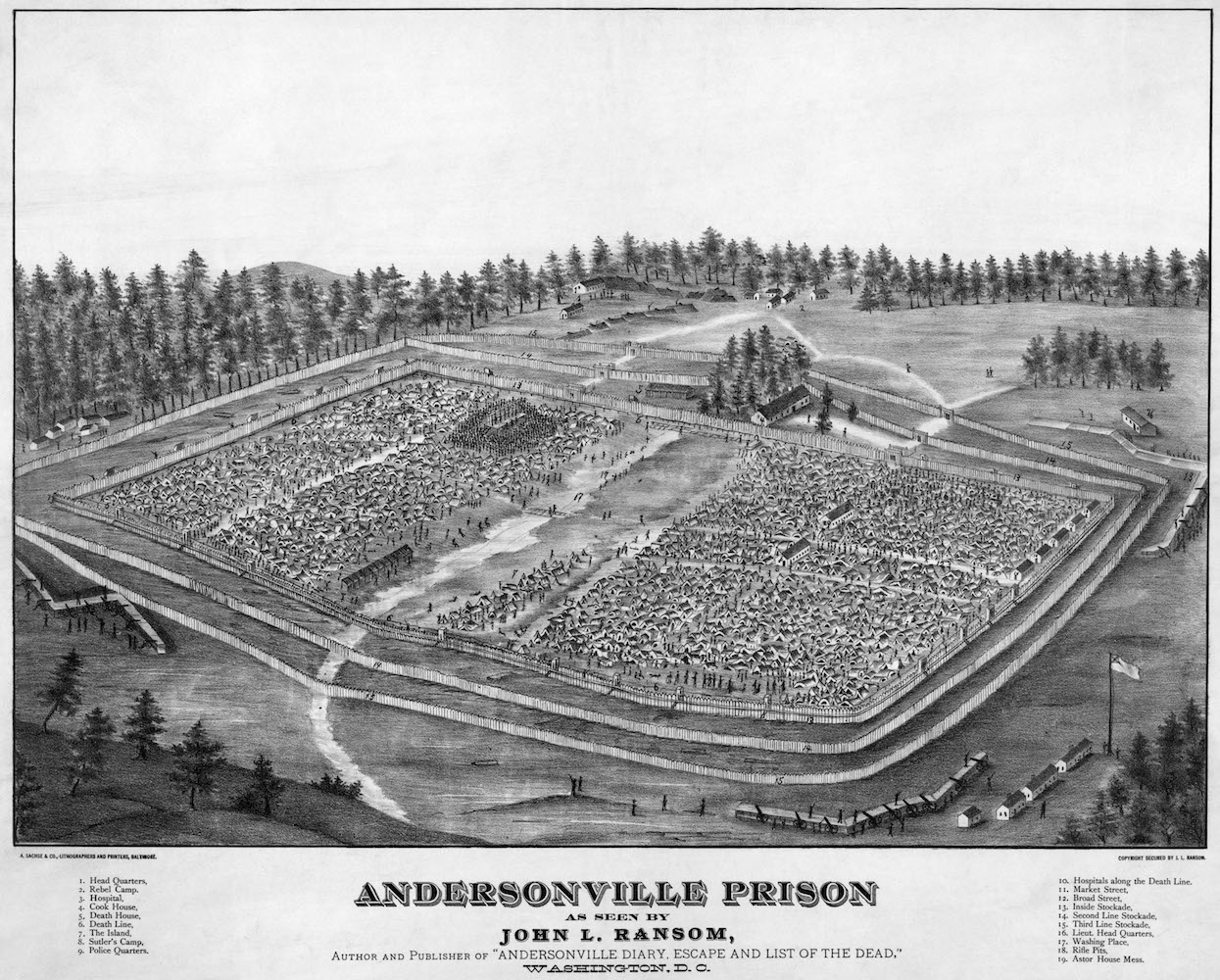

Detail of a panorama sketch of Andersonville (click to see it) makes space for a certain well-attended sextuple hanging.

The ringleaders were also among this bunch. They were assembled on July 11 and executed at a hastily-erected gallows on the north end of camp. As far as the POWs were concerned, the ultimate crime of the Raiders was a violation of the soldier code of death before dishonor. Their bodies were buried separately from other inmates, and the US makes a point of placing no memorial flags at their graves.

To be clear, the Andersonville Raiders were, for most inmates, not the primary problem but an obviously controllable one. Remember that 30% of the interned died, and for the most part those deaths were borne of bad sanitation, hunger, and disease. The removal of the Raiders was a morale boost at best, as Andersonville was still a pee-pee soaked heckhole in which another 10,000 soldiers would die before liberation in May 1865, most of them before the summer’s end.

* It was also known as Camp Sumter, named after the county it resided in.

** The population density at peak was 330,000 people per square kilometer. For comparison, the world’s densest city is Manila, at about 71,000 people per square kilometer.

† It turns out the term “shebang” wasn’t widely-used camp lingo. Drawings and photos of the camp illustrate the variety of dwellings: open sleeping, simple V-tents, structured tents, lean-tos, huts, and shacks were all scattered about the grounds.

‡ They also came with new diseases.

§ The original camp was actually only 16.5 acres, and the population ballooned to 20,000 in early June and 33,000 in August of that year. Ransom notes that the stockade was “enlarged” on July 6. Fall transfers dropped the number to 1,500 and it bumped back up to 5,000 until war’s end. Sanitation issues persisted throughout.

On this day..

1880: A day in the death penalty around the U.S.

A half-dozen murderers hanged in five different U.S. states on this date in 1880.


Cincinnati Commercial Tribune, July 10, 1880. We make the count six, not four.

George Allen Price (Pennsylvania)


Harrisburg (Penn.) Patriot, July 10, 1880.

George Sanford and Richard McKee (Arkansas)


Columbus (Ga.) Daily Enquirer, July 13, 1880.

Alexander Howard (North Carolina), Daniel Washington (South Carolina), and Henry Ryan (Georgia)

(Note: Henry Ryan’s execution is missing from the Espy File of U.S. executions.)

On this day..

1828: William Rice but not John Montgomery, who cheated the hangman with prussic acid

(Thanks to Meaghan Good of the Charley Project for the guest post. -ed.)

Just before 6:00 a.m. on July 4, 1828, prison officers arrived at the cell of disgraced ensign John Burgh Montgomery in Newgate Prison‘s condemned hold.

They were there to escort Montgomery to his hanging. The 33­-year-­old would have been one of the last in England executed for for the crime of uttering forged notes — except that his wardens instead found him lying stone dead. With the aid of prussic acid, the counterfeiter had cheated the hangman of half his day’s prey, leaving his prospective gallows partner, thief William Rice, to face the hemp alone.

Although his guards had confiscated his razor and penknife as a routine precaution against suicide, no one had expected Montgomery to take his own life. He had pleaded guilty before the court and seemed resigned to his fate. In custody he was a model prisoner, spent his last days writing to his loved ones, and “addressed himself with great anxiety to his religious offices.”

Nobody was able to figure out how the condemned man came by enough poison to kill thirty people and how he kept it hidden, given that he and his cell were regularly searched.

The Irish-­born Montgomery, Nicola Sly records in her book Goodbye, Cruel World… A Compendium of Suicide,

was said to be a very respectable, well­-educated man, who had once held a commission in the Army. However, after inheriting a considerable fortune, he frittered it away and resorted to passing phony banknotes to support his rather dissipated lifestyle. Given his pleasing looks, gentlemanly appearance and good manners, he was very successful, since nobody thought him capable of any wrongdoing. However, he was caught after becoming careless and making the mistake of committing frequent repeated offense in a small geographical area of London.

Montgomery left behind several letters, marked by expansive tragic romanticism but no hint of suicidal intent. One letter was for the prison surgeon, asking that his body be used for dissection. He said that by this he wanted to provide some positive contribution to the public to make up for his crimes. He asked that his heart be preserved in spirits and given to his girlfriend.

To the girlfriend he wrote,

My dear idolized L.,

One more last farewell, one more last adieu to a being so much attached to the unhappy Montgomery. Oh, my dearest girl. If it had been in the power of anyone to avert my dreadful doom, your kind exertions would have been attended with such success. Oh, God, so poor Montgomery is to die on the scaffold. Oh, how dreadful have been my hours of reflection, whilst in this dreary cell.

Oh, how tottering were all my hopes; the bitterness of my reflection is bitter in the extreme. This will be forwarded to you by my kind friend Mrs. D. I should wish you to possess my writing portmanteau. Oh, I wished to have disappointed the horrid multitude who will be assembled to witness my ignominious exit. Farewell forever,

P.S. Here I kiss fervently.

The jury on the inquest into Montgomery’s death recorded a verdict of felo de se, meaning that Montgomery had willfully and knowingly taken his own life whilst of sound mind. As such, his body was buried in the graveyard of St. Sepulchre­-without-Newgate at night, and without any memorial service.

On this day..

1681: Archbishop Oliver Plunkett, the last Catholic martyr in Great Britain

Archbishop Oliver Plunkett earned the last Catholic martyr’s crown in Britain on this date in 1681.*

Product of County Meath blood and Italian seminary, Plunkett had been back floating around Ireland as its chief prelate since 1670. In this decade, the English-imposed laws burdening Catholics had been relaxed; Plunkett was able to minister his flock, openly at first and after 1673 as a fugitive whom Irish authorities did not much wish to pursue.

Plunkett’s safety speedily expired with the emergence in England of the Popish Plot, a security panic catalyzed like its modern-day analogues by equal parts bad faith and malice.

The concoctions of an opportunistic fabulist caused the English populace to become convinced in 1678 that a vast and treasonable Catholic conspiracy menaced the land; in its day, it was a delusion held so widely and deeply as to cow into silence and compliance all skeptics, even King Charles himself. Charles’s Lord Lieutenant in Ireland, the Earl of Essex, cynically leaned into the hysteria by whipping fears of a Plunkett-hatched invasion of Ireland by the French, although he well knew that Plunkett was “of a … peaceable temper & … comforable to ye Government.”

Plunkett spent months in hiding, refusing to flee Ireland, until he was finally arrested in December 1679. After proceedings in Ireland collapsed, the prelate was moved to London for a more manageable show trial, the entire transcript of which can be perused here.

In it, the Lord Chief Justice Sir Francis Pemberton chastises Plunkett for soliciting time to collect his witnesses, and concludes with a denunciation of the enemy religion that would not look far out fo place in many a present-day comments section.

truly yours is Treason of the highest Nature, ’tis a Treason in truth against God and your King, and the Country where you lived. You have done as much as you could to dishonour God in this Case; for the Bottom of your Treason was, your setting up your false Religion, than which there is not any Thing more displeasing to God, or more pernicious to Mankind in the World. A Religion that is ten Times worse than all the Heathenish Superstitions; the most dishonourable and derogatory to God and his Glory, of all Religions or pretended Religions whatsoever, for it undertakes to dispense with God’s Laws, and to pardon the Breach of them. So that certainly a greater Crime there cannot be committed against God, than for a Man to endeavour the Propagation of that Religion; but you to effect this, have designed the Death of our lawful Prince and King: And then your design of Blood in the Kingdom where you lived, to set all together by the Ears, to destroy poor innocent People, to prostitute their Lives and Liberties, and all that is dear to them, to the Tyranny of Rome and France.

Now tormented that his opportunistic fear-mongering was actually going to lay the archbishop in his grave, Essex implored the Catholic-sympathetic King Charles to spare Plunkett. “Then, my lord, be his blood on your own conscience,” snapped Charles, politically constrained from a beneficence he would have dearly loved to grant. “You could have saved him but would not, I would save him and dare not.”

On the first of July, he was drawn to Tyburn (a stained glass depiction of it can be found in this post), where he was hanged and quartered. (The strange Anglo-Irish plotter Edward Fitzharris preceded Plunkett on the scaffold, as an undercard attraction.) “He won more credit and repute, as well for himself as for his country, by one hour of suffering, than he could have acquired perhaps by hundreds of years of life,” one observer wrote.

This might very well be so. Aside from being the last Catholic martyr in the Isles, Plunkett is among the most warmly remembered, as evidenced by his recent remit as the patron saint of peace and reconciliation in post-Troubles Ireland — not to mention the loving preservation of his relics at St. Peter’s cathedral in Drogheda.

Readers might enjoy this 68-minute lecture on Plunkett’s life and times.


St. Oliver Plunkett’s head preserved in a shrine at Drogheda, Ireland. Photo by DAVID ILIFF. License: CC-BY-SA 3.0

* July 1 by the Julian calendar still then employed in England; by the Gregorian calendar adopted in most Catholic countries at this point, the date was July 11 — and some Catholic primary sources use the latter date.

On this day..

1797: Richard Parker, for the Nore mutiny

On this date in 1797, a president of the floating republic was put to death by an empire of the lash.

The occasion brings us to the era of Great Britain’s protracted war with Revolutionary France. That war’s essential factor from the British point of view was the navy — crewed in its turn by an immiserated working class, sometimes forcibly impressed, and drawing pay on a schedule that had been set in 1658.

In April 1797, after a wage grievance was dismissed out of hand by the Admiralty, the crew of the Channel Fleet mutinied at Spithead, near Portsmouth. For “mutiny” here, think less H.M.S. Bounty* and more labor strike: keeping discipline within their ranks, they used the leverage of refusing to put out to sea to successfully negotiate that pay rise, as well as the transfer of some distasteful officers who went otherwise unharmed. The Spithead mutiny contributes no execution to our pages.


This hostile caricature of the Spithead mutineers nevertheless depicts — however incredulously — the common sailors’ degree of organization.

However, in its waning days in May, a sympathy mutiny ensued at the fleet lying at an anchorage at the mouth of the Thames, called the Nore. These Spithead and Nore mutinies are generally taken together since they had the same grievances … but their resolutions were very different.

The Nore mutiny, less united and disciplined than that at Spithead, saw several ships at Nore mutiny and elect as their leader this post’s principle character, Richard Parker. Parker was an intelligent, veteran sailor with some history of sticking his neck out for better working conditions. He would always insist that he had no part of the mutiny’s planning and was appointed its leader by surprise; whether or not this was so, he exercised his newfound office, President of the Delegates of the Fleet, as best he could. It was a fraught situation; each ship had its own delegates (hence Parker’s title) who did not always agree, and there were radical and moderate factions, and a proclivity among ships inclining to the latter to slip away from the mutinied fleet even as their erstwhile comrades fired upon them.

But the most perilous function demanded of Parker was to present mutineers’ demands to the Admiralty, whose perspective was that the fleet’s complaints had already been disposed of via Spithead — especially when the Nore demands expanded to include peace with France. The mutiny collapsed, and Parker was marched to Maidstone Prison to the jeers of Londoners.

Even the Newgate Calendar, scold for the status quo, could not resist admiring Parker’s bearing, “throughout the whole of his trial … firm and manly; while he was before the Court, decent and respectful, and from the time he received his sentence, till his execution, resigned and penitent” even while abhorring his “wretched existence.”

After a solemn pause of nearly ten minutes the Lord Advocate rose and, with his head uncovered, read the awful sentence — viz. “The Court judges Richard Parker to suffer death, and to be hanged by the neck, on board any one of his Majesty’s ships, and at such time as the Lords of the Admiralty may think proper to appoint.”

The prisoner listened to the sentence without emotion, and addressed the Court as follows: — “I have heard your sentence; I shall submit to it without a struggle. I feel thus, because I am sensible of the rectitude of my intentions. Whatever offences may have been committed, I hope my life will be the only sacrifice. I trust it will be thought a sufficient atonement. Pardon, I beseech you, the other men; I know they will return with alacrity to their duty.”

The president then briefly addressed himself to the prisoner. He said that, notwithstanding the enormity of the crimes of which he had been found guilty, on the fullest and clearest evidence, yet the Court, in order to afford him the necessary time to expiate his offences, and to make his peace with God, would then not name any day for his execution, but leave that point to the determination of the lords of the admiralty. The prisoner then withdrew, and was soon put in irons.

The time of his execution was fixed for Friday, the 30th of June. 1797. At eight o’clock in the morning a gun was fired on board his Majesty’s ship L’Espion, lying off Sheerness garrison, Vice-Admiral Lutwidge‘s flagship, and the yellow flag, the signal of capital punishment, was hoisted, which was immediately repeated by the Sandwich hoisting the same colour on her foretop.

The prisoner was awakened a little after six o’clock, from a sound sleep, by the provost-marshal, who, with a file of marines, composed his guard; he arose with cheerfulness, and requested permission might be asked for a barber to attend him, which was granted. He soon dressed himself in a neat suit of mourning (waistcoat excepted), wearing his half-boots over a pair of black silk stockings. He then took his breakfast, talked of a will he had written, in which he had bequeathed to his wife a little estate he said he was heir to, and after that lamented the misfortune that had been brought on the country by the mutiny, but solemnly denied having the least connection or correspondence with any disaffected persons ashore; and declared that it was chiefly owing to him that the ships had not been carried into the enemy’s ports. [a threat to sail to France was part of Nore mutiny negotiations]

At half past eight he was told the chaplain of the ship was ready to attend him to prayers upon the quarter-deck, which he immediately ascended, uncovered: at his first entrance on the deck he looked a little paler than corn mon, but soon recovered his usual complexion; he bowed to t lie officers, and, a chair being allowed him, he sat down for a few moments: he then arose, and told the clergyman he wished to attend him: the chaplain informed him he had selected two psalms appropriate to his situation; to which the pris oner, assenting, said, “And with your permission, sir, I will add a third,” and named the 51st. He then recited each alternate verse in a manner peculiarly impressive.

At nine o’clock the preparatory gun was fired from L’Espion, which he heard without the smallest emotion. Prayers being soon after closed, he rose, and asked Captain Moss “if he might be indulged with a glass of white wine”: which being granted, he took it, and, lifting up his eyes, exclaimed, “I drink first to the salvation of my soul! and next to the forgiveness of my enemies!” Addressing him self to Captain Moss, he said, “he hoped he would shake hands with him”; which the captain did: he then desired “that he might be remembered to his companions on board the Neptune; with his last breath sent an entreaty to them to prepare for their destiny, and refrain from unbecoming levity.” His arms were now bound, and the procession moved from the quarterdeck to the forecastle, passing through a double file of marines on the starboard side, to a platform erected on the cat-head, with an elevated projection. Arriving there, he knelt with the chaplain, and joined in some devout ejaculations, to all of which he repeated loudly, “Amen.” Rising again, the Admiral’s warrant of execution, addressed to Captain Moss, was now read by the clerk, in which the sentence of the court martial, the order of the Board of Admiralty and his Majesty’s approbation of the whole proceedings were fully recited, which the prisoner heard with great attention, and bowed his head, as if in assent, at the close of it. He now asked the captain whether he might be allowed to speak, and immediately apprehending his intention might be misconceived he added: “I am not going, sir, to address the ship’s company. I wish only to declare that I acknowledge the justice of the sentence under which I suffer; and I hope my death may be deemed a sufficient atonement, and save the lives of others.”

He then requested a minute to collect himself, and knelt down alone, about that space of time; then rose up and said: “I am ready.” Holding his head up, he said to the boatswain’s mate: “Take off my handkerchief (of black silk); which was done, and the provost-marshal placed the halter over his head (which had been prepared with grease,) but, doing it awkwardly, the prisoner said rather pettishly to the boatswain’s mate, “Do you do it, for he seems to know nothing about it.” The halter was then spliced to the reeve-rope: all this being adjusted, the marshal attempted to put a cap on, which he refused; but, on being told that it was indispensable, he submitted, requesting it might not be pulled over his eyes till he desired it. He then turned round, for the first time, and gave a steady look at his shipmates on the forecastle, and, with an affectionate kind of smile, nodded his head, and said “Good-by to you!” He now said, “Captain Moss, is the gun primed?” — “It is.” — “Is the match alight?” — “All is ready.”– On this he advanced a little, and said, “Will any gentleman be so good as to lend me a white handkerchief for the signal?” After some little pause, a gentleman stepped forward and gave him one; to whom bowing, he returned thanks. He now ascended the platform, and repeated the same questions about the gun. He now ascended the platform. The cap was then drawn over his face, and he walked by firm degrees up to the extremity of the scaffold, and dropped a white handkerchief, which he had borrowed from one of the gentlemen present, and put his hands in his coat-pockets with great rapidity. At the moment he sprang off, the fatal bow-gun fired, and the reeve-rope, catching him, ran him up, though not with great velocity, to the yardarm. When suspended about midway his body appeared extremely convulsed for a few seconds, immediately after which no appearance of life remained.

It being ebb of tide, the starboard yard-arm pointed to the Isle of Grain, where scaffolding was erected for the spectators on shore; a considerable number of yachts, cutters, and other craft, surrounded the Sandwich. The last time the prisoner knelt with the chaplain at the cat-head, though he made his responses regularly, his attention was particularly directed the whole time to the armed boats of the fleet, which were plying round on duty. The whole conduct of this awful ceremony was extremely decorous and impressive; it was evident, from the countenances of the crew of the Sandwich, that the general feeling for the fate of their mutinous conductor was such as might be wished: not a word, and scarce a whisper, was heard among them.


The Newgate Calendar’s illustration of Parker’s execution.

Parker was not mistaken to warn his compatriots to brace for punishment, and his hope that his would be the only life paid in forfeit was sorely disappointed. Twenty-nine more men were hanged as Nore mutineers, in addition to a number of others imprisoned, flogged, or transported. (The Sydney, Australia suburb of Redfern is named for the transported Nore mutineer who once owned the land.)

* Speaking of the Bounty, its old notorious captain William Bligh in 1797 captained one of the mutinied ships at the Nore, on which occasion Bligh discovered “that his common nickname among men in the fleet was ‘that Bounty Bastard’.”

On this day..

1766: Don Francis de Sallesar y Corvetto

A letter from Aranjuez, dated June 30, says,

Don Francis de Sallesar y Corvetto, a native of Murcia, where his father was regidor, was on Friday publicly degraded at Madrid from the rank of nobility, had his tongue and his right hand cut off, and afterwards was hanged. His crime was assassinating some persons, and having formed the horrid design of laying his sacrilegious hands upon the king and the royal family.

On this day..

1685: Richard Rumbold, owner of the Rye House

On this date in 1685, Roundhead militant Richard Rumbold — known affectionately to his comrades from the English Civil War as “Hannibal”, since he shared with the great Carthaginian general the distinction of an eye lost on campaign — was beheaded at Edinburgh‘s Mercat Cross.


J.M.W. Turner watercolor of the Rye House circa 1793.

Rumbold was the owner of the Rye House in Hertfordshire, the manor which in the 1680s would become famous as a regicidal adjective: the titular epicenter of the Rye House Plot. Hannibal Rumbold had intended to station a force of armed men on his grounds with the intent to kidnap/assassinate King Charles II and his Catholic brother and heir presumptive, James as they returned to London from horse races at Newmarket. When fire struck Newmarket, the royal party’s plans changed and the plot never came off … but it was discovered some weeks later and yielded an ample harvest of heads. Rumbold escaped to the continent for a time but was none repentant about it when taken, saying “he did not neither durst repent for it, but on the contrair that if all the hair of his head were men, he would venture them all for the cause.”

In this instance, it also yielded some edifying scaffold oratory, and this man’s parting sentiment that “this is a deluded generation, veiled with ignorance … for none comes into the world with a saddle on his back, neither any booted and spurred to ride him” was of interest to British Whigs and American revolutionaries a century later. It plays much better lo these many years later with ellipsis in place of the “popery” stuff which occurs between, but judge for thyself: here follow Rumbold’s erudite owns in context via an open source volume which has the address titled “Against Booted and Spurred Privilege”

Gentlemen and Brethren: —

It is for all men that come into the world once to die; and after death the judgment! And since death is a debt that all of us must pay, it is but a matter of small moment what way it be done. Seeing the Lord is pleased in this manner to take me to himself, I confess, something hard to flesh and blood, yet blessed be his name, who hath made me not only willing, but thankful for his honoring me to lay down the life he gave, for his name; in which, were every hair in this head and beard of mine a life, I should joyfully sacrifice them for it, as I do this. Providence having brought me hither, I think it most necessary to clear myself of some aspersions laid on my name; and, first, that I should have had so horrid an intention of destroying the King and his brother … It was also laid to my charge that I was antimonarchical. It was ever my thoughts that kingly government was the best of all where justly executed; I mean, such as it was by our ancient laws; — that is, a King, and a legal, free-chosen Parliament, — the King having, as I conceive, power enough to make him great; the people also as much property as to make them happy; they being, as it were, contracted to one another! And who will deny me that this was not the justly-constituted government of our nation? How absurd is it, then, for men of sense to maintain that though the one party of his contract breaketh all conditions, the other should be obliged to perform their part? No; this error is contrary to the law of God, the law of nations, and the law of reason. But as pride hath been the bait the devil hath caught most by ever since the creation, so it continues to this day with us. Pride caused our first parents to fall from the blessed state wherein they were created, — they aiming to be higher and wiser than God allowed, which brought an everlasting curse on them and their posterity. It was pride caused God to drown the old world. And it was Nimrod‘s pride in building Babel that caused that heavy curse of division of tongues to be spread among us, as it is at this day, one of the greatest afflictions the Church of God groaneth under, that there should be so many divisions during their pilgrimage here; but this is their comfort that the day draweth near where, as there is but one shepherd, there shall be but one sheepfold. It was, therefore, in the defense of this party, in their just rights and liberties, against popery and slavery —

[Being here interrupted by drum beating, he said that they need not trouble themselves, for he should say no more of his mind on that subject, since they were so disingenuous as to interrupt a dying man. He then continued: –]

I die this day in the defense of the ancient laws and liberties of these nations; and though God, for reasons best known to himself, hath not seen it fit to honor us, as to make us the instruments for the deliverance of his people, yet as I have lived, so I die in the faith that he will speedily arise for the deliverance of his Church and people. And I desire of all you to prepare for this with speed. I may say this is a deluded generation, veiled with ignorance, that though popery and slavery be riding in upon them, do not perceive it; though I am sure there was no man born marked of God above another; for none comes into the world with a saddle on his back, neither any booted and spurred to ride him; not but that I am well satisfied that God hath wisely ordered different stations for men in the world, as I have already said; kings having as much power as to make them great and the people as much property as to make them happy. And to conclude, I shall only add my wishes for the salvation of all men who were created for that end.

After hanging, they quartered his parts and pinned them up as a warning.

On this day..

2011: Ruyati binti Sapubi, migrant worker beheaded on film

Indonesian migrant worker Ruyati binti Sapubi was beheaded in Mecca on this date in 2011 for the meat cleaver murder of her mistress. She numbered among the several hundred thousand Indonesian women hired as domestic servants in the Gulf kingdom.

“The maid carried out the killing after she was denied permission to leave the kingdom and return to her family in Indonesia, according to officials in Jakarta,” according to press reports on the very sketchy details allowed by Riyadh.

The mild and passive voice here conveys a wild overreaction by the help, but a moment’s consideration of the scenario — a terribly vulnerable imported domestic worker disallowed from leaving her job — puts matters into a different light. (To add diplomatic insult to injury, the Saudis failed to inform Indonesia when the actual execution was imminent.)

Indeed, just days after the execution, word leaked of a Sri Lankan domestic who had been secretly held in outright slavery for 14 years.

Mature Content: The execution was secretly recorded. This is a snuff film.

The Indonesian government slapped an immediate moratorium on overseas work in Saudi Arabia in the aftermath of this horror. Unfortunately, these and similar measures in the 2010s have only compounded the risk of trafficking, increasing the vulnerability of people desperate to secure work abroad.

On this day..

1581: Christman Genipperteinga

June 17 of 1581 was the alleged condemnation date — the best specific calendar date we have — for the German robber/murderer Christman Genipperteinga or Gniperdoliga, who was broken on the wheel for a reported 964 murders.


See? June 17.

A 1581 pamphlet “Erschröckliche newe Zeytung Von einem Mörder Christman genandt” is the earliest account we have of our inaptly named Christman (German Wikipedia entry | the surprisingly much more detailed English), and even this first source supplies us the seemingly outlandish body count.

Our man is supposed to have made a lair in the Rhineland wilds from which he preyed on German and French travelers, and even turned murderer of other bandits after partnering with them.

We of course lack any means to verify independently this murder toll exceeding six per month throughout the whole of his thirteen-year career; if we’re honest about it, we’re a little light on verification that this guy wasn’t a tall tale from the jump. Whether or not he really drew breath, or profited from the pre-modern propensity to overcounting bodies, his fame was certainly magnified by the burgeoning print culture … and its burgeoning fascination with crime. Joy Wiltenburg in Crime & Culture in Early Modern Germany:

It was in the 1570s that reports of robber bands multiplied, reaching a peak in the 1580s and continuing in lower numbers into the seventeenth century. Accounts of such activity were far-flung, from Moravia in the modern Czech Republic to Lucerne in Switzerland and from Wurttemberg in southwestern Germany to Bremen in the north. Although violence and malevolent magic were the most sensational aspects of the bands’ reported activities, stealing was central to their existence.

Even among these ubiquitous broadsheet outlaws, Christman Genipperteinga’s near-millennium stuck in the public imagination.

As years passed, the story has resurfaced in chronicles, histories, and popular lore running all the way down to our present era of listicle clickbait … and they’ve all somehow made this monster into an even more sinister figure than a mere nongenti sexagintuple slayer. Dubious evolutions include:

  • Genipperteinga kidnapping a woman and forcing her to become his mistress, murdering all the children they produced. (She subsequently betrays him to the authorities by arranging to leave a trail of peas to lead them to his hideout.)
  • Genipperteinga cannibalizing his victims, including his own infants.
  • And, Genipperteinga having literal supernatural powers (invisibility, congress with dwarven artificers).

For a larger-than-life criminal, a longer-than-death execution. The story goes that our Christman endured nine agonizing days on the breaking-wheel, his tormentors fortifying him with hearty drinks every day in order to prolong his sufferings.

Again, this real or fanciful detail profits by comparison to the trends in enforcement emerging to meet the social panic over crime. This was a period when Europe saw the death penalty flourish both in terms of its violent spectacle and, as Wiltenburg notes, its raw frequency:

There is some evidence that the swell in crime reports in the later decades of the sixteenth century coincided with a time of generally intense prosecution. According to figures compiled by Gerd Schwerhoff, a number of localities had especially high levels of execution in this period. Augsburg, for example, shows a distinct rise in the proportion of criminals executed in the last four decades of the sixteenth century — double or more the proportions of the preceding and following periods. Nuremberg too had a substantial rise in the last decades of the sixteenth century, with lower numbers before and much lower figures by the mid-seventeenth century. Zurich similarly executed a much higher proportion in the sixteenth century than in the fifteenth or the seventeenth, although its figures are not broken down by decade.

On this day..

1866: Barthelemy Cellier, true sangfroid

Dying graciously is a — in that blessed space of unfeigned equanimity, in between fright and bluster — is a difficult art. On this date in 1866, the central France town of Riom guillotined an otherwise forgettable criminal who attained that Stoical condition.

By the account of La Petit Journal (French, obviously), double murderer Barthelemy Cellier was awoken at 3 a.m. on the morning of his beheading, with news of the rejection of his appeals. “Ah, ah,” said Cellier calmly, “it’s today!” Well, it’s as good today as it is tomorrow!”

Cellier listened to the curé “avec beaucoup de calme”, called for a glass of Bourdeaux wine and a cigarette, and then,

bare-headed, dressed in the prison outfit: gray trousers, white clogs, a gray jacket thrown over his shoulders, smoking his cigarette, walked with a firm step between the two ecclesiastics … Behind came the executioners and mounted gendarmes.

The course was about two hundred meters. Throughout this journey, Cellier’s face was marked by the most perfect serenity; a gracious smile wandering in his eyes and on his lips gave him rather the countenance of a man walking towards his deliverance than of a criminal going to execution.

The scaffold was surrounded by a large number of people from Riom and the surrounding area; but, thanks to excellent preparation, the dismal machine was separated from the crowd by fifty yards at least. Detachments of soldiers rigorously maintained this perimeter.

Arriving at the foot of the scaffold, Cellier raised his head and looked, without pallor, the fatal cleaver.

He threw out his cigarette and crushed it with his foot.

Then, turning to the honorable priests, he spoke for a few seconds with them, kissed both effusively and climbed alone with a sure stride the steps separating him from the platform.

There, with a sudden movement, he dropped the jacket which hid his shoulders, and having with a glance examined the crowd, without bravado, without affectation, always with the same calm and the same smile, he twice graciously greeted the apparatus. Not a single word was spoken. The hour had just tolled. A sudden noise, immediately accompanied by a few women’s comments and a shriek from the crowd, announced that the supreme act had been accomplished. Cellier’s spirit had not been broken for a moment. He died demonstrating true sangfroid. The crowd slowly went away, deeply moved by the dreadful drama which had just been broken up in a few seconds.

On this day..