1689: Sambhaji, Maratha king

On this date in 1689, the Maratha prince Sambhaji was put to a grisly death by Mughal Emperor Aurangzeb.*

Sambhaji was the firstborn son of the man whose daring had created the Hindu Maratha state — and whose death in 1680 seemed to the neighboring Muslim Mughals the right invitation to destroy this nascent rival.

The Mughals were right to worry, for in the 18th century the Maratha polity would grow into an empire dominating the Indian subcontinent, and drive the Mughals into a long decline.

But in the 1680s, it was the Maratha on the back foot as Aurangzeb invaded their haunts on the Deccan Plateau, steadily albeit very slowly reducing Maratha fortresses over the course of the decade (and the next decade).

This war defined Sambhaji’s reign, and ended it too, when he was at last captured with his favorite aide Kavi Kalash in Sangmeshwar. Mockingly dressed up as buffoons, they were paraded through Mughal territory to the emperor, who would present them a demand for Islamic conversion as the price of their lives.

But the doomed wretches knew that, after all, their heads would fall upon the scaffold, or that, if by abject submission and baseness, they escaped death, they would be kept in confinement deprived of all the pleasures of life, and every day of life would be a new death. So both Sambha and Kabkalas indulged in abusive language, and uttered the most offensive remarks in the hearing of the Emperor’s servants … [Aurangzeb] gave orders that the tongues of both should be cut out, so that they might no longer speak disrepsectfully. After that, their eyes were to be torn out. Then, with ten or eleven other persons, they were put to be put to death with a variety of tortures, and lastly he ordered that the skins of the heads of Sambha and Kabkalas should be stuffed with straw, and exposed in all the cities and towns of the Dakhin, with beat of drum and sound of trumpet. Such is the retribution for rebellious, violent, oppressive evil-doers. (Source — British, it must be said)

Sambhaji has not been highly rated for his indifferent internal governance of Maratha, but the clarifying allure of war and the gruesomely patriotic manner of his death earned him hero’s laurels still honored by Hindu nationalists down to the present day; the village of Tulapur where he was put to death honors Sambhaji with several monuments.

For a contemporary — like, say, Aurangzeb — Sambhaji’s death followed closely by the capture of his family when the Maratha capital succumbed to Mughal siege must have appeared to presage the destruction of his state. Things didn’t work out that way: Sambhaji’s younger brother Rajaram and especially Rajaram’s impressive queen Tarabai kept the Mughals bogged down on the Deccan, bleeding money** and time as they struggled to complete the conquest — until by Aurangzeb’s own despondent death in 1707, it was the Maratha on the advance, and the Mughal Empire on the brink of its own collapse.

* Aurangzeb was the son of the man who built the Taj Mahal. He’d needed some violence of his own to claim the Mughal throne from his brothers.

** “The expense in gold and rupees can hardly be accurately estimated. Aurangzeb’s encampment was like a moving capital — a city of tents 30 miles in circumference, with some 250 bazaars, with a ½ million camp followers, 50,000 camels and 30,000 elephants, all of whom had to be fed, stripped the Deccan of any and all of its surplus grain and wealth.” –Stanley Wolpert

On this day..

1984: Ten members of the Tudeh party

On this date in 1984, the Islamic Republic of Iran completed its destruction of the Tudeh party with ten executions.

In the 1940s, the Tudeh was Iran’s largest mass party and a fair bet to take power in the near future but state repression after Mossadegh was overthrown in 1953 had largely driven the Communist movement to the skulking margins.

Its fragments hung on underground, preparing and organizing for the proletarian revolution — an orientation that would leave the Tudeh entirely unprepared for the Iranian Revolution that really occurred. In fairness, few from Tehran to Moscow to Washington could read those tea leaves: who in the winter of the Cold War anticipated a great regional prize like Iran being captured by … the mullahs?

The Revolution released the once-banned party onto terra incognita as a minor outlet for leftward sentiment and perhaps a show of democratic good faith. But from the start it awkwardly existed on sufferance of an entirely incompatible regime. The venerable English journalist Robert Fisk, who covered the Iranian Revolution, filed a wry dispatch for the Times (Nov. 26, 1979) from the Tehran offices of Tudeh leader Nouredin Kianouri — unconvincingly trying to position his own movement within the events sweeping everyone along.

Tudeh is involved in “the radical struggle against imperialism”, and “the struggle for the reorganization of social life, especially for the oppressed strata of society” … and in so far as it is possible, Tudeh — Iran’s oldest political party — stands for the same things as Ayatollah Khomeini.

That, at least, is the theory: and Mr Kianouri holds to it bravely.

Tudeh demands a “popular front” government in Iran and Mr Kianouri professes to see little difference between this and Ayatollah Khomeini’s desire for national unity. “Popular Front”, however, is not an expression that has ever crossed the Imam’s lips and it is difficult to see how Iran’s new fundamentalist religious administration could form any cohesion with the materialist aims of Mr Kianouri’s scientific Marxism.

The article’s headline was “Ayatollah tolerates Communists until they become too popular,” but Tudeh never fulfilled its clause: it was blown out in the 1980 election, failing to win even a single seat, and maneuvered ineffectually for two years until a crackdown shattered its remnants with over 1,000 arrests early in 1983,* heavily targeting Tudeh-sympathizing army officers.** (The aforesaid Mr. Kianouri was forced to make a humiliating televised self-denunciation in 1983, although he surprisingly avoided execution.)

Those arrests culminated in a large show trial of 101 Tudeh principals in December 1983-January 1984, followed by smaller trials of lesser Tudeh figures in several cities over the months to come.

Eighty-seven Tudeh officials caught prison sentences ranging from eight months to life; these “lucky” ones, along with hundreds of other Tudeh adherents arrested in the years to come, would later be well-represented among the victims of Iran’s 1988 slaughter of political prisoners.

That left ten† reserved for execution on February 25 on charges compassing espionage, treason, and the weapons they had once naively stockpiled to fight against a monarchist coup. Notable among them were four high-ranking military officers: Col. Houshang Attarian, Col. Bezhan Kabiri, Col. Hassan Azarfar, and the chief catch, former Navy Commander Admiral Bahram Afzali.

Formally banned in Iran, the Tudeh party does still exists to this day, an exile shadow of its former glory.

* The U.S., officially abhorred of Iran, was in this period covertly aiding Tehran to raise funds to illegally bankroll Central American death squads — the Iran-Contra scandal. According to the American Tower Commission investigation of those events, the Tudeh were one of the lesser casualties this foreign policy misadventure when U.S. intelligence about the Tudeh network, largely obtained via a KGB defector, was passed to Tehran as a pot-sweetener: “In 1983, the United States helped bring to the attention of Tehran the threat inherent in the extensive infiltration of the government by the communist Tudeh Party and Soviet or pro-Soviet cadres in the country. Using this information, the Khomeini government took measures, including mass executions, that virtually eliminated the pro-Soviet infrastructure in Iran.” (See Appendix B here.)

** Iran at this moment was two years deep into its war with Saddam Hussein‘s Iraq, having in 1982 stalled out with a bloody and ineffectual offensive.

Other background of note: a different, Maoist party had in early 1982 launched a failed rising against the Islamic Republic.

† This doesn’t add up to 101. According to Tortured Confessions: Prisons and Public Recantations in Modern Iran, “when a Japanese correspondent asked why the numbers of those sentenced did not tally with those originally brought to trial, he [Mohammed Reyshahri] hedged, it was rumoured some had died during their interrogation.”

On this day..

1944: Missak Manouchian and 21 French Resistance members, l’Affiche Rouge

On this date in 1944, 22 members of the anti-Nazi French Resistance’s “immigrant movement” Francs-tireurs et partisans – main-d’œuvre immigrée (FTP-MOI) were executed by firing squad on the outskirts of Paris.

Comprised of foreign communists whose backgrounds amply motivated them to desperate resistance, FTP-MOI was a notably aggressive partisan unit; a few months before this date’s executions, it had stunningly assassinated SS Col. Julius Ritter on the streets of Paris. Risky tactics, including larger-scale operations like the one that claimed Ritter (these required more partisans to know each other) entailed greater risk of penetration, and the November 1943 arrest of the Armenian commander Missak Manouchian and his group devastated FTP-MOI. After the customary interlude of torture, these were subjected to a show trial with 23 condemned to execution.*

As a gaggle of foreign terrorists, heavily Semitic, this clique looked to the occupation like a marvelous tar with which to blacken the Resistance. To that end the Germans produced a scarlet poster denouncing the Resistance as an “Army of Crime,” its soldiery labeled with strange names and alien nationalities converging on the swarthy Manouchian.**

Soon known as l’Affiche Rouge, the poster instead apotheosized its subjects. In the postwar period it became an emblem of the best of the Resistance — its multinational unity, France as an idea powerful enough that men and women of distant birth would give their lives for her. (Not to mention the postwar French Communists’ claim on le parti des fusillés.)

To this day in France, the backfiring propaganda sheet is one of the best-recognized artifacts of the Resistance.

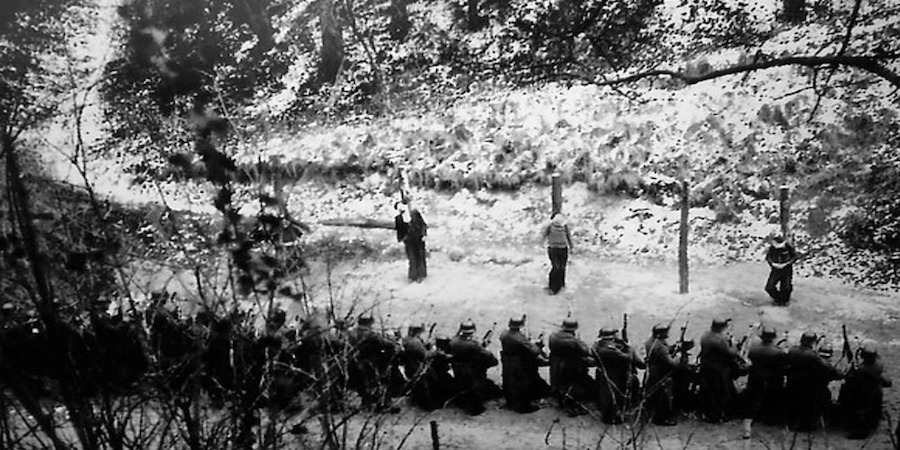
The executions were naturally conducted quietly; the Germans strictly forbade public access to or photography of Resistance heroes in their martyrdoms for obvious reasons.

That made it especially surprising when a few pictures of this execution surfaced recently, surreptitiously snapped from an overlooking vantage by German motorbike officer Clemens Rüter, who kept them hidden for decades. They are to date the only known World War II photos of French Resistance members being executed.

* The 23rd, and the only woman in the group, was Romanian Olga Bancic, also known by the nom de guerre Pierrette; she was not shot on this date but deported to Stuttgart and beheaded there on May 10, 1944. There was also a 24th, a man named Migatulski, who was initially part of the same trial; he was instead remanded to French custody. (See coverage in the collaborationist La Matin from Feb. 19, 1944 and Feb. 22, 1944.)

** We’ve noted before that a Polish Jew named Joseph Epstein who was part of the same cell (and a prime candidate for racist demagoguing) avoided a place on l’Affiche Rouge thanks to his preternatural talent for remaining mum under interrogation.

On this day..

1592: Thomas Pormort, prey of Richard Topcliffe

Thomas Pormort (or Pormant) was hanged on this date in 1592 on a gibbet erected adjacent to a Paul’s Churchyard haberdashery whose proprietor had once entrusted the condemned Catholic priest with his confession.

Pormort was a priest trained on the continent who returned to native soil about the beginning of 1591 to brave the Elizabethan persecution, but managed only a few months in the field before his arrest.

He had the misfortune to face the personal interrogation of the vindictive inquisitor Richard Topcliffe, notorious even in his own day for his gleeful sadism. Topcliffe seems not to have even feigned a politic distaste for the breaking of bones and and of men and made a point to attend the executions his offices effected, including Pormort’s.

Now, back in the day such grim ministers of state could be empowered to toy with their prey in their very own lairs. Even the sainted Thomas More had kept a personal torture chamber at his own home.

So it was with Topcliffe, who inflicted his hospitality on Pormort in the intimacy of his own place, where he apparently had the facilities necessary to put a prisoner to the rack. According to Portmort, the torturer had another intimacy besides during their pain-wracked discourse, taunting or boasting to his victim of carnal indulgences he enjoyed from the queen herself. Pormort would allege at the bar that

Topcliffe told [Pormort] that he was so familiar with her Majesty that he many times putteth [his hands] between her breasts and paps and in her neck.

That he hath not only seen her legs and knees [but feeleth them] with his hands above her knees.

That he hath felt her belly, and said unto her Majesty that she had the softest belly of any woman kind.

That she said unto him, ‘be not these the arms, legs and body of King Henry?’ To which he answered: ‘Yea.’

That she gave him for a favour a white linen hose wrought with white silk, etc.

That he is so familiar with her that, when he pleaseth to speak with her, he may take her away from any company; and that she is as pleasant with everyone that she doth love.

This Penthouse letter for the queen has no factual plausibility, and nobody thought so in 1592. Whether the priest’s report of its utterance is an actual glimpse into a seditious perversion of the torturer, or a desperate attempt by a doomed man to smear his persecutor, Topcliffe took the matter seriously enough that he made Pormort stand on the ladder under his noose in freezing cold for two hours on execution day while Topcliffe browbeat him to withdraw the allegation. (Pormort didn’t budge.)

On this day..

1943: The five martyrs of the lycee Buffon

On this date in 1943, Nazi guns immortalized five student martyrs of the French Resistance.

The Five Martyrs of the lycee Buffon were Parisian high school students who greeted the fascist occupation of their republic with every form of opposition they could command.

Jean-Marie Arthus (“Marchand” by his nom de guerre), Jacques Baudry (“Andre”), Pierre Benoit (“Francis”), Pierre Grelot (“Paul”) and Lucien Legros (“Jeannot”)* started small with subversive pamphleting and placarding but soon moved on to sabotage and armed opposition in affiliation with the Francs-Tireurs et Partisans.

The arrest of one of their teachers, Raymond Burgard, in 1942 spurred them to lead a student demonstration whose mass arrest they barely escaped. By that time their identities were known, and the boys had to go underground; for their remaining months at liberty they lived on the run and participated in occasional (albeit not very damaging) armed attacks on occupying forces — until that summer, when French intelligence arrested Arthus, Baudry, Grelot and Legros, and French police later caught Benoit.

All five were handed off by their collaborationist countrymen to the eager claws of the Germans, who condemned them as terrorists at a military trial.

A number of public places in France honor their memory, like the 14th arrondissement’s Place des Cinq-Martyrs-du-Lycée-Buffon. Their touching and determinedly optimistic last letters to their families can be read at the Cinq martyrsFrench Wikipedia page.

* A sixth school chum, Michel Agnellet, could easily have joined them at the execution posts and in the martyrologies, but the five who were captured did not permit their interrogators to extract his name.

On this day..

1717: Anna Maria Wagemann, the last witch burned at Fürfeld

Three hundred years ago today, Anna Maria Wagemann suffered the last witch execution at Fürfeld.

Conveniently available information on this case appears to derive mostly from a single German-language local history volume which is rather extensively summarized in her German Wikipedia entry.

Despite the late date — the entire cosmology of witchery was coming apart by the 18th century — she fit the classical demographic profile of a witch hunt victim. Wagemann was an aged — 66 or 67 at the time of her trial, she thought — and penniless woman who knew her way around medicinal herbs and had a pre-existing reputation for witchcraft.

When the burning times were truly aflame, marginal people like this could easily be ignited by the accusations a torturer wrung from the last luckless soul to be named to the Black Sabbath. By 1716, when Wagemann went on trial, the case strangely conjoined an ancient superstition to a ponderous Enlightenment legal process, with an 879-page codex of the interrogations with vague witness accusations endorsed by jurists at the University of Tübingen.*

There weren’t any raging famines or plagues afoot that demanded supernatural attribution. It seems in this case that before the neighbors could accuse her of drying up their cows and such, Anna Maria Wagemann was targeted thanks to the oldest enmity in the book: family politics. A daughter-in-law of our principal was either quite convinced she had married into sorcery or else quite weary of the dynamic at family meals, and it was her denunciations (supported by her 9- and 12-year-old daughters) that brought Wagemann to book. It’s difficult to piece together the chain of causation; this woman, Anna Margarethe Wagemann, was herself suspected of witchcraft and jailed for many weeks,** so her charge too might have been issued under duress. In the end, it was only Anna Maria who was tried, and Anna Margarethe gave evidence against her — although Anna Margarethe was also punished by being made to witness the execution with her young daughters, and then being expelled from Fürfeld.

* We’ve seen this university in our pages before, involved in the case against Johannes Kepler’s mother.

** Years later, she would appeal for compensation for her wrongful imprisonment. (It’s not known whether the appeal succeeded.)

On this day..

1573: Gilles Garnier, loup-garou

On this date in 1573, Gilles Garnier was burned at the stake as a lycanthrope.


Detail view (click for the full image) of The Werewolf, or the Cannibal by Lucas Cranach the Elder (1509)

The “Werewolf of Dole” was a scavenging hermit resident on the outskirts of that Burgundian town when a little girl was strangled and partially eaten in October of 1572. Townsfolk feared a maneating wolf but a subsequent pattern of attacks would point at something even more frightful.

As kitsch as it becomes for us in modernity, it is not difficult to discern in the werewolf legend the shadow of a truly terrifying era when predatory wolves and predatory men alike prowled the dangerous byways in Europe, especially France.

And a sure way to conflate the two was through a figure like Garnier (English Wikipedia entry | French), who, in a starving winter, monstrously ate the flesh of his victims. He would later confess — we can only guess through what combination of disordered mind and torturer’s suggestion — that as he foraged one day, wracked by hunger, a phantom appeared to him and offered him an ointment that would confer the lifesaving hunting prowess of the wolf.

Like any opportunistic carnivore, the loup-garou Garnier knew enough to prey upon the weakest.

Shortly after slaying that first victim, Garnier grabbed another little girl and was in the process of a bestial hands-and-teeth attack when some villagers came upon the scene. Garnier fled, but at least some of these accidental witnesses were convinced that they had seen a wolf attack — for what man tears into his still-dying quarry with his bare teeth?

Then again, as observed by Sabine Baring-Gould* — whose The Book of Were-Wolves makes for a goosefleshing Halloween read — there would even post-Garnier in 1573 be an edict promulgated against what Parlement suspected was continuing werewolfery in the vicinity, directing all and sundry “to assemble with pikes, halberts, arquebuses, and sticks, to chase and to pursue the said were-wolf in every place where they may find or seize him; to tie and to kill, without incurring any pains or penalties.” Lycanthropy is stirring deep within this society, authorities, onlookers and offender(s?) all suggestible to one another.

Garnier killed a little boy later that same November, perhaps his most gruesome as he not only cannibalized the fresh corpse but tore off the child’s leg to save for later.

His fourth known victim was his last and resulted in his capture when he was again surprised on the scene. (This time, the witnesses saw only the man — not the wolf.)

His trial, which was for all its fantastic content notably a secular one, was a monument to the fear that must have gripped Dole while children vanished only to turn up as carrion: some fifty witnesses were summoned, many to make connections between Gilles Garnier and canis lupus that one would strain to credit as speculative but were probably quite sincere. Everyone knew there was a werewolf, and then everyone knew Gilles Garnier was that werewolf.

Like the French peasantry, posterity has seen in Garnier what it hopes or expects to see. Do we witness the grim and commonplace effects of torture upon a bystander being scapegoated for the natural incursions of wolves? The predations of a “normal” serial killer refracted through his society’s superstitions? A mentally ill man truly convinced (as with the wendigo psychosis) of his own beastliness? An entirely false confession reflecting Garnier’s own complicity in the same evolving myth that captivated his neighbors?

Or might we allow with Montague Summers the genuine historicity of the monster?

As Nabuchodonosor was so punished by God, so Heaven may also well have permitted Gilles Garnier and the sorcerers of Savoy owing to their vile appetites and their lust for human flesh to have become wolves, losing human form.

From whatever cause this shape-shifting may arise, it is very certain by the common consent of all antiquity and all history, by the testimony of learned men, by experience and first-hand witness, that werewolfism which involves some change of form from man to animal is a very real and very terrible thing. (The Werewolf)

If you prefer your rending human flesh in podcast form, Stuff You Missed In History Class covered this story in a (graphic) Halloween episode.

* An occasional Executed Today guest blogger, through the magic of public domain.

On this day..

831: St. Euthymius of Sardis, iconophile

This is the martyrdom date in 831 for the iconodule saint Euthymius of Sardis.

Euthymius was just a child when Byzantium’s century-long internal conflict over image-veneration wrote St. Stephen the Younger into the pages of this here blog way back in 764.

By the time Euthymius attained the bishopric of Sardis in the 780s, the Empress Irene was putting an end to her predecessors’ anti-icon campaigns, and Euthymius took part in the Second Council of Nicaea that made the new policy official.

Posterity has a difficulty measuring by way of scanty and partisan sources the true state of sentiments surrounding icons during this period but it’s a sure thing that for an empire besieged both west and east, religious questions connected inextricably to geopolitical ones. Irene’s shift towards embracing what iconoclasts saw as graven images spanned about a quarter-century which also coincided with humiliating reverses for Constantinople. Irene’s son was thrashed by the Bulgars to whom her treasury was then obliged to submit tribute; then Irene had that very son deposed and blinded. Irene was toppled in her turn by her finance minister but Emperor Nikephoros too was trounced in battle and his skull wound up as the Bulgar Khan’s ceremonial goblet.

Small wonder that when Leo the Armenian took power in 814 he reflected that

all the emperors, who took up images and venerated them, met their death either in revolt or in war; but those who did not venerate images all died a natural death, remained in power until they died, and were then laid to rest with all honors in the imperial mausoleum in the Church of the Holy Apostles.

For a prelate like Euthymius, this meant a return to the opposition benches. He’s reported to have been arrested and exiled twice in the ensuing years before finally being scourged to death in 824 at the behest of Leo’s successor; however, scholarship has better associated this event with the more vigorous anti-icon persecutions of Theophilus after 829. In 831, Arab forces devastated Cappadocia and also captured Panormos in Byzantine Sicily. In light of these reverses Theophilos discovered that an anti-iconoclast manifesto predicting the emperor’s imminent death had been circulated — so again the link between prestige abroad, sedition within, and those damned icons. Theophilus attributed the pamphlet to a pro-icon bishop named Methodius, who was a friend of Euthymius, and had both men arrested.

Imprisoned on the island of St. Andrew, near Constantinople in the Sea of Marmara, the two men were questioned about their associates by the postal logothete — probably Arsaber, the brother of [anti-icon future patriarch] John the Grammarian — who was accompanied by the chartulary of the inkpot Theoctistus. Euthymius seems to have mocked Theoctistus and would name only one of his visitors: Theoctista, the mother-in-law of both the logothete and the emperor!* Theophilus had both Euthymius and Methodius beaten soundly. While Methodius, who was just over 40, could endure it, the 77-year-old Euthymius died from his injuries on December 26 and became an iconophile martyr. The empress Theodora was reportedly so upset at Euthymius’s death that she told Theophilus that God would desert him for what he had done. (Source)

The History of Byzantium podcast covers this period in episode 103.

* Theoctista was an actual iconophile. Her house in Constantinople later became the Monastery of Gastria — and post-1453, a mosque.

On this day..

1531: John Tewkesbury, Thomas More’s unwilling guest

The honor posterity pays to Sir Thomas More‘s valor for his own eventual martyrdom has always been attenuated by More’s own keenness to visit that martyrdom on others. Six men were put to death as Protestant heretics during the Catholic More’s 30 months as Lord Chancellor and several of them — including John Tewkesbury, who burned at Smithfield five days before the sad Christmas of 1531 — were even held and tortured by More himself, at his personal estate.

More, famous for subjecting his own flesh to the hairshirt, was not ashamed to have his porter’s house outfitted as a personal torture chamber complete with his own set of stocks. When another wrongthinker, George Constantine, managed to break out of More’s cage and flee to the continent, the future saint joked in the Apology how humanely that showed Constantine was treated, that he proved “strong enough to break the stocks, nor waxen so lame of his legs with lying but that he was light enough to leap the walls.” LOL!

Others like Tewkesbury were not so robust after More got through with them.

This leather merchant had found his way to reform ideas after coming into possession of a contraband Tyndale English Bible, and was also found in possession of Tyndale’s subversive Parable of the Wicked Mammon.

“If Paul were now alive, and would defend his own learning, he should be tried through fire; not through fire of the judgment of scripture, (for that light men now utterly refuse,) but by the pope’s law, and with fire of fagots,” Tyndale thunders in Wicked Mammon.

Tewkesbury failed his first trial by fagot: after repelling the personal interrogation of Bishop Cuthberg Tunstall,* Tewkesbury

was sent from the Lollards’ tower to my lord chancellor’s, called sir Thomas More, to Chelsea, with all his articles; to see whether he might accuse others. There he lay in the porter’s lodge, hand, foot, and head in the stocks, six days without release: then was he carried to Jesu’s tree, in his [More’s] privy garden, where he was whipped, and also twisted in the brows with small ropes, so that the blood started out of his eyes … after this, he was sent to be racked in the Tower, till he was almost lame, and there he promised to recant. (Foxe’s Book of Martyrs

Recanting entailed public penitence meant to underscore the consequences of backsliding: carrying to St. Paul’s Cross a fagot of the sort that would be lit under the feet of a repeat heretic.


John Tewkesbury carrying his fagot in penance. Illustration from Foxe’s Book of Martyrs.

It seems, however, that Tewkesbury’s courage, once sapped by More’s persecution, was soon reinvigorated by the same. Foxe claims that he took heart from the example of Richard Bayfield, arrested at Easter for smuggling Tyndale Bibles into England from the Low Countries and returned to his heresies, fagot or no.

And here More’s vigorous escapee George Constantine enters the narrative in earnest, for before Constantine slipped More’s shackles the Lord Chancellor wrung from him the names of several Protestants, including Tewkesbury’s. Our repeat heretic was again imprisoned at More’s servants’ quarters where he received his sentence —

Imprimis, That he confessed that he was baptized, and intended to keep the catholic faith.

Secondly, That he affirmeth, that the abjuration oath and subscription that he made before Cuthbert, late bishop of London, was done by compulsion.

Thirdly, That he had the books of the Obedience of a Christian Man, and of The Wicked Mammon, in his custody, and hath read them since his abjuration.

Fourthly, That he affirmeth that he suffered the two faggots that were embroidered on his sleeve, to be taken from him, for that he deserved not to wear them.

Fifthly, He saith, that faith only justifieth, which lacketh not charity.

Sixthly, He saith, that Christ is a sufficient Mediator for us, and therefore no prayer is to be made unto saints. Whereupon they laid unto him this verse of the anthem: ‘Hail Queen our advocate,’ &c.; to which he answered, that he knew none other advocate but Christ alone.

Seventhly, He affirmeth that there is no purgatory after this life, but that Christ our Saviour is a sufficient purgation for us.

Eighthly, He affirmeth, that the souls of the faithful, departing this life, rest with Christ.

Ninthly, He affirmeth, that a priest, by receiving of orders, receiveth more grace, if his faith be increased; or else not.

Tenthly, and last of all, he believeth that the sacrament of the flesh and blood of Christ is not the very body of Christ, in flesh and blood, as it was born of the Virgin Mary.

Whereupon the bishop’s chancellor asked the said Tewkesbury, if he could show any cause why he should not be taken for a heretic, falling into his heresy again, and receive the punishment of a heretic. Whereunto he answered that he had wrong before, and if he be condemned now, he reckoneth that he hath wrong again.

“For which thynges and dyvers other horryble heresyes, he was delyvered at laste unto the secular handes and burned, as there was never wretche I wene better worthy,” More concluded with a satisfied dusting of hands. (Source)

* Tunstall submitted to Henry VIII’s authority over the Church of England and navigated the frightening Tudor years keeping his head down in preference to having it lopped off — although when he died in 1559 at age 85, it was while in prison for refusing to swear the Oath of Supremacy to Queen Elizabeth.

On this day..

1981: El Mozote Massacre

On this date in 1981, the El Salvador military perpetrated the El Mozote massacre.

It was conducted by the U.S.-trained and -armed death squad, the Atlacatl Battalion, which on December 10 of that year entered the northern village of El Mozote in search of FMLN* guerrillas.

There weren’t any there — just townsfolk whose numbers were swollen by peasant refugees from the brutal civil war. After ransacking the town and interrogating and robbing the residents, the Atlacatl Battalion sent everyone home and bivouaced down for the night in the town square.

Dawn’s light the next morning would bring the unspeakable horror.

The battalion forced the entire population to the town square, divided men from women, and set about murdering men with gunshot, machetes, and worse — and raping and murdering the women — and then slaughtering all the children, too.

More than 800 civilians died. The next month, a Washington Post journalist described “dozens of decomposing bodies still seen beneath the rubble and lying in nearby fields, despite the month that has passed since the incident … countless bits of bones — skulls, rib cages, femurs, a spinal column — poked out of the rubble.”

A few survivors did manage to reach neighboring villages and the story of what had occurred at El Mozote worked its way out to the wider world over the days and weeks to come. It made little matter to the government in San Salvador where bloodbath was policy, openly espoused by the likes of the man who was about to be elected president of the Constituent Assembly.

In Washington, where the checks were written, destroying Latin American peasant guerrilla movements was a Cold War lodestar and so Orwellian denial of this atrocity soon became the virtual law of the land. After heroically risking his life venturing into the conflict zone to collect evidence, the New York Times reporter Raymond Bonner was tarred and feathered by America’s foreign policy apparatchiks and eventually driven off the Times foreign policy beat while the U.S. continued pumping money to the murderers. The Atlacatl Battalion in particular would author several more notorious atrocities in the course of the 1980s dirty war.

A U.N.-backed Truth Commission convened after the conflict finally ended in 1992, investigated the affair and agreed that

There is full proof that on December 11, 1981, in the village of El Mozote, units of the Atlacatl Battalion deliberately and systematically killed a group of more than 200 men, women and children, constituting the entire civilian population that they had found there the previous day and had since been holding prisoner… there is [also] sufficient evidence that in the days preceding and following the El Mozote massacre, troops participating in “Operation Rescue” massacred the non-combatant civilian population in La Joya canton, in the villages of La Rancheria, Jocote Amatillo y Los Toriles, and in Cerro Pando canton.

The El Salvador government officially apologized in 2011. Nobody has ever been prosecuted for the slaughter.


Memorial to the massacre. (cc) image by Amber.

* The Frente Farabundo Marti para la Liberacion Nacional, named for a famous executed Salvadoran peasant rebel.

On this day..