1895: Florence English and Amanda Cody

On this date in 1895, Amanda (Mandy) Cody became the first woman hanged in Georgia’s Warren County when she died with her (male) lover Florence English for murdering Cody’s husband, Cicero and dumping his body in a swamp.

According to The Penalty is Death: U.S. Newspaper Coverage of Women’s Executions (citing the Atlanta Constitution), they were all set to get away with it until English told his mother and “to the surprise of all, [she] told it to the white people living near.”

To credit the New York Times (Nov. 23), they went to the gallows in a rhapsodic religious transport.

SANG HYMNS WHILE BEING EXECUTED

A Negro Man and Woman Continued Their Melody Until the Drop fell.

WARRENTON, Ga., Nov. 22. — Florence English, twenty years old, and Mandy Cody, both colored, were executed here to-day for the murder of the latter’s husband. They died in the ecstacy of religious enthusiasm.

A trio of colored ministers held a prayer meeting in the corridor of the jail during the early morning. The prisoners at times mingled their supplications with those of the preachers, producing intense excitement. The culprits stood in the midst of the visitors, swaying their bodies to and fro, singing plaintive melodies characteristic of the black race.

Shortly before noon the prisoners marched from their cells to the scaffold. As they stepped on the platform both commenced singing an old negro camp meeting melody, “We’ll Soon Be on the Way to Heaven.” While their hands and feet were being pinioned, the murderers still continued the hymn.

They refused to make a statement. The black caps were then drawn over their faces, the hymn still being sung with renewed vigor. When the trap was sprung they were still singing.

On this day..

2002: Craig Neil Ogan, drug war informant

(Thanks to David Carson of the informative Texas Execution Information Center for the guest post, originally run on his site. -ed.)

Craig Neil Ogan, 47, was executed by lethal injection on 19 November 2002 in Huntsville, Texas for the murder of a police officer.

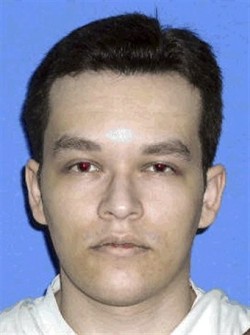
Mugshot clipped from Texas Department of Criminal Justice. More information, including some of Ogan’s own writing, at the Clark County Prosecutor site.

Craig Ogan had worked as an informant for the federal Drug Enforcement Agency since January 1988. Upon his request, the DEA relocated him from St. Louis to Houston in late 1989 after his identity had been revealed in a court proceeding. Ogan was under orders to not personally get involved in any drug transactions. He was also prohibited from carrying a weapon. Despite these instructions, Ogan insisted on arming himself and seeking involvement in drug transactions.

On 8 December 1989, Ogan, then 34, called the DEA agent who supervised him and told him that he was in a restaurant where he had just had an armed confrontation over a drug deal that fell through. He said that a man pointed a gun at his head and called him “narc.” He said that he feared for his life and asked for an escort from the restaurant. The agent arranged for two Houston police officers to escort Ogan from the restaurant back to his apartment. Once at the apartment, the officers watched as Ogan packed his belongings, which included a pistol, a sawed-off shotgun, and some knives. They then followed him to a motel. Ogan checked into a room, and the officers left at around 9:00 p.m.

At about 12:30 a.m., Ogan went to the lobby to complain about his telephone charges and the heater in his room. He argued loudly with the clerk and began kicking at a door. When the clerk called 9-1-1 for assistance, Ogan left.

Around this time, Houston police officers Clay Morgan Gainer and James C. Boswell pulled a car into a parking lot across the street from the motel, for a minor traffic violation. Ogan, then 34, walked over to them and knocked on the passenger window. Officer Boswell, 29, lowered his window and asked Ogan what he wanted. After a heated exchange, Boswell got out of the car. Ogan took Boswell’s pistol and shot him once in the head. He ran. Officer Gainer chased Ogan on foot, shot him in the back, and arrested him.

At Ogan’s trial, Gainer testified that when Boswell lowered his window and asked Ogan what he wanted, Ogan replied, “DEA dropped me off out here, and I’m cold.” Boswell told Ogan that they would help him as soon as they finished with the traffic stop, and to back away from the car. Boswell then raised his window. Ogan, however, demanded immediate attention. He knocked on Boswell’s window again, repeating that he was a DEA informant and that he was cold. Boswell told him, “You need to get out of here if you are not willing to step out of the way and wait. You either need to leave, or you are going to jail.” Ogan persisted with his demands. Boswell got out of the police car. According to Gainer, Boswell removed his sidearm from the holster and held it down against his leg. As he was reaching into the car to unlock the back door, Ogan grabbed Boswell’s gun and shot him once in the head. Ogan then said, “Well, [expletive] you then” and ran.

In addition to the above testimony, Darryl O’Leary, one of the two officers who escorted Ogan from the restaurant, testified that Ogan was “extremely excited” when he arrived. O’Leary said that when he told Ogan he could not take him until a backup officer arrived, Ogan became “impatient, hostile, and loud.”

Ogan had no prior criminal convictions. He had numerous assault charges that had been filed against him, then dismissed.

Sally Webster, a psychologist testifying for the defense, said that Ogan suffered from paranoia and had a passive-aggressive personality, but that these disorders were not mental illnesses and had no bearing on his competency to stand trial. She described Ogan’s mental state on 8 and 9 December as “anxious, agitated, almost hyperactive, very touchy, very worried.” Ogan’s lawyers called Webster to testify in an attempt to assert his mental state as a mitigating factor in determining his punishment, but the tactic backfired. Instead, prosecutors convinced the jury that Ogan’s history of high-strung paranoia made him a future danger to society.

A jury convicted Ogan of capital murder in June 1990 and sentenced him to death. The Texas Court of Criminal Appeals affirmed the conviction and sentence in April 1993. All of his subsequent appeals in state and federal court were denied.

In his appeals, Ogan’s attorneys claimed that their client suffered from a mental illness and that his trial counsel was incompetent for failing to use that in his defense. Ogan, who had an IQ of 140, had attended college, and spoke several languages, told a reporter, “They’re trying to sell me as a nut case. I don’t appreciate that.”

Ogan had a longstanding interest in espionage and had ambitions of joining the Central Intelligence Agency. In one of his letters from death row, he claimed that he had an appointment for an interview with the CIA the day he killed Officer Boswell. His career as a spy, however, never took off. At his trial, DEA agents testified that they considered Ogan to be, though a “marginally successful” informant, mostly a comical figure who ducked behind newspapers whenever a stranger entered their office. They derisively called him “special agent double-oh-five” behind his back. They also criticized him for getting involved in a drug deal without their permission, then calling for their assistance when it got him into trouble.

From death row, Ogan wrote letters that were posted on an anti-death-penalty web site. In one of them, he claimed that his execution represented the “premeditated mass murder” of possibly thousands of his potential descendants. He also provided his version of the conversation between himself and Officer Boswell. In Ogan’s account, he was extremely polite, courteous to a fault, and non-confrontational. Boswell and Gainer, on the other hand, were hostile to him without provocation and called him a “[expletive] DEA snitch.” Ogan wrote that when he told Boswell, “All right, sir; I was only asking for help,” Boswell then threw his door open and burst out of the car “in an insane rage, running/lunging furiously right at me, like a football tackle gone berserk, and clawing frantically at his gun/holster.”

An anti-death-penalty spokesman who visited Ogan on death row described him as “extremely tense.”

Ogan’s execution was delayed for nearly an hour as the Supreme Court considered late appeals questioning his mental competence.

“I would like to say first of all the real violent crimes in this case are acts committed by James Boswell and Clay Morgan Gaines,” Ogan said in his lengthy last statement. “I am not guilty; I acted in self-defense and reflex in the face of a police officer who was out of control,” he said. Ogan referred to a head injury Boswell had suffered and suggested that he had mental problems. He described Boswell as “filled with anger” and “mad at the world.” The lethal injection was given while Ogan was two minutes into his last statement. At 7:05 p.m., he was still talking about Boswell when he paused briefly to collect his thoughts. The lethal drugs took effect as Ogan then snorted, gasped, and lost consciousness. He was pronounced dead at 7:13 p.m.

By David Carson. Originally posted on 20 November 2002. Revised on 5 December 2002.
Sources: Texas Department of Criminal Justice, Texas Attorney General’s office, U.S. Fifth Circuit Court documents, Associated Press, Houston Chronicle, letters from Craig Ogan.

On this day..

1909: Leonard Groce and Lee Roy Cannon, American mercenaries in Nicaragua

In few countries is it possible to trace the development of anti-American sentiment as clearly as in Nicaragua. A century of trouble between the two nations, which led to the death of thousands and great suffering for generations of Nicaraguans, began when the United States deposed President Zelaya in 1909. Benjamin Zeledon [Spanish link -ed.] took up arms to avenge him. Zeledon’s death inspired the young Sandino, who, in turn, inspired the modern Sandinista Front.

For all his faults, Zelaya was the greatest statesman Nicaragua ever produced. If the United States had found a way to deal with him, it might have avoided the disasters that followed. Instead, it crushed a leader who embraced capitalist principles more fully than any other Central American of his era.

-Steven Kinzer, Overthrow: America’s Century of Regime Change from Hawaii to Iraq

It was a century ago today* that the execution of two American soldiers of fortune set all that strife in motion.

Leonard Groce, a mining supervisor, and Lee Roy Cannon, a rubber planter, were among those hired out by the U.S.-backed rebellion of Juan Jose Estrada. Dictatorial Nicaraguan President Jose Santos Zelaya — no known relationship to his namesake bookend at the other end of that century, the recently deposed leftist Honduran President Manuel Zelaya — had earned Washington’s ire by attempting to carve out an excessively independent sphere of action for his country. Most notably, he courted European investment, and mooted funding a possible Nicaraguan competitor to the U.S.-controlled Panama Canal.

Though the Estrada insurrection was spinning its wheels militarily, Groce and Cannon would give it legs diplomatically, and afford the Yankees sufficient pretext to overthrow Zelaya directly.

These two U.S. nationals were caught mining the San Juan River in an admitted attempt to sink a Nicaraguan troop transport, and shot in El Castillo a few days later. (Here‘s Groce’s final letter to his mum — a Spanish translation; I have not been able to find the English original.)

When word reached U.S. Secretary of State Philander Knox about the shootings, he “saw an opportunity to intervene directly.”**

Knox dashed off a bellicose note to the Nicaraguan charge d’affaires calling his

regime … a blot upon the history of Nicaragua …

From every point of view it has evidently become difficult for the United States further to delay more active response to the appeals so long made, to its duty to its citizens, to its dignity, to Central America, and to civilization.

The Government of the United States is convinced that the revolution represents the ideals and the will of a majority of the Nicaraguan people more faithfully than does the Government of President Zelaya.

“Then,” says Steven Kinzer, “he issued an official legal opinion holding that because Estrada’s rebellion had given his men the ‘stature’ of belligerents, Cannon and Groce had been entitled to prisoner-of-war status. That made Zelaya a war criminal.”

Maybe Zelaya mistook the foreign bombers for “unlawful combatants.”


Groce and Cannon temporarily became a media cause celebre in the U.S. This article is from the Nov. 21, 1909 edition of the Salt Lake Herald-Republican.

By late December, with marines† landing, Zelaya bowed to the inevitable and resigned, and Nicaragua began a generation under more-or-less overt U.S. control.

That terrible miscalculation drew the United States into a century of interventions in Nicaragua. They took a heavy toll in blood and treasure, profoundly damaged America’s image in the world, and helped keep generations of Nicaraguans in misery. Nicaragua still competes with Haiti to lead the Western Hemisphere in much that is undesirable, including rates of poverty, unemployment, infant mortality, and deaths from curable diseases.

Kinzer

There’s more coverage of this episode and America’s early 20th century Nicaraguan policy in The Banana Men: American Mercenaries and Entrepreneurs in Central America, 1880-1930 and Beneath the United States: A History of U.S. Policy toward Latin America.

* A few sources give the date as the 16th, and the situation was confused and uncertain enough on the ground that early press reports elide the execution date altogether. The 17th tracks with The Banana Men, Overthrow, and the U.S. diplomatic correspondence.

** Knox, a plutocrats’ attorney from Pennsylvania and certifiable bastard, was also personally connected with Pittsburgh-based mining interests Zelaya was threatening to expropriate. Groce worked for the firm.

† Marine Corps Major (later General) Smedley Butler mounted three different expeditions to Nicaragua during the civil war following Zelaya’s departure. He would later remember of his service in America’s southerly “Banana Wars” interventions, “I spent most of my time being a high class muscle-man for Big Business, for Wall Street and for the Bankers. In short, I was a racketeer, a gangster for capitalism.”

On this day..

1909: Will James, “the Froggie”, lynched in Cairo

One hundred years ago today, Will James was lynched as a murderer in Cairo, Illinois.

“The Frog” or “The Froggie” was a black man implicated in the murder of a white girl, captured in nearby Belknap and

taken to the most prominent square in the city and strung up. The rope broke and the man was riddled with bullets. The body was then dragged by the rope for a mile to the scene of the crime and burned in the presence of at least 10,000 rejoicing persons. Many women were in the crowd, and some helped to hang the negro and to drag the body.

Part of the mob then sought other negroes. Another part, at 11:15 o’clock, after battering down a steel cell in the county jail, took out Henry Salzner, a white man charged with the murder of his wife last August, and lynched him.* (New York Times, Nov. 12, 1912)


Other pictures related to the Will James lynching are at the Without Sanctuary site here (images 41 through 47).

The grey lady’s dim view of this jubilant scene prompted a letter to the editor in defense — the author’s disclaimer notwithstanding — of the lynching, which paints a grim and striking portrait of the town where it occurred.

CAIRO’S NEGROES.

Former Resident Says They Are Spoiled by Coddling and Are a Menace.

As a former resident of Cairo, Ill., where I was the editor of a daily newspaper for three years, I crave a word, not in defense of the double lynching which occurred there a few days ago, but in explanation of it. Cairo, at the extreme southern point of Illinois, at the junction of the Ohio and Mississippi Rivers, is peculiarly located. Across one river is Missouri; across the other is Kentucky, and Tennessee is only fifty miles away. Cairo thus becomes a buffer between the North and the South. It is probably the only town in the North which has a true race problem to deal with. … Out of a population of 13,000 in 1900, 5,000 of the inhabitants of Cairo were negroes. Of the 100,000 negroes in the State of Illinois 5 per cent are massed in this one little town. Aside from this, the floating colored population is unusually large, and Cairo, at some time or other, harbors most of the “bad niggers” from St. Louis, Cincinnati, Louisville, Memphis, Vicksburg, and New Orleans. It is these whom citizens fear the most, and for whom the police are constantly alert. Murders by negroes either of white men or negroes are alarmingly frequent, but the murderer usually escapes either to Kentucky or Missouri, and is never heard of again. Thus crime after crime is recorded against the name of Cairo, with no recompense in the name of the law. On the other hand, there is hardly a time when there are not forty or fifty Cairo negroes in the Southern Illinois Penitentiary, all convicted of theft or burglary.

The white people of Cairo have always dealt indulgently with the negro. For years it has been the policy to keep two negroes on the small police force, and there have been negro Justices of the Peace. A negro physician once came near being elected a member of the Board of Education. While they pay but little taxes, the negroes are provided with three public schools. The Sumner was the first colored High School ever established in the United States. Yet this negro population, coddled as it is, is a constant menace to the town. No white woman dare venture outside of the house at night alone for fear of assault. Many outrages of which the world has never heard have been attempted. This is why, as Mayor Parsons says, the effect of the recent lynching will be “salutary.”

Altogether it is not surprising that a lynching took place in Cairo. The only wonder is that one did not take place long ago.

W.L. CLANAHAN
New York, Nov. 14, 1909

That electric arch and celebratory mob are now long gone from Cairo: in the century since Will James was butchered, Cairo, Ill., has withered — striken in part by its own poisonous legacy of racism. (Also by flooding from the adjacent rivers, the routing of transportation corridors elsewhere, and the general deindustrialization of the heartland.)

During the civil rights struggle as played out in Cairo in the 1960’s and 1970’s (more in this pdf), the town’s white business owners made a name for themselves by refusing to integrate their workforces in response to black boycotts … preferring to go out of business and/or leave town.

Cairo today is a near ghost town at one-quarter of its previous population, and generally appalling quality-of-life indicators.

* Salzner’s lynching occurred after midnight, according to the same article; hence, his absence from this article’s marquee.

On this day..

1845: Lavinia Burnett and Crawford Burnett

On this date in 1845, husband-and-wife murderers Crawford and Lavinia Burnett (nee Sharp) danced a gallows jig built for two in Fayetteville, Arkansas.

The duo contrived with their son, John, to rob and murder a nearby recluse, Jonathan Selby, for the money he was thought to be hoarding.

The family the slays together, pays together.

Alas for mom, dad, and big brother, 15-year-old daughter Minerva shopped them.

John-boy was still on the lam at this time — he’d be caught soon, and hanged December 26 — but Lavinia and Crawford hanged together before a large crowd in the vicinity of the present-day Fayetteville National Cemetery.

It was the first recorded execution of a woman in Arkansas history, and would be the only such until the year 2000.

Among the ranks of the Burnetts’ illustrious if unsuccessful defense team was Isaac Murphy, who would go on to become a notable pro-Union pol during the Civil War (with a murky part in an infamous massacre of Confederate sympathizers), and subsequently became governor of the state during Reconstruction.

On this day..

2009: Khristian Oliver, Bible basher

(Thanks to John Temple, author of The Last Lawyer: The Fight to Save Death Row Inmates and journalism professor at West Virginia University, for the guest post. -ed.)

Barring a last-minute stay of execution, Khristian Oliver will be put to death late this afternoon.
(Update: Khristian Oliver has indeed been executed as scheduled. His likeness lives on in an altarpiece made by his father, an artist.)

In 1998, Oliver, now 32, shot and killed a man whose home he was burglarizing. Oliver’s guilt isn’t being questioned. The argument his attorneys and supporters are using to stave off his upcoming execution has to do with how the jurors in his case handled his sentencing.

An Oct. 15 story in The Guardian described the scene in the jury room this way:

A clutch of jurors huddled in the corner with one reading aloud from the Book of Numbers: “The murderer shall surely be put to death” and “The revenger of blood himself shall slay the murderer.”

Another juror highlighted passages which she showed to a fellow juror: “And if he smite him with an instrument of iron, the murderer shall surely be put to death.” (Apparently one of the same passages, Numbers 35:16, in fuller context.)

Juries debating this most difficult decision often reach for Biblical guidance, and there are no shortage of verses that relate to capital punishment, including the famous “eye for an eye” passage(s). Courts have ruled this improper, not because the Bible is a religious document, but because it is extrinsic evidence, meaning it was not properly introduced as evidence.

The same issue arose in the central case in my new book, The Last Lawyer: The Fight to Save Death Row Inmates.

To write the book, I shadowed a North Carolina legal team for four and a half years as they fought to overturn the death sentence of a man named Bo Jones. The attorneys crisscrossed the back roads of North Carolina to track down and interview most of the jurors from the trial, two of whom chased them off their property. In the end, the attorneys found one woman who claimed that a Baptist minister on the jury had brought a Bible into the room and quoted passages from it.

In the end, this claim didn’t help Bo Jones. A federal appeals judge threw it out, saying his lawyers hadn’t proved that the Bible-quoting had influenced the jury’s verdict. But Jones’s attorneys had plenty of other arguments up their sleeves, while Oliver’s supporters seem to be putting most of their emphasis on the Bible argument.

It remains to be seen whether this will bewas not enough to spare his life.

Update: Prolific death penalty defense attorney David R. Dow (author of Autobiography of an Execution) on his client, Khristian Oliver.


On this day..

1924: Ali Reshti and Sayyid Husain, to placate America

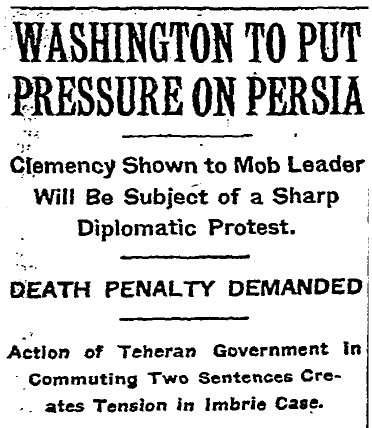
On this date in 1924, diplomatic maneuvering, oil patch politics, and a dead American consul put two Iranian teenagers in front of a firing squad.

Largely forgotten today, the affair which prompted their execution helped Cossack commander Reza Khan‘s ongoing consolidation of power, culminating in another year’s time with his conquest of the Persian throne itself.

By the summer of 1924, he was by title Prime Minister and his domestic opponents could read the writing on the wall: he had made a premature bid for formal executive authority in 1923 only to be rebuffed.* At the same time, he was engaged in the perilous oil game with an attempt to use American companies to break a British oil monopoly.

On July 18, 1924, American Vice Consul Maj. Robert Imbrie and his civilian countryman Melvin Seymour were attacked by a Tehran mob while photographing a well which had become a Moslem devotional site for purported miraculous healings. Imbrie was beaten to death; Seymour was lucky to survive … and it soon emerged that soldiers from the nearby barracks had not only failed to protect the Americans but actually taken part in the assault.

Iran’s emerging strongman lost no time in making the most of it.

The event gave [Reza Khan] … the excuse for declaring martial law and a censorship of the Press … Numerous arrests have been made, chiefly of political opponents of the Prime Minister. (British military attache Col. W.A.K. Fraser)

It’s like Lenin said, you look for the person who will benefit and, uh, you know, uh, you know, you’ll, uh, you know what I’m trying to say …

Assuming one discerns some measure of design in the Imbrie murder, and the convenient outburst of anti-Baha’i paranoia that sparked the fatal incident, one can go a couple of different directions at this point.

  1. That the Prime Minister’s foes, allied with British oil interests (the British angle was so widely believed in Iran at the time that press censorship forbade the incendiary charge), were firing up the rowdies in an attempt to shake his power. This 1924 American cable makes that case:

    “It had the earmarks from the beginning of an artificially inspired movement, of which the organized powers of evil were quick to take advantage in order to create disorder for the Government … Reza Khan found himself faced with a situation before which he was powerless. The fanaticism of the crowd was so incited by the continuous preaching of the Mullahs that any act on his part would have been interpreted as treason to Islam and prima facie evidence that he was a Bahai; hence his unfortunate orders to the military and the police not to intervene under any circumstances in religious demonstrations and under no circumstances to fire.”

  2. That Pahlavi’s own agents fomented the disorder. According to Michael Zirinsky‘s review of the case, another American official speculated that Reza Khan himself hoped a foreigner would die “so that he could declare martial law and check the power of the Mullahs.”

Which, in the event, is exactly what happened.

The U.S. made a great show of demanding exemplary justice, and it had the leverage to do so: Iran (how times change!) wanted American support and American oil exploitation.

Three were condemned to death for their parts in the riot, and after the first, a young soldier named Morteza said to have incited the mob, was shot on Oct. 2, the government announced leniency for the other two.

Not good enough.


“When you are dealing with a government like Persia … if you ask them to execute a Moslem for the death of a Christian … if they do it, you accomplish more for the prestige of your country than if they paid a million.” -a young Allen Dulles, in 1926 testimony to the U.S. House of Representatives.

At American insistence, those other two were recalled to death after all: 17-year-old mullah Sayyid Husain (various alternate transliterations – e.g., Seyid Hussein), who was supposed to have raised the riot-triggering “Baha’i well-poisoner” accusation in the first place, and 14-year-old camel driver Ali Reshti.

Zirinsky once again:

With the ending of the Iran-U.S. dispute by the execution of Ali and Husain on November 2, 1924, Reza was free to leave the capital city. He had support from the foreign legations, he had secured financing for the army, he had reestablished discipline in the Cossack Brigade, and by executing Sayyid Husain — a mullah — he had demonstrated his domination over the clergy … in the course of the next months’ campaign, he completed the unification of Iran and ensured that his government would get all the [Anglo-Persian Oil Company] royalties…

While the Imbrie affair was not the only critical event of Reza’s seizure of total power in Iran, it came at a critical moment in his rise … he used the murder to his best advantage.

And they all lived happily ever after.

* The future Shah’s future rival Mohammed Mossadegh was among the Iranian Majlis members who blocked Reza Khan’s attempt to rule Iran as a republic in 1923.

** “Blood, Power, and Hypocrisy: The Murder of Robert Imbrie and American Relations with Pahlavi Iran, 1924,” International Journal of Middle East Studies, vol. 18, no. 3 (Aug. 1986). Zirinsky quotes an American diplomat who believed Reza Khan was actually intentionally trying to create a situation where a foreigner would be killed, to give him a pretext for bringing his nation to heel with foreign support.

On this day..

1938: The terrified John Deering

We meet people in these pages who go to the scaffold joking, or sarcastic, or cocksure.

Humans bear up to proximity of death with every psychological defense in the book, but even if surprisingly few die in naked terror, make no mistake this Halloween: there’s a reason the executioner is scary.

Shot Through the Heart

Habitual criminal John Deering had a date with a Salt Lake City firing squad this date in 1938.

If anyone should be nonchalant about being ripped open by bullets, it’s a guy who eschewed a prison sentence in Michigan and confessed to murder to get himself extradited to Utah to face capital murder charges — saying that he and the world would both be better off with him dead.

The 39-year-old put on a cool front, but how steady was he, really? In a weird experiment, Deering agreed to be hooked to an electrocardiogram that measured his heart rate during his last moments.

Here comes the science!

The heart of John W. Deering, holdup murderer, beat three times faster than normal just before he was put to death today by a firing squad in the state prison here. The unprecedented recording was termed valuable to heart disease specialists as it showed clearly the effect of fear.

An electro-cardiograph film, recorded with the condemned man’s permission, showed that Deering’s heart beat jumped from normal 72 to 180, although he appeared outwardly calm. It maintained that rate for the several minutes required to complete preliminaries for the execution.

When the doomed man was asked for a last statement his heart beat fluttered wildly, then calmed after he spoke until bullets ended his life. The heart beat stopped 15.6 seconds after the bullets struck, but he was not pronounced dead until two and a half minutes after the five shots rang out. (Chicago Tribune, Nov. 1, 1938)

Still no cure for cancer.

This guy is obviously not to be confused with his tragic Hollywood contemporary of the same name.

On this day..

1901: Leon Czolgosz, William McKinley’s assassin

Back ’round the fin de siècle, everybody who was anybody* was being whacked by anarchists.

On this date in 1901, unemployed (and seemingly unbalanced) steelworker Leon Czolgosz rode the lightning at New York’s Auburn Prison for inducting the late U.S. President William McKinley into the club.

It hadn’t even been eight weeks since Czolgosz met McKinley gladhanding a receiving line at the Pan-American Exposition in Buffalo, and fatally (though it took the victim a week to succumb) shot the second-term Republican president.

Matters progressed from there as one might expect.

In a one-day trial that lasted 8 hours from jury selection to sentence, Czolgosz was condemned to die in New York’s electric chair. He went to his death unapologetic, but also alone; most anarchists disavowed him for hurting the cause.**

Here’s the New York Times account of the assassin’s final moments.

As he was being seated [in the electric chair] he looked about at the assembled witnesses with quite a steady stare and said:

“I killed the President because he was an enemy of the good people — of the working people.”

His voice trembled slightly at first, but gained strength with each word, and he spoke perfect English.

“I am not sorry for my crime,” he said loudly, just as the guard pushed his head back on the rubber headrest and drew the strap across his forehead and chin. As the pressure on the straps tightened and bound the jaw slightly he mumbled: “I’m awfully sorry I could not see my father.”

It was just exactly 7:11 o’clock when he crossed the threshold [into the execution chamber], but a minute had elapsed and he just had finished the last statement when the strapping was completed, and the guards stepped back from the man. Warden Mead raised his hand, and at 7:12:30 Electrician Davis turned the switch that threw 1,700 volts of electricity into the living body.

The rush of the immense current threw the body so hard against the straps that they creaked perceptibly. The hands clinched suddenly, and the whole attitude was one of extreme tension. For forty-five seconds the full current was kept on, and then slowly the electrician threw the switch back, reducing the current volt by volt until it was cut off entirely.

They made good and sure by dissolving the body in sulfuric acid.

Thomas Edison made a video recreation of the scene — not to be confused with actual film of the execution, though some sites present it as such — shortly after. Whether its creation was influenced by Edison’s now-doomed project of discrediting Alternating Current, a business rivalry that had helped introduce the electric chair in the first place, I have been unable to determine; the Edison labs produced a number of silent films exploiting “a whole string of news events surrounding the Pan-American Exposition in Buffalo … both through a monumental display of lights (including test bulbs on the reproduction of the electric chair) and by a booming output of scenics, actualities, and even a historical topical.”

Glum.

More lighthearted (and more audible) is “The Ballad of Leon Czolgosz,” from Stephen Sondheim’s offbeat Broadway hit Assassins, here presented with liberal use of the Edison labs’ Pan-Am Expo footage.

… it’s not the first pop culture ephemera generated by McKinley’s martyrdom; folk ballad variations under different titles (“The White House Blues,” “McKinley,” “McKinley’s Rag,” or this version, “Zolgotz”) were in circulation in the early 20th century. Other variations and some background can be had here.

[audio:Zolgotz.mp3]

This third assassination of an American chief executive in the span of 36 years (with similar fates for James Garfield’s killer and the Lincoln conspirators) led the Secret Service, originally a Treasury Department anti-counterfeiting unit, to assume responsibility for bodily safeguarding the President in 1902.

* We’ve met a few of anarchism’s greatest hits in these pages … as well as their greatest martyrs.

** Anarchist titan Emma Goldman was blamed for inciting the murder and initially arrested; she was also one of the few anarchists to defend Czolgosz: “He had committed the act for no personal reasons or gain. He did it for what is his ideal: the good of the people. That is why my sympathies are with him.”

On this day..

2005: Luis Ramirez, claiming innocence

On this date in 2005, Luis Ramirez was executed in Texas for engineering the murder-for-hire of his ex-wife’s new flame.

Ramirez went to his death still insisting on his innocence.

I did not kill your loved one, but I hope that one day you find out who did. I wish I could tell you the reason why, or give some kind of solace; you lost someone you love very much. The same as my family and friends are going to lose in a few minutes. I am sure he died unjustly, just like I am.

Maybe so. Maybe not.

Contrary to the widespread misapprehension that DNA and other forensic evidence are rendering criminology a perfect science, the majority of criminal procedures make do without them — consequently depending on the more impressionistic and time-honored pillars of jurisprudence: a weighing of circumstantial evidence; an estimate of the credibility of competing witnesses; the structural advantage of the well-resourced prosecutor’s office against its typical adversaries.

There may never be an answer to Luis Ramirez’s last statement, simply because there’s no obvious prospect of a dramatic forensic science reveal.

Wherever Ramirez’s soul might truly stand on the matter of capital murder, he left behind this interesting portrait of human connection on death row.

I’m about the share with you a story who’s telling is long past due. It’s a familiar story to most of you reading this from death row. And now it’s one that all of you in “free world ” may benefit from. This is the story of my first day on the row.

I came here in May of 1999. The exact date is something that I can’t recall. I do remember arriving in the afternoon. I was placed in a cell on H-20 wing over at the Ellis Unit in Huntsville, TX. A tsunami of emotions and thoughts were going through my mind at the time. I remember the only things in the cell were a mattress, pillow, a couple of sheets, a pillow case, a roll of toilet paper, and a blanket. I remember sitting there, utterly lost.

The first person I met there was Napoleon Beazley. Back then, death row prisoners still worked. His job at the time was to clean up the wing and help serve during meal times. He was walking around sweeping the pod in these ridiculous looking rubber boots. He came up to the bars on my cell and asked me if I was new. I told him that I had just arrived on death row. He asked what my name is. I told him, not seeing any harm in it. He then stepped back where he could see all three tiers. He hollered at everyone, “There’s a new man here. He just drove up. His name is Luis Ramirez.” When he did that, I didn’t know what to make of it at first. I thought I had made some kind of mistake. You see, like most of you, I was of the impression that everyone on death row was evil. I thought I would find hundreds of “Hannibal Lecters” in here. And now, they all knew my name. I thought “Oh well,” that’s strike one. I was sure that they would soon begin harassing me. This is what happens in the movies after all.

Well, that’s not what happened . After supper was served, Napoleon was once again sweeping the floors. As he passed my cell, He swept a brown paper bag into it. I asked him “What’s this?” He said for me to look inside and continued on his way. Man, I didn’t know what to expect. I was certain it was something bad. Curiosity did get the best of me though. I carefully opened the bag. What I found was the last thing I ever expected to find on death row, and everything I needed. The bag contained some stamps, envelopes, notepad, pen, soap, shampoo, toothpaste, tooth brush, a pastry, a soda, and a couple of Ramen noodles. I remember asking Napoleon where this came from.

He told me that everyone had pitched in. That they knew that I didn’t have anything and that it may be a while before I could get them. I asked him to find out who had contributed. I wanted to pay them back. He said, “It’s not like that. Just remember the next time you see someone come here like you. You pitch in something.”

I sat there on my bunk with my brown paper bag of goodies, and thought about what had just happened to me. The last things I expected to find on death row was kindness and generosity. They knew what I needed and they took it upon themselves to meet those needs. They did this without any expectation of reimbursement or compensation. They did this for a stranger, not a known friend. I don’t know what they felt when they committed this act of incredible kindness. I only know that like them, twelve “good people” had deemed me beyond redemption. The only remedy that these “good people” could offer us is death. Somehow what these “good people” saw and what I was seeing didn’t add up. How could these men, who just showed me so much humanity, be considered the “worst of the worst.”

Ever since Napoleon was executed, for a crime he committed as a teen, I’ve wanted to share this story with his family. I would like for them to know that their son was a good man. One who I will never forget. I want for them to know how sorry I am that we as a society failed them and him. I still find it ridiculous that we as a people feel that we cannot teach or love our young properly. I’m appalled at the idea that a teen is beyond redemption, that the only solution that we can offer is death. It’s tragic that this is being pointed out to the “good people” by one of the “worst of the worst”. God help us all.

What’s in the brown paper bag? I found caring, kindness, love, humanity, and compassion of a scale that I’ve never seen the “good people” in the free world show towards one another.

On this day..