1847: The San Patricios

At 9:30 a.m. this day, as the American army raised the Stars & Stripes over Chapultepec Castle during the Mexican-American War, it simultaneously carried out a mass hanging of 30 Irish deserters who had gone over to Santa Anna — the Saint Patrick’s Battalion, or the San Patricios.

Irish had been migrating to the United States en masse even well before the Great Famine got rolling in 1845.

And for those of that great migration wave who wound up in the service fighting the Mexican-American War, there was a hint of deja vu — an Anglo and Protestant imperial power seizing land from a “black”* and Catholic neighbor?

Some of the Irish decided they were fighting for the bad guys, and switched sides.**

These were the plurality (though not necessarily the majority) of the couple hundred soldiers who comprised the Saint Patrick’s Battalion. German immigrants and other nationalities, along with American-born deserters (desertion during the Mexican-American War seems to have been rife), made up the balance.

Knowing full well the fate that would await them upon capture, the San Patricios were renowned for their ferocity in battle; at the hopeless Battle of Churubusco, they reputedly forced down a white flag that Mexican comrades were trying to hoist on three separate occasions.

Eventually, the ammunition ran out, and with it, the San Patricios’ luck.

Within days, courts-martial began handing out death sentences to almost the whole of the surviving unit. U.S. General Winfield Scott subsequently reduced a number of sentences, and those who had deserted before the war couldn’t legally be executed … but even the “lucky” ones suffered faint-inducing scourgings and branding on the cheeks with the letter “D”.

And 50 men more were still bound for the gallows.

Twenty hung in the days prior to this at two separate sites, but the Yanks’ piece de resistance was an orchestrated scene on the second day of the Battle of Chapultepec.

On September 13, 1847, at dawn, Harney ordered the thirty remaining prisoners to be brought forward. They stood on wagons with nooses placed around their necks. This included one man who had lost both legs and was unable to walk to his own execution. The site of these executions was within viewing distance of the site where the final battle — the outcome of which could not have been in doubt — was to be fought. There the sentenced soldiers watched until finally, at 9:30, the US victors raised the American flag atop Chapultepec Castle.† At that point the order was given, the wagons were pulled away and the men were all hanged.

It must be remembered that the San Patricios had been standing, bound hand and foot, each with his head in a noose, for nearly four hours in the burning Mexican sun. When Harney finally gave the order for the hangings to proceed, such was the relief that their sufferings were finally at an end that “some of the men actually cheered as the nooses tightened and the wagons pulled away.”

The cruelty of the punishments led a Mexican paper to spit,

these are the men that call us barbarians and tell us that they have come to civilize us … May they be damned by all Christians, as they are by God.

The San Patricios are still honored as heroes in Mexico.

They brand with hot irons the faces of the Irish deserters and then hang them from the gallows. The Saint Patrick Irish Battalion arrived with the invaders, but fought alongside the invaded.

From the north to Molino del Rey, the Irish made theirs the fate, ill fate, of the Mexicans. Many died defending the Churubusco monastery without ammunition. The prisoners, their faces burned, rock to and fro on the gallows. -Eduardo Galeano, Masks and Faces

* The “blackness” of the Irish and the process of their “becoming white” later in the 19th and 20th centuries is one of the more illustrative and well-documented case studies of race and racism as social rather than biological constructs.

** They weren’t alone in this opinion. Many hundreds of miles from the fighting, Henry David Thoreau famously landed in jail for tax resistance in 1846 largely because of his disgust with the war. From Civil Disobedience:

The government itself, which is only the mode which the people have chosen to execute their will, is equally liable to be abused and perverted before the people can act through it. Witness the present Mexican war, the work of comparatively a few individuals using the standing government as their tool; for in the outset, the people would not have consented to this measure.

Abraham Lincoln, then a young Whig delegate to the U.S. House of Representatives, excoriated President James K. Polk for lying the nation into war.

† The capture of Chapultepec Castle, forgotten north of the Rio Grande, is still commemorated in Mexico for the heroism of six teenage cadets who died in its defense. The last of their number, Juan Escutia, leapt from the castle walls wrapped in the Mexican standard to prevent its capture.

On this day..

1852: John and Jane Williams, slaves

On this date in 1852, John and Jane Williams hung in Richmond for the hatchet-murder of the wife and infant child of their master.

This one was a sensation for the antebellum crime beat, the “deep brain-cuts” to the heads of Joseph Winston (who survived) and Virginia Winston and nine-month-old child (who, obviously, did not) administered in the small hours July 19th was just the sort of thing to tap white slaveholders’ fears. (Reportedly, they were cruel masters and had recently threatened to sell Jane without also selling her child.)

That the crime was authored by urban slaves assimilated to the money economy connected it directly with broader anxieties about social transformations, as explored by Midori Takagi in Rearing Wolves to Our Own Destruction:

[U]rban slaves who enjoyed a variety of privileges including hiring out, living apart, socializing without supervision, and cash bonuses. White Richmonders believed these privileges encouraged the slaves to be rebellious …

Although John belonged to the Winston household, he worked at the docks for John Enders during the day. Like most hired slave workers, John could move about the city before and after working hours with no supervision. He also probably received cash from his earnings and could earn extra by performing overtime work. John was not required to live in the Winstons’ house but chose to in order to be with his wife. Janes, on the other hand, was directly owned by the Winstons and most likely did not enjoy the same privileges as her husband. But she was able to move about in the city making trips to the market, did socialize with other slaves and possibly free blacks, and was well aware of the privileges and expectations of hired slaves including her husband.

White residents came to believe that these factors encouraged slaves to act violently by planting within them “the germ of rebellion.” One influential Richmonder, Joseph Mayo (who later became mayor), attributed the “glaring evils” of the slave population to “the system of board money … [and] the assumptions of equality exhibited by the blacks in riding in carriages contrary to law, and in dress and deportment.” Increasingly, white city dwellers began to wonder if they had been — in the words of one resident — “rearing wolves to our own destruction.”

These anxieties, piqued by crimes such as the Williamses’, would lead to a welter of new restrictions on the movement, behavior, and even attire of urban slaves in Richmond in the ensuing years.

But that was for the future. While Richmond had real-life master-murdering miscreants in its clutches, it gave vent to all its opprobrium.

Papers described the crimes as “hardly paralleled in history,” anticipated for Jane (who eventually copped to the crime and unsuccessfully tried to exculpate John) “the fires of her eternal doom,” and her execution “without the smallest particle of sympathy from any human being possessed of the ordinary feelings of justice.” The exhortations of her pastor, the Richmond Daily Dispatch opined, fell upon “unwilling ears. The thick-crowding thoughts of the diabolical murder of two innocent, guileless beings, committed by Janes with the coolness and deliberation of a fiend, rendered unimpressive, cold, and tedious, those ceremonies.”

It is to be hoped [the Dispatch concluded] that her merited and summary execution will operate as a warning to the fractious portion of our negro population.*

In a show of scrupulous regard for the inalienable rights endowed by the Creator, the state of Virginia compensated the convalescing Joseph Winston to the tune of $500 for expropriating and executing his property.

* (Second-hand) sources for the newspaper excerpts: The Penalty is Death: U.S. Newspaper Coverage of Women’s Executions by Marlin Shipman; and, “Black Female Executions in Historical Context” by David V. Baker, Criminal Justice Review, vol. 33, no. 1 (March 2008).

On this day..

1984: Ernest Dobbert, child abuser

At 10:09 a.m. this morning in Starke Prison, 46-year-old Ernest Dobbert threw a wink to his minister and was electrocuted for torturing his nine-year-old daughter to death.

The gist of the offense is described by the Gainesville Sun:

He was a child abuser, dating back to 1969. With his wife in prison for kiting paper, his four children obviously got on his nerves. His daughter, age 9, he tortured by beating with boards and belts, by kicking, by poking in her eyes, and by holding her head underwater in the toilet. He celebrated New Year’s Eve of 1971 by dressing her poor abused body in the finest garb on hand, placing it in a garbage bag and concealing it in the attic.

No chauvinist, he. Within weeks, he had done much the same with his son, aged 7. With the help of another terrorized son, age 12, he buried them both out in the scrub somewhere, with their bodies not yet found.

An unsympathetic character deservedly forgotten a quarter-century later, Dobbert interestingly illustrates some of the wide legal and ethical gray area in the real-life application of the death penalty for the many prisoners who are guilty yet not the like of Ted Bundy.

The Sun editorial cited urges Dobbert’s commitment to a mental institution on the nicely circular grounds that “no person is truly sane who tortures — much less kills — the fruit of his own loins.” This might bespeak an impoverished appreciation of human psychology’s potential.

More legally serious is the matter of intent and premeditation, ambiguous here as it so frequently is in life. Dobbert was convicted of only second-degree murder for killing his son; for slaying his daughter, the jury convicted him of capital murder but recommended only a life sentence, unsure of his degree of calculation.

But Ernest Dobbert is on this blog because Florida law allowed a judge to overrule the jury’s recommendation, opining,

this murder of a helpless, defenseless and innocent child is the most cruel, atrocious and heinous crime I have ever personally known of — and it is deserving of no sentence but death.

Maybe so … maybe no. In a 2000 paper* that undoubtedly plays better for an academic audience than a popular one, death penalty expert (and opponent) Michael Radelet points out that if one does suppose Dobbert’s intent to be less than fully formed, a case like his could be held to constitute a species of “wrongful execution” notwithstanding his guilt for the crime.**

The cases of those wrongly sentenced to death and who were totally uninvolved in the crime constitute only one type of miscarriage of justice. Another (and more frequent) blunder arises in the cases of the condemned who, with a more perfect justice system, would have been convicted of second-degree murder or manslaughter, making them innocent of first degree murder. For example, consider the case of Ernest Dobbert, executed in Florida in 1984 for killing his daughter. The key witness at trial was Dobbert’s 13-year-old son, who testified that he saw his father kick the victim (this testimony was later recanted). In a dissent from the Supreme Court’s denial of certiorari written just hours before Dobbert’s execution, Justice Thurgood Marshall argued that while there was no question that Dobbert abused his children, there was substantial doubt about the existence of sufficient premeditation to sustain the conviction for first-degree murder. “That may well make Dobbert guilty of second-degree murder in Florida, but it cannot make him guilty of first-degree murder there. Nor can it subject him to the death penalty in that State” (Dobbert v. Wainwright, 468 U.S. 1231, 1246 (1984)). If Justice Marshall’s assessment was correct, then Dobbert was not guilty of a capital offense, and—in this qualified sense—Florida executed an innocent man.

For Justice Marshall, of course, all executions are wrongful.

For those otherwise inclined, like Joshua Marquis, an Oregon district attorney with a dim view of overhyped innocence claims, Marshall’s interpretation figures to look downright “startling”.

Florida Governor Bob Graham agreed.

Ernest Dobbert has been executed because of his brutal actions toward his own children. I hope that this indication of the seriousness of child abuse will be an example of the value which the people of Florida place upon the lives of infants and young people in our state, and a measure of the lengths the people of Florida are prepared to go to prevent and punish such crimes.

* “The Changing Nature of Death Penalty Debates,” Annual Review of Sociology, vol. 26, August 2000.

** Fellow anti-death penalty academic Hugo Bedau on people whose murders are “arguably not … capital murder”:

We rarely think about this category when discussing innocence and the death penalty, but it is relevant and extremely important. The problem has been with us for at least two centuries, ever since the invention of the distinction between first-degree (capital) murder and second-degree (noncapital) murder.

On this day..

1876: James Murphy, gibbeted

On this date in 1876, a 19-year-old murderer was twice hanged in Dayton.

Lafcadio Hearn.

Attending John Murphy’s death was a young writer working the crime beat for the Cincinnati Commercial: Lafcadio Hearn.

This rootless Greek emigre, years and miles away yet from his best-remembered station as the Japanese folklorist better known as Koizumi Yakumo, produced for the next day’s edition a startling and evocative slice of Americana from an otherwise obscure hanging.

It also records the physical intrusion — not merely the psychological postulating — of the author himself, wandering the prison corridors in the dark, laying his hand (so it would seem) upon the condemned boy’s ebbing pulse.

“Gibbeted” ran in the August 26 Cincinnati Commercial:


GIBBETED.

EXECUTION OF A YOUTHFUL MURDERER.

SHOCKING TRAGEDY AT DAYTON.

A Broken Rope and a Double Hanging.

Sickening Scenes Behind the Scaffold-Screen.

The execution of James Murphy, yesterday afternoon, at Dayton, for the murder of Colonel William Dawson, in that city, on the night of August 31,1875, was an event, it must be said, which the people of Montgomery County had long looked forward to with no small degree of satisfaction. The murder was of itself peculiarly atrocious, from the fact that it was actually committed without a shadow of provocation. The victim was a worthy and popular citizen, and the feeling of the public in regard to the crime was sufficiently evinced in the fact that the city authorities, subsequent to the arrest of Murphy, were obliged to call out the militia that the claim of legal justice to deal with the criminal might be protected. Colonel Dawson, it may be remembered, was murdered apparently for no other reason than that he refused a drunken party permission to intrude upon the quiet enjoyments of a private wedding party. The Colonel was Superintendent of the Champion Plow Works, at Dayton, and the bridegroom being an employe of the company, the Colonel had, by request, assumed the management of the wedding ball. When Murphy was refused admittance, he induced one of his companions, Lewis Meyers, to entice the Colonel out of doors on the pretext of getting a drink; and soon after the invitation had been accepted. Murphy struck Dawson, and during the subsequent scuffle, suddenly plunged a long knife up to the halt in the Colonel’s left side. The victim of this cowardly assault lived but a few moments afterward, and died without being able to positively identify his assassin.

Circumstantial evidence, notwithstanding, clearly pointed to Murphy as the criminal, and to Meyers as his accomplice; the former being sentenced to death, and the latter, being convicted of manslaughter, to a term of two years in the State Penitentiary. Sentence was passed on the 28th of April, the jury having disagreed upon the first trial, in February, which necessitated a second.

The youth of the prisoner—he was only nineteen years of age—did not, strange as it may seem, excite any marked degree of sympathy for his miserable fate. He was a fair skinned, brown haired, beardless lad, with rather large features, a firm, vicious mouth; sullen, steady gray eyes, shadowed by a habitual frown; a rather bold forehead, half concealed by a mass of curly locks, brushed down, — a face, in short, that, notwithstanding its viciousness, was not devoid of a certain coarse regularity. His parents were hard-working Irish people, but his own features showed little evidence of Celtic blood.

Perhaps the dogged obstinacy of the prisoner in denying, almost to the last, his evident crime, had no little to do with the state of public feeling in regard to him. Moreover, he had long been notorious in the city as a worthless loafer and precocious ruffian, perpetually figuring in some street fight, drunken brawl or brutal act of violence. For a considerable period of time, previous to the murder of Colonel Dawson, he had been the boasted leader of a band of young roughs, from nineteen to twenty years of age, who were known in Dayton as the “chain-gang.”

The boy’s mother had died while he was yet young; but he did not lack a home, and the affection of an old father, and of brothers and sisters—the latter of whom he is said to have cruelly abused in fits of drunken passion. In this connection it of course be in order, religiously, to discourse upon the results of neglecting early admonitions; and, philosophically, upon the evidence that the unfortunate lad had inherited an evil disposition, whereof the tendencies were not to be counteracted by any number of admonitions. But the facts in the case, as they appeared to the writer, were simply that a poor, ignorant, passionate boy, with a fair, coarse face, had in the heat of drunken anger taken away the life of a fellow-being, and paid the penalty of his brief crime, by a hundred days of mental torture, and a hideous death.

Perhaps there are many readers of this article, who may have perused and shuddered at the famous tale of the “Iron Shroud.” You may remember that the victim, immured in the walls of a dungeon, lighted by seven windows, finds that each successive day of his imprisonment, one of the windows disappears forever. There are first seven, then six, then five, then four, then three, then two, then but one—dim and shadowy;—and then the night-black darkness that prefigures the formless gloom of the Shadow of Death. And through the thick darkness booms, hour after hour, the abysmal tones of a giant bell, announcing to the victim the incessant approach of the fearful midnight when the walls shall crush his bones to shapelessness. No one ever read that tale of the Castle of Tolfi without experiencing such horrors as make the flesh creep. Yet the agony therein depicted by a cunning writer is, after all, but a very slight exaggeration of the torture to which condemned criminals are periodically subjected in our prisons—not for seven days, forsooth, but for one hundred. This is the mercy of the law! – to compel the wretched victim to await the slow but inevitable approach of the grimmest and most ignominious of deaths for one hundred days. Fancy the ghastly mental computation of time which he must make to his own heart— “ninety-nine—ninety-eight—ninety-seven—ninety-six—ninety-five,” until at last the allotment of life is reduced to a miserable seven days, as frightfully speedy as those of the Man in the Iron Shroud. And then the black scaffold with the blacker mystery below the drop, the sea of curious and unsympathetic faces, the moment of supreme suspense after his eyes are veiled from the light of the world by the sable hood. But this pyramid of agony is not absolutely complete until apexed by the vision of a fragile rope, the sudden hush of horror, and the bitterest period of agony twice endured. It is cruel folly to assert that because the criminal be ignorant, uneducated, phlegmatic, unimaginative, he is incapable of acutely feeling the torture of hideous suspense. That was asserted, nevertheless, and frequently asserted yesterday, by spectators of the execution. We did not think so. The victim was young and strong, a warm-blooded, passionate boy, with just that coarse animal vitality which makes men cling most strongly to life, as a thing to be enjoyed in the mere fact of possession—he mere ability to hear, see, feel.

The incidents of the prisoner’s jail life during the last week—how he ate, drank, smoked, talked—might be very fully dwelt on as matters of strictly local interest, but may be briefly dismissed in these columns. There is, however, one story connected with that jail-life too strange and peculiar to be omitted. It seems that young Murphy learned to entertain a special affection for Tom Hellriggle, a Deputy Sheriff of Montgomery County, who had attended him kindly since his removal from the jail-room to a cell on the third floor, which opened in the rear of the scaffold. One night recently. Murphy said to Hellriggle, confidentially: “I knew I was going to be hanged, long ago. Do you know that I knew it before I was sentenced?”

“Why, how did you know that?” curiously asked the deputy.

Then the lad told him that during the intervals of the trials, one night between 12 and 1 o’clock, he heard the voice of a woman crying weirdly and wildly in the darkness, and so loudly that the sound filled all the jail-room, and that many of the men awoke and shuddered.

“You remember that, don’t you?” asked the lad.

“I do,” said the deputy; “and I also remember that there was no living woman in the jail-room that night.’

“So,” continued the boy, “they asked me if I heard it, and I said yes; but I pretended I did not know what it was. I believe I said no human being could cry so fearfully as that. But I did know what it was, Tom—I saw the woman.”

“Who was it?” asked Tom, earnestly.

“It was my mother. And I knew why she cried so strangely. She was crying for me.”

There are few men who enter the condemned cell and leave it for the gallows without having entertained during the interval a strong desire to take their own lives, and are for the most part deterred from so doing rather by the religious dread of a dim and vague Something after death, than by any physical fear. So it appears to have been with Murphy. When all hope, except the hope of pardon from the All-forgiving Father, was dead within him, and the Governor of Ohio had refused to grant a reprieve or commutation of sentence, then the prisoner listened much more calmly to the admonitions of Father Murphy, a fat, kindly, red-cheeked Irish priest, who took a heartfelt interest in the “spiritual welfare” of his namesake. He soon expressed repentance for his crime, and even agreed to confess all publically—an act, all the circumstances properly considered, which really evinced more manhood than the act of “dying game” with the secret.

Shortly afterward he handed to Deputy Sheriff Hellriggle a small, keen knife, which he had managed to conceal, despite all the vigilance of his guards “I would not take my own life, now,” he said, “though I were to be hung twice over.” Yet at the time the poor fellow probably had little idea that he would actually suffer the penalty of the law twice. It was evident, however, that he had frequently premeditated suicide, as in a further conversation with his guard he pointed out certain ingenious and novel modes of self-destruction which he had planned. That the criminal possessed no ordinary amount of nerve and self-control under the most trying circumstances, can not for a moment be questioned; nor can it be truthfully averred that his courage was merely the result of stolid phlegm and natural insensibility. None of the family, indeed, appear to inherit over-sensitive organizations, as a glance at the faces of the visitors to the condemned cell sufficiently satisfied us. When James’ oldest brother, a ruddily-featured young man of twenty, visited the prisoner day before yesterday, he mounted the black scaffold erected outside the cell-door, and, after a few humorous remarks, actually executed a double-shuffle dance upon the trap-door, until Sheriff Patton, hearing the noise, at once turned him out of the corridor. But James’ actions in jail, his last farewell to his relations, his sensitiveness in regard to certain reports afloat concerning his past career, and lastly, the very fact that his nerve did finally yield under a fearful and wholly unexpected pressure, all tend to show that his nature was by no means so brutally unfeeling as had been alleged.

The scaffold had been erected at the rear end of the central corridor of the jail hospital ward in the third story of the building, immediately without the cell-room in which the prisoner had been confined subsequent to his removal from the gloomier jail-room below, where he had heard the loud knocking of the carpenters’ hammers, and the hum of saws—sounds of which the grim significance was fully recognized by him without verbal interpretation. “Ah, they are putting up the gallows!” he said: “The noise don’t frighten me much, though.” To the reporter who visited the long, white corridors by lamp-light, with the tall, black-draped and ebon-armed apparition at its further end, these preparations for an execution under roof, instead of beneath the clear sky, and in the pure air, seemed somewhat strange and mysteriously horrible. It is scarcely necessary to describe the mechanism of the scaffold, further than to observe that the trap-door was closed by curved bolts, the outer ends of which were inserted into or withdrawn from shallow sockets in the framework at either side of the door, by foot-pressure upon a lever, which connected with the inner ends of the bolts, and worked them like the handles of huge pincers. The rope did, however, attract considerable attention from all who examined it previous to the execution. It seemed no thicker than a strong clothes-line, though actually three eighths of an inch, and appeared wholly unequal to the task for which it had been expressly manufactured from unbleached hemp. Yet Sheriff Gerard, of Putnam County, who had officiated at five executions, and was considered an authority upon such matters, had had it well tested with a keg of nails and other heavy weights, and believed it sufficiently strong. A bucket of water was suspended to it for some twenty-four hours, in order to remove its slight elasticity. But the bucket turned slowly around at intervals, and, under the constant pressure and motion, it seems that the rope became worn and weakened at the point of its insertion into the cross-beam. The drop-length was regulated to three feet and a half.

The unfortunate boy’ s mental impressions, yesterday morning, must assuredly have consisted of a strange and confused vision of solemn images and mysterious events. From the opening door of his cell he could plainly perceive every mechanical detail of the black gibbet, with its dismal hangings of sable muslin. Sisters of Charity, in dark robes; solemn-faced priests, with snowy Roman collars; Sheriffs and Deputy Sheriffs of austere countenance, which appeared momentarily to become yet more severe; policemen in full dress whispering in knots along the white corridor, a score of newspaper correspondents and reporters scattered through the crowd, writing and questioning and occasionally stealing peeps at the prisoner through the open door; calm-visaged physicians consulting together over open watches, as though eager to feel the last pulsations of the dying heart; undertakers, professional, cool and sad, gathered about a long, handsome black walnut coffin, adorned with silver crosses, which stood in the comer of one hospital room—these and other figures thronged the scene of death and disgrace while without a bright sun and a clear sky appeared for the last time to the wandering eyes of the condemned. He had early in the morning gone through the necessary formal preparations of being shaved, bathing, and putting on the neat suit of black cloth for which he had been measured a few days before. He had slept soundly all night; after having listened to the merry music of the city band, playing before the columned Court-house, but his sleep was probably consequent upon physical and mental exhaustion from haunting fear, rather than a natural and healthy slumber. He had risen at 7 o’clock, made a full confession in presence of the Sheriff, heard mass, listened to Father Murphy’s admonitions, ate a light breakfast, and smoked several cigars. Father Murphy’s admonitions, delivered in simple language, and a strong old-country brogue, seemed to us passive listeners somewhat peculiar, especially when he stated that the “flesh and blood of Jesus Christ, which not even the angels were worthy to eat,” would give strength to the poor lad “to meet his God at half-past 1 o’clock.” But if ever religious faith comforted the last moments of a young criminal, it did in this instance; and it was owing to the kindly but powerful efforts of the little priest that the youth made a full public confession of his crime. This is the confession:

MONTGOMERY COUNTY JAIL,

DAYTON, 0., August 24,1876.

To Warren Munger and Elihu Thompson, my Attorneys:

I will now say to you, and the public in general, that ever since you became my attorneys, at all times until to-day, I have denied that I struck and killed William Dawson, for which crime I am now under sentence of death. This statement I have made you in the mistaken hope and belief that it might do me some good, and I therefore put the blame on another person—Charles Tredtin. Now that all hope is gone, I have to say that you have done all you could for me as my attorneys, and that I feel satisfied with your efforts in my behalf. I am willing now to make public all I know about the murder of Colonel William Dawson. and I desire to make the statement, for I am now about to die, and do not want to die with a lie upon my lips. I do not wish Tredtin to be pointed out as long as he lives as the person who stabbed Colonel Dawson; and I desire also that justice may be done Meyers, who is entirely innocent, and was not connected in any way with the killing of Dawson. The following are the facts:

On the evening of the murder, Jim Alien, John Petty, George Petty, Charles Hooven and myself were at a dance on McClure street. From there I and Hooven and George Petty went down the street to Barlow’s Hall, where there was a dance going on, but of which we did not know until we arrived there. We went in and went up to the bar, and had a drink of beer. About fifteen minutes after this, Gerdes and I started up to get into the ball-room, but before we started Kline, Petty and Tredtin had gone up. When we got within two or three steps of the top of the first stairway I met Brunner there on duty as door-keeper, and he asked me if I had a pass. I told him no, and then he said, “You’ll have to go down stairs.” I said, “All right.” Then Dawson grabbed hold of me and said, “Get down, or I’ll throw you down.” I jerked away from him, laughed at him, and went down stairs. Then Gerdes and I went and saw the man who got married, and asked him if he couldn’t let me up stairs. He said, “Yes, of course I can;” and then I went up with Gerdes and the man who got married, and he told Brunner to let me in. We went into the ball-room, where Kline, Tredtin and Petty were standing. Then Kline said, “Where’s that big son of a bitch that was going to throw you down stairs?” and I said, “What do you want to know for?” He then said, “I want to know.” Then I said, “There he is; whatever you want to say to him, say it.” Then Kline said, “Oh, you big son of a bitch!” After about half an hour Petty and I went down stairs to the bar-room. Gerdes, Tredtin and Kline came down there, where I saw them, but whether they came together or not I don’t know. Kline, Petty and I drank beer together. We all five then went back up stairs. Dawson and Meyers went down stairs, into the bar-room; then we five followed on down, and went out at the side door on the street. We then began talking about the occurrence on the stairway between Dawson and myself, and some one said, but I don’t recollect who it was, “Damn him, we’ll get him before morning.” I don’t recollect that there was anything more said. Meyers was not with us then on the street, or at all in any way connected with us or our party that evening. All five of us then went back together up stairs, where we saw Meyers and Dawson. We staid there some five or ten minutes, when we saw Meyers and Dawson go down stairs and then we five followed after them, and saw them go out of the side door on to the street, and we followed them out. Kline said to me and Petty, near the comer of the side street and Fifth street, “You go down this side of the street and we’ll go down the other.” Petty and I followed after Meyers and Dawson, some distance behind them, while Kline. Gerdes and Tredtin went across to the north side of the street, and went down west on that side of Fifth street. We saw Meyers and Dawson try to get in at the big gate at Weidner’s, and Pearl street. When we came together Dawson sort of turned around, and I struck him with both fists in the breast; Petty struck Meyers, and Meyers caught hold of a post and prevented himself from falling into the gutter, and then straightened himself up and ran away eastward, and Petty started across the street as soon as Meyers ran. My strokes in Dawson’s breast staggered him, and he didn’t recover himself until after Meyers and Petty had left. About the time Dawson recovered himself, Kline and Tredtin run in and struck Dawson too. My passions were now aroused. I drew my knife out of my inside breast coat pocket and stabbed Colonel Dawson. I did it on the instant, and took no second thought about it. I do not remember of hearing Dawson say anything before or after I cut him. He may have said something, but I did not hear him. The purpose of our party of five in following Meyers and Dawson out was to lick them both. I saw Gerdes about the middle of the street coming towards us, but he didn’t get up to us. Which way Kline and Tredtin went I do not know. Dawson started east on Fifth street on a run. I was facing the east when I cut Dawson. After Dawson run I was alone on the sidewalk, when Frank came up and struck at me with his club. I dodged him and struck at him with my knife, but don’t know whether I cut his clothes or not. I then wheeled and started to run west, As I run he threw his club at me, and as I started to run across the street, I fell over the hitching-post in front of Weidner’s, and there I dropped my cap and knife. Frank fired at me with a pistol, and shot at me just as I fell. I got up and started to run across the street, and Frank fired a second time at me as I was about to enter the alley on the north side of Fifth street. I stood in the alley awhile, and then I went home to my father’s house, where I was afterward arrested by the police. Whisky and bad company have been the ruination of me, and the cause of all my bad luck. I had drank a good deal that night of beer and whisky.

This is a true and correct statement about the murder, and is all I wish to say about the matter.

JAMES MURPHY.

He also dictated a letter of thanks to Sheriff Patton. his deputies, and all who had been kind to him during his confinement. Sheriff Patton himself paid for the prisoner’s coffin, a very neat one.

At half-past one o’clock. Deputy Sheriff Freeman appeared at the door of the cell-room, which opened directly upon the ladder leading to the scaffold, and observed in a low, steady voice: “Time’s up, Jim; the Sheriff wants you.” The prisoner immediately responded, “All right; I am ready;” and walked steadily up the steps of the ladder, accompanied by Fathers Murphy and Carey. His arms had been pinioned at the elbows by a strong bandage of black calico. Probably he looked at that moment younger and handsomer than he had ever appeared before; and a hum of audible surprise at his appearance passed through the spectators. Accompanied by his confessor and Father Carey he walked steadily to the front of the platform; and after looking quietly and calmly upon the faces below, spoke in a deep, clear, bold voice, pausing between each sentence to receive some suggestion from the priest at his side.

“Gentlemen, I told a lie in the Court-house by saying Tredtin was guilty.”

“I think I am guilty”—with a determined nod of the head.

“I return thanks to Sheriff Patton, his deputies and all my friends.

“I forgive all my enemies and ask their forgiveness.

“If there is any one here who has any hard feelings toward me, I ask their forgiveness.

“This is my last request.

“Gentlemen, I want all young men to take warning by me. Drink and bad company brought me here to-day.

“And I ask the forgiveness of Mrs. Dawson and her children, whom I injured in passion, when I did not know what I was doing.

“I believe Jesus Christ will save me.”

Sheriff Patton then read in a quiet, steady voice, the death-warrant. It was heavily bordered in black, and bore a great sable seal. “It is my solemn duty,” said the Sheriff, “to execute the sentence passed upon you by the Court:

“State of Ohio, Montgomery County—To William Patton, Sheriff: Whereas, at the January Term, 1876, of the Court of Common Pleas, within and for the County of Montgomery and State of Ohio, to-wit, on the 28th day of April, 1876, upon a full and impartial trial, one James Murphy, now in your custody, was found guilty of deliberate and premeditated murder of one William Dawson, in manner and form as found in a true bill of indictment by the grand jury on the 30th day of October, 1875; and whereas the Court aforesaid, at the term aforesaid, to-wit: on the 12th day of May, 1876, upon the conviction aforesaid, ordered, adjudged and sentenced the said James Murphy to be imprisoned in the County jail until the 25th day of August, 1876, and that on that day, between the hours of 10

A.M. and 4 P.M., he be taken from said jail, and hanged by the neck until he be dead, this is therefore to command that you keep the said James Murphy in safe and secure custody until said day, August 25,1876; and that on said day, between said hours, you take said James Murphy, and in the place and manner provided by law, hang him by the neck until he be dead. Of this warrant, and all your proceedings thereon, you shall make due return forthwith thereafter.

“Witness: JOHN S. ROBERTSON, Clerk of said Court.

“And the seal thereof of the city of Dayton, in said county, this 20th day of June, 1876.

“[Seal Court of Common Pleas]”

“JOHN S. ROBERTSON, Clerk.”

In the meantime Deputy Sheriff Freeman adjusted the thin noose about the prisoner’s neck, and pinioned his lower limbs. “James Murphy, good-bye, and may God bless you!” observed Patton in a whisper, handing the black cap to a deputy. At this moment the representative of the Commercial succeeded in obtaining admittance to the little audience of physicians in rear of the scaffold; and took up his position immediately to the left of the trap-door. The next instant the Sheriff pressed the lever with his foot, the drop opened as though in electric response, the thin rope gave way at the crossbeam above, and the body of the prisoner fell downward and backward on the floor of the corridor, behind the scaffold screen. “My God. My God!” cried Freeman, with a subdued scream; “give me that other rope, quick.” It had been laid away for use “in case the first rope should break,” we were told.

The poor young criminal had fallen on his back, apparently unconscious, with the broken rope around his neck, and the black cap vailing his eyes. The reporter knelt beside him and felt his pulse. It was beating slowly and regularly. Probably the miserable boy thought then, if he could think at all, that he was really dead—dead in darkness, for his eyes were vailed—dead and blind to this world, but about to open his eyes upon another. The awful hush immediately following his fall might have strengthened this dim idea. But then came gasps, and choked sobs from the spectators; the hurrying of feet, and the horrified voice of Deputy Freeman calling, “For God’s sake, get me that other rope, quick!” Then a pitiful groan came from beneath the black cap.

“My God! Oh, my God!”

“Why, I ain’t dead—I ain’t dead!”

“Are you hurt, my child?” inquired Father Murphy.

“No, father, I’m not dead; I’m not hurt. What are they going to do with me?”

No one had the heart to tell him, lying there blind and helpless and ignorant even of what had occurred. The reporter, who still kept his hand on the boy’s wrist, suddenly felt the pulsation quicken horribly, the rapid beating of intense fear; the youth’s whole body trembled violently.

“His pulse is one hundred and twenty,” whispered a physician.

“What’s the good of leaving me here in this misery?” cried the lad. “Take me out of this, I tell you.”

In the meantime they had procured the other rope—a double thin rope with two nooses—and fastened it strongly over the crossbeam. The prisoner had fallen through the drop precisely at 1:44 1/2 P.M.; the second noose was ready within four minutes later. Then the deputies descended from the platform and lifted the prostrate body up.

“Don’t carry me,” groaned the poor fellow, “I can walk—let me walk.”

But they carried him up again. Father Murphy supporting his head The unfortunate wanted to see the light once more, to get one little glimpse at the sun the narrow world within the corridor, and the faces before the scaffold. They took off his ghastly mask while the noose was being readjusted. His face was livid his limbs shook with terror, and he suddenly seized Deputy Freeman desperately by the coat, saying in a husky whisper, “What are you going to do with me?” They tried to unfasten his hand, but it was the clutch of death-fear. Then the little Irish priest whispered firmly in his ear, “Let go, my son; let go, like a man – be a man – die like a man.” And he let go. But they had to support him at arm’s length while the Sheriff pressed the trap-lever—six and one-half minutes after the first fall It was humanely rapid work then.

The body fell heavily, with a jerk, turned about once, rocked backward and forward, and became almost still. From the corridor only the head was visible—turned from the audience. Father Murphy sprinkled holy water upon the victim. The jugular veins became enlarged, and the neck visibly swelled below the black cap. At this time the pulse was beating steadily at 100; the wrist felt hot and moist, and we noticed the hand below it tightly clutched a little brass crucifix placed there by the priest at the last moment. Gradually the pulse became fainter’ Five minutes later, Dr. Crum, the jail physician, holding the right wrist announced it at eighty-four. In ten minutes from the moment of the drop it sunk to sixty. In sixteen minutes the heart only fluttered, and the pulse became imperceptible. In seventeen minutes Dr. Crum, after a stethoscopic examination, made the official announcement of death.

The body was at once cut down by Sheriff Patton, and deposited in the handsome coffin designed for it. Half an hour later we returned to the jail, and examined the dead face. It was perfectly still, as the face of a sleeper, calm and undisfigured. It was perhaps slightly swollen, but quite natural, and betrayed no evidence of pain. The rope had cut deeply into the flesh of the neck, and the very texture of the hemp was redly imprinted on the skin. A medical examination showed the neck to have been broken.

On this day..

1859: Ormond Chase, casus belli not quite

Every foreign policy adventure needs its pretexts, even adventures that never happen.

Quite marvelously, this illustration appeared in the same issue of Harper’s as Sydney Carton’s beheading in the last installment of Dickens’ Tale of Two Cities serial.

On this date in 1859, forces of Mexican General Miguel Miramon provided the United States such a pretext by executing American Ormond Chase in Tepic during the Mexican War of Reform.

This incident, said to have ensnared the luckless Portland (Me.)-born sawyer “for reasons entirely unknown,”* became elevated into the foreign policy calculation of U.S. President James Buchanan.

Buchanan rates as one of America’s worst chief executives for fiddling as the conflagration of Civil War began, but he kept himself busy eyeballing other dark-skinned folk in the hemisphere over whom America ought to claim suzerainty.**

So, in December of 1859, Ormond Chase was name-checked in a State of the Union address further to pressing Buchanan’s case for Mexico as a (to use a modern coinage) failed state — “a wreck upon the ocean, drifting about as she is impelled by different factions.”

“Little less shocking,” the Chief Executive intoned, crowning a litany of injuries “upon persons and property,” “was the recent fate of Ormond Chase, who was shot in Tepic, on the 7th August … not only without a trial, but without any conjecture by his friends of the cause of his arrest.”

And, of course, we know what happens to failed states.

Mexico ought to be a rich and prosperous and powerful Republic. She possesses an extensive territory, a fertile soil, and an incalculable store of mineral wealth. She occupies an important position between the Gulf and the ocean for transit routes and for commerce. … Can the United States especially, which ought to share most largely in its commercial intercourse, allow their immediate neighbor thus to destroy itself and injure them? Yet without support from some quarter it is impossible to perceive how Mexico can resume her position among nations and enter upon a career which promises any good results. The aid which she requires, and which the interests of all commercial countries require that she should have, it belongs to this Government to render, not only by virtue of our neighborhood to Mexico, along whose territory we have a continuous frontier of nearly a thousand miles, but by virtue also of our established policy, which is inconsistent with the intervention of any European power in the domestic concerns of that Republic.

The wrongs which we have suffered from Mexico are before the world and must deeply impress every American citizen. A government which is either unable or unwilling to redress such wrongs is derelict to its highest duties.

I recommend to Congress to pass a law authorizing the President under such conditions as they may deem expedient, to employ a sufficient military force to enter Mexico for the purpose of obtaining indemnity for the past and security for the future.

“The meaning of all this is clear enough,” observed the London Times, an ocean away and correspondingly less euphemistic.†

Before long another Mexican war will sever new provinces from the unhappy Spanish Republic, and give them to the Anglo-Saxon race. In one sense this is a gain to humanity. Beautiful and fertile regions, now desert, will pass under the hands of the cultivator, mines will be worked, harbours will be filled with shipping, and a new life will animate that vast region. It is not likely, however, that the Americans will seek to annex the whole Republic. The Mexicans are not the stuff to make citizens of, and another generation of discord and decay must elapse before their time comes to be improved off the face of the earth. Although we have not the slightest wish to interfere with the Americans, it is but right that an adequate force should be at hand to protect British interests in those quarters.

In the event, Congress actually turned down Buchanan’s use-of-force request — that actually used to happen! — and with Abraham Lincoln’s election the next year, poor Ormond Chase’s purchase on historical significance was dashed by the fierce urgency of the Civil War. His death was a wasted root of an intervention that never was.

As it happens, and as the London Times article’s closing allusion suggests, Buchanan’s suspicion of European interference in the New World was not without foundation. The Mexican Civil War that Buchanan here proposed to join evolved — while the Yankees were busy shooting one another — into a badly botched French‡ attempt to establish a foothold in Mexico.

We have met the most famous casualty of that affair in these pages before: imported Habsburg Emperor Maximilian I.

Shot along with him were two of his loyal generals: one of them was Miguel Miramon, whose men had put Ormond Chase to death eight years before.

* Per a deposition in the U.S. Consul’s investigation.

** More on Buchanan’s Mexican project in this 1883 biography.

† January 11, 1860

‡ Spain and Britain had made the initial foray with France to collect their own debts as well, but soon thought better of the project.

On this day..

1889: “Cattle Kate” Ella Watson lynched

On this date in 1889, Ella Watson, a homesteader with a small ranch, was demonstratively lynched by vigilantes of Wyoming’s powerful cattlemen.


“Cattle Kate”

In the Western frontier amidst the rapine of the Gilded Age, ranching oligopolists had Wyoming by the throat.

Ellen Watson was a late-30’s escapee of an abusive marriage in Kansas who had homesteaded her own land and set up shop as an independent proprietor.

This put her in a class of people soon to be pitted in a resource war against the big ranchers — the Johnson County War, to erupt in 1892.

Watson was a casualty of the increasingly violent run-up to open “war”, a period when the catchall “cattle rustling” charge did the dirty work of licensing arrests and property seizures (and worse) deemed convenient for Big Cattle. When the latter decided that Watson’s stock was stolen, they seized her and partner James Averell and strung them up.

Hanging from the limb of a stunted pine growing on the summit of a cliff fronting the Sweetwater River, were the bodies of James Averell and Ella Watson. Side by side they swing, their arms touching each other, their tongues protruding and their faces swollen and discolored almost beyond recognition. Common cowboy lariats had been used, and both had died by strangulation, neither fallen over two feet. Judging from signs too plain to be mistaken a desperate struggle had taken place on the cliff, and both man and woman had fought for their lives until the last.

The subsequent trial of the paramilitaries ended in acquittal when potential witnesses were bought off or intimidated into silence, leaving “Cattle Kate” a legendary figure most defined by cattlemen-controlled Cheyenne newspapers. These made her out to be not only a thief but a (literal) whore, an image sharply contested by George Hufsmith’s The Wyoming Lynching of Cattle Kate.

Michael Cimino’s legendary cinematic Hindenburg Heaven’s Gate is about the Johnson County War, and features Isabelle Huppert as Watson, opposite Kris Kristofferson as Jim Averell. The film treats her sympathetically … but she’s also a madam who accepts payment for her cathouse’s services in the form of rustled cattle.

On this day..

1939: Howard Long, New Hampshire’s most recent hanging

As of today, it’s been 70 years since the U.S. state of New Hampshire carried out an execution, despite maintaining a death penalty statute almost continuously since.

“Craving for boys,” Long was condemned for molesting and beating to death a 10-year-old in 1937, evidently his second molestation/murder: in the first, he reportedly drove around for 10 hours with his prisoner before plucking up the heart to do the thing, the sort of mental picture to cast a child murder victim of a wannabe-serial killer in the unexpected aspect of boredom.

Long’s execution in the bicentennial of New Hampshire’s first legal hangings was itself the first in 21 years in the Granite State. Although a handful of cases since have potentially fit the steadily narrowing set of death penalty circumstances, none has actually come so far as the gallows (or, today, theoretically, lethal injection) before taking one of the many possible exits — plea bargain, sentence reduction, premature death — from the capital punishment system.

New Hampshire’s present-day death row consists of only one person, and earlier this year its legislature actually voted to abolish the death penalty, a measure spearheaded by State Rep. Renny Cushing, who is the son of a murder victim.* The measure was vetoed by Gov. John Lynch.

* Full disclosure: also a personal friend. Cushing founded Murder Victims Families for Human Rights (MVFHR).

On this day..

1947: Shigematsu Sakaibara, “I obey with pleasure”

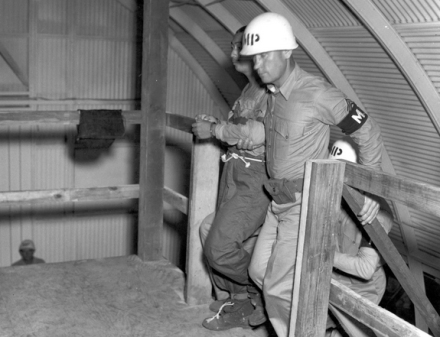
In the evening of June 18, 1947,* six convicted Japanese war criminals were hanged** by the U.S. Navy War Crimes Commission on Guam.


An unidentified Japanese prisoner ascends the gallows on Guam.

The most lastingly notable of the six was Rear Admiral Shigematsu Sakaibara, who was hanged for ordering (and perhaps in one instance, personally conducting) an infamous mass execution on Wake Island that has already appeared in these pages.

According to Judgment at Tokyo:

For some, the hanging of one of these six men had been a horrible tragedy and perhaps even a mistake. Rear Adm. Shigematsu Sakaibara had enjoyed the reputation of “gentleman soldier” and protector of the common man. Hailing from a wealthy family near Misawa in Tohokhu province, some 450 miles north of Tokyo, Sakaibara never forgot his roots. Forever poking fun at the fast-paced Tokyo lifestyle, the rear admiral touted the value of rural living, the integrity and honesty of those who lived in Japan’s rugged north country, and Tokyo’s need to recognize their great contributions to the war effort. Contemplating a postwar political future, he would be following in the footsteps of his politically influential family in northern Japan. That future was linked to championing the rights of returning veterans and other have-nots. Misawa had indeed had a heroic reputation as an important navy town and base for years. Sakaibara had assisted in the training exercises held there for the Pearl Harbor attack plan in late 1941. His future seemed golden no matter who won the war. But what some in his command called “The 1943 Incident” changed all that.


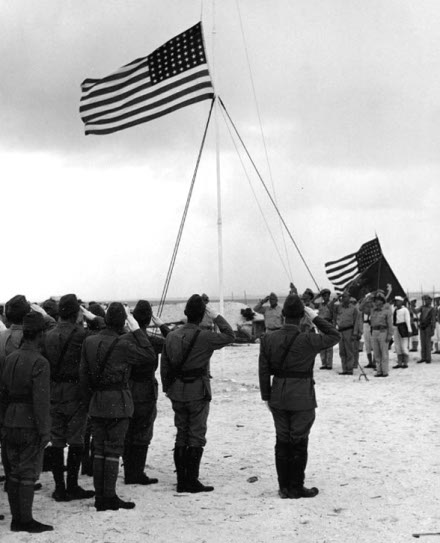
Shigematsu Sakaibara (right foreground) surrendering Wake Island on September 4, 1945.

These events, Sakaibara admitted in his trial, had taken place in an atmosphere of near starvation and impending doom. The defense counsel especially emphasized that point, asking the commission to understand and respect the pressures and strains on Sakaibara at the time of the incident. But the commission was not in a forgiving mood. In the chaos of retreat or not, innocent civilians had been murdered.

… Unfortunately for Sakaibara, several members of his former command expressed surprise on the witness stand when asked about the desperate situation on Wake in 1943. These men insisted that Sakaibara and his defense team’s description of a starving, chaotic Wake was an exaggerated one. There had been no unexpected miseries, confusion, or sense of peril, they said. Sakaibara’s fate was sealed.

True to form, defendant Sakaibara offered a very literate final statement to the commission. In contrast to so many of his colleagues on trial in Tokyo, on Guam, or elsewhere, Sakaibara, albeit with carefully picked words, admitted he was guilty of rash and unfortunate actions. He appeared especially convincing when he noted that he wished he had never heard of Wake Island. But his most memorable comments involved his own view of morality in war. A nation that drops atom bombs on major cities, the rear admiral explained, did not have the moral authority to try so many of his countrymen. With Hiroshima and Nagasaki in mind, Sakaibara claimed there was little difference between himself and the victors over Japan. With that statement a legend grew, particularly in his home town, of Sakaibara, the victim of American revenge.

… As late as the 1990s, some people there, not necessarily of the World War II generation, still bowed in reverence to Sakaibara family members out of respect for the “sacrificed” gentleman soldier.

His last words:

I think my trial was entirely unfair and the proceeding unfair, and the sentence too harsh, but I obey with pleasure.

* Some sources places the executions on June 19; the U.P. wire story, dated June 19th, referred to the hangings occurring “last night,” and the preponderance of evidence I have been able to locate appears to me to support the 18th rather than the 19th.

** An interesting bit of interservice-rivalry color on proceedings in Guam, courtesy of Prisoners of the Japanese:

The United States Navy had hanged fewer than a handful of men in more than a hundred years … Now on Guam they had all kinds of Japanese to try and sentence to death … They had to requisition an Army executioner to show them how to hang. He was a lieutenant with silver-rimmed glasses, a leading-man moustache, and a paunch. He used the traditional British drop formula, but he was an innovator as well: He invented a method of lowering the dead body to the stretcher without having to cut the rope.

On this day..

1987: Jimmy Glass, electrocution appellant

On this date in 1987, Jimmy L. Glass died in Louisiana’s electric chair — having come one vote short of having the device declared unconstitutional by the Supreme Court.

The 20-year-old Glass escaped from a parish jail with fellow inmate Jimmy Wingo on Christmas Eve, 1982, robbing and murdering an elderly couple in the process. Each blamed the other; both got the chair.*

But should they have?

Glass would lend his name to a landmark 1985 Supreme Court decision contesting Louisiana’s method of execution.

By a 5-4 decision, the high court held that electrocution, still at that point the country’s prevailing method of execution despite its medieval reputation for grisly botches, remained a constitutional method of inflicting death.

Liberal Justice William Brennan‘s vigorous dissent from that judgment is not for the squeamish. (For readability, I’ve added emphasis and removed the many citations in the original.)

[E]vidence suggests that death by electrical current is extremely violent and inflicts pain and indignities far beyond the “mere extinguishment of life.” Witnesses routinely report that, when the switch is thrown, the condemned prisoner “cringes,” “leaps,” and ” ‘fights the straps with amazing strength.’ ” “The hands turn red, then white, and the cords of the neck stand out like steel bands.” The prisoner’s limbs, fingers, toes, and face are severely contorted. The force of the electrical current is so powerful that the prisoner’s eyeballs sometimes pop out and “rest on [his] cheeks.” The prisoner often defecates, urinates, and vomits blood and drool.

“The body turns bright red as its temperature rises,” and the prisoner’s “flesh swells and his skin stretches to the point of breaking.” Sometimes the prisoner catches on fire, particularly “if [he] perspires excessively.” Witnesses hear a loud and sustained sound ” like bacon frying,” and “the sickly sweet smell of burning flesh” permeates the chamber. This “smell of frying human flesh in the immediate neighbourhood of the chair is sometimes bad enough to nauseate even the Press representatives who are present.” In the meantime, the prisoner almost literally boils: “the temperature in the brain itself approaches the boiling point of water,” and when the postelectrocution autopsy is performed “the liver is so hot that doctors have said that it cannot be touched by the human hand.” The body frequently is badly burned and disfigured.

The violence of killing prisoners through electrical current is frequently explained away by the assumption that death in these circumstances is instantaneous and painless. This assumption, however, in fact “is open to serious question” and is “a matter of sharp conflict of expert opinion.” Throughout the 20th century a number of distinguished electrical scientists and medical doctors have argued that the available evidence strongly suggests that electrocution causes unspeakable pain and suffering. Because ” ‘[t]he current flows along a restricted path into the body, and destroys all the tissue confronted in this path . . . [i]n the meantime the vital organs may be preserved; and pain, too great for us to imagine, is induced. . . . For the sufferer, time stands still; and this excruciating torture seems to last for an eternity.‘ ” L.G.V. Rota, a renowned French electrical scientist, concluded after extensive research that

“[i]n every case of electrocution, . . . death inevitably supervenes but it may be very long, and above all, excruciatingly painful . . . . [T]he space of time before death supervenes varies according to the subject. Some have a greater physiological resistance than others. I do not believe that anyone killed by electrocution dies instantly, no matter how weak the subject may be. In certain cases death will not have come about even though the point of contact of the electrode with the body shows distinct burns. Thus, in particular cases, the condemned person may be alive and even conscious for several minutes without it being possible for a doctor to say whether the victim is dead or not. . . . This method of execution is a form of torture.”

At least neither the juridical near miss nor Brennan’s graphic description of his impending manner of death dented Jimmy’s sense of humor. Asked for his last words, the “swaggering” inmate, already strapped in the chair, replied

Yeah, I think I’d rather be fishing.

Luckily for Carlisle United, he’s not the same guy as journeyman goaltender Jimmy Glass, who in 1999 improbably struck home one of the greatest goals in English football history.

* Wingo was put to death four days after Glass.

On this day..

1862: William B. Mumford, flag desecrator

On this date in 1862, a 42-year-old gambler hanged at the New Orleans mint where, six weeks before, he had pulled down the Stars and Stripes of the arriving Union occupiers to the delight of a Confederate mob.

Moving to secure the Mississippi, Northern forces had the Big Easy encircled and about to surrender when, an advance team landed in the undefended city and pulled down the Stars and Bars over the mint on Esplanade Avenue.

William Bruce Mumford was among the Confederate loyalists who took exception to the Yankee flag, so he chopped it down and dragged it through the street (provoking a cannonade from a Union warship). The flag was little but tatters by the time he had through with it.

Although the city was not officially occupied at the time of this incident, the mint was a federal building. Army General Benjamin Butler resolved to make a salutary example out of the incident to quell any possible civil unrest.

I find the city under the dominion of a mob. They have insulted our flag — torn it down with indignity. This outrage will be punished in such a manner as in my judgment will caution both the perpetrators and abettors of the act, so that they will fear the stripes, if they do not reverence the stars of our banner.

Butler, it should be allowed, had some reason for this conclusion. The Picayune exulted the act as, well, a call to resistance.

The names of the party that distinguished themselves by gallantly tearing down the flag that had been surreptitiously hoisted, we learn, are W. B. Mumford, who cut it loose from the flag-staff amid the shower of grape. Lieutenant N. Holmes, Sergeant Burns and James Reed. They deserve great credit for their patriotic act. New Orleans, in this hour of adversity, by the calm dignity she displays in the presence of the enemy, by the proof she gives of her unflinching determination to sustain to the uttermost the righteous cause for which she has done so much and made such great sacrifices, by her serene endurance undismayed of the evil which afllicts her, and her abiding confidence in the not distant coming of better and brighter days — of speedy deliverance from the enemy’s toils — is showing a bright example to her sister cities, and proving herself, in all respects, worthy of the proud position she has achieved. We glory in being a citizen of this great metropolis.

This free book argues that Butler’s clemency a few days before to a group of condemned southern enlisted men made mercy politically impossible in the Mumford case, lest the citizenry interpret executive weakness as an invitation to lawlessness.

If that was Butler’s calculus, Confederate die-hards did not appreciate it.

Accordingly, when Mumford was “hung … from a flag-staff projecting from one of the windows under the front portico” of the mint, he won promotion into the pantheon of southern martyrs.

Confederate President Jefferson Davis issued an order condemning General Butler, and even his officers, to death, along with some outsized bluster about embargoing prisoner exchanges that the Confederacy had not the manpower to seriously intend:

William B. Mumford, a citizen of this Confederacy, was actually and publicly executed in cold blood by hanging alter the occupation of the city of New Orleans by the forces under the command of General Benjamin F. Butler when said Mumford was an unresisting and non-combatant captive, and for no offense even alleged to have been committed by him subsequent to the date of the capture of the said city …

the silence of the Government of the United States and its maintaining of said Butler in high office under its authority for many months after his commission of an act that can be viewed in no other light than as a deliberate murder, as well as of numerous other outrages and atrocities hereafter to be mentioned, afford evidence only too conclusive that the said Government sanctions the conduct of said Butler and is determined that he shall remain unpunished for his crimes:

Now therefore I, Jefferson Davis, President of the Confederate States of America, and in their name do pronounce and declare the said Benjamin F. Butler to be a felon deserving of capital punishment. I do order that he be no longer considered or treated simply as a public enemy of the Confederate States of America but as an outlaw and common enemy of mankind, and that in the event of his capture the officer in command of the capturing force do cause him to be immediately executed by hanging; and I do further order that no commissioned officer of the United States taken captive shall be released on parole before exchange until the said Butler shall have met with due punishment for his crimes.

And whereas the hostilities waged against this Confederacy by the forces of the United States under the command of said Benjamin F. Butler have borne no resemblance to such warfare as is alone permissible by the rules of international law or the usages of civilization but have been characterized by repeated atrocities and outrages

… (examples of atrocities omitted) …

I, Jefferson Davis, President of the Confederate States of America and acting by their authority, appealing to the Divine Judge in attestation that their conduct is not guided by the passion of revenge but that they reluctantly yield to the solemn duty of repressing by necessary severity crimes of which their citizens are the victims, do issue this my proclamation, and by virtue of my authority as Commander-in-Chief of the Armies of the Confederate States do order-

1. That all commissioned officers in the command of said Benjamin F. Butler be declared not entitled to be considered as soldiers engaged in honorable warfare but as robbers and criminals deserving death, and that they and each of them be whenever captured reserved for execution.

2. That the private soldiers and non-commissioned officers in the army of said Butler be considered as only the instruments used for the commission of the crimes perpetrated by his orders and not as free agents; that they therefore be treated when captured as prisoners of war with kindness and humanity and be sent home on the usual parole that they will in no manner aid or serve the United States in any capacity during the continuance of this war unless duly exchanged.

3. That all negro slaves captured in arms be at once delivered over to the executive authorities of the respective States to which they belong to be dealt with according to the laws of said States.

4. That the like orders be executed in all cases with respect to all commissioned officers of the United States when found serving in company with armed slaves in insurrection against the authorities of the different States of this Confederacy.

The Confederates never got a chance to enforce the order; he resumed his colorful political career and died in 1893 hailed as Massachusetts’ greatest citizen-soldier. Complain (pdf) as they might of his iron-heeled rule, the residents of New Orleans had good cause to appreciate the relatively early and orderly occupation of their city, which spared it the flames visited on more recalcitrant rebel strongholds.

For the South, the loss of its largest city and the gateway to the Mississippi was a severe blow. As the rebel position crumbled in the months to come, Jefferson Davis must have had a worry for his own neck.

Somehow, he and every other Southerner escaped execution for their treasonable design, which leaves William Bruce Mumford, the riverboat gambler who tore down Old Glory, as the only American since at least the War of 1812 to be put to death for treason against the United States.*

* Anti-slavery rebel John Brown was hanged for treason in 1859, but it was treason against the state of Virginia — not against the U.S. Julius and Ethel Rosenberg were electrocuted for espionage, not treason.

On this day..