1788: Levi and Abraham Doan, attainted Tories

On this date in 1788, Pennsylvania highwaymen-cousins Levi and Abraham Doan(e) were hanged on Windmill Island, Philadelphia.*

A whole clan of outlaws turned Revolutionary War Tories, the Doans — brothers Moses, Aaron, Mahlon, Joseph and the aforementioned Levi plus their cousin Abraham — “were all of the Quaker faith and did not believe in war,”** according to a descendant, but “The new government levied a tax upon Joseph, Sr., the father of the Tory Doan boys, confiscated his farm, threw his wife, 3 daughters and youngest son off of the land, jailed Joseph Sr. for non payment of taxes and branded him on his hand as a criminal. This was the given reason for the start of the notorious group known as the Tory Doans.” During the Revolutionary War they served their pecuniary interest by pillage, and their political interest by informing for the British army, in an exciting sequence of adventures. (A public domain history of the Doans amid the revolution can be enjoyed here.)

None of these activities being well calibrated to earn sympathy in the independent United States that emerged and Pennsylvania hit the lot with a judicial attainder issued by the Supreme Court and ratified by the General Assembly.

In a few years’ time the newborn country’s constitution would prohibit acts of attainder but for a few short years this heritage from the mother country — enabling some organ of the state to levy legal penalties on some outlaw party by decree, absent any sort of trial — incongruously continued in that land of the free. In these very pages we have previously noticed an attainder controversially invoked by brand-name founding fathers of Virginia, also against bandits with a pronounced Tory lean.

Likewise in Pennsylvania the Doan attainder “provoked a constitutional test.” (Source) When gang leader Aaron Doan was arrested, he faced the prospect of immediate execution; however, he was able to produce an alibi relative to the specific incident charged — the robbery of a county treasurer in 1781 — and “to the disappointment of many, he was reprieved under the gallows.” (Maryland Journal, Aug. 19, 1788) He later emigrated to Canada. (His brother Joseph did likewise.)

The kinsmen were not so lucky, this time coming out on the short end of the constitutional test case — as described by patriot statesman Charles Biddle, who made an unsuccessful intervention on their behalf in the Supreme Executive Council that wielded executive power in the commonwealth until 1790.†

The Legislature were inclined to pass a bill in their favor, and appointed a committee, consisting of Mr. Lewis, Mr. Fitzsimons and Mr. Rittenhouse, to confer with the Supreme Executive Council on the subject of their pardon. This I believe was what proved fatal to these young men. Several of the members of the Council thought the Legislature had no business to interfere, as the power of pardoning, by the Constitution, was given to the Council. They refused to pardon or extend the time fixed for their execution. It was in vain the members of the Legislature and the minority in the Council urged the peculiar situation of these unfortunate men; the majority were jealous of the interference of the Legislature, and it was carried by a very small majority, that they should suffer. Going to the Council the day afterwards, I met them going in a cart to the gallows, followed by their relations and friends. It was a very affecting sight. They died with great firmness.

* An island in the Delaware River which was later bisected by a ferry channel, dividing it into Smith’s Island and Windmill Island. Both islands were removed by civil engineers in the late 19th century as an aid to the Philadelphia port.

** To revolutionary patriots, Quakers looked a rather suspiciously British-friendly bunch.

† The body’s president at the time of the Doan hangings was no less than the $100 bill guy himself, Benjamin Franklin. Surprisingly, Benjamin’s son William Franklin had during the war years been the Tory governor of New Jersey in which capacity he had signed off on some political executions of his own.

On this day..

1882: Jack Chatman, waxed wroth

On this date in 1882, Jack Chatman hanged in Louisiana’s Bossier County for murder.

The attached, racist article is from the New Orleans Times-Picayune of August 4, 1882 — anticipating an execution that day from which our man won a short reprieve.

Jack Chatman married a woman, although he and the woman were already married at the time. He resided at the Larkin Place in Bossier. One evening he went to Cash’s plantation, three miles above Shreveport, and found his wife there in company with a cotton picker named John Williams.

He waxed wroth and seizing his spouse by the feet, dragged her out of the house to another cabin a few hundred yards distant. The woman feared violence at his hands, and after a desperate struggle freed herself and ran off, Williams in the meantime came up and the men fought with bare knuckles and it is said Williams got the best of the set-to.

The next morning Chatman took up his position in some cotton near Williams’s cabin, and as soon as Williams appeared at his door Chatman brought his double-barreled shotgun to bear upon his rival and shot him. The secret of the murder was too terrible to keep locked in his bosom, and his mouth soon gave all a key to the real offender.

Chatman was arrested, and on October 24, 1881, he was tried by a jury, composed of colored men, and found guilty of murder unqualified by any phrase which might save his life. An effort to have the verdict reversed by the Supreme Court failed, and there was nought to stand between him and his punishment.

Jack Chatman is thirty-three years of age, and although not tall, is heavily built, weighing 180 pounds, and is credited with having even less intelligence than the average negro.

He admits having killed Williams, but if the deed was to be done over again he does not think he would do it. He says he expects to go to heaven, but boasts that Williams will not be found there, he not having had time to properly prepare himself for eternity.

On this day..

1868: Melvin Baughn, Pony Express rider turned horse thief

We cadge today’s entry from the August 1950 Kansas Historical Quarterly; the article “Legal Hangings in Kansas” by Louise Barry can be perused in pdf form here.

A footnote in the original notes that “During the time in 1860 and 1861, when the Pony Express was in operation, one of the well-known riders on the route between St. Joseph, Mo., and Seneca, was Melvin Baughn. It is said he turned to a life of crime by joining a gang of horse thieves, soon after the Pony Express ended. Mooney is said to have been lynched sometime later.”


The Hanging of Melvin E. Baughn

Three Doniphan county men arrived in Seneca on November 19, 1866, with warrants for four horse thieves known to be in the vicinity. Sheriff William Boulton and a posse of Nemaha county men joined in the hunt. Jackson and Strange, two of the wanted men, were captured a little east of town. Three posse members (Charles W. Ingram, Henry H. Hillix and Jesse S. Dennis) overtook the other two criminals on the road to Capioma. When they rode up to arrest the men — Melvin E. Baughn and Zach Mooney — they were fired upon. Hillix was wounded severely and Dennis was fatally shot in the back, dying a few minutes later. The horse thieves escaped.

Baughn was arrested in Leavenworth on January 6, 1867, on a robbery charge. When recognized as Dennis’ murderer, he was turned over to Nemaha county officers who placed him in the Seneca jail. Four days later an unsuccessful attempt was made to lynch him. On February 6 he and another prisoner escaped.

More than 15 months later Baughn was captured near Sedalia, Mo., after being wounded by officers attempting to arrest him for a robbery. Upon being identified, he was returned to Kansas and to the Seneca jail. He was tried during the next term of the district court, early in August, Judge R. St. Clair Graham presiding. The jury found him guilty of murder in the first degree and on August 7 he was sentenced to be hanged on September 18, 1868.

A gallows was erected on the south side of the Nemaha county jail, and an area of the jail yard was enclosed by a “fence” of canvas. And, on the appointed day, at 3:18 in the afternoon, Baughn was hanged.

On this day..

1911: Ernest Harrison, Sam Reed, and Frank Howard lynched

Ernest Harrison, Sam Reed and Frank Howard, confessed to the murder of Washington Thomas, an aged, respectable colored man. Thomas was employed in a tobacco factory, and Saturday night [September 10, 1911] the three men waylaid him along the railroad track, killed him and robbed his clothes of his salary. They were speedily captured and placed in jail. During the night the colored people of Wickliffe [Kentucky] held secret meetings and decided to lynch the murderers. Everything was quietly done. The bodies of the lynched men were left hanging until noon today, and there will be no effort by the authorities to apprehend the executioners.

Record Herald, Sept. 12, 1911

On this day..

1878: George Howell, family arbiter

From the Morristown (Tenn.) Gazette, September 11, 1878:


EXECUTION OF HOWELL

THE CONFESSION OF THE GUILTY WRETCH

From the Knoxville Chronicle

Yesterday Greeneville was astir with the bustle of unusual excitement consequent upon preparations for the execution of the negro George Howell for the murder of Joseph Martin, near Fullen’s station, December 28th, 1877.

A strong police force was sworn in by the town authorities, and Sheriff A.J. Frazier had summoned a large guard to preserve on the occasion. There were no anticipations of attempted rescue of the prisoner, though frequent rumors to that effect had reached the officials, but it was deemed best to be prepared for any emergency, and though the crowd was large, yet no serious disturbance arose.

HOWELL’S CONFESSION.

Some time after sentence of death was passed on him, the prisoner, Howell, made a full confession of the crime and its antecedents to Mr. J.R. Self, proprietor of the Journal, which, if true, put the family of the deceased in the worst possible light, he having declared in the plainest language that the widow and children of the murdered man, by bribes and threats, instigated him to do the deed.

Your reporter, accompanied by several others, visited the prisoner the day before his expected execution, Aug. 9th, expecting to see a burly black ruffian, but entering the cell, beheld confined in the cage, a negro lad, with a remarkably good countenance, holding a book in his hand. In one corner was a small pallet on which he slept, which was the only furniture it contained.

The prisoner seemed gratified at the entrance of visitors and answered all questions freely, even the frivolous one of whether Martin’s ghost ever appeared to him in the still hours of the night, to which he replied in the negative.

HIS ANTECEDENTS.

The unfortunate boy, George Howell, was born in La Grange, Ga., in October, 1861, his owner being Mr. Arch. Howell, who subsequently operated a steam furniture manufactory. His father’s name was Ephraim and his mother’s Mary, the former of whom is living, but the latter died when the prisoner was five years old. His father was a painter, and after his mother’s death both made their home in Atlanta, Ga., for six or seven years, the former pursuing his avocation of painting, while the boy waited on stores, confectioneries, etc. From thence they afterwards removed to Smyrna, Ga., where the prisoner remained a year in the employ of a Dr. Bell. He went from there to Cartersville, Ga., and by that time having become imbued with the spirit of unrest, visited Dalton and proceeded thence to Cleveland and Knoxville, and drifting as far east as Christiansburg, Va. But not liking the Old Dominion he returned to Bristol the day before the Presidential election in November, 1876. A few days after he entered the employ of J.B. Fitzgerald, near Fullen’s Depot, and remained there about seven months. He then worked a short time for Wm. Durman, perhaps two weeks, when he received a better offer and began working for Joseph Martin on the 19th of June, 1877.

The prisoner, in his interview, reiterated the confession previously made to Mr. Self and others regarding the complicity of Martin’s family with the murder, and avowed his intention, he said:

I had been at Martin’s for some time, perhaps a month, before I discovered any misunderstanding between Martin and his family and this occurred between him and his daughter Tennie. She upbraided him for his staying away from home so late; he kicked her over and struck her with a chair.

The next difficulty occurred between Martin and his wife, she accused him of visiting a house of ill fame near by, he went to his trunk, took out a pistol, and swore he would shoot her.

These wranglings and domestic quarrels continued all along through the summer, I remember of one, which at the time I thought would result seriously; it occurred some time in the fall, and late at night, I was asleep in the barn, little Bob woke me up, I went to the house and found Martin in a terrible rage, he said to me that his wife had refused to occupy his bed, that she had taken a separate room and that he would kill her, or any woman, bearing the name of wife, that would treat him in this manner. Bob and I set up the entire night.

THE BLOODY BARGAIN.

The following narrative of events immediately preceding the tragedy seems almost too horrible for relief, because if not the phatasmagoria [sic] of a disordered brain, the prisoner was but the hired tool of an unnatural wife and children. In this connection it should be stated that an attempt was made two days before the executions, by a member of Martin’s family, to induce Mr. Self, the publisher of the “confession,” to suppress the same, which, however, he declined doing. Continuing, the prisoner said:

Some two months before Christmas the family were all in the sitting room — perhaps some of the smaller children were in bed — when Mrs. Martin commenced abusing her husband (Mr. Martin was away from that night, I think he was at his mother’s or brother’s.) The girls, Margaret and Tennie and their brother Bob, all joined with their mother in denouncing the deceased. Mrs. Martin said that ‘Joe had threatened to kill you, (me) twice, and if I was you (me) I would kill him,’ she said that ‘Joe had followed you (me) one day in the railroad cut with the intention of killing you (me) and that if I did not kill him he would certainly murder me, and, if I would kill him she would bake me some cakes for Christmas.’ Bob spoke up and said that he ‘would give me two calves and a pig if I would kill his father.’ I do not remember my reply, but from that time on it was well-understood in the family that Mr. Martin was to be killed, and that I was to do it, and the family were to swear me out of it.

Mrs. Martin baked the cakes for the prisoner on Christmas, he said, reproaching him at the same time for his failure to perform his promise. Three days later, however, he endeavored to do so, and a runaway team, which diverted his attention, was the means of prolonging Martin’s life a few hours. The same evening after being informed that the gun, with which the fatal deed was committed (an Enfield rifle) was loaded, the prisoner made a new ramrod for it the iron rod being too short, and while cutting it the right length at the wood pile, according to his statement, Bob, a son of Martin’s about thirteen years old, brought him the gun, and told him to go around the house and shoot his father. Bob then went into the house, and the prisoner thus describes the

MURDEROUS DEED.

I went round in front and looked through the window, and saw Mag sitting on one side of the fire-place, Tennie on the opposite, Mr. Martin out in front and Bob sitting away back next the back door. They were all out of range. I stepped up to a plank at the edge of the portico took aim at Martin’s ear and fired. I then ran out at the front gate, next the railroad, poured some powder in the gun, put on a cap as I run, went into the barnyard. At this time I saw Martin and his son in the meadow. I fired my gun into the air, shouting to them that there were some robbers going through the field. I did this for the purpose o making Martin think he had been attacked by ‘tramps.’

I then went to Martin and kept with him until he reached the ‘Ridge’ road, some four hundred yards from his house, and at this point, Mr. Thomas stokes, having heard the firing and Martin’s cries for help, come to us. Mr. Stokes took Martin home with him, and deceased, not having at this time, the slightest suspicion that I was the one who shot him, requested me to go back to his house and see what had become of his children. I did so, little Bobby accompanying me. We returned to the house. I went in the large front room, and from there into a small bed-room and set my gun down and came back in the large room, when Miss Mag. gave me a clean shirt and told me I had better leave the country; that it would be all over the country by next morning, that her father was killed, and I would be in danger.

Howell told how he combatted Miss Maggie’s advice, saying “if they stuck to him he would be in no danger,” and acting on that idea the results was disastrous, for the next morning, he was arrested near Fullen’s depot by James F. Dobson and taken before the jury of inquest, where he denied all knowledge of the deed, but under cross-examination his answers were contradictory and he was arrested and taken to Rheatown, where he was examined before Justice G.A. Shoun. On the way the prisoner made a full confession to D.C. Dukes and Wm. T. Mitchell.

He was lodged in jail at Greeneville, Dec. 29th ult., and the case came up before the February term, 1878, of the Circuit Court, but the trial was postponed till the June following, when a verdict of guilty was rendered.

In his “appendix,” the publisher says:

The ‘confession,’ proper, was written at the suggestion of the prisoner, Howell, and after some hesitation we undertook the task: … The language is our own, but we have adhered strictly to the substance of the matter as detailed by him.

IN PRISON.

During his imprisonment, Howell has been visited frequently by clergyman [sic] and others who have conversed and prayed with him, but apparently with out producing any impression to the last. Many think him obdurate, though others more leniently think he could not comprehend the gravity of his situation. He appeared resigned to his fater and expressed deep regret for the crime.

Our reporter visited Howell in his cell yesterday morning, accompanied by Messrs. Dukes and Self. He was reading the 4th chapter of John, and in response to the question, said that he hoped he was prepared to die. He also said that he derived great pleasure from reading the Scriptures, especially a chapter in Revelations regarding the Great Wonder in Heaven.

The statement having been made by Messrs. Frank and Sevier Martin, brothers of the murdered man, that Howell had been prevente4d by Messrs. Dukes and Self from recanting his charges against the Martin family for complicity in the crime, Mr. D. asked the prisoner to state if such was the fact, who replied that it was not, and so far from it that both these gentlemen had repeatedly urged him to make a clean breast of it, and tell the truth.

Howell’s health has been very bad for some time, and last week his life was considered in danger. He stated that he wished to see the Martin family at the scaffold, where, if they came, he would charge them with having brought him. Howell requested that his body should be given to Dr. J.R. Boyd, who wished to make some slight surgical examination, though he objected to out-and-out dissection.

The crowd in attendance was small as compared with that which assembled on the 9th of August. There is, too, considerable change of public sentiment in regard to the complicity of Martin’s family in his murder.

As is generally known, Howell was respited on the 9th of August last, the day first designated for his execution, by Gov. Porter, through the exertions of W.F. Yardley, Esq., who afterwards unavailingly attempted to procure a commutation of the death penalty to imprisonment for life.

THE GALLOWS

Was erected one mile west of Greeneville, on the Knoxville road, and is the first one on which a “drop” has been used in East Tennessee for many years, and was constructed at Howell’s own request, he not wishing to die by strangulation.

A little after 12 o’clock the black cap and shroud were placed on the prisoner in his cell, and the procession left the jail at 12:40, p.m., reaching the gallows, near the fair ground, at 1:10, p.m. Silence was requested when Howell made a rambling, incoherent talk of thirteen minutes, exhorting the young people against bad advisers. He charged the Martin family with being the cause of his death to the last. He acknowledged his guilt, and the justice of his sentence, and forgave the court, jury and officers.

The devotional exercises were conducted by Judge A.W. Woward.

At 1:49 p.m. the black cap was drawn and the prisoner stepped on the trap. One minute after the cord was cut, and he

FELL FOUR FEET.

In forty-seven minutes he was dead, and, the body being cut down, was given over to Dr. Boyd to partially dissect. The crowd was very orderly during the execution.

Sheriff A.J. Frazier was assisted in the performance of his unpleasant duties by ex-Sheriff W.S. White. Having been in office only four days, this was of course, his first execution, but he evinced a coolness throughout.

PREVIOUS EXECUTIONS.

The last man hung by civil process in Greeneville was Archibald Brown, for the murder of Malinda Hinkle, about twenty-six years ago. But the beginning of the war, there were two victims of drum-head court martial executions, Hinchey and Fry, well known Union men, for the alleged crime of bridge burning.

On this day..

1999: David Leisure, mob war veteran

Gangster David Leisure — not to be confused with the “Joe Isuzu” actor of the same name — was executed by lethal injection in Missouri on this date in 1999.

A rare real-life mafioso — perhaps the first executed in the United States since Murder, Inc. boss Louis “Lepke” Buchalter in 1944 — Leisure shattered the tense 19-day calm after St. Louis mob boss Anthony Giordano died in 1980.

What would the post-Giordano underworld look like? The Leisure family sized up 75-year-old James “Horseshoe Jimmy” Michaels Sr. as a rival to eliminate for reasons both personal and professional. Paulie Leisure, his brother Anthony, and their cousin, our man David Leisure, already held Michaels responsible for permitting the murder of another family member in 1964. But as a more direct inducement, Michaels purposed to wrest control of a mobbed-up union from the Leisures.

On September 17, under Paulie’s orders, David Leisure and Anthony Leisure tailed Michaels onto Interstate 55, where by remote control they detonated a bomb they’d attached to the undercarriage of their enemy’s Chrysler Cordoba.

A nationally known gangland war ensued, nicknamed the “Syrian-Lebanese War” — not in tribute to world news but because mobsters of Levantine descent were a principal St. Louis crime faction, and it was for primacy among them that the Michaels and Leisure circles murdered one another. The next year, Paulie Leisure lost his legs to a retaliatory bomb, which in turn led the Leisures to kill Michaels’s grandson, and on and on.

By 1983, FBI informants had brought all our Leisure characters under indictment. David Leisure already had lengthy prison sentences for racketeering and for a different car bomb murder by the time the Show Me State was ready to prosecute the Michaels murder. Paul Leisure never got the death penalty but he died in federal prison a few months after his cousin’s execution. The St. Louis mafia has been said to be reduced by the present day to little more than a social club for aging wiseguys from a bygone world.

On this day..

1858: Peter Williams and Abraham Cox, to the air of Old Ironsides

Peter Williams and Abraham (or Abram) Cox were hanged on this date in 1858* in Auburn, Maine, for the maritime murder of the crew of the Albion Cooper.

They’ll tell you all about it in a lyrical “last words” that would have you believe they did a musical number on the scaffold, to the air of the Oliver Wendell Holmes poem “Old Ironsides”. A couple of fine gentlemen have done us the favor of making a shanty of the poem on YouTube, if this helps put you in the mood, although, since “Williams and Cox” imitate Holmes’s meter and nautical theme but not his brevity, you’ll need to run it back a few times if you mean to make it to the end.

And a one and a two …

* The Espy file of U.S. executions erroneously attributes the double hanging to August 27, 1860.

On this day..

1854: Willis Washam, “I never done it, though, boys”

Today’s hanging comes courtesy of a public domain History of Greene County, Missouri, whose account we reproduce in full below:


HANGING OF WILLIS WASHAM — THE FIRST LEGAL EXECUTION IN GREENE COUNTY.

August 25, 1854, the first legal hanging came off in Greene county. The subject was one Willis Washam, of Taney county. The crime which it was alleged Washam committed, and for which he was hung, was thus described at the trial: —

Washam lived on a little farm down on White river, near Forsyth, in Taney county. He was a poor man, somewhat well advanced in years, and lived a retired, obscure life. He had married a woman, who had a son, some fourteen years of age at the time of his death. The Washam family was not a model one. The old man and his wife had frequent quarrels, and both of them treated the son with great cruelty, frequently beating him with uncommon severity. It is said that the boy often showed fight, and was known to strike his mother with a single-tree and with a hoe.

One morning Washam and the boy went down on Bee creek to fish. According to the old man, when they reached the fishing place they separated. The boy never returned home alive. Some days afterward his body was found in Bee creek, with a heavy stone tied about the neck and marks of violence on the body. Mrs. Washam at once accused her husband of having killed her son, and, giving an alarm, he was at once arrested and imprisoned at Forsyth.

Becoming alarmed, Washam struck out for Arkansas, taking with him his own little boy, aged probably eight years, and riding a famous horse which he called “Tom Benton.” He worked on a cotton plantation down on the Arkansas river for some months, or until, as he said, he had a buckskin purse a foot in length full of silver dollars. His little boy never murmured for a long time, but at last one morning, while the two were lying in bed, he threw his arms about his father and said, “Daddy, when are you going to take me home to see my mammy?” Washam immediately arose, and in two hours was on his way back to Taney county, and behind him on old “Tom Benton,” was his little boy, who was overjoyed at the prospect of soon seeing his “mammy.” Arriving at home, Washam was cordially received by his wife, who told him that he was now considered innocent of the crime of which he was accused: that no proceedings had been commenced against him, and that indeed the matter had almost died out in the minds of the community. Washam lay down to sleep in fancied security, but before morning he missed his wife, and searching for her found that she had left the premises. Suspicioning that she had gone to Forsyth to betray him (which was true) Washam again mounted “Tom Benton” and started to escape. He had not gone far before he was overtaken by the sheriff of Taney county, and arrested and taken to Forsyth. On his way to Forsyth the sheriff said Washam offered him “Tom Benton” if he would let him escape; but Washam said that the sheriff himself offered “to look the other way” if Washam would give him his horse. Washam had been indicted and on being arraigned at Forsyth took a change of venue to this county. There were many threats made to lynch him by the people of Taney county. At the July term, 1854, of the circuit court of this county Washam was brought to trial. Judge Chas. S. Yancey presided. E. B. Boone was circuit attorney, A. G. McCracken clerk and Junius T. Campbell sheriff (by appointment). Hon. Littleberry Hendrick was the counsel for the prisoner. The jury before whom Washam was tried was composed of Ezekiel C. Cook, foreman; Wm. Gray, Qualls Banfield, Wm. White, James S. McQuirter, Sam’l McClelland, Mark Bray, John Freeman, Thos. Green, Joseph Moss, John R. Earnest, and Jabez R. Townsend. The trial lasted two days. The testimony was mainly of a circumstantial character, and that most damaging to the prisoner was the evidence of his wife. On the 21st of July the jury reurned a verdict of “guilty of murder in the first degree.” The next day Judge Yancey sentenced Washam to be hung at Springfield on the 25th of August following, — speedy punishment and short shrift certainly.

Mr. Hendrick made a hard fight for his client, but it was without avail. He made a strong speech to the jury, and urged the members to be careful not to hang a fellow-man on circumstantial evidence. After Washam was sentenced Mr. Hendrick moved for a new trial and for arrest of judgment; both motions were overruled. He then moved for a suspension of the sentence until the case could be heard in the Supreme Court; this motion was also overruled. He then prepared to appeal the case to the Supreme Court, but as there was to be an adjourned term of the circuit court held in August, he decided to attempt to set aside the sentence of the court then. At this adjourned term, two days before the hanging of his client, he moved to vacate, set aside, and annul the judgment of the court and set aside the verdict of the jury, but Judge Yancey refused to take any action in the matter.

It is doubtful if Mr. Hendrick could have secured a new trial for his client in the Supreme Court, since all the proceedings had been regular, and there remained but the matter of guilt and innocence, questions of fact, which the jury had passed upon; yet it is strange that he did not take the case to the Supreme Court, at any rate, even if but for the purpose of delay, and it is said that he afterward expressed regret that he did not do so, as he was fully convinced of VVasham’s innocence.

On the 25th of August, the day set for the execution, without commutation, postponement, or mitigation of the sentence, Willis Washam was hung. The execution took place in the northeastern part of Springfield, on the north side of “Jordan,” [Creek] and west of the present site of the cotton factory. The gallows stood not far from the tree on which the negro ravisher was hung. An immense crowd from all parts of Southwest Missouri was present, coming from Buffalo, from Bolivar, from Warsaw, and other points miles away. Washam made a short speech on the gallows, saying he was innocent of the crime for which he was to be made to suffer, “and,” said he, “if I had plenty of money to hire big lawyers with and pay expenses, I could get clear. My old woman has sworn my life away, but I am ready to die. I never done it, though, boys; I never done it.”

Sheriff Samuel Fulbright had been elected sheriff a few days previously, and he was the executioner. It is said that he always regretted the part he had to perform on this occasion, even to his dying day, and there are those silly enough to allege, without any good reason, that this was the moving cause that impelled him to take his own life, which he did, by poison, only a few years since. Washam died game, and after being pronounced dead his body was cut down and given to Dr. —-, of Springfield, who used it for scientific purposes. A few years since a story was put in circulation and obtained some credence, that Mrs. Washam, wife of him who was hung and mother of the murdered boy, had died at her home in Taney or Wright county, and on her deathbed, it is said, she made confession that her husband was innocent of the crime for which he died at Springfield, and that she, herself, had perpetrated the dreadful deed and murdered her own son with her own hands, tying the stone to his neck and sinking the body in Bee creek, and, then by all manner of devices, had contrived to fasten the burden of guilt upon her husband, and caused him to suffer what should have been her punishment. After careful investigation the writer has been unable to obtain a corroboration of this story, and does not hesitate to declare it a fabrication. At any rate, from the evidence and all of the facts adduced, there seems no reasonable doubt but that Washam was guilty of a deliberate and atrocious murder and suffered a just punishment. It is said that the story of Mrs. Washam’s confession was first told by an ingenious but unscrupulous attorney, who was trying to acquit a client of murder in the circuit court of this county.


Meanwhile, in Pennsylvania, another family homicide was avenged on the scaffold. This account from the Washington (Penn.) Review and Examiner of September 9 that same year will read very banal to anyone without an abiding interest in the particulars of the Anglo hanging ritual, until we come to the final paragraph’s gruesome revelation that “the left eye was found to be forced out of its socket and very black all around; the knot of the rope was on this side.”

On this day..

1950: The Hill 303 massacre

North Korean regulars on this date in 1950 committed a notorious mass execution upon 41 U.S. prisoners during the Korean War.

The Hill 303 massacre took place upon a 303-meter hill guarding the northern approach to Waegwan. In mid-August of 1950, said hill was defended by the U.S. Army’s 2nd Battalion, 5th Cavalry Regiment, 1st Cavalry Division, which narrowly escaped encirclement there by the advancing North Koreans.

Most of them escaped encirclement.

It’s a barely remembered atrocity in a war that America has consigned to forgetfulness; the massacre has seemingly never had anything like a thorough investigation. An indelible horror to the five men* who lived to tell the tale, its narrative outline is crude timelessness itself: holding these 42 U.S. POWs for two days, the North Koreans were themselves pummeled by a counterattack on the fiercely-fought hill;** unable to continue guarding the Americans, their captors fusilladed them.

This indiscriminate mass firing mere minutes ahead of the American approach was far from a thorough affair — hence the survivors, who were subsequently able to point out some of the captured Koreans who took part.


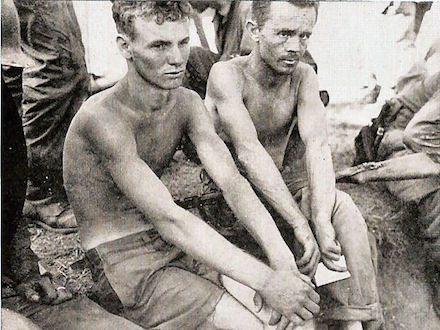
Massacre survivors James Rudd and Roy Day.

As a result of this and other summary battlefield executions, U.S. Gen. Douglas MacArthur addressed a threatening leaflet that was heavily dropped behind North Korean lines, threatening to “hold you and your commanders criminally accountable” according to the recent Nuremberg precedent.

There’s a monument to this gratuitous bloodbath that’s been recently installed, at the site of the shooting which is also nearby to a still-extant U.S. Army base called Camp Carroll. (The stone displays the date “June 25, 1950” — which denotes the start of the war, and not the day of the massacre.)

* Even the exact figures involved are a bit slippery. I believe we have 37 humans killed out of 42 captured, leaving five survivors. Some sources give it as 41 (attempted) executions with four survivors. A private named Frederick Ryan apparently was given last rites and declared dead on the scene but miraculously survived, possibly accounting for the variance.

** Hill 303 changed hands at least seven times.

On this day..

1765: Andrew Oliver lynched in effigy to the Liberty Tree

On this date in 1765, Boston patriots lynched the merchant designated as the imperial taxman. They only did so in effigy, but the “execution” scared him permanently off the job while also making a gallows-tree into one of the earliest symbols of American independence.

One of the key pre-revolution irritants for the future United States, the 1765 Stamp Act imposed taxes in the form of stamp duties on a variety of printed products, for the purpose of funding the British army deployed to North America. It was a levy long familiar to London lawmakers but it sent the colonies right around the bend, and since the colonies sat no Member of Parliament who could flip an official wig it also popularized the classic revolutionary slogan about “taxation without representation.”*

Enacted in the spring of 1765 and due to take effect in November, the Stamp Act drew immediate outrage in the colonies and especially in that hotbed of subversion, Boston.

There, Andrew Oliver, scion of a shipping magnate clan, was tapped to collect the levy. It figured to be just the latest in a series of lucrative state appointments. How was he to know in advance that this particular legislation would unleash the crazies? Perhaps he should have given more heed to the publication of ominous warnings over the roster of tax collector names.


Boston Post-Boy, August 5, 1765

On the morning of Wednesday, August 14, a crowd of irate Bostonians mobbed the corner of Essex Street and Orange Street (present-day Washington Street) and upon a large elm tree strung up an effigy of Oliver alongside a boot — the footwear comprising a second, punny, effigy of the Stamp Act’s sponsor the Earl of Bute.

“What greater Joy can NEW-ENGLAND see,” ran the menacing note pinned to the mannequin, “Than STAMPMEN hanging on a Tree!” As is clear from the following newspaper account, versions of which circulated widely in New England, these were no mere theatrics but a very proximate physical threat; even the elm’s property owner dared not take down the provocative display for fear that the crowd would pull down his house. Likewise taking the better part of valor, Oliver pledged to anti-tax colonists that he would not take the office, and he kept his word.**


Providence Gazette, August 24, 1765

After this triumphant debut, the elm in question became a common rallying-point for the hotheaded set, a frequent stage for speechifying, rabble-rousing, and fresh instances of popular justice all further to the patriot cause until, as Nathaniel Hawthorne put it, “after a while, it seemed as if the liberty of the country was connected with Liberty Tree.” Of course, it’s all a question of whose liberty; a Tory gloss on this deciduous republican made it “an Idol for the Mob to Worship; it was properly the Tree ordeal, where those, whom the Rioters pitched upon as State delinquents, were carried to for Trial, or brought to as the Test of political Orthodoxy.” When besieged in Boston in 1775-1776, British Tories cut the damned thing down, so for subsequent generations it was only the Liberty Stump.


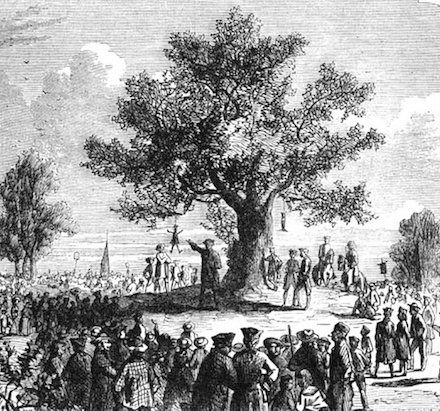
“The Colonists Under Liberty Tree,” illustration from Cassell’s Illustrated History of England, Volume 5, page 109 (1865)

The Liberty Tree is commemorated today at its former site, and forever in verse by revolutionary firebrand Thomas Paine.

In a chariot of light from the regions of day,
The Goddess of Liberty came;
Ten thousand celestials directed the way,
And hither conducted the dame.

A fair budding branch from the gardens above,
Where millions with millions agree,
She brought in her hand as a pledge of her love,
And the plant she named Liberty Tree.

The celestial exotic struck deep in the ground,
Like a native it flourished and bore;
The fame of its fruit drew the nations around,
To seek out this peaceable shore.

Unmindful of names or distinctions they came,
For freemen like brothers agree;
With one spirit endued, they one friendship pursued,
And their temple was Liberty Tree.

Beneath this fair tree, like the patriarchs of old,
Their bread in contentment they ate
Unvexed with the troubles of silver and gold,
The cares of the grand and the great.

With timber and tar they Old England supplied,
And supported her power on the sea;
Her battles they fought, without getting a groat,
For the honor of Liberty Tree.

But hear, O ye swains, ’tis a tale most profane,
How all the tyrannical powers,
Kings, Commons and Lords, are uniting amain,
To cut down this guardian of ours;

From the east to the west blow the trumpet to arms,
Through the land let the sound of it flee,
Let the far and the near, all unite with a cheer,
In defence of our Liberty Tree.

* Visitors to the U.S. capital of Washington D.C., whose 700,000 residents cast no votes in the Congress they live cheek by jowl with, can find this familiar grievance right on the city’s license plates.

** How far this surly bunch was prepared to go on August 14, 1765, one can only guess at; however, in later years, there would be several instances of Bostonians tarring and feathering various tax collectors. These guys did not do civility politics.

On this day..