1870: William Dickson, the last in Kansas for a lifetime

On this date in 1870, William Dickson’s hanging in the Leavenworth jail yard accidentally put the kibosh on Kansas executions for the next 74 years.

The Sunflower State entered the Union bleeding and had not shown particularly reticent about capital punishment during its first decade of statehood, the 1860s.

Dickson was just an illiterate laborer who murdered a pedlar in Delaware township — but the public hanging brought out the worst in the mob, and “During the execution order was maintained only by the most strenuous efforts, and repeated threats.” (Leavenworth Bulletin, Aug. 9, 1870)

The distasteful scene moved the legislature to revise the state’s capital statutes, unusually placing the responsibility of actually ordering hanging dates directly on the governor instead of a judge. (Such dates also had to be “not less than one year from the time of conviction.”)

The ensuing decades of Gilded Age governors proved perfectly happy never to do so. So, even though courts kept issuing death sentences, they were never carried out. Kansas finally abolished the death penalty outright in 1907. It was restored only in 1935, and the first hanging under the reinstated statute — the first since Bill Dickson — finally took place in 1944.

On this day..

1862: Frisby McCullough, Missouri bushwhacker

On this date in 1862, Confederate soldier Frisby McCullough was shot as a terrorist during the U.S. Civil War’s guerrilla Missouri campaign.

McCullough had a youthful stint in the California gold rush to his back when he returned to Missouri in the mid-1850s to practice law. (He also served in the Missouri State Guard, a pro-slavery militia that had been established in 1861 by the since-exiled secessionist governor.)

With the onset of the Civil War in 1861, McCullough signed up for the pro-slavery Southern army and after a few different assignments became detailed to aid Confederate Col. James Porter in the hasty bush war raging in that frontier state.

We’ve previously detailed that conflict here. For purposes of this post it will suffice to say that the border state of Missouri was fiercely contested during this war, and claimed by North and South alike.

The Union commander John McNeil was not very inclined to charitably reading the treasonable secessionist irregulars who opposed him in the state, whom the Union considered to be operating illicitly behind its lines — in the character of spies and saboteurs, like the British agent John Andre during the Revolutionary War. This very much applied to our man, since McCullough’s particular gift was recruitment — you know, luring loyal citizens into sedition and rebellion.

On August 6, 1862, McNeil’s forces routed Porter’s at the Battle of Kirksville, and they pressed their victory. The very next day after, McNeil had 15 Confederate prisoners taken at Kirksville executed as former POWs who had violated their paroles by returning to the field: “I enforce the penalty of the bond,” McNeil icily reported to Washington.

Not long after, northern sentries also captured the ailing McCullough riding alone near Edina. He wasn’t a parolee — but “he had no commission except a printed paper authorizing the bearer to recruit for the Confederate army,” McNeil would write of him later in a missive to a comrade. At a snap trial on the 8th, “he was found guilty of bushwhacking and of being a guerilla. He was a brave fellow and a splendid specimen of manhood. I would gladly have spared him had duty permitted. As it was he suffered the same fate that would have fallen to you or me if we had been found recruiting within the Confederate lines. He met a soldier’s death as became a soldier.”

A memoir of the southern travails during this conflict titled With Porter in North Missouri; a chapter in the history of the war between the states is in the public domain; chapter XXII relates with umbrage the fate of McCullough whom the author Dr. Joseph Mudd* greatly admired:

Leaning against a fence he wrote a few lines to his wife, and these, with his watch and one or two other articles, he delivered to an officer to be given her, with assurance of his devoted affection in the hour of death. Upon the way to the place of his execution he requested the privilege of giving the order to fire, which was granted to him. All being ready, he stood bravely up, and without a tremor in his manly frame or a quiver in his clarion voice, he called out, ‘What I have done, I have done as a principle of right. Aim at the heart. Fire!’

… He was a good citizen, a high-minded gentleman, of fine presence, brave as a lion, gentle as a woman. Even in his death the strongest Unionists who knew him respected and admired his virtues and entertained the most bitter regrets that what they considered his misconceptions of duty had led him to his fearful fate. At the time of his death he was thirty-three years of age.

* Dr. Joseph Anthony Mudd hailed from Maryland: he was the brother of the Maryland Dr. Samuel Mudd who narrowly avoided execution as a conspirator in the assassination of President Abraham Lincoln.

On this day..

1872: Charles Marlow, brewer

Immigrant brewmeister Charles Marlow was hanged in Mayville, New York on this date in 1872 for

Deeply in debt, Marlow improved his asset balance when he lured the more solvent William Bachmann to his place (he also lived at his brewery), then took him to the cellar where he poisoned his guest’s drink and finished him off with an iron bar.

You could take our word for it, but better still is friends of the site Murder By Gaslight. Those archives have the full details on this momentary crime sensation — including the Clue-like charge sheet catching 11 different possible means of the mysterious murder, the hung jury, the hanging’s-eve confession, and the “Polander” boarder who overheard the murder and blew the whistle on the whole thing.

On this day..

1991: Andrew Lee Jones, the last electrocuted in Louisiana

Gruesome Gertie galloped her last on this date in 1991, when that Louisiana mercy seat claimed her final soul, Andrew Lee Jones.

Gertie’s reign in the Bayou State ran fifty years and 87 successful electrocutions (out of 88 attempts), although it was cheated of cinematic immortality when the Dead Man Walking film depicted a lethal injection where voltage had done the real work.*

Art was merely imitating life for by the time that film dropped in 1995, Louisiana had long since mothballed Gertie in favor of the the needle.**

As is usually the case, the the criminal himself was only an accidental distinction for the milestone. Andrew Lee Jones in 1984 had abducted eleven-year old Tumekica Jackson, the daughter of his on-again, off-again girlfriend. He raped and strangled to death the little girl — while drunk, he said. In the days after the crime, Jones had hinted to a friend that recently “he did something he didn’t want to do” and he “done fucked up.” But he seems to have had an inkling from death row that he was marked, telling a British pen-friend — more on her in a bit — “I’m definitely hoping that I won’t be the last one to set in that chair. I got the feeling that they are trying to get one more before they put an end to it.

Capital defense attorney David Dow, who joined Jones’s appellate team in its final weeks, remembered Jones’s last hours in his Machinery of Death: The Reality of America’s Death Penalty Regime:

Several of us sat with Andrew throughout the evening in a large room directly outside the execution chamber. In addition to Andrew and me, Debra Voelker (our investigator), Neal Walker, and Michelle Fournet were there. We sat around a table talking. There were guards in the room as well, but they kept their distance. Andrew was handcuffed and shackled at the waist throughout the evening. His feet were also shackled. We would talk for a while, then Andrew would get up and shuffle away to go call his family, and the rest of us would pull ourselves together. We tried as much as possible to take our cues from Andrew. More than anything he seemed to want distraction, and we took turns providing it. Surreal is the only word that comes to mind when I think about that evening. Yet it was real.

One of the most difficult times for Andrew in the long wait came at 9:30 p.m. when we received word that his last appeal had been denied by the Supreme Court. Andrew refused to talk to Nick, who had called from the office to give him the news, because Nick was crying. Andrew had forbidden any tears. He came back from the phone to the waiting room and sat down quietly. Then he looked straight into my eyes and asked, “Why can’t they just do it now? How am I going to get through the next few hours?” I had no answer. I tried to imagine that in a few hours his life would be over while mine would be beginning a new day. i tried to imagine what it was like for him to look at me, knowing this. We stared at each other, and I shook my head. Someone suggested that Andrew purchase something else from the vending machine, and we all laughed thankfully. For Andrew, one of the great thrills of the last day of his life was his ability to put coins in a vending machine, punch a button, and receive food or drink. It had been over seven years since he had come in contact with coins or a vending machine.

Forty-five minutes before Andrew was executed, guards removed him from the visiting room, saying he would return soon. Fifteen minutes later, he walked back in with that smile of his, but awkward and blinking ferociously. In preparation for attaching the electrodes, the guards had shaved his head, one leg, and, as Andrew pointed out, “even my eyebrows.” He was embarrassed. He wondered how he looked. Of course there were no mirrors. Andrew kept blinking. He explained that there were tiny bits of hair from his shaved eyebrows that were getting in his eyes. He was shackled at the waist and couldn’t reach his eyes. Neal pulled a handkerchief from his pocket and asked if it would be okay to wipe Andrew’s eyes for him.

One of the many silences crept over the table where we sat. Andrew laughed. “At least,” he said, “they let me keep my Air Jordans. I thought they’d take those too, but they didn’t. I’ve spent my whole life running and I want to hit the other side running.” Michelle reminded Andrew that he’d always dreamed a plane would crash at Angola, setting him free. Andrew said it wasn’t too late. We all laughed.

The worst moment came when Andrew was led into the execution chamber. It stays with me. Andrew had passed by us in the hall on the way to the door to the chamber. He gave a strained smile and flapped his shackled hands at us. I watched his back after he passed. At the door to the execution chamber, the guards stopped and made Andrew take off his Air Jordans. As he bent to do so, he looked back, directly into my eyes. I will never forget the raw fear in his eyes. There were tears in mine. All pretenses were gone.

After the execution, that British penpal we mentioned, Jane Officer,† co-founded an NGO to support capital appeals in Jones’s memory. Formerly called the Andrew Lee Jones Fund, it’s now known as Amicus. Officer’s book If I Should Die … (review) describes her correspondence and relationship with Jones.

* Artistic license: director Tim Robbins wanted to keep the focus on capital punishment as such instead of permitting the audience to get away with revulsion only at a “less humane” method.

** Ironically that circumstance has latterly jammed up the state’s death chamber; as of this writing, Louisiana hasn’t executed anybody since 2010 owing in large measure to problems with procuring the drugs. Reintroducing the electric chair has been one of the solutions bandied.

† Officer reportedly began writing to Jones after seeing the documentary 14 Days in May, about an egregious wrongful execution in Mississippi.

On this day..

1857: John Dorsey

The public domain volume 1886 Professional Criminals of America might divert the devotee of classic true crime with its numerous vignettes from the latter 19th century, quite a few of them unsolved. Executed Today of course cottons to the section on executions at Manhattan’s The Tombs Prison, such as the following:

JOHN DORSEY (negro), a sailor, was executed in the Tombs prison for the murder of Ann McGirr, alias Ann Hopkins. The crime was committed at No. 3 Worth Street on March 10, 1857. The scene of the crime was a five-story tenement inhabited by colored prostitutes. Dorsey and the woman lived together, and on the night of March 10, 1857, he returned home under the influence of liquor. He met his mistress. Ann McGirr, in the alleyway. They had some words, and Dorsey becoming angry drew a razor from his pocket and cut the woman’s throat from ear to ear. Dorsey was convicted of murder in the first degree, in the Court of General Sessions, May 21, 1857, before Judge Abraham D. Russell. He was hanged on July 17, 1857.

On this day..

1857: Danforth Hartson, again

(Thanks to Robert Elder of Last Words of the Executed — the blog, and the book — for the guest post. This post originally appeared on the Last Words blog. Fans of this here site are highly likely to enjoy following Elder’s own pithy, almanac-style collection of last words on the scaffold. -ed.)

“For God’s sake, don’t do that again.”

Danforth Hartson, convicted of murder, hanging, California.
Executed July 15, 1857

Hartson (aka Sailor Jim) claimed self-defense in a fight that followed his argument with “estimable citizen” John Burke, whom he knocked to the ground and then shot in the chest. Burke was able to make a full statement, naming Hartson as the murderer, before he died.

Hartson’s last words came after he slipped through the noose and fell through the trap door.

On this day..

1864: The Andersonville Raiders

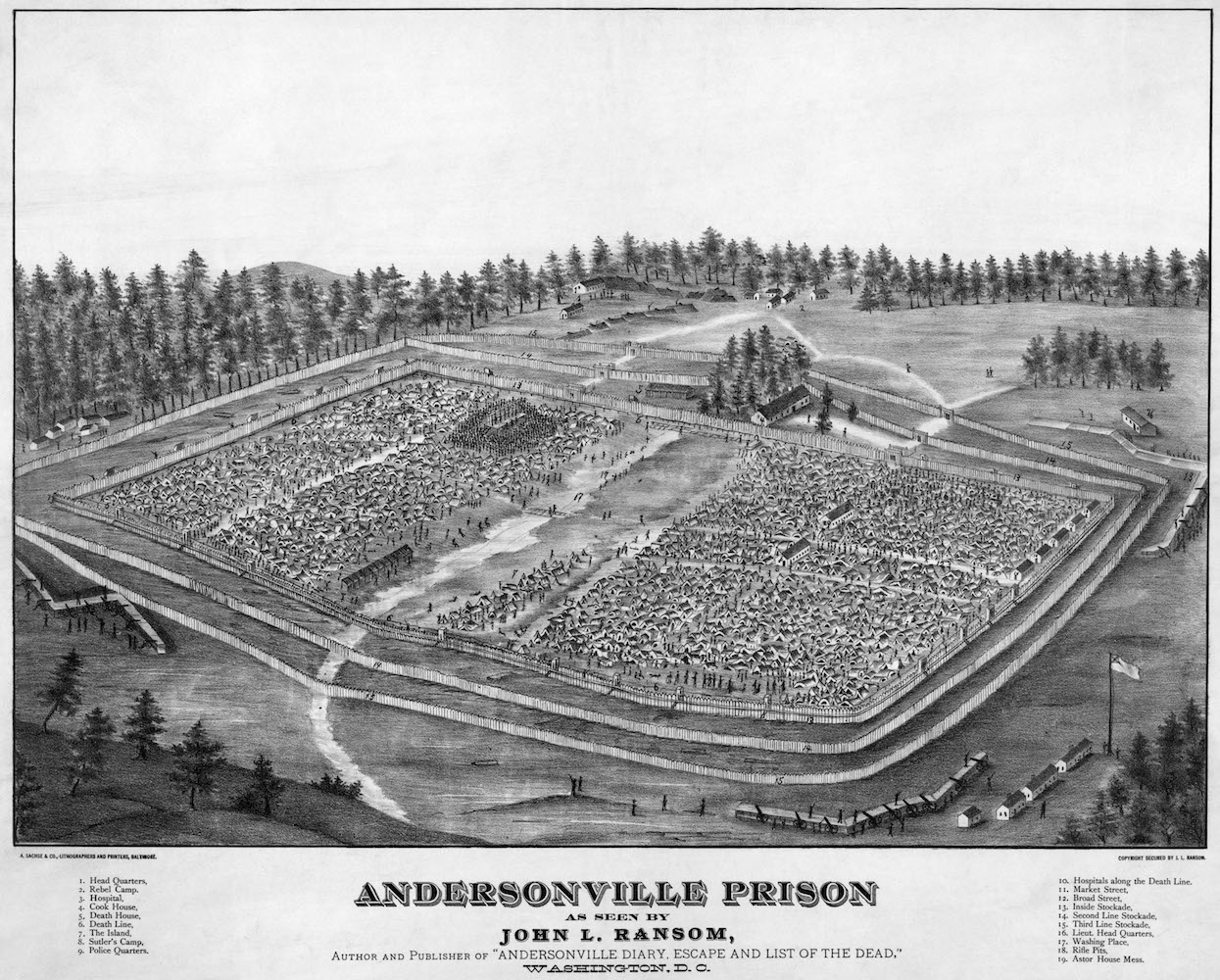
It’s not hard to understand why the Andersonville Raiders turned criminal. But on this day in 1864, the group was decapitated when six of its leaders were hanged in a quasi-legal action at the most inhospitable prisoner of war camp in the Confederacy.*

Andersonville Prison was opened in February 1864, 26.5 Georgian acres (about 0.1 square kilometers, or about the size of a square 4 city blocks on a side) of tightly-packed tents with a ditch of water flowing through its center. Its design population was 10-15,000 prisoners; its true population at one point was almost 30,000.** Some 45,000 Union soldiers went in, passing first the outer stockade, then the so-called “dead line” that demarcated the line outside of which they could be shot summarily, and finally into a mass of malnourished, often sickly humanity. Of these, 13,000 never emerged.

The Confederacy, you may recall, was not the war’s winner. As an aspiring nation, the CSA borrowed heavily to fund its arms, then found itself strapped for basic supplies as the war dragged on. By 1863 the nation was already economically depressed, and when a CSA-USA prisoner exchange agreement broke down, the Confederacy found itself with a lot of Union soldiers to house and nowhere to put them. Enter Andersonville: far enough from the North to be “safe”, easily defensible, and in the heart of slave labor to build it. All the Confederacy needed to build some basic housing was wood, which should be … oh wait … war update!…the Union controlled lumber supplies. Guess there won’t be housing.

Prisoners instead got lumped in with their brigade, and (at least initially) basic materials to make some sort of shelter.† New arrivals often showed up without being thoroughly checked over, so they might come in with food and supplies that weren’t already available to other internees.‡ Very quickly, the grounds were littered with Union POWs from around the country, people with vastly different backgrounds and goods. As the camp’s population breached 10,000 and then 20,000,§ there were, of course, inmates with designs on better living.

It’s not hard to see where this is going.

Sometime around May 1864, dozens of them assembled into a loose affiliation. The Raiders were headed by about a half dozen men: Charles Curtis, Patrick Delaney, John Sarsfield, William Collins (“Moseby”), a guy known only as “A. Munn”, and W.R. Rickson (or possibly Terry Sullivan; there’s an unusual disparity in diary accounts on the person’s name, but first-hand diary entries from the moment prefer Rickson) were considered the principal offenders. Each headed a small band of thieves who would trick new entrants, burgle tents, or use violence or threats of violence to amass “wealth” and keep themselves well-fed, well-clothed, and, most importantly to them in this hostile place, alive.

The Raiders had some huge advantages when they committed these crimes. Thanks to their amalgamated resources, they had good odds of being better armed and more fit than their victims — unless those victims were green, in which case they just knew the place better. The thieves started out as midnight raiders who turned tail at the first sign of genuine resistance unless they thought they could readily overpower the victim. By mid-June they were brazen, according to John Ransom: “Raiders … do as they please, kill, plunder and steal in broad day light, with no one to molest them.”

The victims were soldiers who, even if they weren’t killed, were left without resources in a deadly environment. Even the robberies and beatings were, in many cases, a prolonged form of murder, and Union inmates knew it. Indeed, Collins was thought by most to have never directly assaulted anyone, but he was known to steal blankets from the ill.

It’s unclear what the full Raider population was (estimates range from 100 to 500, but most people settle on the 100-200 range). What we can say definitively is that it was large enough to be a problem. Late in June of that year, a group called “the regulators” began taking police-like action against the perpetrators. Inmates brought their complaints to the group, which sought out and punished — usually through head shaving or other non-destructive means — those they found responsible.

On June 29, that problem started getting a real solution when the Raiders assaulted and robbed a prisoner now known only as Dowd. Dowd complained to the guards, and Andersonville’s overseer, Captain Henry Wirz, officially endorsed the Regulators as a police force/tribunal to maintain order. But first he announced an end to inmate rations until the Raiders were given up. (What a guy!)

The Regulators, headed by a man called “Lumber” (or maybe “Limber”) Jim, quickly had 80-100 inmates to deal with. Jury trials were implemented in the spirit of (but without most of the protections of) common law, and most punishments ranged from setting in the stocks to running the gauntlet.
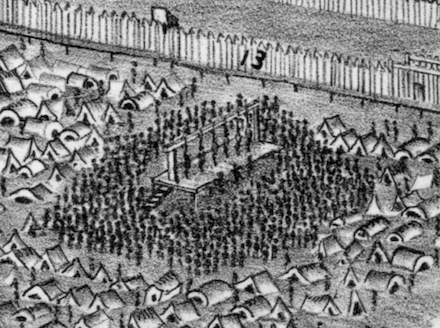

Detail of a panorama sketch of Andersonville (click to see it) makes space for a certain well-attended sextuple hanging.

The ringleaders were also among this bunch. They were assembled on July 11 and executed at a hastily-erected gallows on the north end of camp. As far as the POWs were concerned, the ultimate crime of the Raiders was a violation of the soldier code of death before dishonor. Their bodies were buried separately from other inmates, and the US makes a point of placing no memorial flags at their graves.

To be clear, the Andersonville Raiders were, for most inmates, not the primary problem but an obviously controllable one. Remember that 30% of the interned died, and for the most part those deaths were borne of bad sanitation, hunger, and disease. The removal of the Raiders was a morale boost at best, as Andersonville was still a pee-pee soaked heckhole in which another 10,000 soldiers would die before liberation in May 1865, most of them before the summer’s end.

* It was also known as Camp Sumter, named after the county it resided in.

** The population density at peak was 330,000 people per square kilometer. For comparison, the world’s densest city is Manila, at about 71,000 people per square kilometer.

† It turns out the term “shebang” wasn’t widely-used camp lingo. Drawings and photos of the camp illustrate the variety of dwellings: open sleeping, simple V-tents, structured tents, lean-tos, huts, and shacks were all scattered about the grounds.

‡ They also came with new diseases.

§ The original camp was actually only 16.5 acres, and the population ballooned to 20,000 in early June and 33,000 in August of that year. Ransom notes that the stockade was “enlarged” on July 6. Fall transfers dropped the number to 1,500 and it bumped back up to 5,000 until war’s end. Sanitation issues persisted throughout.

On this day..

1880: A day in the death penalty around the U.S.

A half-dozen murderers hanged in five different U.S. states on this date in 1880.


Cincinnati Commercial Tribune, July 10, 1880. We make the count six, not four.

George Allen Price (Pennsylvania)


Harrisburg (Penn.) Patriot, July 10, 1880.

George Sanford and Richard McKee (Arkansas)


Columbus (Ga.) Daily Enquirer, July 13, 1880.

Alexander Howard (North Carolina), Daniel Washington (South Carolina), and Henry Ryan (Georgia)

(Note: Henry Ryan’s execution is missing from the Espy File of U.S. executions.)

On this day..

2006: Sedley Alley

A gentleman with the interesting name of Sedley Alley was executed by lethal injection in Tennessee on this date in 2006, for the positively horrific rape-murder of Lance Corporal Suzanne Marie Collins.

True crime writer John Douglas has explored this case in Journey Into Darkness and Law & Disorder.

The ghastly crime occurred in 1985, when the 19-year-old Collins went for a jog at Millington Air Force Base; her attacker stabbed her about the head with a screwdriver and raped her with a tree branch so violently that the branch tore the young woman’s lung.

Alley’s next-day confession followed by his shifting accounts of the events led him to try a hail-mary insanity defense at trial … a surprising contrast to the innocence claim he floated late in his appeals process.

The generation-long labyrinth of judicial appeals between homicide and execution led Collins’s parents, Jack and Trudy, to become outspoken victims’ rights advocates. “There never will be closure,” Jack Collins once told a filmmaker. “What you get is a modicum of peace. You get a feeling that somebody cares. The state of Tennessee cared enough about our daughter that it carried out an execution on her killer. But no closure until the day we die.”

On this day..

1865: Thomas King, heartstabber

From the public domain History of Siskiyou County, California Illustrated with Views of Residences, Business Buildings and Natural Scenery, and Containing Portaits and Biographies of its Leading Citizens and Pioneers.

THOMAS KING.

After lying in jail two years, and receiving two trials, hoping for a release from the extreme penalty of the law until a few weeks before his death, Thomas King was executed on the twenty-third day of June, 1865, for a heartless and causeless murder, for dealing a death-blow, unprovoked and unexpected. He was born in Ireland, and when about twelve years of age, left his home because his parents had punished him for some offense. For several years he roamed about the United Kingdom, the associate of bad characters, until for the commission of
some felony he was transported to Australia.

When the Crimean war was raging, a regiment was raised among the convicts, by order of Lord Raglan, the men being given their liberty at the close of the war. In this regiment King enlisted, and after the fall of Sebastopol received his discharge. He made his way to Halifax, and from there to California, and to this county. After mining at Humbug, Scott Bar and various other places, he went to the south fork of Scott river, where he committed the terrible crime, for which the law exacted the penalty of his life.

On the second of July, 1863, having already become considerably under the influence of liquor, he entered French’s saloon, and began flourishing a knife in a threatening manner, and was deprived of it by the barkeeper. Among others in the saloon was James Duffy, who had been drinking, and whom King accused of having his knife. The accusation was denied, and upon being informed where the knife was, King demanded it from the barkeeper and it was restored to him. Throwing the weapon upon the floor and striking a tragic attitude, he exclaimed: “There lays me dagger. Whoever picks it up, dies by me hand.”

Not dreaming of danger, Duffy stooped, picked up the weapon and laid it upon the counter, saying, “You wouldn’t kill me, your best friend, would you?” “Yes, I would,” he said, as he took up the knife and made several false motions, touching Duffy’s breast with the handle, while the victim stood there smiling, unconscious of danger. Suddenly King reversed the knife, and with a, quick, hard blow, buried it deep in Duffy’s heart, the murdered man sinking to the floor with the exclamation, “You have cut me.” King made a pass with the bloody weapon at the barkeeper, and then sprang to the door and fled. The horrified witnesses of the tragedy stood for an instant in blank amazement, and then hastened in pursuit of the murderer, whom they soon overtook and secured after a slight resistance.

He remained in jail until the following February, when, after a trial lasting three days, he was found guilty of murder in the first degree, and was sentenced by Judge E. Garter to be executed Friday, March 18, 1864. An appeal to the Supreme Court gained for the condemned man a new trial, based upon the construction of a statute, and not upon the merits of the case. He was again tried in September, and was sentenced to be hanged on Friday, November 4, 1864, but an application to the Supreme Court produced a stay of proceedings until the case could be reviewed by that body. While awaiting the decision of the court, on Saturday, the eighth of February, 1865, he made a bold, and for a time, successful attempt to regain his freedom. Confined in the jail, which was the old wooden building first erected by the county, were also George Foster and Robert Ferry, both under a sentence to the penitentiary for grand larceny, and McGuire, a deserter from the army. The last named was allowed in the corridor, and was in the habit of calling for water. About eight o’clock on the night in question Foster succeeded in getting out of his cell, and after releasing the prisoners from their cells, had McGuire call for water, as usual, and when Jailor McCullough opened the door he was seized, gagged, and bound, and the prisoners escaped, having their irons still upon them. They had been gone but twenty minutes when their flight was discovered. The town was aroused, and people started in all directions in search of the fugitives. About daylight Ferry was caught at Cherry creek by John Hendricks and others. having been unable to get rid of his irons. About two o’clock Sunday afternoon William Short and Charles Brown found King in a clump of manzanita bushes, near Deming’s old brickyard, but a short distance south-west of Yreka. His long confinement of nineteen months had so weakened him that he had been unable to proceed further or to remove the irons from his limbs, although one of them he had succeeded in sawing partially through. A party composed of Livy Swan, A.V. Burns, J. Babb, A.D. Crooks, Sherman, Stone, and Groots, in pursuit of Foster and McGuire, stopped Monday night at Cherokee Mary’s, a resort for thieves, nine miles from Yreka. About four o’clock Tuesday morning the two fugitives approached the house and were ordered to surrender, and upon attempting to escape were fired upon by Jesse Sherman, with a shot gun, and Foster was wounded in the head and captured, while McGuire escaped by flight. Foster had succeeded in removing his irons, and now, severely wounded, was conveyed again to jail, while McGuire went to Fort Jones, and, finding escape impossible, gave himself up. Foster and Ferry had the terms of their sentences increased, while McGuire, who would have been released in a few days, was sent to San Quentin for two years for his little exploit in jail-breaking.

George Foster, alias Charles Mortimer, alias Charles J. Flinn, was the leader in the jail delivery, a hardened and reckless felon, and ended his career upon the scaffold. He was first sent to San Quentin from San Francisco for three years, and when his term expired, went back, chloroformed a man and robbed him of $1,800, was arrested, and escaped from officer Rose, by knocking him senseless and nearly cutting his throat. He then came to Siskiyou county, and was soon sentenced to three years for grand larceny, which term was increased to seven years for his participation in the jail delivery. After his release he continued his career of crime, finally murdering a woman in Sacramento, September 19, 1872, for which act he paid the penalty upon the gallows, not, however, until his brother lost his life in a desperate attempt to release him from the jail in which he was confined while awaiting the day of his execution.

The Supreme Court having reviewed the case and sustained the decision of the lower court, King was brought before Judge Garter in May, and was sentenced to be hanged on Friday, June 23, 1865. Preparations were accordingly made by Sheriff A.D. Crooks by erecting a gallows in the jail-yard. King’s conduct during the trials had been one of bravado and defiance, and this he maintained to the last, being quite abusive while on the scaffold. He remarked as they were leading him from his cell to the place of his death, “I’m the handsomest man here, if I am going to be hung.” But few spectators were admitted within the jail walls to witness the last act of this terrible drama, which culminated at nine minutes to two o’clock. The murderer who thus received the just punishment for the crime, nearly two years after he had plunged the fatal knife into an innocent and unsuspecting bosom, was buried a little east of town, near the remains of Crowder and Sailor Jim, executed several years before.

On this day..