1929: Homer Simpson

Eighty-five years ago today, the state of Georgia executed a gentleman whose most remarkable characteristic to his contemporaries was that he was the onetime Chief of Police of Cleveland, Tenn. — and most remarkable characteristic to posterity is that his name was Homer Simpson.

WORST. EPISODE. EVER.

Other Simpsons characters to face the electric chair include Snake, an unnamed Convicted Man in a hurricane, and (appropriately for this post) Police Chief Wiggum

Despite the inevitable cartoonish riffs in this here post, the Homer Simpson case was a shocking and controversial one. When Simpson was returned to his native Cleveland four days after he died in Georgia’s electric chair, a reported 10,000 souls crowded the funeral, predominantly sharing the sentiment that Simpson’s own father expressed in a subsequent book, The Life and Fate Of Homer C. Simpson: The Man Who Was Electrocuted for a Crime He Did Not Commit.

That father, Jake Simpson, had been a Tennessee legislator who had the opportunity during his single term to cast the decisive vote* cementing not only Tennessee’s ratification, but also nationwide constitutional adoption, of women’s suffrage.

Homer’s vision was not as sharp as his dad’s.

Adrift after a Republican electoral wave swept him out of the sheriff’s office, Homer accepted the invitation of a World War I buddy to hop a train to Jacksonville, Fla. for a dubious “job” just over the Georgia border.

The “job” for Homer was to pose as a wealthy land-buyer in order to lure a local banker off to a lonely property where he could be trussed up while the conspirators emptied his vaults. It was supposed to be a bloodless robbery, but the victim, Carl Arp Perry, energetically fought back when they pulled a gun on him and that army buddy Malcolm Morrow shot him three times.

The bleeding Perry was loaded back into the “buyer’s” car to raid the bank to the tune of $4,600. This was supposed to be the easy part — nobody had a plan B for a mortally wounded man bleeding out in the back. Panicking, they fled back to their safehouse in Jacksonville with Perry still in tow but wrecked one of the two getaway cars. Homer — and again, this man is a former police chief — pulled Perry out and deposited him in the brush near the accident, bustling with his two confederates past a Good Samaritan who had pulled over to find out what was wrong.

The three fled the scene. The Samaritan brought the expiring Carl Perry to a hospital and summoned the police. Perry was a goner but he held on long enough to give John Law a detailed description of that night’s events and of his assailants.

We can see already that former Rep. Jake Simpson’s book implies a far surer claim on innocence than the bare facts might permit for a disinterested observer.

The core argument Simpson pere et fils advanced by way of mitigation was that Homer had no intention of hurting anyone, did not shoot Carl Perry himself, and indeed pled with Morrow at the critical moment to stop firing at their prisoner.

This point does not lack moral weight; in its time, it helped to support a push for a new trial or executive clemency.

As a legal matter, however, Simpson’s fate was determined by the felony murder rule which made all parties to the bank robbery scheme jointly culpable for the homicide that arose out of it. This standard has made a fair few non-triggerman accomplices with even lesser participation than our man here eligible for execution in the U.S. right down to the present day.

And there’s an anti-Simpson case to make as well, beginning with the part where he comes from several states away (bringing guns along with him) and continuing to the part where however sincerely he desired Perry not be shot, he utterly failed to aid Perry once the shooting had occurred. For the state, the acme was dumping the injured man out of the wrecked automobile, presumably to die. (Simpson’s angle was that they were removing him from a dangerous spot and with other drivers stopping Perry was sure to receive aid. So actually, see, they helped him.)

Days before they were to die, Malcolm Morrow unexpectedly confessed to being the sole triggerman in a vain attempt to save his old friend. “I shot Perry and I am willing to take the blame. If Simpson dies for the crime for which I, alone, am responsible, he will be getting a tough break at the hands of the law.” And the governor even took a personal meeting with both men’s mothers hours before the execution.

But there was no relief for either prisoner.

On the day that both Morrow and Simpson were electrocuted, Simpson’s hometown paper The Banner published a last goodbye.

To my dear friends at dear old Cleveland who have been faithful in your efforts to help me: I want to thank each one of you for your kindness in all that has been done both in your petitions and letters, and your faithful prayers. But dear ones it looks like that all is in vain and there seems to be no mercy for me.

After the good jury signed the petition for me and also wrote personal letters in my behalf, and the Chief Justice and his associate justice wrote letters and also went in person to the governor, and said I did not have a fair trial, and also said that according to the laws of the state of Georgia that I did not deserve the death penalty, after all this was done, with the good petitions and letters, and good prayers, I felt encouraged. But after all it looks like I will have to say goodbye to you dear ones.

Now dear kind friends I love you all and appreciate your kindness, but it seems that the time has come when you can do no more for me, and now my last request of you is that please do what you can to comfort and cheer my dear kind old Dad, and my precious darling mother, my sweet sisters and dear brothers, who have been so faithful and done everything that they can do.

He’s buried back home in Fort Hill Cemetery

Homer Simpson’s case has enjoyed a bit of present-day rediscovery. There’s an online book dedicated it; titled The Grave: Murder in the Deep South, it traces Carl Perry’s story and that of his family. A Simpson descendant was also recently reported to be working on a book titled Homer Simpson Must Die.

* Tennessee was the 36th and final state necessary to ratify the 19th Amendment, and the measure carried in Tennessee by one vote: every vote was by definition decisive. The decisivest, though, was that of Mr. (Harry) Burns, who switched his vote at the 11th hour under pressure from his mother.

On this day..

1817: James Lane

I was born near Goshen, in the state of Connecticut, about the year 1793. My father was a show-man, and his business leading him much from home, I was neglected, and suffered to follow my own inclinations … I chose for my companions the most vicious boys, and spent most of my time in quarrelling, fighting, sabbath-breaking, and other vices. I was indeed sent to school a short time; but, disliking restraint and study, made but little progress in learning. Thus by parental neglect on the one hand, and bad example on the other, were sown those seeds of vice, which, as will be seen in my narrative, produced such a dreadful harvest of crimes.

-From the Narrative of the life of James Lane: who was executed at Gallipolis (Ohio), September 9, 1817, for the murder of William Dowell, with some observations on his behaviour under condemnation : to which is added the address of the court, on pronouncing sentence of death upon the prisoner.

The gallows narrative commenced thereby will arrive on this date in 1817 at a hangman’s tree in Ohio. But it begins, as is customary, delving into the miscreant’s youthful forays into theft, through which he soon “stifled the voice of conscience, which cried against it.” He suffered 10 lashes at the public whipping-post of Litchfield for robbing a schoolhouse of books, and had a couple of close brushes for his habit of walking into unattended farm houses and making off with clothes.

The War of 1812 gave Lane the opportunity to mend his ways, or at least collect enlistment bonuses, which he did on at least three occasions. Being caught in desertion attempts one time, Lane was “sentenced to be cobbed two mornings, fifteen strokes each time. This mode of punishment is very severe. It is performed by laying the offender across a barrel, and whipping him with rods. Five or six others suffered the same punishment with me, some of them much worse than I.”

At last, following more successful desertions, he found his way up the Hudson to

Catskill, [where] I fell in with one Church, as hardened as desperate as myself. We formed an acquaintance with each other, and travelled together to a place near the city of New York. Here we went into a store to buy some small article; and the store keeper suspecting our money to be bad, I flew into a violent passion, snatched the watch from his pocket, and stamped it under my feet. Church then seized a scythe and drove him out of the door. We then locked ourselves in and in spite of the danger which threatened us, ate and drank our fill of the good things we found. By this time, a number of people had assembled in the chamber over our heads, and were making their way down the trap door to take us. Hardened, insensible, and enraged with liquor and passion as we then were, it would have been no wonder if we had put fire to some barrels of powder there. This we might easily have done; but either did not think of it at the time, or were prevented by some other circumstance. I thank God for preventing this dreadful crime; for preserving my life and the lives of so many people as would have been thus destroyed, and giving me a space for repentance.


But it seems so idyllic in Thomas Cole’s 1833 “Catskill Scenery”.

They got a three-year sentence in the penitentiary for this brazen raid, and Lane piously averred that “the time spent there was the happiest of my life.”

“But such deep rooted habits as ours are not to be cured by a few years of confinement,” the narrator continues, rubbishing the penitentiary movement without which he might have been hanged already. “No sooner were we at liberty, than we betook ourselves to our old course of life.”

The old confederates burgled in Albany, then wandered to New York, and Philadelphia, and Pittsburgh, separating along the way. Lane lived hand to mouth, moving town to town, working a day or two here and there, stealing when the opportunity arose, and wasting whatever money he laid hands upon “in drinking, carousing, and every other species of vice.”

Following the Ohio River, he made his last call at the river hamlet of Gallipolis, Ohio where he “first met with Dowell, removing from Virginia, for whose murder I am so justly condemned to suffer death.”

The next morning I went to his house, or shed, about six miles from Gallipolis, on my way to Chillicothe, entered, sat down, and talked in a friendly manner with him and a female slave, his house keeper. I then walked on to Mr. Ryan’s, about a quarter of a mile from Dowell’s, where the latter soon came in to buy some meat. We were both asked to breakfast, and accepted the invitation. When Dowell had paid for the meat, I perceived that he had about forty dollars left. To possess myself of this, I resolved to commit the horrid crime of murder! and this on a man who had never done me any injury, whose house I had entered an hour or two before as a friend, and been treated as such, and with whom I had just partaken at the table of the bounties of Providence; and not only on him, but on the woman also, and her four children, and then set fire to the home. Astonishing and incredible wickedness!!! Six human beings were to be sent to their final account, in a sudden and awful manner, and perhaps unprepared — and for what? That I might have a few dollars to throw away, or worse than throw away, as I had done with all my former ill gotten money!!? I can plead no excuse. I was able to work, and not ashamed to beg, till I could find employment. — Shall I say I was urged on by the devil? No doubt I was; but his temptation could have been of no avail, if I had not lent a willing ear to him. I had never resisted him. I was completely his slave! Just, I repeat it, is the sentence of death pronounced against me!!

Lane executed his exclamation-mark plan that night, stealing a cudgel from yet another farm and slipping back to ol’ Moneybags Dowell’s. When the house was asleep, he crept into the house and to Dowell’s very bedside, and slew him unawares with a mighty two-handed smash.

The blow woke Dowell’s slave — who is never referred to by name in this narrative — and after a struggle she managed to escape out the door and elude her murderous pursuer, and we presume her four children did likewise since they were also not murdered. When Lane returned to the emptied Dowell house, he could find no money — “for it since appears he had left it with Mr. Ryan.” He fled over the river into Virginia (today West Virginia), but was captured a few miles away, and as will be readily perceived, was thoroughly worked over before his execution by the local divine.

Since a small town like Gallipolis (population as of the 1850 census: 1,686) didn’t exactly have regular traffic to the gallows, this was a big occasion for the ministers as well. To Lane’s confession, the Rev. Gould appends a two-page summary modestly reviewing his soul-saving offices. Lane’s own biography traces the classic gallows narrative, from sabbath-breaking to the noose; the like formula for Gould’s review ought to be taking Lane from his initial condition, “destitute of all religious knowledge, insensible of his sinfulness, and unconcerned about futurity” to the hope of eternal salvation.

Gould, however, remained skeptical of Lane’s histrionics of religiosity. After the prisoner was sentenced, he “broke off profane swearing, acknowledged his guilt, and became sober,” but as Gallipolis’s pious citizens held prayer meetings in the jail or read the Bible to him, Gould thinks it was his narcissism as much as his conscience that was excited and “the increasing attention which he received from every kind of character, elated him, and did much to divert his mind from the thoughts of death.” Although sometimes “under lively representations of his situation and of the mercy of God in Christ Jesus, his feelings were softened into tears,” these interludes “lasted but a few moments” and “he showed no pleasing signs of repentance, no attachment to the Saviour.”

The evening before execution, like careless sinners, he was unwilling to be disturbed with the thoughts of his unpreparedness and danger. He said he had left off swearing, and had prayed a good deal; and therefore believed that God would pardon him. This appeared to be the foundation of his hope to the last. On the day of execution, his sensibility nearly or quite left him. He appeared not to realize his situation. When he was first placed upon his coffin, at divine service, however, he was affected … [but] on the gallows, he expressed his willingness to die, saying he had made his peace with God; but manifested little sense of the importance of death and of eternity.

On this day..

1916: Kosta Kromphold


According to the Portland Oregonian, Kosta Kromphold mellowed to a phonograph in his jail cell on the eve of his execution — including “If I Had a Thousand Lives to Live.”

A Russian native, the forgettable Kosta Kromphold had left his dear mum in New York City and chased his fortune to the Pacific coast, where he found it at gunpoint in the money-box of a Chinese restauranteur in Marysville.

Kosta really got himself into the egg drop soup during the subsequent chase by two bicycle (of course — this is California!) cops. Firing back at his pursuers, he shot officer John Sperbeck dead, right through the mouth.

According to April Moore’s Folsom’s 93: The Lives and Crimes of Folsom Prison’s Executed Men, “A Mrs. A. Meyers of New York City wrote to Governor Hiram Johnson on behalf of her housekeeper, Johanna Kromphold, the condemned man’s mother, saying that Mrs. Kromphold had already lost two of her three children. Mrs. Meyers’s message continued, ‘By taking this young boy’s life, you not only take one but two, as I am positive she will never live through this terrible ordeal.'”

This appeal didn’t work, and on September 1, 1916, Kromphold imparted a dying plea to the Folsom Prison chaplain: “Write my mother. I haven’t the heart to do it.”

On this day..

1878: Sevier Lewis, a family affair

(Thanks to Meaghan Good of the Charley Project for the guest post. -ed.)

On August 30, 1878, Sevier (aka Severe, Savier) Lewis was hanged in Empire City, Oregon — today known as Coos Bay — for the murder of his much younger half-brother, Zachariah T. “Zack” Lewis on May 22, 1876.

The brothers were two of Hiram Hamilton Lewis’s nine children. Hiram was 74 years old at the time of Zack’s murder, and ambitious in spite of his age: he was running for state legislature.

Sevier, who was in his early fifties, was married and had seven children. Zack was twenty-five, single and still living at home. It was said he’d taken an interest in Sevier’s sixteen-year-old daughter Sylvia. Her father warned him to stay away, but Zack wouldn’t listen and kept coming around pestering his niece with unwanted advances. Finally Sevier had had enough.

Well, that’s one version of the story. Here’s another one:

Sylvia confided to her young uncle that she’d been raped by her father, and become pregnant. Zack went to Sevier and told him to stop the molestation immediately or he would tell the entire family what he had done. He helped Sylvia move in with her grandparents to protect her, and told Sevier that if he touched her again, he would kill him. Sevier touched her again.

These starkly contrasting purported motives may assign which characters, in the ensuing violent tableau, don the white hats and which the black. But either way, one late spring day, Sevier loaded his gun and went to his father’s home where he found little brother working in the fields. Sevier shot him dead, and then took flight.

In December 1877, a full year and a half after the shock murder and probably about the time Sevier was getting comfortable with having gotten away with it, a Coos County man chanced to recognize the fugitive in a hotel bar in Seattle and had him arrested.

Sevier’s own father and Sevier’s own son both testified against him at the subsequent trial, traveling 200 miles to to so. His defense attorney didn’t try to pretend he was innocent and only pleaded for a recommendation of mercy. He was convicted of his brother’s murder in June 1878 and sentenced to be hanged by the neck until dead. The judge also ordered him to cough up $830.10 in court costs, including $21 worth of beer he’d been prescribed during his incarceration.


Oregonian, August 31, 1878.

Lewis’s scaffold speech was bitter and disjointed — “bravado and blasphemy on the gallows,” the Portland Oregonian headlined it. He rambled on about how everyone was prejudiced against him, expressed love for his family and added, “If I could die a thousand times and save my daughter I would do it. If I could save her I would be satisfied to die.”

Author Diane L. Goeres-Gardner describes his final moments in her book Necktie Parties: Legal Executions in Oregon, 1851-1905:

Defiant, stubborn and vindictive, he finally forced Sheriff Aiken to manhandle him closer to the hanging rope. Even as the black cap was pulled over his head and he was being pushed forward he yelled, “What in the hell are you doing that for? I am not afraid to die.”

It was a clean hanging. His neck snapped and Sevier Lewis died within minutes.

What happened to Hiram Lewis’s political aspirations? Well, given the scandal, it’s no surprise that he lost the election. He moved to Lane County after Zack’s murder and died in 1879, supposedly of a broken heart.

What can history tell us about which brother to believe? Was Sevier really trying to protect his daughter, or did Zack pay the ultimate price for his attempt to rescue Sylvia from her predatory father?

Andie E. Jensen, author of Hangman’s Call: The Executions and Lynchings of Coos County, Oregon 1854-1925, studied the available records and notes that Sevier’s youngest child Lucy’s year of birth is unknown — the dates range from 1875 to 1877 — while all his other children had their exact date and place of birth recorded. He speculates that Lucy, said to be the daughter of Sevier and his wife Elizabeth, was in fact Sylvia’s child.

“Fact or fiction,” he concludes, “we will never know for sure. The end result was the execution of Sevier Lewis, whose act of murder victimized more than just his half brother Zack.”

On this day..

1962: James Dukes, philosophical

(Thanks to Robert Elder of Last Words of the Executed — the blog, and the book — for the guest post. Fans of this here site are highly likely to enjoy following Elder’s own pithy, almanac-style collection of last words on the scaffold. -ed.)

A circled passage in the section “He Is Sentenced to Death,” in Plato’s Apology:

The hour of departure has arrived and we go our ways, I to die and you to live. Which is better God only knows.

— James Dukes, convicted of murder, electric chair, Illinois.
Executed August 24, 1962

Dukes was executed for killing Detective John Blyth Sr., who had pursued him after he had beaten his girlfriend in church and shot two other men who tried to stop him. On Dukes’s execution day, Detective Daniel Rolewicz, who took part in the final gun battle, told a newspaperman, “I’ve been waiting a long time for this night.”

Dukes made no oral statement but left behind a copy of the Apology for the press.

(Dukes was the last person executed in Illinois prior to the national death penalty hiatus of the late 1960s. He was also the last person electrocuted in Illinois, and the last put to death in Chicago’s Cook County. -ed.)

On this day..

1833: A 13-year-old slave girl

(Thanks to Meaghan Good of the Charley Project for the guest post. -ed.)

On Tuesday, the 23rd inst., Harriet, slave of JAMES H. SHEPPERD, JR., aged about 13 years, was convicted of the murder, by drowning, of a son of ALEXANDER McKENZIE, Esq., of Hardeman county; she was sentenced to be hung on the 23rd of August. The boy deceased, was aged about 5 years, and was drowned in a common flour barrel fixed in a spring near the residence of his father. (Source)

On this date in 1833, a thirteen-year-old slave girl was hanged for murder in Bolivar, Tennessee.

The teenager, called Harriet, belonged to James H. Shepperd, Jr. On some unspecified date, she drowned a five-year-old boy, the son of Alexander McKenzie, in a flour barrel near his home in Hardeman County.

A local news account noted, “The circumstances as detailed by the witnesses on the trial, show the transaction to have been one of the most wanton and aggravated murders, perhaps ever committed by a female so young, and created considerable excitement in the minds of a virtuous community.” Harriet was convicted on July 23 and executed exactly a month later.

Harriet was the youngest female ever legally executed in Tennessee. She was not, however, the youngest person in the state to meet with that fate. That honor goes to twelve-year-old Jesse Ward, also a slave, who was hanged for arson in Knoxville in 1809. He burned down his master’s house and several barns because he was angry at being whipped.

On this day..

1851: John McCaffary, the last hanged by Wisconsin

On this date in 1851, the domestic abuser John McCaffary (or McCaffrey) was publicly hanged in Kenosha, Wisconsin.* His crime — singularly ill-concealed — was a noisy row with his wife Bridgett that ended with him tipping her into a rain barrell and holding her in it until she stopped moving.

Neighbors alerted by Bridgett’s shrieks arrived to find the newly-minted widower redwet-handed, and his late wife stuffed in the backyard butt.

There had been a few executions in Wisconsin before McCaffary’s, but this was the first one after Wisconsin attained statehood in 1848. It was attended by a large crowd of 2,000 to 3,000 onlookers — a third of them female, to the special chagrin of newsmen.

And those 2,000 to 3,000 onlookers, as it turned out, witnessed something never to be repeated. From that day until this, the state of Wisconsin has never again put a human to death.**

The crowd played a part in that eventuality. Wisconsin was a reforming northern state — in a few years, the anti-slavery Republican Party would be founded there — and the spectacle of public enjoyment under the gallows struck as regrettable the sorts of people who, say, write Madison Democrat editorials. (“Murder before the people, with its horrors removed by the respectability of those engaged in its execution.” (Source))

Christopher Latham Sholes, a Kenosha publisher whose main claim to historic fame was later inventing the first commercially successful typewriter,† was seated in the Wisconsin State Assembly in 1852 as a Free Soiler. He too had denounced the execution in his newspaper — “the crowd has been indulged in its insane passion for the sight of a judicially murdered man … we hope this will be the last execution that shall ever disgrace the mercy-expecting citizens of the State of Wisconsin.” (See It Happened In Wisconsin, 2nd, or this link.) As a legislator, he put his political capital where his editorials were and spearheaded a successful campaign to get rid of capital punishment.

On July 12, 1853, Wisconsin followed the example of its neighbor, Michigan, and abolished the death penalty full stop.


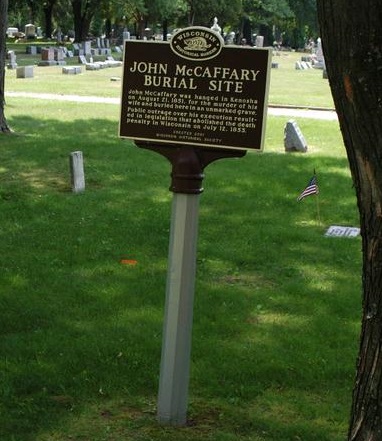
Burial marker for McCaffary in Kenosha’s Green Ridge Cemetery, erected in 2001. ((cc) image from Matt Hucke.) The McCaffary house on Court Street is also a registered historic landmark, and possibly haunted by Bridgett’s ghost.

There’s a handy roundup of resources related to the McCaffary execution here.

* The present-day name. Kenosha was then known as Southport.

** According to Invitation to an Execution: A History of the Death Penalty in the United States, there was an 1868 Wisconsin execution under Oneida (not Wisconsin) law, conducted on tribal lands.

† Said typewriter also debuted the now-standard QWERTY keyboard layout.

On this day..

1883: Ah Yung

(Thanks to Meaghan Good of the Charley Project for the guest post. -ed.)

On this day in 1883, Chinese immigrant Ah Yung, aka Ah Kee, was hanged in Missoula, Montana.

As Tom D. Donovan notes in his book Hanging Around The Big Sky: The Unofficial Guide to Lynching, Strangling and Legal Hangings of Montana, his execution had three distinctions:

  • The first (of nine) legal executions in Missoula County;
  • The first Chinese person hanged in Montana;
  • The quickest reported hanging, with death declared in only a minute and a half.

Ah Yung was condemned for the January 29, 1883 murder of Chung Yu, the paymaster of the Wing See Company.

However, the authorities believed his murder was the least of Ah’s crimes; he was suspected of killing no fewer than seventeen people, two whites and fifteen Chinese.

Ah Yung shot and killed Chung Yu and wounded another man during a botched robbery, then fled the scene. The authorities offered a $400 reward for his arrest, and he was captured a month after the murder at Frenchtown, Montana. But, as Donovan records, “because of some bizarre reason, there was a question whether or not the reward was going to be paid for his captor released the prisoner.”

Fortunately, the murderer remained free for only a few days and didn’t have the opportunity to commit any more crimes before he was captured again, and this time sent to jail in the newly incorporated city of Missoula.

Chinese immigrants, especially drawn by gold strikes,* were a sizable constituent in frontier Montana as throughout the American West. A Montana travelogue in the Nov. 25, 1882 Utah Salt Lake Tribune

“Gangs of Chinamen clearing away the forest and underbrush … laboring with pick, shovel and wheelbarrow.” This was the Northern Pacific then under frenetic construction through forbidding Rocky Mountain terrain in subzero temperatures. In Missoula itself, “Celestials” were “numerous enough to form a Chinese quarter. They have an eye to business, and where you find a live, busy camp or town in this remote region, there, too, you find the inevitable Chinaman.”

A Presbyterian minister and a Catholic priest attempted to offer pastoral counsel to the condemned man, only to discover that he was utterly ignorant of religion. Pressed to confess, Ah Yung refused and kept repeating, “Me no kill him,” — a statement he held to his dying moments.

* Welcomed initially, the Chinese were an increasingly contentious presence in Montana (and elsewhere) in the 1880s. Still, there were over a hundred independent Chinese mining operations known in Montana at this time.

On this day..

1864: Barney Gibbons, chance recognition

One hundred fifty years ago today, Barney Gibbons was executed by musketry by the Civil War Union army in St. Louis, Missouri.

Gibbons was among the many soldiers in that chaotic war who in the time before identity cards and omnipresent databases deserted the respective armies at their convenience. Whatever the fulminations of the right-thinking against such behavior, only a slight risk of capture and exemplary punishment attended such an act.

Gibbons’ own slip into the statistically improbable might be the slightest imaginable risk of them all.

The New York native was enlisted in the Seventh Infantry Regiment when it was sent at the outset of hostilities to the New Mexico theater of the war; there he slipped away from the march one day and re-enlisted in the Confederate army, serving against his former comrades in several battles — notably Glorieta Pass.

Then Gibbons deserted the Confederate army as well, turned up as a teamster in New Orleans, and eventually made his way to St. Louis.

And that was that, or at least it often would have been. By 1864, who could bother to search out an obscure private fallen off the march three years before?

One summer’s day in 1864, however, a former 7th Infantry sergeant named Richard Day chanced to pass Barney Gibbons on the street and somehow recognized him. “He has a cut upon his lip, and a peculiar manner of walking,” Day would later insist at the court-martial. “Capt. Jones of our company was always at him because he never could walk like a soldier, he would throw his head forward and his arms to the rear. He always walked with his hands open and fingers apart even when he had gloves on.”

Now, despite the certitude of our verbiage so far, the fact of the matter is that “Gibbons” denied all this all the way to the stake — and there were no better forensics on offer than Day’s personal recollection. That was pretty much state of the art, even if we now know that eyewitnesses are highly error-prone.

We pick up Gibbons’s horrifying last moments (following Catholic baptism) via the New York Times correspondent, as reprinted by the Cleveland Plain Dealer on August 23, 1864:

Although there is not at the post of St. Louis an officer who ever witnessed an execution, the preliminaries were conducted in a skillful, orderly and decent manner. — All the troops of the post were in attendance, and a hollow square having been formed with one side open toward the embankment of the for, the condemned man was placed beside a post, with a seat attached, his common pine coffin lying on the ground beside him. After making a brief statement, in which he denied having deserted, but said that he straggled and was overtaken by the rebels, he pronounced his sentence most unjust …

He was seated, and his arms tied behind the post, a white cap was drawn over his face, and six musketeers drawn up within fifteen feet of his breast. The command was given:

“Make ready.”

“Aim.”

“Fire” and two bullets entered the abdomen. And now succeeded a few seconds in which transpired a scene which shook the stoutest heart, and made every human creature present shudder. From beneath the ghastly cap came a wail of agony which pierced every ear, and as the utterance “Oh! oh! too low,” escaped from the lips of the quivering form writhing in the throes of a horrible death, every one seemed paralyzed with horror. With a quick motion the officer of the squad waved the six muskets aside and four others took their place. “Make ready.” “Aim” — but mercifully before the third command was given, the four pieces were discharged, three leaden messengers of death entering the sternum, and a mighty convulsive shudder ended the being of the poor deserter. What an eternity of woe in those intervening few seconds! What a crowding of events from infancy, hallowed by a mother’s love and prayers to the dreadful details of the present scene! Yet, all passed before the mind’s eye of the dying man, and the wonderful palimpsest of his brain touched by the consciousness of instant death, gave him to see in a second all that had been for years forgotten, ere he entered upon the unknown.

The error in firing arose from the fact, discovered too late for remedy, that the sights of the muskets were set for long range.

On this day..

1912: Sing Sing’s seven successive sparks

New York’s electric chair handled record traffic on this date in 1912: seven successive electrocutions.

The first two men committed unrelated and isolated crimes.

  • John Collins got drunk and started firing a pistol in his Manhattan apartment. Police responded, and Collins shot a patrolman through the chest when they entered his domicile and tried to arrest him.
  • Joseph Ferrone, a violent wife-murderer who reacted to his guilty verdict by smashing a glass and slashing a juror with the jagged edge before he was restrained.

The last five were the culmination of another record: six people (these were nos. two through six) executed for one homicide. More specifically, and this was their newspaper billing, “Six Italians”.

Ringleader Lorenzo Cali

Lorenzo Cali, Santo Zanza, Vincenzo Cona, Salvatore DeMarco, Angelo Giusto and Filippo DeMarco were all Sicilians who were among the million-plus emigres to leave the island in the wake of the devastating 1908 Messina earthquake, had washed up at Croton Lake outside of New York working on the aqueducts that supplied that swelling metropolis with its fresh water.

It was backbreaking work at less than $2 a day, with tent barracks for recuperation because it was a prohibitive two-hour train ride back to the last stop on the New York subway.

In 1911, Cali caught wind of the passing of a nearby farm owner — Henry J. Griffin, whose comfortable home (usually occupied by boarders from the aqueduct’s managerial ranks) must have looked a fair sight from the muddy workers’ tents. It was said that he had left his wife not only that property but a $3,000 insurance policy. That would be a good four times the average annual earnings of a workingman at the time: had that policy been cashed out, grabbing the proceeds would be a better day’s labor by far than tending the aqueduct.

On the night of November 8-9 of that year, our Six Italians — led by Cali, who had made a point of casing the house over the preceding weeks — stole by moonlight into the woods near the house and waited for the male residents to leave for the day. Once they did, the Italians raided the farm.

Though they easily overpowered the three women left there, they didn’t find any $3,000. One of the women, Mary Hall, the young wife of an aqueduct superintendent, lost her composure in the face of the bandits screaming at her to produce more money; desperate to control her sobbing and shrieking, Santo Zanza stabbed her fatally in the chest.

But as the men fled the house with pennies on their hoped-for fortune and a dying woman at their back, the other two matrons of the house summoned police — Aqueduct Police, actually, a special force detailed to keep order in the unruly laborers’ shanties. Four of the men were arrested in the vicinity that afternoon; Cali, the ringleader, made it back to his Brooklyn tenement but was caught there two days after the murder. Only Salvatore DeMarco, known to his confederates as “Penolo”, remained on the lam.

A speedy succession of four different trials (Filippo DeMarco and Cali opted to be tried together) commenced at the Westchester County courthouse in White Plains before the month was out. Heavy guard (“Black Hand” notes kept arriving at the judge’s door; for fear of a possible rescue attempt by underworld characters, Italians were barred from attending the trial) did not in the least encumber their rapidity.

Angelo Giusto had implicated Santo Zanza as the killer (“the confession was wrung from the prisoner by up-to-date third-degree methods,” a newspaper reported) and a cycle of desperately competing confessions and accusations ensued among the lot to easily doom them all. The general thrust of the non-Zanza defendants was that the whole thing was a robbery only, and that Zanza had gone rogue in knifing Mary Hall to death. Even if true, however, those statements amounted to confessing capital crimes under felony murder rules imputing to all participants in the criminal enterprise joint liability for all its consequences. There was one death by one man’s hand, but all six were murderers.

Twenty-six days after Mary Hall’s death, all five Italians stood together in the courtroom to receive their death sentences. The trials had taken just a few hours apiece; jury deliberations consumed less than a quarter-hour for all cases save that of the youngest, Giusto.


New York Times headlines from November 29 (left) and December 6 of 1911. “Less than thirty hours’ actual court time was used in the four trials,” the latter article reported by way of high-fiving the state’s attorneys. “It is believed that Westchester has established a new record for the quick disposal of murder cases in this State.”

Two days after that, the last fugitive Salvatore DeMarco was finally arrested at his East Flatbush apartment. He was tried, convicted, and condemned all in a single day on December 19.

As the short appeals process unfolded over the ensuing months, public pressure for mercy was exerted by the Italian consulate specifically on behalf of the men who had not bloodied their own hands. Even Santo Zanza, who was executed separately from the rest on July 12, climbed aboard, and gave statements designed to accentuate his own culpability and underscore his fellows’ innocence of his design. But considering the sensational nature of the crime, and its context of growing public fear of violent crime rife among New York’s Italian immigrants, this was not one to recommend itself to the governor‘s clemency.

There is a detailed Crime Library summation of this case that begins here; note that most of its navigation links insert a gratuitous (and link-breaking) space after the phrase /croton in the web address; clicking through the 15-page story requires some annoying manual url manipulation.

On this day..