1838: The slave Mary, the youngest executed by Missouri

(Thanks to Meaghan Good of the Charley Project for the guest post. -ed.)

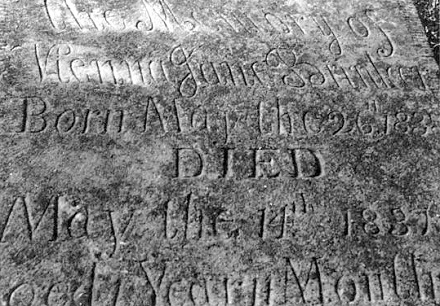
On this date in 1838, a teenage slave girl named Mary was hanged in Crawford County, Missouri. She had murdered Vienna Jane Brinker, a white child two weeks short of her second birthday.

Mary’s original owner was Abraham Brinker, Vienna Jane’s grandfather. Abraham was murdered by Indians southwest of Potosi in Washington County, Missouri in 1833. He died without a will and his widow, Fanny, and son, John, became administrators of his estate. John appropriated Mary for himself and eventually made her the babysitter for Vienna Jane, his daughter.

Mary, described as “shrewd” and “remarkably fond of children,” was “about thirteen” at the time she killed the toddler on May 14, 1837. That day Vienna Jane’s body was found in a stream on the Brinkers’ property. She’d been struck on the head and flung into the water, where she drowned.

Just why Mary committed the murder may never be known,* but she readily admitted killing Vienna Jane — at least, once Mary “was tied to a log” and interrogated with the sheriff, who “began to act as though he were going to whip Mary” — and her guilt was taken as given throughout her surprisingly protracted 15-month legal odyssey. The judge instructed Mary’s trial jury:

If the Jury shall find from the evidence that Mary, the accused person was under fourteen years when she committed the offense alleged in the indictment, then, unless they shall also find from the evidence that at the time when said offense was committed the said Mary had sufficient mind to know what act would be a crime or otherwise, they shall find for the defendant.

The jury found against her and sentenced her to death.

Mary’s lawyers — there were three of them — appealed on several grounds, but her age was not one of them. The appellate court granted her a second trial on a technicality, but she was convicted again and did not appeal further.

Writing of this case in her book Death Sentences in Missouri, 1803-2005, author Harriet Frazier remarks that “Mary remains the youngest known person ever put to death by the authority of the state of Missouri. It is no accident that she was a female and a slave.”

Willard Rand turned her case into a two-act play, The Trial of Mary, a Slave, which was performed in the Crawford County courthouse in 1990.

* This page on Brinker family history mentions speculation that Mary was revenging her own prospective sale, and/or that she might have had an illegitimate child by her master whom the family sold against Mary’s will.

On this day..

2008: Christopher Scott Emmett, jocund

(Thanks to Robert Elder of Last Words of the Executed — the blog, and the book — for the guest post. This post originally appeared on the Last Words blog. Fans of this here site are highly likely to enjoy following Elder’s own pithy, almanac-style collection of last words on the scaffold. -ed.)

“Tell my family and friends I love them, tell the governor he just lost my vote. Y’all hurry this along, I’m dying to get out of here.”

— Christopher Scott Emmett, convicted of murder, lethal injection, Virginia.
Executed July 24, 2008

The Washington Post reported: “Emmett fatally beat his roofing company co-worker, John F. Langley, with a brass lamp in a Danville, Va., motel room in 2001. He then stole Langley’s money to buy crack.” He later lost an appeal in Virginia claiming that the state’s lethal injection protocol constituted “cruel and unusual” punishment.

On this day..

1896: John Pryde, Brainerd murderer

On this date in 1896, John Pryde hanged in Crow Wing County jail for a Brainerd murder over a little bit of money.

Pryde had worked all the preceding winter in a lumber camp but closed his engagement (so he said) with a Valentine‘s Day jaunt to Lothrop — abandoned in the present day but then the terminal stop on the Brainerd & Northern Minnesota Railway, where the lumber he’d been hewing would be loaded up for the Brainerd sawmill. According to this site about Minnesota ghost towns, Lothrop “was a typical hell-raising, end-of-tracks town.”

Some of the hell so raised consisted in the timeless pastime of wagering on small cardboard rectangles, and to hear Pryde’s (possibly suspect) account of it he got sharked at the poker table: ” I knew nothing about cards, only what I had found out by looking on. I tried the game and won, at one time being $100 ahead, and if I had known enough to quit then I would not be where I am today. But I was flush and my companions urged me to keep right on, saying that luck was with me and I could win everything in sight. I did so, to my regret, and lost all my winnings and also my winter’s wages, having but a few dollars in my pocket when I reached Brainerd, and I was all broke up.”

Back in Brainerd so penniless and broke up, Pryde decided a buddy from the logging camp could supply him and sent Andrew Peterson a letter urging him to hie to Brainerd immediately for a job that was waiting him. Peterson did so; Pryde met him on his return on Feb. 24 and escorted his victim around the outskirts of the city to a spot sufficiently remote to shoot him in the back of the head and rummage through his possessions.

Pryde found one dollar.

Unfortunately for Pryde, Peterson survived — not for good, just long enough to be found and identify his killer before he succumbed and made it a murder charge.

By the time authorities took Pryde into custody on this intelligence, he had already made arrangements for another logger to come on down for another “job”, with the same object in mind. (But hopefully more than a dollar in his pockets.)

With that pleasing want of artifice that can characterize the Upper Midwest at its finest, Pryde admitted everything and lodged a guilty plea just days after Peterson’s March 3 death. He did add that he regretted the mistake he made in not slashing Peterson’s throat to finish him for sure, and then burning the body to hide the crime.

Pryde’s fall — from an employed and relatively flush young man on the make to a condemned murderer — took all of three weeks.

There were suggestions that Pryde might have pulled the same trick on a different fellow who had disappeared from the work camp. He rejected that quite indignantly.

This story from his last days, and including his gallows address (blaming gambling) and his written last statement (blaming gambling) shows a man really locking in a narrative.

What we know about John Pryde is that he killed in cold calculation someone who was in no way connected to his gambling woes, and he was preparing to do the same a second time. There’s really only so much misbehavior one gets to write off to tilt. But Pryde was a young man and we might allow that a sense of guilt (however belated) and a wish to reconcile himself to his loved ones (however hypocritically) are not of themselves discreditable qualities. There were no protracted appeals or dramatic stays of execution to grow him into any other person but the one who shot his work chum dead for a buck. He had a bare five months to make sense of it all: one wonders if his parents in Chicago, who received this last missive from him, ever did.

I received your letter and was glad to hear from you, but I know that it was a hard thing for you to hear what I have done. Well, mother, I have thrown my whole life away, and not only that, how I have disgraced you and pa, and my only sister for the rest of your life; it is true that I made an awful mistake in life. Dear mother, my life was thrown away by the gambling hell hole, there is nothing in the world but that, and it would break most anyone up. It was my first time to gamble, and I was led away by one of my companions and was led into an eternal destruction, that is what put me in the place I am in now. Now my lot is a hard one, but I have made my peace with the Lord, and am prepared to meet my father in Heaven. God will forgive the most sinful if we only believe in Him. The Bible says that God has forgiven the greatest of sins.

I am very sorry over this matter, but it can’t be helped now. There is one thing, that I hope this will warn other young men and will put them on the straight road and show them what gambling will lead a young man to do, first from one thing and then to another.

Dear mother, now I have given you all the news that I have. Oh, dear mother, I cannot reward you for your kindness. You always stuck up for me, and if I had only taken your advice, I don’t think I would be where I am today. It is true what you said. I had a good home, and did not realize what a home was. I know I ought not to have left home but we young men do not pay enough attention to our mother and father. Now, father and mother, don’t take this matter too hard, as it won’t help it in the least. We all have go to go some time, sooner or later. There is a home prepared for us all and there we will have peace and joy. Now I will bring this letter to a close, hoping it will find you all well, as I remain, your most loving son,

JOHN PRYDE.

Now, I will bid you good bye, good bye. Father, forget me not, keep this letter to remember me.

On this day..

1801: Chloe

On this date in 1801, the teenage slave “negro Chloe” — as the press reports almost invariably called her — was hanged at Carlisle, Penn., for murdering her owner’s two young children.

Although a slave by every experience of her short life, Chloe and others of her generation actually existed in a legal twilight space between slave and free. Pennsylvania in 1780 had taken a step towards emancipation that was pioneering for its time but the halfest of half-measures: the Gradual Abolition Act made the children of slaves born in Pennsylvania after 1780 into indentured servants who would be manumitted by age 28.* As a result, dwindling numbers of grandfathered legal slaves remained in Pennsylvania until 1847, even as the state became an antebellum hotbed of abolitionist activism with a huge population of free blacks and slaves fled from Southern plantations via the Underground Railroad.

In Chloe’s case, she had been born to a slave in 1782, then willed when her owner William Kelso died in 1789 to William’s daughter Rebecca, who eventually sold Chloe on to a dealer.

In 1794, Chloe was bought and sold repeatedly: she was sold in July of that year, and then again in August, and then again in October, until an Irish merchant named Oliver Pollock finally bought her in March of 1795 and gave her a little bit of stability. In her eventual last confession, Chloe credited Pollock and his daughter as the only owners who took any care for her education.

Pollock, however, sold Chloe as well at the end of 1796. One wonders if the “high passion” to which she would eventually attribute her murders made her a notably ungovernable slave-child for all these passing masters, or whether it was all just happenstance — that she was just a commodity that could be liquefied in a pinch.

Whatever the case, Andrew Carothers — the man who bought Chloe from Pollock — would be her last master.**

The hard-working Andrew Carothers and his wife, Mary, had a little log cabin in Cumberland County, home to six children. Chloe was their first slave, to relieve Mary of her household labors while Andrew cleared a plot of forested land nearby, and the tone of Chloe’s last confession — widely published at the time of her execution — clearly implies a going resentment for Mary. Chloe will have just turned 18 years old when she commits her capital crimes; she’s grown out of childhood and through adolescence in this family, working as Mary’s constant domestic drudge and probably sleeping in the barn.

On January 24, 1801, the family realized that four-year-old Lucetta had gone missing. Andrew found her dead in the nearby creek where they drew water.

Since we’ve begun our story at the end we know the author of the deed in advance. Chloe would say that she had been given of late to “temptations” to do violence to her owners — sudden fancies that she would unthinkingly indulge. She had already tried and failed to murder the family’s youngest son, she said, and twice attempted to fire the barn.

On that fatal Saturday, Chloe had taken Lucetta to the creek when she needed to retrieve some water without, she said, intending any mischief. But the “temptation” came upon her there and she yielded to it readily, suffocating Lucetta and leaving her in the creek.

By returning nonchalantly and playing surprised that evening, Chloe evaded suspicion in this instance. It wouldn’t have been so implausible that an unattended little girl in a rural family might have fallen into a river and drowned, and a relieved Chloe “promised myself good days” without violent urges.

But, she said, Mary’s strict discipline soon undid those better angels. After Lucetta was buried on Sunday the 25th, Mary “made me strip off my short-gown, and gave me a severe whipping, with a cowskin; also on Tuesday she gave me another, and on the following Saturday she gave me a third.” For one who had so lately experienced the cruel pleasure of visiting lethal violence upon her tormenter’s own flesh and blood, this treatment was too much to bear. That weekend she lured another daughter, six-year-old Polly, to the creek and did her the same way.

Chloe was reported to have forsworn “any spite or malice against” her victims — “on the contrary, I loved them both.”

But, she said, she murdered them because their tattling on her misbehaviors set her up for Mary’s corrective hidings (“far beyond the demerit of the fault”); and, “the second and greatest motive … to bring all the misery I possibly could upon the family, and particularly upon my mistress.”

If suspicion had escaped Mary the first time around, it now insisted upon itself.

Mary’s account of matters also hit the papers; she said that on the Monday following Polly’s death she accused Chloe of the horrible crime. “She [Chloe] said she did not do it, had no hand in it, and full denied it till Monday was a week.” That must have been an excruciating week, doing the wash and preparing dinner with the sullen teenager who you’re also convinced is picking off your family and torturing to that effect. “I was much whipped by my master, to extort a confession,” Chloe recalled. At last the Carothers’ pressure overwhelmed their slave.

I said [to Chloe] it was not worth while to deny it, her countenance would condemn her, it was plain she had a hand in it — it was plain, for the children would have crawled on their hands and feet out of the run if somebody had not held them in … she might as well tell as not — I could not bear the sight of her about the house; I was sure she had done it.

Chloe eventually consented to confess not to Mary Carothers but to a neighbor, Mrs. Clendinen, who had a lighter personal touch and not so much acrimonious history with Chloe. Even so it was still another two weeks before they escorted Chloe to the sheriff. The spiritual instruction that her many owners had never bothered with in her life now became available to her as she approached death — obviously all-inclusive with ghostwriting services as well.

Oh! what have I done? In revenging the injuries I suffered, I have drawn the fierce indignation of heaven upon myself. The voice of the blood of two innocent children crieth against me from the ground. Is my sin too great, for the mercy of God to pardon? Is my stain too deep for the blood of Jesus to wash away? I am full encouraged to trust that, loud as the blood of these innocents cries for vengeannce, the blood of Jesus cries louder still for mercy and pardon and I trust that his unbounded goodness will not suffer me to perish.

The original source of both Chloe’s and Mary Carothers’s accounts are separate 1801 articles in Kline’s Carlisle Weekly Gazette: July 22 (Chloe) and June 24 (Mary). Both were subsequently reprinted by other newspapers around the young country.

* This law inconvenienced the political elites of the early Republic, since it also prohibited importing new slaves — even for the Southern congressmen who came to Philadelphia while that city served as the U.S. capital during the 1790s. George Washington, famous for crossing the Delaware, had to run his black slaves over that river to New Jersey periodically while he was president, lest they become automatically liberated by residing continuously in Pennsylvania for six-plus months.

That said, the Gradual Abolition framework did sustain a market in human chattel inasmuch as somebody’s compulsory labor unto age 28 was still a value that could be calculated and sold. The way to import slaves to Pennsylvania was to bring them in under the same transit auspices that Washington used, legally manumit them there into “indentured servitude” pending their 28th birthday, and then sell the indenture contract.

** John Carothers, Andrew’s cousin, had been poisoned in 1798 with his own wife Mary in another, unrelated Cumberland County death penalty case.

On this day..

1789: Francis Uss

On this date in 1789, Francis Uss was publicly hanged in Poughkeepsie, New York, for burglary.

Anthony Vaver, author of Bound With An Iron Chain: The Untold Story of How the British Transported 50,000 Convicts to Colonial America, unfolded this wanderer’s story on Vaver’s blog Early American Crime; click onward to find how the Strasbourg-born Uss wound up fighting at Yorktown and staying in America.*

Uss gave over an autobiographical manuscript shortly before his hanging, and although the last page of its remaining copy is regrettably damaged, the man’s meditations on his ineluctable doom remain these centuries later an affecting, human wail.

The terrors of the approaching awful Friday rise up in fearful anticipation before me! I have realized them so often that they cease to be ideal. Once more I will indulge them and, hand in hand with horror, once more walk over the gloomy stage.

After a night spent in disturbed slumbers and terrific dreams, I rise from the floor and see the gleamings of a rising sun which I never never more will see go down. The birds hail in cheerfullest notes the new-born day—but music to me has lost its charms, and to me the new-born day brings woe unutterable. Food is set before me; but I turn with loathing [from(?)] nourishment, for what connexion is there between life and me? My pious friends surround me, and retire not, till they have wearied Heaven with the most fervent supplications in my behalf. Oh that I felt their fervor, had their faith, and enjoyed their consolations! — The day fast advances — I hear the din of crouds assembled in the streets — Again there is a noise at the prison door! The massy key grates upon the wards of the lock, and grates too upon my very soul. The door recoils, and enter the ministers of justice. Pity is painted on every countenance. The sounding file is applied, my chains drop to the earth, and my limbs are once more free, only soon to be bound in never-ending obstruction.

Heavens! What are my feelings while the suffocating cord is adjusted to my throat! Death is in the very touch and I think with unutterable …

* Anthony Vaver has also guest-blogged for Executed Today.

On this day..

1814: Two War of 1812 deserters

On this date two centuries ago, there was — or at least, there was supposed to be — a military execution for desertion from U.S. forces during its War of 1812 against Britain/Canada.

I depend here on only a single source, this public-domain tome about the history of New York City.

There’s a noticeable discrepancy here in that the execution order (the first document) references, and names, two people sentenced to die — but the ensuing garrison orders consistently refer to “the prisoner” in the singular. I have not been able to clarify this discrepancy, and it’s worth noting that the Espy file of historic U.S. executions — which is incomplete, but nevertheless pretty complete — does not note an execution on or around this date. It’s possible that either or both of the men were pardoned; there had been an amnesty proclaimed in June for (successful) deserters who were still on the lam, and although that wouldn’t have directly covered these cases, it might have signaled a corresponding leniency liable to extend within the courts-martial system.

Headquarters 3d Military District,

N. Y., July 7th, 1814.

Capt. Moses Swett or officer commanding troops on Governor’s Island.

Sir :–The general court martial which convened on Governor’s Island on the 23d ult., of which Col. D. Brearly,* of the 15th Inft. is president, having sentenced John Reid and Roger Wilson, privates in the corps of artillery, to be shot to death — By power in me vested you are hereby directed to have the sentence carried into execution on the day and at the hour prescribed in the general order of the 3d inst., for which this shall be your warrant. I am, sir, your obedient servant,

Morgan Lewis, Major-General Commanding 3d M. D.

They didn’t stand on ceremony in the Third Military District, which comprised southern New York and northern New Jersey. (Hence the artillery batteries in Battery Park.)

Off the tip of Manhattan, at Governors Island, this warrant was put into execution the very next day.

Garrison Orders.

Fort Columbus, July 7th, 1814.

The troops on Governor’s Island will parade tomorrow morning at 11:30 o’clock on the Grand Parade, for the purpose of witnessing the execution of the prisoner [singular — sic?] sentenced by a general order of the 3d inst. to be shot to death.

The troops will form three sides of a square, the artillery will form the right and left flank, the Infantry the rear; the execution parties, consisting of a sergeant and twelve privates, will parade at 11:30 o’clock and placed under the command of Lieut. Forbes, Provost Marshal; the guards of the advanced posts will have their sentries at their respective posts, and will repair to the parade at 11:30, those under charge of the Provost Marshal will join the execution party, for the purpose of escorting the prisoner to the place of execution.

The execution parties, in divisions preceded by the music with the Provost Marshal at their head, will march in front of the prisoner, the music playing the dead march; the guards formed in divisions will march in rear of the prisoner.


According to our source, the dirge “Roslyn Castle” was the go-to tune for a military execution at the time. It was a popular Scottish air alluding to a gorgeously ruined Midlothian fortress.

The procession will enter the square from the rear, face ten paces from the coffin placed in the center, upon which the prisoner kneels by a signal from the Provost Marshal. The music ceases, the warrant and sentence of death is read, the signal to fire is then given to the execution parties. By order of

M. Swett, Commander.

* Nephew of one of the founding fathers.

On this day..

1999: Gary Heidnik, serial kidnapper

On this date in 1999, Gary Heidnik was executed in Pennsylvania for a horrific spree that saw him kidnap five African-American women to a makeshift torture dungeon in his Philadelphia basement.

Intelligent but socially maladroit and diagnosed from his youthful U.S. Army service as mentally ill, Heidnik gave a preview of his later notoriety by signing his girlfriend’s sister out of a mental hospital in 1978 and locking her up in his basement to rape. He spent most of his resulting sentence in a mental institution of his own, refusing even to speak for two-plus years after claiming in 1980 that Satan had stopped up his throat.

Afflictions of the infernal and the criminal justice variety somehow failed to impede the growth of Heidnik’s personal sham church and tax dodge, the “United Church of the Ministers of God” from piling up a half-million in assets operating from the mid-1970s until Heidnik’s last arrest in 1987.

Heidnik got out of detention for the 1978 kidnap-rape in 1983. After a short mail-order marriage to a Filipina woman who ditched him in 1986 for beating and raping her, he finally went full Gary Heidnik.

On November 25, 1986, Heidnik authored the first of the abductions that would etch his name in serial killer lore, snatching Josefina Rivera and imprisoning her in the cellar of his house at 3520 North Marshall Street. (Rivera recently published an autobiographical account of her captivity.)

For the next five months, Heidnik’s underdark played host to its owner’s unspeakable depravities. Five women he kept there for various periods, shackled to pipes and subject to the gratifications of his violent sexual predilections. One woman, Sandra Lindsay, died of the maltreatment, leading to Heidnik’s closest accidental brush with the law: the stench of incinerating pieces of her dismembered corpse in his oven attracted the complaints of neighbors. Heidnik coolly shooed away the responding police officers with a story about burning the roast.

His prison’s most distinctive chilling feature was a tomblike hole handy for punishing resistance; a second woman, Deborah Dudley, died when Heidnik flooded and electrocuted this crevasse with her in it.

Considering the diabolically systematic nature of the torture dungeon, it’s actually a lucky job that it didn’t go on much, much longer. Remarkably, Heidnik’s last kidnap victim Agnes Adams was able to talk her way into a spot of temporary leave which she naturally used to summon disbelieving police and arrest Heidnik on March 23, 1987.

Once exposed to public view the Marshall Street monster could scarcely fail to leave a cultural impression. Among other things, Heidnik is one of several serial killers on whom Thomas Harris based the fictional murderer “Buffalo Bill” in his 1988 novel Silence of the Lambs.

On this day..

1646: Jan Creoli, for sodomy in slavery

(Thanks to Meaghan Good of the Charley Project for the guest post. -ed.)

On this date in 1646, a black slave named Jan Creoli was executed in Manhattan, part of what was then called New Netherland and is now New York.

Creoli had been caught having carnal knowledge of a ten-year-old boy, another slave named Manuel Congo. Several of his own fellow Africans turned him in to the authorities. When Manuel Congo was brought face-to-face with Creoli, the boy “without being threatened in any way confessed to the deed in the presence of the prisoner.”

In her book Brothers Among Nations: The Pursuit of Intercultural Alliances in Early America, 1580-1660, author Cynthia J. Van Zandt notes,

The statement that a ten-year-old child who had been raped might “confess to the deed” seems startling to modern eyes, but it is highly significant for understanding Dutch authorities’ actions. As far as New Netherland’s officials were concerned, Manuel Congo was not just a victim but also a participant in the crime of sodomy despite his age and the fact that he had been raped. Dutch officials in New Netherland and in the United Provinces regarded sodomy as one of the worst social crimes possible, every bit as serious as murder.

Confronted with his victim’s testimony, Creoli admitted his guilt and shamefacedly added that he’d also committed sodomy while in the Dutch Caribbean colony of Curacao.

He was accordingly executed: tied to stake, garrotted, and his body burned to ashes. Little Manuel got off lightly: he was only whipped.

On this day..

1979: Bill Stewart, ABC News reporter

On this date in 1979, the American Broadcasting Company journalist Bill Stewart was executed at a somocista checkpoint during Nicaragua’s bloody civil war.

And what is more, the deed was caught on film — pre-emptively balking the crumbling Nicaraguan dictatorship of the ability to, say, blame the killing on the Sandinista rebels.

Warning: This is the execution footage.

Stewart was stopped in a marked press vehicle in Managua, ordered to lie down, and then kicked and shot through the head while colleagues looked on. Though his summary execution by national guardsmen was taped by fellow journos in the convoy, the reasons for it are well into the fog of war: even the identity of the guardsman who pulled the trigger isn’t known. (The commander of the roadblock would claim that it was a “Private Gonzalez” who conveniently died in combat later the very same day.) The immediate “investigation” promised by dictator Anastasio Somoza didn’t really have much chance to get off the ground before Somoza himself had to take to the skies fleeing, on July 17, the collapse of his own regime. Whether the executioner also escaped the revolution, fled into exile, became a Contra guerrilla, or actually did die in the fighting, only God can say.

“The murder of American newsman Bill Stewart in Nicaragua was an act of barbarism that all civilized people condemn,” said U.S. President Jimmy Carter, who of course was backing Somoza.* “Journalists seeking to report the news and inform the public are soldiers in no nation’s army. When. they are made innocent victims of violence and war, all people who cherish the truth and believe in free debate pay a terrible price.”

Stewart’s career and murder are a principal inspiration for the 1983 film Under Fire.

* Or more precisely by this point, backing Somocismo sin Somoza — ease out the unpopular Somoza but keep the same system.

On this day..

1936: Arthur Gooch, the only execution under the Lindbergh Law

This date in 1936 marks the first and only occasion that the federal government hanged a (non-murdering) kidnapper under the Lindbergh Law.

Even before the notorious Lindbergh baby kidnapping case, the “snatch racket” of kidnappings for ransom had claimed a firm foothold among Depression-era America’s moral panics. The bill that would become known as the Lindbergh Law was actually introduced in Congress three months before little Charles Lindbergh, Jr. disappeared out the window of his New Jersey nursery. Its sponsors were Missouri lawmakers concerned that gang-ridden St. Louis was becoming a kidnapping hub, like the high-profile 1931 abduction of Dr. Isaac Kelley.*

The theory behind the bill — and this was particularly relevant to St. Louis, a border port right across from Illinois and accessible via the Mississippi River to the whole Midwest — was that kidnappers could more easily ply their nefarious trade by carrying their hostages over a convenient border and exploiting the respective states’ inability to coordinate with one another. By elevating interstate kidnapping to a federal felony, the idea was to put manhunts into the hands of the FBI, whose jurisdiction was the entire United States.

The Lindbergh case provided just the right impetus for Congress to advance into law a bill that might otherwise have died quietly in committee. There’s just something to be said for being the one with a plan at the right time … even though the Lindbergh baby was found dead four miles away from the house he was plucked out of, and probably never crossed a state line himself.

At any rate, the Lindbergh Law also made kidnapping alone a capital crime, even if the abductee was not harmed. And it is for this that Arthur Gooch ascended into barstool trivia.
Gooch’s life and case are the focus of this 125-page Master’s thesis (pdf), but the long and short of it is that Gooch and a buddy named Ambrose Nix were on the lam after busting out of the Holdenville, Okla., jail, and ended up heading south to Texas.

They committed a robbery in Tyler, Texas on November 25, 1934. The next day, while stopped with a flat at a service station in Paris, Texas — close by the Texas-Oklahoma border — two policemen approached the suspicious vehicle. In the ensuing struggle, Nix managed to pull a gun on everyone and force the subdued cops into the back of their own patrol car, which the fugitives then requisitioned to high-tail it over the Oklahoma border. There they released their captives unharmed. There had never been a ransom attempt.

A month later, Gooch was arrested in Oklahoma — while Nix died in the shootout, leaving his partner alone to face the music.

Arthur Gooch was a career criminal, and the fact that he violated the Lindbergh Law was easy to see, but his crime also wasn’t exactly the scenario that legislation’s drafters had foremost in mind. In fact, Gooch also underscores one of the oft-unseen dimensions of the death penalty in practice: the discretionary power of prosecutors and judges at the intake end of the whole process.

Gooch attempted to plead guilty to his charge sheet, but his judge, former Oklahoma governor Robert Lee Williams, refused to accept it. Williams was explicit that his reason was that the Lindbergh Law’s language required a jury verdict to impose a death sentence.

By contrast, in October of 1934 — a month before the legally fateful confrontation at the Paris service station — a black farmhand named Claude Neal suspected of the rape-murder of a white girl was dragged out of protective custody in Alabama and taken across the adjacent Florida state line, where an angry mob lynched him. Despite the urging of the NAACP, FDR’s Attorney General Homer Stille Cummings completely refused to interpret Neal’s abduction as a Lindbergh Law kidnapping. The two cases even turned on the same phrase of the Lindbergh statute: interstate kidnapping “for ransom or otherwise.” While Cummings decided pre-emptively that “or otherwise” didn’t cover lynch law, one of his U.S. attorneys would go to the Supreme Court in January 1936 to argue for a broad interpretation of that phrase in the context of Gooch’s appeal.

But even without a comparison to Claude Neal’s murder, the justice of executing Arthur Gooch was hotly disputed by a vigorous clemency campaign. The chance intercession of a state line had elevated a small-time crime committed further to avoiding arrest into a capital offense, basically on a technicality. “It would be a rotten shame to hang that boy when a short jail term is his desert,” one Oklahoma City society woman argued to the Jeffersonian Club. “Gooch was given an application of the poor man’s law.” It seems clear that for Judge Williams as for President Roosevelt (who denied Gooch’s clemency appeal) the result was heavily influenced by the political exigencies of pushing a tough-on-crime standard, and by Gooch’s previous history as a crook. (He’d broken out of jail in the first place because he was a member of a group of local hoods in Okmulgee that committed several armed robberies.)

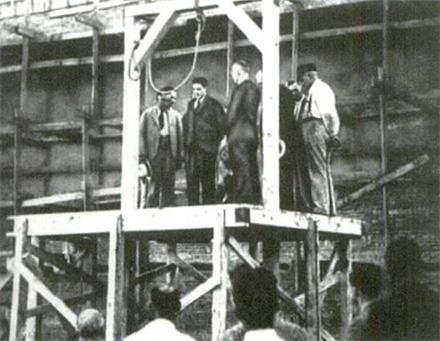
Gooch was philosophical at the end. “It’s kind of funny — dying,” he mused. “I think I know what it will be like. I’ll be standing there, and all of a sudden everything will be black, then there’ll be a light again. There’s got to be a light again — there’s got to be.” We can’t speak to what Gooch saw after everything went black, but it definitely wasn’t “all of a sudden”: Oklahoma’s executioner, Richard Earnest Owen, was an old hand with his state’s electric chair, but the federal execution method was hanging, which Owen had never before performed (and never would again). Gooch took 15 minutes to strangle at the end of the rope.


Arthur Gooch on the gallows

* The Kelley kidnapping, unsolved for several years, eventually traced to the strange character Nellie Muench. Readers (at least stateside ones) who follow that trailhead should be sure to keep an eye out for the cameo appearance of Missouri judge Rush Limbaugh, Sr. — grandfather of the present-day talk radio blowhard.

On this day..