1864: Martin Robinson, treacherous guide

On this date in 1864, a Union officer frustrated of a design to raid Richmond during the U.S. Civil War hanged a local African-American guide whom he thought had intentionally misled him like Susanin.

The account of an army chaplain attached to the 5th New York Cavalry explains:

The guide, a negro, had misled us during the night, and, to obviate the delay of retracing our steps. Col. Dahlgren, on the representations of the negro that an excellent ford was to be found at Dover Mills, concluded to cross at that point. After two hours’ halt we again moved on, and soon reached Dover Mills, but only to meet disappointment.


Dover Milles, Civil War era illustration

The negro had deceived us, no ford existed at this point nor any means of crossing the river. He then stated that the ford was three miles below: this was obviously false, as the river was evidently navigable to and above this place, as we saw a sloop going down the river.

… he came into our lines from Richmond … [and] was born and had always belonged in the immediate vicinity of Dover Mills, was very shrewd and intelligent, and it would seem impossible that he should not know that no ford existed in the neighborhood, where he had seen vessels daily passing. Col. Dahlgren had warned him that if detected acting in bad faith, or lying, we would surely hang him, and after we left Dover Mills, and had gone down the river so far as to render further prevarication unavailing, the colonel charged him with betraying us, destroying the whole design of the expedition, and hazarding the lives of every one engaged in it, — and told him that he should be hung in conformity with the terms of his service. The negro became greatly alarmed, stated confusedly that he was mistaken, thought we intended to cross the river in boats, and finally said that he had done wrong, was sorry, etc. The colonel ordered him to be hung, — a halter strap was used for the purpose, and we left the miserable wretch dangling by the roadside.

Our correspondent terms this the case of the “Faithless Negro”, but posterity has the luxury of a less paranoiac reading than indulged by a troupe of hotheaded commandos deep in enemy territory all a-panic as their expedition implodes. The James River was just plain swollen with winter rains. Bad luck all around.

A Goochland County marker marks the spot of the botched crossing and subsequent execution.

But we’re really just getting started. Stay tuned for some serious blowback from this bootless military debacle.

The full story of the raid is a tangled and contested affair, but it’s well worth perusing in detail. To sum up:

This expedition’s leader, Col. Ulric Dahlgren, abandoned the effort and in the attempt to fall back, rode into a Confederate ambush the next day. He died in the fusillade, while his men were captured.

The body of this late Col. Dahlgren, on whose authority our misfortunate guide was put to death, was found by the Confederates to bear some startling papers* … indicating that the intent of his ill-starred expedition was not merely to liberate starving northern prisoners, but that “once in the City it must be destroyed & Jeff. Davis and Cabinet killed.”

Within days, the story was abroad and Richmond newspapers floridly outraged at this proposed breach of chivalrous warfare.

Though Confederate General Robert E. Lee was able to quash public demands for the Dahlgren party’s summary execution, the documents may indeed have marked a turning point in the war’s conduct, a public announcement of total warfare sufficient for the South to “inaugurate a system of bloody retaliations.”** If so, it was a well-timed license: the Confederacy was in the process of being steamrolled and would soon require recourse to more desperate strategems.

After Dahlgren, argues Come Retribution: The Confederate Secret Service and the Assassination of Lincoln, “there was an increase in Confederate clandestine activity designed to encourage the antiwar faction in the North to organize and revolt” — even including a mirror-image Confederate cavalry raid on Washington D.C. with an eye towards capturing Lincoln.

There are, in fact, some historians who postulate that it was “bloody retaliation” for Dahlgren’s attempt on the Confederate president that ultimately led southern agents to initiate the late-war plots against Abraham Lincoln’s person — resulting ultimately in Lincoln’s assassination:

Ulric Dahlgren, and [his] probable patron [U.S. Secretary of War] Edwin Stanton set out to engineer the death of the Confederacy’s president; the legacy spawned out of the utter failure of their effort may have included the death of their own president.

That is some blowback.

Books exploring the alleged link between the Dahlgren Papers and the Lincoln assassination

* It must be said that the Dahlgren papers have been continually contested as frauds from the moment they were known, though many historians do indeed consider them legitimate. We are in no position to contribute to that debate, and for the purposes of this post’s narration the question is immaterial: the papers, forged or not, certainly existed, were widely publicized, and genuinely angered many southerners.

** These words are the demand of the March 8, 1864 Richmond Dispatch.

On this day..

1951: The first four of the Martinsville seven

On this date in 1951, the first of two batches comprising the “Martinsville Seven” — black, all — went to the Virginia electric chair for gang-raping a white woman. (The remainder were executed on Feb. 5)


Newspaper scan (click for larger image) via Mr. Beaverhousen (cc).

Somewhat forgotten today, the Martinsville Seven were in their day the locus of radical activism against Jim Crow in the South — very much like Willie McGee, who was put to death in Louisiana later that same year.

In fact, this case generated a bit of a legal milestone: a month before the executions began, the U.S. Supreme Court declined an appeal seeking relief on the then-novel grounds of equal protection — rather than due process.

The argument was that the Old Dominion’s superficially race-neutral rape statute was anything but; that argument was buttressed by data showing that Virginia had executed 45 black men for raping white women from 1908 to 1950, but never once in that period executed any white man for raping a black woman. (The high court only declined to take the appeal; it wouldn’t get around to explicitly ruling equal protection claims based on racial patterns out of bounds until 1987’s McCleskey v. Kemp.)

This seems to be the debut use for this gambit, bound to become an increasingly powerful one both in and out of the courtroom during the civil rights movement.

And it was available — and necessary — here because the Martinsville Seven basically looked guilty as sin. Their confessions and the victim’s accusation and the testimony of a young eyewitness said that, drink-addled, they had opportunistically grabbed a white Jehovah’s Witness housewife when she was proselytizing on the wrong side of the tracks.

Eric Rise, author of The Martinsville Seven: Race, Rape, and Capital Punishment, noted in a scholarly article,*

certain striking characteristics distinguished the proceedings from classic “legal lynchings.” The evidence presented at trial clearly proved that nonconsensual sexual intercourse with the victim had taken place. All seven defendants admitted their presence at the scene, and although some of the men may not have actually consummated the act … The prosecution emphasized the preservation of community stability, not the protection of southern womanly virtues, as the dominant concern of Martinsville’s white citizens. Most significant, the trial judge made a concerted effort to mute the racial overtones of the trials. Although white juries decided each case, blacks appeared in every jury pool. Race-baiting by prosecutors and witnesses, notably evident at Scottsboro and other similar trials, was absent from the Martinsville proceedings. By diligently adhering to procedural requirements, the court attempted to try the case “as though both parties were members of the same race.”**

The standard playbook for fighting a “legal lynching” case was leveraging outrage over a plausibly innocent convict and an outrageous kangaroo court.†

Paradoxically, by taking these elements out of the mix (relatively speaking), the Martinsville Seven perfectly isolated the extreme harshness of the penalty and the structural discrimination under which it was imposed. The NAACP took up the case on appeal strictly for its discriminatory characteristics, steering for its part completely clear of any “actual innocence” argument.

These challenges posed discomfiting questions that jurists shrank away from. The Virginia Supreme Court, in denying an equal protection application, fretted that actual legal relief could mean that “no Negroes could be executed unless a certain number of white people” were, too. Timeless.

Though a later U.S. Supreme Court would completely overturn death-sentencing for rape, based in part on its overwhelming racial slant, justices have generally avoided meddling to redress broad statistical patterns rather than identifiable process violations specific to particular cases.

Those questions of substantive — rather than merely procedural — equality in the justice system remain potently unresolved, still part of Americans’ lived experience of the law from death row to the drug war to driving while black. As if to underscore the point in this instance, just two days prior to the first Martinsville executions, the Wall Street bankster acting as American proconsul in conquered Germany pardoned imprisoned Nazi industrialist Alfried Krupp, and restored him to the fortune he had amassed working Jewish slaves to death during the war. It was a very particular quality of mercy the U.S. showed the world in those days. (The Martinsville case was known, and protested, worldwide.)

Carol Steiker (she used to clerk for liberal Justice Thurgood Marshall, who as an NAACP lawyer worked on the Martinsville case) argues‡ that the Martinsville Seven’s legacy is linked to their later obscurity, for “[t]heir attempt to present statistical proof of discrimination in capital sentencing represents a ‘road not taken'” — neither in 1951, nor since.

The road taken instead had Joe Henry Hampton, 22, Howard Hairston, 21, Booker Millner, 22 and Frank Hairston, 19 electrocuted one by one this morning in 1951. Their three co-accused, John Clabon Taylor, 24, James Luther Hairston, 23, and Francis DeSales Grayson, 40, followed them on February 5.

* “Race, Rape, and Radicalism: The Case of the Martinsville Seven, 1949-1951” in The Journal of Southern History, Aug., 1992.

** This quote an actual trial admonishment of the judge, Kennon Whittle.

† Graded on a curve: this is still Jim Crow Virginia. Six trials were wrapped up at warp speed in 11 days, with a total of 72 jurors — each one white. The implied comparison is something along the lines of, all seven tried together in the course of an afternoon, with a good ol’ boy defense attorney mailing it in.

‡ Review of Rise’s book titled “Remembering Race, Rape, and Capital Punishment” in the Virginia Law Review, Apr., 1997

On this day..

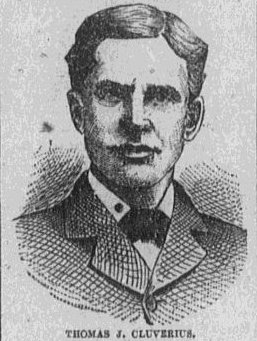
1887: Thomas Cluverius, Richmond murderer


Dallas Morning News, January 14, 1887.

On this date in 1887, a long-running (for the time) legal drama in Richmond ended with the hanging of Thomas Cluverius for murder.

On Friday the 13th — March 13, 1885 — Cluverius killed his cousin and lover Lillian Madison, who was eight months pregnant with his child, an act “as dark as any that can be found in all the calendar of crimes.” (Columbus Daily Enquirer, Jan. 15, 1887)

From the illicit affair to the shocking crime of passion and calculation to the damning lost watch key found at the site of the murder: everything conspired to spill newsprint, not only in Virginia but nationwide.

Nevertheless, by the time he hanged, the young lawyer was supported by at least a chunk of public opinion prepared to credit his dogged insistence on innocence.* He maintained it all the way to the scaffold. The drama of a potential gubernatorial reprieve, backed by hundreds of Old Dominion worthies, went to literally the very last hour of the condemned man.

The facts of this case now 125 years in the grave enjoy meticulous and evocative coverage at The Shockoe Examiner, a Richmond blog that we come to via Murder by Gaslight’s Cluverius post.

We’re very pleased on this occasion to interview a writer who has given “Tommie” and “Lillie” a more literary treatment. John Milliken Thompson‘s first novel The Reservoir (review), just published in the summer of 2011, illuminates the timeless conflicts between lust and propriety, in the very specific locale of post-Reconstruction Richmond.

ET: For you as a writer, how did you come by this story, and why did you decide to make it your first novel?

JMT: I came across a brief mention of the case in a book on Richmond history and made a mental note of it.

Sometime later I began looking into the case and, after finding all kinds of material on the trial and on Richmond in the 1880s, I became more and more intrigued. A failed attempt to turn the story into a nonfiction account led me to write it as a novel.

Book CoverWhat was the most challenging thing about approaching the story?

Creating believable, interesting characters within a compelling plot is THE challenge of writing any piece of fiction. This one was no different, though it helped to have a historical framework and tons of good material to turn to.

That said, one of the toughest things about telling this story was getting the voice right. My goal was to create a narrative that could get close in to Tommie’s head, without revealing too much (to the reader or himself), and then pull farther back.

I found it interesting that you said you “felt so connected to these long-dead people that [you] owed it to them to get it right,” because I have that sense myself sometimes. In the end, what are you hoping that 21st century readers take away from the story? What did you take away from it?

In the end, I think what I most want is for readers to feel moved by the plight of these young people, who made some crucial mistakes and paid dearly for them. We all make mistakes in our youth; sometimes we learn our lessons before we get in deeper, sometimes not.

The inference is that Tommie killed Lillian because she was pregnant. How damaging would Lillian’s giving birth really have been to Tommie socially, professionally, or otherwise? Do we need to look for more complex motivations?

That’s a good question, and Tommie even considers what his life would be like if he had “done the right thing” by Lillie and married her. Even if he had been able to live down the scandal of marrying a pregnant girl, which in those days and in their circle would’ve been significant, it would still not have been the life this ambitious young man had envisioned for himself.

And what about the world he lived in — 1880s Virginia, and the place of the crime, Richmond. What’s this place like a generation after the Civil War? And why did this crime in this place become national news?

Well, Richmond, the former Confederate capital, was making a comeback after being ravaged by the war. This event caught the interest of the general public because of the high standing of the families involved and because the lawyers trying the case were distinguished men and famous orators.

Despite maintaining innocence to the last, it seems pretty difficult to imagine that Thomas Cluverius was actually innocent. Still, at the time there were plenty of people who apparently thought he might be. Why on earth did he attract that level of support? If not for the watch-key, might he have avoided conviction altogether?

That’s the fickle nature of the public — once the scapegoat has been cast out, there is a lingering sense of doubt and guilt that causes many of us to look into our own hearts … let he who is without sin.

I think the watch-key did play a big role, but it wasn’t necessarily the sine qua non. I think the sheer volume of testimony offered by the prosecution overwhelmed any reserve the all-male jury might have felt. The burden of proof, in fact if not by law, lay with the defense, and the proof (of innocence) simply wasn’t there.

What are you working on next?

I’m finishing up a coming-of-age novel about a young woman who suffers a number of poignant losses in turn-of-the-century North Carolina. By the way, until “turn-of-the-century” means turn of the 21st (maybe in two decades?) I’m using that phrase to mean turn of the 20th.

Thanks for inviting me on your blog.

* Or empathize with the young lawyer’s lost-potential pathos.

On this day..

1864: Ranger A.C. Willis, parabolically

On this date in 1864, Confederate ranger A.C. Willis — whose Christian name is given as Albert or Absalom — was captured in Rappahannock County, Virginia and summarily, spectacularly hanged.

The context was the increasingly dirty war in Virginia against Confederate guerrilla John Mosby, whose rangers were severely hampering Union operations in Virginia. The northern army had resorted to less than genteel expedients with the previous month’s summary execution of a half-dozen (actual or suspected) Mosby’s Rangers.

On this date, they did it again.

According to Custer and the Front Royal Executions of 1864:

[Col. William] Powell’s men had first tied the rope they used to hang Willis with to the top of a young sapling, which was then bent nearly double. When it was released, it shot Willis skyward in an abrupt, strangled flight. Powell was jubilant about the execution he had ordered. Powell stated in his report: “I wish it distinctly understood by the Rebel authorities that if two to one is not sufficient I will increase it to 22 to one, and leave the consequences in the hands of my Government.”

We don’t have a picture of this jubilation-worthy execution, but we’ll make do with the picture in our heads.

On this day..

1832: Lucy (Wells), jealous slave

This date in 1832 was the Republic’s only execution of a female in Tyler County, West Virginia (then part of Virginia): a slave named Lucy who murdered the daughter of a neighboring family.

Detail on this case comes salvaged from the now-defunct (we think) death penalty history site Before the Needles:

Just across Middle Island from the Wells home lived a family which had a daughter named Mary Ann Fletcher.

Communication between the two homes was by canoe or johnboat and quite frequently Lucy was sent to the creek bank to set Miss Fletcher across the stream for a visit to the Wells home when they heard a halloo from the opposite shore. For some reason Lucy became intensely jealous of the attention which her master’s family lavished on the young Fletcher girl and determined to slay her.

One day after visiting the Wells home Lucy was sent with Miss Fletcher to set her across the creek and after a little longer delay than usual Lucy returned to “Stonehurst” her usual calm self, but later in the evening Mr. Fletcher came to the creek bank and hallooed across to “Stonehurst” and asked if they would send Mary Ann home immediately, as it was growing late.

Squire Wells and his family wondered what had happened, but did not think of anything wrong untill Mr. Fletcher called to them a second time. Lights were secured by both families who went to the crossing and in a short time the body of Mary Ann, drowned, was discovered.

An examination of the body disclosed the she had evidently died from foul play, because the fingers of both hands had been badly crushed and she also had bruises on her head and face. Lucy was immediately suspected and shortly confessed that she had pushed Miss Fletcher out of the boat, and when she did not readily drown, and had caught the sides of the canoe with her hands, she (Lucy) had pounded Miss Fletchers hands with the paddle, struck her over the head several times and pushed her under the surface of the stream.

On this day..

1861: Not William Scott, the Sleeping Sentinel

On this date in 1861, Vermont private William Scott of the new-formed Army of the Potomac, then fortifying Washington D.C. for the unfolding Civil War in the aftermath of Bull Run, was led out for execution for having fallen asleep at his post.

The so-called Sleeping Sentinel took a sick comrade’s watch even though he himself was bushed, and … well, you know the rest.

Condemned for a dereliction of duty which “may endanger the safety of a command, or even of the whole army” (the words of the army’s commander Gen. McClellan), Scott still attracted widespread sympathy due to the obviously sympathetic nature of his situation. He was a youth new to war, with an exemplary military record outside of his forty winks.

“The American people,” reckoned the New York Times, “are quite unprepared to hear of a measure of such fearful and unwarned rigor as that which was awarded private SCOTT.”

Appeals went straight to the White House, which was conveniently located in the Army of the Potomac’s back yard, and freshman president Abraham Lincoln magnanimously spared the lad.

Still, wanting to use the case to impress military discipline upon the rabble of corn-fed conscripts, that clemency was delivered with a terrifyingly dramatic flourish. Scott was left to contemplate his last hours on the earth, and, Dostoyevsky-like, marched out to the stake ostensibly to face the firing squad. Only then did he and his fellow-soldiers hear the commutation order.*

This exhilarating climax did not long stay the hand of the Reaper, as it transpired.

Scott died in battle the following spring. In death he lives on, as befits the habitues of these pages: fellow Vermonter Lucius E. Chittenden, who was serving in the U.S. Treasury when all this sleeping sentinel stuff went down, commemorated William Scott for posterity in a subsequent entry to the merciful-Lincoln mythology, a postwar volume titled Lincoln and the Sleeping Sentinel.

The story was also made into a 1914 silent film, which sadly doesn’t seem to be available online: but never fear, this syrupy poem will amply represent our Sentinel’s contribution to the canon.

But God is love – and finite minds can faintly comprehend
How gentle Mercy, in His rule, may with stern Justice blend;
And this poor soldier, seized and bound, found none to justify,
While war’s inexorable law decreed that he must die.

‘Twas night. In a secluded room, with measured tread and slow,
A statesman of commanding mien paced gravely to and fro.
Oppressed, he pondered on a land by civil discord rent;
On brothers armed in deadly strife: it was the President!

The woes of thirty millions filled his burdened heart with grief;
Embattled hosts, on land and sea, acknowledged him their chief;
And yet, amid the din of war, he heard the plaintive cry
Of that poor soldier, as he lay in prison, doomed to die!

‘Twas morning. On a tented field, and through the heated haze,
Flashed back, from lines of burnished arms, the sun’s effulgent blaze;
While, from a somber prison house, seen slowly to emerge,
A sad procession, o’er the sward, moved to a muffled dirge.

And in the midst, with faltering step, and pale and anxious face,
In manacles, between two guards, a soldier had his place.
A youth, led out to die; and yet it was not death, but shame,
That smote his gallant heart with dread, and shook his manly frame!

Still on, before the marshalled ranks, the train pursued its way,
Up to the designated spot, whereon a coffin lay-
His coffin! And, with reeling brain, despairing, desolate-
He took his station by its side, abandoned to his fate!

Then came across his wavering sight strange pictures in the air:
He saw his distant mountain home; he saw his parents there;
He saw them bowed with hopeless grief, through fast declining years;
He saw a nameless grave; and then, the vision closed-in tears!

Yet once again. In double file, advancing, then, he saw
Twelve comrades, sternly set apart to execute the law-
But saw no more; his senses swam-deep darkness settled round-
And, shuddering, he awaited now the fatal volley’s sound!

Then suddenly was heard the sounds of steeds and wheels approach,
And, rolling through a cloud of dust, appeared a stately coach.
On, past the guards, and through the field, its rapid course was bent,
Till, halting, ‘mid the lines was seen the nation’s President!**

He came to save that stricken soul, now waking from despair;
And from a thousand voices rose a shout which rent the air!
The pardoned soldier understood the tones of jubilee,
And, bounding from his fetters, blessed the hand that made him free!

A few letters from Scott’s own hand are preserved here. A (defunct) mini-blog exploring the case in detail can be perused here.

* There was actually American precedent for this sort of stagey non-execution in a case from the War of 1812.

** Obviously, Lincoln did not actually bring his presidential person to the execution grounds to issue this pardon in the flesh: in fact, the presiding officer on-site simply read out the pardon: “the President of the United States has expressed a wish that as this is the first condemnation to death in this army for this crime, mercy may be extended to the criminal.”

Part of the Themed Set: Americana.

On this day..

1882: Ham Yeatts

On this date in 1882, William Hamilton “Ham” Yeatts was hanged in Chatham, Va., for the murder of his friend Pressley Adkerson.

When a fellow lures you to a deserted stretch of rural train-track and pops a cap in your head, it’s a given that he’s nursing some manner of grievance.

In the case of Ham Yeatts, that grievance is said to have been a rivalry with Pressley Adkerson — really, we couldn’t make these names up — over the affections of the local knockout, Fanny Rorer. This here page claims that Yeatts, having just wed the girl, was aghast to discover that his friend had deflowered her premaritally.

But we take note of this report of the hanging in the Richmond Daily Dispatch to the effect that the provocation was merely the victim’s nasty prophecy that Yeatts was liable to end up in a penitentiary, the stronger cuckolding allegation arising as the doomed youth made a desperate play for clemency.

Yeatts’s hanging was delayed by a week when he raised these claims of offended manhood — resulting in a bid on his life by a lynch mob, “defeated of their laudable ambition by the alertness of the guards”* — but it was all to no avail.

He requested that he be executed in a blue flannel suit, and that his body be encased in a metallic coffin with a glass face and be placed in an upright position in a cemented grave with steps leading down into it so that those who wished to see him “lying in state” could do so.

So … add vanity to wrath, envy, and lust on Ham’s cardinal sins register.

After the execution the crowd turned their attention to the circus, which had just entered the town, and Yeatts and his crime were for the time forgotten.

Oh.

Though sometimes described as the last hanging in Pittsylvania County, it apparently wasn’t.

Yeatts was only one of four men hanged in various places around the U.S. that August 4, as the Augusta (Ga.) Chronicle described in its next day’s edition …

FERNANDINA, Fla., August 4. — Merrick Jackson, colored, was hanged here to-day, at 1 o’clock, p.m. He murdered a colored boy, named John Thomas, near King’s Ferry, on November 19, 1881. On the scaffold he offered up a prayer, and thanked the Sisters of Charity for their kindness to him. He met his fate with composure. He died by strangulation.


JACKSONVILLE, Fla., August 4. — Harrison Carter, colored, who murdered Lewis Adams, colored, at Baldwin, in this county, on January 6, 1882, was executed in the ail hard here to-day.


MOBILE [Ala.], August 4. — Armand Coleman, colored, was hanged, to-day, at West Point, Miss., for the murder of Georgia Bright, on May 13, 1880. He was sentenced to be hanged on May 4, 1881, and the case was carried to the Supreme Court, where he was resentenced, but respited by the Governor till to-day. Three thousand persons were present, a large number of whom were negro women. The prisoner ascended the scaffold with a firm step, smiling pleasantly. He said he was willing to go and trusted in God. He denied his guilt to the last.


It was not all the hangman’s day, however. Louisiana Gov. John McEnery respited the scheduled August 4 execution of Jack Chapman in Bossier parish. (Chapman still hanged, on September 22.)

* The Daily Inter Ocean (Chicago, Ill.), July 31, 1882.

On this day..

1783: Philip, a negro slave of Henry Garrett

From the Chronicles of the Scotch-Irish settlement in Virginia

Called Court on Philip, a negro slave of Henry Garrett, and formerly property of Major Thomas Johnston, of Louisa County, charged with murdering Alexander Hunter, of Augusta County, and wounding the wife of Samuel Henry.–Guilty and to be hanged on 16th April next at 10 o’clock a. m. His value is fixed at £65.

On this day..

1677: Giles Bland

On this date in 1677, Giles Bland was hanged in the Virginia colony for the late Bacon’s Rebellion.

Bland was in that remote colony as the agent of his father, the London merchant John Bland.

This John Bland fellow had an interesting career — as suggested by the title of Neville Williams’s “The Tribulations of John Bland, Merchant: London, Seville, Jamestown, Tangier, 1643-1680” in The Virginia Magazine of History and Biography (Jan. 1964). We elide here the former two and the last one except to observe that they made John Bland a very wealthy man, and landed him in Samuel Pepys’s diary.

Accordingly, John Bland’s New World interests were considerable, and we suppose that his son Giles, dispatched thither after John’s brothers had died in the New World, was a bit too conscious of the weight his surname carried.

He griped about colonial corruption, put about “malicious reports” of royal governor William Berkeley, “bespattered with … dirt … thrown upon the whole government of Virginia,” and — foreshadowing alert! — got into the drink to the detriment of his good judgment:

[G]oing to the house of Thomas Ludwell in company with Sir Henry Chicheley after they had drank plentifully there happened a discourse in which Giles Bland thought Ludwell’s speech too severe in relation to his father, and told Ludwell’s that he dealt basely and unworthily to cast such aspersions upon his father and himself, and being transported with passion upon “further exchange of language” came to blows, and exchanged gloves to meet in the morning. His son slept not all night, and continuing hot headed, hastened to the place appointed, where, missing Ludwell, he nailed the glove on the door of the Grand Assembly [house] writing some words under it. Ludwell more wisely sought reparation before the Governor and Council, where Giles Bland was ordered to ask forgiveness which he performed, and the Court fined him 500l. for his abuse done to the Assembly, the payment to be suspended for two years to enable him to supplicate his Majesty to remit the same, it being intended rather to deter him from the like rash actions in time to come, than to ruin him for what he had unadvisedly committed.

Put Giles down for “undeterred.”

As conflicts between the Virginia planters and Berkeley’s party came to a head — planters were sore about taxes, trade, and overly friendly Indian relations — Bland was tapped to represent the former back in the mother country.

But rather than sail for England, the young hothead hitched onto the rising of Nathaniel Bacon — and then was almost immediately intercepted by his foes. “Those who are best able to render an account of this affair do aver,” we read, “that there was no other treason made use of but their want of discretion, assisted by the juice of the grape.”

(Getting captured while distracted by more hedonistic pursuits was a pattern with these Bacon’s rebels, or at least a pattern of the propaganda written about them.)

Rather than summary execution, Giles Bland faced several months’ ill-treatment in irons. Still, Berkeley was in enough of a hurry to get the lad into the ground as the last of the Bacon’s Rebellion martyrs that he seems to have suppressed the prisoner’s legitimate appeal for royal clemency.

John Bland was in the winter of his years when this grim news arrived in London; he would die there in 1680 — having committed yet one more member of his family, his wife Sarah, to the Atlantic crossing, and “feeling no greater grief under my many adversities and infirmities … than her necessary absence in Virginia about my unhappy affairs and estates there.”

On this day..

1780: The slave Violet, her head stuck on a pole

This date in 1780 — a month to the day since she had allegedly torched the home of her master, Sampson Sawyers* — a slave woman named Violet was hanged at Staunton.

The above named Violet was led to the barr and upon examination denied the fact wherewith she stands charged whereupon Rebecca Sawyers James Sawyers John Crow and Nan a negroe girl were sworn and examined as witnesses touching the fact as also the examination of the said Violet was taken and subscribed before James Trimble Gent. on consideration of which and of the circumstances relating to the Crime the Court are of opinion that she is guilty, and do accordingly order that she be hanged by the neck until she be dead for the said fact on the fourth day of March next at or near the town of Stanton at twelve o’clock at Noon and after she is cut down that her head be severed from her body by the neck and stuck upon a pole in the public place near Staunton and the Court do adjudge the value of the said slave to one thousand eight hundred pounds which is ordered to be certified

Slave insurrection was, of course, a deadly serious matter in the Old Dominion even in these pre-Nat Turner days. You could lose a whole city to a well-placed incendiary, which made it a particularly — shall we say — high-leverage form of resistance for the disarmed chattel. Women comprised 30% (pdf) of the convicted slave arsonists in colonial Virginia.

According to Philip J. Schwarz, every slave known to have been convicted of arson from 1740 to 1785 drew a death sentence.

The laws only tightened in the 19th century; Virginia went on to mandate death for arson in 1819 — which for slaves included burning not only buildings, but grain. (Source)

As to the grisly public monument made of Violet’s head, an Annals of Augusta County, Virginia remarks that the “custom seems to have been general in Virginia, at this, or an earlier period. The ghastly memorials thus set up were doubtless to inspire a wholesome dread in the minds of the negro slaves. They impressed themselves in many instances as local topographical designations. Witness: negro-foot precinct, in Hanover county, and Negro-head, Negro-foot and Negro-quarter, in Amelia county.”

* Sampson Sawyers was (apparently) the father of Col. John Sawyers, an American Revolution officer about whom more here. The reader will be relieved to learn that despite the loss of the naughty Violet, Col. Sawyers “was one of the extensive slave owners in Knox County in its earlier history. He was able at the marriage of his sons to give each of them several slaves, so that at the emancipation of the slaves in 1863 the Sawyers’ slaves were quite numerous, and right here I wish to pay a tribute to these slaves. Being reared in the Sawyers family, who were Scotch-Irish Presbyterians, they were a better class of slaves than was generally to be found in that day.”

That’s Knox County not in Virginia but in Tennessee, where Sampson Sawyers was a signatory (pdf) of the Cumberland Compact.

On this day..