An unspecified Monday: Fagin

On an unspecified Monday in what seems to be an unspecified autumn of the 1830s, Charles Dickens had hanged one of his most memorable characters: Oliver Twist‘s Jewish pickpocket-magnate Fagin.*

The prolific English scribbler who conjured Fagin had keen empathy for the man or woman on the scaffold, leading him to contribute some of literature’s most poignant execution scenes.

Detail view (click for the full image) of the condemned Fagin in his cell, from an 1867 edition of Oliver Twist/

This from the serialized novel that hit print from 1837 to 1839 is no exception.

Dickens does not stage Fagin’s actual hanging; the writer’s predilection is for the mind of the doomed as it reaches the precipice, and let the reader fill in the final details.

And in Fagin’s case, that mind belongs to a complex character for whom the reader likely has some empathy: despite Fagin’s villainy, he’s also the orphan Oliver’s surrogate father-figure and said urchin’s ticket out of the anonymous desperation of the urban poor.

As for the date, the murder committed by Fagin’s partner-in-crime Bill Sikes occurs in “autumn” (chapter 47) — probably early autumn since the relatively proximate chapter 38 is in “summer”. That murder precipitates Sikes’s death and Fagin’s capture almost immediately: though the ensuing juridical sequence is not directly, or even indirectly, delineated, the narrative’s sense certainly suggests that Fagin was prosecuted with all speed. A sequence of arrest-trial-execution in London at this period could easily take place within just a few weeks.**

This doomed wretch in his final hours is sketched in Oliver Twist‘s second-last chapter, “Fagin’s Last Night Alive”. (Text via Project Gutenberg.) It surely draws on Dickens’ 1835 visit to Newgate’s condemned cells.


The court was paved, from floor to roof, with human faces. Inquisitive and eager eyes peered from every inch of space. From the rail before the dock, away into the sharpest angle of the smallest corner in the galleries, all looks were fixed upon one man—Fagin. Before him and behind: above, below, on the right and on the left: he seemed to stand surrounded by a firmament, all bright with gleaming eyes.

He stood there, in all this glare of living light, with one hand resting on the wooden slab before him, the other held to his ear, and his head thrust forward to enable him to catch with greater distinctness every word that fell from the presiding judge, who was delivering his charge to the jury. At times, he turned his eyes sharply upon them to observe the effect of the slightest featherweight in his favour; and when the points against him were stated with terrible distinctness, looked towards his counsel, in mute appeal that he would, even then, urge something in his behalf. Beyond these manifestations of anxiety, he stirred not hand or foot. He had scarcely moved since the trial began; and now that the judge ceased to speak, he still remained in the same strained attitude of close attention, with his gaze bent on him, as though he listened still.

A slight bustle in the court, recalled him to himself. Looking round, he saw that the juryman had turned together, to consider their verdict. As his eyes wandered to the gallery, he could see the people rising above each other to see his face: some hastily applying their glasses to their eyes: and others whispering their neighbours with looks expressive of abhorrence. A few there were, who seemed unmindful of him, and looked only to the jury, in impatient wonder how they could delay. But in no one face—not even among the women, of whom there were many there—could he read the faintest sympathy with himself, or any feeling but one of all-absorbing interest that he should be condemned.

As he saw all this in one bewildered glance, the deathlike stillness came again, and looking back he saw that the jurymen had turned towards the judge. Hush!

They only sought permission to retire.

He looked, wistfully, into their faces, one by one when they passed out, as though to see which way the greater number leant; but that was fruitless. The jailer touched him on the shoulder. He followed mechanically to the end of the dock, and sat down on a chair. The man pointed it out, or he would not have seen it.

He looked up into the gallery again. Some of the people were eating, and some fanning themselves with handkerchiefs; for the crowded place was very hot. There was one young man sketching his face in a little note-book. He wondered whether it was like, and looked on when the artist broke his pencil-point, and made another with his knife, as any idle spectator might have done.

In the same way, when he turned his eyes towards the judge, his mind began to busy itself with the fashion of his dress, and what it cost, and how he put it on. There was an old fat gentleman on the bench, too, who had gone out, some half an hour before, and now come back. He wondered within himself whether this man had been to get his dinner, what he had had, and where he had had it; and pursued this train of careless thought until some new object caught his eye and roused another.

Not that, all this time, his mind was, for an instant, free from one oppressive overwhelming sense of the grave that opened at his feet; it was ever present to him, but in a vague and general way, and he could not fix his thoughts upon it. Thus, even while he trembled, and turned burning hot at the idea of speedy death, he fell to counting the iron spikes before him, and wondering how the head of one had been broken off, and whether they would mend it, or leave it as it was. Then, he thought of all the horrors of the gallows and the scaffold—and stopped to watch a man sprinkling the floor to cool it—and then went on to think again.

At length there was a cry of silence, and a breathless look from all towards the door. The jury returned, and passed him close. He could glean nothing from their faces; they might as well have been of stone. Perfect stillness ensued—not a rustle—not a breath—Guilty.

The building rang with a tremendous shout, and another, and another, and then it echoed loud groans, that gathered strength as they swelled out, like angry thunder. It was a peal of joy from the populace outside, greeting the news that he would die on Monday.

The noise subsided, and he was asked if he had anything to say why sentence of death should not be passed upon him. He had resumed his listening attitude, and looked intently at his questioner while the demand was made; but it was twice repeated before he seemed to hear it, and then he only muttered that he was an old man—an old man—and so, dropping into a whisper, was silent again.

The judge assumed the black cap, and the prisoner still stood with the same air and gesture. A woman in the gallery, uttered some exclamation, called forth by this dread solemnity; he looked hastily up as if angry at the interruption, and bent forward yet more attentively. The address was solemn and impressive; the sentence fearful to hear. But he stood, like a marble figure, without the motion of a nerve. His haggard face was still thrust forward, his under-jaw hanging down, and his eyes staring out before him, when the jailer put his hand upon his arm, and beckoned him away. He gazed stupidly about him for an instant, and obeyed.

They led him through a paved room under the court, where some prisoners were waiting till their turns came, and others were talking to their friends, who crowded round a grate which looked into the open yard. There was nobody there to speak to him; but, as he passed, the prisoners fell back to render him more visible to the people who were clinging to the bars: and they assailed him with opprobrious names, and screeched and hissed. He shook his fist, and would have spat upon them; but his conductors hurried him on, through a gloomy passage lighted by a few dim lamps, into the interior of the prison.

Here, he was searched, that he might not have about him the means of anticipating the law; this ceremony performed, they led him to one of the condemned cells, and left him there—alone.

He sat down on a stone bench opposite the door, which served for seat and bedstead; and casting his blood-shot eyes upon the ground, tried to collect his thoughts. After awhile, he began to remember a few disjointed fragments of what the judge had said: though it had seemed to him, at the time, that he could not hear a word. These gradually fell into their proper places, and by degrees suggested more: so that in a little time he had the whole, almost as it was delivered. To be hanged by the neck, till he was dead—that was the end. To be hanged by the neck till he was dead.

As it came on very dark, he began to think of all the men he had known who had died upon the scaffold; some of them through his means. They rose up, in such quick succession, that he could hardly count them. He had seen some of them die,—and had joked too, because they died with prayers upon their lips. With what a rattling noise the drop went down; and how suddenly they changed, from strong and vigorous men to dangling heaps of clothes!

Some of them might have inhabited that very cell—sat upon that very spot. It was very dark; why didn’t they bring a light? The cell had been built for many years. Scores of men must have passed their last hours there. It was like sitting in a vault strewn with dead bodies—the cap, the noose, the pinioned arms, the faces that he knew, even beneath that hideous veil.—Light, light!

At length, when his hands were raw with beating against the heavy door and walls, two men appeared: one bearing a candle, which he thrust into an iron candlestick fixed against the wall: the other dragging in a mattress on which to pass the night; for the prisoner was to be left alone no more.

Then came the night—dark, dismal, silent night. Other watchers are glad to hear this church-clock strike, for they tell of life and coming day. To him they brought despair. The boom of every iron bell came laden with the one, deep, hollow sound—Death. What availed the noise and bustle of cheerful morning, which penetrated even there, to him? It was another form of knell, with mockery added to the warning.

The day passed off. Day? There was no day; it was gone as soon as come—and night came on again; night so long, and yet so short; long in its dreadful silence, and short in its fleeting hours. At one time he raved and blasphemed; and at another howled and tore his hair. Venerable men of his own persuasion had come to pray beside him, but he had driven them away with curses. They renewed their charitable efforts, and he beat them off.

Saturday night. He had only one night more to live. And as he thought of this, the day broke—Sunday.

It was not until the night of this last awful day, that a withering sense of his helpless, desperate state came in its full intensity upon his blighted soul; not that he had ever held any defined or positive hope of mercy, but that he had never been able to consider more than the dim probability of dying so soon. He had spoken little to either of the two men, who relieved each other in their attendance upon him; and they, for their parts, made no effort to rouse his attention. He had sat there, awake, but dreaming. Now, he started up, every minute, and with gasping mouth and burning skin, hurried to and fro, in such a paroxysm of fear and wrath that even they—used to such sights—recoiled from him with horror. He grew so terrible, at last, in all the tortures of his evil conscience, that one man could not bear to sit there, eyeing him alone; and so the two kept watch together.

He cowered down upon his stone bed, and thought of the past. He had been wounded with some missiles from the crowd on the day of his capture, and his head was bandaged with a linen cloth. His red hair hung down upon his bloodless face; his beard was torn, and twisted into knots; his eyes shone with a terrible light; his unwashed flesh crackled with the fever that burnt him up. Eight—nine—then. If it was not a trick to frighten him, and those were the real hours treading on each other’s heels, where would he be, when they came round again! Eleven! Another struck, before the voice of the previous hour had ceased to vibrate. At eight, he would be the only mourner in his own funeral train; at eleven—

Those dreadful walls of Newgate, which have hidden so much misery and such unspeakable anguish, not only from the eyes, but, too often, and too long, from the thoughts, of men, never held so dread a spectacle as that. The few who lingered as they passed, and wondered what the man was doing who was to be hanged to-morrow, would have slept but ill that night, if they could have seen him.

From early in the evening until nearly midnight, little groups of two and three presented themselves at the lodge-gate, and inquired, with anxious faces, whether any reprieve had been received. These being answered in the negative, communicated the welcome intelligence to clusters in the street, who pointed out to one another the door from which he must come out, and showed where the scaffold would be built, and, walking with unwilling steps away, turned back to conjure up the scene. By degrees they fell off, one by one; and, for an hour, in the dead of night, the street was left to solitude and darkness.

The space before the prison was cleared, and a few strong barriers, painted black, had been already thrown across the road to break the pressure of the expected crowd, when Mr. Brownlow and Oliver appeared at the wicket, and presented an order of admission to the prisoner, signed by one of the sheriffs. They were immediately admitted into the lodge.

‘Is the young gentleman to come too, sir?’ said the man whose duty it was to conduct them. ‘It’s not a sight for children, sir.’

‘It is not indeed, my friend,’ rejoined Mr. Brownlow; ‘but my business with this man is intimately connected with him; and as this child has seen him in the full career of his success and villainy, I think it as well—even at the cost of some pain and fear—that he should see him now.’

These few words had been said apart, so as to be inaudible to Oliver. The man touched his hat; and glancing at Oliver with some curiousity, opened another gate, opposite to that by which they had entered, and led them on, through dark and winding ways, towards the cells.

‘This,’ said the man, stopping in a gloomy passage where a couple of workmen were making some preparations in profound silence—’this is the place he passes through. If you step this way, you can see the door he goes out at.’

He led them into a stone kitchen, fitted with coppers for dressing the prison food, and pointed to a door. There was an open grating above it, through which came the sound of men’s voices, mingled with the noise of hammering, and the throwing down of boards. There were putting up the scaffold.

From this place, they passed through several strong gates, opened by other turnkeys from the inner side; and, having entered an open yard, ascended a flight of narrow steps, and came into a passage with a row of strong doors on the left hand. Motioning them to remain where they were, the turnkey knocked at one of these with his bunch of keys. The two attendants, after a little whispering, came out into the passage, stretching themselves as if glad of the temporary relief, and motioned the visitors to follow the jailer into the cell. They did so.

The condemned criminal was seated on his bed, rocking himself from side to side, with a countenance more like that of a snared beast than the face of a man. His mind was evidently wandering to his old life, for he continued to mutter, without appearing conscious of their presence otherwise than as a part of his vision.

‘Good boy, Charley—well done—’ he mumbled. ‘Oliver, too, ha! ha! ha! Oliver too—quite the gentleman now—quite the—take that boy away to bed!’

The jailer took the disengaged hand of Oliver; and, whispering him not to be alarmed, looked on without speaking.

‘Take him away to bed!’ cried Fagin. ‘Do you hear me, some of you? He has been the—the—somehow the cause of all this. It’s worth the money to bring him up to it—Bolter’s throat, Bill; never mind the girl—Bolter’s throat as deep as you can cut. Saw his head off!’

‘Fagin,’ said the jailer.

‘That’s me!’ cried the Jew, falling instantly, into the attitude of listening he had assumed upon his trial. ‘An old man, my Lord; a very old, old man!’

‘Here,’ said the turnkey, laying his hand upon his breast to keep him down. ‘Here’s somebody wants to see you, to ask you some questions, I suppose. Fagin, Fagin! Are you a man?’

‘I shan’t be one long,’ he replied, looking up with a face retaining no human expression but rage and terror. ‘Strike them all dead! What right have they to butcher me?’

As he spoke he caught sight of Oliver and Mr. Brownlow. Shrinking to the furthest corner of the seat, he demanded to know what they wanted there.

‘Steady,’ said the turnkey, still holding him down. ‘Now, sir, tell him what you want. Quick, if you please, for he grows worse as the time gets on.’

‘You have some papers,’ said Mr. Brownlow advancing, ‘which were placed in your hands, for better security, by a man called Monks.’

‘It’s all a lie together,’ replied Fagin. ‘I haven’t one—not one.’

‘For the love of God,’ said Mr. Brownlow solemnly, ‘do not say that now, upon the very verge of death; but tell me where they are. You know that Sikes is dead; that Monks has confessed; that there is no hope of any further gain. Where are those papers?’

‘Oliver,’ cried Fagin, beckoning to him. ‘Here, here! Let me whisper to you.’

‘I am not afraid,’ said Oliver in a low voice, as he relinquished Mr. Brownlow’s hand.

‘The papers,’ said Fagin, drawing Oliver towards him, ‘are in a canvas bag, in a hole a little way up the chimney in the top front-room. I want to talk to you, my dear. I want to talk to you.’

‘Yes, yes,’ returned Oliver. ‘Let me say a prayer. Do! Let me say one prayer. Say only one, upon your knees, with me, and we will talk till morning.’

‘Outside, outside,’ replied Fagin, pushing the boy before him towards the door, and looking vacantly over his head. ‘Say I’ve gone to sleep—they’ll believe you. You can get me out, if you take me so. Now then, now then!’

‘Oh! God forgive this wretched man!’ cried the boy with a burst of tears.

‘That’s right, that’s right,’ said Fagin. ‘That’ll help us on. This door first. If I shake and tremble, as we pass the gallows, don’t you mind, but hurry on. Now, now, now!’

‘Have you nothing else to ask him, sir?’ inquired the turnkey.

‘No other question,’ replied Mr. Brownlow. ‘If I hoped we could recall him to a sense of his position—’

‘Nothing will do that, sir,’ replied the man, shaking his head. ‘You had better leave him.’

The door of the cell opened, and the attendants returned.

‘Press on, press on,’ cried Fagin. ‘Softly, but not so slow. Faster, faster!’

The men laid hands upon him, and disengaging Oliver from his grasp, held him back. He struggled with the power of desperation, for an instant; and then sent up cry upon cry that penetrated even those massive walls, and rang in their ears until they reached the open yard.

It was some time before they left the prison. Oliver nearly swooned after this frightful scene, and was so weak that for an hour or more, he had not the strength to walk.

Day was dawning when they again emerged. A great multitude had already assembled; the windows were filled with people, smoking and playing cards to beguile the time; the crowd were pushing, quarrelling, joking. Everything told of life and animation, but one dark cluster of objects in the centre of all — the black stage, the cross-beam, the rope, and all the hideous apparatus of death.


* Fagin was named for a workman named Bob Fagin, who showed a few tricks of the trade when the boy Dickens did his own turn in a workhouse.

** For instance, the the London Burkers in 1831 and Benjamin Courvoisier in 1840 were each condemned to death less than two months after their arrests, and each hanged within days of sentence.

On this day..

1835: John Smith and James Pratt, the last hanged for sodomy in Great Britain

On this date in 1835, John Smith and James Pratt (sometimes reported as John Pratt) were hanged outside Newgate Prison for (in the exhausting fulminations of the Old Bailey trial records) “feloniously, wickedly, diabolically, and against the order of nature, carnally … commit[ted] and perpetrate[d] the detestable, horrid, and abominable crime (among Christians not to be named) called buggery.”


Generic gallows image from this Smith and Pratt hanging-day broadside.

These men were the last put to death anywhere in the realm under the ghastly Tudor-era Buggery Act,* and indeed among the last to die at Newgate for any crime other than murder or attempted murder.

“The grave will soon close over me,” Smith allegedly wrote to a friend before his hanging, “and my name [be] entirely forgotten.”

But that’s not altogether true.

Unbeknownst to the sufferers, they were destined for literary preservation by a young writer on the make, one Charles Dickens: Smith and Pratt make an appearance in Dickens’ Sketches by Boz, an 1836 compilation of London scenes of which “A Visit to Newgate” is perhaps the best-known.

This piece narrates a visit Dickens paid, according to William Carlton’s “The Third Man at Newgate” (The Review of English Studies, Nov., 1957), on November 5, 1835. Dickens would write in subsequent correspondence that the experience left him “intensely interested in everything I saw.”

Prisons and the threat or reality of execution would loom large in that redoubtable author’s canon. “You cannot throw the interest over a year’s imprisonment, however severe, that you can cast around the punishment of death,” the perspicacious 23-year-old told his publisher.

So too did the still-living apparitions of the condemned Smith and Pratt occupy Dickens’s reflections in “A Visit to Newgate”; they comprise a good third of the essay.

In the press-room below, were three men, the nature of whose offence rendered it necessary to separate them, even from their companions in guilt. It is a long, sombre room, with two windows sunk into the stone wall, and here the wretched men are pinioned on the morning of their execution, before moving towards the scaffold. The fate of one of these prisoners was uncertain; some mitigatory circumstances having come to light since his trial, which had been humanely represented in the proper quarter. The other two had nothing to expect from the mercy of the crown; their doom was sealed; no plea could be urged in extenuation of their crime, and they well knew that for them there was no hope in this world. ‘The two short ones,’ the turnkey whispered, ‘were dead men.’

Smith and Pratt, of course, were the “dead men.”

Their third companion, otherwise unconnected with them, was a soldier named Robert Swan, convicted of robbery. Swan was indeed reprieved, a few days before the execution. “Boz” sketched the aspect of these men as he observed them:

The man to whom we have alluded as entertaining some hopes of escape, was lounging, at the greatest distance he could place between himself and his companions, in the window nearest to the door. He was probably aware of our approach, and had assumed an air of courageous indifference; his face was purposely averted towards the window, and he stirred not an inch while we were present. The other two men were at the upper end of the room. One of them, who was imperfectly seen in the dim light, had his back towards us, and was stooping over the fire, with his right arm on the mantel-piece, and his head sunk upon it. The other was leaning on the sill of the farthest window. The light fell full upon him, and communicated to his pale, haggard face, and disordered hair, an appearance which, at that distance, was ghastly. His cheek rested upon his hand; and, with his face a little raised, and his eyes wildly staring before him, he seemed to be unconsciously intent on counting the chinks in the opposite wall. We passed this room again afterwards. The first man was pacing up and down the court with a firm military step – he had been a soldier in the foot-guards – and a cloth cap jauntily thrown on one side of his head. He bowed respectfully to our conductor, and the salute was returned. The other two still remained in the positions we have described, and were as motionless as statues.

If we have Dickens to thank in part for this unexpected glimpse of these poor fellows in the shadow of death, we also can hardly help but notice that — and this is in keeping with Smith’s forecast of posthumous anonymity — he does not name them, nor breathe a word about their scandalous crime. Only the man destined for the reprieve has animation; Smith and Pratt, immobile and affectless, are … but are little else besides. “Dead men,” like that turnkey said. This is not necessarily implausible, but it is also very pat for the literary construction of “A Visit to Newgate,” and we might be entitled to wonder how close to journalistic accuracy the writer has really come here, or regret the details Dickens has discarded that might have salvaged their humanity for a later readership.

Dickens’ party proceeded from these characters to a tour of the physical cells in which these doomed “statues” passed their last sleepless nights.

A few paces up the yard, and forming a continuation of the building, in which are the two rooms we have just quitted, lie the condemned cells. The entrance is by a narrow and obscure stair-case leading to a dark passage, in which a charcoal stove casts a lurid tint over the objects in its immediate vicinity, and diffuses something like warmth around. From the left-hand side of this passage, the massive door of every cell on the story opens; and from it alone can they be approached. There are three of these passages, and three of these ranges of cells, one above the other; but in size, furniture and appearance, they are all precisely alike. Prior to the recorder’s report being made, all the prisoners under sentence of death are removed from the day-room at five o’clock in the afternoon, and locked up in these cells, where they are allowed a candle until ten o’clock; and here they remain until seven next morning. When the warrant for a prisoner’s execution arrives, he is removed to the cells and confined in one of them until he leaves it for the scaffold. He is at liberty to walk in the yard; but, both in his walks and in his cell, he is constantly attended by a turnkey who never leaves him on any pretence.

We entered the first cell. It was a stone dungeon, eight feet long by six wide, with a bench at the upper end, under which were a common rug, a bible, and prayer-book. An iron candlestick was fixed into the wall at the side; and a small high window in the back admitted as much air and light as could struggle in between a double row of heavy, crossed iron bars. It contained no other furniture of any description.

(Later in the 19th century, this dank vault was improved by conjoining two adjacent chambers to comprise the condemned cell.)

A year after Sketches‘ February 1836 publication, Dickens’ serialized novel of the London underclass Oliver Twist began its run. That story’s heart-wrenching denouement of the thief Fagin awaiting execution in Newgate seems to owe a debt to Dickens’ meditation in Sketches on the dolorous condition of Smith, Pratt, or any doomed prisoner facing death in these awful cells.

“A Visit to Newgate” concludes:

Conceive the situation of a man, spending his last night on earth in this cell. Buoyed up with some vague and undefined hope of reprieve, he knew not why – indulging in some wild and visionary idea of escaping, he knew not how – hour after hour of the three preceding days allowed him for preparation, has fled with a speed which no man living would deem possible, for none but this dying man can know. He has wearied his friends with entreaties, exhausted the attendants with importunities, neglected in his feverish restlessness the timely warnings of his spiritual Fagin in Newgate – Cruikshank consoler; and, now that the illusion is at last dispelled, now that eternity is before him and guilt behind, now that his fears of death amount almost to madness, and an overwhelming sense of his helpless, hopeless state rushes upon him, he is lost and stupefied, and has neither thoughts to turn to, nor power to call upon, the Almighty Being, from whom alone he can seek mercy and forgiveness, and before whom his repentance can alone avail.

Hours have glided by, and still he sits upon the same stone bench with folded arms, heedless alike of the fast decreasing time before him, and the urgent entreaties of the good man at his side. The feeble light is wasting gradually, and the deathlike stillness of the street without, broken only by the rumbling of some passing vehicle which echoes mournfully through the empty yards, warns him that the night is waning fast away. The deep bell of St. Paul’s strikes – one! He heard it; it has roused him. Seven hours left! He paces the narrow limits of his cell with rapid strides, cold drops of terror starting on his forehead, and every muscle of his frame quivering with agony. Seven hours! He suffers himself to be led to his seat, mechanically takes the bible which is placed in his hand, and tries to read and listen. No: his thoughts will wander. The book is torn and soiled by use – and like the book he read his lessons in, at school, just forty years ago! He has never bestowed a thought upon it, perhaps, since he left it as a child: and yet the place, the time, the room – nay, the very boys he played with, crowd as vividly before him as if they were scenes of yesterday; and some forgotten phrase, some childish word, rings in his ears like the echo of one uttered but a minute since. The voice of the clergyman recalls him to himself. He is reading from the sacred book its solemn promises of pardon for repentance, and its awful denunciation of obdurate men. He falls upon his knees and clasps his hands to pray. Hush! what sound was that? He starts upon his feet. It cannot be two yet. Hark! Two quarters have struck; – the third – the fourth. It is! Six hours left. Tell him not of repentance! Six hours’ repentance for eight times six years of guilt and sin! He buries his face in his hands, and throws himself on the bench.

Worn with watching and excitement, he sleeps, and the same unsettled state of mind pursues him in his dreams. An insupportable load is taken from his breast; he is walking with his wife in a pleasant field, with the bright sky above them, and a fresh and boundless prospect on every side – how different from the stone walls of Newgate! She is looking – not as she did when he saw her for the last time in that dreadful place, but as she used when he loved her – long, long ago, before misery and ill-treatment had altered her looks, and vice had changed his nature, and she is leaning upon his arm, and looking up into his face with tenderness and affection – and he does NOT strike her now, nor rudely shake her from him. And oh! how glad he is to tell her all he had forgotten in that last hurried interview, and to fall on his knees before her and fervently beseech her pardon for all the unkindness and cruelty that wasted her form and broke her heart! The scene suddenly changes. He is on his trial again: there are the judge and jury, and prosecutors, and witnesses, just as they were before. How full the court is – what a sea of heads – with a gallows, too, and a scaffold – and how all those people stare at HIM! Verdict, ‘Guilty.’ No matter; he will escape.

The night is dark and cold, the gates have been left open, and in an instant he is in the street, flying from the scene of his imprisonment like the wind. The streets are cleared, the open fields are gained and the broad, wide country lies before him. Onward he dashes in the midst of darkness, over hedge and ditch, through mud and pool, bounding from spot to spot with a speed and lightness, astonishing even to himself. At length he pauses; he must be safe from pursuit now; he will stretch himself on that bank and sleep till sunrise.

A period of unconsciousness succeeds. He wakes, cold and wretched. The dull, gray light of morning is stealing into the cell, and falls upon the form of the attendant turnkey. Confused by his dreams, he starts from his uneasy bed in momentary uncertainty. It is but momentary. Every object in the narrow cell is too frightfully real to admit of doubt or mistake. He is the condemned felon again, guilty and despairing; and in two hours more will be dead.

Lotta books about Dickens

A magistrate with the Dickensian name of Hesney Wedg(e)wood appealed vigorously for clemency for Smith and Pratt — pointing out that the only reason these two had been doomed among the rather many enthusiasts** for this victimless offense was that they were penurious enough to have to pursue their desires in a lodging-house rented by a friend where they were easily spied-upon.

(The testimony lodged against them in court came from the nosy landlord who got suspicious, and with his wife peeped through the keyhole on “Pratt laying on his back with his trowsers below his knees, and with his body curled up—his knees were up—Smith was upon him—Pratt’s knees were nearly up to Smith’s shoulders—Smith’s clothes were below his knees … and a great deal of fondness and kissing.” The landlord burst in on the sodomites and put a stop to the fondness right away.)

“There is a shocking inequality in this law in its operation upon the rich and the poor,” wrote Wedgwood.

It is the only crime where there is no injury done to any individual and in consequence it requires a very small expense to commit it in so private a manner and to take such precautions as shall render conviction impossible. It is also the only capital crime that is committed by rich men but owing to the circumstances I have mentioned they are never convicted. The detection of these degraded creatures was owing entirely to their poverty, they were unable to pay for privacy, and the room was so poor that what was going on inside was easily visible from without. (Quoted here)

* The first executed under the Buggery Act shared his scaffold with Thomas Cromwell almost 300 years before. Although there were no further executions for sodomy after Smith and Pratt in 1835, that penalty remained theoretically available for the “crime” until 1861.

** See this book-length pdf.

On this day..

1858: James Rodgers, lamented

On this date in 1858, youthful delinquent James Rodgers was hanged in New York City.

The 19-year-old Irish immigrant Rodgers, according to the New York Herald‘s Nov. 13 post-hanging review, was one of a gaggle of ne’er-do-wells “well known to the police of the Sixteenth precinct as loungers about the corners.”

Corner-loungers evidently share behavioral DNA with the common high school meathead, for Rodgers (drunk on rum) precipitated his trouble by carrying “his arms a-kimbo, so that one elbow hit [John] Swanston violently as he went by him.” Swanston, a respectable burgher returning from market with his wife, didn’t take kindly to this territory-marking, and exchanged words with Rodgers until the punk terminated the conversation by planting a knife between Swanston’s ribs. The unfortunate gentleman, perhaps second-guessing his decision to make such a big deal over the elbow, expired painfully in the street as witnesses rushed to the scene.

If the Herald is to be believed, a concerted clemency push (including author Caroline Kirkland, who called personally on Gov. John King) went begging owing to a general public outcry against corner-lounging Irish hoodlums and their a-kimbo elbows.

Even though Rodgers was hanged in private in the Tombs, New Yorkers strained the roofs of nearby buildings (at ten to fifty cents per head) just to get a glimpse of him being walked to the gallows with the rope picturesquely around his neck and whatever else they could peep over the walls.

Reportedly contrite (he slept on the stone floor of his cell and ate bread and water by way of self-mortification), prayerful, handsome, and at the gallows unflinching, the youthful Rodgers died game … and also harrowingly.

The Tombs was already by this point employing a gallows that jerked the condemned upward rather than dropping him through a trap: the idea was that this method would humanely kill the wretch on the first strike of the knot.

That was not the case for James Rodgers.

By the time the executioners axed through the rope restraining the counterbalance and the fall of a 250-pound lead weight yanked Rodgers into the air, the noose’s knot had slipped to the nape of the culprit’s neck where it would fail to deliver a lethal fracture. The killer twisted and fought horribly for some eight minutes as he strangled to death, even freeing his right hand from its restraint and with it tearing at his heart. “Sickening to behold,” reported the New York Times.

So, that was James Rodgers. Like many murderers of the time, and especially those who could be constructed as sympathetic people led astray by drink, the man got himself a hanging ballad, “The Lamentation of James Rodgers.”

This ditty appears to have been appropriated, meter and lyrics alike, a generation later for the ballad “Charles Guiteau” — whose subject is the nutter assassin of President James Garfield. Guiteau hanged in 1882.

It’s pretty striking, really, even if not unusual for the genre; the lyrics show a line-for-line lift.

Lamentation of James Rodgers

Come all you tender Christians,
I hope you will draw near,
And likewise pay attention
To those few lines I have here:
For the murder of Mr. Swanston
I am condemned to die,
On the twelfth day of November
Upon the gallows high.

My name is James Rodgers
The same I ne’er denied,
Which leaves my aged parents
In sorrow for to cry,
It’s little ever they thought
All in my youth and bloom,
I came into New York
For to meet my fatal doom.

Charles Guiteau

Come all you tender Christians
Wherever you may be
And likewise pay attention
To these few lines from me.
For the murder of James A. Garfield
I am condemned to die
On the thirtieth day of June
Upon the scaffold high.

My name is Charles Guiteau
My name I’ll never deny,
To leave my aged parents
To sorrow and to die.
But little did I think
While in my youthful bloom
I’d be carried to the scaffold
To meet my fatal doom.

Here’s the Garfield version … as the guilt-ridden young tough James Rodgers is not much remembered on YouTube.

On this day..

1848: Robert Blum, German democrat

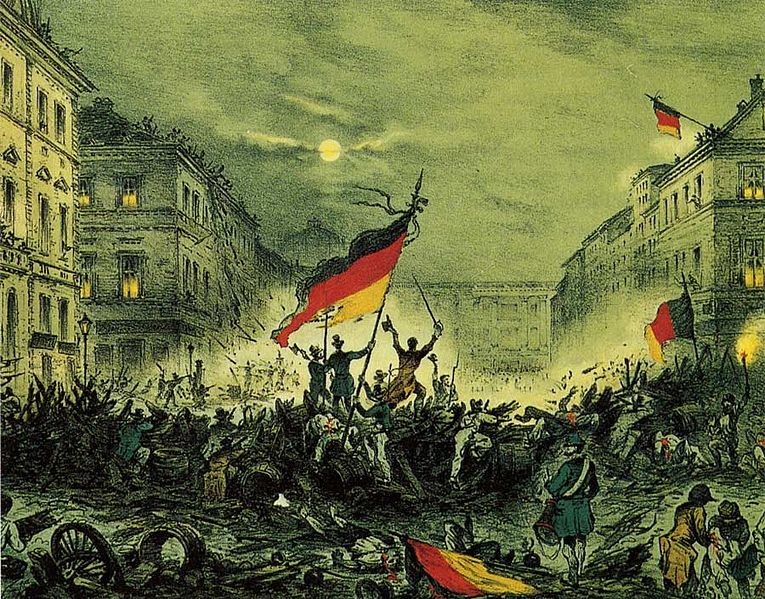
On this date in 1848, a day short of his forty-second birthday, the German revolutionist Robert Blum was summarily shot in Vienna — a tragic victim of Germany’s Revolutions of 1848.

Marker at Robert Blum’s birthplace in Cologne reads “I die for the German liberty that I fought for. May the fatherland remember me.” (cc) image from Elke Wetzig.

Blum grew up in a penniless proletarian family but drifted into the literary set. He spent the 1830s penning liberal-minded plays, poetry, newspaper correspondence. He uncovered a magnetic personality and a gift for organization.

By the 1840s he was a — maybe the — preeminent left-liberal in the Kingdom of Saxony: pro-parliamentary democracy, anti-violence, for a wide grant of civil liberties and mass education.

The pressures, both liberal and radical, pushed to the brink the small realms in the German Confederation, as well as the neighboring Austrian Empire. Both struggled to handle even the liberals’ demands like expanding the franchise and freedom of the press, with old hereditary polities that might not be up to changing times. Germany, Marx and Engels wrote in the Communist Manifesto (1847), “is on the eve of a bourgeois revolution.”

Right on cue…

That pregnant year of 1848 found Blum in the Frankfurt parliament, and his neither-fish-nor-fowl leftism — a little too out there for mainstream liberals; a little too bourgeois for real radicals — made Blum the perfect pick for a solidarity mission.

When in September 1848 the Austrian army was defeated trying to crush a Hungarian rebellion, the Habsburg capital of Vienna took the example and mounted a revolution of its own, putting the government to flight.

Blum was sent as sympathetic delegate to this abortive Viennese commune, but found himself trapped in the city when the Austrian army encircled it in late October.

The Austrians, when they caught him, sent their own message back by denying him any form of deference for his parliamentary rank. Blum’s direct condemnation was a stark warning by the Habsburg state to agitators, but also to their putative brethren dreaming of a Greater Germany. Austria wasn’t buying what the Großdeutsche people were selling.


Detail view (click for the full image) of Carl Steffeck’s painting of Robert Blum’s execution. Here’s a YouTube recreation (in German).

Blum went on to a posthumous career as a star liberal martyr among the German circles who had use for such a character.

Blum’s seven-year-old son Hans grew up to follow his father’s literary footsteps … but from quite the other side of the aisle. He was a pro-Bismarck nationalist.

On this day..

1801: James Legg, crucified ecorche

On this date in 1801, 73-year-old James Legg(e) was hanged for murdering his mate William Lamb(e) at Chelsea Hospital.

Both men were pensioned ensigns from His Majesty’s service. According to the trial transcript, Legg was sinking into obvious depression. A nurse of long acquaintance remarked on

a lowness, a melancholy and deranged state; knowing him so long, I took the opportunity of asking him what was the matter with him, and the reason of his melancholy; he told me his mind was confused; that he had no rest night or day; that he was hurried from place to place, and could not tell what he was doing; and I really was afraid he would make away with himself; I was always unhappy when he was out of my sight, for fear he should do himself an injury; I never mentioned it to the doctor, because he was harmless … sometimes when I spoke to him, he would start like a person surprized out of a sleep; sometimes he would give me an answer, and sometimes only just a bow; I still observed that lowness and melancholy, and that his head was always confused down to the time of this unfortunate event.

Ah. The “unfortunate event.” Legg took it to mind that Lamb was “a tyrannical tempered man” who gave him “repeated insults” and challenged him to a duel. (Lamb’s widow, the only witness to the murder, said her husband had no beef with his killer.)

When Lamb quizzically (or scornfully) discarded the pistol that the irate Legg had forced into his hand, Legg just shot him dead.

He probably had no expectation that he’d just punched his ticket to artistic immortality.

Legg hanged exactly a month after the homicide. During the interval, three Royal Academy of Arts members — sculptor Thomas Banks and painters Benjamin West and Richard Cosway — pulled some strings with the Chelsea Hospital surgeon Joseph Carpue to get Legg’s body after death.

These gentlemen had an idea that centuries of artistic representation of Christ’s crucifixion were nonsense from a physiological point of view.


Giotto crucifixion fresco, c. 1300.

It was a natural outgrowth of Europe’s long fascination with anatomical accuracy — a fascination that made liberal use of executed bodies.

Despite the centrality of Christ’s crucifixion to western culture, nobody had seen an actual crucifixion — not for centuries. So, sure, you can make the guy on the cross look like a proportioned, three-dimensional human being …


Possible Michelangelo (otherwise, Marcello Venusti) Crucifixion with the Madonna, St. John and Two Mourning Angels.

… but is this really what a proportioned, three-dimensional human being would look like when nailed to a cross?

That Chelsea surgeon Carpue and his artist friends had the best way to find out. (Well … the second-best.)

“A building was erected near the place of the execution; a cross provided,” Carpue recorded. After hanging, “the subject was nailed on the cross; the cross suspended … the body, being warm, fell into the position that a dead body must fall into … When cool, a cast was made, under the direction of Mr. Banks, and when the mob was dispersed it was removed to my theatre.” West supposedly exclaimed that he had “never before seen the human hand” until he saw James Legg’s nailed and stretched.

Carpue proceeded to flay the cadaver and make a second cast from the grisly skin-less ecorche … an artistic/anatomical practice of the age whose best-known product is Smugglerius, also cast from a hanged man.

That latter ecorche still survives, and the despondent veteran James Legg’s last pose, hypothetically in the manner of the Savior, can be seen to this day the Royal Academy.

(Debate and experimentation over the particulars of an execution by cross also continue to this day.)

On this day..

1942: Helmuth Huebener, Mormon anti-Nazi


Poster announces Helmut Hubener’s execution.

On this date in 1942, 17-year-old Helmuth Hübener was executed at Plotzensee Prison for listening to the BBC.

Huebener was a Mormon youth with the political perspicacity to abhor fascism from a very young age: the former Boy Scout (Mormons really take to scouting) ditched the Hitler Youth after Kristallnacht, which happened when Huebener was only 10 years old.

As Germany forged ahead towards worse horrors in the years, conscientious people of all ages had moral dilemmas to resolve. Mormons in Nazi Germany weren’t persecuted per se and to keep it that way that small community generally kept its head judiciously down.

Not Huebener.

Horrified by the privations of their Jewish neighbors, Huebener with fellow Mormon teens Karl-Heinz Schnibbe and Rudi Wobbe began illegally listening to foreign radio broadcasts and using the material to compose anti-fascist pamphlets for distribution around Hamburg.

Themes like Germany’s coming defeat (a Huebener circle favorite) never went over well with the authorities; a 1939 law decreed that “Whoever willfully distributes the broadcasts of foreign stations which are designed to endanger the strength of resistance of the German people will, in particularly severe cases, be punished with death.”

Huebener’s friends, aged 18 and 16, were judged only sufficiently severe for hard labor sentences; both survived the war but have since died. Huebener as the ringleader got the death penalty. (The local Mormon congregation expediently excommunicated him, a judgment later reversed from church headquarters in Salt Lake City.) And clearly Huebener was failing to “support the troops”, in the present-day parlance: his own older brother Gerhard had been drafted into the Wehrmacht and was away at the front.

“My Father in heaven knows that I have done nothing wrong,” young Helmuth wrote shortly before his beheading. “I know that God lives and He will be the proper judge of this matter.”

The Latter-Day Saints church, not usually thought of as a hive of anti-authority activity, has only gradually warmed up to celebrating its appealing young resistance martyr.

In addition to a number of books, Huebener is the subject of the documentary Truth & Conviction as well as the forthcoming feature film Truth & Treason.

A few books about Helmuth Huebener

Three Against Hitler and When Truth Was Treason were written by Huebener’s un-executed confederates.

Novels inspired by Helmuth Huebener

On this day..

2006: Danny Rolling, the Gainesville Ripper

During the first week of classes in August 1990 at the University of Florida’s city of Gainesville, five college students were brutally murdered during a terrifying burglary-rape-murder spree.

On this date in 2006, serial killer Danny Rolling finally paid for the murders.

“The face of evil in our community” and Florida college towns’ most infamous serial killer since Ted Bundy made the FSU Chi Omega sorority his last port of call, Rolling was a 26-year-old with sociopathy born of an abusive home life. (Here’s a pdf profile of the guy.)

After shooting his hated father in the face — the Shreveport, La., policeman lost an eye but lived — Rolling headed east to Florida. He would later say that he aspired to become a “superstar” criminal — just like Bundy.*

Little did anyone know that Rolling was already a murderer. Only after his grisly turn in Gainesville was he linked back to a theretofore unsolved 1989 Shreveport triple homicide that saw a man, his daughter, and his son stabbed to death. Rolling had posed young Julie Grissom for investigators.

It was a signature behavior the Gainesville police were about to know all too well.

Out of nowhere, the horror murders leaped onto Florida front pages: 18-year-old Sonja Larson and 17-year-old Christina Powell, stabbed to death on August 24, 1990 (Larson was raped, too): both girls’ bodies theatrically posed.

The very next day, 18-year-old Christina Hoyt raped, stabbed to death, and decapitated — the severed head positioned as if scrutinizing its former torso.

Terrified students began taking what protective measures they could against the hunter in their midst, but just two days later 23-year-old Tracy Paules was raped, knifed, and posed … after Rolling also killed the boyfriend that she had staying over for safety.

Arrested soon thereafter on an unrelated burglary, Rolling’s campsite turned up the evidence linking him to the Gainesville Ripper’s predations. Superstardom was on the way: Rolling’s murders helped inspire the Wes Craven slasher classic Scream.**

When the much-delayed case finally came to trial in 1994, Rolling unexpectedly pleaded guilty without any deal to avoid the death penalty. Why dilute his infamy by denying it? “There are some things you just can’t run from, this being one of those,” Rolling told the judge in his singsong drawl.

Maybe had he come of age just a few years later, the Gainesville Ripper might have scratched that itch for notoriety holding forth on the coming age of new media channels instead of butchering humans.

Certainly Danny Rolling, arranger of mutilated corpses, had the character of a performer; recordings of his own renditions of folk songs were among the artifacts police recovered from the killer’s campsite. Later, in prison, Rolling became a prolific death row artist and his “murderabilia” art can be found for sale on the Internet.

He also personally illustrated The Making of a Serial Killer, a book about his crime spree that Rolling co-authored with Sondra London — a true crime author who fell in love with her subject.

A few books about (and by) Danny Rolling

Whatever charms people perceived in Danny Rolling have understandably been lost on those who survived the victims. And Rolling’s wicked “superstardom” remains yet a sensitive subject in Gainesville, where many residents still remember those days of panic the Gainesville Ripper sowed in 1990.


Memorial to Danny Rolling’s victims painted on Gainesville’s 34th Street Wall. Image (c) hecht 801 and used with permission.

* There was a more direct link between Bundy and Rolling as well: (non-death-row) murderer Bobby Lewis, who became Bundy’s friend while the latter was in prison, later also befriended Danny Rolling, even acting as a go-between for Rolling’s dealings with investigators.

** There’s also a 2007 (posthumous to Danny) horror film directly about the Gainesville murders.

On this day..

1865: Paul Bogle

On this date in 1865, Baptist deacon Paul Bogle was hanged at the Morant Bay courthouse for his part in that locale’s eponymous rebellion.


Third World’s “1865 (96 degrees in the shade)” celebrates Paul Bogle: “Today I stand here a victim the truth is I’ll never die”

Bogle helped lead of the protests-cum-riots that became that rebellion.

Baptists played an essential role in the affair, which has led some to call it the “Native Baptist War”. And indeed, Baptism had long intertwined with underclass resistance: Jamaica’s most famous slave rebel, Samuel Sharpe, was also a Baptist deacon. A previous royal governor in Jamaica had once warned that “the worst evil which hangs with a menacing aspect over the destinies of this island is the influence exercised with baneful effect by the majority of Baptist missionaries.”

From the standpoint of the powerful in Jamaica and Britain, 1865 would vindicate that warning.

A (white) Baptist missionary named Edward Underhill had penned a January 1865 letter bemoaning the miserable condition of most Jamaicans and starkly disputing received wisdom that blacks were just too lazy to work: “The simple fact is, there is not sufficient employment for the people; there is neither work for them, nor the capital to employ them.” (Underhill later wrote a book on the events, The tragedy of Morant Bay, a narrative of the distrubances in the Island of Jamaica in 1865.)

Underhill’s letter got into public circulation and as a result there were a number of “Underhill meetings” perhaps comprising an “Underhill movement” on the island in 1865 — essentially a going social campaign that rooted deeply in Jamaica’s native Baptist communities. Though “native Baptists” is a vague term, it distinguishes not only black from white but, in the words of Mary Turner, a whole “proliferation of sects in which the slaves developed religious forms, more or less Christian in content that reflected their needs more closely than the orthodox churches, black or white.”

William Gordon had switched his religious allegiance to native Baptist and was known to speak at Underhill meetings: that’s part of what got him hanged.

Likewise, our day’s focus, Paul Bogle, was a native Baptist minister, in the St. Thomas-in-the-East parish — and it was the protest of Bogle and his supporters against an unjust prosecution that started the whole rebellion off.


Statue of a militant Paul Bogle (that’s a sword in his hands) outside the Morant Bay courthouse where all the trouble started. (cc) image from dubdem sound systems.

There was, accordingly, an immediate reward out on Bogle’s head, and an immediate demonization in the respectable English press. There, he was “the notorious Paul Bogle,” in the words of one letter to the editor (London Times, Nov. 18 1865), in whose Baptist chapel rebellious “panthers” wantonly “drank rum mixed with gunpowder and the brains of their victims.”

By the time that letter had been dispatched, Bogle’s purported orgies had long since been interrupted: captured by Maroons, he was delivered to custody, instantly tried, an hanged that very day in a batch of 18 rebels.

A horror to Victorian planters, Bogle has won the reverence of posterity as a freedom fighter and national hero.


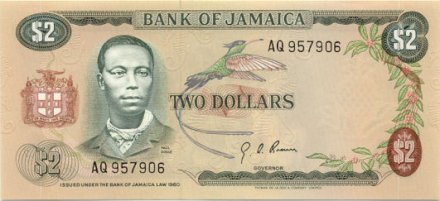
Paul Bogle on the (now out-of-circulation) Jamaican two-dollar bill.

On this day..

1817: Gertrudis Bocanegra, Mexican independence heroine

On this date in 1817, Mexican War of Independence heroine Gertrudis Bocanegra was publicly shot in her native town of Pátzcuaro for treason.

Bocanegra (English Wikipedia entry | Spanish), a literate Enlightenment woman was already 45 years old when the rebellion against the Spanish empire broke out.

Her husband and son joined Hidalgo‘s forces, in which service they would lay down their own lives.

Gertrudis Bocanegra kept a safe house, gathered supplies and money, shuttled messages … until Spanish authorities arrested her in 1817 and tortured her for information. (Need one even ask if the noble Bocanegra informed on her compatriots?)

She’s known as La Heroína de Pátzcuaro and is the namesake for, among other things, a plaza in that city and the striking Biblioteca Gertrudis Bocanegra, where one can find this:


(cc) image from eperales depicts Juan O’Gorman‘s monumental Historia de Michoacan. We’ve seen this monument before, as it depicts the Spanish burning to death the last native Tarasco ruler.

Bocanegra’s own execution is also shown in the mural — in the lower right, obscured by the bookshelves in the photograph above, but captured in detail in this Spanish blog post.

On this day..

1763: Gabriela Silang

On this date in 1763, the mestiza Philippines national hero Maria Josefa Gabriela Carino Silang was captured and summarily hanged — along with a number of the soldiers she had led against the Spanish.


Monument to Gabriela Silang in Makati City, Philippines. (cc) image from Jun Acullador.

Gabriela took primary leadership of a 2,000-strong rebel army after its co-leader, her husband Diego, was assassinated by his enemies in May 1763.

Said enemies were the Spanish colonial authorities, whom Diego and his helpmate Gabriela had raised revolt against and with an army wielding homemade muskets and blowguns, driven from the capital of Ilocos Sur. It was Great Britain’s occupation of the Philippines during the Seven Years War that opened the opportunity for the rebellion: the British even appointed Diego Silang governor of the province his army was in the process of conquering. They just didn’t actually help him.

Spain’s assault on the rebels, once organized, was sufficiently overwhelming to drive Gabriela Silang out of the city of Vigan, and then to repel her counterattack — the occasion for her capture and her death.

Gabriela Silang is memorialized in a number of monuments and place names in the Philippines; the women’s organization GABRIELA also engineered its acronym to pay tribute to her.

On this day..