On this date in 1945, Karl (or Carl) Hulten, a 22-year-old American paratrooper, hanged in Pentonville Prison for murdering an English taxi driver for £8.
The “cleft chin murder” — so dubbed because the victim had this feature — is explored as extensively as anyone need know about it in George Orwell’s curmudgeonly 1946 essay “Decline of the English Murder”.
For Orwell, the “great period” elapsed in part because the 20th century’s monumental destruction of human life dwarfed the meaning of individual homicides, and in part because the crimes themselves (and even their frequent medium, arsenic) connected to frustrated (usually domestic) Victorian passions and imbued “dramatic and even tragic qualities which make [them] memorable and excite pity for both victim and murderer.”
But that was then. Orwell wants these newfangled atavistic hoodlums and their crummy American films to get off his damn terrace.
Sure, but where’s the heart? (London Times, Jan. 24, 1945)
Now compare the Cleft Chin Murder. There is no depth of feeling in it. It was almost chance that the two people concerned committed that particular murder, and it was only by good luck that they did not commit several others. The background was not domesticity, but the anonymous life of the dance-halls and the false values of the American film. The two culprits were an eighteen-year-old ex-waitress named Elizabeth Jones, and an American army deserter, posing as an officer, named Karl Hulten. They were only together for six days, and it seems doubtful whether, until they were arrested, they even learned one another’s true names. They met casually in a teashop, and that night went out for a ride in a stolen army truck. Jones described herself as a strip-tease artist, which was not strictly true (she had given one unsuccessful performance in this line); and declared that she wanted to do something dangerous, “like being a gun-moll.” Hulten described himself as a big-time Chicago gangster, which was also untrue. They met a girl bicycling along the road, and to show how tough he was Hulten ran over her with his truck, after which the pair robbed her of the few shillings that were on her. On another occasion they knocked out a girl to whom they had offered a lift, took her coat and handbag and threw her into a river. Finally, in the most wanton way, they murdered a taxi-driver who happened to have £8 in his pocket. Soon afterwards they parted. Hulten was caught because he had foolishly kept the dead man’s car, and Jones made spontaneous confessions to the police. In court each prisoner incriminated the other. In between crimes, both of them seem to have behaved with the utmost callousness: they spent the dead taxi-driver’s £8 at the dog races.
Judging from her letters, the girl’s case has a certain amount of psychological interest, but this murder probably captured the headlines because it provided distraction amid the doodle-bugs and the anxieties of the Battle of France. Jones and Hulten committed their murder to the tune of V1, and were convicted to the tune of V2. There was also considerable excitement because — as has become usual in England — the man was sentenced to death and the girl to imprisonment. According to Mr. Raymond, the reprieving of Jones caused widespread indignation and streams of telegrams to the Home Secretary: in her native town, “SHE SHOULD HANG” was chalked on the walls beside pictures of a figure dangling from a gallows. Considering that only ten women have been hanged in Britain this century, and that the practice has gone out largely because of popular feeling against it, it is difficult not to feel that this clamour to hang an eighteen-year-old girl was due partly to the brutalizing effects of war. Indeed, the whole meaningless story, with its atmosphere of dance-halls, movie-palaces, cheap perfume, false names and stolen cars, belongs essentially to a war period.
Perhaps it is significant that the most talked-of English murder of recent years should have been committed by an American and an English girl who had become partly Americanized. But it is difficult to believe that this case will be so long remembered as the old domestic poisoning dramas, product of a stable society where the all-prevailing hypocrisy did at least ensure that crimes as serious as murder should have strong emotions behind them.
On this date in 1925, the Serbian outlaw Jovan “Jovo” Stanisavljevic, better known by his nickname Caruga (Charuga), was hanged before a crowd of 3,000 in Osijek.
Caruga soon deserted the front lines on a false pass — but his unauthorized leave became permanent when he came across a Hungarian soldier paying court to the innkeeper’s daughter whom Caruga, too, desired. Caruga shot him dead.
He did a short turn in prison but escaped in 1919 and shortly thereafter established himself the captain of a posse of brigands styled the “Mountain Birds”. From roosts in the Papul and Krndija mountains they preyed on the nearby Slavonian plains — ducking away freely when needed to Dalmatia or Bosnia in what was now the independent (and quite unsettled) Kingdom of Serbs, Croats and Slovenes. (This polity would become Yugoslavia four years after Caruga’s execution.)
Caruga et al obtained a reputation as a Robin Hood-esque character who revenged himself on the rich. He was a late throwback to the classical hajduk character, a complex thief-with-the-heart-of-gold archetype who straddled the line between freebooting highwayman and rebel partisan during the era of Ottoman ascendancy in the Balkans. (The term’s roots trace to a caste of independent Hungarian footsoldiers in the 1600s.)
While the Turks were out of the picture at this point, the romance of the road and the social resentments rife in the fractious young kingdom were still sufficient to support a legendary bandit. Sentiment and fair fortune only turned against him after a botched raid on the estate of one Count Eltz of Vukovar, which resulted in an armed standoff with the local gendarmerie and the death of an innocent forester caught in the crossfire. Caruga was taken with some of his gang not long after.
Caruga is the subject of the so-called “last Yugoslavian film” before that country split apart. The movie Caruga stars the Croatian actor Ivo Gregurevic in what could arguably read as an allegory for the banditry of the outgoing communist years.
Most information about this date’s subject is in Serbo-Croatian; see for instance this .doc file.
* A number of present-day sports clubs in the former Yugoslavia use the name “Hajduk”, not unlike the way “Spartak” (Spartacus) brands Bulgarian and former-USSR teams. For instance, HNK Hajduk Split in Croatia, and FK Hajduk Kula in Serbia.
February 24, 2013 is the Jewish festival of Purim. (Actually, it began at sundown last night.)
This holiday, corresponding to 14 Adar of the Hebrew calendar, falls on different dates of the Gregorian calendar (most often in March). It commemorates a bloody story from the Book of Esther. (The quotes in this post are from this translation of Esther.)
The factual historicity of Esther is pretty questionable, but that debate is a bit beside the point for purposes of the present post. As folklore or fact, the story of Esther and Mordecai, of their near-destruction and the consequent execution of their persecutor, is a staple of tradition and literature.
The thumbnail version of the Purim story has Esther (Hadassah), a Jew living in the Persian capital of Susa, plucked out of obscurity to become the (or a) queen of a “King Ahasverus”.
If Esther has a historical basis, this would be about the fourth or fifth century B.C.E., and “Ahasverus” could be Xerxes (the guy who invaded Greece and made Herodotus famous), or the much later Artaxerxes II.
Esther is an orphan being raised by her cousin Mordecai, and when Esther wins “Who Wants To Live In The Persian Harem?” Mordecai advises her to keep judiciously silent about her Hebrew lineage.
Mordecai doesn’t manage the same trick, however, and offends the king’s powerful minister Haman by refusing to bow to him. This gets the overweening Haman upset at not only Mordecai but at all Jews who share his anti-idolatry scruples, and Haman persuades King Ahasverus to authorize their indiscriminate slaughter:
“There is a certain people scattered abroad and dispersed among the peoples in all the provinces of your kingdom; their laws are different from those of every other people, and they do not keep the king’s laws, so that it is not for the king’s profit to tolerate them. If it please the king, let it be decreed that they be destroyed.”
13 Adar is the date fixed for the Jews’ destruction, by pur, a casting of lots — hence the festival’s eventual date and name. Haman, of course, does not realize that this policy makes Esther his enemy.
In order to save her cousin and her people, Esther must risk a death sentence of her own by approaching the king unbidden in his inner chambers. Mordecai charges her to her duty with a timeless moral force:
“Think not that in the king’s palace you will escape any more than all the other Jews. For if you keep silence at such a time as this, relief and deliverance will rise for the Jews from another quarter, but you and your father’s house will perish. And who knows whether you have not come to the kingdom for such a time as this?”
Esther pulls this dangerous maneuver off, and gains thereby a private audience with just the king and Haman. There, she springs her trap — revealing her Jewish identity.
The king again said to Esther, “What is your petition, Queen Esther? It shall be granted you. And what is your request? Even to the half of my kingdom, it shall be fulfilled.”
Then Queen Esther answered, “If I have found favor in your sight, O king, and if it please the king, let my life be given me at my petition, and my people at my request. For we are sold, I and my people, to be destroyed, to be slain, and to be annihilated. If we had been sold merely as slaves, men and women, I would have held my peace; for our affliction is not to be compared with the loss to the king.”
Then King Ahasverus said to Queen Esther, “Who is he, and where is he, that would presume to do this?”
And Esther said, “A foe and enemy! This wicked Haman!” Then Haman was in terror before the king and the queen.
Word arrives at this inopportune juncture that Haman, who has been gleefully preparing his vengeance, has just had completed a 50-cubit (~20-meter) gallows to execute Mordecai upon. The enraged king instead orders Haman hung on it.
“Hanging” Haman on the “gallows” was traditionally interpreted in the ancient and medieval world as crucifixion,* or some analogously excrutiating way to die.
By any method of execution, though, the dramatic power of the scene — sudden reversal of fortune, virtue elevated over wickedness, the oppressed turning the tables on their oppressors, divine deliverance — is obvious.
At least the guy was remembered. Hands up if you can name any other ancient Persian courtier.
“The Punishment of Haman” is a corner of Michelangelo’s Sistine Chapel.
However, this satisfying palace politics turnabout is not the end of the story, and punishment is not reserved only for the wicked minister.
Esther persuades the king not only to revoke Haman’s order, but to issue a new one — one that Esther and Mordecai will write tabula rasa over the king’s seal.
The writing was in the name of King Ahasverus and sealed with the king’s ring, and letters were sent by mounted couriers riding on swift horses that were used in the king’s service, bred from the royal stud. By these the king allowed the Jews who were in every city to gather and defend their lives, to destroy, to slay, and to annihilate any armed force of any people or province that might attack them, with their children and women, and to plunder their goods, upon one day throughout all the provinces of King Ahasverus, on the thirteenth day of the twelfth month, which is the month of Adar
…
So the Jews smote all their enemies with the sword, slaughtering, and destroying them, and did as they pleased to those who hated them. In Susa the capital itself the Jews slew and destroyed five hundred men, and also slew Parshandatha and Dalphon and Aspatha and Poratha and Adalia and Aridatha and Parmashta and Arisai and Aridai and Vaizatha, the ten sons of Haman the son of Hammedatha, the enemy of the Jews; but they laid no hand on the plunder. That very day the number of those slain in Susa the capital was reported to the king.
And the king said to Queen Esther, “In Susa the capital the Jews have slain five hundred men and also the ten sons of Haman. What then have they done in the rest of the king’s provinces! Now what is your petition? It shall be granted you. And what further is your request? It shall be fulfilled.”
And Esther said, “If it please the king, let the Jews who are in Susa be allowed tomorrow also to do according to this day’s edict. And let the ten sons of Haman be hanged on the gallows.”
So the king commanded this to be done; a decree was issued in Susa, and the ten sons of Haman were hanged. The Jews who were in Susa gathered also on the fourteenth day of the month of Adar and they slew three hundred men in Susa; but they laid no hands on the plunder.
Now the other Jews who were in the king’s provinces also gathered to defend their lives, and got relief from their enemies, and slew seventy-five thousand of those who hated them; but they laid no hands on the plunder.
This bloodbath is obviously a bit more ethically problematic than Haman’s individual fate.
Now, sure, this is an event of questionable authenticity situated in Iron Age tribal mores and exaggerated by the ubiquitous ancient inflation of head counts. The subtext (“defend their lives” … “relief from their enemies”) also implies something like civil strife, blows exchanged rather than merely blows delivered. The overt text says that the victims were people who intended to do exactly the same thing to the Jews.
Still, the plain words on the page says 75,000 humans were slaughtered by a mobilized ethno-nationalist group, “children and women” among them. Just imagine the same parable about a Serb in a Bosnian king’s court, and say a little thanksgiving that the Book of Esther doesn’t identify these 75,000 as constituents of any specific demographic group that remains a going concern today.
Purim is a beloved holiday among its celebrants, but most any explication of it on the Internet comes with a comment thread agonizing over (or rationalizing) the body count. (For example.)
The fact that the story was told, and that it gained great popularity among the Jews, and by some of those in later ages came to be regarded as one of the most sacred books of their canon is, however, a revelation to us of the extent to which the most baleful and horrible passions may be cherished in the name of religion … it is not merely true that these atrocities are here recited; they are clearly indorsed.
Blessedly Purim Fest is not ultimately defined by the likes of Streicher, nor by the bloodthirstiness that is this site’s regrettable stock in trade. For most observants it’s simply one of the most joyous holidays of the year, a time for gifts and feasting and dress-up and carnivals and celebration sometimes thought of as the “Jewish Mardi Gras” or “Jewish Halloween”. Adherents have even been encouraged in all religious solemnity to drink in celebration until they can no longer tell “blessed be Mordecai” from “cursed be Haman.”
Deliverance indeed. L’chaim.
* The concept of Haman crucified in turn encouraged Jews under Christendom to use the figure of Haman (who once upon a time, could be subject to Guy Fawkes-like effigy-burning on Purim) as a veiled stand-in for the current oppressor Christ, and/or encouraged Judeophobic Christians to impute this intention to Purim observances.
A humanist patrician with a soft spot for Plutarch, Burlamacchi had orchestrated a bid to break away an independent federation of Tuscan cities — Florence, Pisa, and his own city of Lucca.
The dream of the Republic and liberty lived long after Rome’s legions had ceased to tromp. It’s just that said dream got reliably tromped over whenever it threatened to materialize in reality.
These prospectively-liberated cities existed with formal independence under the aegis of the allied Holy Roman Emperor Charles V — and were locally bullied by the Medici Duke Cosmo. That made two Caesars who would not be keen on fragmented city-states coalescing into Burlamacchi’s Republic of Tourist Hotspots; for good measure, Burlamacchi threw in some religious reform and anti-clericalism that would be sure to go down poorly with the church. (Lucca was notorious in the Vatican’s eyes as a center of heterodoxy.)
Against this likely formidable opposition, our plotter counterpoised an astonishing rolling-putsch plan.
His scheme was to march a militia, under cover of “training,” out to the environs of Pisa where he would appeal to the Pisans to throw off their Florentine shackles, then march the resulting larger troop to Florence and appeal to the Florentines to kick out the Medici. Revolution accomplished, the neighboring cities — Siena, Arezzo, Lucca itself — would naturally adhere to this new confederation.* He meant, he later told his judges, to “free all of Tuscany.”
Pretty ambitious. Or optimistic. Or … bonkers.
Once the impossible dream plot was betrayed from the inside, Duke Cosmo, as the most direct target of the intended march, wanted Burlamacchi delivered to his own hands for interrogation and punishment; the elders of Lucca could not do this without making an impolitic show of submission to their neighbor.** Charles V resolved the impasse by taking Burlamacchi to the imperial seat of northern Italy, Milan, and cutting his head off there.
During Italy’s 19th century risorgimento, the Italian writer Carlo Minutoli rediscovered Burlamacchi and popularized him as a forerunner of the new Italian nationalists. (Burlamacchi had long been forgotten as an embarrassment in the intervening centuries.)
Accordingly, with the (proto-)unification of Italy, Tuscan sculptor Ulisse Cambi was commissioned to produce a monumental statue of Francesco Burlamacchi. This would-be Aratus still keeps watch on Lucca’s Piazza San Michele.
(cc) image from alphaorionis. Note that, according to The Renaissance in the Streets, Schools, and Studies (whose chapter “Fortune’s Fool” by Mary Hewlett was invaluable to this post), the historical Burlamacchi actually never carried a sword and hated bloodshed.
* The confederated city-states model was really big in the family. Burlamacchi’s teenage — at the time of the execution — son Michele later emigrated to Geneva, in the Swiss Confederation, and converted to Calvinism.
** Lucca was declining as a power at this time, and all the more insistent about jealously guarding a maximal appearance of sovereignty. The city-state’s major project in the 16th century was throwing up city-girding defensive walls meant to preserve her independence.
On this date in 1751, Irish boxer James Field was hanged at Tyburn.
He had ditched his criminal record in Dublin for the burgeoning London metropolis and hung out a shingle at a pub on Drury Lane. (Perhaps he knew the Muffin Man.)
“dustmen, scavengers, flue-fakers, gardeners, fish-fags, and brick-layer’s labourers … the Hibernian was relating the ill usage he had been subjected to, and the necessity he had of making a hasty retreat from the quarters he had taken up” (Description of Drury Lane … from 1821. Close enough.)
Field soon developed a blackhearted reputation in London, and because he was a big bad boxer on the brute squad, constables were known to “fail to recognize” him the better to get home safe to dinner.
Even in a city without a professional police force, though, that’s a thin reed to rest one’s liberty upon. Eventually the mighty British Empire marshaled the marshals necessary to run Field to ground for a violent heist. This time, his hulking build clinched his sure identification, and he earned the hemp for his felonies.
“On January 28th 1656, there was punished Joris Fonteyn [or Fonteijn] of Diest, who by the worshipful lords of the law court was granted to us an anatomical specimen. On the 29th Dr. Joan Deyman made his first demonstration on him in the Anatomy Theatre, three lessons altogether”.”
Dr. Joan Deyman had succeeded Dr. Nicolaes Tulp in the redoubtable position of the guild’s Praelector Anatomiae — the physician entrusted with the guild’s once-per-year public anatomical reading over the dissection of an executed criminal. In his day, Tulp and his dissection had been painted by Rembrandt.
With the new praelector in the wealthy city came its guild’s need for fresh art to keep up with the Joneszes.
New subject, new work … but the same artist. A mere sapling when he rendered Dr. Tulp, Rembrandt was a fully mature painter of 50 when he put this scene to canvas.
Sadly, this painting was damaged in a 1731 fire, destroying most of its figures, including the titular one.
Braaaaaaaaaaaaaiiiiinnnnnssssssssss! Dr. Deyman’s hands are all that remain of him. The cadaverous Joris Fonteyn, however, belongs to the ages.
Since it was part of the anatomization law for the unfortunate subjects to be given a decent burial, Fonteyn’s exit from the annals of history is another entry (pdf) in the surgeon’s guilds records:
Wednesday, February 2, at 9 o’clock in the evening the body was interred with fitting dignity in the South Churchyard.
There exists a receipt for January 9, 1386, in which the executioner of Falaise, France, acknowledges payment of ten sous and ten deniers
for his efforts and salary for having dragged and then hanged at the [place of] Justice in Falaise a sow of approximately three years of age who had eaten the face of the child of Jonnet le Macon, who was in his crib & who was approximately three months old, in such a way that the said infant died from [the injuries], and [an additional] ten s. tournoise for a new glove when the Hangman performed the said execution: this receipt is given to Regnaud Rigaut, Vicomte de Falaise; the Hangman declares that he is well satisfied with this sum and that he makes no further claims on the King our Sire and the said Vicomte.
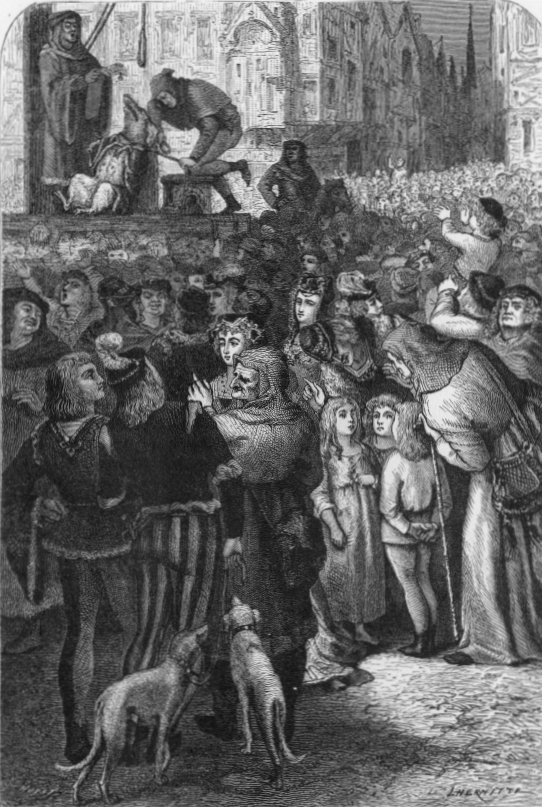
From this tiny kernel of primary documentation — the only primary source that exists — an impressive legend has grown up around the “Sow of Falaise”. It’s been alleged by subsequent interlocuters that the condemned sow was dressed up as a person for execution, that other pigs were made to attend in order to take warning by their swinish sister’s fate, and even that the incident became so famous as to merit depiction in a church fresco.
The supposed fresco has been whitewashed, but Arthur Mangin’s L’Homme et la Bete (1872) took a stab at reconstructing it.
This bizarre scenario can’t help but raise the question for we later observers — just what was the objective in trying and “executing” a farm animal? Did the human supporting cast to this scene not feel itself ridiculous?
According to Paul Friedland‘s research for his fascinating recent survey of public executions, Seeing Justice Done: The Age of Spectacular Capital Punishment in France, the subsequent embroideries around the Sow of Falaise have no basis in fact. They were simply made up … or rather, they were interpolations of authors who were baffled as we to see a sow hoisted on a gibbet.
“Punishment may be about many things, but in the last instance, we citizens of the modern world have an almost visceral need to believe that it is primarily about one thing: deterrence,” Friedland opines.
“The punishment of a pig for murder violates our modern understanding of the essential purpose of punishment because it punishes an animal, which we ordinarily do not believe to be capable of criminal intent, and because it does not lend itself very well to the principle of exemplary deterrence.” The tale’s evolution in later centuries “allowed an incomprehensible anecdote from the past to fit neatly into the modern paradigm of penal deterrence.”
Seeing Justice Donesituates that murderous pig within an unfolding saga of penal theory and practice stretching from the Roman Empire to the 20th century. And while Friedland’s study focuses on France in particular, the historical threads he teases out will look familiar much further afield.
We had the pleasure of interviewing Dr. Friedland about his book recently, and we’re pleased to present it here not in our customary Q&A form, but as Executed Today‘s debut podcast. The mediocre sound quality is on me, but Dr. Friedland’s insights are more than worth it. (Unlike your host, Friedland is a podcasting natural; catch him in a July 2012 episode of the New Books In Human Rights podcast.)
Trouble seeing the podcast player? Access the interview on podbean.
On this date in 1868, Priscilla Biggadike withstood one last gallows-foot plea from her minister to admit to poisoning her husband.
‘I implore you not to pass away without confessing all your sins; not only generally, but especially this particular case, for which you are about to suffer. I had hoped that you would have made that confession, and thus have enabled me, as a minister of Christ, to have pronounced the forgiveness of your sins … It has grieved me much to find that [you] still persist in the declaration, that you are not accountable for your husband’s death; that you still say that you did not administer the poison yourself; that you did not see any other person administer it, and that you are entirely free from the crime. Do you say so, now?
The Prisoner, still in a firm voice, said, yes.
The Chaplain. — There is only one [hope] left, that you have endeavoured to confess your sins to God, though you will not to your fellow creatures. All I can now say is that I leave you in the hands of God; and may he have mercy on your soul. What a satisfaction it would be to your children, to your friends, to your relations, to know that you had passed from death into life, in the full persuasion that your sins were forgiven you … I am sorry I cannot exercise that authority [to pronounce sins forgiven] at the present moment.
Then, at the stroke of 9 a.m., she was hanged by ten-thumbed executioner Thomas Askern. True to form, Askern made a mess of it, and Biggadike painfully strangled to death with the rope’s knot infelicitously positioned under her chin* … although, since this execution was behind the walls of Lincoln Castle (in fact, it was the first female hanging after an 1868 Act of Parliament had made all hangings private), at least it didn’t incense a vast concourse of onlookers.
Posterity, though, has taken plenty of umbrage at Priscilla Biggadike’s fate.
She and her late husband Richard kept two lodgers in a two-room house in the village of Stickney.
Richard already suspected an affair between Priscilla and one of those lodgers, Thomas Procter (or Proctor), when he returned home from work on September 30, 1868, enjoyed tea and cakethat his wife had made for him, and then fell violently, fatally ill. The post-mortem examination showed Richard Biggadike had been poisoned with arsenic.
Priscilla Biggadike and Thomas Procter were both arrested on suspicion of murder but charges against Procter were soon dropped.
Priscilla was known to have quarreled with her husband over that whole infidelity thing, and she had alluded at least once to having arsenic around for killing mice. She was accordingly found guilty of poisoning him, though “only,” in the words of the jurors when the judge pressed the question, “upon the ground of circumstantial evidence.”
Indictment, trial, conviction, and execution for the “Stickney Murderess” wrapped up in two months’ time. But the discharged co-accused, Thomas Procter, years later made a deathbed confession that it was really he who poisoned Richard Biggadike.
(During the investigation, Priscilla had even attempted to blame Thomas Procter, reporting that on one occasion prior to the murder he’d even made what looked like an attempt to poison Richard by mixing white powder into his tea, after which Richard became sick. Police didn’t regard the accused as a particularly credible source for obvious reasons, but it’s hard to believe anyone would have failed to follow up on that sort of lead.)
On account of that whole wrongful-hanging mix-up, Priscilla Biggadike received a posthumous pardon. She’s even had a short musical made about her conviction, which was recently performed in Lincoln Castle. If you visit, you can still see the cell where she passed her final days.
* The bad botch of this job led Lincolnshire officials to audition for their next execution a local cobbler and amateur noose enthusiast destined to revolutionize the British hanging with his scientific approach: William Marwood.
December 21 was an execution date at Tyburn in 1692, with eleven men and women put to death.
They were, as usual, physically escorted on the 21st — and spiritually escorted in the days leading up to that black date — by the Ordinary of Newgate.
We have often referred to this character and, in the present series, cited him repeatedly.
This clergyman was appointed to London’s stinking prison to tend to the souls of its inmates, particularly those condemned to die.
Under the tenure of Samuel Smith, the Ordinary of Newgate began in about 1684* to put out a regular broadsheet published the day after London’s eight or so annual hanging-days. Laboriously titled The Ordinary of Newgate, His Account of the Behaviour, Confession, and Dying Words of the Malefactors who were Executed at Tyburn, it was sold by street-peddlers for (at first) a penny.
A typical Ordinary’s account by Smith had a three-act arc:
An account of the honored clergyman’s own sermonizing, even the literal day-by-day exhortations and their progress (or not) in bringing the condemned round to a satisfactory spiritual state. The Account for December 21, 1692, for instance, begins:
THE Ordinary preacht several Sermons to the Condemed Criminals being Twenty One. The first was on the Lord’s-Day immediately before their Condemnation on the Monday following, from this Text, viz. The 19th. Psalm, the 12th. Verse. Who can understand the Errors of his Life? Cleanse thon me from my secret Faults. The Observation from the Words was this, That the smallest Sins even Errors in Opinion and Infirmities in our Obedience to God’s Laws, ought to be repented of, as needing pardoning Mercy.
Biographical thumbnails of the condemned, of no regular format but often remarking the person’s age, profession, birthplace, and life circumstances … and always attentive to whether s/he had come by repentance. This is Samuel Smith’s take on one of the 11 hanged today:
Robert Marshal: Condemned for Murthering William Curtys, in White-Chappel. He pretended now, as formerly, that he is blind, and Begged under that Disguise. But being denied Relief by Curtys, Marshal, with his Begging-staff, in both his Hands, struck him on the Head, and made a Fracture in his Skull, of which he died; and he immediately attempted to run away. He confessed on Tuesday, that though his Sight was not strong enough for Labour, yet he could see his Way, in Walking, so as to go safely. He was born in Jamaica, bred up a Sea-man . He was unwilling to give any Account of his Life, being very obstinate.
The scene at Tyburn itself, with the Ordinary’s prayers and the public behavior and confessions of the doomed.
They were fervently exhorted to Confess their Faults, the Effects of which had brought them to such disgrace: After which the Ordinary took great pains with them in Prayer, and other suitable Applications, to bring them to a sense of the near approaches of Death; to which they adher’d, and joined in the Prayers; and singing of a penitential Psalm in as fervent a manner as could be reasonably expected from Persons of so mean Education, as were the most of them. They lamented their dismal Fall, desiring all Spectators of such a Tragedy to be warn’d by them, &c.
As to the Particulars of their Confessions. they did not much enlarge themselves; only the Blind Man was penitent, and desired all Persons to take warning by him; owning that he could see; hoping God would forgive him all his Offences, &c.
In the 18th century these hang-day reports would expand even further.
For historians these records, formulaic as they are, remain “a unique and inestimable source of knowledge of the poor people who were hanged.” (Linebaugh).
For the Ordinary’s contemporaries, they were something else besides: the voice of authority on “the Malefactors,” their usual submission, the facts of their lives and the expected public lessons of the crimes and punishments.** Certainly the Ordinary was at pains to assert his “official” status; in the Account at issue for this date’s hanging, he appends the notice,
Whereas there formerly have been, and still are, several False Accounts in Print, in relation to the Condemned Prisoners; and particularly, this very Session, that Robert Marshal, the Blind Beggar, was Executed two Days since; which is utterly false: The Ordinary thinks it necessary to acquaint the World, (to prevent the like for the future,) that no true Account can be given of the Condemned Prisoners Behaviour, Confessions, and Last Dying Speeches, which is not Attested under his own Hand.
Accept no substitutes!
The Ordinary had good reason to defend his position, for the Ordinary’s own livelihood depended upon his marketing his black-bordered pamphlets. This was naked entrepreneurship, direct to Smith’s pocket, and his product stood in competition with every other scandal-sheet hawker crowding the gallows.
Nor was the printed word the only way to monetize the office of Ordinary. In an environment when many people were condemned to death and many were pardoned, Smith was accused of shaking down prisoners to intervene for more lenient treatment.
For instance, in this wonderfully vicious send-off to the cleric after he died in 1698, satirist Thomas Brown accuses Smith (in the bolded passage) of taking payola to help illiterate prisoners claim benefit of clergy — an anachronistic legal mechanism wherein a condemned first-time offender could escape the noose by showing that he could read. (The loophole was reformed in 1706 to eliminate the reading test entirely, although this also came with making many offenses no longer “clergyable” at all.)
An Elegy on that most Orthodox and Pains-taking Divine, Mr. Samuel Smith, Ordinary of Newgate, who died of a Quinsey, on St. Bartholomew’s Day, the 24th of August, 1698.
Tyburn, lament, in pensive sable mourn,
For from the world thy ancient priest is torn.
Death, cruel death, thy learn’d divine has ended,
And by a quinsey from his place suspended.
Thus he expir’d in his old occupation,
And as he liv’d, he dy’d by suffocation.
Thou rev’rend pillar of the triple-tree,
I would say post, for it was prop’d by thee;
Thou penny-chronicler of hasty fate,
Death’s annalist, reformer of the state;
Cut-throat of texts, and chaplain of the halter,
In whose sage presence vice itself did faulter:
How many criminals, by thee assisted,
Old Smith, have been most orthodoxly twisted?
And when they labour’d with a dying qualm,
Were decently suspended to a psalm?
How oft hast thou set harden’d rogues a squeaking,
By urging the great sin of Sabbath-breaking;
And sav’d delinquents from Old Nick’s embraces,
By flashing fire and brimstone in their faces?
Thou wast a Gospel Smith, and after sentence
Brought’st sinners to the anvil of repentance;
And tho’ they prov’d obdurate at the sessions,
Couldst hammer out of them most strange confessions,
When plate was stray’d, and silver spoons were missing,
And chamber-maid betray’d by Judas kissing. Thy christian bowels chearfully extended
Towards such, as by their Mammon were befriended.
Tho’ Culprit in enormous acts was taken,
Thou would’st devise a way to save his bacon;
And if his purse could bleed a half pistole,
Legit, my lord, he reads, upon my soul.
Spite of thy charity to dying wretches,
Some fools would live to bilk thy gallows speeches.
But who’d refuse, that has a taste of writing,
To hang, for one learn’d speech of thy inditing?
Thou always hadst a conscientious itching,
To rescue penitents from Pluto’s kitchen;
And hast committed upon many a soul
A pious theft, but so St. Austin stole:
And shoals of robbers, purg’d of sinful leaven,
By thee were set in the high road to heaven.
With sev’ral mayors hast thou eat beef and mustard,
And frail mince-pies, and transitory custard.
But now that learned head in dust is laid,
Which has so sweetly sung, and sweetly pray’d:
Yet, tho’ thy outward man is gone and rotten,
Thy better part shall never be forgotten.
While Newgate is a mansion for good fellows,
And Sternhold‘s rhimes are murder’d at the gallows;
While Holborn cits at execution gape,
And cut-purse follow’d is by man of crape;
While Grub-street Muse, in garrets so sublime,
Trafficks in doggrel, and aspires to rhime;
Thy deathless name and memory shall reign,
From fam’d St. Giles’s, to Smithfield, and Duck-lane.
But since thy death does general sorrow give,
We hope thou in thy successor will live.
Newgate and Tyburn jointly give their votes,
Thou may’st succeeded be by Dr. Oates.
* There are irregular Smith accounts from the late 1670s (he took over the position in 1675) as he felt out the genre, but he only institutionalized the periodical in the mid-1680s.
** Smith and all the Ordinaries harp endlessly on what amount to “gateway crimes”: idleness, drunkenness, bad company, and especially (as our satirist observes) breaking the Sabbath. They’re constantly inveigling prisoners to warn the execution crowd against these vices.
On this date in 1761, King Canek Chan Montezuma was torn apart in the main square of Merida.
This august regnal name was asserted by a shaman previously known as Jacinto Uc de los Santos (English Wikipedia entry | Spanish). “Canek” echoed the history of the Mayan Itza kings, but it was Jacinto in using it for a single month’s insurrection that fixed its immortality.
“Memory is not just a tool of the spirit for calling up the past. Rather it is a skill which allows us in a moment to see what is in its essence outside of time. Memory allows us to rise to a state, not available to the mind alone, where everything is present.”
Jacinto Canek’s life followed by just a few decades Spain’s final conquest of the last independent Mayan peoples, the Itza, in the 1690s, complete with the usual religious assimilation, political control, and enslavement.
Canek, a commoner (perhaps an orphan) with some education, mounted in November 1761 a surprise revolt at the village of Cisteil (or Quisteil). There he deposed the parish priest and preached from the Catholic pulpit in the Mayan tongue:
My beloved children, I know you yearn to throw off the heavy yoke you have labored under since the Spanish subjugation … Spanish rule [brings] nothing but suffering servility.
About this same time, a Spanish merchant on his routine business rolled into town, blithely unaware of the gathering rebellion. Canek found the interloper insolent, and had him killed.
Crowned the new Mayan king and asserting semi-divine powers, Canek rapidly gained the support of neighboring towns. Within a week, he fielded 1,500 Mayan soldiers to defend Cisteil against a Spanish force sent to suppress them. Hundreds died in a bitter hand-to-hand battle on November 26, 1761, and Cisteil burned … but the Spanish won, and Canek, following a short flight, was captured with his remaining followers.
The Spanish governor of Yucatan, Jose Crespo (Spanish link), ordered Canek to a tortuous execution: tortured, broken, burned, and his ashes scattered. Many of his other followers were also put to death in various ways around the same time.
Mural of Jacinto Canek’s torture by Fernando Castro Pacheco at the Palacio de Gobierno in Yucatan, Mexico. (cc) image from Yodigo.
The Spanish hadn’t heard the end of this.
In the next century, Canek’s name was on the lips of Mayan descendants and mixed-blood Mestizos when they revolted again in the long-running (1847-1901, or even later: Quintana Roo maintained itself semi-autonomous until the 1910s) Caste War against domination by the European-identifying peoples of what was now the independent state of Mexico.
For decades, large areas of the Mayan Yucatan remained deadly to enter for any white-skinned outsider.
Today, it’s safe to check out the monumental tribute to Jacinto Canek on the Merida boulevard that bears his name.

 The “cleft chin murder” — so dubbed because the victim had this feature — is explored as extensively as anyone need know about it in George Orwell’s curmudgeonly 1946 essay “Decline of the English Murder”.

 Caruga was born to peasant stock within the