This doctor made his Nazi bones by forging a relationship with Heinrich Himmler (he married Himmler’s ex-mistress), and joining Himmler’s SS.
Rascher was doing cancer-cure experiments on animals, but once he had Himmler in his Rolodex he graduated to research on homo sapiens.
From 1941 to 1944, Rascher conducted some of the textbook ethical trespasses of Berlin’s human experimentation regime, using Dachau prisoners in:
high-altitude experiments to help fighter pilots, tested by subjecting prisoners to rapid de- and re-pressurization;
freezing experiments, tested by subjecting prisoners to freezing water or outdoor exposure, and then attempting by various methods to restore body warmth;
blood clotting experiments, tested by giving prisoners major gunshot wounds or other grievous bodily injuries, then monitoring how well a new drug slowed the bleeding.
Class act all the way. Rascher did publish some papers and deliver some conference presentations on aspects of his horrifying science, but in one of those little contradictions of the evil security state, the man was foiled in his bid for an advanced academic credential because much of the research was too secret for his peers to review.
In the end it was a much more mundane breach of ethics that did him in: Rascher and wife were arrested in 1944 for having actually kidnapped the children they claimed were their own.
They were stashed away in separate camps. For unclear reasons — perhaps because Rascher connected all this atrocious research back to Himmler, who was vainly trying to cut a peace deal with the West at this point, or maybe simply because Himmler was annoyed at the embarrassment his protege’s misconduct had given him — the bad doctor was summarily shot in his cell as the Allies bore down on Dachau.
(We will note in passing this argument, and this, disputing that story as well as this execution date. Executed Today is not in a position to contribute to that conversation.)
Elsewhere …
Caption: Polish and Russian forced laborers shot by the SS after they had collapsed from exhaustion during a death march. Wisenfeld, Germany, April 26, 1945.
On this date in 1945, the commandant of Waffen-Grenadier Regiment 73 was lynched by his own men.
These were remnants of a regiment within the notorious Dirlewanger brigade comprised largely of ex-prisoners set at liberty to do the dirtiest of SS work.
So there was a certain poetic justice to Ehlers’ fate. An SS man since 1938, Ehlers had fought all over in the bloody preceding years (he’d been in the army and the Luftwaffe during the interwar period), and served in several different SS formations.
The Dirlewanger forces at this point had been beaten to a pulp by the Red Army, and were bleeding deserters every day. The remnants of Ehlers’ regiment mustered on this day in an attempt to reorganize. Instead, Ehlers was lynched by his men for reasons unknown: his previous turn commanding Dachau, where many of his men might have once been imprisoned, is one possible factor.
April 25, 1945 is more illustriously marked in the annals of World War II as Elbe Day, when American troops coming from the west and Soviet troops from the east met at Torgau on the Elbe River, splitting the Reich in two.
The canned publicity shot of U.S. and Soviet officers meeting in Torgau.
On this date in 1945 — the same date when, in Berlin, a last mopping-up terminated the remaining participants in the Valkyrie assassination plot, such as Albrecht Haushofer — successive war crimes by the German and Soviet armies slew hundreds at the nearby village of Treuenbrietzen.
In the German installment of the Massaker von Treuenbrietzen, the army led 131 Italian internees taken prisoner after that erstwhile ally had gone over to the Allies in 1943 out to a gravel pit, and gunned them all down. (Stone markers now label the site.)
Only four men survived the mass execution.
“I can not explain this miracle,” said Edo Magnalardo, an Italian who played dead until the heap of corpses was buried, and then climbed out and found some Russians to surrender to/be liberated by. This German article records Magnalardo’s recollections of events, and the long and fruitless struggle for an official investigation.
For Germans in Treuenbrietzen, surrendering to the Red Army was a much less liberating experience … not that anybody had a choice in the matter.
Beginning on this date, Soviet soldiers carried out a horrifying rampage that left upwards of a thousand Treuenbrietzen men dead.
Apparently provoked when a Russian officer celebrating the village’s capture had been shot dead during a brief German reconquest, Soviet troops shot an estimated 270 or so civilians at the edge of the nearby forest on April 23. Over the next two weeks, they kept shooting: some 800 to 1,000 men (mostly) are believed to have been killed in this way by the end of the war. As for the women … there would soon be a need to set up a gynecological station in a local office, and require that all report for VD testing.
Since Treuenbrietzen ended up in communist East Germany after the war, this part of the massacre was seriously downplayed for a long time.
But no matter how officially favored the winning side in the war, the grim fate of so many noncombatants in Treuenbrietzen surely shames those who participated in it. As one survivor put it in the German press, “He who takes revenge can not be celebrated as a liberator, even though he has helped to end this disastrous war.”
This date is locally commemorated in Treuenbrietzen for both massacres, and both Italian and Russian diplomats have participated in memorial ceremonies.
Although his career prospects in Nazi Germany were ultimately limited owing to that lineage’s kinship to Frederick the Great’s Jewish banker, they were not so limited that he was not able to become a university professor and one of the founding figures in the field of engineering network synthesis filters. The elliptical filter is known as the “Cauer filter” in his honor.*
By the end of World War II, he was, like millions of less-distinguished countrymen and -women, merely a person in the way of a terrible conflagration.
Cauer succeeded in evacuating his family west, where the American and not the Soviet army would overtake it — but for reasons unclear he then returned himself to Berlin. His son Emil remembered (pdf) the sad result.
The last time I saw my father was two days before the American Forces occupied the small town of Witzenhausen in Hesse, about 30 km from Gottingen. We children were staying there with relatives in order to protect us from air raids. Because rail travel was already impossible, my father was using a bicycle. Military Police was patrolling the streets stopping people and checking their documents. By that time, all men over 16 were forbidden to leave towns without a permit, and on the mere suspicion of being deserters, many were hung summarily in the market places. Given this atmosphere of terror and the terrible outrages which Germans had inflicted on the peoples of the Soviet Union, I passionately tried to persuade my father to hide rather than return to Berlin, since it was understandable that the Red Army would take its revenge. But he decided to go back, perhaps out of solidarity with his colleagues still in Berlin, or just due to his sense of duty, or out of sheer determination to carry out what he had decided to do.
Seven months after the ending of that war, my mother succeeded in reaching Berlin and found the ruins of our house in a southern suburb of the city. None of the neighbors knew about my father’s fate. But someone gave identification papers to my mother which were found in a garden of the neighborhood. The track led to a mass grave with eight bodies where my mother could identify her husband and another man who used to live in our house. By April 22, 1945, the Red Army had crossed the city limits of Berlin at several points. Although he was a civilian and not a member of the Nazi Party, my father and other civilians were executed by soldiers of the Red Army. The people who witnessed the executions were taken into Soviet captivity, and it was not possible to obtain details of the exact circumstances of my father’s death.
Cauer’s name was actually on a list of scientists the Soviets were looking to recruit, not eliminate. Presumably he and those other civilians who shared his nameless grave fell foul of the occupying army in some incidental way and were shot out of hand in the fog of war.
By contrast, April 22 was the lucky day for Wehrmacht General Helmuth Weidling.
Weidling had been forced by overwhelming Russian power to withdraw from a position and an enraged Hitler ordered him summarily shot.**
Fortunately, it was not effected so “summarily” that Weidling wasn’t able to get his side of the story in and have the execution order revoked. Lucky Helmuth was within hours, uh, “promoted” to commander of the Berlin Defence Area, which is supposed to have led him to remark, “I’d rather be shot than have this honour.”
This was not to be his fate.
Instead, after a week’s overseeing the suicidal exertions of his underaged, underarmed Volkssturm militia, it fell to Weidling on May 2 to issue the order directing remaining garrisons in Berlin to lay down their arms.
On April 30, 1945, the Führer committed suicide, and thus abandoned those who had sworn loyalty to him. According to the Führer’s order, you German soldiers would have had to go on fighting for Berlin despite the fact that our ammunition has run out and despite the general situation which makes our further resistance meaningless. I order the immediate cessation of resistance.
The devastated Berlin of the Soviet encirclement was Weidling’s last glimpse of his homeland: he was flown to the USSR as a prisoner of war and died there in captivity in 1955.
* Also working against the big brain’s career path in academia: “few people could appreciate the vast potential of Cauer’s special field of work … for mathematicians, he seemed too involved in applied sciences, and for electrical engineers his contributions included too much mathematics.” These days, Cauer’s disciplined application of mathematical principles to the field of network filtering is precisely what he’s remembered for.
** This was a notably bad day for der Fuhrer: it was also on April 22 when the impotence of the German army’s remaining shreds caused him to launch into that bunker tirade that has spawned a thousand Internet parodies.
On this date in 1956 or very shortly thereafter, Jesus Maria de Galindez was probably executed in the Dominican Republic.
Jesus Maria de Galindez
The previous day, he had vanished without a trace from New York City. According to unconfirmed but highly credible accounts, he was killed on orders from — and in the presence of — Dominican dictator Rafael Leonidas Trujillo.
Galindez’s disappearance caused an international incident. It was covered in numerous newspapers and periodicals, including Time and Life, and was the subject of much speculation and many conspiracy theories. In spite of an extensive search, his body has never been found. The case has remained in memory into the 21st century, however, as this 2001 New York Press article demonstrates.
Who was Galindez?
Born in Spain in 1915, he was a political activist, a committed anti-fascist and Basque nationalist. As a result, he ran into trouble with Spain’s dictator, Francisco Franco, and had to run for his life.
In 1939, Galindez set up shop in the Dominican Republic, only to find fascism polluting this country as well. He had to run again in 1946, this time to New York City.
While working on his Ph.D in political science from Columbia University, Galindez found the time to teach college classes, write a newspaper column which was syndicated throughout Latin America, and represent the Basque government-in-exile. He was a busy man.
He was also very afraid, and with good reason. Like most despots, Rafael Trujillo held grudges for a long, long time, and his henchmen kidnapped and/or killed many of his enemies, even those outside the country. One of Galindez’s friends was killed by Trujillo’s agents in Manhattan in 1952.
Galindez then wrote a letter to be opened in the event of his death or disappearance, stating that if he should come to harm, Trujillo was surely behind it.
On March 12, 1956, Galindez taught a class at Columbia and a student gave him a lift to the subway. This was the last time he was seen alive. When he was reported missing five days later, all his belongings were found undisturbed in his apartment. The FBI and the New York Police Department searched for him without result.
According to an investigation by Life magazine, which published its conclusions in 1957, Trujillo’s agents forcibly abducted Galindez on March 12, drugged him and bundled him aboard a small private plane piloted by an American, Gerald Murphy.
Early in the morning on March 13, Murphy stopped in Miami for fuel, then continued southward, stopping at Monte Cristi in the Dominican Republic. From there another pilot, Octavio de la Maza, took over. De la Maza was a tough character who had already committed one murder, in England. He flew Galindez to Ciudad Trujillo. Galindez was then shot to death in Rafael Trujillo’s presence and buried.
The Dominican government tried to buy off Murphy with a plum job as a flight captain, but pretty soon he started blabbing about his mysterious plane trip and its passenger, whom he’d at first thought was a wealthy invalid.
Pilot Octavio de la Maza: mopped up.
Thus was a second assassination necessary to cover the first: in December 1956, Murphy vanished without a trace in the Dominican Republic, only days before he was due to fly home to America. His body was never found. Now, his co-pilot had to be silenced, and a very neat job it was too: Octavio de la Maza was arrested and charged with Murphy’s murder. He had just enough time to get his parents out of the country before the ax fell, but never came to trial because he was found hanged in his cell in January … conveniently leaving a full confession in writing: Murphy had hit on him, and De la Maza lost his temper and pushed him off a cliff.
The world smelled a rat. Trujillo, of course, denied everything and went so far as to hire an American lawyer, Morris Ernst, to conduct his own investigation into Galindez’s disappearance. After ten months, Ernst issued a report predictably exonerating his employer. He claimed Galindez had stolen money earmarked for the cause of Basque Nationalism and simply walked out of his life.
And there the matter rests.
No charges were brought against anyone in Galindez’s disappearance. Columbia awarded him his Ph.D in absentia and his thesis, published as The Era of Trujillo, became a bestseller throughout Latin America.
What goes around comes around: Trujillo was himself assassinated in 1961. One of the men who plotted his murder was Antonio de la Maza, Octavio’s brother.
On this date in 1870, the lynching of a mulatto freedman in Alamance County, North Carolina sounded the tocsin for ex-Confederates’ rollback of Reconstruction.
Perhaps America’s most tragic period, the aftermath of the Civil War saw a too-brief attempt to enforce ex-slaves’ civil rights, before it succumbed to violent counterattack. The prevailing historiography in the century-long era of Southern apartheid that followed remembered it as a time of impertinent Negroes ravishing Dixie’s virtue by being seated in the legislature and giving orders to their natural betters.
Winners write history, after all.
Those of the pro-Republican coalition at the time, before Northerners folded their hand, had a mind to write a different history.
Alamance County was one epicenter of this aborted alternative. The enclave was cool to secession from the beginning, and in the early years of Reconstruction had a live black-white coalition. Wyatt Outlaw, a mixed-race Alamance native who had fought for the Union, was a local leader in it. A member of the antislavery Union League, which registered freedmen as voters throughout the South, he was appointed a town commissioner for Graham, N.C. under the state’s new constitution.
This made him a prime target of Ku Kluxers. On the night of February 26, 1870, an armed party of white supremacists about 100 strong raided his home and strung him up on an elm tree facing the county courthouse. Pinned to his corpse for the edification of the morning’s churchgoers was a note:
“Beware you guilty — both white and black.”
North Carolina Governor William Holden complained to the U.S. Senate of federal unwillingness to act against such outrages.
What is being done to protect good citizens in Alamance County? We have Federal troops, but we want power to act. Is it possible the government will abandon its loyal people to be whipped and hanged? The habeas corpus should be at once suspended.
After another pro-Reconstruction politician was murdered later that year, Holden boldly took the initiative himself and called out the troops to arrest suspected Klansmen. But the right-wing Democratic party won midterm elections in 1870, and promptly impeached Holden for this atrocious tyranny; he was the first U.S. governor ever removed from office by impeachment.*
A “carpetbagger” ally of Wyatt Outlaw named Albion Tourgee — a judge who stood as one of North Carolina’s most prominent and hated advocates for African American equality — later wrote a novel about his experiences, A Fool’s Errand, by One of the Fools. Now in the public domain and available free online, this book’s portrayal of the Reconstruction South is receiving renewed scholarly appreciation** — including Tourgee’s catalogue of terrorism against emancipated blacks and the Republican government. The novel was a sensation (pdf) in its time.
One of the characters in Fool’s Errand is a nearly exact representation of Wyatt Outlaw: “Uncle Jerry Hunt”, who resists the Klan. It is “chiefly through Uncle Jerry’s persuasions, and because of his prominence and acknowledged leadership, this spirit had gone out among the colored men of the county.” He meets a graphic end that almost journalistically reports Outlaw’s real fate.
It was a chill, dreary night. A dry, harsh wind blew from the north. The moon was at the full, and shone clear and cold in the blue vault.
There was one shrill whistle, some noise of quietly moving horses; and those who looked from their windows saw a black-gowned and grimly-masked horseman sitting upon a draped horse at every corner of the streets, and before each house, –grim, silent, threatening. Those who saw dared not move, or give any alarm. Instinctively they knew that the enemy they had feared had come, had them in his clutches, and would work his will of them, whether they resisted or not. So, with the instinct of self-preservation, all were silent–all simulated sleep.
Five, ten, fifteen minutes the silent watch continued. A half-hour passed, and there had been no sound. Each masked sentry sat his horse as if horse and rider were only some magic statuary with which the bleak night cheated the affrighted eye. Then a whistle sounded on the road toward Verdenton. The masked horsemen turned their horses’ heads in that direction, and slowly and silently moved away. Gathering in twos, they fell into ranks with the regularity and ease of a practiced soldiery, and, as they filed on towards Verdenton, showed a cavalcade of several hundred strong; and upon one of the foremost horses rode one with a strange figure lashed securely to him.
When the few who were awake in the little village found courage to inquire as to what the silent enemy had done, they rushed from house to house with chattering teeth and trembling limbs, only to find that all were safe within, until they came to the house where old Uncle Jerry Hunt had been dwelling alone since the death of his wife six months before. The door was open.
The house was empty. The straw mattress had been thrown from the bed, and the hempen cord on which it rested had been removed.
The sabbath morrow was well advanced when the Fool [i.e., Tourgee himself] was first apprised of the raid. He at once rode into the town, arriving there just as the morning services closed, and met the people coming along the streets to their homes. Upon the limb of a low-branching oak not more than forty steps from the Temple of Justice, hung the lifeless body of old Jerry. The wind turned it slowly to and fro. The snowy hair and beard contrasted strangely with the dusky pallor of the peaceful face, which seemed even in death to proffer a benison to the people of God who passed to and fro from the house of prayer, unmindful both of the peace which lighted the dead face, and of the rifled temple of the Holy Ghost which appealed to them for sepulture. Over all pulsed the sacred echo of the sabbath bells. The sun shone brightly. The wind rustled the autumn leaves. A few idlers sat upon the steps of the court-house, and gazed carelessly at the ghastly burden on the oak. The brightly-dressed church-goers enlivened the streets. Not a colored man was to be seen. All except the brown cadaver on the tree spoke of peace and prayer–a holy day among a godly people, with whom rested the benison of peace.
The Fool asked of some trusty friends the story of the night before. With trembling lips one told it to him,
“I heard the noise of horses–quiet and orderly, but many. Looking from the window in the clear moonlight, I saw horsemen passing down the street, taking their stations here and there, like guards who have been told off for duty, at specific points. Two stopped before my house, two opposite Mr. Haskin’s, and two or three upon the corner below. They seemed to have been sent on before as a sort of picket-guard for the main body, which soon came in. I should say there were from a hundred to a hundred and fifty still in line. They were all masked, and wore black robes. The horses were disguised, too, by drapings. There were only a few mules in the whole company. They were good horses, though: one could tell that by their movements. Oh, it was a respectable crowd! No doubt about that, sir. Beggars don’t ride in this country. I don’t know when I have seen so many good horses together since the Yankee cavalry left here after the surrender. They were well drilled too. Plenty of old soldiers in that crowd. Why, every thing went just like clock-work. Not a word was said–just a few whistles given. They came like a dream, and went away like a mist. I thought we should have to fight for our lives; but they did not disturb any one here. They gathered down by the court-house. I could not see precisely what they were at, but, from my back upper window, saw them down about the tree. After a while a signal was given, and just at that time a match was struck, and I saw a dark body swing down under the limb. I knew then they had hung somebody, but had no idea who it was. To tell the truth, I had a notion it was you, Colonel. I saw several citizens go out and speak to these men on the horses. There were lights in some of the offices about the court-house, and in several of the houses about town. Every thing was as still as the grave,–no shouting or loud talking, and no excitement or stir about town. It was evident that a great many of the citizens expected the movement, and were prepared to co-operate with it by manifesting no curiosity, or otherwise endangering its success. I am inclined to think a good many from this town were in it. I never felt so powerless in my life. Here the town was in the hands of two or three hundred armed and disciplined men, hidden from the eye of the law, and having friends and co-workers in almost every house. I knew that resistance was useless.”
“But why,” asked the Fool, “has not the body been removed?”
“We have been thinking about it,” was the reply; “but the truth is, it don’t seem like a very safe business. And, after what we saw last night, no one feels like being the first to do what may be held an affront by those men. I tell you, Colonel, I went through the war, and saw as much danger as most men in it; but I would rather charge up the Heights of Gettysburg again than be the object of a raid by that crowd.”
After some parley, however, some colored men were found, and a little party made up, who went out and saw the body of Uncle Jerry cut down, and laid upon a box to await the coming of the coroner, who had already been notified. The inquest developed only these facts, and the sworn jurors solemnly and honestly found the cause of death unknown. One of the colored men who had watched the proceedings gave utterance to the prevailing opinion, when he said,–
“It don’t do fer niggers to know too much! Dat’s what ail Uncle Jerry!”
And indeed it did seem as if his case was one in which ignorance might have been bliss.
The multitalented, ahead-of-his-time Tourgee might well have uttered the same sentiment in 1896, when he was the lead attorney on the losing side of Plessy v. Ferguson — the Supreme Court’s landmark sanction of the color line that Uncle Jerry’s hangmen had drawn.
* Narrowly beating Nebraska’s David Butler, who got the boot a few months later. Holden remains the only governor to suffer this indignity in North Carolina history; there has been a recent push in the Raleigh legislature to posthumously pardon him. Holden’s own memoirs are also available free online.
** Along with the book’s contention that northern Republicans were to blame for vacillating on Reconstruction. “This cowardly shirking of responsibility, this pandering to sentimental whimsicalities, this snuffling whine about peace and conciliation, is sheer weakness … [the North is] a country debauched by weak humanitarianisms, more anxious to avoid the appearance of offending its enemies than desirous of securing its own power or its own ends.”
“The sovereignty of a people cannot be argued about, it is defended with a gun in the hand.”
-Sandino
On this date in 1934, the first name in Nicaraguan anti-colonial resistance was abducted and summarily executed by the Nicaraguan National Guard.
From 1927 until his death, Sandino led an armed peasant insurgency from the Nicaraguan mountains against the Yankee imperialists and the domestic dictatorship they backed.
Washington had had its nose (and its marines) in Managua’s business for decades, continuously occupying the Central American country since 1912. The Marine Corps saw this country’s people as
Densely ignorant … little interested in principles … naturally brave and inured to hardships, of phlegmatic temperament, tough, capable of being aroused to acts of extreme violence, they have fought for one party or the other without considering causes since time immemorial … a state of war is to them a normal condition.*
All this was the time of Sandino’s own coming-of-age. The son of a wealthy landowner and his domestic servant, Sandino grew up with the unprivileged and the working classes, eventually asorbing an eclectic mix of that period’s revolutionary ideologies.
From 1927 he took to the Segovia and began writing the playbook for the 20th century guerrilla: mobile infantry irregulars, striking from familiar-to-them forest cover, melting away among sympathetic campesinos.
The “Colossus of the North” — Sandino made no bones about his foe; his personal seal showed an American marine being killed — invariably described him as a “bandit” because he also raided towns to commandeer food, clothing, and medicine.
“Washington is called the father of his country; the same may be said of Bolivar and Hidalgo; but I am only a bandit, according to the yardstick by which the strong and the weak are measured.”
-Sandino
The strong, in this case, found little public appetite for the steady attrition of servicemen, and the U.S. employed a familiar strategy of its own: “Nicaraguanizing” the conflict by building up a National Guard to do the dirty work domestically.
That Guard’s head was headed by Anastasio Somoza — the very son of a bitch of whom FDR said, “but he’s our son of a bitch.”
While it’s hardly the only country to have been favored with an American son of a bitch, you could say that Nicaragua has been the American empire’s very own heart of darkness. Washington’s initial interest in the place after the Spanish-American War concerned preventing a canal project to compete with Panama. It invented dive-bombing to hunt Sandino. And it ranged around the world and outside the law to battle Sandino’s successors under the aegis of a modern imperial presidency.
Small wonder that an official anthem of the movement denounces “The Yankee / The enemy of all humankind.”
In the immediate aftermath of the American departure in January 1933, Sandino began coming to terms with the the country’s new president: the Sandinistas disarmed in exchange for amnesty and land. But Somoza, who at this point was “only” the head of the National Guard, was building up his own power … and he meant to have done with this inconvenient insurgent.
After Sandino left a presidential meeting on this date, at which the erstwhile rebel negotiated for his continuing demand to disband Somoza’s Guardia, Sandino was stopped at the gates by Guardsmen. They took Sandino, his brother, and two of his generals and marched them off to be shot. Then the Guard forcibly broke up the Sandinista remnants. Somoza soon seized official power for himself; his family ruled, and plundered, Nicaragua until 1979. Washington never called them bandits.
While Sandino vanished (the whereabouts of his remains are unknown), his revolutionary vision and praxis also persist down to the present day.
Sandinismo (aging much better than Somocismo) would influence Fidel Castro and Che Guevara during the Cuban Revolution.
The United States, of course, went right back to war against its long-dead “bandit” foe.
* From Julian C Smith’s officially commissioned History of the Guardia Nacional de Nicaragua (1933), as quoted in Michael J. Schroeder’s “Bandits and Blanket Thieves, Communists and Terrorists: The Politics of Naming Sandinistasin Nicaragua, 1927-36 and 1979-90,” Third World Quarterly, Vol. 26, No. 1 (2005).
On this date* in 1799, Constantine Hangerli was deposed from his post as Prince of Wallachia by a Moorish executioner.
A veritable watchword for bad times, Hangerli was one of a clutch of disposable puppet rulers situated on the Wallachian throne by the Ottomans around the turn of the 19th century.
As had often before been the case, Wallachia was sorely pressed at this time by the cumulative exactions of its native boyars, the Ottoman Porte, and the plunder taken by the expeditions of rising Bosnian warlord Osman Pasvan Oglu.
Our man is famous, in particular, for the “Hangerli winter” of 1798, just after his elevation — when a confiscatory tax regime seized most of the countryside’s lifestock. Hangerli had a message for the generally currency-poor common man who objected to the much-despised per-head duty on cattle.
Pay the taxes, and you won’t be killed.
Hangerli’s real problem this year wasn’t the unmourned misery of his overtaxed serfs, but the Ottoman commander sent to rein in the Bosnians. Pasvan Oglu whipped that expedition, and its general Hussein Kucuk turned up at Hangerli’s doorstep late in 1798.**
Since it was dangerous for Ottoman generals to lose, Kucuk evidently arrived intending to put some blame on Hangerli — or at least, Hangerli thought that was the case. Secret dispatches from both parties to Istanbul ensued.
Whoever it was who schemed first, Kucuk schemed best. Selim III (later to die of palace scheming himself) decreed Hangerli’s immediate execution and dispatched a kapucu, one of the frightening envoy-executioners (two different men, in this case) who carried such decrees to their victims.
* I believe this may be per the Old Style/Julian date still in use in the Orthodox world.
On this date in 1860 in “Bleeding Kansas” — the frontier zone of dirty war by and against the Slave Power where John Brown got his start — a man named John Guthrie was hanged under scant-to-no color of law.
The site of this execution is still known as Guthrie’s Mountain or Mound … and it’s even alleged that the spot is still ill-omened by the event, and that the dying Guthrie “assailed his executioners for lynching an innocent man,” prophesying that “each of them would meet a horrible death” which curse the imminent U.S. Civil War carried into effect.
For a fuller account, see this pdf of a 1982 Kansas History article, “Guthrie Mound and the Hanging of John Guthrie”.
I know a story I think worth preserving of a Bourbon county execution without benefit of clergy, but it was not a lynching. I have had the story from a lot of people, including two eyewitnesses — not participants, of course. Away back in the later territorial days, when Bourbon county was in the ‘region beyant the law,’ a young man named Guthrie was caught up near Mapleton riding somebody else’s horse. Everybody knows that at that time in those parts, horse stealing and nigger chasing and homicide were offenses in a class by themselves. The hardheaded and hard-fisted farmers thereabouts gathered in a hurry. But there were no courts that they respected or had reason to respect. What to do?
Just across the river south of Mapleton in the Little Osage bottom is a little round hill about three hundred feet high shaped almost exactly like an overturned soup bowl. They adjourned to the top of that hill. There they elected a judge and a sheriff and a prosecuting attorney. They selected a jury and tried their man, who admitted his guilt. After the verdict and the proper sentence, the sheriff had no place to keep the man, so he executed the sentence at once by hanging him to the limb of a jack oak tree nearby. His body was buried where it was cut dawn. It is there yet.
From what I have been told I am quite satisfied that that trial was quite as regular and formal as many cases in the regular courts of that day, though not sanctioned by the law.
By the way, that hill is the same ‘pretty little hill’ where Lieut. Zebulon M. Pike ate the fried venison steak that September morning in 1806, as he notes in his journal. It is still called Guthrie mountain, and is one of the real beauty spots of old Bourbon.
The horse-thief story has different versions, in which Guthrie is either innocent of the charge or not. For what it may be worth, the 1860 New York Times also reported a “very imperfect” version of this take.
However, there’s at least one primary document suggesting that “thieving” may have been a pretext for killing the man over his anti-slavery stance.
Mapleton, K. T., Feb. 12, 1860. “MY DEAR PARENTS: … Last Sunday night about 1 o’clock a man named John R. Guthrie was hanged about a mile and a half from here on the top. of what is known as Tigret Mound. He was left suspended until Monday eve. His corpse was in plain sight from here as he hung. The proslavery’s hung him for an alleged crime of horse stealing. They arrested him without authority or shadow of law and never gave him even a mock trial, as has generally been the case. The country is again in commotion. I know not what will be the result, the probability is that unless Montgomery takes the field again it will soon blow over and give them a chance to hang the next ones that gets in their way.
–Free Stater (i.e., anti-slavery) Alpheus H. Taylor
“I decapitated with my blessed right hand the head of the American Jew, Daniel Pearl, in the city of Karachi, Pakistan. For those who would like to confirm, there are pictures of me on the Internet holding his head.”
Warning: Although the filming was botched, this execution video still has plenty of gore and a severed head.
On this date in 2002, American hostage Daniel Pearl was executed by his captors in Karachi, Pakistan.
The 38-year-old Wall Street Journal reporter had been abducted January 23 by Islamic radicals while pursuing an interview with a (mistakenly) suspected handler of shoe bomber Richard Reid. Instead of being taken to the interview, Pearl was disappeared and held hostage for a variety of implausible demands targeting the United States’ relationship with Pakistan’s military government.
The reporter’s death this day was not confirmed until late February, when his killers released a video on the Internet interspersing images of American and Israeli violence with footage of Pearl speaking — and then, horrifically, of Pearl being beheaded with a knife.** It was the first of several hostage–beheading videos various militants would release in the next few years.
Pearl’s captors drew a direct line from his Jewishness to his murder in the statements they forced him to make:
My name is Daniel Pearl. I am a Jewish American from Encino, California USA … I come from, uh, on my father’s side the family is Zionist … My father’s Jewish, my mother’s Jewish, I’m Jewish … My family follows Judaism. We’ve made numerous family visits to Israel … Back in the town of B’nei Braq there is a street named after my great grandfather Chayim Pearl who is one of the founders of the town.
It was the more startling because Pearl himself was a very secular Jew. Pearl did not set out to be a martyr for his cultural or religious heritage: that identity as the identity was thrust upon him.
And it’s been suggested that it was thrust upon Pearl’s captors as well, whose object in kidnapping an American reporter might have been a much more parochial kidnapping commonplace — publicity, cash — but who became politically boxed in when their hostage was publicized by the media as a “Jewish-American reporter”. One of the emails the captors had pre-drafted actually announced Pearl’s release. It was edited after the kidnapping … to announce Pearl’s execution within 24 hours, as a Mossad agent. Al-Qaeda’s Khalid Sheikh Mohammed seems to have been summoned from outside the abductors’ circle as a ringer with the captors unsure of how to dispose of their prey.
As an investigative reporter, Pearl’s own work had in some notable instances countered the preferred narratives of American hegemony. For instance, his reporting rubbished American charges that the Khartoum pharmaceutical factory Bill Clinton ordered bombed in 1998 was actually a chemical weapons plant. His work in Kosovo led him to contradict the most bellicose “genocide” allegations from that region’s dirty ethnic war.
He was a star reporter in the prime of his life, a man who poured out words that defined a career and a public persona. From February 1, 2002, suddenly and without justice, that text was torn from his hands. In its place, during the charged months after September 11 and the American invasion of Afghanistan, came a silent Rorschach blot.
Pearl, the Jewish martyr. Pearl, the victim of blowback. Pearl, the journalistic icon. Pearl, the naive liberal in the heart of darkness. Pearl, the mandate for waterboarding and Iraq.
Pearl, the object lesson.
Pearl, the axe for others’ grinding.
Omar Sheikh, a Pakistani militant reportedly linked to Britain’s MI6 and the author of the kidnapping, was arrested within days of Pearl’s murder. He remains imprisoned under sentence of death in Pakistan for the crime.
* Mohammed also claimed that he wanted to kill Pearl personally to “make sure I got the death penalty” if he were eventually arrested.
** Among the many bone-chilling details to emerge from the subsequent investigation, it became clear that the actual murder was not shown — only some quick flashes of re-enacted throat-cutting — because the cameraman missed the shot of the kill.

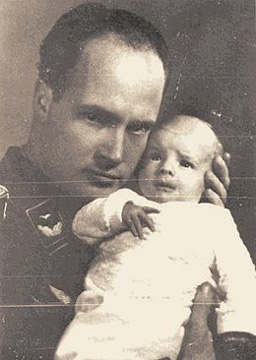 If that’s what happened, it’s no more than Rascher (English Wikipedia page | German) deserved.
.jpg)

 By contrast, April 22 was the lucky day for Wehrmacht General

 From 1927 until his death,
  A veritable watchword for bad times,
