On this date in 1907* an audacious would-be suicide bomber was executed by tsarist Russia.
Thousands of Russians immersed themselves in the late 1900s in revolutionary struggle after the Romanovs bloodily stopped the 1905 revolution. So many of them were executed that the gallows became known as “Stolypin’s Necktie”, after the sitting Prime Minister.
Twenty-one-year-old conservatory pianist and singer Evstolia Ragozinnikova got involved in a plot to assassinate the said Stolypin. (It was only one among several such plots, one of which finally succeeded in 1911.)
But “Tolia” feigned madness and then escaped the psychiatric hospital where she’d been confined. She rejoined her Socialist-Revolutionary conspirators, some of whom tried to get her to flee to Milan to further her musical studies.
Instead of concert houses, Ragozinnikova raised the curtain on her magnum opus on October 28* with a bid to land a Guy Fawkes-like blow against the autocracy.
Communist-turned-anticommunist Whittaker Chambers would, much later, remember in his correspondence with William F. Buckley the power that deeds like Ragozinnikova’s had to inspire, notwithstanding Lenin’s eventually-orthodox disavowal of terrorism. For Chambers, it was not material immiseration but spiritual disinheritance, existential despair — the sort that made artists into suicide bombers — that was the true midwife of Communism.
I may presume in supposing that the name of Ragozinikova is unknown to you. But the facts are these. In 1907, the Russian government instituted a policy of systematically beating its political prisoners. One night, a fashionably dressed young woman called at the Central Prison in Petersburg and asked to speak with the commandant, Maximovsky. This was Ragozinikova, who had come to protest the government’s policy. Inside the bodice of her dress were sewed thirteen pounds of dynamite and a detonator. When Maximovsky appeared, she shot him with her revolver and killed him. The dynamite was for another purpose. After the murder of Maximovsky, Ragozinikova asked the police to interrogate her at the headquarters of the Okhrana. She meant to blow it up together with herself; she had not known any other way to penetrate it. But she was searched and the dynamite discovered. She was sentenced to be hanged.
Awaiting execution., she wrote her family: ‘Death itself is nothing, … Frightful only is the thought of dying without having achieved what I could have done How good it is to love people. How much strength one gains from such love.’
Chambers aside, she’s not so well attested on the English-lanuage Internet; there’s a bit about her in Russian here and here, as well as some references to both Ragozinnikova and her peers in an academic pdf, “Women in the World of Gender Stereotypes: The Case of the Russian Female Terrorists at the Beginning of the 20th Century” by Nadezda Petrusenko in International Journal of Humanities and Social Science, April 2011.
* Gregorian dates. By the local Julian calendar in Russia, she committed her murder on October 15, and was hanged on October 18.
Ivorian politics pitted the more prosperous coastal Christian south against the more rural Muslim inlands, but the 2000 election did not: Alassane Ouattara, the northern/Muslim standard-bearer was eliminated from the election by a conveniently-introduced summer 2000 law disqualifying candidates with a foreign parent. Ouattara was a former Ivorian Prime Minister, but for this election, he wasn’t Ivorian enough to stand.
Political bad blood became political bloodsport with the Oct. 22 election.
On Thursday, Oct. 26, 2000 — which was also the day that election’s winner Laurent Gbagbo was officially sworn in, despite thousands protesting — pro-Gbagbo militias went to town on Ouattara supporters, Muslims, immigrants.
In pro-Gbagbo sections of Abidjan like the suburbs of Abobo and Yopougon, ethnic Dyula or Dioula were rounded up en masse, mosques attacked by mobs, and people menaced, beaten, or worse.
In the late afternoon of October 27, the bullet-ridden bodies of fifty-seven young men were found dumped in two piles in a forest clearing on the outskirts of Yopougon. After speaking with two survivors of and several witnesses to events surrounding the massacre, Human Rights Watch researchers established that paramilitary gendarmes based at the Gendarme Camp of Abobo were directly responsible for the killings. This incident was the single worst atrocity of the election period.
The massacre took place on October 26, 2000 in two stages. The first involved the shooting of detainees at the Gendarme Camp of Abobo, where young men rounded up from Abobo neighborhood were taken during the morning and early afternoon of October 26, 2000. Prior to the shooting detainees were subject to … brutality and torture … At approximately 3:00 p.m…. at least two gendarmes opened fire on the detainees held there, killing some thirty to forty.
The second stage showed the signs of being a well-planned operation. Well-armed gendarmes deployed intoa neighborhood bordering the Gendarme Camp of Abobo and rounded up between eight and thirteen young men who were used as porters to load the dead onto a truck and later dispose of the bodies in the forest. The porters and all other survivors were then gunned down, though some were not killed. These survivors described the presence of one truck, two jeeps, and the involvement of some thirty gendarmes in this operation.
Two men (they’re both directly quoted in the Human Rights Watch report) survived the second stage of the massacre by playing dead.
This unpunished incident — eight gendarmes were tried, but all acquitted — has blended into the rich tapestry of grievances stoking Ivory Coast tensions down to the present day.
Laurent Gbagbo … under arrest. (Not for this massacre.)
When outright civil war erupted in 2002, anti-Gbagbo rebels reportedly yelled “This is for Yopougon!” when gunning down policemen.
In 2010 Ouattara beat Gbagbo in yet another presidential election. That led to a fresh round of nastycivil war.
That war’s upshot was to seat Ouattara — he’s President of the Ivory Coast as of this writing — and to extradite Gbagbo for war crimes proceedings at the Hague. But in the course of that more recent bloodletting, Yopougon once again became a massacre site, and its football pitch “an open-air cemetery”.
On this date in 1865, Baptist deacon Paul Bogle was hanged at the Morant Bay courthouse for his part in that locale’s eponymous rebellion.
Third World’s “1865 (96 degrees in the shade)” celebrates Paul Bogle: “Today I stand here a victim the truth is I’ll never die”
Bogle helped lead of the protests-cum-riots that became that rebellion.
Baptists played an essential role in the affair, which has led some to call it the “Native Baptist War”. And indeed, Baptism had long intertwined with underclass resistance: Jamaica’s most famous slave rebel, Samuel Sharpe, was also a Baptist deacon. A previous royal governor in Jamaica had once warned that “the worst evil which hangs with a menacing aspect over the destinies of this island is the influence exercised with baneful effect by the majority of Baptist missionaries.”
From the standpoint of the powerful in Jamaica and Britain, 1865 would vindicate that warning.
A (white) Baptist missionary named Edward Underhill had penned a January 1865 letter bemoaning the miserable condition of most Jamaicans and starkly disputing received wisdom that blacks were just too lazy to work: “The simple fact is, there is not sufficient employment for the people; there is neither work for them, nor the capital to employ them.” (Underhill later wrote a book on the events, The tragedy of Morant Bay, a narrative of the distrubances in the Island of Jamaica in 1865.)
Underhill’s letter got into public circulation and as a result there were a number of “Underhill meetings” perhaps comprising an “Underhill movement” on the island in 1865 — essentially a going social campaign that rooted deeply in Jamaica’s native Baptist communities. Though “native Baptists” is a vague term, it distinguishes not only black from white but, in the words of Mary Turner, a whole “proliferation of sects in which the slaves developed religious forms, more or less Christian in content that reflected their needs more closely than the orthodox churches, black or white.”
William Gordon had switched his religious allegiance to native Baptist and was known to speak at Underhill meetings: that’s part of what got him hanged.
Likewise, our day’s focus, Paul Bogle, was a native Baptist minister, in the St. Thomas-in-the-East parish — and it was the protest of Bogle and his supporters against an unjust prosecution that started the whole rebellion off.
Statue of a militant Paul Bogle (that’s a sword in his hands) outside the Morant Bay courthouse where all the trouble started. (cc) image from dubdem sound systems.
There was, accordingly, an immediate reward out on Bogle’s head, and an immediate demonization in the respectable English press. There, he was “the notorious Paul Bogle,” in the words of one letter to the editor (London Times, Nov. 18 1865), in whose Baptist chapel rebellious “panthers” wantonly “drank rum mixed with gunpowder and the brains of their victims.”
By the time that letter had been dispatched, Bogle’s purported orgies had long since been interrupted: captured by Maroons, he was delivered to custody, instantly tried, an hanged that very day in a batch of 18 rebels.
A horror to Victorian planters, Bogle has won the reverence of posterity as a freedom fighter and national hero.
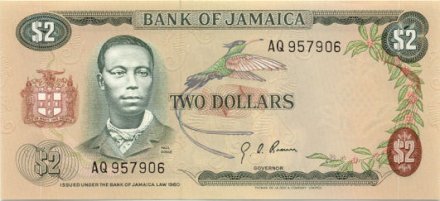
Paul Bogle on the (now out-of-circulation) Jamaican two-dollar bill.
“No incident of the dreadful story” of Morant Bay, wrote Edward Underhill, “produced a more painful impression than the arrest, trial, and execution of Mr. G.W. Gordon” this date in 1865.
The son of a white planter and a mulatto slave, George William Gordon was an able businessman and became a Jamaican assemblyman.
In that capacity, he was a vocal critic of British colonial maladministration, an advocate for blacks, and a political foe of Jamaica’s governor, Edward John Eyre. He’d already had government commissions canceled because of his politics.
Gordon had nothing to do with the Morant Bay outbreak. He was away from the disturbance altogether, in Kingston, when it broke out.
But he was regarded by many white elites as a class enemy, and Eyre did not intend to miss this opportunity to eliminate him. A few years later, a French tribunal would express the rationale as it cracked down on the Paris Commune: guilty or no, “a prudent and wise Government must rid itself [of troublemakers] when it finds a legitimate occasion to do so.”
Accordingly, Gordon was arrested by civil authorities in Kingston — he actually turned himself in when he heard there was a warrant out on him — and then transferred into the hands of the drumhead military tribunals that were operating in the conflict zone, obviously with the intent of terminating a gadfly.
[Kingston authorities] were not the ministers or apparitors of the martial authority, and did not possess the power to take up Mr. Gordon for the purpose of handing him over to the martial law. Nevertheless, they did it. They did it by the exercise of the strong hand of power, because it was thought that a conviction could not be got at Kingston. It was altogether unlawful and unjustifiable. To Mr. Gordon it made the difference of life or death.
Gordon, in his last letter to his wife, took it all in an understandably contemptuous stride:
General Nelson has just been kind enough to inform me that the court-martial on Saturday last has ordered me to be hung, and that the sentence is to be expected in a hour hence, so that I shall be gone from this world of sin and sorrow.
I regret that my worldly affairs are so derranged: but it cannot be helped … I never advised or took part in any insurrection. All I ever did was to recommend the people who complained to seek redress in a legitimate way … It is however the will of my heavenly Father that I should thus suffer in obeying His command, to relieve the poor and needy, and to protect, as far as I was able, the oppressed …
do not be ashamed of the death your poor husband will have suffered. The judges seemed against me; and from the rigid manner of the Court, I could not get in all the explanations I intended. … It seemed that I was to be sacrificed.
Much of what Governor Eyre did in those desperate days skirted, at best, the edges of what might be legally colorable. But at least those instances, in the main, were directed at people alleged to have been actual rebels or rioters. Eyre could safely expect wide latitude where the security of the realm was at stake.
In Gordon, however, there was a man whose crime was nothing other than to have sympathized with the real and crushing plight of the lower orders and advanced their cause politically. Eyre’s magistrates made that fact alone into sedition, and twisted the rules of their own courts-martial to pin it on Gordon.
Given the exceptionally lawless nature of this scenario — and Gordon’s own visibility as a colonial elite — his became the lightning-rod case for English liberals incensed at Eyre’s behavior. John Stuart Mill, Charles Darwin, Herbert Spencer, and others demanded Eyre’s prosecution for the affair, Thomas Huxley writing for the faction,
the killing of Mr. Gordon can only be defended on the ground that he was a bad and troublesome man; in short, that although he might not be guilty, it served him right.
I entertain so deeply-rooted an objection to this method of killing people — the act itself appears to me to be so frightful a precedent, that I desire to see it stigmatised by the highest authority as a crime.
It can hardly surprise the reader, versed as we are by this late date in official impunity, that not Eyre nor any lieutenant was ever thus stigmatised.
While Eyre evaded due punishment, Gordon could not escape the plaudits of posterity. He’s been honored as a Jamaican National Hero, and the very building where the present-day parliament sits is called the Gordon House in his honor.
Another victim was William Grant, saddler, of Morant Bay. The following record of the proceedings in his case is probably unique in the history of judicial or quasi-judicial investigations :—
William Grant, charged with being one of the ringleaders and originators of this rebellion.
The Provost sworn states :—
About four or five days ago I was informed that this man was the originator and founder of the party who raised the rebellion, that he was not likely to be seen himself, but makes the others. He keeps a saddler’s shop, where the secret meetings took place. On the road from St. Thomas-in-the-East to the Guinness (Ginnep) tree, where placards had been posted, calling secret meetings, I searched the house of Chisholm, also a confederate, and in the presence of Mr. Jones, E.A., I took a blue card, as an admission ticket to a Society of Friends, printed William Grant, Founder. That card I sent to the Governor.
The prisoner Duncan Stuart, in his defence, when called upon by Captain Astwood, voluntarily made this statement. He had previously made it in the presence of Mr. Miller, J.P., whose signatures I here produce. “Grant called Bogle at Dr Alveranga’s, and said, ‘Don’t pull this down, wait a little, don’t join with the Volunteers, when you see what they do, run in.’ Grant said, ‘Now is the time to vindicate.’ ”
Mr. Miller, Justice of Peace, for St. Thomas-in-the-East, sworn:—
That statement was voluntarily given and sworn to before me.
Geo. F. Judah, Sergeant-Major of Volunteers:—
I gave the prisoner my rifle to repair on the morning of the riot, and he has kept it, and I have never seen it since.
The prisoner in his defence merely states that he never knew anything about the riot before it actually broke out. He has acknowledged to having corresponded with Mr. Gordon, but that, he states, was quite private, about some land.
This man was evidently a ringleader, a persuader, and adviser, and did his utmost to keep in the background and push the ignorant on to rebel.
Found Guilty, October 20th, 1865. Sentence, Death.
H. Brand, President,
Lieutenant E.N.
Approved and confirmed,
A. A. Nelson,
Brig. Genl. Commanding Field Force.
[The proceedings of the Courts-martial were retained by the Commissioners, and they refused to exhibit them to the Counsel for the parties complaining of the measures of suppression. General Nelson and others were therefore not cross-examined in reference to these trials.]
The first witness, Ramsay, the Provost-Marshal, told the Court only of what he had been informed — the great crime of the prisoner apparently being that he was the founder of a Society of Friends, and had actually a blue card of membership in his house.
The witness, Duncan Stewart, was not called. He had already been tried and was under sentence of death, and was duly hanged the same evening along with Grant. (See List). A so-called statement of this man was produced in writing. It will be noticed he spoke only of “Grant” having used certain words. Three Grants were hung at Morant Bay, and a William Grant was convicted by a Special Commission at Kingston, while the Royal Commissioners were sitting, and sentenced to penal servitude for life. It is clear from the evidence then given that the William Grant alluded to by Duncan Stewart was the one who was then sentenced. John Dickenson, on being examined by the living William Grant at that trial said:— “There was a William Grant, a saddler, who is hung. You are left. You are the man.” (No. 355 of Papers laid before the Royal Commissioners by Mr. Eyre).
Ramsay had evidently a strong interest in the conviction of this prisoner. He sent the following letter to Captain Luke, on 16th October, 1865:— “I also personally apprehended William Grant, the founder of the Society of Friends. I hope I may not be thought seeking for pecuniary benefit alone in claiming the rewards for information against G. W. Gordon at large, seizure of Chisholm, Grant, and Miles.”
Brand, the President of the Court-Martial, seems to have felt the evidence was weak, and he supplemented it by the following statement of his own. “This man was evidently a ringleader, a persuader, and adviser, and did his utmost to keep in the back ground and push the ignorant on to rebel.” The Judge having thus convinced himself, by his own conclusive testimony, adds “Found guilty. Sentence, death,” and, as a matter of course, the experienced officer of Her Majesty’s Service, who was the revising officer, adds:—”Approved and confirmed. A. A. Nelson, Brig.-Genl., Commanding Field Force, Morant Bay, 20th October, 1865.”
It is unnecessary to add that in the list of the executed is to be found the name “William Grant, under date of the 20th October. Charge, ringleader of rebellion!”
On this date in 1561, the Persian Shah abandoned Ottoman prince Sehzade Beyazit to the vengeance of his “magnificent” father.
A late and sad casualty of Istanbul’s pivotal family tragedy, Beyazit was actually a son of Suleiman the Magnificent‘s favorite wife, the freed Ukrainian slave Hurrem Sultan or Roxelana.
Unfortunately, he wasn’t the first son.
After Roxelana engineered the execution of heir apparent Mustafa on spurious grounds, Beyazit and his brother Selim were the last princes standing.
The natural rivalry between the two for eventual power was surely colored by the clear portent Mustafa’s execution had sent that the succession game was rigged for Selim. After several years of growing estrangement, Beyazit finally revolted outright only to be defeated in battle by Selim in 1559.
The loser found refuge in Persia, but only long enough for the Safavids to negotiate the price of his surrender to the hands of Suleiman … whose executioner went on the road to the Persian city of Qazvin to strangle not only Sehzade Beyazit but his four sons, too.
Extirpating the treasonable branch of the family tree cleared the succession for Selim, whose eight-year turn in power would be remembered as moment the hitherto-all-vanquishing Ottomans began their long, slow slide to Sick Man of Europe status. Particularly given that coda, Suleiman’s own
When the Austrian ambassador took leave of Suleyman in his old age, it was scarcely a living being he described, but a sort of metaphor of empire, rotting and majestic, fat, made up, and suffering from an ulcerous leg.
There’s more about this misfortunate lesser son in Turkish here, and a Turkish poem he wrote beseeching his father’s forgiveness here.
On this date in 1944, Pietro Caruso was shot to death by a firing squad for his reign as the head of police in fascist Rome.
Renowned for his sadism towards the enemies of Mussolini, Caruso was most infamous for his role rounding up Italians* for a Nazi mass-execution just months before — the Ardeatine Massacre.
Subject of the first war crimes trial in Allied-occupied Italy, Caruso almost wasn’t around long enough to make this blog: an angry mob invaded the courtroom where he was tried just days earlier, attempting to lynch him.
Authorities managed to safeguard the war criminal, but the mob sated its bloodlust by grabbing another fascist who had turned state’s evidence and was all set to testify against Caruso until he was hauled out and drowned in the Tiber.
Apparently they didn’t need his evidence anyway.
The war, of course, was not yet over … and in northern Italy’s ongoing fascist enterprise, the blackshirts conducted retaliatory executions to retaliate for executing Caruso for retaliatory executions.
* Caruso’s defense: the Nazis had demanded 80 prisoners of him for this reprisal execution. Caruso moderated it to 50. David Broder would have approved.
On this date in 1783, six men were hanged at Tyburn for “returning before expiry” from convict transportation.
This was a neat little euphemism covering a very desperate act at the sundering of the American colonies from their mother country.
We’ve previously covered in these pages the underappreciated extent of convict transportation from the British Isles in populating the future United States. Anthony Vaver, who blogs at Early American Crime, in his recent book Bound With An Iron Chain pegs convicts as the second-largest bloc of American “immigrants,” (after African slaves) to the tune of 50,000 souls in the 18th century.
The American Revolution put a halt to that human traffic.
In time, London would transition to dumping its criminal cargo on Australia.
But at the moment the colonies broke free, the Down Under wasn’t yet fulfilling that role, and policymakers faced a conundrum. The judicial machinery continued to sentence thieves to transportation; without an outlet, those unfortunates accumulated cheek to jowl aboard stinking prison hulks on the Thames.
What to do? In 1785, a Parliamentary committee looked back wistfully on the good old days:
That the old system of transporting to America answered every good purpose that could be expected from it; that it tended directly to reclaim the objects on which it was inflicted, and to render them good citizens; that the climate being temperate, and the means of gaining a livelihood easy, it was safe to entrust country magistrates with the discretionary power of inflicting it … that it tended to break, in their infancy, those gangs and combinations which have since proved so injurious to the community; that it was not attended with much expense to the public …
Well, it so happened that this effective and affordable solution, though interrupted by war, was not legally barred in the new United States.
So Britain did what any cost-conscious imperial power would do: sent out a ship with some convicts to see if they couldn’t still be gifted to labor-hungry America. “Perhaps a greater insult to any Nation could hardly have been offered,” griped one Founding Father afterwards.
The gallows held little terror for some prisoners sentenced to convict transportation, who might even have preferred execution. London’s Public Advertiser reported this never-implemented threat on March 24, 1785:
We hear that one of the respited capital convicts, who received sentence of transportation at the adjourned session at the Old Bailey, told the Recorder, in his own name and those of his companions, that they did not esteem the being pardoned, on condition of transportation to Africa, as an act of mercy, but had much rather be hanged at home; and that they were determined to endeavour to sink either the lighter which is to convey them to Gravesend (to which place they are to be guarded by 30 of the militia) or the ship which is to carry them over.
Alright, America. You don’t have to be that way about it.
The ship detailed for this insulting mission was the Swift, and its passage was troubled long before it sighted the Chesapeake. The “cargo” of the Swift mutinied and ran the ship aground in England.
Thirty-nine escapees were recaptured and most sentenced once again to transportation, but six swung at Tyburn on this date. They really were at the end of an era, and not only of North American convict transportation: Tyburn itself hosted its last public execution just a few weeks later.
Nothing daunted, the owners of the Swift reassembled a slate of captives and made another run, reaching Annapolis, Md. on Christmas eve: fortuitous timing, because irritated state legislators weren’t in session and therefore couldn’t block the ship’s unwanted merchandising. The problem was, it was little better wanted by its intended market. According to Vaver, “[o]nly 30 of those on board were sold by mid-January … [the shippers] managed to sell most of the convicts by the spring, but they incurred serious losses after having to provide food, clothing, and medicine for those who languished on board the ship until they could be unloaded.”
They were the last British convicts sold in her rebellious colonies. One last ship made another voyage in 1784 and was turned away flat by every U.S. port, finally managing to offload in British Honduras.
Ere the decade was out, London had established a new penal colony at Botany Bay and set about transferring this particular “special relationship” from the United States to Australia.
At the evening roll-call of the prisoners, Max Bialas instructed those who had arrived that same day to line up on the side. It was not clear who was to be liquidated — the new arrivals or those who had arrived earlier. At that moment Berliner jumped out from the ranks of the prisoners, lurched toward Bialas and stabbed him with a knife. A great commotion followed. The Ukranian guards opened fire. Berliner was killed on the spot. and in the course of the shooting more than ten other prisoners were killed and others were wounded. When the tumult subsided the prisoners were lined up again for roll-call. Christian Wirth, who was in Treblinka at the time, arrived on the scene accompanied by Kurt Franz, the second in command of the camp. Ten men were removed from the ranks and shot on the spot in full view of all the others. On the following day, during the morning roll-call, another 150 men were taken out, brought to the Lazarett [the so-called “hospital” which was in fact an execution site] and shot there.
Little is known about Berliner.
According to the testimony of fellow-inmate Abraham Krzepicki, he was a middle-aged Jewish citizen of Argentina who had lived in that country for many years.
He and his wife and young daughter traveled to Poland on vacation in the summer of 1939. They could have picked a better time: when Germany invaded on September 1, 1939, the Berliners were unable to return home. Their Argentine passports should have protected them, but they ended up in the Warsaw Ghetto and were transported to Treblinka. Berliner’s wife and child were gassed immediately, but he was spared to work.
This reprieve would be expected to last days, or a few weeks at the most before he too would go to the gas chamber. Berliner became consumed with rage and the thirst for revenge, supposedly saying, “When the oppressors give me two choices, I always take the third.”
As he must have known he would, Berliner died a horrible death — according to Krzepicki, he was beaten to death with a shovel.
Ironically, following Bialas’s murder, conditions for prisoners at Treblinka actually improved.
This was strictly for pragmatic reasons, as Arad noted: “The Jews selected for temporary work were a danger to the Germans, and the Berliner incident had proved it … When people knew they had nothing to lose, an act of despair like that of Meir Berliner could happen again and again.”
Rather than constantly killing and replacing their workers, the Nazis in charge of the camp decided to create a permanent staff of prisoner-workers and treat them with relative humanity. In this way, they hoped to prevent further acts of suicidal violence on the part of the Jews.
The existence of a permanent cadre of workers made it possible to plan and organize a revolt and mass escape from the camp. In August 1943, after months of conspiring and gathering the necessary weapons, the inmates killed most of the guards and made a run for it. About 300 or so actually made it outside of camp; of those, approximately 60 would survive the war.
On this date* in French-occupied Moscow of the War of 1812, many alleged arsonists — unnamed and unnumbered — were shot by Napoleon’s army in the ashes of Moscow.
Although real, flesh-and-blood Muscovites died, they are best known via their bespectacled fictional companion, Pierre Bezukhov, whose miraculous escape is one of the pivotal episodes of Tolstoy’s War and Peace.
Merely the greatest novel in history by some reckonings — we’ll just let Tolstoy fight it out with Dostoyevsky for top of table in the competitive 19th Century Russia literary scene — the epic War and Peace tracks that country’s transformation under the revolutionary pressures of the Napoleonic age.
In Russian director Sergey Bondarchuk’s sprawling cinematic adaptation of War and Peace, the part of Pierre Bezukhov is played by Bondarchuk himself.
Pierre Bezukhov (“without ears”) is one of the book’s central figures, the illegitimate son of a count who unexpectedly inherits, forever consumed with his next impulsive, passionate quest for meaning (boozing around, freemasonry, religion …).
Pierre finds himself present in Moscow when the Grande Armeerolls in following its Pyrrhic victory at the Battle of Borodino. His fancy of the moment is to assassinate Napoleon: “he suddenly felt that what before had seemed to him merely a possibility had now become absolutely necessary and inevitable. He must remain in Moscow, concealing his name, and must meet Napoleon and kill him, and either perish or put an end to the misery of all Europe.” And to think, a younger Pierre actually used to admire Napoleon.
Historically, the city of Moscow started burning as soon as the French occupied it. The reasons for this conflagration have been widely disputed; Tolstoy detours in War and Peace to characterize it as nothing more than the natural consequence of the occupation, when the city’s civil infrastructure has broken down and the everyday fires that spark in wooden buildings are more liable to grow out of control.
The French blamed terrorists.
A bulletin of the Grande Armee dated September 20 (Gregorian date; this corresponds to the Julian date September 8) reports on the successful efforts to bring arsonists to heel through the expedient of mass executions.
Three hundred incendiaries have been arrested and shot; they were provided with fuse six inches long, which they had between two pieces of wood: they had also squibs, which they threw upon the roofs of the houses. The wretch Rastapchin had these prepared, on the pretence that he wished to send a balloon, full of combustible matter, amidst the French army …
The fires subsided on the 19th and 20th; three quarters of the city are burned; among other palaces that beautiful one of Catherine, which had been newly furnished: not above a quarter of the houses remain. …
Manufactures were beginning to flourish at Moscow: they are destroyed. The conflagration of this capital will throw Russia one hundred years back. The weather is becoming rainy: the greatest part of the army is in barracks in Moscow.
In this paranoid occupation, the fictional Pierre, wandering Moscow armed without a good excuse, gets himself picked up by French troops.
The travail of his resulting drumhead trial offers the anti-authoritarian (and anti-death penalty) Tolstoy the opportunity to reflect on the “legal” arrangements, a passage Tolstoy dates September 8 on the Julian calendar — the same day that army bulletin above was penned.
[Pierre] learned that all these prisoners (he, probably, among them) were to be tried for incendiarism. On the third day he was taken with the others to a house where a French general with a white mustache sat with two colonels and other Frenchmen with scarves on their arms. With the precision and definiteness customary in addressing prisoners, and which is supposed to preclude human frailty, Pierre like the others was questioned as to who he was, where he had been, with what object, and so on.
These questions, like questions put at trials generally, left the essence of the matter aside, shut out the possibility of that essence’s being revealed, and were designed only to form a channel through which the judges wished the answers of the accused to flow so as to lead to the desired result, namely a conviction. As soon as Pierre began to say anything that did not fit in with that aim, the channel was removed and the water could flow to waste. Pierre felt, moreover, what the accused always feel at their trial, perplexity as to why these questions were put to him. He had a feeling that it was only out of condescension or a kind of civility that this device of placing a channel was employed. He knew he was in these men’s power, that only by force had they brought him there, that force alone gave them the right to demand answers to their questions, and that the sole object of that assembly was to inculpate him. And so, as they had the power and wish to inculpate him, this expedient of an inquiry and trial seemed unnecessary. It was evident that any answer would lead to conviction.
It’s only by Pierre’s chance ability to forge a human connection with the officer detailed to condemn him that he’s mysteriously, and arbitrarily, not sentenced to death — a fact that Pierre doesn’t even realize until he’s led out with the rest of the prisoners only to see that it’s “only” the others who are being shot. This is the narration at length from Book XII, Chapters 10-11.
On the eighth of September an officer- a very important one judging by the respect the guards showed him- entered the coach house where the prisoners were. This officer, probably someone on the staff, was holding a paper in his hand, and called over all the Russians there, naming Pierre as “the man who does not give his name.” Glancing indolently and indifferently at all the prisoners, he ordered the officer in charge to have them decently dressed and tidied up before taking them to the marshal. An hour later a squad of soldiers arrived and Pierre with thirteen others was led to the Virgin’s Field. It was a fine day, sunny after rain, and the air was unusually pure. The smoke did not hang low as on the day when Pierre had been taken from the guardhouse on the Zubovski rampart, but rose through the pure air in columns. No flames were seen, but columns of smoke rose on all sides, and all Moscow as far as Pierre could see was one vast charred ruin. On all sides there were waste spaces with only stoves and chimney stacks still standing, and here and there the blackened walls of some brick houses. Pierre gazed at the ruins and did not recognize districts he had known well. Here and there he could see churches that had not been burned. The Kremlin, which was not destroyed, gleamed white in the distance with its towers and the belfry of Ivan the Great. The domes of the New Convent of the Virgin glittered brightly and its bells were ringing particularly clearly. These bells reminded Pierre that it was Sunday and the feast of the Nativity of the Virgin. But there seemed to be no one to celebrate this holiday: everywhere were blackened ruins, and the few Russians to be seen were tattered and frightened people who tried to hide when they saw the French.
…
Pierre had been taken by one set of soldiers and led first to one and then to another place with dozens of other men, and it seemed that they might have forgotten him, or confused him with the others. But no: the answers he had given when questioned had come back to him in his designation as “the man who does not give his name,” and under that appellation, which to Pierre seemed terrible, they were now leading him somewhere with unhesitating assurance on their faces that he and all the other prisoners were exactly the ones they wanted and that they were being taken to the proper place. Pierre felt himself to be an insignificant chip fallen among the wheels of a machine whose action he did not understand but which was working well.
He and the other prisoners were taken to the right side of the Virgin’s Field, to a large white house with an immense garden not far from the convent. This was Prince Shcherbatov‘s house, where Pierre had often been in other days, and which, as he learned from the talk of the soldiers, was now occupied by the marshal, the Duke of Eckmuhl (Davout).
They were taken to the entrance and led into the house one by one. Pierre was the sixth to enter. He was conducted through a glass gallery, an anteroom, and a hall, which were familiar to him, into a long low study at the door of which stood an adjutant.
Davout, spectacles on nose, sat bent over a table at the further end of the room. Pierre went close up to him, but Davout, evidently consulting a paper that lay before him, did not look up. Without raising his eyes, he said in a low voice:
“Who are you?”
Pierre was silent because he was incapable of uttering a word. To him Davout was not merely a French general, but a man notorious for his cruelty. Looking at his cold face, as he sat like a stern schoolmaster who was prepared to wait awhile for an answer, Pierre felt that every instant of delay might cost him his life; but he did not know what to say. He did not venture to repeat what he had said at his first examination, yet to disclose his rank and position was dangerous and embarrassing. So he was silent. But before he had decided what to do, Davout raised his head, pushed his spectacles back on his forehead, screwed up his eyes, and looked intently at him.
“I know that man,” he said in a cold, measured tone, evidently calculated to frighten Pierre.
The chill that had been running down Pierre’s back now seized his head as in a vise.
“You cannot know me, General, I have never seen you…”
“He is a Russian spy,” Davout interrupted, addressing another general who was present, but whom Pierre had not noticed.
Davout turned away. With an unexpected reverberation in his voice Pierre rapidly began:
“No, monseigneur,” he said, suddenly remembering that Davout was a duke. “No, monseigneur, you cannot have known me. I am a militia officer and have not quitted Moscow.”
“Your name?” asked Davout.
“Bezukhov.”
“What proof have I that you are not lying?”
“Monseigneur!” exclaimed Pierre, not in an offended but in a pleading voice.
Davout looked up and gazed intently at him. For some seconds they looked at one another, and that look saved Pierre. Apart from conditions of war and law, that look established human relations between the two men. At that moment an immense number of things passed dimly through both their minds, and they realized that they were both children of humanity and were brothers.
At the first glance, when Davout had only raised his head from the papers where human affairs and lives were indicated by numbers, Pierre was merely a circumstance, and Davout could have shot him without burdening his conscience with an evil deed, but now he saw in him a human being. He reflected for a moment.
“How can you show me that you are telling the truth?” said Davout coldly.
Pierre remembered Ramballe, and named him and his regiment and the street where the house was.
“You are not what you say,” returned Davout.
In a trembling, faltering voice Pierre began adducing proofs of the truth of his statements.
But at that moment an adjutant entered and reported something to Davout.
Davout brightened up at the news the adjutant brought, and began buttoning up his uniform. It seemed that he had quite forgotten Pierre.
When the adjutant reminded him of the prisoner, he jerked his head in Pierre’s direction with a frown and ordered him to be led away. But where they were to take him Pierre did not know: back to the coach house or to the place of execution his companions had pointed out to him as they crossed the Virgin’s Field.
He turned his head and saw that the adjutant was putting another question to Davout.
“Yes, of course!” replied Davout, but what this “yes” meant, Pierre did not know.
Pierre could not afterwards remember how he went, whether it was far, or in which direction. His faculties were quite numbed, he was stupefied, and noticing nothing around him went on moving his legs as the others did till they all stopped and he stopped too. The only thought in his mind at that time was: who was it that had really sentenced him to death? Not the men on the commission that had first examined him — not one of them wished to or, evidently, could have done it. It was not Davout, who had looked at him in so human a way. In another moment Davout would have realized that he was doing wrong, but just then the adjutant had come in and interrupted him. The adjutant, also, had evidently had no evil intent though he might have refrained from coming in. Then who was executing him, killing him, depriving him of life — him, Pierre, with all his memories, aspirations, hopes, and thoughts? Who was doing this? And Pierre felt that it was no one.
It was a system — a concurrence of circumstances.
A system of some sort was killing him — Pierre — depriving him of life, of everything, annihilating him.
From Prince Shcherbatov’s house the prisoners were led straight down the Virgin’s Field, to the left of the nunnery, as far as a kitchen garden in which a post had been set up. Beyond that post a fresh pit had been dug in the ground, and near the post and the pit a large crowd stood in a semicircle. The crowd consisted of a few Russians and many of Napoleon’s soldiers who were not on duty- Germans, Italians, and Frenchmen, in a variety of uniforms. To the right and left of the post stood rows of French troops in blue uniforms with red epaulets and high boots and shakos.
The prisoners were placed in a certain order, according to the list (Pierre was sixth), and were led to the post. Several drums suddenly began to beat on both sides of them, and at that sound Pierre felt as if part of his soul had been torn away. He lost the power of thinking or understanding. He could only hear and see. And he had only one wish- that the frightful thing that had to happen should happen quickly. Pierre looked round at his fellow prisoners and scrutinized them.
The two first were convicts with shaven heads. One was tall and thin, the other dark, shaggy, and sinewy, with a flat nose. The third was a domestic serf, about forty-five years old, with grizzled hair and a plump, well-nourished body. The fourth was a peasant, a very handsome man with a broad, light-brown beard and black eyes. The fifth was a factory hand, a thin, sallow-faced lad of eighteen in a loose coat.
Pierre heard the French consulting whether to shoot them separately or two at a time. “In couples,” replied the officer in command in a calm voice. There was a stir in the ranks of the soldiers and it was evident that they were all hurrying — not as men hurry to do something they understand, but as people hurry to finish a necessary but unpleasant and incomprehensible task.
A French official wearing a scarf came up to the right of the row of prisoners and read out the sentence in Russian and in French.
Then two pairs of Frenchmen approached the criminals and at the officer’s command took the two convicts who stood first in the row. The convicts stopped when they reached the post and, while sacks were being brought, looked dumbly around as a wounded beast looks at an approaching huntsman. One crossed himself continually, the other scratched his back and made a movement of the lips resembling a smile. With hurried hands the soldiers blindfolded them, drawing the sacks over their heads, and bound them to the post.
Twelve sharpshooters with muskets stepped out of the ranks with a firm regular tread and halted eight paces from the post. Pierre turned away to avoid seeing what was going to happen. Suddenly a crackling, rolling noise was heard which seemed to him louder than the most terrific thunder, and he looked round. There was some smoke, and the Frenchmen were doing something near the pit, with pale faces and trembling hands. Two more prisoners were led up. In the same way and with similar looks, these two glanced vainly at the onlookers with only a silent appeal for protection in their eyes, evidently unable to understand or believe what was going to happen to them. They could not believe it because they alone knew what their life meant to them, and so they neither understood nor believed that it could be taken from them.
Again Pierre did not wish to look and again turned away; but again the sound as of a frightful explosion struck his ear, and at the same moment he saw smoke, blood, and the pale, scared faces of the Frenchmen who were again doing something by the post, their trembling hands impeding one another. Pierre, breathing heavily, looked around as if asking what it meant. The same question was expressed in all the looks that met his.
On the faces of all the Russians and of the French soldiers and officers without exception, he read the same dismay, horror, and conflict that were in his own heart. “But who, after all, is doing this? They are all suffering as I am. Who then is it? Who?” flashed for an instant through his mind.
“Sharpshooters of the 86th, forward!” shouted someone. The fifth prisoner, the one next to Pierre, was led away- alone. Pierre did not understand that he was saved, that he and the rest had been brought there only to witness the execution. With ever-growing horror, and no sense of joy or relief, he gazed at what was taking place. The fifth man was the factory lad in the loose cloak. The moment they laid hands on him he sprang aside in terror and clutched at Pierre. (Pierre shuddered and shook himself free.) The lad was unable to walk. They dragged him along, holding him up under the arms, and he screamed. When they got him to the post he grew quiet, as if he suddenly understood something. Whether he understood that screaming was useless or whether he thought it incredible that men should kill him, at any rate he took his stand at the post, waiting to be blindfolded like the others, and like a wounded animal looked around him with glittering eyes.
Pierre was no longer able to turn away and close his eyes. His curiosity and agitation, like that of the whole crowd, reached the highest pitch at this fifth murder. Like the others this fifth man seemed calm; he wrapped his loose cloak closer and rubbed one bare foot with the other.
When they began to blindfold him he himself adjusted the knot which hurt the back of his head; then when they propped him against the bloodstained post, he leaned back and, not being comfortable in that position, straightened himself, adjusted his feet, and leaned back again more comfortably. Pierre did not take his eyes from him and did not miss his slightest movement.
Probably a word of command was given and was followed by the reports of eight muskets; but try as he would Pierre could not afterwards remember having heard the slightest sound of the shots. He only saw how the workman suddenly sank down on the cords that held him, how blood showed itself in two places, how the ropes slackened under the weight of the hanging body, and how the workman sat down, his head hanging unnaturally and one leg bent under him. Pierre ran up to the post. No one hindered him. Pale, frightened people were doing something around the workman. The lower jaw of an old Frenchman with a thick mustache trembled as he untied the ropes. The body collapsed. The soldiers dragged it awkwardly from the post and began pushing it into the pit.
They all plainly and certainly knew that they were criminals who must hide the traces of their guilt as quickly as possible.
Pierre glanced into the pit and saw that the factory lad was lying with his knees close up to his head and one shoulder higher than the other. That shoulder rose and fell rhythmically and convulsively, but spadefuls of earth were already being thrown over the whole body. One of the soldiers, evidently suffering, shouted gruffly and angrily at Pierre to go back. But Pierre did not understand him and remained near the post, and no one drove him away.
When the pit had been filled up a command was given. Pierre was taken back to his place, and the rows of troops on both sides of the post made a half turn and went past it at a measured pace. The twenty-four sharpshooters with discharged muskets, standing in the center of the circle, ran back to their places as the companies passed by.
Pierre gazed now with dazed eyes at these sharpshooters who ran in couples out of the circle. All but one rejoined their companies. This one, a young soldier, his face deadly pale, his shako pushed back, and his musket resting on the ground, still stood near the pit at the spot from which he had fired. He swayed like a drunken man, taking some steps forward and back to save himself from falling. An old, noncommissioned officer ran out of the ranks and taking him by the elbow dragged him to his company. The crowd of Russians and Frenchmen began to disperse. They all went away silently and with drooping heads.
“That will teach them to start fires,” said one of the Frenchmen.
Pierre glanced round at the speaker and saw that it was a soldier who was trying to find some relief after what had been done, but was not able to do so. Without finishing what he had begun to say he made a hopeless movement with his arm and went away.
* It’s our practice (although we’re sure it’s been violated here and there) to utilize Gregorian dates universally after the mid-18th century, even for executions in Orthodox Christendom where the Julian calendar prevailed into the 20th century. For this post, seeing as it’s straight from the text of Tolstoy himself, in his magnum opus, channeling the soul of the Russian rodina, we’re making an exception: the 12-day-slower, local-to-Russia Julian calendar prevails … just like the Russians themselves did.

 Thousands of Russians immersed themselves in the late 1900s in revolutionary struggle after the Romanovs bloodily stopped the 1905 revolution. So many of them were executed that the gallows became known as “Stolypin’s Necktie”, after the sitting Prime Minister.
 In the late afternoon of October 27, the bullet-ridden bodies of fifty-seven young men were found dumped in two piles in a forest clearing on the outskirts of Yopougon. After speaking with two survivors of and several witnesses to events surrounding the massacre, Human Rights Watch researchers established that paramilitary gendarmes based at the Gendarme Camp of Abobo were directly responsible for the killings. This incident was the single worst atrocity of the election period.

 The son of a white planter and a mulatto slave,


