2001: Timothy McVeigh, Oklahoma City bomber

At 7:14 a.m. on this date in 2001, Oklahoma City bomber Timothy McVeigh was executed at the federal penitentiary in Terre Haute, Ind.

More ink has been spilled about the 33-year-old Gulf War veteran and his infamous crime than this space can possibly hope to summarize. Books can be — and have been — written debating whence McVeigh sprang and whether he was rightly convicted.

McVeigh tended to keep coy about his version of his activities on April 19, 1995,* but he was never less than frank about his philosophy.

Though his avowed motive, the Waco slaughter that occurred two years to the day before Oklahoma City, has never exactly been secret, the way he’s connected those events has also never been particularly welcome. And McVeigh would say that the fact that he suffered execution while the only parties punished in the Waco siege were the survivors makes his point.

For all its moral monstrosity, the Gulf War veteran’s critique of his violent actions vis-a-vis those the state claims legitimacy for makes discomfiting reading, and is not always so easy to answer. From our distance of time, knowing that three months after McVeigh’s execution another terrorist act to beggar Oklahoma City would propel the United States back into Iraq, it strikes eerily prescient notes.

In a 1998 essay, McVeigh savaged the government for its hypocritical posture towards the country he had once fought, Iraq:

The administration has said that Iraq has no right to stockpile chemical or biological weapons (“weapons of mass destruction”) — mainly because they have used them in the past.

Well, if that’s the standard by which these matters are decided, then the U.S. is the nation that set the precedent. The U.S. has stockpiled these same weapons (and more) for over 40 years. The U.S. claims that this was done for deterrent purposes during the “Cold War” with the Soviet Union. Why, then is it invalid for Iraq to claim the same reason (deterrence) — with respect to Iraq’s (real) war with, and the continued threat of, its neighbor Iran?

…

If Saddam is such a demon, and people are calling for war crimes charges and trials against him and his nation, why do we not hear the same cry for blood directed at those responsible for even greater amounts of “mass destruction” — like those responsible and involved in dropping bombs on [Dresden, Hanoi, Tripoli, Baghdad, Hiroshima and Nagasaki]?

…

The truth is, the use of a truck, a plane, or a missile for the delivery of a weapon of mass destruction does not alter the nature of the act itself.

These are weapons of mass destruction — and the method of delivery matters little to those on the receiving end of such weapons.

Whether you wish to admit it or not, when you approve, morally, of the bombing of foreign targets by the U.S. military, you are approving of acts morally equivalent to the bombing in Oklahoma City. The only difference is that this nation is not going to see any foreign casualties appear on the cover of Newsweek magazine.

It seems ironic and hypocritical that an act viciously condemned in Oklahoma City is now a “justified” response to a problem in a foreign land.

Another note sent shortly before his execution to author Gore Vidal travestied government warmaking talking points:

[T]his bombing was also meant as a pre-emptive (or pro-active) strike against those forces and their command and control centers within the federal building. When an aggressor force continually launches attacks from a particular base of operations, it is sound military strategy to take the fight to the enemy. Additionally, borrowing a page from U.S. foreign policy, I decided to send a message to a government that was becoming increasingly hostile, by bombing a government building and the government employees within that building who represent that government. Bombing the Murrah Federal Building was morally and strategically equivalent to the U.S. hitting a government building in Serbia, Iraq, or other nations. Based on observations of the policies of my own government, I viewed this action as an acceptable option. From this perspective what occurred in Oklahoma City was no different than what Americans rain on the heads of others all the time, and, subsequently, my mindset was and is one of clinical detachment.

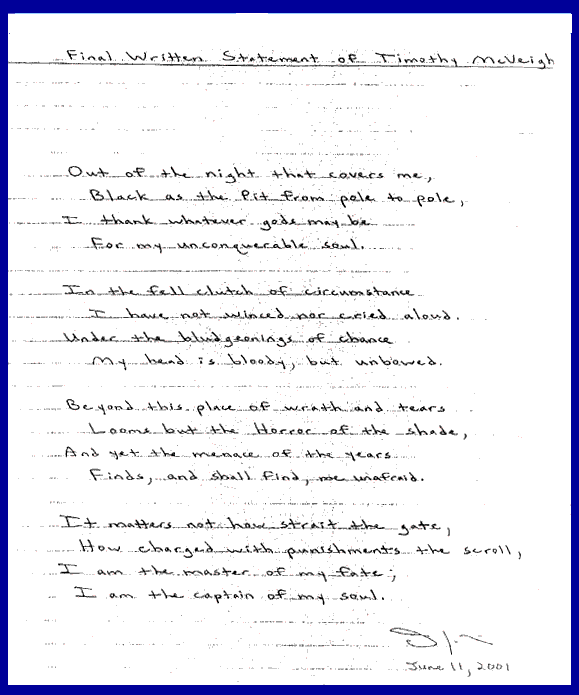
He broadcast clinical detachment in the execution itself — the first conducted by the federal government since 1963, technically imposed for the eight federal employees among his 168 victims — from his waiver of appeals to his unnervingly unblinking death mask to the stoic 19th century poem “Invictus” that formed his written (and only) final statement.

* Also — coincidentally or not — the execution date of Richard Snell in Arkansas, a militia man (and white supremacist, which McVeigh was not) who had once tried to blow up the Murrah building himself.

On this day..

1358: Guillaume Cale, leader of the Jacquerie

On this date in 1358, 14th-century France’s most serious peasant uprising was crushed when its capable commander was lured into his enemies’ power and torturously put to death in Clermont.

The Jacquerie (English Wikipedia entry | French) sprang from the fertile farmlands north of Paris. It had a hundred fathers, no one of them self-evidently the decisive cause but many in debatable combinations and proportions conspiring to render a perfect storm of catastrophe for the despised villeins who sweated out their masters’ chivalrous living.

The Calamitous 14th Century, historian Barbara Tuchman subtitled her popular work on this period: France was buffeted by famine, the Black Death, and attendant social and economic shocks; the Hundred Years’ War opened, laying the countryside waste at the hands of crossing armies, and then marauding mercenaries during the downtime between battles, and then “friendly” forces pillaging for sustenance and pressing peasants into uncompensated labor. In 1356, the English captured France’s King John II at the Battle of Poitiers, opening a yawning gap in the country’s political authority and undermining the mounted nobility’s military prestige vis-a-vis the (smaller) yeoman army that had routed it.

We do not seem to have a certain record of what match was set to this tinderbox — the most suggestive proximate cause is a fresh tax for fortifying noble citadels in the area — but the conflagration singed the gentry’s beard. Froissart, who wrote a few years after the fact and from a distinctly hostile standpoint, captured the aristocracy’s view of rising:

[C]ertain people of the common villages, without any head or ruler, assembled together in Beauvoisin. In the beginning they passed not a hundred in number they said how the noblemen of the realm of France, knights and squires, shamed the realm, and that it should be a great wealth to destroy them all: and each of them said it was true, and said all with one voice: “Shame have he that cloth not his power to destroy all the gentlemen of the realm!”

Thus they gathered together without any other counsel, and without any armour saving with staves and knives, and so went to the house of a knight dwelling thereby, and brake up his house and slew the knight and the lady and all his children great and small and brent his house. … And so they did to divers other castles and good houses; and they multiplied so that they were a six thousand, and ever as they went forward they increased, for such like as they were fell ever to them, so that every gentleman fled from them and took their wives and children with them, and fled ten or twenty leagues off to be in surety, and left their house void and their goods therein. These mischievous people thus assembled without captain or armour robbed, brent and slew all gentlemen that they could lay hands on, and forced and ravished ladies and damosels, and did such shameful deeds that no human creature ought to think on any such, and he that did most mischief was most praised with them and greatest master. I dare not write the horrible deeds that they did to ladies and damosels; among other they slew a knight and after did put him on a broach and roasted him at the fire in the sight of the lady his wife and his children; and after the lady had been enforced and ravished with a ten or twelve, they made her perforce to eat of her husband and after made her to die an evil death and all her children.

Froissart’s Chronicle is the most notable of the age and (calumniously) the most defining one on the event; it helped establish the word “jacquerie” as a synonym for bloodthirsty insurrection that would be pinned to countless riots and risings for centuries to come. Some other chronicles suggest more deliberate and purposeful (and less maniacal) organization by these original Jacques, and the trenchant “charge against these noble traitors, who have shirked on their duties to defend the kingdom, who desire to do nothing but devour the sustenance of the commoners.” (Source)

Interestingly, and seemingly contrary to the obvious reading of a downtrodden underclass driven to desperation, more recent scholarship has pointed out that the rising broke out in the best farmland, seemingly among the wealthiest of the rural third estate — artisans, proprietors, petty bureaucrats and clergy.

Leadership fell to this day’s victim, Guillaume Cale, also known by the folksy sobriquet “Jacques Bonhomme” (Goodman, or Goodfellow). A charismatic man of some fighting experience, he was able to marshal this mob into a creature of passable military capacity.

His short appearance on our stage also suggests a character of strategic vision not the less impressive for its failure to materialize.

Cale was a well-off farmer, like the backbone of his movement, and reached out to make common cause with the nearby Parisian bourgeoisie then in rebellious possession of their own city — a far more consequential challenge to authority that was soon to meet its own violent termination.

The terrorized nobility turned to Charles the Bad, King of Navarre at that time attempting to exploit the captivity of John II to hoist himself onto the throne of France. Even though Charles was also treating with the Parisian bourgeoisie in this endeavor, as Jonathan Sumption puts it in his authoritative The Hundred Years’ War: “The opportunity to present himself as the leader of the united nobility of France was not to be missed.”

Charles handled the rebels with efficiency, if not with honor. Tuchman relates:

[Charles of Navarre] invited Cale to parley, and upon this invitation from a king, Cale’s common sense apparently deserted him. Considering himself an opponent in war to whom the laws of chivalry applied, he went to the parley without a guard, whereupon his royal and noble opponent had him seized and thrown into chains. The capture of their leader by such easy and contemptuous treachery* drained the Jacques’ confidence and hope of success. When the nobles charged, the commoners succumbed … To consummate his victory, Charles of Navarre beheaded Guillaume Cale after reportedly crowning him, in wicked mockery, King of the Jacques with a circlet of red-hot iron.

The potentially tricky Battle of Mello turned into a butchery that shattered the Jacquerie, and relieved nobles gorged themselves for weeks to come on peasant blood — no less horribly than any depredation of the Jacquerie. “Our mortal foes, the English, would not have done what the nobles then did in our homeland,” wrote another 14th century scribe, Jean de Venette. (Cited by Robert Knecht; some additional Venette commentary on the Jacquerie is here, in French.)

If Cale’s decision to risk parley seems madness in retrospect, picture his situation. Sumption says the Jacquerie’s bands were already beginning to dissipate; Cale himself was known and surely in line for execution — practically the preordained denouement of every medieval peasant uprising — if he were to throw in the towel peaceably. He had no way forward but forward, and even supposing that Cale-commanded peasant lines would have held at the battle that particular day, his forces had no military prospects beyond a few more weeks.

The Jacques needed something — an exit strategy, perhaps, with the opportunity to return to life pardoned of reprisal and guaranteed against the next onerous levy; or, a cemented part in the alliance of Navarre and the Parisian bourgeoisie. To get that something, Guillaume Cale had to throw the dice, and what better odds would he get than in a pavilion face to face with the man who might become king of France? Staying in the field at the head of his ill-armed peasant horde must have looked the more improbable gamble.

Cale’s wager failed horribly this day, but from the luxurious vantage of centuries, the movement of people in those days shows the germ of an altogether more revolutionary future. Thierry‘s history of the Third Estate (available free at Google Books):

The destruction of the Jacques was followed almost immediately by the failure of the revolution of the bourgeoisie in Paris itself. Those two movements, different as they were, of the two great classes of the commonalty, terminated simultaneously — one to revive and carry all before it when its time should come; the other to leave nothing behind it but an odious name, and sad recollections.

…

The Tiers Etat, displaced from the dominant position which it had prematurely won, resumed its ordinary part of patient industry, less pretentious ambition, and slow but uninterrupted progress.

Update: Nice tangential follow-up from The Naked Philologist into a fantasy literature recommendation. Also see more about those jittery nobles.

* You’re supposed to think this is okay because chivalric codes written by nobles say nobles don’t have to keep oaths to commoners. Readers still appalled at Charles the Bad’s bad faith: enjoy the Schadenfreude of his bad end.

On this day..

1983: Simon Thelle Mogoerane, Jerry Mosololi and Marcus Motaung, anti-apartheid soldiers

This date at dawn in 1983, three African National Congress cadres were hanged — together with two unrelated common criminals — for attacks on apartheid-era South African police stations.

“Terrorists” in the eyes of the white government and “freedom fighters” in the eyes of many blacks, the “Moroka Three” — Simon Thelle Mogoerane, Jerry Mosololi and Marcus Motaung — bore arms against as part of the ANC’s military wing, Umkhonto we Sizwe (MK).

Their attacks in 1979 and 1981 had claimed the lives of four (black) policemen.

South African law until 1990 mandated hanging for a murder conviction without any extenuating circumstances — a “fact associated with the crime which serves in the mind of reasonable men to diminish morally, albeit not legally, the degree of the prisoner’s guilt.” The courtroom adjunct to MK’s guerrilla operations was establishing its position that its soldiers were prisoners of war under international law, and that that classification constituted an extenuating circumstance under South African law.

1977 protocols had extended the Geneva Conventions governing treatment of prisoners of war to explicitly cover anti-colonial and anti-racist insurgents. South Africa, unsurprisingly, did not ratify this amendment. The judge dismissed the argument that these protocols had acquired the binding force of customary international law — “we do not need to waste time.”

A decade or so later, in the waning years of apartheid, this sort of argument would find a toehold. But not in a defiantly “anti-terrorist” Pretoria of the early eighties.

The three were hanged in the face of worldwide appeals for clemency — such as this one from U.S. Congressmen and -women, and the pamphlet below by the British Anti-Apartheid Movement:

The entirety of this 24-page pamphlet is available free (at least for the remainder of this month) at the Aluka collection of digital Africa-related documents.

The executions likewise met outcry both domestic (South Africa banned public demonstrations) and international (like this U.N. resolution).

On this day..

1718: John “Jack Ketch” Price, former hangman

On this date in 1718, the former common hangman got a taste of his own medicine.

As the 18th and especially 19th centuries unfolded and executions became more private, orderly and “humane,” the executioner’s office became more subtle and bourgeois. In the early 1700’s, however, it was commonly filled by a character who might just as easily have been on the other end of the rope. And once in a while … they were.

One disreputable character who performed the office for twenty years and more following the Stuart Restoration, Jack Ketch, lent his very name to the position (and its accoutrement — e.g., “Jack Ketch’s knot,” the hangman’s noose).

Our day’s victim, by the Christian name of John Price, was “Jack Ketch” in 1714-1715 until his debts caught up with him, and if the Newgate chronicle be believed wasn’t half-bad at the gig. Alas that he lost the position: his life in every other respect is reported by our sanctimonious interlocutors as one of drunken savagery.*

In such a state a couple of years later, he beat a woman to death during an attempted (or actual) rape at Bunhill Fields, at which location the law compelled him, in the parlance of the times, to “dance with Jack Ketch.” The prospect of hanging concentrated old Ketch’s mind wonderfully on the task of not missing one precious moment that might be spent drinking.

[H]e was no sooner confined in the condemned hold, than laying aside all thoughts of preparing himself for his latter end, he appeared quite void of all grace; and instead of repenting for his manifold sins and transgressions, he would daily go up to chapel intoxicated with cursed Geneva [i.e., gin] … As he was riding in the cart he several times pulled a bottle of Geneva out of his pocket to drink before he came to the place of execution

…

One would imagine that the dreadful scenes of calamity to which this man had been witness, if they had not taught him humanity, would at least have given him wisdom enough not to have perpetrated a crime that must necessarily bring him to a similarly fatal end to what he had so often seen of others: but perhaps his profession tended rather to harden his mind than otherwise.

Price/Ketch was not the only public executioner to find himself on the receiving end of his former trade, but he does seem to have the distinction of being the only one who was also gibbeted — his carcass hung up in an iron cage in the London district of Holloway.

Update: John Price’s career narrated by Lucy Inglis of Georgian London in a podcast interview with Early American Crime.

On this day..

1923: Albert Leo Schlageter, Nazi martyr

On this date in 1923, a German paramilitary was shot by a French firing squad near Dusseldorf for his anti-occupation sabotage efforts.

Albert Leo Schlageter, a World War I veteran and conservative Catholic who signed up with the right-wing Freikorps and tangled with communists after the war, joined the fledging Nazi party when it absorbed his Freikorps unit in 1922.

The next year, France occupied the Ruhr to secure war reparations payments then crippling Germany, which would do much to speed the rise of the Nazis in the years ahead.

Schlageter was nabbed sabotaging railroad lines in resistance, and Berlin’s protests didn’t help him much.

He became a Nazi martyr literally overnight, and as the nationalist right ascended, the place of his passion was marked with a 90-foot cross and used for party rallies. His name christened a naval vessel, a Luftwaffe fighter wing, two SA units, and several Nazi badges and decorations:

A 1923 NSDAP pin honoring Schlageter.

There was also a play about him, Schlageter, whose debut performance was for Hitler’s first birthday as Chancellor in 1933. The most famous work of Hanns Johst, it was notable for the line “Wenn ich ‘Kultur’ höre, entsichere ich meinen Browning!” — “When I hear the word ‘culture’, I reach for my gun!” — subsequently adopted by so many gun-reaching Nazi kulturkampfers that it is provenance is regularly misattributed.

Unsurprisingly, Schlageter’s cult has waned into obscurity since 1945. But one needs not endorse his philosophy or its horrifying posthumous expressions to appreciate the man’s struggle against foreign occupation and bravery in what he took to be the country’s interests.

For the Communist Karl Radek, this martyr of the right stood for many more whose sincere intentions had been bent against themselves — “those German Fascisti, who honestly thought to serve the German people.” Addressing the Communist International’s Executive Committee in the days after the officer’s execution, Radek anticipated Schlageter pointing the way to a future very different from that which came to pass:

Schlageter, a courageous soldier of the counter-revolution, deserves to be sincerely honoured by us, the soldiers of the revolution.

…

Schlageter went … to the Ruhr, not in the year 1923 but in the year 1920. Do you know what that meant? He took part in the attack of German capital upon the Ruhr workers; he fought in the ranks of the troops whose task it was to bring the miners of the Ruhr under the heel of the iron and coal kings. The troops of Waters, in whose ranks he fought, fired the same leaden bullets with which General Degoutte quelled the Ruhr workers. We have no reason to believe that it was from selfish motives that Schlageter helped to subdue the starving miners.

The way in which he risked his life speaks on his behalf, and proves that he was convinced he was serving the German people.

…

[The German Communist Party] believe[s] that the great majority of the nationalist-minded masses belong not to the camp of the capitalists but to the camp of the workers. We want to find, and we shall find, the path to these masses. We shall do all in our power to make men like Schlageter, who are prepared to go to their deaths for a common cause, not wanderers into the void, but wanderers into a better future for the whole of mankind; that they should not spill their hot, unselfish blood for the profit of the coal and iron barons, but in the cause of the great toiling German people, which is a member of the family of peoples fighting for their emancipation.

…

Schlageter himself cannot now hear this declaration, but we are convinced that there are hundreds of Schlageters who will hear it and understand it.

On this day..

1881: Not Billy the Kid

“You will be hanged by the neck, Billy, until you are dead, dead, dead!”

“You can go, Judge, to hell, hell, hell!”

We have no source for whether William Bonney’s reply to the judge who sentenced him to hang was vindicated by the Almighty. But the judge’s sentence, due to be executed this day, assuredly never came to pass: two weeks before, Billy the Kid effected the last of his famous escapes.

The exploits of this legendary gunfighter — and his legend rather exceeds his exploits — are exhaustively chronicled online. The Manhattan-born Kid, a pup of 21 at his death, was a gunfighter in the Lincoln County War, a fight between two frontier magnates. Billy counted himself among the Regulators, a deputized posse (so it claimed, by way of legality) that was the armed militia of a murdered rancher.

Billy’s winning way with the press after his capture helped endear him to popular imagination, even after he was condemned in Mesilla, New Mexico for ambushing a lawman.

Here’s how Emilio Estevez played the crime in Young Guns:

On April 28, in a building that still stands in Lincoln, New Mexico, Bonney got the drop on one of his guards and high-tailed it out of town.

Though spared the ignominy of the gallows, Billy the Kid would not long outlive his judicially appointed hour. Lincoln County sheriff Pat Garrett found and killed the fugitive a few months later.

Ironically, this transaction darkened the reputation of the successful officer of the law — the circumstances of the killing were ambiguous, and seem less than honorable to some — while helping valorize the young outlaw who by all rights should long since have been at the end of a rope. And for this, maybe Billy’s shade has stood Garrett’s a drink or two, because a shadowy and youthful disappearance from the scene helped catapult Billy into folklore that has long outlasted the forgotten Lincoln County War.

Billy the Kid — even the name evokes the American self-image with perfect pitch — has come to so fully embody the floating signifiers of the Wild West, of America in its adolescence, that around the same time Bob Dylan composed “Knockin’ on Heaven’s Door” for the clip above (the 1973 film Pat Garrett and Billy the Kid), Billy Joel took the gunslinger for an all-purpose western motif in “The Ballad of Billy the Kid”. Joel’s song’s describes a life that seems to be just what the listener thinks it ought to be while remaining factually untrue of its titular character in almost every particular, including, in his version, a picturesque death by hanging:

The ballad form of romanticized narrative poetry suits our elusive subject well. Skip music and cinema a generation ahead and we have Guns n’ Roses covering “Knockin’ on Heaven’s Door” and power balladeer par excellence Jon Bon Jovi climbing the charts with this signature hit from the Young Guns II soundtrack:

On this day..

1887: Alexander Ilyich Ulyanov, Lenin’s brother

On this date in 1887, a young revolutionary went to the gallows with four other comrades for an attempt on the life of Tsar Alexander III.

Alexander (or Aleksandr) Ilyich Ulyanov was among 15 members of Narodnaya Volya, the terroristic revolutionary organization, nabbed (in an “amateurish” scheme) trying to blow up the monarch on the anniversary of his father’s assassination. The five of these who refused to plead for mercy paid for their principles with their necks.

The young man had kept his political affiliations rigorously secret from his close-knit bourgeois family. Little could he have suspected that the boy he shared a room with —

— would render his own passion a footnote in perhaps the 20th century’s epochal event.

Seventeen-year-old Vladimir Ilyich Ulyanov, years yet from the moniker “Lenin” by which history knows him, was supposedly fired by this event with a vow for vengeance and the politically mature resolve that “we will go another way!” — that is, another way than terrorism. Here’s the manful young Bolshevik* consoling his grief-stricken mother with revolutionary ardor:

But Lenin’s radicalization seems in fact to have not even begun as of this date, when he was consumed with studying for his exams (in a month’s time, he would graduate with a gold medal from a school headed by the father of Lenin’s future opponent during the Russian Revolution).

Though Lenin’s eventual political persona would comprehensively reject his brother’s tactics, the impression Alexander left upon him must have been profound. According to Tony Cliff in Building the Party: Lenin, 1893-1914, Vladimir Ilyich grappled with Narodism, Marxism and their proper relationship throughout his political development during his university years, and at least at certain moments Narodism appeared compelling to him.

According to Cliff, Lenin’s wife considered this passage from his What Is To Be Done? somewhat autobiographical:

Many of them [Russian Social Democrats] had begun their revolutionary thinking as adherents of Narodnaya Volya. Nearly all had in their early youth enthusiastically worshipped the terrorist heroes. It required a struggle to abandon the captivating impressions of those heroic traditions, and the struggle was accompanied by the breaking off of personal relations with people who were determined to remain loyal to the Narodnay Volya and for whom the young Social Democrats had profound respect.

Lenin mastered that struggle. In the end, he indeed went another way.

* Except there was no such thing yet, but never mind.

On this day..

1980: Thirteen deposed Americo-Liberian officials

On this date in 1980, days after the coup d’etat that overthrew the Liberian government, thirteen of its former officials were shot on the beach near an army barracks in Monrovia.

This day’s scene — messily conducted, according to journalist witnesses, and with four forced to watch the first nine shot owing to a shortage of stakes — got its start in antebellum America, where a weird coalition of slaveholders, abolitionists and slaves themselves conceived ex-slave colonies in Africa as the way to let off the domestic pressure of the “peculiar institution.”

And thus was born Liberia, where African-American settlers promptly assumed the role of privileged elite vis-a-vis the natives that white colonists had elsewhere in the colonial world. The tiny “Americo-Liberian” population ran the country for over a century through the True Whig Party — an aptly retro title.

This was a better deal for the Americo-Liberians than for the other 15 or so ethnic groups, and resentment over economic disparities started gathering head through the 1970’s.

On April 12, 1980, an ethnically Krahn officer named Samuel Doe overthrew — and personally murdered — the last Americo-Liberian president, William Tolbert.

Ten days later, Tolbert’s older brother and an assortment of cabinet officers and other ministers of the True Whig government followed the ex-president into the hereafter* — setting the stage for Doe’s brutal turn in power and the almost continual civil war that has become Liberia’s watchword over the past generation.

* Only four had actually been death-sentenced by their military tribunals, but Doe had the more lenient sentences overruled.

On this day..

1995: Richard Snell – did he go out with a bang?

At 9 p.m. this evening on this date, white supremacist Richard Snell was executed for murder in Arkansas.

He went out full of venom and smugness, his last words menacing the state’s governor:

Governor Tucker, look over your shoulder; justice is coming. I wouldn’t trade places with you or any of your cronies. Hell has victories. I am at peace.

(Source — but possibly erroneous; note the comments to this post)

It had been as satisfying* for Snell as last days on earth come: the very morning of his execution, militia fellow-traveler Timothy McVeigh blew up Oklahoma City’s Murrah Federal Building.

It is not for this venue to attempt any definitive judgment on the connections and cul-de-sacs of the much-scribbled-about white supremacist labyrinth. It is enough for our purposes to note several items which may be coincidence and have sometimes been reckoned rather more.

  • April 19 had already become the militia movement’s holy day: April 19, 1775, had sparked the American Revolution; more to the point, it had been the date in 1993 of the slaughterous Waco siege. Snell’s execution was slated for that date intentionally, much to the outrage of his sympathizers: so was McVeigh’s plot.
  • Twelve years before his death, Snell himself had schemed to blow up the very same building.
  • Snell has been reported to have predicted that there would be a bombing on his execution date.

After his execution, Snell was returned to Oklahoma Christian Identity mecca (and possible McVeigh haunt) Elohim City, where he lay three days in an open casket before being interred in the community’s cemetery under a headstone marked “Rev Richard Wayne Snell. Patriot.”

* Snell was “smiling and chuckling and nodding” on his last day as he watched coverage of the bombing.

On this day..

2007: Du’a Khalil Aswad, honor killing victim

On or about this date one year ago, a 17-year-old Kurdish Yazidi (alternatively, Yezidi) girl was stoned to death by her own community for falling in love with a Muslim boy.

Details on exactly how Du’a Khalil Aswad came to her end are slightly unclear: whether or not she converted to Islam, for instance, and whether she was lured to her death or simply taken by force.

What is blood-chillingly plain is the end itself — a mob “honor killing,” carried out publicly by (at least in part) men of her family, and anachronistically filmed with cell phones and therefore soon to rocket around the Internet. The existence of this video is what makes this incident notable to the wider world.


Caution: This video contains graphic footage. We have issued this warning before in these pages, but what follows here is of a different character: this is a powerless child, communally beaten to death while she pleads for help, recorded from a couple meters’ distance by someone (one of many, one can see) who felt filming was the most pressing possible occupation of his time at this moment. It’s exceedingly violent, exceedingly personal and exceedingly recent. Even at that, this is only an excerpt of a half-hour ordeal.

The fact that this video is hosted by Spiked Humor and comes with the associated teaser link adds an unwanted layer of perversity, but YouTube has repeatedly censored it; it takes some digging (this clip turned up here; a longer one can be downloaded here) to find any extended clip.

So, to repeat: This video contains extraordinarily graphic footage.

This is, to be sure, borderline as an execution — although it is one community’s ritual slaying in judgment, which is an uncomfortably close definition. Whatever one calls it, it apparently prompted a retaliatory massacre of Yazidis by Sunni gunmen,* and some months later, the deadliest suicide bombing of the American occupation.

It has also prompted at least some agitation for addressing the continued existence of honor killings especially in northern Iraq. Arrests for carrying out this killing were reported last spring, but I have been unable to find any subsequent report indicating a trial, conviction, acquittal or release.

** Although the existence of that context for the latter massacre was immediately reported, the video itself didn’t reach a worldwide audience until some days afterwards.

Update: Honor killing activists remember Aswad on the anniversary of her death here.

On this day..