1973: Five for an Afghanistan coup

On this date in 1973, the government of Mohammed Daoud Khan — himself freshly installed as the first Afghan president, after deposing his cousin, the king, in a July 1973 coup — had five alleged conspirators executed.

The events of late 1973 are described here:

Radio Kabul announces the discovery of an allegedly Pakistan-backed plot to overthrow the new regime. A number of civilians and high-ranking military personalities are arrested, including former Prime Minister Mohammad Hashim Maiwandwal, who is later reported to have hanged himself on October 1 while awaiting trial. Five defendants are subsequently condemned to death and executed on December 25, while others receive long terms of imprisonment. A second attempted coup is foiled in December. The Kabul press accuses Pakistan of fomenting these conspiracies, but no solid evidence for the accusation is forthcoming. In view of Pakistani Prime Minister Zulfikar Ali Bhutto‘s desire for friendly relations with Afghanistan, it seems more likely that the conspiracies were the products of domestic discontent.

Mohammed Daoud Khan was successfully overthrown in 1978 by a Communist … setting in motion the sequence of events that would unleash the bloody Soviet-Afghan War.

On this day..

1944: The massacres of Wereth and Malmedy, during the Battle of the Bulge

Two mass shootings of U.S. World War II infantrymen in Belgium marked this date in 1944.

It was the second day of the Battle of the Bulge, Nazi Germany’s surprise last offensive in the Ardennes. Hitler, in an inspired albeit ultimately unsuccessful gambit, intended here to burst through the thin-spread Allied line under cover of air power-negating foul weather, and still his western front enemies in time to fortify his east before the Red Army could destroy the Reich.

Needing to inflict a demoralizing lightning defeat, Hitler authorized rougher treatment of POWs than was usual on the western front, resulting in six weeks of savage no-quarter fighting and battlefield atrocities more characteristic of the eastern front. Our focus today is two such instances.

Wereth Eleven

Eleven artillerists from the all-black 333rd Field Artillery Battalion — having taken refuge at a farmhouse in the village of Wereth after their position was overrun during the German offensive — were arrested by the SS on December 17, 1944, taken to a nearby field, and summarily executed.

A monument in Wereth commemorates the massacre. (cc) image from Herald Post.

A villager named Matthias Langer had willingly taken them in, but an informer in the community made the Germans aware of their presence.

So, as dusk fell, a patrol of SS men pulled up to Langer’s home and took the black Americans into custody. They weren’t ever seen alive again.

Their bodies were recovered after Americans recaptured the position weeks later, showing the injuries of gratuitous brutalization inflicted before their murder.

However, the U.S. Army closed its investigation hastily and kept the soldiers’ families in the dark about the nature of the men’s deaths.

It only came to public light many years later thanks to Matthias Langer’s son, Hermann — who was a 12-year-old boy during the Battle of the Bulge but could never shake the haunting sight of the frightened refugees being marched away under German guns.

Malmedy Massacre

About 10 kilometers away on the same day, a column of approximately 120 American POWs was machine-gunned without warning by its German captors in a field near the village of Malmedy — which is where those who survived fled to for safety.

This Malmedy Massacre, which is much the larger and better-known atrocity compared to that of Wereth, claimed 84 lives.*

It also resulted in a postwar death sentence for the German commander Joachim Peiper — although that sentence was never carried out, at least not judicially. Controversially freed in 1956, Peiper was assassinated in 1976: an unknown group calling itself the Avengers claimed credit.


The Malmedy Massacre as depicted in the 1965 film Battle of the Bulge.

* The figure of 72 is sometimes given; this appears to describe the count of bodies initially (in January 1945) recovered in the meadow where the shooting took place. An additional 12 victims of the massacre were discovered in outlying stretches over the following weeks: men who had managed to flee some distance before they were felled. This same unit also massacred other prisoners in the surrounding days.

On this day..

1856: Six Tennessee slaves, election panic casualties

On this date in 1856, the white citixens of Dover, Tennessee hanged at least six black slaves in the midst of a regional panic.

They could well sense, as could all Americans, the hollowing authority of slavery in the 1850s with the Civil War looming ahead in 1861. Conflict over the issue had split the country sectionally over the disposition of the huge territory annexed in the Mexican-American War; the matter came to literal blows on the western frontier in the “Bleeding Kansas” bush war.

On the cultural plane, these are the years that germinated the definitive anti-slavery novel Uncle Tom’s Cabin (1852); on the legal plane, they produced the the notorious pro-slavery Dred Scott Supreme Court case (1857).

And on the political plane, the slavery issue tore apart the old Whig Party — and so the 1856 presidential election for the first time featured the new anti-slavery Republican Party as the chief opposition. The very first Republican presidential nominee, John Fremont, carried 11 states on November 4, 1856: not enough to capture the White House, but enough to put the Slave Power in fear for its human chattel and catalyze, in the weeks surrounding the vote, paranoid reactions in various southerly locales to the effect that Fremont-inspired blacks would be coming to dispossess all the masters.

Now it only takes a glance at Twitter to evidence the capacity of a presidential ballot to dominate the public mind, so there can hardly be doubt that seditious rumors of liberty fell from black lips which had never been so close to tasting emancipation. “Wait till Fremont is elected, and den I guess as how, missess, you will have to dew de pots yourself,” a Memphis kitchen-slave supposedly told her mistress on the eve of the election. (New York Herald, December 11, 1856) The masters too would have spoken of the same topic, but with trepidation; nobody knew but what the future could hold, and words overheard would have worked their way to and fro across the color line to shape hope, terror, anticipation. The newspapers from the last weeks of 1856 have reports of rumored insurrections and white vigilance committees in Missouri, in Texas, in Arkansas, in Louisiana.

As is usual in slave rising panics no firm evidence exists that black plots consisted in this moment of anything more substantial than whispered hopes. Whites in scattered localities saw Nat Turner everywhere — and nowhere was this more the case than in western Tennessee. There, slaves around the Cumberland River were believed to be organizing a Christmas Day rising* to cut their masters’ throats, run amok, and rendezvous with an imagined army of Fremont liberators. One correspondent described for northern papers how

the credulity of these poor people is such that, in the belief of the whites who excite them, they imagine that Col. Fremont, with a large army is awaiting at the mouth of the river Cumberland … Certain slaves are so greatly imbued with this fable, that I have seen them smile while they are being whipped, and have heard them say that ‘Fremont and his men can bear the blows they receive.’ (via the Barre (Mass.) Gazette, Dec. 19, 1956)

Against such hope — more blows. A truly horrifying and widely republished editorial in the Clarksville (Tenn.) Jeffersonian that Dec. 3 proposed an overwhelming bloodletting to crush this prospective jacquerie.

It is useless to shut our eyes and deny the facts, or sneer at the developments which have been made. Every hour multiplies the proof and corroborates previous discoveries. It is no Titus Oates affair, but a solemn, fearful and startling reality, and must be dealt with accordingly.

The crimes contemplated should be atoned for precisely as though those crimes had been attmpted and consummated. Fearful and terrible examples should be made, and if need be, the fagot and the flame should be brought into requisition to show these deluded maniacs the fierceness and the vigor, the swiftness and completeness of the white man’s vengeance. Let a terrible example be made in every neighborhood where the crime can be established, and if necessary let every tree in the country bend with negro meat. Temporizing in such cases as this is utter madness. We must strike terror, and make a lasting impression, for only in such a course can we find the guaranties of future security …

The path of future safety must be wet with the blood of those who have meditated these awful crimes. Misplaced clemency, and we believe that any clemency would be misplaced, may at no distant day bring upon this people, the horrors and the inexpressible crimes which marked the enfranchisement of St. Domingo. While retributive justice, sternly and unbendingly enforced, will certainly remove the cause of the evils we now suffer and prove our sure protection against their repetition in all time to come.

So far as this writer can establish it is not certain how many people overall in Tennessee and throughout the Slave Power met the guns and nooses of white vigilantes, but some of the best-established are a sextet hanged at Dover on December 4, 1856. This town on the Cumberland was roiled by rumors that slaves from nearby communities intended to march, armed, on Dover itself, an idea that seems not much less fanciful than that of deliverance by Fremont; it became thereby an epicenter of the suppression, and favors us from a sea of unreliable timelines and misstated figures with a concrete eyewitness description.

Tuesday morning [sic — the writer means Thursday, Dec. 4, having narrated Wednesday, Dec. 3 immediately prior], I went to Dover, and arrived there about 2 o’clock. The people had hung four negroes at 11 o’clock that morning, and two more then in town to be hung. I got to the place of execution in time to see the last one go off. Of the six that were hung, three had been preachers. They were all proved to be ring-leaders. I learned that the men at the forge were at work whipping the truth out of their negroes, so I rode out there that night, and was up with them all night. I never had such feelings in my life. I saw a list of negroes that had been whipped, and was told what they all had stated, and then I heard the balance examined — some taking five and six hundred lashes before they would tell the tale … One of the negroes at the forge died from whipping that night, several hours after the operation.

We are at work here to-day. We have one negro in chains, and will hang him I think, certain; if the committee will not the community are determined to do it. I think we will have quite an exciting time here before we get through. I have no doubt but that it is a universal thing all over the Southern States, and that every negro fifteen years old, either knows of it or is into it … (Louisville Daily Courier, Dec. 29, 1856)

Two key academic sources on this affair are:

  • Harvey Wish, “The Slave Insurrection Panic of 1856,” The Journal of Southern History, May, 1939
  • Charles Dew, “Black Ironworkers and the Slave Insurrection Panic of 1856,” The Journal of Southern History, August 1975

* Shades of Jamaica.

On this day..

1635: The village of Mattau

On this date in 1635, Dutch soldiers occupying Formosa (Taiwan) massacred 26 people of the holdout aboriginal village of Mattau.

The Dutch had established themselves in southern Formosa from 1624 but their authority there was at first tenuous, and violently contested by some of the island’s natives. The Dutch spent the 1620s shoring up their Fort Zeelandia outpost and carefully noting the grudges to avenge.

Come 1635 the Europeans felt ready to deal out a little payback. First in line was a village some two or three thousand strong known as Mattau — today, the Madou District in the Tainan metropolis — whose people had bloodied the Dutch back in 1629 by repelling an expedition to the tune of 63 casualties.


Taiwanese aborigines, from Olfert Dapper, Gedenkwaerdig bedryf (1670)

The missionary Robert Junius left an account of how revenge was served:

It is well known to you all how some years ago the inhabitants of the village of Mattau most treacherously and shamefully killed sixty of your servants. On account of their great cunning they were most successful in their treachery, so that all of our people were killed without one of our enemies being even wounded. This was looked upon by them as a great unheard-of victory, and it filled them with pride. Not only Mattau but other villages, as Soulang and Bakloan, began to rebel against us, and matters took so serious a turn that we hardly ventured to set foot on Formosa. They even went so far as to hint that they would chase us from Tayouan. All this perplexed the Governor to such a degree that he scarcely ventured to leave the precincts of the Fort at night …

as long as Mattau remained unchastised the inhabitants showed a bold face, imagining that we had not the power, and did not dare to avenge the frightful crime that had been committed against us, by attacking their village. Consequently, we were regarded with very much contempt by all the people, especially by those of Mattau, who often showed how very little they were afraid of us, venturing not only to ill-treat the Chinese provided with our licences, but even tearing up Your Excellencies’ own passports and treating them with contempt. Governor Putmans, seeing how insolent these people had become, and that such conduct was no longer to be borne, very earnestly begged Governor-general Brouwer to send hither a sufficient military force to humble them and adequately defend the settlement. This enforcement of law and order was also very desirable on account of the Chinese residing here; because the security and prosperity of their sugar plantations required our protection against the natives, who were continually damaging them, as appeared from the many complaints that were made to us. Again, we who were occupied in the spiritual cultivation, with the conversion of these people of Sinkan — from time immemorial enemies of Mattau — foresaw that, if the people of Mattau were not humiliated, it was probable that one day this village would be fired by them and the inhabitants chased away; we then being left as shepherds without their flocks. In order that the foundation of our building might be rendered firmer in the future, the Governor-general was also requested by us to send a sufficient military force, and in the month of August 1635 the troops happily arrived.

After some deliberation about the place which should be first attacked, Governor Putmans decided to assault Mattau first and foremost; because the people there had done us most injury, and because victory could more easily be obtained by attacking a village in our neighbourhood than one village situated at a distance. Hence, on 22 November 1635 we received a communication from the Governor in which he desired us to meet him with some men of Sinkan. We resolved to do so next morning. We also told the Sinkandians what our plan was, and urged them to join us, so that the friendly relationship between us might thereby be rendered closer. To this they agreed.

We had not proceeded far on our march when the Sinkandians joined us, armed in their usual manner, thus proving their allegiance. They reported that one of the chief men of Mattau had been captured and put in irons in Sinkan. Soon after, we approached the village of Bakloan, very near which we had to pass. In order to prevent its inhabitants from taking flight, we endeavoured to calm their fears, assuring them that no harm would be done to them. Not far from Bakloan, we received tidings that the Sinkan men had already cut off a head, which they came to show while the blood was still flowing from it.

The sun was beginning to set when we reached the river near Mattau, and as the locality was quite unknown to us, many considered that it would be more prudent to pass the night on the bank of the river. But on His Honour receiving further information about the place, and hearing from the Sinkan men that the inhabitants of Mattau were preparing to flee, so as to leave us nothing but an empty village in the morning, he resolved to make victory all the greater by attacking Mattau that very night. Animated by the greatest courage, and heeding no obstacle whatever, we suddenly, to the great dismay of the inhabitants, appeared in the village, and the enemy did not venture to offer any resistance. Having passed along some of the streets, a rest was given to the men, a suitable place for passing the night was chosen, and the Sinkandians were securely placed in the midst of us. Next day the village was set on fire; and we found that in all twenty-six men of Mattau had been killed.

This demonstrative massacre, combined with the Lamey Island massacre a few months later, did vigorous work for the pacification campaign; not only the Mattau but other natives who heard news of the slaughter soon sued for peaceful submission to the Dutch hegemony — which in turn permitted the peaceable cultivation of Chinese sugar plantations most profitable to the Dutch East India Company.

That is, until a Chinese warlord chased the Dutch off Formosa in 1662.

On this day..

1936: The Seven Martyrs of Madrid

On this date in 1936, the Seven Martyrs of Madrid became martyrs.*

These sisters of Catholicism’s Visitandine or Visitation Order were the last remaining to watch over their convent, which had been mostly evacuated for fear of anti-clerical violence in the unfolding Spanish Civil War.

Indeed, even these seven felt it wiser to stay in a nearby apartment where they secreted the convent’s treasures and kept their holy orders as quiet as possible.

Their precautions were justified — but insufficient. On the night of November 17, weeks after the Spanish capital was besieged by the Francoists an anarchist militia tossed the place, interrogated them, and then returned the next day to have them summarily executed on the outskirts of town.

“I beg God that the marvelous example of these women who shed their blood for Christ, pardoning from their hearts their executioners,” Pope John Paul II said when beatifying these sisters in 1998, “may succeed in softening the hearts of those who today use terror and violence to impose their will upon others.”

* Technically, only Sisters Gabriela de Hinojosa, Teresa Cavestany, Josefa Barrera, Ines Zudaire, Engracia Lecuona, and Angela Olaizola were shot on the 18th. Sister Cecilia Cendoya escaped her captors but later turned herself in and obtained the crown of martyrdom a few days afterwards.

On this day..

1945: The Rüsselsheim Massacre perpetrators

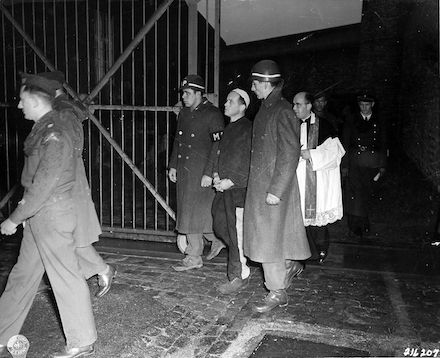
The U.S. Army hanged five German civilians as war criminals at Bruchsal Prison on this date in 1945. Their crime: lynching the crew of a downed American bomber, the day after Allied bombing raids devastated the manufacturing town of Rüsselsheim.

The lynching is known as the Rüsselsheim Massacre, and it claimed the lives of six of the nine flyers of a B-24 Liberator cheekily christened Wham! Bam! Thank You, Ma’m!. One of their number survived thanks to his shrapnel wounds, which saw him safely to hospital while his comrades were being transported.

The other two were simply lucky to survive the beatings administered by a mob of enraged civilians who caught sight of the Americans under the escort of only two German soldiers. On the night of August 25-26, Britain’s Royal Air Force had dumped more than 1,600 tons of explosives on Rüsselsheim to destroy the Opel factory and rail lines there. It was only the latest, and ultimately the largest, of several raids on the town dating back to July. A later U.S. study reckoned 315 Opel workers killed and 277 injured during the July-August raids, to say nothing of the devastation on other townspeople and on Opel’s slave labor.* A POW, Frenchman Pierre Cuillier, recorded of the August 25-26 attack that “a bomb fell on the dug-out for Russian women. We hear of 119 victims, a number that in reality is surely much higher.”

Under the circumstances, the good folk of Rüsselsheim were not pleased on the morning of the 26th to see Allied airmen in their town being marched to a train transfer … even if, and surely the distinction must fail to impress amid the smoldering rubble of one’s own hometown, this particular American crew had not been part of this particular British bombing. (The Americans had been shot down two days earlier en route to do a similar thing to Hanover.)

“There are the terror flyers. Tear them to pieces! Beat them to death! They have destroyed our houses!” cried Margarete Witzler and Käthe Reinhardt. As the Americans protested, the crowd overpowered the guards and took its rough revenge with whatever bludgeons were ready to hand.

At last, Joseph Hartgen, an air raid warden, finished them off with his pistol … or at least, finished off six before his chamber went empty.


Spoiler alert: it will not go well for Herr Hartgen.

Somehow the two un-shot men, Sgt. William M. Adams, and Sgt. Sidney E. Brown, still drew enough breath by the end of the ordeal to sneak away when they were being dumped into a mass grave. Captured again a few days later, they survived the war in a POW camp.**

Eleven Rüsselsheimers stood trial in Darmstadt for these Lynchmorde by July, when war was still raging in the Pacific: it was the very first war crimes proceeding under U.S. occupation.

The defendants tried out a pre-Nuremberg version of the “only following orders” defense, blaming Nazi propaganda against bomber crews for inciting the murders. The U.S. prosecutor† scoffed: “They were all grown men and women. If they are called on to commit the murder and they do, they are just as responsible as any other murderers.”

Harten and six others of the 11 caught death sentences, but the two women — Witzler and Reinhardt — both had their sentences reduced.

Warning: Although not graphic, this is a video of actual hangings.

* Quotes and figures from Working for the Enemy: Ford, General Motors, and Forced Labor in Germany During the Second World War, which is topical because Opel was a General Motors subsidiary.

** Brown lived long enough to return to Rüsselsheim at official invitation in 2001 for a formal apology. However, at the time of the trial, it was still mysterious how there came to be only six exhumed bodies from eight lynched airmen: Adams and Brown only emerged out of the mass of returning POWs after convictions had already been secured.

† The army prosecutor at the proceeding was one Lt. Col. Leon Jaworski, but he’s better known for hunting larger game later in his career as the special prosecutor during the Watergate investigations. (Jaworski is the guy embattled President Richard Nixon appointed after firing Archibald Cox in the Saturday Night Massacre.) Jaworski’s eventual legal victory over the White House in United States v. Nixon obtained the incriminating Watergate tapes in late July of 1974, forcing Nixon’s resignation just days afterwards, on August 9, 1974.

On this day..

1965: Eighteen prison rioters from Pulau Senang

On this date in 1964, newly-independent Singapore hanged 18 former inmates of the Pulau Senang penal settlement for a deadly 1963 riot.


Pulau Senang. (cc) image by Jnzl.

“Island of Ease” the name means in Malay — but inmates at the experimental prison colony established there in 1960 found it anything but. Singapore’s 1959 elections, its first under self-rule within the British Empire, brought in the People’s Action Party. The PAP still rules Singapore to this day, famously tough on crime.

Ever thus. One of PAP’s objectives in 1959 was to root out a plague of gangsterism in the city, and to that end it instituted the Pulau Senang settlement on the virtually uninhabited 81-hectare coral island. It had a classic penitential vision: hard-core underworld gangsters sweating away their appetite for crime, learning hard work and practical trade skills, emerging reformed — “every violent lawless man could find their own way back to decent society given a proper chance and hard work,” in the words of its superintendent, Irishman Daniel Stanley Dutton.

And it had its moment in the sun: during the colony’s short life, several hundred of its inmates were found sufficiently rehabilitated for release.

But obviously not every resident was a success story, for on July 12, 1963, a confrontation over laboring conditions on the Isle of Ease spiraled into a mutiny that saw the inmates hack Dutton himself to death with the tools he’d given them to save their own souls. Two of Dutton’s assistants were also slain in the rising, and before gendarmes arrived to restore order the inmates had torched and sacked most of the colony infrastructure that they and their predecessors had painstakingly constructed over the preceding three years.

The ensuing mass trials saw a shocking 18 men capitally convicted and eventually hanged on a single date: October 29, 1965. (Twenty-nine others received lesser prison sentences for mere rioting convictions.)

Dutton’s untimely end also meant the end of his project, which was retired from the Singapore penal system in 1964. Today, it’s a military testing grounds and live-fire range.

On this day..

1949: Nicolae Dabija, anti-communist partisan

On this date in 1949, the Romanian anti-communist partisan Nicolae Dabija (English Wikipedia entry | Romanian) was shot at Sibiu, along with six other members* of that resistance.

Although cousin to Romania’s pre-Ceausescu Communist ruler Gheorghe Gheorghiu-Dej, Dabija — not to be confused with the 19th century general of that name nor with the latter-day Moldova M.P. of the same name — charted a distinctly separate ideological course.

He was decorated for his service on the Axis’s Eastern Front during World War II, but this same credential got him expelled from the army in the postwar Red takeover.

Nothing daunted, Dabija and some like-minded comrades** formed an armed anti-communist militia a few dozen strong in Transylvania’s Apuseni Mountains named the National Defense Front, Haiducian Corps — a nod to the Balkans’ historical outlaws/rebels. The Securitate reduced them over the course of 1948-1949 months, culminating in a March 3-4, 1949 forest battle that brought Dabija et al into custody.

* Ioan Scridon, Traian Mihaltan, Titus Onea, Augustin Ratiu, Gheorghe Oprita, Silvestru Bolfea. (Source)

** Brothers with the apt surname Macavei.

On this day..

1799: Egyptians after the Revolt of Cairo

Every night we cut off thirty heads, and those of several chiefs; that will teach them, I think, a good lesson.”

-Napoleon to the Directory on October 27, 1799, after crushing the Revolt of Cairo

Napoleon’s private secretary on the adventure in Egypt, Louis Antoine Fauvelet de Bourrienne, claimed that Napoleon exaggerated for effect, and the executions were more in the neighborhood of a dozen per night. The beheaded corpses were stuffed in sacks and tossed into the Nile.

Bourrienne’s biography of Napoleon also relates (albeit without a date)

Some time after the revolt of Cairo, the necessity of ensuring our own safety urged the commission of a horrible act of cruelty. A tribe of Arabs in the neighbourhood of Cairo had surprised and massacred a party of French. The general-in-chief ordered his aide-de-camp, Croisier, to proceed to the spot, surround the tribe, destroy their huts, kill all the men, and conduct the rest of the population to Cairo. The order was to decapitate the victims, to bring their heads in sacks to Cairo, to be exhibited to the people. Eugene Beauharnais accompanied Croisier, who joyfully set out on this horrible expedition, in the hope of obliterating all recollection of the affair of Damanhour.

Next day the party returned. Many of the poor Arab women had been delivered on the road, and the children had perished of hunger, heat, and fatigue. About four o’clock, a troop of asses arrived in Ezbekyeh Place, laden with sacks. The sacks were opened and the heads rolled out before the assembled populace. I cannot describe the horror I experienced; but, at the same time, I must acknowledge that this butchery ensured for a considerable time the tranquility and even the existence of the little caravans which were obliged to travel in all directions for the service of the army.

On this day..

1826: Seventy-two Janissaries

We credit the London Times of November 27, 1826 for this tidbit on the Ottoman Empire’s mop-up of the Janissaries, the truculent infantry elites who had been shattered earlier that same year during the “Auspicious Incident”.

The news from Constantinople extends to the 25th ult. It is stated that on the 18th a plot was discovered which had for its object to kill MEHEMED PACHA, who commands in Asia, the SERASKIER-PACHA, and the TOPCHI-BACHI [chief of the cannoneers -ed.]. The ex-Janissaries who are incorporated with the new troops were the authors of this project. They had agreed to come to a review, which was to take place on the 19th, provided with ball-cartridges, and on the order to fire, had resolved to discharge their muskets on these Pachas and their Staff-officers. The conspiracy was revealed to MEHEMED PACHA by a Captain and four Topchis, whom the conspirators had endeavoured to gain over to their cause. The information was immediately conveyed to the SULTAN and the Government, who took prompt and decisive measures to punish the guilty and intimidate the disaffected. They despatched 1,500 of the most suspected towards Nicomedia, under the pretext of suppressing a revolt, but with the real design of getting rid of obnoxious and dangerous defenders. It is supposed that when this detachment arrives at the Dardanelles it will be sent to Chios. On the 20th ult. the GRAND VIZIER ordered the execution of eight Mussulmans, and the SERASKIER commanded six to be strangled, on a charge of corresponding with the disaffected. On the 21st, the latter officer is said to have executed in secret, and without trial, 72 more, among whom were four captains. The Government banishes all the unmarried Janissaries, even though they exercise trades and are entirely unconnected with the soldiers of that suppressed corps. The Mussulman population, it is said, are to be disarmed, as well as those whom they call “Christian dogs.”

On this day..