1789: Five wheelbarrow men

John Byrns (aka Francis Burns), John Bennet, Daniel Cronan, John Ferguson (aka John Taylor) and John Logan* hanged in Philadelphia on this date in 1789.

The offenders were “wheelbarrow men,” which in the idiolect specific to late 1780s Pennsylvania denoted prisoners who were detailed, in order “to correct and reform offenders, and to produce such strong impressions on the minds of others as to deter them from committing the like offences,” to suffer “continued hard labour publicly and disgracefully imposed.”

As its own text declares, the 1786 statute creating this class was a part of Pennsylvania’s avant-garde move towards a penitential penal philosophy, with a corresponding reduction in capital sentences for property crimes: Pennsylvania had hanged about 40 people for mere robbery or burglary in the preceding decade. As explained by Louis Masur’s Rites of Execution: Capital Punishment and the Transformation of American Culture, 1776-1865 (which is also our source for the count of hanged thieves), “in 1786, most almanacs in Philadelphia and elsewhere included the proverb that industry promoted virtue.”

It became readily apparent, however, that the “wheelbarrow law” neither reformed the prisoners nor prevented vice. Indeed, it seemed to many that the convicts became even more licentious and that unprecedented amounts of criminal activity infested the community.

Such prisoners were “subjects of great terror, even while chained” given these walking spectacles’ notorious dissolution, and still worse their propensity for fleeing their wheelbarrows to become desperate fugitives. Pennsylvania newspapers from this era have an alarming quantity of notices published by gaolers warning of escaped wheelbarrow men … and not a few reports of actual or suspected crimes committed by them. For example …


Philadelphia Mercury, Oct. 23, 1788.

New-Hampshire Spy, Dec. 2, 1788.

By the time full 30 wheelbarrow-men escaped on a single night in October 1788, elite opinion had turned solidly against this disastrous experiment, and the law would be repealed by 1790 — substituting for public shaming the penitential benefits imposed solitude. But before the wheelbarrow men had disappeared into historical curiosity, our five of them in September 1789 robbed and also murdered a man named John McFarland in his home on Philadelphia’s Market Street.


New York Daily Gazette, Sep. 25, 1789.

* Quite a few Johns about down the years.

On this day..

1871: Eugen Kvaternik, for the Rakovica revolt

On this date in 1871, Eugen Kvaternik and a number of companions were shot as rebels.

A patriot who had long aspired to detach Croatia from the Austro-Hungarian Empire, Kvaternik (English Wikipedia entry | Croatian) found enough traction to give it a go during the late 19th century’s rise of swirling nationalist rivalries.

His Rakovica Revolt, named after the village where Kvaternik announced the Croatian People’s Republic on October 7, 1871, was speedily crushed, however. Kvaternik’s rebels routed on the 10th with the appearance of a federal army and the arrests began forthwith.

On October 11, a military tribunal sentenced Kvaternik and various comrades to death — sentences that were implemented immediately by musketry. Today, there are streets and city squares in independent Croatia named to Kvaternik’s honor.


The Killings of Rakovica (Death of Eugen Kvaternik), by Oton Ivekovic.

On this day..

1967: The Asaba Massacre

The Asaba Massacre during Nigeria’s Biafran War culminated on this date in 1967 with a horrific mass execution.

Nigeria had attained independence in 1960 but still carried the legacy of its many decades under British control. Notably, the borders bequeathed to Nigeria amalgamate a coastal, Christian population in the south to an inland, Muslim population in the north — a fissure that continues to shape Nigeria down to the present day.

The ethnicity of interest for this post is the Igbo, one of those southern and Christian populations, and also a people who had been ethnically cleansed from the north in 1966 after an exchange of Christian and Mulim coups brought Nigeria to the brink of disintegration. Their homeland in southeast Nigeria — historically known as Igboland, and called Eastern Region within Nigeria — would become from May 30, 1967 the breakaway state of Biafra.

Biafra’s bid for independence triggered a devastating war with the Nigerian federal government. By the time that it ended in early 1970, perhaps as many as two million Biafrans were dead from mass starvation.

Asaba, where our massacre takes place, is a predominantly Igbo city on the western (non-Biafran) shore of the Niger River, opposite the Biafran eastern shore city Onitsha.

In the war’s opening weeks, Biafran forces actually struck out from their homeland and into Nigeria proper, crossing the Niger River. They would re-cross it in the opposite direction days before this massacre, taking bridges from Asaba to Onitsha and then cutting those bridges to frustrate the federal troops pursuing them.

Federal soldiers reaching Asaba in the first days of October took out that frustration on the city’s Igbo population, whom they robbed and abused as rebel sympathizers. Murders/summary executions for several days together comprise the Asaba Massacre or Massacres … but the single most emblematic and traumatic event took place on Saturday the 7th.

On October 4-6, soldiers occupied the town, and some began killing boys and men, accusing them of being Biafran sympathizers. On October 7, Asaba leaders met, and then summoned everyone to gather, dancing and singing to welcome the troops, and offering a pledge to One Nigeria. People were encouraged to wear akwa ocha, the ceremonial white, embroidered clothing that signifies peace, hoping that this strategy would end the violence. Although there was much trepidation, and some refused to participate, hundreds of men, women, and children assembled for the march, walking to the village square of Ogbeosewa, one of the five quarters of Asaba. Ify Uraih, then 13 years old, describes what happened when he joined the parade with his father and three older brothers, Paul, Emmanuel (Emma), and Gabriel:

There, they separated the men from the women … I looked around and saw machine-guns being mounted all around us … Some people broke loose and tried to run away. My brother was holding me by the hand; he released me and pushed me further into the crowd … They shot my brother in the back, he fell down, and I saw blood coming out of his body. And then the rest of us … just fell down on top of each other. And they continued shooting, and shooting, and shooting … I lost count of time, I don’t know how long it took … After some time there was silence. I stood up … my body was covered in blood, but I knew that I was safe. My father was lying not far away; his eyes were open but he was dead.

Exactly how many died is not clear; between 500 and 800 seems likely, in addition to many who died in the previous days. Most victims were buried in several mass graves, without observing requisite ceremonial practices. Along with his father, Uraih lost Emma and Paul; Gabriel was shot repeatedly, but recovered. The long-term impacts were profound; many extended families lost multiple breadwinners, and the town’s leadership was decimated. ()Source)

On this day..

1973: Jose Gregorio Liendo, “Comandante Pepe”

Comandante Pepe was shot on this date in 1973.

Jose Gregorio Liendo (English Wikipedia entry | Spanish), a onetime agronomy student, had quit his studies years before to join a Marxist guerrilla organization.

From the gorgeous inaccessibility of Chile’s mountainous border with Argentina, the Revolutionary Left Movement (MIR) launched pinprick-level attacks on the state in the late 1960s and took land reform by the barrel of the gun by seizing farms around Panguipulli for the use of workers.

The quixotic former student turned campesino revolutionary, Liendo became one of MIR’s most visible public faces under the nom de guerre of “Comandante Pepe”, even settling down in the mountains and marrying a local.

In the early 1970s this movement enjoyed the simpatico of the socialist Salvador Allende government. (One of MIR’s co-founders was President Allende’s nephew.)

That moment ended abruptly with the September 11, 1973 coup replacing a socialist administration with a far-right military dictatorship — and the latter immediately began slaughtering leftists.

The MIRistas themselves managed a few small attacks on the Pinochet regime in the weeks following the coup but were speedily overwhelmed. Captured after an attack on a carabineros station, “Pepe” with eleven comrades — a mixture of students and lumber workers — were condemned to immediate execution by a drumhead military tribunal in Valdivia.

“A week later, on October 9, the army executed seventeen more persons in the area,” according to Mark Ensalaco. “They were loggers, farmers, and peasant activists. The following day Helicopter Squadron 3 arrested sixteen employees of the same lumber and forestry complex where Comandante Pepe had worked and agitated. The prisoners were taken to a bridge over the Tolen River and executed.”

There’s a recent historical novel about this legendary character, Lo Llamaban Comandante Pepe (They Called Him Comandante Pepe).

On this day..

1678: Five at Tyburn

Three men and two women hanged at Tyburn on this date in 1678.

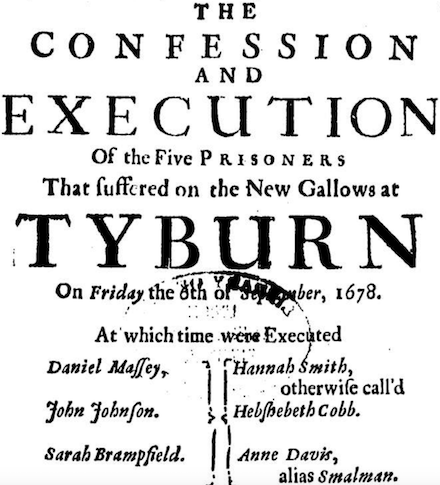
Our text here is one of the earliest of the Ordinary’s Accounts, a far shorter and less ostentatious affair than examples of the genre even a few years later from the hand of a clergyman who has scarcely begun to grasp his true calling, moving copy.


THE CONFESSION AND EXECUTION Of the Five PRISONERS That suffered on the New Gallows at TYBURN On Friday the 6th of September 1678.

At which time were Executed

Daniel Massey. John Johnson. Sarah Brampfield. Hannah Smith, otherwise call'd Hebshebeth Cobb. Anne Davis, alias Smalman.

With Brief Notes of Two SERMONS Preached before them after Condemnation, their Carriage in Prison, and last Speeches at the place of Execution.

The Confession & Execution of the several Prisoners that suffered on the New Gallows at Tyburn, on Friday the 6th of September 1678.

AT the last Sessions there were in all Ten persons Condemned to die; Four menf or Robberies on the Highway, and Six women for Felonies here in Town, either Lifting (as they call it) of Goods out of Shops, or else Robbing those whom they pretended to serve: both which wicked Practises are become so common, and more than once followed by these incorrigible Prisoners, that it was highly necessary to make them Exemplary. Two of the before-mentioned men, viz. those concerned in that barbarous Assault and Robbery, whereof a particular Narrative hath been made publick by the unexpected Mediation of some generous Friends; and the women whose Crimes had not been so great and obstinately continued in as the others, obtained his Majesties gracious Reprieve: and another woman, immediately after she stood attainted, was reprieved by the Court, in reguard she was found by a Female Jury to be quick with Childe.

The Rest came this day to suffer, being charitably indulged in pity to their Souls, so long time to sit and prepare themselves for their great and terrible Change. In order to which, on the Lords-day before, there were two Sermons on most suitable Texts preached before them in the Chappel of Newgate. That in the Forenoon on the fifth verse of the 38 Psalm — My wounds stink and are corrupt, because of my foolishness: Wherein the Minister very pathetically laid open the deplorable Condition such sinners are in by Nature, wallowing not onely in their original Depravity and Corruption, but in continued actual Transgressions against the holy Laws of God; whereby they become abominable, and as a loathsome stench in the Nostrils of that pure Majesty and all good men; and all this occasioned by their own foolishness, that is, their wilful rebellion and obstinacy against all the dictates of Reason, offers of Grace, and impulses of the Holy Spirit upon their Consciences. Which having, like a true Bonaerges, hereby endeavoured to awaken, and put them into a serious sense and apprehension of their lost, undone, and perishing Estate, without speedy and sincere Repentance.

In the Afternoon, as a Son of Consolation, from the 147 Psalm, vers. 3. He healeth the broken in heart, and bindeth up their wounds, he came to shew them the infinite Mercies of God, and Love of Jesus Christ, if they would come in and accept of Pardon and Salvation upon Gospel-terms. That although they had made their wounds to fester and rankle by their foolishness, and had Souls all over bespread with a filthy Leprosie, yet there was Balm in Gilead, an Almighty Physician, both able and willing to heal them, if they would submit to his Prescriptions. In order to which, he gave them divers most necessary and excellent Directions; Not to deceive themselves with a false and palliated Cure, but to close with Christ on his own Terms, and in all his Offices, as their King to Rule them, and their Prophet to Guide them, as well as their Priest to Intercede and make Atonement for them. To hate Sin more, because it was displeasing to God, than because it brought upon them temporal or eternal Punishments. To be as desirous to be Holy as to be Happy; because none can be justified until they are sanctified, Etc.

During the whole time of Religious Worship, and the Sermons, they behaved themselves very Reverently and Attentively; nor was the Minister wanting afterwards, daily to visit them, with pressing Exhortations, and necessary directions to sit them for their last end; especially charging them to disburthen their Consciences, and give glory to God by a free and hearty Confession of their Sins; which had so good an effect, as to bring them to an Acknowledgment; not only in general term, but particularly bewailing the Ill Courses of their past Lives; in neglect of the publick Divine Worship, Violation of the Lords day, Drunkenness, Swearing, and continual practises of Lascivious Debauchery; Two of them above the rest abounding in expressions of Penitence, and endeavouring to improve those few moments of their Lives, to work out their Salvation, and make their peace with God; begging heartily forgiveness from his most holy Majesty, for their Rebellion against his Precepts, and of all those whom they had wronged, by violent taking away their Temporal Goods.

Some of the Women had been Condemned before, and would often bewail the wickedness of their Hearts, that would take no warning thereby: the Men alleadged, they were ignorantly drawn in to that ill Fact, for which they suffer’d, being their first of that kind, and rather by the unhappy operation of too much Drink, than any premeditated design; yet confessed, they had more than once deserved to Dye, and freely acknowledged the justice of the punishment they were to suffer.

At the place of Execution they said little, besides those common, but too much neglected Exhortations, desiring all present to take Warning by them, and remember their Creator in the days of their youth; Not to suffer themselves to be seduced by Ill Company, or sensual pleasures, which had been the means of their destruction, and would be so of all, that did not continually keep a reverent fear of God, and his Worship and Laws in their Hearts.

Thus heartily praying to God for Forgiveness, and to receive their Souls for the alone Merits of his blessed Son; and desiring all good people to joyn with them and for them in those Supplications, they submitted to the Sentence, and taking their leave of all things in this world, were wasted into the unfathomable Regions of Eternity.

FINIS.

On this day..

1786: Five men at York Castle, under the “Bloody Code”

(Thanks to Meaghan Good of the Charley Project for the guest post. -ed.)

On this date in 1786, five young men were hanged together before a large crowd in front of York Castle. They were William Nicholson, John Charlesworth, James Braithwaite, William Sharp and William Bamford.

William Knipe’s Criminal chronology of York castle; with a register of criminals capitally convicted and executed at the County assizes, commencing March 1st, 1379, to the present time records,

The above were all executed at Tyburn without Micklegate Bar.

Nicholson, aged 27, labourer, for stealing two geldings, the property of Robert Athorpe Esq., of Dinnington. Thomas Whitfield, Mr. Athorpe’s man, was the principal witness against him.

John Charlesworth, of Liversedge, clothier, for breaking into the house of Susan Lister, of Little Gomersal, single woman, and stealing various articles of trifling value; also further charged with stopping William Hemmingway, of Mirfield, clothier, and robbing him of three guineas and a half and some silver and copper. He was 21 years of age.

Braithwaite, for breaking into the dwelling-house of Thomas Paxton, of Long Preston, innkeeper, and stealing various article therefrom. He was a hawker and a pedlar, and 30 years of age.

William Sharp, labourer, aged 26, and William Bamford, labourer, aged 28, for robbing Duncan M’Donald, of Sheffield, button-maker, by breaking into his house, and carrying away a number of horn combs, a silver threepenny-piece, and fourpence in copper. Sharp was a native of Conisbro’, and Bamford, a native of Clifton.

It was noted that Nicholson, Charlesworth, Sharp and Bamford all left a widow and children behind, but Braithwaite had “two wives and three children by his lawful one, and two by the other, to whom he gave £70, and appeared most attached to her, as he would not permit the former to take leave of him.”

This British Library article on crime and punishment in Georgian Britain explains why these individuals were punished so severely for what, to modern eyes, look like relatively minor offenses:

The 18th-century criminal justice system relied heavily on the existence of the ‘bloody code’. This was a list of the many crimes that were punishable by death—by 1800 this included well over 200 separate capital offences. Guilty verdicts in cases of murder, rape and treason — even lesser offences such as poaching, burglary and criminal damage — could all possibly end in a trip to the gallows. Though many people charged with capital crimes were either let off or received a lesser sentence, the hangman’s noose nevertheless loomed large.

On this day..

1950: The Hill 303 massacre

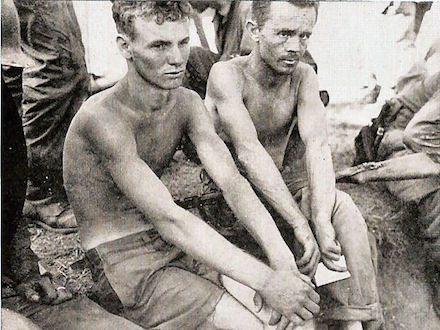
North Korean regulars on this date in 1950 committed a notorious mass execution upon 41 U.S. prisoners during the Korean War.

The Hill 303 massacre took place upon a 303-meter hill guarding the northern approach to Waegwan. In mid-August of 1950, said hill was defended by the U.S. Army’s 2nd Battalion, 5th Cavalry Regiment, 1st Cavalry Division, which narrowly escaped encirclement there by the advancing North Koreans.

Most of them escaped encirclement.

It’s a barely remembered atrocity in a war that America has consigned to forgetfulness; the massacre has seemingly never had anything like a thorough investigation. An indelible horror to the five men* who lived to tell the tale, its narrative outline is crude timelessness itself: holding these 42 U.S. POWs for two days, the North Koreans were themselves pummeled by a counterattack on the fiercely-fought hill;** unable to continue guarding the Americans, their captors fusilladed them.

This indiscriminate mass firing mere minutes ahead of the American approach was far from a thorough affair — hence the survivors, who were subsequently able to point out some of the captured Koreans who took part.


Massacre survivors James Rudd and Roy Day.

As a result of this and other summary battlefield executions, U.S. Gen. Douglas MacArthur addressed a threatening leaflet that was heavily dropped behind North Korean lines, threatening to “hold you and your commanders criminally accountable” according to the recent Nuremberg precedent.

There’s a monument to this gratuitous bloodbath that’s been recently installed, at the site of the shooting which is also nearby to a still-extant U.S. Army base called Camp Carroll. (The stone displays the date “June 25, 1950” — which denotes the start of the war, and not the day of the massacre.)

* Even the exact figures involved are a bit slippery. I believe we have 37 humans killed out of 42 captured, leaving five survivors. Some sources give it as 41 (attempted) executions with four survivors. A private named Frederick Ryan apparently was given last rites and declared dead on the scene but miraculously survived, possibly accounting for the variance.

** Hill 303 changed hands at least seven times.

On this day..

1704: Roland Laporte, posthumously, and five aides, humously

On this date in 1704, the great Camisard commander Pierre Laporte was publicly burned. He was already two days dead, but the same could not be said by five comrades-in-rebellion who were quite alive as they were broken on the wheel.

Familiarly known by the nom de guerre “Roland”, Laporte (English Wikipedia entry | the far more detailed French) was a whelp of 22 when entrusted with command of about 400 Protestant guerrillas operating around Lassalle, and his native Mialet.

These were rebels in a very dirty regional civil war in France’s heavily Protestant southeast, following the crown’s revocation of tolerance for the heretics. Roland proved himself one of its ablest prosecutors, putting Catholics to fire and sword be they enemy troops or wrongthinking neighbors.

By 1704 the insurgency was circling the drain as Camisard officers were either killed off or bought off. Our self-proclaimed “general of the children of god” was not the type to be had for 30 pieces of silver plus an army commission,* and so only violence would do for him. On August 14, betrayed by an informer who was amenable to purchase, Roland was slain in a Catholic ambush at Castelnau-les-Valence. Five officers escorting him opted not to go down fighting and surrendered instead, which proved a regrettable decision.

But even death could not slake the vengeance of his foes. “On the 16th August, 1704, the body of Roland Laporte, general of the Camisards … was dragged into Nimes at the tail of a cart and burnt, while 5 of his companions were broken on the wheel around his funeral pyre.”

For the unusually interested reader, there’s a 1954 French biography by Henri Bosc — who also authored a multi-volume history of the Camisard war — titled Un Grand Chef Camisard Pierre Laporte dit Roland, 1680-1704. It’s long out of print and appears to be difficult to come by.

* Not long before Roland’s defeat, just such a deal had shockingly induced fellow Camisard commander Jean Cavalier to turn coat.

On this day..

1939: Las Trece Rosas

The Spanish Civil War’s victorious fascists shot Las Trece Rosas — “the thirteen roses” — on this date in 1939.


Plaque at the Cementerio de la Almudena in Madrid in honor of 13 young women shot there by Francoist troops on August 5, 1939. (cc) image by Alvaro Ibanez.

Earlier that 1939, Franco had clinched victory by finally capturing the capital city after a siege of 29 months. A punishing suppression of the Spain’s leftist elements ensued, running to hundreds of thousands imprisoned, executed, or chased into exile.

Our 13 Roses were members of a communist/socialist youth group, JSU, and they had been arrested in rolling-up of that organization. They were crowded into the overflowing dungeons of the notorious women’s prison Las Ventas.

A few Spanish-language books about Las Trece Rosas

And there they resided on July 29, 1939, when their JSU comrades struck back against the dictatorship by assassinating Isaac Gabaldón, the commander of Madrid’s fascist police.* The 13 Roses were immediately court-martialed and executed in revenge. Their names follow; there’s a bit more detail about them in Spanish here:

  • Carmen Barrero Aguado (age 24)
  • Martina Barroso García (age 22)
  • Blanca Brissac Vázquez (age 29)
  • Pilar Bueno Ibáñez (age 27)
  • Julia Conesa Conesa (age 19)
  • Adelina García Casillas (age 19)
  • Elena Gil Olaya (age 20)
  • Virtudes González García (age 18)
  • Ana López Gallego (age 21)
  • Joaquina López Laffite (age 23)
  • Dionisia Manzanero Salas (age 20)
  • Victoria Muñoz García (age 19)
  • Luisa Rodríguez de la Fuente (age 18)

The affair is the subject of a 2007 Spanish film.

* Gabaldon’s predecessor, the police commander under the Spanish Republic, Jose Aranguren, had been removed from his post and executed in April.

On this day..

1540: The Botolph Plotters of Calais, the last English Carthusian, and Thomas More’s son-in-law

The 4. of August, Thomas Empson sometime a monke of Westminster, which had beene prisoner in Newgate more than three yeares, was brought before the Justices of goale deliverie at Newgate, and for that he would not aske the king pardon for denying his supremacie, nor be sworne thereto, his monkes cowle was plucked from his backe, and his body repried till the king were informed of his obstinacie. The same 4. of August were brawen to Tiborne 6. persons, and one led betwixt twaine, to wit, Laurence Cooke, prior of Dancaster, William Horne a lay brother of the Charterhouse of London, Giles Horne gentleman, Clement Phillip gentleman of Caleis, and servant to the lord Lisle, Edmond Bromholme priest, chaplaine to the said lord Lisley, Darby Gening, Robert Bird, all hanged and quartered, and had beene attainted by parliament, for deniall of the kings supremacie.

John Stow, Annals of England to 1603 (see page 977 of this archive.org version)*

Tyburn hosted a mass execution on this date mingling several different offenders with a Catholic bent from Henrician England’s religion/politics bloodsport.

The most politically intriguing are Clement Phillip (or Philpott) and Edmund Brindholme, two members of the retinue of the Viscount Lisle. Lord Lisle governed Calais, Henry VIII’s vital French bridgehead.

Phillip and Brindholme were part of the “Botolph Plot”, so named for a fellow-servant called Gregory Botolf or Botolph.

Botolph was an energetic conspirator and/or trumped-up con man who represented to his mates that he was shuttling mash notes with the exiled Cardinal Reginald Pole, Henry VIII’s once-loved, now-despised nemesis noted for his noisy denunciations of the king’s break with Rome. Botolph’s declared objective was to “get the towne of Calais into the hands of the Pope and Cardynal Pole; this was the matter that I went to Rome for; and I have consulted with the Holy Father the Pope and with the Reverent Father Cardynall Pole.”

The implausibility of these fanciful pretensions — one chronicle calls this guy “Gregory Sweetlips” which gives you an idea of his credibility — stood in inverse relationship to the damage such a plot’s execution would inflict: Calais was a commercially and strategically important port that had been in English hands for nearly 200 years; for a dynasty perpetually nervous of its prestige, fumbling it away could have proven catastrophic.** So once a plan to betray it from the very governor’s household was exposed, the crown prosecuted it ferociously, although as best I can determine Botolph himself appears to have successfully escaped the royal vengeance.

Lord Lisle himself was also clapped in the Tower† for his servants’ misbehavior but no attainder was ever proceeded upon. In 1542, Henry cut him a break and released him; Lisle would already have been near or past the age of 70 by this point, which we mention as context in reporting that news of his intended release caused the poor ex-governor to keel over dead of a heart attack. “Henry VIII’s Mercy was as fatal as his Judgments,” one waggish historian would later remark.‡

Things might have gone less mercifully for Lisle had not his situation happened to overlap with the fall of Thomas Cromwell, which unfolded that same summer of 1540.

Cromwell was beheaded on July 28, significantly upstaging this August 4 coterie, and events in Calais might have played a part in that unhappy end. Politically weakened by his authorship of the failed Anne of Cleves marriage, Cromwell’s defeat is sometimes read in the light of excessive reformation zeal unleashed in Calais. (Like most theses about Tudor England, the Calais-reformers line has its detractors.) One possible way to read the Botolph Plot stuff is as one of Cromwell’s very last, desperate gambits: threatened by the conservative Duke of Norfolk, who had the whip hand during this brief interval thanks to his kinship to incoming queen Catherine Howard, Cromwell struck back against his persecutors “with the concentrated energy of a desperate gambler” (Source) … by going hard after the papist plot in Calais and implicating in the treason Howard’s ally, the aforementioned Lisle.


In William Horn(e) the crown completed the destruction of the Carthusian order, which had been violently suppressed several years previous — with 18 executions into the bargain. Eleven more Carthusians had avoided the scaffold only to be consigned to the dungeons where pestilence and neglect took their toll, until only Horn survived.

Nobody seems quite able to put a finger on why Horn was kept alive all that time: was he just hardier or “luckier” than the rest, or was he being intentionally saved as an accent upon an occasion such as this? With him went Friar Lawrence Cook, the last Carmelite executed in the king’s suppression of that order: he hailed from Yorkshire and had once countenanced that region’s subversive (in Henry’s eyes) Pilgrimage of Grace.

In a similar vein, we also find among this batch Giles Heron, a son-in-law of the first name in Catholic obstinacy, Sir/Saint Thomas More. Heron had kept his head about him and even sat on the Middlesex grand jury that recommended proceedings against Anne Boleyn, which is the sort of thing a Thomas More client wouldn’t mind doing at all.

Alas, he was in the judgment of a contemporary “wise in words, but foolish in deeds” during such dangerous times. Comfortably situated as a rentier landlord, Heron appears to have fallen into a ferocious tiff with a tenant who revenged an eviction by informing to Cromwell’s spies about Heron’s divergences from the new orthodoxy. The evidence of this tenant, one Lyons, eventually led Parliament to attaint Heron. The confiscated estates would be restored to Heron descendants under Queen Mary.

Darby Gynnyng — to use a more Gaelic rendering of his name — was a bit more forceful about his dissidence, for he came “late of Dublin,” where he “has maintained divers of the King’s enemies in Ireland, especially Fitz Garrard whom he succoured and accompanied.”

* A somewhat different roster for the same date is supplied by Wriothesley’s Chronicle (p. 121 of this archive.org version) which might be double-counting his “six persons more” to suggest so many as 13.

This yeare, the fowerth daie of Awgust, were drawen from the Tower of London to Tiburne, Giles Heron, gentleman, Clement Philpott, gentleman, late of Callis, and servant to the Lord Lile, Darbie Gynning, Edmonde Bryndholme, priest, William Horn, late a lay brother of the Charter Howse of London, and another, with six persons more, were there hanged drawn, and quartered, and one Charles Carow, gentleman, was that daie hanged for robbing of my Ladie Carowe, all which persons were attaynted by the whole Parliament for treason.

** The Tudors actually did lose Calais to French siege in 1558. These were the last months of the ailing Queen Mary’s rule; she’s reported to have wailed on her deathbed that “When I am dead and cut open, they will find Philip [her husband] and Calais inscribed on my heart.”

† Seized upon Lord Lisle’s arrest were seven years of correspondence comprising more than 3,000 distinct documents. This trove has survived to present times and become an invaluable resource for historians’ exploration of Tudor life. It’s known as the Lisle Papers; there are published collections and commentaries on them available by the late Muriel St. Clare Byrne.

‡ Still, this was a better fate than that enjoyed by the next Viscount Lisle, John Dudley, who briefly exercised de facto rulership of England only to have his head cut off after the fall of Lady Jane Grey.

On this day..