1942: Nikola Vaptsarov, Bulgarian poet

Poet Nikola Vaptsarov was shot on this date in 1942 for organizing anti-fascist resistance in Axis Bulgaria.

A communist machinist — the Varna naval academy where he learned engineering is now named for him* — Vaptsarov — Vaptsarov was a proper proletarian poet who only ever versified on the side.

Nevertheless, he was well-known in his time and remains so to this day in Bulgaria, particularly given his political bona fides and martyrdom thereto, which bear ready comparison to Spanish Civil War martyr Frederico Garcia Lorca.

Spain

What were you to me?
Nothing.
A land forgotten and remote,
a land of knights and high plateaux.
What were you to me?
The hearth
where blazed a strange and cruel love,
a wild intoxicant
of blood,
of glinting blades
and serenades,
of passion,
jealousy
and psalms.

Now you are my destiny,
now I live and share your fate.
In your struggle to be free
wholly I participate.

Now I’m stirred, now I rejoice
at all your victories in the fight.
In your youth and strength I trust
and my own strength with yours unite.

Crouching in machine-gun nests,
I fight on to victory,
down among Toledo’s streets,
on the outskirts of Madrid.

A worker in a cotton shirt
torn by bullets near me lies,
Ceaselessly the warm blood streams
from the cap pulled o’er his eyes.

It is my blood that I feel humming
through my veins, as suddenly
in him I recognize the friend
I once knew in a factory

where we shoveled coal together,
stoking the same furnace fire,
and found there was no barrier
to check our young and bold desire.

Sleep, my comrade, sleep in peace!
Though now the blood the blood-red flag be furled,
your blood into mine will pass
and stir the peoples of the world.

The blood you gave, already flows
through village, factory, town and state,
arouses, urges and inspires
all working men to demonstrate.

That workers never will lose heart,
but will advance relentlessly,
determined both to work and fight
and shed their blood that men be free.

Today your blood builds barricades,
infuses courage in our hearts,
and with a reckless joy proclaims:
‘Madrid is ours!
Madrid is ours!’

The world is ours! Friend, have no fear!
The whole expanding universe
its ours!
Beneath the southern sky
sleep
and have faith,
have faith in us!

-Vaptsarov

Vaptsarov published his lone book, Motor Songs, in 1940, which was the same year he was interned demonstrating against Bulgaria’s tenuous neutrality and in favor of alliance with the USSR. A few months after his release, the Third Reich forced Bulgaria into the Axis. A member of the Central Military Committee of the Bulgarian Communist Party, Vaptsarov was arrested for doing just the sort of things that such a committee would be doing in 1942.

A Selected Poems volume of his was published posthumously; it can be enjoyed free here.** Perhaps the most moving entry is the very last one, a short composition dedicated to his wife just hours before his execution.

On Parting

To my wife

Sometimes I’ll come when you’re asleep,
An unexpected visitor.
Don’t leave me outside in the street,
Don’t bar the door!

I’ll enter quietly, softly sit
And gaze upon you in the dark.
Then, when my eyes have gazed their fill,
I’ll kiss you and depart.

The fight is hard and pitiless.
The fight is epic, as they say.
I fell. Another takes my place —
Why single out a name?

After the firing squad — the worms.
Thus does the simple logic go.
But in the storm we’ll be with you,
My people, for we loved you so.

2 p.m. — 23.VII.1942

* You’ll also find the man’s tribute on the frigid slopes of Vaptsarov Peak on the Antarctic Livingston Island. More accessibly, there are museums to him in the Bulgarian capital of Sofia as well as Vaptsarov’s hometown of Bansko.

** Some other sites with Vaptsarov poems: here and here.

On this day..

1661: Antonius Hambroek, defying Koxinga

Missionary Antonius Hambroek was put to death on this date in 1661 as the warlord Koxinga wrested control of Formosa (Taiwan) from the Dutch.

In the 1620s, the running Dutch-Spanish war as projected into both countries’ colonial extrusions had resulted in the two dividing that South China island: the Dutch in the south, based at Fort Zeelandia, and Spain in the north. In 1641 the Dutch conquered Spanish Formosa to establish themselves as the apex predators on a rough and lawless island.


Fort Zeelandia.

But that’s before they ran into Koxinga.

Simultaneous with the Dutch advance on Formosa, China’s Ming dynasty was in the process of collapsing. From the 1640s, civil wars between the advancing Manchus (eventually victorious as the incoming Qing dynasty) and the remnants of the Ming would tear at the mainland.

Koxinga was the last great Ming commander. He’d been born on a Nagasaki beach to a Japanese mother. His family ran a commercial concern stretching across the South China Sea as far as Vietnam and the Philippines; its dubious legality confers the romantic sobriquet “pirate” upon Koxinga but think corporate raider here. “Some people call him a pirate, but he was a businessman,” said present-day Taiwan historian Chu Cheng-yi.

And in both commerce and war, Koxinga could flex.

The author of this book about Koxinga’s victory over Dutch Formosa describes his book in this video.

Paradoxically the Ming’s collapse launched Koxinga; his very name as history knows it derives from a title (“Lord of the Imperial Surname”) conferred by the executed Longwu Emperor in gratitude for staying loyal when even Koxinga’s own dad had gone over to the Qing. In one cinematic moment, with the Ming looking toast, Koxinga torched the scholarly robes he had earned studying for a respectable court career and swore he would don nothing but armor until he’d expelled the Manchus from China.

This “Badass of the Week” post chronicles his scintillating military career; in the twilight of the Ming, Koxinga’s victories gave the foundering dynasty its last legitimate cause for hope and in the course of the 1650s his sword-arm established a Qing-defying state in the southerly province of Fujian. From this base in 1659 he launched a proposed history-altering attack on Nanjing that only narrowly failed.

Win or lose on terra firma, the pirate was nails on the waves. “Never before nor since was a more powerful and mighty fleet seen in the waters than that of Koxinga, numbering more than 3,000 junks,” Jesuit missionary Vittorio Ricci wrote of the armada he had once assembled to attack Xiamen. (Source) “The sight of them inspired one with awe. This squadron did not include the various fleets he had, scattered along neighboring coasts.”

In his reduced circumstances post-Nanjing, Koxinga managed “only” 400 ships to launch from Fujian with 25,000 souls … to arrive at Formosa and set up shop there. “Hitherto this island had always belonged to China, and the Dutch had doubtless been permitted to live there, seeing that the Chinese did not require it for themselves,” he remarked. “But requiring it now, it was only fair that Dutch strangers, who came from far regions, should give way to the masters of the island.”

To make the argument persuasive, Koxinga delivered his ultimatum via this post’s principle, Antonius Hambroek (English Wikipedia entry | Dutch), a missionary whom Koxinga cautioned not to return with a displeasing answer at the risk of his life.

On May 25, 1661, Koxinga sent Hambroek to Fort Zeelandia with one of the Chinese leader’s letters demanding surrender. Hambroek had to leave his wife and children behind as hostages to assure his return. When Coyett refused to surrender, Hambroek was urged to stay at the fort as he and his family were bound to be killed because of the failure of his mission. The emotional pull to remain was intensified by the discovery that two of his daughters from whom the family had been separated during the chaos of the invasion were among the refugees in the fort. But Hambroek decided his duty was with his wife and other children. The two daughters, says, the fort daybook, “hung about his neck, overwhelmed with grief and tears to see their father ready to go where he knew he must be sacrificed by the merciless enemy.” The fate of Hambroek is recorded by Caeuw, the commander of the relief fleet. Two native boys got into the fort in October and said they had seen Koxinga fly into a rage the previous month and order the decapitation of all the Dutch male prisoners, Hambroek among them. The wives were given to Koxinga’s captains as concubines and the small children were sent to China. Koxinga himself took one of Hambroek’s teenage daughters — “a very sweet and pleasing maiden” according to Caeuw — as one of his concubines. In August there was also a killing of captive Dutch from the hinterland and Fort Provintia [a lesser outpost opposite Fort Zeelandia -ed.]; Koxinga believed they had been inciting the aborigines against the Chinese. The Dutch reports say five hundred men were either beheaded or “killed in a more barbarous manner.” Many women and children were killed too, but others were “preserved for the use of the commanders, and then sold to the common soldiers. Happy was she that fell to the lot of an unmarried man, being thereby freed from vexations by the Chinese women, who are very jealous of their husbands,” says the fort’s daily journal.

The results of these incidents are still evident in some parts of southern Taiwan. There are areas where the people have decidedly European features and even occasionally the red or auburn hair common among seventeenth century Dutch.

-Jonathan Manthorpe, Forbidden Nation: A History of Taiwan

Koxinga’s siege delivered him Fort Zeelandia by February of the following year.


Antonius Hambroek taking leave of his daughters, by Jan Willem Pieneman (1810)

The fate of Hambroek, Zeelandia, the women, and all the rest make for literary pathos in Joannes Nomsz’s Anthonius Hambroek (1775). Koxinga lives on as an iconic hero celebrated in China and Taiwan and Japan, which is a complicated trick indeed. (A refugee prince from the ancien regime setting up a holdout state on Taiwan made him an obvious propaganda reference for Chiang Kai-shek.) For all his legend, his life remains a bit of a what-might-have-been: a few months after taking Fort Zeelandia, Koxinga died suddenly, perhaps of malaria, still well shy of his fortieth year. His son Zheng Jing, whom the violent-tempered Koxinga had nearly executed in his last hours, maintained an independent Formosa-Fujian kingdom that held out against the Qing until 1683.


Statue of Koxinga at the present-day remains of Fort Zeelandia.

On this day..

1714: Eleven at Tyburn, amid recidivism

On this date in 1714, the Tyburn gallows groaned with eleven felons … luckless small-timers, most of them (as we shall see) repeat offenders, whom Executed Today retrieves here in its repeatedly offending eleventh year.

As we sometimes do, we’ll be channeling the words of the Newgate Ordinary, friend of the site Paul Lorrain. His “ACCOUNT OF The Behaviour, Confessions, and Last Speeches of the Malefactors that were Executed at Tyburn, on Friday the 16th of July, 1714” can be enjoyed in full here.

Lorrain begins by noting that “Nineteen Persons, viz. Fifteen Men, and Four Women,” caught death sentences at the most recent sitting of the grim blackrobes, but “Seven of the Men, and One of the Women, having obtain’d HER MAJESTY‘s Reprieve (which I pray GOD they may have Grace duly to improve) Eleven of ’em are now order’d for Execution.”

Those fortunate eight, consider ’em the reserve army for future hangmen. Many of the remaining eleven had in their own time been recipients of such a reprieve and had failed to duly improve, as Lorrain notes repeatedly in his summations below (we’ve linked their antecedent crimes where we could find them in the invaluable Old Bailey Online.)

1. Ann Edwards, condemn’d for two Burglaries; viz. First, for breaking open and robbing the Lodgings of Mr. James Moody; and, Secondly, for doing the like in those of Mr. Emmanuel Francisco; taking out of the former a Pewter Dish, and 3 Plates; and out of the latter several Goods of Value; both which Facts she committed at the same time, and in the same House, on the 30th of May last. She said, she was 36 Years of Age, born at Preston in Lancashire; That she had, for these 15 Years past, liv’d in the Parish of St. James Westminster, and other Neighbouring Parishes, and there serv’d in the Capacity of a Cook (and sometimes in that of a House-keeper) in several good Families; That (besides the Facts she was now condemn’d for) she had done many ill things in her Life-time, and was about two Years ago burnt in the Hand, and order’d to the Work-house, where she remain’d a Twelvemonth, according to the Order of the Court; and being afterwards Discharg’d, but not Reform’d, she soon return’d to her former evil Course, and thereby brought her self to this Untimely and Shameful Death. She said, she heartily repented of all the Sins she ever committed, and desir’d me to pray to GOD for her poor Soul, overwhelm’d with Grief. This I promis’d her I would do, and withal instructed her to pray for her self, and pacify the Wrath of GOD, and obtain His Mercy; which (upon her true Repentance) she would certainly find, through the Merits and Mediation of the Saviour of all Men, especially of them that believe, as the Apostle tells us, 1 Tim. 4.10.

2. William Dyer, who pleaded to a Pardon at the Old-baily on the 12th of August, 1713, was now brought again under Condemnation for two new Facts by him committed, viz. First, for breaking open the House of Mr. John Palmer of Edmonton in Middlesex, taking thence a Gown and Petticoat, with other Goods, on the 13th of June last; and, Secondly, for doing the like in the House of Mr. John Blunt of the same Place, on the 23d of the same Month. He said, he was born in that Parish of Edmonton, and had been a Domestick Servant in several good Families thereabouts, and in London. He confess’d, he had robb’d some of his Masters, both while he liv’d with them, and afterwards; and that particularly since he had obtain’d his Pardon, instead of answering the easy Condition of it, which was, That he should transport himself out of the QUEEN’s Dominions in Europe,* within 6 Months after (which he had 2 or 3 times fair Opportunity to have done) he return’d to his wicked Practice of robbing Houses in his Neighbourhood, and elsewhere; so that, tho’ he pretended he would honestly apply himself to his Business of Carpentry (a Trade he had formerly serv’d part of his Apprentiship to) yet his chief Employment, ever since his Discharge out of Newgate in August last, had been Robbing and Stealing, and doing suchlike Mischiefs, to the great Prejudice of the Publick: And herein his Wickedness and Impiety advanc’d so far, as not to spare even the Curate of his own Parish, whose House he broke open and robb’d in January last, about which time also, he said, he stole a black Mare out of the Grounds of Mr. John Allen in that Parish, for which One William Huggins was try’d at the Old-baily in February following. This William Dyer could read well, and had been carefully instructed in the Principles of the Christian Religion, by those worthy Persons he had serv’d; but yet, for all that, he prov’d desperately Wicked, and was like to have committed Murder, in attempting to shoot the Man that apprehended him. He seem’d, in all his Carriage under this Condemnation, to be unsincere and obstinate; and I must needs say this of him, That he gave me very little Signs of true Repentance for a great while; for when I examin’d him in private, he refus’d to make a free Confession of the many ill things he had done, the discovery whereof might have been of Use and Satisfaction to those honest Persons he had so basely wrong’d; but instead of clearing his Conscience by such a Confession; he said, He had declar’d too much already, and would say no more. Being ask’d how Old he was, he answer’d me, That he could not exactly tell, but thought he might be about 28 Years of Age. As I was discoursing him in private, shewing him the Necessity of doing what I advis’d him to, in order to avoid the severe and terrible Judgments of GOD, and obtain his Mercy, and the Pardon of his Sins, I observ’d him to fleer and snigger, mixing Tears and Laughter together; wherein (as indeed in his whole Deportment) he discover’d both a great Weakness, and Indisposition of Mind; but at last his Confession to me seem’d to be sincere, and Repentance true.

NB. That the Facts for which this William Dyer was formerly condemn’d were, viz. the breaking open and robbing the House of Mrs. Elizabeth Wiser, taking thence a Silver Mugg, and a Spoon, on the 15th of February, 1711-12: And likewise for stealing Ribbons and other Goods out of the House of Mr. Charles King, on the 27th of June, 1712. Of both which Facts he was convicted at the Sessions held at the Old-baily in July following.

3. Margaret Stevenson alias Sarah Williams, alias Susan Rogers, alias Susan Lambeth, which last was her right Name; Condemn’d for Stealing a Piece of green Persian Silk of the value of 3 l. out of the Shop of Mr. John Johnson, on the 25th of May last. She said, she was near 28 Years of age, born at Hamersmith in Middlesex; That she coming to London young, was bound to a Seamstress in Chick-lane, with whom she serv’d the full time of her Apprentiship, viz. 7 years; That she afterwards work’d for her self, and for a great while together liv’d an honest Life; but at last falling into bad Company, was thereby corrupted, and enticed into the commission of several Things, which at first were very much against her Conscience, tho’ (thro’ Custom) became easie to it at last; but she now found by her woful Experience, that, soon or late, Sin brings always along with it unspeakable Sorrow and Misery. She own’d that she was justly condemn’d; and, that she had been so before, and receiv’d Mercy (which, to her great Grief now, she had taken no care to make good use of); for, she having formerly obtain’d the QUEEN’s Free Pardon, which she pleaded at the Old baily on the 12th of August last, under the Name of Sarah Williams, she did soon after return to her evil Course of Life, changing her Name indeed, but not her Manners. NB. The Fact for which she was formerly Condemn’d and Pardon’d, was, the Stealing 60 Yards of Persian Silk out of the Shop of Mr. William Ball, on the 8th of June, 1713.

4. Robert Cook, alias Hedgley, which was his right Name, Condemn’d for Breaking the House of Mrs. Mary Mellers, and stealing thence 8 Pewter-Dishes, 40 Plates, and other Goods, on the 13th of May last. He said, he was about 24 Years of age, born at Hoddesdon in Hartfordshire; and, That while in the Country, he was employ’d in Husbandry: Afterwards he came to London, and being prest to Sea, serv’d above 7 Years on board the Lenox, the Boyne, the Monmouth, and other Men of War. He confess’d, he had been a great Offender; That in May last was Twelve-month he was whipt for a Felony he had committed about that time; and, That the Sentence now pass’d upon him was very just, and he readily submitted to it, praying GOD to fit him for his great Change. He likewise confess’d, That he committed a Robbery in a House at Islington, about 9 months ago, taking thence some Pewter, a Coat, a Hat, &c.

5. Thomas Davis, Condemn’d for being concern’d in the same Fact with Robert Cook, last mention’d. He said, he was 23 Years of age, born at Shrewsbury: That he came up to London about 8 Years ago, and was bound Apprentice to a Waterman for 7 Years, which Time he serv’d faithfully; and being out of it about 6 months since, ply’d for himself. He confess’d the Fact for which he was condemn’d, but said it was his first; and I could not disprove it, but told him, ‘Twas pity he ever enter’d upon such a Course as this, which seldom fails of ending in Destruction.

6. George Horn, Condemn’d for a Robbery committed jointly by him and Thomas Perkins, on the Person of Mr. Thomas Gamball, from whom they took a Coat, a Hat, and a Shirt, with 11 s. and other Goods, upon the QUEEN’ Highway, between Clerkenwell and Islington, on the 25th of May last. He said, he was 23 Years of age, born in the Parish of Allhallows in Thames-street, London; and by his Trade was a Lighterman, that us’d to carry Corn, Wood, &c. He confess’d, That once he was burnt in the Hand for a Felony which he committed about 2 Years ago, and afterwards went to Sea , where he serv’d sometimes on board several Men of War, and at other times in Merchantmen. I found him of a very harden’d Disposition, that could not be brought, but with much difficulty, to a sense of his great Duty and Spiritual Interest, being at first regardless of his present miserable state, and of the Means of preventing his falling into that which is infinitely worse, viz. the State of the Damned. I did what I could to rouze him up to a due Consideration of the Danger he was in; to awaken in him a just Fear, and excite him to a sincere Love of GOD.

7. Thomas Perkins just before-mention’d, as being concern’d with the said George Horn in the Robbery committed on Mr. Gamball. He said, he was about 20 Years of Age, born in the Parish of St. James Clerkenwell: That he went to Sea, and was a Servant to a Commander of one of HER MAJESTY’s Men of War; and afterwards returning home, was bound for 7 years Apprentice to his own Father, a Smith; That his Father dying when he had but three Years to serve, he left off that Occupation, and went to Sea again; and there being employ’d for about 2 Years, he at last return’d to his Trade of Smithery, working Journey-work with One that had formerly serv’d his Father: That falling into bad Company, he (when in Drink) was perswaded to assist George Horn in the Commission of this Robbery he is now to die for: And tho’ he confest he had been an ill Liver, yet he said, he never was Guilty of any such Fact before.

8. James Powell, alias Ashwood, alias Bowen, alias Neale, which last was his right Name. This Malefactor had formerly receiv’d Sentence of Death, being then try’d by the Name of James Ashwood, and obtain’d a Pardon on condition he should (which he did not) transport himself out of the QUEEN’s Dominions in Europe, and pleaded to it accordingly on the 12th of August, 1713; and now was Condemn’d again for a Burglary, viz. for breaking open the House of Mr. Tho. Hulls, and taking from thence Two Guinea’s, and Thirty Shillings in Silver, on the 15th of May last. He said, he was about 20 Years of Age, born in the Parish of St. Martin in the Fields, and was bound Apprentice to a Perriwig-maker in that Parish; but his Master dying, and so being left to himself, presently fell into ill Courses, which he was now sensible he could not well have left off (so far he was engag’d in them) if this Death had not put a stop to his wicked Career.

9. Charles Goodall, alias Goodale. This Malefactor likewise had formerly receiv’d Sentence of Death, for stealing a Silver Cup and other Goods out of the House of Mr. John Beale, on the 6th of November, 1711, and obtain’d a Pardon on condition he should (but like the abovesaid James Powell did not) transport himself out of the QUEEN’s Dominions in Europe: Which Pardon he pleaded on the 6th of June, 1712; as he did to another (and that a Free one) on the 12th of August, 1713; and now was Condemn’d again for breaking open the House of Mr. Albion Thompson, and taking thence a Coat, and several other Goods of Value, on the 17th of May, 1714. He said, he was about 19 Years of Age, born in the Parish of St. Giles in the Fields; but, when very young, his Parents remov’d to that of St. Clement-Danes, and there he liv’d with them, and by them was brought up to School very carefully; but did not improve his Time as he might have done; for he betook himself to ill Courses, and so Corrupt he was, that tho’ after his Pardon he had resolv’d to lead a better Life, (which for a time he did, at his Father’s House) yet it was not long before he return’d again to his wicked Ways, that brought him to this his Untimely End: A Matter which, upon reflection, was a great Grief to him, and ought to be an effectual Warning to other loose Livers, as he had (and confest himself to have) been; for which he earnestly implor’d GOD’s Mercy, and the Pardon of all whom he had any ways offended.

10. Mary Billingsby, alias Brown, Condemn’d for trepanning Judith Favero, an Infant, into a By-place near Hoxton, and there stripping her, and putting her in fear of her Life. She said, she was about 18 Years of Age, born at Norwich, and had liv’d 3 Years in George-yard in Shoreditch, and was there imploy’d in Doubling of Worsted . At first she deny’d the Fact, but afterwards confest it, saying, That Poverty had driven her to it: Upon which I told her, This was a very bad Excuse; and, That if she had been an honest and diligent Person, she might have supply’d her Wants otherwise than by such unlawful Means, and such too as were most base and cruel. I found her very ignorant, not being able so much as to Read, nor give an Account of any Thoughts she had of the World to come, and what would become of her there; till she was taught, That by the Merits of CHRIST, embrac’d by Faith and Repentance, (which I particularly explain’d to her) she might be sav’d.

11. Robert Porter, alias Sandey, Condemn’d for breaking open the House of Mr. James Deluce, and taking thence a Wastcoat, two Wigs, and three lac’d Hats, on the 2d instant. He said, he was 16 Years of Age, born in the Parish of Stepney, and for some small time serv’d a Weaver there; but leaving his Master’s Service, went a pilfering. I found him very obstinate and untractable, unwilling to confess any ill thing he had done; yet when I told him, That he had formerly been convicted of a Felony, and for it order’d to the Work-house, out of which he made his Escape, he own’d all this to be true, but would say no more; nor at first receive such proper Instructions and Admonitions, as were given him, in order to bring him to Repentance and Salvation: But at last finding himself in the Death-Warrant, and so having no further Hope of Life here, he appear’d more concern’d for his Soul than before: I was not wanting in making Use of this Opportunity to bring him (if possible) to a thorough Sence of his past sinful Life, his present sad Condition, and his future Eternal State, from which he was not far off, and which would be a State either of Happiness or Misery to him, according as he did or did not sincerely repent of his Sins. This (with several pressing Exhortations I us’d to this purpose) seem’d to make some kind of Impression upon his obdurate Heart: But whether they melted it indeed into that true Repentance, which alone is available to Salvation, I shall not take it upon me here to determine: but advise them, who walk in the same wicked Paths, to repent sooner and better.

As was his wont (except perhaps with Catholic convicts who tended to give him a cold shoulder) the chaplain exercised his office all the way to Tyburn

to which they were this Day carried from Newgate in 4 Carts, [where] I attended them for the last time, and endeavour’d to perswade them throughly to clear their Consciences, and strive more and more to obtain GOD’s Grace, that they might make a good End in this World, and be receiv’d into that State of Bliss and Glory in the next, which shall have no End. To this purpose I earnestly spoke to them, and pray’d for them: Then I made them rehearse the Apostles Creed, and sing some Penitential Psalms; and finally recommending their Souls to the boundless Mercy of our Good and Gracious GOD, I withdrew from them, leaving them to their private Devotions, for which (and for their speaking to the People to take Warning by them) they had some little Time allow’d them: After this the Cart drew away, and they were turn’d off, calling all the while upon GOD, to have Mercy on their departing Souls.

Note, That William Dyer did particularly confess, That he had committed the following Robberies, viz. 1st, he robb’d a House and a Shop at Tottenham, 2dly, the Reverend Mr. Butto’s House; 3dly, Mr. Allen of a Mare at Edmonton in Middlesex; 4thly, Mr. Coward’s House at Waltham-stow; 5thly, Mr. Huvet’s House; and 6thly, Mr. King’s in the Parish of Greenstead; 7thly & lastly, the House of Mr. Reynolds at Stanford-rivers in Essex. These he said, were (as far as he could remember) all the Houses he had broken and robb’d, &c. (besides those he stood Condemn’d for) since his Discharge out of Newgate in August last; and, That he never robb’d on the Highways, nor ever committed Murder.

This is all the Account I here can give of these Malefactors; Four of of whom, together with Five others mention’d in my former Papers, make up Nine out of Fifty-four that pleaded the QUEEN’s Pardon in August last, who (by new-repeated Offences) brought themselves to this shameful End: Which I pray GOD may be such a Warning to those that remain, that they never return again to their Sins and Follies, but lead such a Course of Life as may be comfortable to them in this World, and (through Mercy) advance them to unspeakable Joys and Comforts in the World to come.

PAUL LORRAIN, Ordinary .

Friday, July 16. 1714.

* At the time, this was still a generic sentence of exile (note that the onus is on the prisoner to “transport himself” out of Great Britain). Our hanging-date, however, arrives barely three years distant from the opening of organized mass convict transportation to the Americas, which would continue until the American Revolution. This era is covered in detail by Early American Crime author and occasional Executed Today guest-blogger Anthony Vaver, author of Bound with an Iron Chain: The Untold Story of How the British Transported 50,000 Convicts to Colonial America.

On this day..

1864: The Andersonville Raiders

It’s not hard to understand why the Andersonville Raiders turned criminal. But on this day in 1864, the group was decapitated when six of its leaders were hanged in a quasi-legal action at the most inhospitable prisoner of war camp in the Confederacy.*

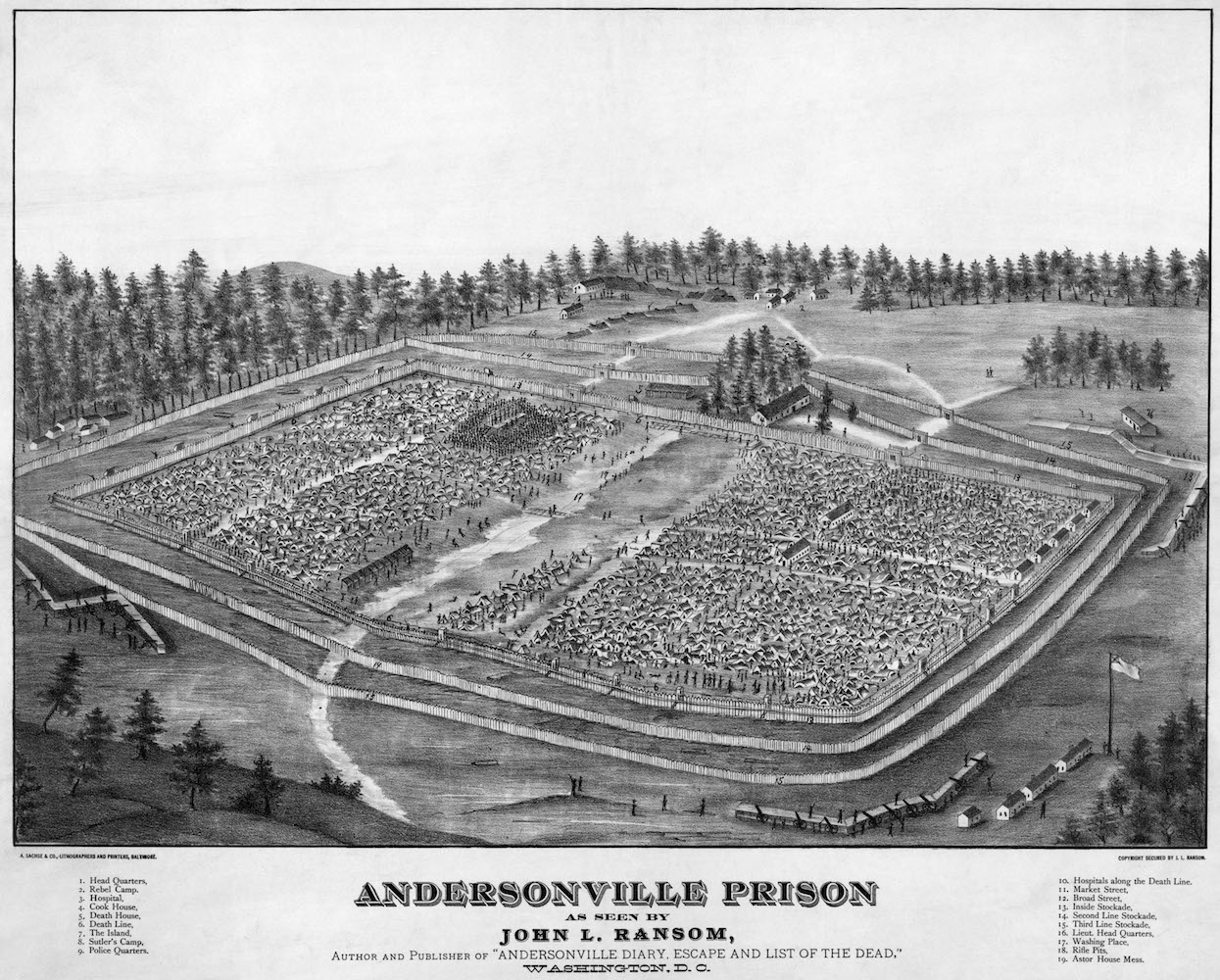
Andersonville Prison was opened in February 1864, 26.5 Georgian acres (about 0.1 square kilometers, or about the size of a square 4 city blocks on a side) of tightly-packed tents with a ditch of water flowing through its center. Its design population was 10-15,000 prisoners; its true population at one point was almost 30,000.** Some 45,000 Union soldiers went in, passing first the outer stockade, then the so-called “dead line” that demarcated the line outside of which they could be shot summarily, and finally into a mass of malnourished, often sickly humanity. Of these, 13,000 never emerged.

The Confederacy, you may recall, was not the war’s winner. As an aspiring nation, the CSA borrowed heavily to fund its arms, then found itself strapped for basic supplies as the war dragged on. By 1863 the nation was already economically depressed, and when a CSA-USA prisoner exchange agreement broke down, the Confederacy found itself with a lot of Union soldiers to house and nowhere to put them. Enter Andersonville: far enough from the North to be “safe”, easily defensible, and in the heart of slave labor to build it. All the Confederacy needed to build some basic housing was wood, which should be … oh wait … war update!…the Union controlled lumber supplies. Guess there won’t be housing.

Prisoners instead got lumped in with their brigade, and (at least initially) basic materials to make some sort of shelter.† New arrivals often showed up without being thoroughly checked over, so they might come in with food and supplies that weren’t already available to other internees.‡ Very quickly, the grounds were littered with Union POWs from around the country, people with vastly different backgrounds and goods. As the camp’s population breached 10,000 and then 20,000,§ there were, of course, inmates with designs on better living.

It’s not hard to see where this is going.

Sometime around May 1864, dozens of them assembled into a loose affiliation. The Raiders were headed by about a half dozen men: Charles Curtis, Patrick Delaney, John Sarsfield, William Collins (“Moseby”), a guy known only as “A. Munn”, and W.R. Rickson (or possibly Terry Sullivan; there’s an unusual disparity in diary accounts on the person’s name, but first-hand diary entries from the moment prefer Rickson) were considered the principal offenders. Each headed a small band of thieves who would trick new entrants, burgle tents, or use violence or threats of violence to amass “wealth” and keep themselves well-fed, well-clothed, and, most importantly to them in this hostile place, alive.

The Raiders had some huge advantages when they committed these crimes. Thanks to their amalgamated resources, they had good odds of being better armed and more fit than their victims — unless those victims were green, in which case they just knew the place better. The thieves started out as midnight raiders who turned tail at the first sign of genuine resistance unless they thought they could readily overpower the victim. By mid-June they were brazen, according to John Ransom: “Raiders … do as they please, kill, plunder and steal in broad day light, with no one to molest them.”

The victims were soldiers who, even if they weren’t killed, were left without resources in a deadly environment. Even the robberies and beatings were, in many cases, a prolonged form of murder, and Union inmates knew it. Indeed, Collins was thought by most to have never directly assaulted anyone, but he was known to steal blankets from the ill.

It’s unclear what the full Raider population was (estimates range from 100 to 500, but most people settle on the 100-200 range). What we can say definitively is that it was large enough to be a problem. Late in June of that year, a group called “the regulators” began taking police-like action against the perpetrators. Inmates brought their complaints to the group, which sought out and punished — usually through head shaving or other non-destructive means — those they found responsible.

On June 29, that problem started getting a real solution when the Raiders assaulted and robbed a prisoner now known only as Dowd. Dowd complained to the guards, and Andersonville’s overseer, Captain Henry Wirz, officially endorsed the Regulators as a police force/tribunal to maintain order. But first he announced an end to inmate rations until the Raiders were given up. (What a guy!)

The Regulators, headed by a man called “Lumber” (or maybe “Limber”) Jim, quickly had 80-100 inmates to deal with. Jury trials were implemented in the spirit of (but without most of the protections of) common law, and most punishments ranged from setting in the stocks to running the gauntlet.


Detail of a panorama sketch of Andersonville (click to see it) makes space for a certain well-attended sextuple hanging.

The ringleaders were also among this bunch. They were assembled on July 11 and executed at a hastily-erected gallows on the north end of camp. As far as the POWs were concerned, the ultimate crime of the Raiders was a violation of the soldier code of death before dishonor. Their bodies were buried separately from other inmates, and the US makes a point of placing no memorial flags at their graves.

To be clear, the Andersonville Raiders were, for most inmates, not the primary problem but an obviously controllable one. Remember that 30% of the interned died, and for the most part those deaths were borne of bad sanitation, hunger, and disease. The removal of the Raiders was a morale boost at best, as Andersonville was still a pee-pee soaked heckhole in which another 10,000 soldiers would die before liberation in May 1865, most of them before the summer’s end.

* It was also known as Camp Sumter, named after the county it resided in.

** The population density at peak was 330,000 people per square kilometer. For comparison, the world’s densest city is Manila, at about 71,000 people per square kilometer.

† It turns out the term “shebang” wasn’t widely-used camp lingo. Drawings and photos of the camp illustrate the variety of dwellings: open sleeping, simple V-tents, structured tents, lean-tos, huts, and shacks were all scattered about the grounds.

‡ They also came with new diseases.

§ The original camp was actually only 16.5 acres, and the population ballooned to 20,000 in early June and 33,000 in August of that year. Ransom notes that the stockade was “enlarged” on July 6. Fall transfers dropped the number to 1,500 and it bumped back up to 5,000 until war’s end. Sanitation issues persisted throughout.

On this day..

2018: Shoko Asahara and six Aum Shinrikyo followers, for the Tokyo sarin attack

Shoko Asahara and six of his followers in the Aum Shinrikyo cult were hanged today in Japan as authors of one of the most infamous terrorist attacks in recent history: the sarin attack on the Tokyo subway of 1995.

Thirteen people died and several thousand more were injured when members of this millenial sect deposited punctured bags of homemade liquid sarin on multiple rail lines of Tokyo’s subway during Monday rush hour.

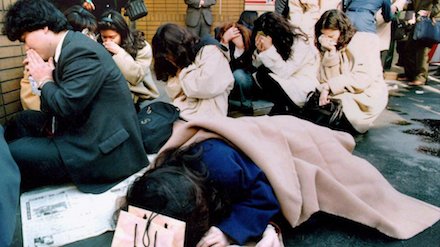
It was only one of several gas attacks perpetrated by Aum Shinrikyo during the 1990s; just nine months previous, they had killed nine people in a sarin attack in Matsumoto. But it is by far the most notorious. Images of stricken commuters, blinded and suffocating under the nerve agent’s influence, sprawled on the transit platforms or outside them shocked orderly Japan in 1995, especially so since it came fast on the heels of the devastating January 1995 Kobe earthquake.

These comprised “two of the gravest tragedies in Japan’s postwar history,” according to Haruki Murakami’s Underground: The Tokyo Gas Attack and the Japanese Psyche. “It is no exaggeration to say that there was a marked change in the Japanese consciousness ‘before’ and ‘after’ these events.” Japanese Justice Minister Yoko Kamikawa struck a similar chord in announcing the hangings today: “These crimes … plunged people not only in Japan but in other countries as well into deadly fear and shook society to its core.”

Its mastermind Shoko Asahara, the first man executed this morning, emerged soon thereafter into public view a bedraggled and half-blind fanatic, almost the picture of an agent of chaos. Shockingly, his cult had been able to thrive in the early 1990s thanks in part to murdering an attorney who was investigating Aum Shinrikyo back in 1989.

Beyond the seven hanged on July 6, 2018, six additional members of the cult still remain under sentence of death in Japan for the Tokyo subway atrocity.

On this day..

1530: Johnnie Armstrong, border reiver

Scottish “border reiver” John Armstrong of Gilnockie was hanged on this date in 1530 with his followers at Caerlanrig, without benefit of trial.

The job description of the border reiver was to, well, reave the border. These mounted raiders exploited the wide gaps in sovereignty that opened along the ill-controlled England-Scotland border throughout the 16th century (their heyday) and indeed for centuries prior. They plundered vulnerable* farmers both north and south of the notional line. Sometimes the prize was livestock; other times, the “black rent” due your basic protection racket would suffice.

Their presence left an indelible imprint on the Anglo-Scottish marches, from the farmhouse fortresses called bastle houses to provisions in the “March Law” governing the manner of permissible counter-raiding.

Nettlesome as they were, they also stood useful mercenaries hired out for a number of the era’s battles; notably, English-hired reivers held off a much larger Scottish incursion in 1542. Only with the union of the crowns under James VI of Scotland/James I of England were the reivers finally suppressed.**

Johnny/Johnnie Armstrong, the younger brother of Thomas, Laird of Mangerton, is perhaps the most lasting legend among them — thanks to the signal boost he would later receive from Sir Walter Scott. Chief of a reiver band 160 strong, Armstrong made himself enough of a headache for English-Scottish diplomacy that the Scots king James V resorted to treachery to eliminate him. Having dialed up the frontier “prince” for a meeting, James simply had the sharp-dressed marauder arrested and summarily hanged when the reiver came to call. Thirty-six of his fellow reivers died with him.

Johnny Armstrong is the subject and the title of a notable child ballad (no. 169) whose lyrics can be perused in their entirety here; several renditions of its climactic third chapter can be found in the usual places.

John murdred was at Carlinrigg,
And all his galant companie;
But Scotlands heart was never sae wae,
To see sae mony brave men die.

Because they savd their country deir
Frae Englishmen; nane were sae bauld,
Whyle Johnie livd on the border-syde,
Nane of them durst cum neir his hald.

* “Vulnerable” mostly meant, neither in the ambit of a powerful protector, nor of the reiver’s own clan.

** A subsequent echo of the border reivers — in the same vein and the same region, but clearly distinct from them — emerged later in the 17th century in the form of the moss troopers.

On this day..

1941: 3,500 Jews at the Khotyn Fortress … but not Adolph Sternschuss

(Thanks to Meaghan Good of the Charley Project for the guest post. -ed.)

On July 4, 1941, a thirteen-year-old Jewish boy named Ephraim Sternschuss began his diary in the Nazi-occupied Zloczow, Poland, with these lines:

Mother knows nothing about Father’s murder. I won’t be the one to tell. But I have to express what I’m feeling … I’ll write down all the details so when I’m old I’ll remember my youth and this World War, even though I’m not sure I’ll live through it.

I’m writing while lying on my back. I can’t move my legs. Mother says I’m in shock. Maybe I am. Maybe I’m so anxious because I can’t tell her about Father, who was drafted yesterday into forced labor and Mother still believes he’s alive.

The eastern Polish town of Zloczow had been annexed by the Soviet Union after the partition of Poland with the Molotov-Ribbentrop Pact in 1939. Zloczow‘s Jews, who at 14,000 people constituted about half of the population, lived in relative safety until the summer of 1941, when the Nazis invaded the Soviet Union.

They arrived in Zloczow on July 2. With the help of enthusiastic local Polish and Ukrainian collaborators, the SS rounded up 3,500 Jews, among them Adolph Sternschuss, Ephraim’s father. The victims were told they would be sent to forced labor — excavating mass graves of Soviet victims, digging anti-tank ditches, and such.

They were, in fact, digging their own graves.

Ephraim described his father’s departure thusly:

Father was taken at 10:00 a.m. An evening earlier Mrs. Reichard came by and told us that at a local Ukrainian meeting, it was decided to carry out an anti-Jewish pogrom the very next day. Unfortunately, Father didn’t believe her because she was such a gossip. Father was sitting in the kitchen when two Ukrainians came in, Warwara from our street and Bojko a tailor …

They told Father to get ready for work. Father changed into an old suit, emptied his pockets of everything except a penknife, a handkerchief and a Soviet ID. They said to give Father bread because “he would return only at two in the afternoon and he’d get hungry until then.” (My god, what hypocrisy!) Mother made two sandwiches with sausage. They also told him to bring a shovel and he kissed Mother and me and went away.

Adolph did not return at two o’clock, and at four that afternoon, Ephraim and his mother, Anna, heard the sound of distant gunfire coming from the Khotyn Fortress. A neighbor came by and told Ephraim there had been a mass shooting (the perpetrators were members of Einsatzgruppe C) and “all the men were killed.”


Khotyn Fortress. (cc) image from Andriy Baranskyy.

Ephraim assumed his father must be dead. He started his diary because he couldn’t bear to speak the dreadful fact aloud, but had to confide in somebody, if only an old school notebook.

What he didn’t know was that Adolph Sternschuss had, in fact, miraculously survived the shooting. The happy news was delivered to Ephraim’s family on July 5: Adolph was alive and hiding with friends of the family.

Around four o’clock the mother of Mrs. Kitai, Mother’s friend, came in and said that Father was alive and staying with them. Hurray! I went wild, jumping, laughing, everything. Mother gave her clean underwear for Father and asked her to tell him to stay there, not to come home, until the situation improved. Mother went out to tell Mrs. Reichard the news, and about an hour later the door opened and Father came in.

I’ll never forget the sight. His black suit was gray with dirt and dust, on his head he wore some wrinkled hat … He held the package of underwear Mother sent him and a small army shovel. When he entered I jumped out of bed and screamed “Mummy!” and ran to him. I kissed him although he was terribly stinking, like a corpse — and he started crying. It was the first time I saw Father cry.

Together with Mrs. Beer we pulled a sofa into the other room and hid the door behind a mirrored chest. We helped Father remove his clothes and then we saw what the Ukrainians were capable of. His whole back was beaten to a black pulp and swollen and he had a hideous bruise on his head.

We washed him and then he ate something and then we put him to bed and he fell asleep. He didn’t say a word.

Over the next few days, Adolph described his ordeal and his incredible survival to his only child, who wrote it all down in detail in his diary. Adolph’s story, as told to Ephraim, is worth quoting almost in full:

At noon I brought him a meal and he told me what he had gone through. I didn’t recognize his monotonous tone, but there, in the darkness of the basement, I sensed that he was reliving his ordeal. Well, in the beginning he worked near the Fortress, burying cadavers of horses.

Then he was transferred to the Fortress itself. At the entrance he was ordered to show his papers, but he lied, claiming he had none. “A man is only an addition to his identity card,” he said as if he were the father I knew.

They worked in two places: the inner court of the prison and the garden. They had to dig up mass graves of corpses killed by the NKVD — Ukrainians and Poles (and some Jews like Dr. Grosskopf and his son-in-law). The bodies were laid out in rows to be identified.

On that occasion, the Ukrainians beat the Jews, accusing them of committing these murders. Naturally, the Germans and the S.S. troops joined in, beating the Jews mercilessly. Father was followed by a short, white-haired butcher who hit him with a stout stick he had pulled out of the fence, and by a tall, blond S.S. soldier who used a coiled rope.

At noon two officers came up to Father and asked his profession. He answered, “Lawyer.” Probably they could tell from his accent that he had studied in Vienna,* but they asked him anyway. When he confirmed it, one of the Germans asked, “You aren’t Jewish, are you?” and Father said he was, and the German, furious, said, “Then I can’t do anything for you,” and the two of them stormed off.

Shortly after, the shooting began …

Around three o’clock they shot Father, but as he happened to already be in the ditch, all four bullets hit the pile of dirt, and Father fell down and pretended to be dead. An hour later it started raining and that’s what saved him: the Ukrainians and Germans were forced to stop shooting and shelter themselves under the roof.

At 9 p.m. sharp Kuba Schnapp and Freimann pulled Father out of the ditch and all three made their escape. Father practically had to be dragged away because both of them, and two corpses, were lying on his left leg. “After playing Indians,” said Father and it seemed to be that he smiled, they slipped through a hole in the fence and parted ways.

Father wanted to enter Winczura’s house but was refused. He then moved on to Barabasz and there, in the attic, were about thirty people. The next day he was forced to leave because of the terrible conditions. He moved over to a client of his, Mrs. Lewant, and stayed in the attic with the Kitai family. From there he returned home.

“One thing is etched in my memory forever,” he said. “I never imagined that Jews could die like that. They were like Romans. Proud, erect, silent. Thus they were killed.”

Seventy years later, one “old, toothless” witness, one of the fifteen remaining Jews still living in the area, recalled the massacre: “The earth shifted for days. They couldn’t bury them fast enough.”

Unfortunately, Adolph didn’t live long after he crawled out from under those corpses in the mass grave. He was not young, and his health was ruined by his horrific experience. Just a few days before Christmas, he died in his bed after a series of heart attacks.

On December 29 that year, Ephraim wrote mournfully,

Only those who have lost their fathers will understand me — and regrettably there are so many now. Dr. Hreczanik was right when he said to Mother, “your husband was killed at the Fortress.”

This first mass killing in Zloczow was followed by others. In late August 1942, the Germans rounded up 2,700 Jews and deported them to the Belzec Extermination Camp. In early November, a further 2,500 people were taken away.

A month later, a ghetto was established for between 7,500 and 9,000 people from Zloczow as well as the remnants of several nearby Jewish communities. Rather than go into the ghetto, Ephraim and his mother went into hiding, concealed outside the village of Jelechowice by sympathetic Ukrainian Catholic farmers: Grzegorz “Hryc” Tyz, his wife Maria “Misia” Koreniuk, and Helena Skrzeszewska.

The Sternschusses made the right choice: in April 1943 the Zloczow Ghetto was liquidated and all the survivors were shot and buried in mass graves.

Ephraim and Anna Sternschuss remained hidden on the rural farm for the rest of the war. When it was safe they just stayed inside the house; when there was danger they hid “downstairs” under the floor, “in a grave-like pit, narrow and long.” He kept writing in his diary:

We walk about the house without any inhibition, trusting Rex to faithfully do his duty. He barks differently at anyone so we can know in advance whether he’s a friend or a foe. In any case, whenever we hear him, Mother and I enter our room, shut the door and Misia, if the visitor is a stranger, sings “Chiming of Bells in the Dusk.” Then we sit quietly, almost without breathing, waiting for the visit to end. Nobody must know about our existence here.

The Sternschuss family’s hosts refused to accept any payment for their stay, but Ephraim and his mother did have to chip in to cover the cost of their food. Over time, others joined them: Ephraim’s aunt and uncle, Lipa and Linka Tennenbaum; the Tennenbaums’ daughters, Eda and Selma; the five members of the Parille family; and Edzia Weinstock and her daughter Eva.

Thus, the farm became a sanctuary for eleven Jews, plus the three hosts — all living on a small farm with a three-room farmhouse, a shed, an outhouse, and an uncertain grant of borrowed time. Ephraim occupied himself writing in his diary, drawing, and reading. Misia Koreniuk, one of his hosts, was a teacher, and she freely shared her “huge chest of books and magazines” with him. Ephraim even began teaching himself algebra and geometry.

It wasn’t all a nightmare. There was, for example, an amusing incident in February 1943 where they got the farm animals drunk on moonshine vodka:

It was a pity to have to throw it away, so Hryc scattered a bit in the yard for the chickens and the rest he put in the trough for the cow Krasula. The chickens pecked — and immediately lay down on the earth, absolutely foggy minded. But Krasula started going berserk, running around and climbing trees. It was terribly funny but also a bit dangerous. Hryc managed to overcome her with much difficulty and tied her up in the stable.

Through his hosts Ephraim kept up with the progress of the war and tracked the Allied advance in his diary, eagerly awaiting liberation. Yet it was hard to stay optimistic and he occasionally had thoughts of suicide. As he wrote in October 1943, he struggled to keep from succumbing to apathy and despair:

It’s all nonsense. […] Nobody knows us. We don’t have anybody in the whole wide world. Nobody. Only Mother and I. Therefore there’s no other option: one mustn’t give in to crises. We have to stay united. Today my heart is heavy. I’m writing almost in darkness but I must write. Too much crap weighs on my heart and I must pour all of it, at least in this diary.

Why is it called life? The best years of my youth have gone by and will not return. Never. Even if it all ends today, it won’t do any good … This is my life. And if I add the well known fact that everybody is born with a death verdict — what’s there to live for?

On November 6, 1943, a baby girl was born on the farm — the offspring of one of the members of the Parille family. Before the war, the mother had tried for years to get pregnant, going through “all possible treatments and nothing helped. And here, of all places, did she give birth.”

Ephraim wrote that their host, Hryc, started sobbing in despair when he found out:

So we aren’t only fourteen but fifteen with the baby! Not too bad … That’s to say very bad. Lipa is right saying that the baby can betray us all. We learned not to speak but to whisper, but a baby?! What’s to be done?

Within a few days the baby died. Perhaps it was just as well.

The situation became even more precarious in late January 1944, after a unit of retreating Germans showed up at the farm and the commander requisitioned a room in the farmhouse for himself and his Russian girlfriend.

Thus the farmhouse was divided: the German in one room, the three Ukrainian farmers in the next room, eight Jews in the 3×4 meter room down the hall, and three more hidden in the shed!

The German officer never found out about the hidden Jews, and as Ephraim noted, the man’s presence turned out to have a silver lining, because it protected everyone from the threat of looting, arson and murder at the hands of anti-Semitic Ukrainian partisans, who had become very active in the area.

Also, Helena Skrzeszewska was able to cajole the military kitchen into giving her their leftover soup, which she fed to the Jews. Ephraim noted wryly, “We live at the expense of Hitler.”

He was actually upset when the German officer left the farm two weeks later, writing,

Our citadel is no more. Again fearful nights will begin without the landlords who’ll go to the village for their sleep. We’ll remain on our own against the gangs, full of fear of the Ukrainian killers, of being set on fire … Again night watches every two hours, with a pistol and six bullets.

Sure enough, in early March, while Ephraim’s hosts were away from the farm, the Ukrainian partisans tried to set the place on fire. Ephraim was on watch that night:

I don’t know if I panicked. But now, while writing that, I think I wasn’t absolutely clear about what I was doing. Anyhow, after raising [the others in hiding], I opened the door and like an idiot went out into the lighted yard. Two sprints brought me to the well. I crouched behind its side and emptied my pistol of all its bullets, shooting into the darkness of the forest like a movie cowboy. The first time in my life.

In the meantime Lipa, Mother, Linka and Edzia came out with buckets. […] I don’t think it took us a long time to control the situation. The fools didn’t shoot at us from the forest despite the fact that we were in the light. I assume — and I’m not the only one thinking like that — that they were frightened of us being armed.

In the morning, when our landlords came back from the neighbors, they were surprised to learn that the house was still standing. […] Hryc went to the forest and found blood stains in the snow.

Later the month the Germans returned and searched the farm for signs of partisan activity, and actually encountered Ephraim’s aunt and mother inside the house:

Mother and Auntie locked us in and ran to the entrance door. They hardly made it when the door was busted open in spite of the big lock hanging outside. The Germans were astonished running into them. Despite Lipa’s warnings to Mother not to reveal her knowledge of German, she explained to them that they were locking themselves in the house in fear of the partisans.

“The partisans are all Juden,” said one of the Germans, and then asked where did Mother acquire such a German [language]. She told him she lived in Salzburg and came here to get married. “It’s all Love’s fault,” said the German, asked her to forgive him, went out and in a moment returned with a bomboniere.

In the meanwhile dawn was breaking and they discovered the Germans were S.S. troops. Mother says that if she wasn’t hit by a heart attack she would never have one. Immediately she told them they were being “evacuated” to the West. The Germans, perfect gentlemen that they were, proposed to help them, give them a truck. Auntie thanked them, said there was no need, everything was under control. Indeed.

Half an hour later our landlords returned back from the village. They looked really terrified when they saw Mother and Linka standing at the entrance to the house with two S.S. men. Mother introduced them, bid the Germans farewell and entered the hideout with Auntie.

The hideout happens to be east of the house, not west.

All the Jews spent three days in the underground hideout until the SS officers left. By then the front was very close, as Ephraim wrote on March 13:

In the nights, during shifts, we hear the “music” of artillery. The front keeps coming closer. Two days ago they were at Podhorce, 15 kms away! The windows were shaking to the blasts of cannon. But the Germans, damn it, pushed them back to a point 35 kms from us. There they stand and shoot. What bad fortune! Tarnopol has been liberated and we are not.

On March 26, Ephraim noted that it was the 1,000th day he had spent living under German occupation: “The 1,000 days we’ve spent in the Reich are like 1,000 years. With my whole heart I wish the Fuhrer and his admirers to have 1,000 such days …”

And he had months left to endure before he would see freedom.

On July 3, the second anniversary of the massacre at the Khotyn Fortress, Ephraim was using the outhouse when he saw a car stop and two Germans emerge with two men and a child. The Germans shot all three of them and left their bodies by the road. The victims, he found out later, were Jews who had been caught hiding nearby.

Liberation finally came to Jelechowice on July 16, 1944, as noted by a single sentence in red pencil in Ephraim’s diary: “THE BOLSHEVIKS HAVE ARRIVED!!!” He was sixteen years old, and had survived 1,111 days under the Germans.

On the third day after liberation, he recorded,

Mother, Auntie and I went to town. Zloczow made a terrible impression on us. Only bombed, burnt houses, torn wires on the road. A mass of troops on the way to Lvov. Our house is burnt. The neighbors — who couldn’t really understand how we managed to survive — said that the Germans had set the house on fire because it contained the archives of the Gestapo.

In the house, which was inhabited by the Gestapo unit, we found our dining room furniture in one of the rooms. It looked strange to me. That’s precisely what we need: a big table, or a buffet …

We haven’t met Jews.

Ephraim’s last diary entry was on July 29. He wrote of finally encountering some other survivors:

Maybe twenty people, perhaps thirty … All stood and cried. For sure I don’t have to write that picture down in the diary. I’ll remember it to the end of my life. All the Jews, the ten thousand Jews of Zloczow, were praying together in one small room. I heard the heart-rending sobbing, the wailing, the “Magnified and sanctified be His great name” prayer for the dead, and the “God, full of compassion” one, and I understood once and for all that they, we, address somebody who was absent when needed, and perhaps now wasn’t needed any longer, or maybe simply never existed. It was noontime and

The diary ends in mid-sentence.

Ephraim remained in Poland for over a decade after the war. He attended engineering school for two years, then switched his studies to theater. He moved to Israel in 1957. There he changed his family name from Sternschuss to Sten.

In Israel, Ephraim married, had children, and had a successful career as an author, actor, director and playwright for both stage and radio. But for decades he kept his diary hidden and did not speak of his Holocaust experiences to anyone.

Although he had a normal existence in his adopted country, he never recovered emotionally from the trauma of the war, describing it as “the load crushing my soul.”

He had thought, he said, once he left Poland, that he might finally “become a regular human being. But the world wouldn’t let me.”

In the 1990s, Ephraim returned to Zloczow, which is now part of Ukraine and called Zolochiv. Two of his Ukrainian rescuers had died, but Ephraim had a tearful reunion with Hryc Tyz, who told him, “You are my relatives. I didn’t believe I’d be lucky to yet see somebody from my family.”

His four-day trip inspired him to dig out his diary and translate it into Hebrew so that his children could read it. The diary was published in English in 2006, with annotations by an older Ephraim fifty years after the fact, under the title 1111 Days in My Life Plus Four.

Ephraim Sten died in 2004.

The Khotyn Fortress is a major tourist attraction in Ukraine and is considered one of the nation’s most stunning castles. In a nearby field, a “foul-smelling marsh” where “the grass is high and thick,” is a memorial for the 3,500 Jews (but not Ephraim’s dad) who were murdered there in July 1941.

* Zloczow answered to the sovereignty of the Austro-Hungarian Empire until 1918.

On this day..

1697: The Paisley Witches

On this date in 1697, the Paisley, Renfrewshire Gallow Green played stage for the strangling and burning of six “witches.” They’re known as the Paisley witches, the Renfrewshire witches, or the Bargarran witches, and are sometimes acclaimed the last mass-executed witches in western Europe.

This book posits a more than incidental resemblance between Salem and Renfrewshire, given that the “possessed child” figure was not a usual ornament for Scottish witchcraft cases.

In a setup bearing a disturbing similarity to the Salem witch trials,* an 11-year-old brat named Christian Shaw, the daughter of a local laird, got a tongue-lashing from the family servant and then turned around and accused her a sorceress.

The psychological mechanisms at play make interesting speculation in such cases. Was she merely a spiteful little monster, or did she believe in accordance with the superstitions of her time that the servant’s curses had effect, and suffer real afflictions that ensued upon this belief? Can we see her in the end as a creature necessarily produced by her nation in its troubled hour, unmoored as it was by the political and religious dislocations of the Glorious Revolution, gnawed by famine, and hurtling towards an unwilling union with England? (The bizarre execution of an Edinburgh university student for blasphemy also unfolded in 1696-1697.)

We leave such speculations to the reader as we plunge into the onset of supernatural doings in these environs almost a year before the consequent executions — via a 1698 pamphlet titled “A True Narrative of the Sufferings and Relief of a Young Girle Strangely Molested, by Evil Spirits and their Instruments, in the West”

August 22 [1696], the Child went to Bed in good health; but so soon as she fell asleep, began to struggle and cry, Help, Help: And then suddenly got up, and did fly over the top of a Resting-bed, where she was lying (her Father, Mother, and others being in the Room, and to their great Astonishment and Admiration) with such violence, that probably her Brains had been dasht out, if a Woman, providentially standing by, and supported by a Door at her back, had not broke the force of the Childs motion, who being laid in another Bed, remained stiff and insensible as if she had been dead, for the space of half an Hour; but for Fourty eight Hours thereafter could not sleep, crying out of violent Pains thorow her whole Body, and no sooner began to sleep or turn drowsie but seemed greatly affrighted, crying still Help, Help.

These frightening spasms continued for days, contorting her body and robbing her of speech; helpless doctors bled her to no effect.

Some dayes thereafter was an alteration in her Fitts, so far, that she got speaking, during the time of them; and while she was in the fits, fell a crying, that Katharine Campbel and Agnes Naismith were cutting her side, and other parts of her Body; Which parts were in that time violently Tormented. And when the fit was over she still averred, that she had seen the same Persons doing the same things which she complained of while under the fit (it being remarkable that in the intervals she was still as well and sensible as ever) and would not believe but that others present saw them as well as she!

Katharine Campbell was servant who had chewed her out. Agnes Naismith was an old lady with a witchy reputation. In time they would headline the execution that occasions this post.

We must here pause to remark that the decision of the adults around Christian Shaw to steer this crisis in the girl’s life towards a judicial witch hunt was by no means predetermined. While capital statutes against bewitchment remained on the books, they were fading in practice; according to the invaluable Survey of Scottish Witchcraft database, there had been only a single witchcraft prosecution in Scotland since 1683, and that one did not result in execution. The sudden eruption of a dormant and vanishing cosmology, with sufficient force to devour seven humans, shocks the eye.

Credit must go to Shaw for a rare commitment to the performance, as her symptoms continued intermittently for months, and accumulated a growing roster of accused supernatural tormentors. She was taken to Glasgow for treatment, and taken again; she went on regimens of prayer and fasting; at one point she began pulling debris out of mouth like a prestidigitator, in such number and variety that her doctor remarked that “Were it not for the hairs, hay, straw, and other things wholly contrary to human nature, I should not despair to reduce all the other symptoms to their proper classes in the catalogue of human diseases.”

Although modernity will doubt that they bewitched the child, the accused women, Agnes and Katharine, knew exactly what was up when they were brought to confront their accuser. They addressed their common peril with opposite strategems. Agnes, “did (tho not desired) pray for her, viz. that the Lord God of Heaven and Earth might send the Damsel her health,” which prayer cured Christian Shaw of continuing to accuse Agnes of muddling her (“upon the contrary, as she apprehended, defending her from the fury of the rest” of the witches) — whereas the saltier Katharine “could by no means be prevailed with to pray for the Damsel, but upon the contrary when desired by some, cursed them and all the Family of Bargarran, and in particular the Damsel and all that belonged to her, withal adding this grievous Imprecation; The Devil let her never grow better, nor any concern’d in her, be in a better condition than she was in, for what they had done to her.” I like this Katharine, but Laird Bargarran had the sheriff throw her forthwith into the dungeon; the reader may recall from our foreshadowing that Agnes’s more diplomatic approach did not ultimately serve her any better.

By January, five months after Christian’s first fits, the doctors and ministers had been defeated and the Privy Council appointed a tribunal to investigate the matter and shoo away the hags bothering Christian Shaw. The annals of their actions makes for repellent reading, even by the standards of judges. Readers with strong eyeglass prescriptions can enjoy the full pdf here, but most will probably prefer this lucid summary by Undine, a onetime Executed Today guest blogger. We also have a Victorian compilation of records related to the affair here.

The hunt swept up a 14-year-old boy and his 11-year-old brother, a 17-year-old girl who was made to furnish accusations that incriminated still more people besides. One can see in our credulous 1698 account the enspelled little shit begin to revel in her theatrics and the power she held over her neighbors.

February 12. Margaret Laing and her Daughter Martha Semple, being delated by the three Confessants, and accused by the Girl to have been active instruments in her Trouble, came of their own accord to Bargarran’s House, and before they came up Stairs the Girl said, she was now bound up, and could not accuse Margaret Laing to her face: And accordingly the Girl’s Mother having desired somer of those who were sitting by her to feel some parts of her Body, and they having done it, found her Body so stiff and inflexible, that there was no moving of it, and immediately again found some parts of her Body contracted and drawn hard togethe [sic], as if by Cords; after this Margaret Lang and her Daughter, having gone to the Chamber of the Girle, did in presence of the Ministers and others, desire the Damsel to come to her; for she would do her no Harm, and laying her Arms about her, spake very fairly to her, and question’d her if ever she had seen her other Daughter among her Tormentors, to which the Girle did positively reply, she had frequently seen her Daughter; but declined thorow fear to accuse herself, saying faintly No, after which Margaret and her Daughter returning into the Hall, and the Minister enquiring at her why she said No, seeing she had accus’d her before, she answered, take me contrar, upon which she was seiz’d with a grievous Fit; yet after her recovery being urg’d again by those present to tell her Mind freely, whether or not Margaret Lang was one of her Tormentors the Child thereupon Essaying to say Yes, and having half-pronounced the Word, was cast into unexpressible Anguishes; and again in the interval of the Fit, she Essay’d to express the same thing, and saying only the word Tint (that is soft) was on a sudden struck with another fit, and when the fit was over, and the Child returned to the Chamber, Margaret Lang who was sitting near the Hall door, spoke these words after her. The Lord bless thee, and ding (that is beat, or drive) the Devil out of thee. A little after which words, Margaret going down stairs, the Damsel came to the Hall and said, her Bonds were now loos’d, and that now she could accuse Margaret Lang to her Face, and declar’d the occasion of her being so Restrain’d and Bound up while Margaret was present, was her letting fall a parcel of Hair at the Hall door as she came in; being a Charm made by her for that end, which also had been the occasion of her uttering the word Tint in the former fit: And accordingly a parcel of Hair had been found at the Hall-door, after Margaret Lang had gone straight from the Hall to the Chamber, which immediately was cast into the Fire and burnt. And its remarkable, that it could be attested that there was no Hair, or any other thing else in that place before Margaret Lang came in, and the Girle being enquired, what way she knew Margaret Lang had laid the forementioned Charm upon her, replyed, something speaking distinctly to her as it were above her Head, had suggested that to her.

In the end — and posterity unfortunately lacks the original trial record — there were seven condemned to death and although their names in the surviving accounts “are not very distinctly stated” they appear to comprise our two original accused, Katharine Campbell and Agnes Naismith, the aforementioned Margaret Lang, the 14-year-old child James Lindsay and an apparent kinsman named John Lindsay, and also John Reid and Margaret Fulton. (Some accounts more mawkishly make it little James Lindsay with his 11-year-old brother Thomas, but that’s not indicated by the primary sources which repeatedly note that Thomas is “under the age of pupilarity.”)

John Reid managed to hang himself in prison and cheat the executioner. Katharine Campbell did him one better by fighting her persecutors all the way to the stake, and deservedly showering everyone in earshot with curses. The legend has it that Campbell’s malediction lurks behind any civic setback endured by Paisley down the years, such as the 1810 Paisley canal disaster. A horseshoe placed over the embittered sorceress’s grave to keep ill fortune at bay was lost in the 1960s; in 2008, a brass horseshoe plaque was installed in its place at the intersection of Maxwellton and St. George Streets — the memorial admitting the injustice done to all the Renfrewshire witches.

As for the witches’ accuser, Christian Shaw mirrored in her own life’s story the epochal shift that transformed witches from a legally recognized threat to a ridiculous superstition — as she grew up to become essentially the founder of Paisley’s distinctive (and still to this day important) thread industry by creating the “Bargarran Thread” .

* Coincidentally, the first execution of the Salem trials also occurred on June 10.

On this day..

1944: The Massacre of Tulle

On June 9, 1944, the 2nd SS Panzer Division hanged 99 habitants of the French town Tulle as revenge upon the French Resistance.

On June 7, the Communist Francs-Tireurs et Partisans (FTP) guerrillas launched a pre-planned attack on German and milice positions in Tulle. By the 8th, the FTP had liberated the town* … temporarily.

Come the evening of the 8th, the 2nd SS Panzer Division — which had been stationed in southern France but was rumbling north to fortify the German position in the wake of the Allied landing at Normandy — arrived at Tulle and re-occupied the city.

On the morning of the 9th, the Germans went door to door and detained nearly all the men in Tulle over the age of 16, an estimated three to five thousand potential hostages. By the afternoon these had been efficiently culled to 120 semi-random targets for exemplary revenge to cow the populace, people who looked too scruffy to the Germans and didn’t have an alert contact with sufficient pull to exclude them from the pool. The count was determined, as a poster announcing the executions explained, as the multiple of 40 German soldiers estimated lost* during the FTP action.

Throughout the afternoon, that threat was enacted with nooses dangled along lampposts and balconies on the Avenue de la Gare — although not to the full 120 but rather to the odd number of 99. It remains unclear why the hangings stopped early; certainly it was no excess of sentiment on the part of the Panzer division, which had been redeployed to France after giving and getting terrible casualties on the far bloodier eastern front.

“In Russia we got used to hanging. We hanged more than 1,000 at Kharkov and Kiev, this is nothing for us here,” a Sturmbannführer Kowatch remarked to a local official.

And so in batches ten by ten, before an audience of other prisoners and frightened townspeople peeping through shuttered windows and mirthful SS men, the hostages were marched to their makeshift gallows, forced up ladders with rifle-butt blows, and swung off to publicly strangle to death. The avenue’s unwilling gibbets were not suffered to discharge their prey until the evening, when the 99 were hurriedly buried in a mass grave. Afterwards, another 149 were deported en masse to Dachau, most of whom would never return.

The never-repentant commander who ordered the mass execution, Heinz Lammerding, was condemned to death in absentia by a French court; however, West Germany refused extradition demands,** and Lammerding died in 1971 without serving a day in prison.

This event remains a vivid civic memory in Tulle, as well as the namesake of the Rue du 9-Juin-1944; travelers might peruse a guide to the numerous memorials in the vicinity available here (pdf).

The 2nd SS Panzer Division proceeded the next day on its northerly route to Oradour-sur-Glane, and there participated in the mass murder of its inhabitants, an atrocity that is much better remembered today than that of Tulle. The journey and operations of this division are the subject of a World War II microhistory titled after the unit’s nickname, Das Reich: The March of the 2nd SS Panzer Division Through France, June 1944.

* The 40-to-50 German dead in Tulle include some summarily executed. For example, nine officers of the SD were shot in a graveyard after capture.

** Lammerding’s comfortable liberty became headline news in the 1960s, which was not long after Israeli commandos had kidnapped the fugitive Nazi Adolf Eichmann. France allegedly mulled such an operation to bring Lammerding to justice.

On this day..

1916: The Zainuco Massacre

On this date in 1916, eight convicts were summarily executed by Argentine police after a prison break in an affair known as the Zainuco Massacre.

Almost all the information about this event available online appears in Spanish and this also applies to the links in this post.

Jose Cancino, Nicolas Ayacura, Fructuoso Padin, Jose Lopez, Antonio Stradelli, Transito Alvarez, Francisco Cerda and Desiderio Guzman were among the last escapees among over 100 inmates who had overpowered their guards and fled the overcrowded Nequen prison on May 23.

Most of these men would be trapped and re-arrested in the coming days, but a large body of them forged rapidly westward, hoping to cover the 500 kilometers to the Chilean border. Not until a week later did police catch up with them, at a place called Zanaicuo south of the city of Zapala.

Bivouaced at a ranch there, the fugitives* were awakened from their rest during the dark early hours of May 30 by a fusillade; they had looted where possible during their flight, but their ammunition was not plentiful and quickly exhausted itself, forcing the escapees’ surrender.

At this point, their captors divided their prizes, either 15 or 16 souls, into two halves. The first of these halves, the lucky half, marched away to Zapala, destined to return to their irons. The other eight were brought to a lagoon, putatively to freshen up … and there they were shot dead, to a man. The cops’ story was that a couple of them tried to grab guns, though a resident of the parts who found the bodies reported that all eight had been shot execution-style in the head. They were consigned to a mass grave.

A few months later, nosy Neuquen journalist Abel Chaneton, who evinced an unwanted degree of interest in this incident, was also shot dead by police, permitting the quiet closure of the case.

And there it has rested ever since — mostly in obscurity, although a human rights consortium recently marked the centennial of the killings by placing a sculpture and marker, reading:

100 years after the Zainuco massacre, we rise up against oblivion and the impunity of this and all the crimes of the state authorities.

* A South African named Martin Bresler had separated from the main body of prisoners and did indeed manage to reach Chile — allegedly surviving a freezing night by nesting inside his horse, tauntaun style. He moved to the United States, fought in World War I, and wound up dying in a Buenos Aires mental asylum in 1942.

On this day..