1943: Thirteen Red Orchestra members

Thirteen anti-fascist resistance members of the “Red Orchestra” ring(s) were efficiently beheaded by the Plötzensee Prison fallbeil on this date in 1943.


Let no one say that I wept and trembled and clung to life. I want to end my life laughing, laughing the way I loved and still love life.

Erika von Brockdorff

They were:

German Wikipedia’s list of executions in the Reich has only the above 11 listed for this day; via … @KrasnojKapelle on Twitter and this Bundesarchiv page, the others were

* A psychoanalyst, Rittmeister contributed through his correspondence the whimsical/ominous title of a volume about the history of his field — “Here Life Goes on in a Most Peculiar Way”: Psychoanalysis before and after 1933.

On this day..

1974: Leyla Qasim, Bride of Kurdistan

On this date in 1974, Kurdish activist Leyla Qasim was hanged by the Ba’ath regime in Baghdad.

A middle daughter among four brothers from the heavily Kurdish Khanaqin district, Qasim joined the Kurdish Student Union as a student at Baghdad University in the early 1970s.

The Iraqi government had fought a running war against Kurdish rebels throughout the 1960s, resolved only by a tenuous truce; by the spring of 1974 armed conflict began again.

Visible Kurdish activists living right in the capital became a natural target.

Qasim and four male companions were arrested in late April, accused of plotting against Iraq (various accounts have this down to a hijacking scheme or cogitating the murder of Saddam Hussein). They were tortured, condemned in a televised trial, and executed together.

She purportedly gave her family the last words of a proper martyr: “I am going to be [the] Bride of Kurdistan and embrace it.”

She’s still regarded as a Kurdish heroine and many families confer her name on their daughters.

On this day..

1896: Five Persians by gatching

From the London Graphic, August 15, 1896:

An Execution in Pesia

From a corrspondent

A hideous form of execution, which has not been practiced for twenty years, was revived the other day to strike terror into the hearts of the people. The murder of the Shah was followed by a succession of robberies on the road between Bushire and Isfahan, the nomad tribes going out in large parties and looting villages and caravans, and an Englishman was even stripped naked and beaten with sticks. One hundred thousand pounds was estimated as the value of property that changed hands during one week. Every day individuals came naked into Shiraz, and the roads were strewn with merchandise that the robbers found unsuitable to carry off.

At this juncture H.R.H. Rukn-ed-Dowleh, Governor of Shiraz, marched out of prison five men, who, common report said, had been there for the last five months, and had had nothing whatever to do with the matter, but had merely been brought from the south, because they refused to pay the excessive taxes imposed on them.

These men were to be executed to frighten the people by being buried alive in plaster of Paris. This form of execution is called “Gatching,” and consists of a hollow pillar being erected over a hole about two feet deep, so that the whole forms a well into which the prisoner is put, sometimes (the most merciful method) head downwards, and at others with his head sticking out over the top; Plaster of Paris is then emptied in, and between each basketful water is poured down the well. The gatch then swells, and when it hardens it stops the circulation, causing the most excruciating agony.

About nine a.m. on Sunday, May 10th, the five prisoners, chained neck to neck, were marched out of prison, and slowly escorted by a large mob, who were kept from pressing too close by soldiers with fixed bayonets and others with long sticks, they were taken to the Koran Gate, near the Bagh-i-No, on the town side of which, alongside the road, their wells had been prepared. It took one hour to reach the Bagh-i-No, but the torture of this form of execution being unknown to the prisoners, they walked along without a sign of fear.

They were taken into a high-walled garden, a guard being placed at the entrance, and in a short time the first to be executed was brought out. Round his neck was a steel collar with a chain, which his guard held tightly in his hand. Someone offered him a pitcher of water, from which he eagerly drank, and then, not knowing to what awful death he was doomed, he walked calmly and without a word to his well.

It took nearly half an hour to fill the well with gatch, during all which time the sticks of the soldiers were in use to keep the crowd from pressing too close and hampering the movements of those employed with the gatch. After this, the second was brought out, and as the crowd moved to the well prepared for him I took the accompanying photograph, which shows the man buried up to the chin, his face covered with powdered gatch and his eyes closed, so as not to see the crowd standing round; the gatch has not begun to set, and the man is suffering no pain.

Having obtained a photograph of a form of execution which I hope has been resorted to for the last time, I hurried from the spot, and only just in time, as I afterwards heard, to escape the most heartrending scenes. When the gatch became solid and tightened on the poor prisoner, his yells were frightful to listen to, and as they were carried over the walled garden, those waiting their turn realised that the death to which they were doomed, so far from being the painless one they had hoped for, was instead of a terrible nature. As the fourth man was led from the garden he begged the executioner to take him to the Bazaar, where he would find some one to give him ten tumans (2 l.), after which he could cut his head off. The fifth man became even more frantic as the yells issued from the mouths of his companions. “Spare me! Spare me!” he cried, “and I will show you were 2,000 tumans (400 l.) lie hid,” but his offer came too late.

When, three days later I passed along the road, I found capitals had been added to the pillars, covering the heads of the poor men, who had thus horribly been done to death.

On this day..

1818: Five from the Lancaster Assizes, “most dangerous to society”

On this date in 1818, four hanged at Lancaster Castle for uttering forged notes, along with a fifth hanged for burglary and horse theft — all casualties of the latest Lancaster Assizes. For the account, we excerpt Jackson’s Oxford Journal of May 9, 1818; the footnotes are from that source as well.

LANCASTER ASSIZES, April 13.

Address of Chief Baron Richards, on passing sentence of Death upon the prisoners capitally convicted of forgery, and of uttering forged Bank of England notes.

Wm. Oxenham*, convicted of uttering a forged Bill of Exchange, was first placed at the bar.

Chief Baron — “William Oxenham, you have been convicted of uttering a forged Bill of Exchange, well knowing at the time you uttered it that it was forged. The crime of which you have been convicted, on the most satisfactory evidence, by a most intelligent Jury, is a crime the most dangerous to society, and which loudly calls for the highest punishment the law can inflict; for no man, in a commercial country like this, can, by any care, effectually protect himself from such attempts. If there should be any disposition at the foot of the Throne to extend its mercy towards you, I shall rejoice: but of this I can offer no assurance; and if there should be any mitigation of your sentence, it will only be on condition of your being forever removed from this country.” — His Lordship then passed upon him the last sentence of the law in the usual terms.

The following prisoners were then placed at the bar: — Wm. Steward†, Thomas Curry†, Margaret M’Dowd†, R. Wardlaw†, R. Moss, Hannah Mayor, and J. Vaughan, convicted of uttering forged Bank of England notes; and G. Heskett†, convicted of burglary and horse-stealing.

The Chief Baron, addressing by name the first seven prisoners, thus proceeded, —

You have been severally convicted of uttering forged Bank of England notes, knowing them to be forged: the law has affixed to this crime the punishment of death, and it is an offence which, on account of its injurious consequences to society at large, requires the infliction of the highest punishment.

It is a practice which must be repressed; and if this cannot be effected by other means, it must be done by visiting it with the utmost severity of the law; for the negotiation of forged notes is the strongest and most extensive mode of plundering the public which can be resorted to, and it is one against which no care or prudence can be an effectual protection. I had, the last Assizes, the very melancholy duty, in this place, of passing the sentence I am now about to pass upon you, upon a number of persons convicted of this offence, and which sentence was carried into effect with respect to most of them: but I do not perceive that this sad example has been attended with any advantage, or that it has produced any diminution in the number of offenders of this description; you have not taken warning from it; for I observe that your offences are all subsequent to the last Assizes. It is, therefore, necessary that examples should still continue to be made; and it is my duty to tell you that some of you, nay, that most of you, beyond all question, must suffer the full sentence of the law.


* This prisoner was so unwell, that he was obliged to be supported into Court, and placed in a chair, until sentence was passed upon him.

† The prisoners thus marked were left for execution, and suffered the sentence of the law on Saturday se’nnight [i.e., Saturday, 18 April 1818], at Lancaster.

On this day..

1868: Gujarat’s “Tribal Martyrs”

When current India Prime Minister Narendra Modi was Chief Minister of Gujarat, he implemented a “Tribal Martyrs’ Day” celebration for April 16 — in honor of a hanging on that date in 1868 of five Nayak.

Joriya Parmeshwar, Rupsingh Nayak, Golaliya Nayak, Ravjida Nayak and Babariya Galama Nayal all hanged in the city of Jambughoda, against the British Raj. Their authenticity as patriots rather than brigands has been disputed, but certainly Britain’s ready resort to summary justice in the course of her authority on the subcontinent earns no presumption of good faith for any designation.

“The stories of rebellion and martyrdom by Gujarat’s tribal leaders against tyranny of foreign rulers had remained buried in history and I have unfolded the chapter about the valour of these five forgotten leaders from tribal-dominated town of Jmbughod,” Modi declared. In a seeming dig at the governing Congress Party that he would soon expel from power, Modi added that “sacrifices of a large number of martyrs, who laid their lives for freedom of our nation, have been deliberately erased by some elements so that people could no longer remember their martyrdom.”

On this day..

1794: Madame Lavergne and Monsieur Lavergne, united in love

The below will be found in Elizabet Starling’s Noble Deeds of Woman, Or, Examples of Female Courage and Virtue; similar glosses on the same narrative are afoot in several other public domain volumes.

As will be affirmed by a glance at a converter for France’s revolutionary calendar, this text badly botches its translation of the date of “11 Germinal” — another reminder that nobody cares about the dates. “Germinal” means “seed” and so is of course a spring month; there are rosters of the Paris Terror victims available which confirm that March 31 is the correct execution date for both Monsieur and Madame Lavergne.

CONSTANCY OF MADAME LAVERGNE.

Mightier far
Than strength of nerve or sinew, or the sway
Of magic potent over sun and star,
Is love, though oft to agony distrest,
And though his favorite seat be feeble woman’s breast.

WORDSWORTH.

Madame Lavergne had not long been married when her husband, who was governor of Longwy, was obliged to surrender that fort to the Prussians. The French however, succeeded in regaining possession of the place, when M. Lavergne was arrested and conducted to one of the prisons in Paris. His wife followed him to the capital: she was then scarcely twenty years of age, and one of the loveliest women of France. Her husband was more than sixty, yet his amiable qualities first won her esteem, and his tenderness succeeded to inspire her with an affection as sincere and fervent as that which he possessed for her. While the unfortunate Lavergne expected every hour to be summoned before the dreaded tribunal, he was attacked with illness in his dungeon. At any other moment this affliction would have been a subject of grief and inquietude to Madame Lavergne; under her present circumstances, it was a source of hope and consolation. She could not believe there existed a tribunal so barbarous as to bring a man before the judgment-seat who was suffering under a burning fever. A perilous disease, she imagined, was the present safeguard of her husband’s life; and she flattered herself that the fluctuation of events would change his destiny, and finish in his favor that which nature had so opportunely begun. Vain expectation! The name of Lavergne had been irrevocably inscribed on the fatal list of the 11th Germinal, of the second year of the republic, (June 25th, 1794,) [sic; see above -ed.] and he must on that day submit to his fate.

Madame Lavergne, informed of this decision, had recourse to tears and supplications. Persuaded that she could soften the hearts of the representatives of the people by a faithful picture of Lavergne’s situation, she presented herself before the Committee of General Safety: she demanded that her husband’s trial should be delayed, whom she represented as a prey to a dangerous and afflicting disease, deprived of the strength of his faculties, and of all those powers, either of body or mind, which could enable him to confront his intrepid and arbitrary accusers. ‘Imagine, oh citizens!’ said the agonized wife of Lavergne, ‘such an unfortunate being as I have described dragged before a tribunal about to decide upon his life, while reason abandons him, while he cannot understand the charges brought against him, nor has sufficient power of utterance to declare his innocence. His accusers, in full possession of their moral and physical strength, and already inflamed with hatred against him, are instigated even by his helplessness to more than ordinary exertions of malice: while the accused, subdued by bodily suffering and mental infirmity, is appalled or stupefied, and barely sustains the dregs of his miserable existence. Will you, oh citizens of France! call a man to trial while in the phrensy of delirium? Will you summon him, who perhaps at this moment expires upon the bed of pain, to hear that irrevocable sentence, which admits of no medium between liberty or the scaffold? and, if you unite humanity with justice, can you suffer in old man — ?’ At these words, every eye was turned on Madame Lavergne, whose youth and beauty, contrasted with the idea of an aged and infirm husband, gave rise to very different emotions in the breasts of the members of the committee from those with which she had so eloquently sought to inspire them. They interrupted her with coarse jests and indecent raillery. One of the members assured her, with a scornful smile, that, young and handsome as she was, it would not be so difficult as she appeared to imagine to find means of consolation for the loss of a husband, who, in the common course of nature, had lived already long enough. Another of them, equally brutal and still more ferocious, added, that the fervor with which she had pleaded the cause of such a husband was an unnatural excess, and therefore the committee could not attend to her petition.

Horror, indignation, and despair, took possession of the soul of Madame Lavergne; she had heard the purest and most exalted affection for one of the worthiest of men condemned as a degraded passion; she had been wantonly insulted, while demanding justice, by the administrators of the laws of a nation; and she rushed in silence from the presence of these inhuman men, to hide the bursting agony of her sorrows.

One faint ray of hope yet arose to cheer the gloom of Madame Lavergne’s despondency. Dumas was one of the judges of the tribunal, and him she had known previous to the Revolution. Her repugnance to seek this man, in his new career, was subdued by a knowledge of his power and her hopes of his influence. She threw heiself at his feet, bathed them with her tears, and conjured him, by all the claims of mercy and humanity, to prevail on the tribunal to delay the trial of her husband till the our of his recovery. Dumas replied, coldly, that it did not belong to him to grant the favor she solicited, nor should he choose to make such a request of the tribunal; then, in a tone somewhat animated by insolence and sarcasm, he added, ‘And is it, then, so great a misfortune, madame, to be delivered from a troublesome husband of sixty, whose death will leave you at liberty to employ your youth and charms more usefully?’

Such a reiteration of insult roused the unfortunate wife of Lavergne to desperation; she shrieked with insupportable anguish, and, rising from her humble posture, she extended her arms towards Heaven, and exclaimed, ‘Just God! will not the crimes of these atrocious men awaken Thy vengeance? Go, monster!’ she cried to Dumas; ‘I no longer want thy aid, — I no longer need to supplicate thy pity; away to the tribunal! — there will I also appear; then shall it be known whether I deserve the outrages which thou and thy base associates have heaped upon me.’ From the presence of Dumas, Madame Lavergne repaired to the hall of the tribunal, and mixing with the crowd, waited in silence for the hour of trial. The barbarous proceedings of the day commenced, and on M. Lavergne being called for, the unfortunate man was carried into the hall by the gaolers, supported on a mattress. To the few questions which were proposed to him, he replied in a feeble and dying voice, and the fatal sentence of death was pronounced upon him.

“Scarcely had the sentence passed the lips of the judge, when Madame Lavergne cried, with a loud voice, ‘Vive le roi!’ The persons nearest the place whereon she stood eagerly surrounded, and endeavored to silence her; but the more the astonishment and alarm of the multitude augmented, the more loud and vehement became her cries of ‘Vive le roi!’ The guard was called, and directed to lead her away. She was followed by a numerous crowd, mute with consternation and pity; but the passages and staircases still resounded every instant with ‘Vive le roi!’ till she was conducted into one of the rooms belonging to the court of justice, into which the public accuser came to interrogate her on the motives of her extraordinary conduct.

‘I am not actuated,’ she answered, ‘by any sudden impulse of despair or revenge for the condemnation of M. Lavergne, but from the love of royalty, which is rooted in my heart. I adore the system that you have destroyed. I do not expect any mercy from you, for I am your enemy; I abhor your republic, and will persist in the confession I have publicly made, as long as I live.’

Such a declaration was without reply, and the name of Madame Lavergne was instantly added to the list of suspected persons: a few minutes afterwards, she was brought before the tribunal, where she again uttered her own accusation, and was condemned to die. From that instant, the agitation of her spirits subsided, serenity took possession of her mind, and her beautiful countenance announced only the peace and satisfaction of her soul.

On the day of execution, Madame Lavergne first ascended the cart, and desired to be so placed that she might behold her husband. The unfortunate Lavergne had fallen into a swoon, and was in that condition extended upon straw in the cart, at the feet of his wife, without any signs of life. On the way to the place of execution, the motion of the cart had loosened the bosom of Lavergne’s shirt, and exposed his breast to the scorching rays of the sun, till his wife entreated the executioner to take a pin from her handkerchief and fasten his shirt. Shortly afterwards, Madame Lavergne, whose attention never wandered from her husband for a single instant, perceived that his senses returned, and called him by his name; at the sound of that voice, whose melody had been so long withheld from him, Lavergne raised his eyes, and fixed them on her with a look at once expressive of terror and affection. ‘Do not be alarmed,’ she said; ‘it is your faithful wife who called you; you know I could not live without you, and we are going to die together.’ Lavergne burst into tears of gratitude, which relieved the oppression of his heart, and he became once more able to express his love and admiration of his virtuous wife. The scaffold, which was intended to separate, united them forever.

On this day..

1825: El Pirata Cofresi

I have killed hundreds with my own hands, and I know how to die. Fire!

-Last words of Roberto Cofresi

A monument to Roberto Cofresi rises from the water in his native Cabo Rojo.

On this date in 1825, the Puerto Rican pirate Roberto Cofresi was publicly shot in San Juan with his crew.

The family of “El Pirata” — his father was an emigre who fled Trieste after killing a man in a duel — bequeathed him the upbringing and honorific (“Don”) due to a gentleman without any of the money. Dunned by multiplying creditors, he took to the sea to keep his finances afloat and for a time made a legitimate living in the late 1810s as a piscator and a ferryman. Soon, the crises in Puerto Rico’s economy and governance prodded him into more adventurous pursuits, beginning with highway robbery around his hometown of Cabo Rojo. Wanted posters testify to his landside notoriety; soon, he would combine his vocations as a buccanneer.

In his brief moment, about 1823-1825, he became one of the Caribbean’s most feared marauders, and one of the last consequential pirates to haunt those waters. His career plundering prizes and evading manhunts is recounted in surprising detail on the man’s Wikipedia page, which is in turn an extended summary of an out-of-print Spanish-language book. Given the development of maritime policing by this point it was an achievement to extend his career so long … but everyone has to retire, one way or another.


Norwich Courier, April 27, 1825

A proclamation issued justifying the execution testifies both to the example authorities wished to be understood by his fate, and their awareness that they contended with a strain of sympathy for the outlaw. This is as quoted in Southern Chronicle (Camden, South Carolina, USA), July 2, 1825:

The name of Roberto Cofresi has become famous for robberies and acts of atrocity, and neither the countryman, the merchant nor the laborer could consider himself secure from the grasp of that wretch and his gang. If you ought to pity the lot of these unhappy men, you are bound also to give thanks to the Almighty, that the island has been delivered from a herd of wild beasts, which have attempted our ruin by all the means in their power. You are also bound to live on the alert, and be prepared, in conjunction with the authorities to attack those who may hereafter be so daring as to follow their example.

His throwback profession, his acclaimed charisma, his talent for eluding pursuit, and a purported streak of Robin Hood-esque social banditry all helped to make him a legend that has long outlived the forgotten Spanish agents who hunted him. With his threat to the sea lanes long gone, he’s become a beloved staple of literature, folklore, and popular history in Puerto Rico and especially his native Cabo Rojo. Again, a lovingly curated Wikipedia page on this posthumous career awaits the curious reader.


Label for a Ron Kofresi-brand rum, which one might use to toast his memory with a piña colada: it’s a drink he’s alleged to have invented.

On this day..

1728: Five at Tyburn

The Ordinary of Newgate (in this case, James Guthrie) furnishes us the following “ACCOUNT, Of the Behaviour, Confession, and dying Words of the Malefactors who were Executed at Tyburn, on Wednesday the 27th of this Instant March, 1728.”:


***N. B. Whereas in the last Dying Speech of the Malefactors, who were executed on Monday the 12th of February last, several literal Mistakes and other gross Errors, which perverted the Sense, escap’d Correction, through the Hast of the Press: The Readers are hereby desir’d to excuse the same, and may be assur’d that effectual Care shall be taken to prevent the like for the future, by printing the Dying Speeches correctly.

AT the King’s Commission of Oyer and Terminer, and Jail Delivery of Newgate, held (before the Right Honourable Sir EDWARD BECHER, Lord Mayor of the City of London; the Honourable Mr. Baron Comyns; the Hon. Mr. Justice Probyn; the Hon. Mr. Baron Thompson, Recorder of the City of London; and John Raby, Esq, Serjeant at Law; and others his Majesty’s Justices of Jail Delivery, and Oyer and Terminer aforesaid: Together with several of his Majesty’s Justices of the Peace for the said City of London and County of Middlesex) at Justice-Hall, in the Old-Baily, on Wednesday, Thursday, Friday, Saturday, Monday, and Tuesday, being the 28th and 29th of February, and the 1st, 2d, 4th, and 5th of March, 1728. in the first Year of his Majesty’s Reign.

Six Men, viz Benjamin Branch, Martin Bellamy, William Shann, John Potter, James Stagles, alias Howard, and Richard Kelme; and two Women, viz. Margaret Wallis, alias Staineus, and Margaret Murphy, were found guilty of capital Offences by the Jury, and received Sentence of Death.

While under Sentence, they having been for the most part young People of lewd and dissolute Lives, and consequently ignorant of Religion, both in Speculation and Practice, were instructed in those Principles, which are necessary to be known by us, both as Men and Christians. I shew’d them, that Nature itself teacheth us, that unto God the Sovereign Lord of the Universe, Worship, Reverence, and Homage is due from all his Creatures, and that Man who (as the Heathens, who were only led by the light of Nature, acknowledged) was form’d after the divine Image, and substituted Lord of this inferior Orb, was in a more especial Manner bound, in Token of his dependance, to give all due Obedience, by dedicating himself to the Service of God, his Creator and special Benefactor. But if they fell short in complying with the first Principles of natural Religion, which is insufficient for Salvation; how much greater must their Guilt be, who being descended of Christian Parents, and living in the midst of so great Light, had despised those glorious Revelations, which were intended to elevate and perfect our depraved Nature? That Theft and Robbery were destructive of all human Society, and reduc’d Man, who is made after the Image of God, who is the God of Order, into the State of savage Animals and Birds of Prey. Besides, that the Commission of the Sin of Theft and Robbery was attended with innumerable other, the worst of Sins; such as a tendency to Murder, and commonly a continued Practice of Lying, Drinking, Whoring, and many such like Vices; and it is evident, that those who give themselves up to this wicked Course of Life, are the vilest Wretches, and abandon’d to every thing which is good. I instructed them in the Nature of the Christian Sacraments, both of Baptism and the Lord’s Supper, how they are Seals of the Gospel-Covenant, and Pledges of all those Blessings procur’d to us by the Sufferings and Death of our Lord Jesus; and that the Lord’s Supper was a proper Provision to strengthen our Faith, in order to prepare us for a new State of Life, and that never-ending Eternity, upon which they were to enter.

While these and the like Exhortations were us’d, John Potter, James Stagles, Richard Kelme, Margaret Murphy, and Margaret Wallis, alias Staineus, were apparently devout and serious; Benjamin Branch, and Martin Bellamy comply’d with the Worship, by making regular Responses, but were seldom attentive to the Exhortations, and were otherways guilty of carrying themselves most undecently at Prayers and other Times, especially for Men in their miserable and dangerous Circumstances; for which I reprov’d them sharply and frequently; but they were the most obstinate and obdurate Criminals I ever saw. William Shann never came to Chapel but once, having been afflicted with sickness, and afterwards with swelling in his Legs and Feet, so that he could not walk; but as I frequently visited him in the Cell, he still declar’d himself very Penitent, and readily comply’d with Prayers and Exhortations.

Upon Thursday, the 21st, of March, the Report of these eight Malefactors under Sentence of Death, was made to His Majesty in Council. When William Shan, for Felony and Burglary, in breaking the House of Richard Wright of Coleman-street, and taking thence 30 Guineas, 10 l. in Silver, 8 Moiders, 2 broad Pieces, and one half broad Piece, on the 8th of December last, the Property of Richard Wright aforesaid. And Richard Kelme of St. John Hackney, for stealing a Brown Gelding, value 7 l. the Property of Mr. Yellowly; a Mare, val, 7 l. the Goods of Mr. Sanders; a Bridle, Saddle, and Saddle-cloth, the Property of John Laurence, out of the Stable of the said John Laurence, receiv’d His Majesty’s most Gracious Reprieve. The remaining Six, viz. Benjamin Branch, Martin Bellamy, John Potter, James Stagles, alias Howard, Margaret Murphew, and Margaret Wallis, alias Stainens, were ordered for Execution.

Benjamin Branch, of St. Andrew’s Holbourn, was Indicted for Assaulting Jane Marshal on the Highway, putting her in Fear, and taking from her two Guineas, two half Guineas, and 3 s. and 6 d, in Silver, 2 Pocket-pieces, value 5 s. a bunch of Keys, and 2 silk Handkerchiefs, on the 27th of Jan. last.

Benjamin Branch, 27 years of Age, descended of honest Parents, who gave him good Education at School, in Reading and Writing, and instructed him in the Christian Religion: When of Age, they put him to an Employment, at which he might have liv’d well; but being of a loose Temper, and not willing to confine himself to constant Business, he Associated himself with the worst of Company, and commenc’d Thief and Street-Robber in an extraordinary Manner, surpassing most of his Accomplices in those unlawful and wicked Practices. He confess’d, that he had committed many Street-Robberies, and particularly that for which he was Convicted, that he met with a deserved Punishment, having Sin’d against much Light and Knowledge, and the Convictions of his own Conscience: For his Father (as he said) bred him to his own Business of a Goldsmith and a Lapidary , and put him in a way of living Creditably in the World, but shaking off all fear of God and Regard to Man, and joining himself to a Band of Thieves and Robbers, he became one of the most Noted about Town in that way. He always attended publick Prayers in Chapel, and made Responses regularly, but with too much Indifferency, and for the most part was attentive to the Exortations, only sometimes he spoke to his Friends, and some who were next him. And upon the second Sunday before his Death, he and Bellamy, as I began to speak upon Death, which I judg’d a proper Subject and Discourse for their Case; went out of their Place to talk with Strangers; this giving offence to the Auditory, I desir’d them to return and compose themselves, and hear the Word of the Lord with Reverence and Attention; they were so rude as to cry out, expressing themselves in a very undiscreet Manner, before a good number of People, a Behaviour unbecoming any Person, but especially Men in their deplorable Circumstances. I reproved them sharply, and told ’em, that however they might slight the Ordinances dispens’d by Man, yet that God the righteous Judge, who was ready to take Vengeance upon his Adversaries, would shortly bring them to a terrible Account for so notorious Contempt of his Word, if they did not repent. I have not observ’d two so very audacious Sinners, when so near their latter End. When the Report was made, Branch became more serious and civil, acknowledging himself to have been one of the greatest of Sinners, most unthankful to God and Man, for the great Blessings he had receiv’d, and for misimproving the Talents where with God had endow’d him; adding, that his sometimes laughing and speaking proceeded not from any Contempt of God’s Word and Ordinances, but from his Youth and want of Consideration. He declar’d himself penitent for all his Sins, particularly, his great Vices of Covetousness, Robbery, Whoredom, and their Attendants, which had brought him to a shameful and untimely Death; that he died in Peace with all the World, and in the Faith of being sav’d only through the Merits of Jesus Christ.

Martin Bellamy, of St. Katherine Cree Church, was indicted for Felony and Burglary, in breaking the House of Giles Holliday, on the 5th of February last in the Night time, and taking thence 12 Pounds of sewing silk, Value 10 l. and 20 pair of worsted stockings, Value 5 l. the Property of Giles Holloday aforesaid.

Martin Bellamy, born of honest Parents, who gave him good Education, instructing him in Christian Principles, and the Knowledge of other things proper to fit him for Business in the World. He was about 28 Years of Age, by Trade a Taylor, in which Art he was very skillful, and might have liv’d in Credit and an honest manner, but giving loose Reins to his irregular Passions, he addicted himself to all manner of Wickedness. About 4 Years ago, he married and liv’d only 5 Weeks with his Wife, for being taken up for some Fraud or Theft, he was put into Clerkenwell Bridewell, whether (as he said) his Wife’s Brother-in-Law coming to him, desir’d to know, where his Prosecutor liv’d, upon Pretence of making Matters easie, but the said Brother went to the Gentleman and advis’d him to prosecute Bellamy; upon which he resenting this suppos’d Injury, took up an irreconcileable Prejudice against his Wife and all her Relations, never cohabiting with her any more. About this time, he betook himself to his old Companion a young Woman, whom he call’d Amey Fowler, who pass’d for his Wife above the space of six Years, bare him several Children and liv’d in good Friendship with him. Her he commended, though (it seems) he could by no means agree with his true Wife, because she disapprov’d of his naughty Courses. He said also, that Amey Fowler was altogether ignorant of and had no Concern in his Robberies, he having deserted her Company also, when he follow’d that extravagant manner of Life. This he desir’d to be publish’d, because the World blam’d her for his Misfortunes, as advising him to undertake his villainous Attempts. He gave Account of a great many Robberies and Burglaries he had committed; such as, his obliging the Watchman in Thames-street to throw his Lanthorn and Staff into the River, and holding a Pistol to his Breast, till three other Thieves robb’d a Tea-shop to the Value of 20 l. in Goods. In East-Cheap he robb’d a Shoemaker’s Shop, and knock’d the Watchman down with a bag of Shoes, which he was forc’d to leave out of hast to make his Escape. In Coleman-street he robb’d a Stocking Shop of Goods to the Value of 70 l. He robb’d a Gentleman near St. Botolph’s Aldersgate of a silver Watch with a Case, but left him 6 s. in Money, and cut the Band of his Breeches, to prevent his pursuing him. For a little Premium to support himself in Prison, he put some upon a way of recovering part of their Goods. Some Years ago, upon a false Pretence, he got 10 Guineas from one in Smithfield, in the Name of the late Jonathan Wild, but made his Peace with Jonathan, by giving him 5 l. and gave his Bond for Payment of the Money at the Baptist-head Tavern, but this is still unpaid. Many such Accounts he told of himself, but with such an air of Indifference and Boldness, as shew’d him to be no way penitent for his Crimes, but to take Delight in recounting his Villainies, and thus glorying in his Shame. Altho’ he outwardly comply’d with Prayers, yet at other Times he behav’d himself with such Audacity, sometimes falling out into violent fits of Passion and Swearing; so that he seem’d to have been Craz’d and out of his Senses, not allowing himself time seriously to think upon his latter End, and improving his few remaining Moments, in working out his Souls Salvation with Fear and Trembling: Till some time after the Dead-Warrant came out, he began to Cry and Lament his unhappy Fate; his Conscience then beginning to Awake, because of the most irregular Life he had Led, and the terrible Account he had to make. I frequently and sharply Reprov’d him for his Miscarriages, and for his former vicious Life, having giving himself wholly up to work Wickedness. I represented to him the dangerous Condition he was in, what a terrible Thing it was to fall into the Hands of the living God, of a Just and Sin-revenging God; For who can abide with ever lasting Burnings? And that without holiness no Man can see the Lord. He acknowledg’d himself one of the greatest of Sinners; beg’d God and Man Pardon for the many Offences of his Life, declar’d himself Penitent for all his Sins; that he believ’d in Christ, through whose Merits he hop’d to be Saved; and that he Died in Peace with all the World. Branch and Bellamy own’d themselves much oblig’d to two worthy Divines, who visited them three or four Days before they Died.

James Stagles, alias Howard, of St. Dunstan’s Stepney, was Indicted for Assaulting John House on the Highway, putting him in Fear, and taking from him two Pocket Pieces, val. 6 d. 6 s. in Silver, and some Half-pence, on the 6th, of February last.

James Stagles alias Howard, 43 years of Age, (as he said) descended of honest Parents, who gave him good Education, and instructed him in Principles of Christianity. When of Age, he was not put out to any Employment, but served Gentlemen, and married a Woman in Yarmouth, with whom he got a good Portion, which he prodigally squander’d and lavish’d away. He Travel’d over great part of the World, Italy, France, the Holy-land, and several other Countries, attending his Masters, and could speak some Foreign Languages; and when he came home (as he said) he was worth some thousand of Pounds, which he spent in his foolish Rambles; he purchas’d a Place for himself, which he lost because of his Miscarriages. Being out of Business, and not knowing what to do, and wanting Grace and good Manners, he took himself to the Highway, for two or three Years past; during which time, he was not Inferior to any of his Profession in doing Mischief. He had formerly made himself an Evidence against one George Noble, who was Executed at St. Edmund’s-Bury, who deny’d the Fact of which he was Convicted, at his last Hour.

Upon a Letter from an unknown Hand at the desire of Noble’s Widow, I ask’d, if Noble was guilty according to his Evidence? He answer’d, that it was known he was Guilty, and that his Wife need not enquire into that Affair, knowing the Truth thereof. As to the Robbery of which he was convicted, he denied that he took the Money from the Gentleman, but that it was handed to him by another Person, who is a creditable Man, but whom he did not incline to discover, thinking he should not have been Convicted, and after Conviction it being to no Purpose, he did not judge it proper to ruin a poor Family. He confess’d himself to have been a most wicked and profligate Fellow, and that he had met with a deserved Punishment for his Crimes. Although (as he said) when he was abroad, he was sollicited to alter his Profession, as to Religion, which indeed I believe was, what he least minded, yet he was still of the Communion of this Church, in which he was Baptized. He declar’d himself sincerely penitent, having always behav’d himself very devoutly at Prayers, but that sometimes he spoke to Branch, that he believ’d in Jesus Christ his only Saviour, and died in Peace with all the World.

Margaret Murphey, of St. Martins in the Fields, was indicted for privately and feloniously stealing out of the House of John Cordes, a Silver Salver, val. 5 l. a Silver Tea-pot, val. 5 l. on the 15th of January last, the Property of Peter Casteels.

Margaret Murphey, 30 Years of Age, born in Ireland, of honest Parents. Her Father dying when she was very young, she got little Education, and if she was put to School, what Instructions were given her were quite obliterated, by Reason of her perverse and wicked Nature. She married a Husband in her own Country, and came over to London 9 Years ago, where she kept House for some time, and as one who liv’d near her, told me, maintaining a good Character among the Neighbours. But (as she told me) her Husband was a very naughty Fellow, and made all away in a most profuse and extravagant Manner, which made her rack her Wit what Course to take, and falling in with ill-dispos’d People, they brought her into Acquaintance of some of Jonathan Wild’s Gangs, which prov’d her Ruin. She voluntarily appear’d as Evidence against Jonathan Wild, who was convicted upon her Evidence chiefly; and upon the desire of one, being ask’d, if the Evidence she gave against Jonathan was True as she deliver’d it? She answer’d, that it was, and several Persons knew it to be so, and that there was no Force put upon her in that Affair, she appearing of her own accord. She own’d herself to have been a very great Sinner, to have liv’d a most irregular and debauch’d Life, to have been concern’d in a great Number of Robberies and Felonies, having for some Years past liv’d upon what unlawful Purchase she could make that way, and to have met with a most deserved Punishment for the Villainies she had committed. As to the Crime of which she was convicted, she said, that she never saw the Silver Tea pot which was sworn against her, and she only got the Salver from another Woman to sell, who never told her what way she came by it; to make this appear probable, she said, that she did not know Mr. Casteels in Long-Acre, having never heard of him, nor his House. But that it was her great Misfortune to be under so bad a Character, because of her Acquaintance with the late Jonathan Wild, and her appearing as Evidence against him, which made her Name still more infamously Famous. I desir’d her to submit to the Will of God, since Providence had justly brought her under severe Afflictions, and the Lash of an ignominious Death for her reprobate and unaccountable Life. She acknowledg’d the Justice of her Sentence according to the Laws of the Land, declaring that she believ’d in Jesus Christ her only Saviour; that she repented of all her Sins; dying in the Romish Communion, and in Peace with all Mankind.

Margaret Wallis, alias Staining, was Indicted for breaking the House of Henry Clark of Islington, on the 3d, of February last, in the Night-time, and taken thence 12 Pewter-plates, a Napkin, 5 Handkerchiefs, 4 Aprons, a black and white Silk-hood, a Mob, 3 holland Shirts, 2 pair of Stockings, a Top-knot, a Wrapper, 2 Gowns, six holland Shifts, a Petticoat, a Fann, a pair of Lace-Ruffles, and a Remnant of brocaded Silk.

Margaret Wallis, alias Staining, 21 years of Age, of mean Parents in the Country, who gave her no Education. She always serv’d Honestly (as she said) except in the particular instance of this Robery for which she died. She was a very ignorant Creature. I instructed her in the first Principles of Christianity, and with difficulty brought her to a little Knowledge. Altho’ she was Sick most of the time she was under Sentence, excepting two or three times, she always attended in Chapel, and to appearance, with abundance of Devotion and Seriousness. She own’d herself guilty of the Robbery of which she was Convicted, and that her Sentence was just according to Law. She declar’d, that she was truly Penitent for her many Sirs, that she believ’d to be Saved thro’ the Merits of Jesus Christ, and Died in Peace with all Mankind.

At the Place of Execution.

THEY all behav’d with very great Seriousness and Devotion, to appearance. James Stagles, alias Howard, desir’d me to write down to the Country, and give a near Relation of his an Account of his deplorable Fate, to communicate the same to the rest of his Friends. Mrs. Murphey declar’d, that she knew nothing of Mr. Casteels nor his House, who swore himself Proprietor of the stollen Plate for which she died; that she knew of no more then a Salver, which was given her by another Woman to dispose off, and this she knew to be stollen, but from whence she could not tell. As for the Tea-pot, she never heard of it. She said also, that she knew nothing of his Grace the Duke of Montague’s rich Hangings, and that the Woman, nam’d Sullivane, swore falsely against her, for which she freely forgave her, and prayed God to forgive her. They all adher’d to their former Confessions, and went of the Stage, crying out, Lord Jesus receive my Spirit.

Just as the Prisoners were bringing out of Newgate, to go to the Place of Execution, a Reprieve came for John Potter, before-mention’d.

At the Place of Execution, Martin Bellamy read a Paper to the Auditors, wherein he lamented the Follies of a mispent Life, &c. the Copy whereof is as follows,

Gentlemen,

I Am brought here to suffer an ignominious Death, for my having willfully transgressed against the known Laws of God and my Country. I fear there are too many here present, who come to be Witnesses of my untimely End, rather out of Curiosity than from a sincere Intention to take Warning by my unhappy Fate. You see me here in the very Prime of my Youth, cut off like an untimely Flower in a rigorous Season, thro’ my having been too much addicted to a voluptious and irregular Course of Life, which has been the Occasion of my committing those Crimes for which I am now to suffer. As the Laws of God, as well as Men, call upon me to lay down my Life as justly forfeited, by my manifold Transgressions. I acknowledge the Justice of my Sentence, and I patiently submit to the same, without any Rancour, Ill will, or Malice, against any Person what soever, hoping, thro’ the Merits of Christ Jesus (who laid down his Life for Sinners, and who on the Cross pronounc’d a Pardon for the repenting Thief under the Agonies of Death) to be with him admitted to partake of that Glorious Resurrection and Immortality, he has been so graciously pleased to promise to the sincere Penitent. I earnestly exhort and beg of all here present, to think seriously of Eternity, a long and endless Eternity, in which we are to be rewarded, or punish’d, according to our good or evil Actions in this World, that you will all take Warning by me, and refrain from all wilfull Transgressions and Offences; let a religious Disposition prevail upon you, and use your utmost Endeavours to forsake and flee from Sin, the Mercies of God are great, and he can save, even at the last Moment of Life; yet do not therefore presume to much, least you provoke him to cast you off in his Anger, and become fearfull Examples of his Wrath and Indignation. Let me prevail upon you to forget and forgive me all the Offences and Injuries I have either committed, or promoted, in Action, Advice, or Example, and intreat your Prayers for me, that the Lord would in Mercy look down upon me in the last Moments of my Life.

“Look down in Mercy, O God I beseech thee, upon me a miserable, lost, and undone Sinner; number not my Transgressions nor let my Iniquities rise up in Judgment against me; wash me and I shall be clean, purge me and shall be free from Offence. Tho’ my Sins be as Scarlet they shall be whiter than Snow, if thou pleasest but to receive me amongst those who are Redeem’d by the Merits of thy dear Son Christ Jesus And Oh! Blessed Jesus disown me not in my last Extremity, but number me amongst those whom thou hast redeem’d, that I may sing Praises to the most High, and extol thy Holy Name in the Courts of Heaven, for ever and ever more. Amen.”

This is all the Account given by me,

JAMES GUTHRIE, Minister at Newgate.

ADVERTISEMENT.

This Day is Publish’d,

The LIFE of Martin Bellamy, with an Account of all the several Robberies, Burglaries, Forgeries, and other Crimes by him Committed. Also the Method practised by Himself, and his Companion, in the Perpetration thereof. Necessary to be Perus’d by all Persons, in order to prevent their being Robb’d for the future. Dictated by himself in NEWGATE, and Publish’d at his Request, for the Benefit of the Publick. And his Speech to the Spectators at the Place of Execution. Printed and Sold by J. Applebee, in Black-Fryers, A. Dodd, at the Peacock without Temple-Bat, and E. utt, at the Royal Exchange. Price Six-Pence.

London: Printed by JOHN APPLEBEE, in Black-Fryers.

On this day..

1841: The Jewboy’s Gang

On this date in 1841, Australian bushranger Edward “Teddy the Jewboy” Davis was hanged in Sydney along with five others of his gang. The reader may guess the chief’s distinguishing demographic characteristic, and some lists mark him the only Jewish bushranger.

He’d been transported from England in 1833 at the age of about 16, for a trifling theft. “Obsessed by the idea that he had been wronged when he was transported and governed by an indomitable desire for freedom,” Davis began repeatedly escaping from his penal assignments only to be repeatedly captured.

Indefatigable as Monty Python’s Swamp Castle King, he just kept trying until he got it right.

By 1839 the young Hebrew had formed a seven-strong outlaw gang plundering New South Wales’s future wine country, the Hunter Valley. Their captain seems to have brought along from the old country the romantic conception of a cavalier-thief, as this charming account of one of their raids suggests, wherein the victim “says he was treated in the most gentlemanly manner by them, and that he never spent a happier night in his life.” The stylish marauders, we find, dressed themselves “rather gaudy, as they wore broad-rimmed Manilla hats, turned up in front with abundance of broad pink ribbons, satin neck-cloths, splendid brooches, [and] all of them had rings and watches.”

They kept by a sage policy of Davis’s to eschew deadly violence for fear of bringing down the authorities’ wrath, but they didn’t quite keep to it well enough. One of their number, John Shea, slew a man in December 1840, and a posse hunted them down the very next day, and interviewed in jail, “Davies said that he would always oppose the shedding of blood, for he knew if they once committed a murder they would not reign a week; whilst saying so he looked at the other four men,* and said, you now see we have not reigned a day.”

Edward Davis, 26, Robert Chitty, 37, James Everett, 25, John Marshall, 27, Richard Glanville, 31, and the 27-year-old Shea were hanged behind Sydney Gaol on the 16th of the following March.

The notoriety which the crimes of these men has attained drew together a large concourse of spectators to witness their execution. The entrance to the Gaol, in George-street, was besieged for admission long before the arrival, at nine o’clock, of a strong military guard from the barracks, and so great was the pressure of the crowd, that it required the unremitting exertions of Captain Innes to preserve order. At ten minutes past nine, the culprits were strongly pinioned, and conducted from the cells to the area in front of the drop, where they knelt down. Chitty, Everett, Marshall, and Glanville, were attended by the Rev. William Cowper and the Rev. John Elder. The Rev. Mr. Murphy, Catholic Priest, accompanied Shea; and Davis (being of the Jewish persuasion), was attended by Mr. Isaacs, Minister of the Jewish congregation in New South Wales. All the culprits (if we except Everett), deeply lamented their having committed the crimes for which they were about to die, and acknowledged the justice of their sentences. Everett ascended the scaffold hurriedly, and in an evident state of excitement. He was followed by Chitty, Marshall, and Glanville, all three of whom, on reaching the scaffold sung the first verse of the Morning Hymn, to be found in many editions of the book of Common Prayer, commencing “Awake my soul, and with the sun.”

This act of devotion, we have since heard was entirely spontaneous, not having been suggested, or even expected by either of the reverend gentlemen, who attended to administer the consolations of religion according to the rites of the Protestant Church. The ropes were speedily adjusted, and the white caps drawn over the faces of the wretched criminals; in the short interval which elapsed before the withdrawal of the fatal bolt, Marshall and Glanville were engaged in loud and apparently fervent prayer, and we observed the culprit Davis (who was attired in a suit of mourning), thank the Jewish Minister for the attention paid him in his last moments. The struggles of all the men were of short duration; the immense crowd dispersed peaceably. It will be remembered that these men were apprehended, chiefly through the active exertions of Mr. Day, Police Magistrate, Maitland.

* A fifth accomplice was captured a short time afterwards and joined his mates on the gallows.

On this day..

1584: Five Catholic priests

John Hungerford Pollen collected and translated this document in Unpublished Documents Relating to the English Martyrs. It comprises the testimony of a friendly Catholic witness to the martyrdom of five priests at Tyburn on this date in 1584, as conveyed to another priest, the future martyr Robert Southwell. The historical moment for these martyrdoms was the weeks following the exposure of the Catholic Throckmorton Plot; most of the priests had been in prison many months, but appear to have their martyrdoms catalyzed by a seemingly perilous security situation.

The Martyrdome of Mr Haddock, Emerford, Fenn, Mutter, priests.

The 6 day of February Mr Heywood and five other priests were brought to the Kings-bench barre, indited of high treason for conspiring at Rhemes and Rome, as it was surmised against F. Campian. They all pleaded not guilty and so were conveyed to the Tower. F. Haywood was in Jesuit’s weed, so grave a man as ever I sett my eyes upon, he wore a coate of black very low and upon the same a cloke of black, downe almost to the grownde. He had in his hand a black staff and upon his head a velvet coyfe and there upon a broade seemly black felt.

The 9 [sic] of February the five priests were brought againe to the barre, and arrained upon the former endightment: they pleaded and protested innocency. Their old friend [Charles] Sledd [an informer noted, like George Eliot, for turning in Catholic priests -ed.] gave in evidence against them: The Jury found them out of hand Guilty, and the Judge gave sentence of death. Whereupon the priests soung Te Deum and such like godly verses.

Upon Wednesday being the last day of the Terme, these five priests were drawen from the Tower to Tyborne upon hurdles; the first that was brought into the cart under the gibbet was Mr Haddock, a man in complexion fayre, of countenance milde, and in professing of his faith passing stoute. One of the Sherifs called Spencer much incensed against them, together with certaine ministers bad Mr Haddock confesse the fact and ask the Queen forgivenesse. Whereupon Mr Haddock calling God to witnesse, protested upon his soule that he was not guilty of the treason, and therfore would not aske the Queen forgivenesse: and further sayd, ‘I take her for my lawfull Queen, I have seyd this morning these many paternosters for her, and I pray God she may raigne long Queene. If I had her in the wildernesse I would not for all the world putt a pinn towards her with intent to hurt her.’

Then seyd the Sherif Spenser, ‘There is since thy arrainment worse matter found against thee [by Munday the spye]’: Whereunto answered Mr Haddock, ‘You have found nothing since; and soe belyke I was wrongfully arrained.’

Then Antony Munday was brought in, who uttered these speeches, ‘Upon a time you and I, with another whose name I have forgotten, walking together at Rome, the other wished the harts [Munday actually said ‘heads’ -ed.] of 3 of the nobility being of her counsell. Whereupon you sayd, M. Haddock, To make up a masse, I would we had the hart [head] of the Queen.’

Then sayd Spenser and other of his officers, ‘Away with the villaine traytor.’

But Mr Haddock, moved with these foresaid talke and speeches sayd as followeth. ‘I am presently to give an account [of all that I have done during life before the tribunal of God]; and as before God I shal answer, I never spake nor intended any such thing. And Munday, if thou didst heare me speak any such thing, how chanced it thou camest not to the barre to give this in against me upon thy othe.’ ‘Why,’ sayd Munday, ‘I never heard of your arraingement.’

Then said Spencer, ‘Didst not thou call the Queen heretick?’ ‘I confesse,’ sayd Haddock, ‘I did.’ Whereupon Spencer together with the ministers and other of his officers used the aforesaid speeches of treason, traytor, and villaine.

Mr Haddock sayd secretly a hymne in latin and that within my hearing, for I stood under the gibbet. A minister being on the cart with him, requested him to pray in English that the people might pray with him. Where upon Mr Haddock put the minister away with his hand, saying, ‘Away, away, I wil have nothing to doe with thee.’ But he requested all Catholics to pray with him and for his country. Where upon sayd one of the standers-by, ‘Here be noe Catholicks’: ‘Yes,’ sayd another, ‘we be all Catholics.’ Then sayd Mr Haddock, ‘I meane Catholicks of the Catholick Roman Church, and I pray God that my bloud may encrease the Catholick faith in England’: whereunto sayd Spenser: ‘The Catholic faith, the devel’s faith. Away with the traytor Drive away the cartel’ And so Mr Haddock ended his life, as constantly as could be required.

When the cart was dryven away, this Spenser presently commanded the rope to be cut, but notwithstanding the officer strock at the rope sundry times before he fell downe; and the reporte of them that stood by the block was that at what time the tormenter was in pulling out of his bowells, Mr Haddock was in life. By his own confession he was 28 yeares of age.

After Mr Haddock was taken to the block Mr Hemerford was brought unto the cart; he was very milde, and sometime a scholler of St John’s College in Oxford. Spenser bad him confesse and aske forgivenesse as before: but he protested innocency as Mr Haddock had done; yet sayd, ‘Where in I have offended her, I ask her forgivenesse, but in this fact of treason alleaged against me, I never offended.’

Then sayd a minister, master of art of St John’s College of Oxford, ‘You and I ware of old acquaintance in Oxford, by which I request you to pray openly and in English, that the people may pray with you.’ Then said M Hemerford, ‘I understand latin well enough, and am not to be taught of you. I request only Catholicks to pray with me.’ Where upon answered the minister, ‘I acknowledge that in Oxford you were alwaies by farre my better. Yet many times it pleaseth God, that the learned should be taught by the simple.’ One Risse termed a Doctor of Divinity, asked Mr Hemerford whither he would hold with the Pope or the Queen, in case the Pope should send an army into England. Whereunto Mr Hemerford answered, That in case they were sent in respect of the Pope’s own person, then he would holde with the Queen; but if it were sent to suppresse heresy or to restore the land to the catholick faith, then he would holde with the Pope. His speech was short being not permitted to speak much, and in substance the rest of his speech, not here sett down verbatim, was to the same effect that Mr [Haddock’s] was. He was cutt downe half dead: when the tormentor did cutt off his membres, he did cry ‘Oh! A!’ I heard my self standing under the gibbet.

Mr Fenn was the third that suffred, being bidd to doe as before, answered as his fellows did & sayd. ‘I am condemned for that I with Ms Haddock at Rome did conspire, & at which time Mr Haddock was a student at Rome and I a prisoner in the Marshalsea, or at the lest I am sure that I was in England, but to my remembrance, I was a prisoner in the Marshalsea. Therefore good people judge you whether I am guilty of this fact or noe.’

A minister called Hene avouched a place of St Paul whereunto Mr Fenn said: ‘I am not to be taught my duty by you.’

The rest of his speeches were to the same effect his fellows were. Before the cart was driven away, he was stripped of all his apparell saving his shirt only and presently after the cart was driven away his shirt was pulled of his back, so that he hung stark naked, where at the people muttered greatly, and the other sherif, called Massam, sayd to the officers, ‘You play the knaves. They be men. Let them be used like men,’ and alwaies commanded that they should hang until they were dead. Notwithstanding the other sherif commanded that they should be cut downe presently, and soe was Mo Fenn, but his companions following him were permitted to hang longer.

Mr Nutter was the 4th man, sometime schollar of St John’s College in Cambridge, and Mr Munden was the fifth & last: they denyed the fact, acknowledged the Queen Majesty to be their Queene and prayed for her, as the former had done, and soe in most milde and constant manner ended their life. Many a one in my hearing sayd, ‘God be with their sweet soules.’

What I have putt downe I hard myself, and therefore I may boldly speake it. If you please, you may shew it to your friends, provyded alwaies you tell not my name.


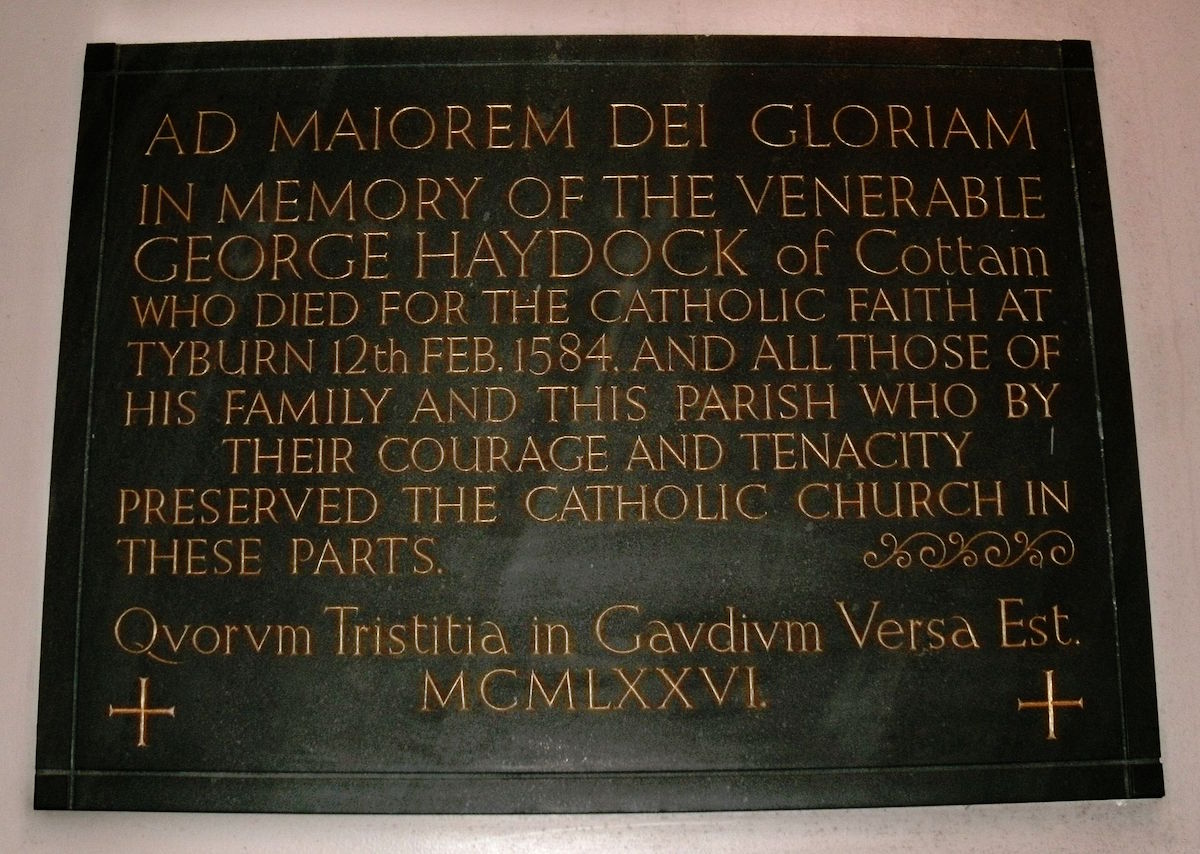
Plaque honoring George Haddock/Haydock at St. Andrew’s & Blessed George Haydock’s Catholic Church, Cottam, Lancashire. (cc) image by Skodoway.

On this day..