On this date in 1962, the architect of the Final Solution received such justice as could be meted to him on earth at Israel’s Ramla Prison.
Adolf Eichmann, the vacuum cleaner salesman turned SS Obersturnbannfuhrer, remains the only person judicially executed in the history of modern Israel, whose intelligence services kidnapped him from Argentina where he had settled after the war.
Other Nazis had used the “only following orders” defense with little success in the Nuremberg Trials shortly after World War II. On trial years later (and at the hands a Jewish state) Eichmann — a bookish, unmenacing man who invoked Kant — posed the questions of individual responsibility and human psychology in starker terms.
To be sure, he was no anonymous functionary. Neither, however, had he dirtied his nails at the stomach-churning business end of the Holocaust: rather, he had engineered the stupendous logistical project of deporting Eastern Europe’s Jews for extermination, an (impressive) accomplishment worth exponentially more lives than any Einsatzgruppe could ever account for, yet simultaneously abstract from the upshot.
Eichmann said he did it without ill-will towards its subjects — simply to obey and to achieve.
The Banality of Evil
[I]f it was of small legal relevance, it was of great political interest to know how long it takes for an average person to overcome his innate repugnance of crime, and what exactly happens to him once he has reached that point. To this question, the case of Adolf Eichmann supplied an answer that could not have been clearer or more precise.
-Hannah Arendt
Hannah Arendt took him at his word* and saw in Eichmann the abyss gazing back into us, into his judges — not a monster but a man unsettling in his normalcy, whose job was not TPS reports or quarterly sales results but turning humans into ash.
The company man. The career man. Every man, standing in for countless thousands more who pushed the papers that drove the trains to Auschwitz.
What for Eichmann was a job, with its daily routine, its ups and downs, was for the Jews quite literally the end of the world.
Not everyone accepts her conclusions, but Arendt’s characterization of “the banality of evil” has become the man’s epigraph. And Eichmann disturbs us precisely because we seem to be able to meet him on his terms, even sympathize with him when the horror of his crimes begs for a monster like Streicher or Goebbels we could safely consign to the Other.
Arendt’s turn of phrase has a certain breezy (hackneyed, even) life in the public discourse, but her analysis of Eichmann’s careerism remains a challenging and deeply relevant one for we heirs of the world that hanged him.
The complete transcript of Eichmann’s trial is available online here. Video of his trial has been posted online here (in English) and here (original languages).
* Albeit with some reservations; others have argued that Eichmann was considerably more personally invested in his mass-murder project than his demeanor at trial admitted. Certainly he had an interest in showing the mellower Eichmann when he was on trial for his life.
On this date in 1979, John Spenkelink was electrocuted in Florida — the first man executed involuntarily in the U.S. since 1967.
A series of court decisions in the 1970’s had scrapped the country’s old death penalty institutions and obliged legislators to restructure the process. Now, the new architecture was in place and the decade-long hiatus in actual executions was drawing to a close.
Gary Gilmore had earned trivia-question notoriety as the first put to death under the new regime two years before, but Gilmore was always an outlier, a bizarrely active exponent of his own death who greased the skids for himself.
Spenkelink was the true harbinger. For six years, a span which seemed long then but would today rate on the speedy side, Spenkelink resisted death with every tool at his disposal. Florida officials fought just as stubbornly to kill him.
An itinerant parolee, he had in 1973 shot a fellow drifter named Joseph J. Szymankiewicz.
Spenkelink claimed that Szymankiewicz had stolen his money, forced him to play Russian roulette, and sexually assaulted him, all of which seemed within the vicious character attested of the victim. But the killing itself was clearly not a moment of passion or immediate self-defense: Spenkelink had left their shared hotel room, returned with a gun, and shot his man in the back.
In the new Court-mandated balancing act between “aggravating” and “mitigating” factors whose intent was to harmonize unfair application of the death penalty, this evident premeditation is what doomed Spenkelink. (The fact that Spenkelink committed the crime for pecuniary gain — that is, to get back his own money — also militated against him. The Clark County (Ind.) Prosecutor’s site has some legal briefs in addition to media reports on the case.)
In the larger reality not circumscribed by legal briefs, the defendant wasn’t exactly Charles Manson. More considerable than the act itself was where it occurred (North Florida) and the rootless, friendless character of its author — a “white nigger”. As Florida Supreme Court Justice Richard Ervin put it:
As usual under “discretion,’ it is left to sentencing judges to determine in particular cases who will get death. We know intuitively who will: the poor, the underprivileged, the public defender clients, the blacks and other minority people, the mentally incompetent or those holding unpopular or unorthodox ideologies. The affluent usually escape the death penalty.
…
The result here is an old story, often repeated in this jurisdiction where the subconscious prejudices and local mores outweigh humane, civilized understanding when certain segments of the population are up for sentencing for murder.
Or in Spenkelink’s epigram, which he often signed to prison correspondence, “capital punishment means those without capital get the punishment.”
The last of his 22 appeals* was rejected by the Supreme Court this very day. Ten minutes later, trussed hand and foot with each of his orifices stopped up and two shots of whiskey for the ride, Spenkelink was presented in Old Sparky to the event’s official witnesses.** It had been 15 years since the chair’s last use; prison officials didn’t remember how to operate it — but they managed to pull it off with no more than the electric chair’s average ration of gruesomeness.
Five minutes later, Spenkelink was declared dead — and the death penalty was back in America.†
* Filed by David Kendall, later to gain a measure of fame as Bill Clinton’s personal attorney during his impeachment.
** Spenkelink was gagged when the blinds were opened to the witnesses, and denied a final statement (his famous bon mot about those without the capital is sometimes mistakenly reported as his last words). Since the witnesses had not seen the prisoner brought in, rumors spread that he had fought the guards, even that his neck had been broken in the altercation and that he was dead or dying by the time the first 2,250-volt jolt hit him. This rumor in turn caused the state not only to exhume and autopsy Spenkelink, but to institute a policy of autopsying all executed prisoners … and the documentary trail created by this policy contributed to the Sunshine State’s later legal and public relations headaches with its execution protocols.
† Executions would remain freak events — one or two a year — until the mid-1980’s when they finally resumed taking place with regularity sufficient to return them to the everyday fabric of American life.
Any queen decapitated by her king would of course rate an entry in these grim pages. But this does not quite explain Anne Boleyn‘s enduring appeal, relevance and recognizability for the most casual of modern observers, and her concomitant footprint in popular culture, even with the “Greek tragedy” quality of her life.
Anne stands at the fulcrum of England’s epochal leap into modernity. Whether she was that fulcrum might depend on the reader’s sympathy for the Great Man theory of history, but little more do we injure our headless queen to regard her as the woman for her time and place — the accidental hero (or villain) raised up and thrown down by the tectonic forces of her milieu.
Through Anne was born — for reasons of momentary political arrangements of long-forgotten dynasts, which seems a shockingly parochial proximate cause — the English Reformation, and through the Reformation was born the crown’s decisive triumph over the nobility, the broad middle class nurtured on the spoils of Catholic monasteries, the rising Britannia fit to rule. Most would take as an epitaph historical accidents of such magnitude.
Of course, by those same accidents, Anne was the instrument of thousands of deaths herself, and little did she appear troubled in life by the corpses upon which she ascended the throne.
Her own family maps the change wrought on England. An ancestor was beheaded in the Wars of the Roses, medieval England’s last great breakdown; her uncle Thomas Howard was one of the throwback scheming Dukes, mastered by his sovereign to the extent of issuing Anne’s capital sentence from his own lips;* the beheaded woman’s daughter, Queen Elizabeth I, set a recognizably centralized English state on the path of empire.
Fitting tribute that, from the Tower where she met her end** to lands undreamt-of in her time, people still, like Henry, find her captivating.
* Anne’s father also declared for her guilt. Unprincipled as these men undoubtedly were, it cannot have been a pleasant responsibility; the question of whether she was actually guilty of adultery-cum-treason, the fatal charge extracted from a supposed lover by torture, has been hotly and inconclusively disputed by posterity.
** With a solemn speech submissive to Henry but not admitting any guilt — in an earlier moment of levity, she had famously remarked of the French swordsman hired to do the job, “I heard say the executioner was very good, and I have a little neck.”
On this date in 1792 — a surprisingly late date, just nine months before the king himself would die under its blade — debuted the iconic symbol of the French Revolution, the guillotine.
Today, it turned a thief and killer named Nicolas Pelletier from thug to trivia. Much more illustrious names would follow, and anon.
Though predecessors of the grim machine had been used centuries before in Scotland, Italy and Switzerland, the guillotine ushered in a distinctly modern era of technological application to capital punishment informed by egalitarianism — prior to the French Revolution, nobles and commoners had different modes of execution — and by legal and medical expertise aimed at minimizing pain.*
In fact, the device’s namesake, physician Joseph-Ignace Guillotin, opposed the death penalty altogether; he approved scientific and “painless” execution as a stopgap measure.**
For his troubles, the humane doctor’s name became synonymous with terror, enough so that his descendants changed their handle. One wonders how the doctor judged his own legacy; certainly better for any condemned person to die on the guillotine than the breaking wheel, but the mechanical efficiency of the “French razor” and the depersonalization of the condemned in relation to the headsman and the witnesses also made possible the mass executions the French Revolution is known for.
Singular Guillotin, respectable practitioner: doomed by a satiric destiny to the strangest immortal glory that ever kept obscure mortal from his resting-place, the bosom of oblivion! … “With my machine, Messieurs, I whisk off your head (vous fais sauter la tete) in a twinkling, and you have no pain;”–whereat they all laugh. (Moniteur Newspaper, of December 1st, 1789 (in Histoire Parlementaire).) Unfortunate Doctor! For two-and-twenty years he, unguillotined, shall near nothing but guillotine, see nothing but guillotine; then dying, shall through long centuries wander, as it were, a disconsolate ghost, on the wrong side of Styx and Lethe; his name like to outlive Caesar’s.
* Pain reduction was distinctly not the order of the day under the ancien regime. Often, quite the opposite.
** It was still another physician, Antoine Louis, who actually designed the decapitation machine; for a time, it was known as the Louisette. The working model was built from Louis’ design by a piano maker — and it may be more than coincidence that the science of constructing this mechanically complex musical instrument was also bursting with creativity on the cusp of the Industrial Revolution.
On this date in 1670, a 70-year-old upstanding Edinburgher went to the stake for confessing — unbidden — to witchcraft.
The “Wizard of West Bow” had had a distinguished military career and an exactingly pious public life among Edinburgh’s strictest Presbyterians. So it came as something of a surprise when, after being struck by an illness, he up and copped to a lifelong sexual relationship with his sister Jean … and a lifetime of hitherto unknown black arts, powered by a Satanic walking-staff. He was so far from being suspect that town elders at first thought him daft.
Only when Jean backed his story with the sort of details to give vapors to the “Bowhead Saints” neighborhood did things get serious. She especially warned about that staff.
So on this day, the dumbfounded city worthies had to tote one of their own to the area around Edinburgh’s modern Pilrig Street and have him strangled and burnt at the stake. Whatever moved Weir to issue his damning (literally!) admission, he was plainly quite in earnest: when asked to pray at the stake, he shot back, “Let me alone, I will not. I have lived as a beast, and I must die as a beast.” The staff was thrown onto the pyre with him; it was said to burn abnormally slowly.
His sister was hanged shortly thereafter for the same offenses, scandalizing her upstanding neighbors by tearing her clothes off on the way to the scaffold.
For a century, nobody dared live in Weir’s house, which the cremated major — and/or that staff, floating about looking for its owner — supposedly haunted. The house is long torn down, but the tale is natural fodder for any “haunted Edinburgh” tour.
One is struck in such a story by its modernity — perhaps the reason it could speak to a Victorian novelist like Robert Louis Stevenson.
The interpretive framework we begin with for witch hunts is — well, a “witch hunt.” Our own sense of what unjust social persecution is shapes the way we read these long-gone cases, the confessions forced from the victims’ lips. We identify with the “witches”; it is the alien world that ferrets them out and burns them that wants explaining.
Major Weir unnervingly turns the tables on such voyeurs as your correspondent. He steps without warning out of a forgotten mass of long-gone peoples, his confession not merely voluntary but insistent against skepticism — and suddenly we grapple for our bearings not in sociology but in abnormal psychology: here is a man very much of his society who has unexpectedly rejected it, boasts of rejecting it all along, and does so not craving after reconciliation to his people but in order to die (as does his sister) obstinate in that rejection. We can perhaps identify less readily with this individual than with his crestfallen friends.
Whether or not the Weirs really did anything that would count as a crime today — although one is practically forced to agree that at a minimum, the siblings violated a sexual taboo still enforced now — we have a template for this man not in the McCarthy hearings but straight from the evening news: the unassuming neighbor revealed to be a serial killer; the trusted rector who turns out to have been a pedophile.
On this date in 1905, Fou Tchou-Li suffered the last execution by lingchi in Beijing, for the murder of a Mongolian prince.
Lingchi, or slow slicing, involved the public dismemberment of the victim. As such, it became iconic to westerners as an image of exotic Chinese cruelty — albeit iconic in a mythicized form, the accounts conflicting, undependable, Orientalist. (Many different ones are collected at the Wikipedia page.)
Lingchi is especially notable — apart from fathering the phrase “death by a thousand cuts” in the English lexicology — for its overlap with the era of photography.
Fou Tchou-Li’s death was captured on film, and the images famously captivated Georges Bataille for the expression of seeming ecstasy on the face of the dying (or dead) man.
Bataille was said to meditate daily upon the image below in particular — “I never stopped being obsessed by this image of pain, at the same time ecstatic and intolerable.”
Agony and ecstasy? A sequence of images, strong stuff in spite of their low quality, describing Fou Tchou-Li’s execution can be viewed here. Notice, however, that it’s not the one pictured here — the scholar who maintains this page claims the man’s identity became confused by western interlocutors. The different, unnamed man who as “Fou Tchou-Li” riveted Bataille is pictured here.
In Regarding the Pain of Others, Susan Sontag explained the mystical nexus of pleasure and pain Fou Tchou-Li’s torture suggested to the French theorist, aptly comparing it to graphic but pre-photographic exaltations of torture in the western artistic tradition, such as Saint Sebastian:
To contemplate this image, according to Bataille, is both a mortification of the feelings and a liberation of tabooed erotic knowledge — a complex response that many people must find hard to credit. … Bataille is not saying that he takes pleasure in the sight of this excruciation. But he is saying that he can imagine extreme suffering as a kind of transfiguration. It is a view of suffering, of the pain of others, that is rooted in religious thinking, which links pain to sacrifice, sacrifice to exaltation — a view that could not be more alien to a modern sensibility.
It’s no idle point to say that all this reads quite a lot into a single frame that may not be all that representative of the moment, though that wouldn’t necessarily diminish Bataille’s gist. More, these are western interpretations of — projections upon — an image marked as fundamentally outside in a tableau irresistibly blending the colonizer and the colonized.
Taiwanese video artist Chen Chieh-jen interpreted the photography that so captivated Bataille, and its colonial context, in Lingchi: Echoes of a Historical Photograph (review).
Two weeks after this date, China abolished the punishment for good.
On this date in 1888, Jochin Henry Timmerman was hanged across from the cemetery in Goldendale, Washington for the murder of a freight driver.
The account of this bit of local color in a territory still a year away from statehood comes from Washington’s HistoryLink website.
The page includes a lengthy account of the crime and capture of the only man ever hanged in Klickitat County. We excerpt here the affair’s climax.
Because Timmerman steadfastly maintained his innocence, the execution was scheduled to take place after the arrival of the April 6 daily overland mail stage. This was in case Territorial Governor Eugene Semple (1840-1908) sent a stay of execution. Early Klickitat Valley Days states “Friends of Timmerman had a skilled long distance rider with a swift saddled horse waiting at a railroad telegraph station (in) Grant, Oregon, 15 miles from Goldendale, across the Columbia River. A steam ferry tug waited on the Oregon shore, so the rider would not be delayed, if a coveted life saving yellow envelope was placed in his hands” (p. 78). Governor Semple sent no telegram, and the mail stage arrived without a letter of reprieve.
Timmerman, meanwhile, was given a quart of whiskey upon awakening and allowed to consume it all in preparation for his ordeal. The execution took place in Goldendale under Sheriff VanVector’s [sic] direction on a gibbet erected directly across from the town cemetery. The event drew a large crowd. Cora E. Van Hoy Ballou, who watched the execution as a young child, later remembered her mother calling to her and her sister on the morning of April 6, “Wake up children, pappy has gone to the barn to get the team. We’re going to town to see the hanging” (Early Klickitat Valley Days, p. 78). The Van Hoy family was not alone: The Washington Standard reported that more than 3,000 people witnessed Timmerman’s execution.
Timmerman rode to his execution in a wagon sitting up in his own coffin, reportedly smoking the cigar. He mounted the scaffold unassisted and tossed the cigar butt into the crowd, who fell upon it and fought for bits as souvenirs. Local tradition later told that just before his hanging Timmerman prophesied that Goldendale would soon be destroyed by fire, and indeed, on May 13, 1888, a little more than a month after Timmerman’s execution, seven blocks of Goldendale’s business district did burn down.
Timmerman went to his death maintaining his innocence. His last words are reported to have been this advice: “All I can say is that if you ever get caught in a scrape like this, don’t let them take you alive”
On this date in 1689, in a Warsaw marketplace, Kazimierz Lyszczynski had his tongue torn out, his head struck off and his body burned to ashes which were shot from a cannon — all for scratching a few words with the whiff of atheism.
God is not the creator of man; but man is the creator of a God gathered together from nothing.
His actual writings are not known directly — his books were burned along with his flesh — but only from the transcripts of his rather hysterical trial, so it’s uncertain what he actually believed; for that matter, he vigorously (albeit unsuccessfully) abjured atheism. Some sources say that he was nailed for as little as irreverent marginal notations in a theological tract he found unconvincing; others report that he actually wrote a heretical text.
Cazimir Lyszczynski, a noble and landowner of Lithuania, a man of a very respectable character, was perusing a book entitled Theologia Naturalis, by Henry Aldsted, a Protestant divine, and finding that the arguments which the author employed in order to prove the existence of divinity, were so confused that it was possible to deduce from them quite contrary consequences, he added on the margin the following words — “ergo non est Deus,” evidently ridiculing the arguments of the author. This circumstance was found out by Brzoska, nuncio of Brest in Lithuania, a debtor of Lyszczynski, who denouned him as an atheist, delivering, as evidence of his accusation, a copy of the work with the above-mentioned annotation to Witwicki, bishop of Posnania, who took up this affair with the greatest violence … nothing could shelter the unfortunate man against the fanatical rage of the clergy … On the simple accusation of his debtor, supported by the bishops, the affair was brought before the diet of 1689, before which the clergy, and particularly the bishop Zaluski, accused Lyszczynski of having denied the existence of God, and uttered blasphemies against the blessed Virgin and the saints. The unfortunate victim, terrified by his perilous situation, acknowledged all that was imputed to him, made a full recantation of all he might have said and written against the doctrine of the Roman Catholic church, and declared his entire submission to its authority. This was, however, of no avail to him, and his accusers were even scandalized that the diet permitted him to make a defence, and granted the term of three days for collecting evidence of his innocence, as the accusation of the clergy ought, in their judgment, to be sufficient evidence on which to condemn the culprit.
Pope Innocent XI at least salvaged the performance of the Catholic hierarchy in the affair by condemning, rather than promoting, the ambitious bishops.
Whatever the doomed man’s actual doctrines and writings, it is likely not coincidence that one finds this atrocious affair during at the moment of his country’s political collapse. The heretical knight’s 55 years corresponded to Poland’s fall from central Europe’s dominant power into the plaything of neighboring hegemons. The Polish-Lithuanian Empire stood at its maximum extent at his birth; during Lyszczynski’s boyhood, the Zaporozhian Cossacks broke free of Warsaw; as a young man, he saw the Swedes, the Russians, and Poland’s former vassal Prussia strip the empire of peoples and land.
By the time of Lyszczynski’s misfortunate death, Poland was a second-rate power on the brink of irrelevance — an abyss into which it would plunge in the century to come. Corwin’s Political History of Poland (another Google Books freebie) lays the scene:
The constant internal dissensions caused and nourished by foreign intrigues were in no mean measure responsible for the King’s failures in his final campaigns and in his diplomacy. They resulted in the loss of territory and the decline of Poland’s position as a great European power. French and Austrian money supported Polish anarchy. Diets were constantly torn up some even before the presiding officer could be elected. No law could be enacted. Corruption was rampant. Several attempts were made to depose the King. Religious intolerance became intensified and the first and last auto da fe in Poland was executed in 1689, on one Casimir Lyszczynski for his atheistic proclivities. The country became a theatre of constant strife between the various magnate families. At times the clashes resulted in formal civil wars.
It might be small consolation for having one’s head chopped off, but Lyszczynski’s reputation has far outrun his persecutors’, and in the lands of the old Polish-Lithuanian Empire, he cuts a pathbreaking figure for secularists and freethinkers.
Lyszczynski’s gravestone — image (c) Irina Shvets and used with permission. The inscription reads, “Oh, travelers! Do not pass these stones. You will not stumble upon them if you don’t stumble upon the truth. Recognize the truth: for even those who know that it is the truth teach that it is a lie. The teachings of the wise are bound by deceit.”
A Catholic man with the name Giovanni Battiste (“John the Baptist”) Bugatti could hardly have had a more ironic role in church history than the man who, on this date in 1796, dispatched his first victim as official executioner of the Papal State. Nicholas Gentilucci was hanged for killing a clergyman and his coachman, then robbing two friars while on the lam; Gentilucci’s corpse was subsequently quartered.
Little is known about Gentilucci, but much is known of his then-17-year-old executioner, for Bugatti, who would become known simply as Mastro Titta, turned out to be the most individually prolific taker of life in turn-of-the-19th century Rome.
Bugatti was born in Rome in 1779 and, even while putting criminals of the state to death, lived and worked on the west side of the Tiber River as an umbrella painter. Executions were a side job, and these ghastly deeds were recognized as such by the church, which compensated him a paltry three cents of a Roman lira for each body.
“Minister of Justice”
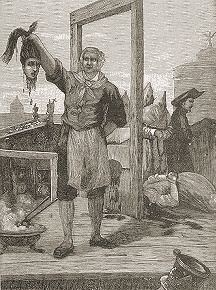
Mastro Titta brandishes an executed woman’s head.
The original Mastro Titta — the titular corruption of the “Minister of Justice” — took responsibility for each of his “patients” (as he called them, and as they were notoriously referred to by others), dutifully noting each of the 516 in his memoir. He stood for 69 years as the primary administrator of the death penalty in papal Rome, killing variously by beheading, hanging, and use of the mallet. Some were charged with murder, others with conspiracy, others with more petty crimes, but all were found guilty by the court of judges chosen by the Church’s bishops and cardinals.
The Minister’s performances were not without an (increasingly practiced) flair, heavy on the religious symbolism. Bugatti’s residence on the west side of the river meant that, when he was to carry out a punishment, he had first to cross the river.
Initially, the executions were carried out in the Piazza del Popolo, but that location was retired in the 1820’s; it’s not clear how consistent the location was after this, but at least one later execution occurred near San Giovanni decollato, home to the group of monks dedicated to comforting the condemned even when the final blow didn’t occur at its doorstep. Regardless of the locale, a spectacle soon arose surrounding that crossing and the parade which followed, as documented by Italian dialect poet G.G. Belli in 1835 (presumably for the execution of Giovanni Orioli di Lugo on July 11 of that year):
The Dilettante at the Bridge
They approach: Attention: the ceremony is brief.
Behold the condemned, neck bare and stretched.
He is the first man of the opera, the Patient,
The Ace of Spades, lord of the fesitval.
And behold the professor that will soon be
The surgeon acting for the people
For three pence, the community,
He will cure the ills of their pained head!
But not the man on the left: the other, to the right.
He in the second place is the Assistant.
The proceedings wait for Mastro Titta.
Do you want the usual from me, who takes the head?
I who never miss it: I am consistent;
And I know him as well as I know the Pope.
The translation is largely mine, with help on some difficult sections from a well-written and complete description of Mastro Titta’s life and work here and here.
Just a Job
A pinch of snuff before I snuff you?
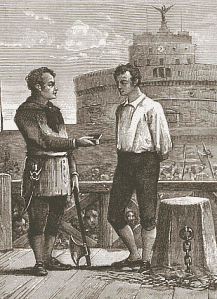
Bugatti was known for playing the role of executioner in a manner which left no doubt as to his feelings towards the act: it was his job, his service to the Church itself, undisturbed by any personal animus towards the condemned — particularly early in his career.
He often offered snuff to his victims and spoke briefly and quietly with them prior to the execution, likely ploys to ease the victim into his role in the spectacle. Dickens viewed one of Mastro Titta’s beheadings on 8 March 1845*, and, in his Pictures From Italy, he remarked on the callousness of the event.
In keeping with this attitude, most of the entries in Mastro Titta’s memoir are fewer than 20 words. They reflect a man who seeks to distance himself from the crowd’s bloodlust. A selection:
“Tommaso Tintori, guilty of homicide, 28 February 1810″ (The first using the “new edifice for beheading from the French government” — that is, the guillotine)
“Pecorari Angel, of Poli, aged 29. Peasant guilty of premeditated homicide of one woman, condemned to «death as an example» in Poland on 21 January 1847.” (There were a number of prisoners sentenced in other Catholic parts of Europe sent to Rome for Titta’s ministrations.)
“Sabbatino Proietti, aged 25, «decapitated» in Rieti for petty theft and highway robbery and murder on 20 August 1853, died converted, executed through administration of justice at the public square at the Bridge.”
“Angelo Lisi di Alatri, found guilty of premeditated highway robbery and murder in Frosinone, «dead» on 30 April 1862.”
An Anomalous Man
Bugatti was born just seven years prior to the Grand Duchy of Tuscany becoming the first of the Italian states to abolish the death penalty. There, Leopold II barred torture and punishment of death, a decision heavily influenced by Cesare Beccaria’s On Crimes and Punishments and a desire to distance his nation from Rome.
In the neighboring Papal State, however, the practice continued, the embodiment of the church’s power over its people in matters earthly and spiritual. Executions of the time performed for various reasons, but with a handful of exceptions, they were almost exclusively performed on persons in the lower class. Many relied on the use of torture or testimony from confessionals. Papal executions were carried out until the 1870s and only declared unnecessary (though not banned by the Church) by Pope John Paul II in the 1990s.
A complete discussion of the role of executions in the Catholic Church is too much for this space,** but a man like Bugatti serves usefully to exemplify the absurdity endowed in these killings by the Catholic Church. Where the half-dozen popes who served over Bugatti thought such executions to be necessary for the control of the masses, they had no such ideas about nobles who committed crimes.
The execution itself consisted of a parade with masked priests, banners, scriptural readings, and sermonizing, culminating in the death of the condemned. John L Allen of the National Catholic Reporter described the treatment of these executions in that day as “a liturgy”, and descriptions from writers such as Lord Byron show a scene which could only be described as a mix of Catholic Mass and town festival.
Such ritualized killing came to contrast starkly with the Italian celebration of an anti-death penalty position, and the two stood at odds for over a century. In 1909, the topic was hot enough that a plaque glorifying two Italians executed by Bugatti in 1825 was erected; a dozen years later, its contents were concealed out of deference to Rome until after the Second Vatican Council. The commemorated, Angiolo Targhini and Leonida Montanari (here’s their Italian Wikipedia page), were convicted essentially of riling the people, and they were summarily beheaded; their story was the inspiration for Luigi Magni’s 1969 classic Nell’anno del Signore:
“So ends the long list of Bugatti.”
Mastro Titta was given an official residence, and at the end of his term, he was handsomely rewarded with a pension for his service — 30 scudi per year. His final executions were carried out on 17 August 1864, wearing his traditional red cloak (now on display at the Criminology Museum of Rome): Antonio Olietti of Rome and Domenico Antonio Demartini were beheaded for homicide.
The Minister of Justice was 85, four and some years from the end of his life, and the final line in his memoir reads, “So ends the long list of Bugatti. May that of his successor be shorter.”
Indeed it was.
The final executions in Rome occurred on 24 November 1868 at the hands of Antonio Balducci, Bugatti’s long-time apprentice; the event was marked by Pope Pius IX famously intoning in response to calls for a stay, “I can’t, and I don’t want to.” The last execution in the Papal State was of Agatino Bellomo on 9 July 1870, in Palestrina, shortly before the nascent unified Italy absorbed Rome.
Mastro Titta is still known in Italy,† but, adrift amid a particularly violent period of revolution, his legacy as papal executioner is largely lost to the rest of the world.
* The day’s guillotinee was Giovanni Vagnarelli, 26, from Augustine; he killed Bavarian Anna Cotten and robbed her, and her wife’s statement at confessional was used to convict Vagnarelli. Such confessional convictions were not uncommon, as Bugatti’s own memoir confirms.
** There’s surprisingly little reading out there about this topic, though it would seem ripe for a book or two. Here’s what I can find:
“Fear and Loathing in Bologna and Rome: The Papal Police in Perspective”, Steven Hughes, Journal of Social History, 1987.
“Capital Punishment: The Curious History of its Privileged Place in Christendom”, James J. Megivern, Proceedings of the American Philosophical Society, 2003.
† A half dozen kilometers from the bridge that Mastro Titta crossed on his way to carry out Papal justice now stands the Mastro Titta Pub. It is reportedly “tastefully done” and serves mostly Belgian beers.
On this date in 1957, Cypriot guerrilla Evagoras Pallikarides was hanged by British colonial authorities for gun possession.
As it was throughout the Empire in the middle 20th century, independence was the order of the day in Cyprus. But it was not simply whether there would be self-rule in Cyprus: the form and terms of independence were themselves hotly contested.
Cyprus would be a fresh battleground between those bitter rivals Turkey and Greece, each asserting an interest in their ethnic cousins on the island; overlapping that, it would be a battleground between the institutional Communist opposition AKEL, which opposed military action for separatism, and the nationalist EOKA, demanding not simply independence but enosis, union with Greece as part of the pan-Hellenic project so inflammatory to the Turks.
From 1955 to 1959, EOKA conducted a four-year campaign of bombing, assassinations and military engagements.
As a 17-year-old, Palikarides — already facing trial and likely prison time for his resistance activities — disappeared to join an EOKA guerrilla cell. A poetic young soul, he bid his classmates farewell with this note left to explain his absence on their first morning without him:
Old classmates. At this time, someone is missing from among you, someone who has left in search of freedom’s air, someone who you might not see alive again. Don’t cry at his graveside. It won’t do for you to cry. A few spring flowers scatter on his grave. This is enough for him …
I’ll take an uphill road
I’ll take the paths
To find the stairs
That lead to freedom
I’ll leave brothers, sisters
My mother, my father
In the valleys beyond
And the mountainsides
Searching for freedom
I’ll have as company
The white snow
Mountains and torrents
Even if it’s winter now
The summer will come
Bringing Freedom
To cities and villages
I’ll take an uphill road
I’ll take the paths
To find the stairs
That lead to freedom
I’ll climb the stairs
I’ll enter a palace
I know it will be an illusion
I know it won’t be real
I’ll wonder in the palace
Until I find the throne
Only a queen
Sitting on it
Beautiful daughter, I will say,
Open your wings
And take me in your embrace
That’s all I ask …
Pallikarides fought for a year before being apprehended with a gun illegally in his possession — a hanging crime under British anti-terrorism laws, but as Pallikarides was just the ninth (and last) EOKA man executed, it seems plain that law was not receiving draconian enforcement. At least one author claims that the authorities threw the book at him on the gun charge because of a murder they believed he committed as a guerrilla but could not prove.
The fact that he turned 19 a fortnight before his execution likewise did not avail him clemency — as the young rebel predicted in court:
I know you will hang me. Whatever I did, I did as a Cypriot Greek fighting for liberty.
As youthful martyrs to nationhood are wont to become, Pallikarides (along with his poetry) lives on as a potent symbol to Greek Cypriots. Shortly after Cyprus achieved independence in 1960, his name and visage were affiliated with a Cyprus football club, Evagoras (which later merged with another club to become AEP Paphos).


 Anne stands at the fulcrum of England’s epochal leap into modernity. Whether she was that fulcrum might depend on the reader’s sympathy for the Great Man theory of history, but little more do we injure our headless queen to regard her as the woman for her time and place — the accidental hero (or villain) raised up and thrown down by the tectonic forces of her milieu.
 The account of this bit of local color in a territory still a year away from statehood comes from Washington’s
  God is not the creator of man; but man is the creator of a God gathered together from nothing.
 Mastro Titta was given an official residence, and at the end of his term, he was handsomely rewarded with a pension for his service — 30 scudi per year. His final executions were carried out on 17 August 1864, wearing his traditional red cloak (now on display at the
