Though executioners don’t quite bat 1.000 — who does, at any human endeavor? — the field on the whole succeeds more often than not.
On this date in 1864, the Confederate guerrilla John S. Mosby had seven Union prisoners executed, but he only managed to kill three of them — an efficiency very well below the Mendoza Line for the executioner’s trade.
It was a rare competence gap for the brilliant cavalryman.
The irregulars Mosby commanded in the Shenandoah Valley had frustrated for six months the consolidation of rampant northern armies, thereby preserving the Confederate capital of Richmond and extending the Civil War.
The situation had quick become intolerable for the Union, and Gen. Ulysses Grant emphasized (pdf) to Gen. Phil Sheridan the cruel anti-insurgent tactics he would countenance for “the necessity of clearing out the country so that it would not support Mosby’s gang. So long as the war lasts they must be prevented from raising another crop.”
Incensed, the Confederate “gray ghost” began stockpiling blue bodies from the offending command of George Armstrong Custer — yes, the Little Bighorn guy; he was perceived by Mosby to be responsible for the atrocity, although the actual paper trail on the execution order seems to be a little sketchy.
Mosby, who fancied himself the genteel sort who would closely abide the laws of war when fighting for the right to maintain human chattel, sent a lawlerly appeal up the chain of command seeking permission “to hang an equal number of Custer’s men.” General Robert E. Lee and Confederate Secretary of War James Sedden granted it.
The preparations began innocently enough on a quiet Sunday morning (November 6, 1864) when 27 Union prisoners of war were ushered with no explanation about what was happening out of a brick storehouse located in Rectortown, Virginia …
[They] were then marched to the banks of Goose Creek, about half a mile away. some, but definitely not all, of this specially selected pool of 27 prisoners belonged to Custer’s commands both past and present … [but] of the seven men eventually selected to die on Mosby’s orders only two were actually members of the Michigan Cavalry Brigade.
All 27 of the prisoners were lined up along Goose Creek and then made to draw slips of paper from a hat. Twenty of those slips of paper which were part of the macabre lottery were simply that, blank pieces of paper. The other seven — one for each of Mosby’s men executed at Front Royal and in Rappahanock County — were marked with a number …
Of the men who were forced to draw those slips of paper, some of them simply stared into space. Others, once they understood what was happening, prayed. There were a few of them who simply broke down.
Among the prisoners was a young drummer boy … who broke down completely, sobbing … He drew a blank slip and immediately proclaimed: “Damn it, ain’t I lucky!” When a second drummer boy was found to be unlucky enough to have drawn one of the marked slips of paper, upon the request of the men who had been spared, Mosby personally ordered the boy to be released from the seven condemned prisoners and the 18 remaining prisoners (excluding the first drummer boy) drew from the slips of paper for a second time.
Then one of the seven adults also got himself swapped out of the scrap by flashing a Masonic sign at a Confederate lodge member. The things that stand between life and death.
Out of the nine to come under death’s pall and the seven who were actually marched overnight to the place of execution (as close to Custer’s camp as Mosby dared) only three were there successfully ushered past death’s threshold.
At 4 a.m. on Monday, November 7, 1864 (the day before the election which would give Abraham Lincoln his second term in the White House and would therefore become the signature on the death warrant of the Confederacy), the Rangers and their prisoners reached the execution site in Beemer’s Woods, a mile west of Berryville, and the executions were carried forward. However, everything did not go exactly according to plan.
In the pre-dawn darkness and confusion (either through carelessness or lack of caring for their orders, since none of the prisoners had actually been involved in depredations against Confederate civilians) the Rangers allowed two of the seven prisoners (one of whom, G.H. Soule, 5th Michigan Cavalry Regiment, punched out a guard) to escape outright. Two other prisoners were apparently shot in the head, but surviving, having only been grazed, also escaped since they pretended, and were apparently believed, to be dead. The remaining three prisoners were hanged. The identities and whether or not these three prisoners were members of either Custer or Powell’s commands are unknown. Lt. Thompson, in accordance with his orders attached a placard to one of the hanged men (just as similar placards had been attached to the bodies of all three of Mosby’s hanged men). Mosby’s placard read: “These men have been hung in retaliation for an equal number of Colonel Mosby’s men hung by order of General Custer at Front Royal. Measure for Measure.”
Believing his purpose accomplished, or at any rate close enough for rebel government work, Mosby then wrote to Union General Sheridan justifying the action and assuring him that future “prisoners falling into my hands will be treated with the kindness due to their condition, unless some new act of barbarity shall compel me, reluctantly, to adopt a line of policy repugnant to humanity.”
The letter, and the 3-out-of-7 reprisal, actually worked — with no further measures exacted for measure or tits given for tat. For the waning months of the war the rival forces confined themselves to killing one another on the battlefield, and not in the stockade.
Well, mostly: one of the conspirators in the plot to assassinate Abraham Lincoln in April 1865 — which did assassinate Lincoln, but was really a wider attempt to decapitate the entire northern government — was a former Mosby’s ranger named Lewis Powell aka Payne. Lincoln killer John Wilkes Booth also seemed to flee in Mosby’s direction (Mosby’s units were still in the field, not covered by the April 9 Appomattox surrender.) There exists an unproven but delicious speculative hypothesis that the hand of John Mosby was among those behind an exponentially more ambitious “line of policy repugnant to humanity.”
Be that as it may, Mosby actually became a Republican after the war — for which he received some Southern death threats — and lived fifty eventful years. Among other things, the aged Mosby regaled the young George Patton (whose father Mosby knew) with Civil War stories.
On this date* in French-occupied Moscow of the War of 1812, many alleged arsonists — unnamed and unnumbered — were shot by Napoleon’s army in the ashes of Moscow.
Although real, flesh-and-blood Muscovites died, they are best known via their bespectacled fictional companion, Pierre Bezukhov, whose miraculous escape is one of the pivotal episodes of Tolstoy’s War and Peace.
Merely the greatest novel in history by some reckonings — we’ll just let Tolstoy fight it out with Dostoyevsky for top of table in the competitive 19th Century Russia literary scene — the epic War and Peace tracks that country’s transformation under the revolutionary pressures of the Napoleonic age.
In Russian director Sergey Bondarchuk’s sprawling cinematic adaptation of War and Peace, the part of Pierre Bezukhov is played by Bondarchuk himself.
Pierre Bezukhov (“without ears”) is one of the book’s central figures, the illegitimate son of a count who unexpectedly inherits, forever consumed with his next impulsive, passionate quest for meaning (boozing around, freemasonry, religion …).
Pierre finds himself present in Moscow when the Grande Armeerolls in following its Pyrrhic victory at the Battle of Borodino. His fancy of the moment is to assassinate Napoleon: “he suddenly felt that what before had seemed to him merely a possibility had now become absolutely necessary and inevitable. He must remain in Moscow, concealing his name, and must meet Napoleon and kill him, and either perish or put an end to the misery of all Europe.” And to think, a younger Pierre actually used to admire Napoleon.
Historically, the city of Moscow started burning as soon as the French occupied it. The reasons for this conflagration have been widely disputed; Tolstoy detours in War and Peace to characterize it as nothing more than the natural consequence of the occupation, when the city’s civil infrastructure has broken down and the everyday fires that spark in wooden buildings are more liable to grow out of control.
The French blamed terrorists.
A bulletin of the Grande Armee dated September 20 (Gregorian date; this corresponds to the Julian date September 8) reports on the successful efforts to bring arsonists to heel through the expedient of mass executions.
Three hundred incendiaries have been arrested and shot; they were provided with fuse six inches long, which they had between two pieces of wood: they had also squibs, which they threw upon the roofs of the houses. The wretch Rastapchin had these prepared, on the pretence that he wished to send a balloon, full of combustible matter, amidst the French army …
The fires subsided on the 19th and 20th; three quarters of the city are burned; among other palaces that beautiful one of Catherine, which had been newly furnished: not above a quarter of the houses remain. …
Manufactures were beginning to flourish at Moscow: they are destroyed. The conflagration of this capital will throw Russia one hundred years back. The weather is becoming rainy: the greatest part of the army is in barracks in Moscow.
In this paranoid occupation, the fictional Pierre, wandering Moscow armed without a good excuse, gets himself picked up by French troops.
The travail of his resulting drumhead trial offers the anti-authoritarian (and anti-death penalty) Tolstoy the opportunity to reflect on the “legal” arrangements, a passage Tolstoy dates September 8 on the Julian calendar — the same day that army bulletin above was penned.
[Pierre] learned that all these prisoners (he, probably, among them) were to be tried for incendiarism. On the third day he was taken with the others to a house where a French general with a white mustache sat with two colonels and other Frenchmen with scarves on their arms. With the precision and definiteness customary in addressing prisoners, and which is supposed to preclude human frailty, Pierre like the others was questioned as to who he was, where he had been, with what object, and so on.
These questions, like questions put at trials generally, left the essence of the matter aside, shut out the possibility of that essence’s being revealed, and were designed only to form a channel through which the judges wished the answers of the accused to flow so as to lead to the desired result, namely a conviction. As soon as Pierre began to say anything that did not fit in with that aim, the channel was removed and the water could flow to waste. Pierre felt, moreover, what the accused always feel at their trial, perplexity as to why these questions were put to him. He had a feeling that it was only out of condescension or a kind of civility that this device of placing a channel was employed. He knew he was in these men’s power, that only by force had they brought him there, that force alone gave them the right to demand answers to their questions, and that the sole object of that assembly was to inculpate him. And so, as they had the power and wish to inculpate him, this expedient of an inquiry and trial seemed unnecessary. It was evident that any answer would lead to conviction.
It’s only by Pierre’s chance ability to forge a human connection with the officer detailed to condemn him that he’s mysteriously, and arbitrarily, not sentenced to death — a fact that Pierre doesn’t even realize until he’s led out with the rest of the prisoners only to see that it’s “only” the others who are being shot. This is the narration at length from Book XII, Chapters 10-11.
On the eighth of September an officer- a very important one judging by the respect the guards showed him- entered the coach house where the prisoners were. This officer, probably someone on the staff, was holding a paper in his hand, and called over all the Russians there, naming Pierre as “the man who does not give his name.” Glancing indolently and indifferently at all the prisoners, he ordered the officer in charge to have them decently dressed and tidied up before taking them to the marshal. An hour later a squad of soldiers arrived and Pierre with thirteen others was led to the Virgin’s Field. It was a fine day, sunny after rain, and the air was unusually pure. The smoke did not hang low as on the day when Pierre had been taken from the guardhouse on the Zubovski rampart, but rose through the pure air in columns. No flames were seen, but columns of smoke rose on all sides, and all Moscow as far as Pierre could see was one vast charred ruin. On all sides there were waste spaces with only stoves and chimney stacks still standing, and here and there the blackened walls of some brick houses. Pierre gazed at the ruins and did not recognize districts he had known well. Here and there he could see churches that had not been burned. The Kremlin, which was not destroyed, gleamed white in the distance with its towers and the belfry of Ivan the Great. The domes of the New Convent of the Virgin glittered brightly and its bells were ringing particularly clearly. These bells reminded Pierre that it was Sunday and the feast of the Nativity of the Virgin. But there seemed to be no one to celebrate this holiday: everywhere were blackened ruins, and the few Russians to be seen were tattered and frightened people who tried to hide when they saw the French.
…
Pierre had been taken by one set of soldiers and led first to one and then to another place with dozens of other men, and it seemed that they might have forgotten him, or confused him with the others. But no: the answers he had given when questioned had come back to him in his designation as “the man who does not give his name,” and under that appellation, which to Pierre seemed terrible, they were now leading him somewhere with unhesitating assurance on their faces that he and all the other prisoners were exactly the ones they wanted and that they were being taken to the proper place. Pierre felt himself to be an insignificant chip fallen among the wheels of a machine whose action he did not understand but which was working well.
He and the other prisoners were taken to the right side of the Virgin’s Field, to a large white house with an immense garden not far from the convent. This was Prince Shcherbatov‘s house, where Pierre had often been in other days, and which, as he learned from the talk of the soldiers, was now occupied by the marshal, the Duke of Eckmuhl (Davout).
They were taken to the entrance and led into the house one by one. Pierre was the sixth to enter. He was conducted through a glass gallery, an anteroom, and a hall, which were familiar to him, into a long low study at the door of which stood an adjutant.
Davout, spectacles on nose, sat bent over a table at the further end of the room. Pierre went close up to him, but Davout, evidently consulting a paper that lay before him, did not look up. Without raising his eyes, he said in a low voice:
“Who are you?”
Pierre was silent because he was incapable of uttering a word. To him Davout was not merely a French general, but a man notorious for his cruelty. Looking at his cold face, as he sat like a stern schoolmaster who was prepared to wait awhile for an answer, Pierre felt that every instant of delay might cost him his life; but he did not know what to say. He did not venture to repeat what he had said at his first examination, yet to disclose his rank and position was dangerous and embarrassing. So he was silent. But before he had decided what to do, Davout raised his head, pushed his spectacles back on his forehead, screwed up his eyes, and looked intently at him.
“I know that man,” he said in a cold, measured tone, evidently calculated to frighten Pierre.
The chill that had been running down Pierre’s back now seized his head as in a vise.
“You cannot know me, General, I have never seen you…”
“He is a Russian spy,” Davout interrupted, addressing another general who was present, but whom Pierre had not noticed.
Davout turned away. With an unexpected reverberation in his voice Pierre rapidly began:
“No, monseigneur,” he said, suddenly remembering that Davout was a duke. “No, monseigneur, you cannot have known me. I am a militia officer and have not quitted Moscow.”
“Your name?” asked Davout.
“Bezukhov.”
“What proof have I that you are not lying?”
“Monseigneur!” exclaimed Pierre, not in an offended but in a pleading voice.
Davout looked up and gazed intently at him. For some seconds they looked at one another, and that look saved Pierre. Apart from conditions of war and law, that look established human relations between the two men. At that moment an immense number of things passed dimly through both their minds, and they realized that they were both children of humanity and were brothers.
At the first glance, when Davout had only raised his head from the papers where human affairs and lives were indicated by numbers, Pierre was merely a circumstance, and Davout could have shot him without burdening his conscience with an evil deed, but now he saw in him a human being. He reflected for a moment.
“How can you show me that you are telling the truth?” said Davout coldly.
Pierre remembered Ramballe, and named him and his regiment and the street where the house was.
“You are not what you say,” returned Davout.
In a trembling, faltering voice Pierre began adducing proofs of the truth of his statements.
But at that moment an adjutant entered and reported something to Davout.
Davout brightened up at the news the adjutant brought, and began buttoning up his uniform. It seemed that he had quite forgotten Pierre.
When the adjutant reminded him of the prisoner, he jerked his head in Pierre’s direction with a frown and ordered him to be led away. But where they were to take him Pierre did not know: back to the coach house or to the place of execution his companions had pointed out to him as they crossed the Virgin’s Field.
He turned his head and saw that the adjutant was putting another question to Davout.
“Yes, of course!” replied Davout, but what this “yes” meant, Pierre did not know.
Pierre could not afterwards remember how he went, whether it was far, or in which direction. His faculties were quite numbed, he was stupefied, and noticing nothing around him went on moving his legs as the others did till they all stopped and he stopped too. The only thought in his mind at that time was: who was it that had really sentenced him to death? Not the men on the commission that had first examined him — not one of them wished to or, evidently, could have done it. It was not Davout, who had looked at him in so human a way. In another moment Davout would have realized that he was doing wrong, but just then the adjutant had come in and interrupted him. The adjutant, also, had evidently had no evil intent though he might have refrained from coming in. Then who was executing him, killing him, depriving him of life — him, Pierre, with all his memories, aspirations, hopes, and thoughts? Who was doing this? And Pierre felt that it was no one.
It was a system — a concurrence of circumstances.
A system of some sort was killing him — Pierre — depriving him of life, of everything, annihilating him.
From Prince Shcherbatov’s house the prisoners were led straight down the Virgin’s Field, to the left of the nunnery, as far as a kitchen garden in which a post had been set up. Beyond that post a fresh pit had been dug in the ground, and near the post and the pit a large crowd stood in a semicircle. The crowd consisted of a few Russians and many of Napoleon’s soldiers who were not on duty- Germans, Italians, and Frenchmen, in a variety of uniforms. To the right and left of the post stood rows of French troops in blue uniforms with red epaulets and high boots and shakos.
The prisoners were placed in a certain order, according to the list (Pierre was sixth), and were led to the post. Several drums suddenly began to beat on both sides of them, and at that sound Pierre felt as if part of his soul had been torn away. He lost the power of thinking or understanding. He could only hear and see. And he had only one wish- that the frightful thing that had to happen should happen quickly. Pierre looked round at his fellow prisoners and scrutinized them.
The two first were convicts with shaven heads. One was tall and thin, the other dark, shaggy, and sinewy, with a flat nose. The third was a domestic serf, about forty-five years old, with grizzled hair and a plump, well-nourished body. The fourth was a peasant, a very handsome man with a broad, light-brown beard and black eyes. The fifth was a factory hand, a thin, sallow-faced lad of eighteen in a loose coat.
Pierre heard the French consulting whether to shoot them separately or two at a time. “In couples,” replied the officer in command in a calm voice. There was a stir in the ranks of the soldiers and it was evident that they were all hurrying — not as men hurry to do something they understand, but as people hurry to finish a necessary but unpleasant and incomprehensible task.
A French official wearing a scarf came up to the right of the row of prisoners and read out the sentence in Russian and in French.
Then two pairs of Frenchmen approached the criminals and at the officer’s command took the two convicts who stood first in the row. The convicts stopped when they reached the post and, while sacks were being brought, looked dumbly around as a wounded beast looks at an approaching huntsman. One crossed himself continually, the other scratched his back and made a movement of the lips resembling a smile. With hurried hands the soldiers blindfolded them, drawing the sacks over their heads, and bound them to the post.
Twelve sharpshooters with muskets stepped out of the ranks with a firm regular tread and halted eight paces from the post. Pierre turned away to avoid seeing what was going to happen. Suddenly a crackling, rolling noise was heard which seemed to him louder than the most terrific thunder, and he looked round. There was some smoke, and the Frenchmen were doing something near the pit, with pale faces and trembling hands. Two more prisoners were led up. In the same way and with similar looks, these two glanced vainly at the onlookers with only a silent appeal for protection in their eyes, evidently unable to understand or believe what was going to happen to them. They could not believe it because they alone knew what their life meant to them, and so they neither understood nor believed that it could be taken from them.
Again Pierre did not wish to look and again turned away; but again the sound as of a frightful explosion struck his ear, and at the same moment he saw smoke, blood, and the pale, scared faces of the Frenchmen who were again doing something by the post, their trembling hands impeding one another. Pierre, breathing heavily, looked around as if asking what it meant. The same question was expressed in all the looks that met his.
On the faces of all the Russians and of the French soldiers and officers without exception, he read the same dismay, horror, and conflict that were in his own heart. “But who, after all, is doing this? They are all suffering as I am. Who then is it? Who?” flashed for an instant through his mind.
“Sharpshooters of the 86th, forward!” shouted someone. The fifth prisoner, the one next to Pierre, was led away- alone. Pierre did not understand that he was saved, that he and the rest had been brought there only to witness the execution. With ever-growing horror, and no sense of joy or relief, he gazed at what was taking place. The fifth man was the factory lad in the loose cloak. The moment they laid hands on him he sprang aside in terror and clutched at Pierre. (Pierre shuddered and shook himself free.) The lad was unable to walk. They dragged him along, holding him up under the arms, and he screamed. When they got him to the post he grew quiet, as if he suddenly understood something. Whether he understood that screaming was useless or whether he thought it incredible that men should kill him, at any rate he took his stand at the post, waiting to be blindfolded like the others, and like a wounded animal looked around him with glittering eyes.
Pierre was no longer able to turn away and close his eyes. His curiosity and agitation, like that of the whole crowd, reached the highest pitch at this fifth murder. Like the others this fifth man seemed calm; he wrapped his loose cloak closer and rubbed one bare foot with the other.
When they began to blindfold him he himself adjusted the knot which hurt the back of his head; then when they propped him against the bloodstained post, he leaned back and, not being comfortable in that position, straightened himself, adjusted his feet, and leaned back again more comfortably. Pierre did not take his eyes from him and did not miss his slightest movement.
Probably a word of command was given and was followed by the reports of eight muskets; but try as he would Pierre could not afterwards remember having heard the slightest sound of the shots. He only saw how the workman suddenly sank down on the cords that held him, how blood showed itself in two places, how the ropes slackened under the weight of the hanging body, and how the workman sat down, his head hanging unnaturally and one leg bent under him. Pierre ran up to the post. No one hindered him. Pale, frightened people were doing something around the workman. The lower jaw of an old Frenchman with a thick mustache trembled as he untied the ropes. The body collapsed. The soldiers dragged it awkwardly from the post and began pushing it into the pit.
They all plainly and certainly knew that they were criminals who must hide the traces of their guilt as quickly as possible.
Pierre glanced into the pit and saw that the factory lad was lying with his knees close up to his head and one shoulder higher than the other. That shoulder rose and fell rhythmically and convulsively, but spadefuls of earth were already being thrown over the whole body. One of the soldiers, evidently suffering, shouted gruffly and angrily at Pierre to go back. But Pierre did not understand him and remained near the post, and no one drove him away.
When the pit had been filled up a command was given. Pierre was taken back to his place, and the rows of troops on both sides of the post made a half turn and went past it at a measured pace. The twenty-four sharpshooters with discharged muskets, standing in the center of the circle, ran back to their places as the companies passed by.
Pierre gazed now with dazed eyes at these sharpshooters who ran in couples out of the circle. All but one rejoined their companies. This one, a young soldier, his face deadly pale, his shako pushed back, and his musket resting on the ground, still stood near the pit at the spot from which he had fired. He swayed like a drunken man, taking some steps forward and back to save himself from falling. An old, noncommissioned officer ran out of the ranks and taking him by the elbow dragged him to his company. The crowd of Russians and Frenchmen began to disperse. They all went away silently and with drooping heads.
“That will teach them to start fires,” said one of the Frenchmen.
Pierre glanced round at the speaker and saw that it was a soldier who was trying to find some relief after what had been done, but was not able to do so. Without finishing what he had begun to say he made a hopeless movement with his arm and went away.
* It’s our practice (although we’re sure it’s been violated here and there) to utilize Gregorian dates universally after the mid-18th century, even for executions in Orthodox Christendom where the Julian calendar prevailed into the 20th century. For this post, seeing as it’s straight from the text of Tolstoy himself, in his magnum opus, channeling the soul of the Russian rodina, we’re making an exception: the 12-day-slower, local-to-Russia Julian calendar prevails … just like the Russians themselves did.
Edward III had proceeded to invest Calais directly after the previous year’s staggering win at Crecy. The crippled French leadership could not relieve the city, and after fruitlessly probing for an opening, the relief army marched away at the start of August 1347.
By this time reduced to eating vermin and ordure, the starved city had little choice but to capitulate. According to Froissart’s account, the king declared that “the Calesians have done him so much mischief, and have, by their obstinate defence, cost him so many lives and so much money, that he is mightily enraged.” He wasn’t only sore about the city’s holding out over the preceding year: Calais was notorious as a refuge for English Channel pirates who had long bedeviled the commerce of Edward’s realm.
As a condition for sparing the rest of the town, Edward demanded that six of its leading citizens present themselves to him, “with bare heads and feet, with ropes round their necks, and the keys of the town and castle in their hands.” Edward seems truly to have meant (much against the conscience of his own nobles) to put these men to death “for that the Calesians had done him so much damage, it was proper they should suffer for it.”
This information caused the greatest lamentations and despair [in Calais]; so that the hardest heart would have had compassion on them; even the lord de Vienne wept bitterly.
After a short time, the most wealthy citizen of the town, by name Eustace de St. Pierre, rose up and said: “Gentlemen, both high and low, it would be a very great pity to suffer so many people to die through famine, if any means could be found to prevent it; and it would be highly meritorious in the eyes of our Saviour, if such misery could be averted. I have such faith and trust in finding grace before God, if I die to save my townsmen, that I name myself as first of the six.” When Eustace had done speaking, they all rose up and almost worshipped him: many cast themselves at his feet with tears and groans Another citizen, very rich and respected, rose up and said, he would be the second to his companion, Eustace; his name was John Daire. After him, James Wisant, who was very rich in merchandise and lands, offered himself, as companion to his two cousins; as did Peter Wisant, his brother. Two others then named themselves, which completed the number demanded by the king of England.
Wealthy elites sacrificing themselves for the greater good? The past really is a different country.
These six duly presented themselves, nearly naked and haltered and braced to bear the brunt of Edward’s vengeance. The English king had the executioner summoned … and then, Edward’s (very pregnant) queen Philippa dramatically fell to her knees
and with tears said, “Ah, gentle sir, since I have crossed the sea with great danger to see you, I have never asked you one favour: now, I most humbly ask as a gift, for the sake of the Son of the blessed Mary, and for your love to me, that you will be merciful to these six men.”
The king looked at her for some time in silence, and then said; “Ah, lady, I wish you had been anywhere else than here: you have entreated in such a manner that I cannot refuse you; I therefore give them to you, to do as you please with them.” The queen conducted the six citizens to her apartments, and had the halters taken from round their necks, after which she new clothed them, and served them with a plentiful dinner: she then presented each with six nobles, and had them escorted out of the camp in safety.
Edward still had the last laugh when it came to Calesian carnage.
This nigh-unconquerable foothold on the French coast would persist in English hands for two centuries: the first century spanned the Hundred Years’ War, which England was licensed to protract by dint of (and France would not settle because of) the menacing northern base England won this day. “Each will have to take up his shield,” ran a French verse cited in Barbara Tuchman’s A Distant Mirror: The Calamitous 14th Century, “For we’ll have no peace till they give back Calais.”
The Six Burghers persisted even longer than that.
George Bernard Shaw wrote a one-act play standing the story on its head, in which a henpecked Edward exasperatedly yields to his nagging wife’s merciful caprice, to the open derision of the burghers themselves.
A bit more exalted of spirited is Rodin‘s sculpture group Les Bourgeois de Calais — rendering six emaciated, suffering, and courageous figures.
I have, as it were, threaded them one behind the other, because in the indecision of the last inner combat which ensues, between their devotion to their cause and their fear of dying, each of them is isolated in front of his conscience. They are still questioning themselves to know if they have the strength to accomplish the supreme sacrifice–their soul pushes them onward, but their feet refuse to walk.
They drag themselves along painfully, as much because of the feebleness to which famine has reduced them as because of the terrifying nature of the sacrifice … And certainly, if I have succeeded in showing how much the body, weakened by the most cruel sufferings, still holds on to life, how much power it still has over the spirit that is consumed with bravery, I can congratulate myself on not having remained beneath the noble theme I dealt with.
On this date in 1788, France’s last attempt at an execution by breaking-wheel was thwarted by a vast crowd sympathetic to the condemned … which stormed the scaffold in Versailles and liberated the victim.
As neat a parable as one might like to find of the entire revolutionary storm then rising on France’s horizons, Jean Louschart’s tale begins with a conflict at home between the young man Jean — neck-deep in Voltaire, Rousseau, and the rest of Enlightenment thought — and his father, a respected and conservative smith not to keen on the boy’s books. Then add to this, that the Louschart family took on one Madame Verdier as a boarder, and Jean grew smitten with that woman’s daughter Helen, to the chagrin of Madame Verdier … who wanted to marry that girl off to Jean’s own father.
So Mathurin Louschart eventually got into it with his son Jean over the boy’s subversive reading. When Mathurin ordered Jean to be silent, the young man just feeling his oats retorted that this was a novel way of settling the dispute. This jab at the elder’s native prerogatives led Mathurin to drive Jean from the house full stop.
That might have been all there was to it if not for the pull of Helen. The Greeks would have understood.
Jean eventually snuck back intending to elope with the willing Helen and salvage her from her father’s hand, but Helen’s mother sniffed out the plan … and the boy entered his former domicile to find Helen being soundly thrashed by Madame. This led Jean to try to protect her, which led Mathurin to intervene, which led to a dramatic bout of father-son violence in which Mathurin was fatally struck with a smithy hammer. Madame Verdier would accuse the young man of willful murder; Jean’s supporters insisted that he had merely tossed the hammer back into the house as he fled it (having overpowered the father’s own murderous rampage), accidentally causing the father’s death. Jean himself kept mum at trial, certain that he could never convince the judges of this version of events and content to suffer for having shed his father’s blood.
We’ll take it here from the Memoirs of the Sansons. The voice here is the grandson of the venerable French Revolution executioner Charles Henri Sanson, who was before that the venerable executioner of the ancien regime. (The mob addresses him familiarly as “Charlot” here.) Fathers and sons had this much in common at least.
the court sentenced [Jean Louschart] to die on the wheel. The prisoner, however, was not condemned to amende honorable, which included the amputation of the hand; and the judges added a retentum to their sentence by which Jean Louschart was to be secretly strangled before his limbs were crushed.
Now public opinion, in Versailles, had already settled that Jean was innocent, and the news of his forthcoming execution caused general excitement. The execution was appointed to take place on August 3. On the morning of the 2nd, Charles Henri Sanson sent from Paris two carts containing the instruments of torture, and beams and boards for the erection of the scaffold. He himself went to Versailles in the afternoon. The emotion caused by Jean Louschart’s impending fate was limited to Versailles; and my grandfather was so thoroughly convinced that he had to deal with a vulgar criminal that he was greatly surprised when he found the whole town in a fever. The Place Saint-Louis was covered with so great a multitude that the assistants and carpenters could hardly go on with their work. No hostility was manifested, however; the crowd was noisy, but its mood was gay; the name of Jean was scarcely pronounced; and the workmen who were erecting the platform were merely jeered. One of the carpenters having, however, struck an urchin who was throwing stones at him, cries of ‘Death!’ were uttered; in an instant all the mocking faces became dark and threatening ; the assistants and carpenters were attacked, and their lives were in great danger. But a body of a hundred men, who could easily be identified as smiths by their athletic proportions and brawny faces, interfered, and partly by strength, partly by persuasion, they induced the crowd to retreat.
My grandfather had not bestowed much attention on this popular demonstration, but he became more attentive when the interference of the smiths took place. He felt convinced that the crowd was obeying a by-word, and that if it had retreated it was merely because it preferred to wait for a more favourable time for action. He directed his assistants to finish the erection of the scaffold as quickly as possible, and returned to Paris, where he lost no time in acquainting the proper authorities with his apprehensions.
Political emotion had already given rise to many storms in the provinces. Normandy, Bretagne, Bear n had risen on behalf of their parliaments, attacked in their privileges. Dauphine had taken a decisive step; after a long series of riots, the representatives of the three orders, nobility, clergy, and tiers-tiat, had assembled, and proclaimed their provincial independence. Paris, however, had heard with indifference of the arrest of two members of the Parliament d’Espremenil and Monsabert; and the authorities had no idea that a struggle between the Government and the people could take place in the very town inhabited by the King and his Court, so that only a few soldiers were sent to Versailles.
The multitude which had thronged the Place Saint-Louis retired during the night; only a few young men remaining to watch what took place around the scaffold. It was rumoured that Helen Verdier had thrown herself at the Queen’s feet, imploring the reprieve of the culprit, and that Marie Antoinette had prevailed on the King to grant it. The news had doubtless led to the dispersion of the crowd.
Charles Henri Sanson made the most of the circumstance. He caused a strong paling to be erected around the scaffold; and, on their side, the executive magistrates took upon themselves to advance the hour of execution.
It was two o’clock in the morning when my grandfather left the Place Saint-Louis for the prison, and he remarked that the men who were still in the place dispersed in different directions as he went away. Jean Louschart was stretched on his pallet when he entered his cell. The doomed man rose and calmly surveyed him. The clerk of the parliament read aloud the sentence, to which he listened with much attention. He then murmured a few words, among which only those of ‘ Poor father!’ were heard, and he added in a loud voice:
‘In two hours I shall justify myself before him.’ On being told that it was time to depart for the scaffold, he turned to the executioner, saying, ‘You can be in no greater hurry than I am, sir.’
At half-past four o’clock the cart moved in the direction of the Place Saint-Louis. The executive magistrates were in hopes that, owing to the retentum, everything could be finished before the population awoke. But they soon perceived their mistake. The streets were swarming with people. The whole of the population was astir. Deafening clamours burst from the crowd as the cart appeared, and it was with the greatest difficulty that it made its way. The prisoner did not even seem to suspect that all this movement was caused by the sympathy people felt for him. At the corner of the Rue de Satory a piercing cry was heard, and a girl was seen waving her handkerchief. Jean Louschart looked up, and rising to his feet, he tried to smile, and exclaimed, ‘Farewell, Helen, farewell!’ At that moment a smith of high stature and herculean proportions, who was walking near the cart, cried in a thundering voice: ‘It is an revoir you should say, Jean. Are good fellows like you to be broken on the wheel?’
A horseman drove him back, but applause and cheers came from every quarter. It was obvious, by the pale faces of the clerk, the policemen, and the soldiers who surrounded the cart, that the agents of the law were anything but confident. The scaffold, however, was reached without accident. The crowd was thickly packed on the Place Saint-Louis. As the cart stopped Jean Louschart addressed a question to the priest who was sitting near him, and my grandfather heard the latter answer, ‘To save you.’ ‘No, father,’ said the doomed man in a feverish voice and with some impatience; ‘if I am innocent of the intention of committing the crime, my hands are nevertheless stained with blood. I must die, and I wish to die.—Be quick, sir,’ he added, turning to my grandfather.
‘Sir,’ answered Charles Henri, pointing to the infuriated masses that were already breaking through the paling, ‘if there is a man here who is in danger of death it is not you.’
Hardly were the words out of his mouth than a tempest of groans and screams burst forth. The paling was broken and trodden under foot, and hundreds of men rushed on the scaffold. The smith who had already spoken to Louschart was among the foremost. He seized the prisoner in his muscular arms, cut his bonds, and prepared to carry him off in triumph. An extraordinary scene now took place; Jean Louschart struggled violently against his saviours, turned towards the executioner and begged for death with the earnestness usually displayed by other culprits in asking for mercy. But his friends surrounded him, and at length succeeded in carrying him away.
My grandfather’s position was perilous in the extreme. Separated from his assistants, alone amidst a crowd that knew him but too well, he really thought that his last hour was at hand. His countenance probably betrayed his thoughts, for the tall smith came up to him, and seized his arm: ‘Fear nothing, Charlot,’ he cried; ‘we don’t want to harm you, but your tools. Henceforth, Charlot, you must kill your customers without making them suffer.’ And speaking to the crowd: ‘Let him pass, and take care he is not hurt.’
This harangue calmed the crowd, and my grandfather was allowed to withdraw. In less time than it takes to write this account the scaffold and all its accessories were broken into pieces, which were thrown on the pile prepared for the burning of the prisoner’s body; and the terrible wheel was placed on the summit as a kind of crown. Fire was set to the heap, and men and women, holding each other by the hand, formed an immense ring and danced around the crackling pile until it was reduced to ashes.
Louis XVI pardoned the unwillingly liberated Jean Louschart, and abolished the breaking-wheel.
At the time, Nigeria was liable to put to death condemned prisoners without warning at any time, like Japan does today … except that Nigeria carried out such executions by the dozens. In one instance Angel witnessed, there were 58 executions in a single day.
On August 2, 1994, a Tuesday, that occasion finally arrived for Arthur Judah Angel — or so it seemed.
“I was chained; I was given my last meal that was August 2, 1994,” Angel said in an interview. “38 others were executed that very day. Only God knew how I was spared. He was the one that made my name disappeared in the book. I did not know how it happened. But it happened. I died, in fact, every person on the death row dies every day.”
Who exactly it was that saved Angel on that date I have not seen conclusively documented, but they say that God helps those who help themselves. In this case, Angel helped himself with his charcoal sketches on death row, which soon brought him to the attention of some well-placed people in the prison bureaucracy, a Catholic bishop — even a British arts organization which organized exhibitions of his work in 1993 and 1994.
Angel’s death sentence was commuted in 1995, and he was released outright in 2000. He well knows that, like those other 38 people who hanged this date, he’d be forgotten if not for his fortuitous escape. Life is just too damn cheap for exonerating the dead.
“I am able to clear my name because I am alive,” Angel said. “If I had been executed, nobody would believe that I was innocent. If I didn’t make it, no one would know. I knew many people who were innocent in prison. Yet they died in prison. Only people like me, who were close to them until their death, knew they were innocent. The rest of the world learnt that armed robbers were executed on so and so day; nobody knew they were innocent.”
But Angel did survive, and is remembered — not only for his exoneration, but for the 51 startling sketches he made of Nigeria’s death row. They (and other anti-death penalty art Angel has created since) have been exhibited worldwide by human rights NGOs.
Angel, who’ll turn 50 this November, continues to work as an artist from a studio outside Lagos — and uses his art to campaign against the death penalty, as one might imagine. He has written a book, I Refused to Die; unfortunately for its prospective international readership, the book requires expensive shipping from Nigeria.
(There’s also a bit of video from a news report here.)
On this day in 1941, seventeen-year-old Shaya “Shaike” Iwensky came within seconds of being shot by the Einsatzgruppen outside the city of Daugavpils, Latvian SSR. Sheer dumb luck — and a slight miscalculation by the Germans — saved his life.
Shaike was born and raised in Jonava, Lithuania and fled to Daugavpils with his brother when the Germans invaded the Soviet Union in June 1941. On June 29, he was arrested along with the other Jewish male adults in town. His brother, who was fifteen years old, was arrested alongside him, but released the same day because of his age.
For the next week and a half, Shaike was held in a crowded prison cell, fed almost nothing, and forced to work during the day.
On July 8, he noted “a change for the worse in our guards, an extraordinary meanness … In my worst fears, I could not have conjured up the kind of hell in which I now found myself.”
That day he and his comrades were stuck in a truly Sisyphean ordeal: forced to roll rocks up a hill, three men to a rock. They kept losing their grip and the rocks would slide back.
That night some other prisoners told him they had been forced to dig huge ditches, which were covered in chlorine.
The next day, the eighteenth day of Operation Barbarossa, Shaike found out what the ditches were for:
A series of shots … a short interruption and again shots … and again … It wasn’t long before we got the confirmation of what we’d been suspecting all along. One of the men in a neighboring cell stuck his head in the doorway, and said, “They are killing Jews. From the washroom window someone saw people lined up in the yard. They are from the first floor.”
Though this testimony specifically concerns a different massacre, in November of 1941, it gives a sense of the environment.
A couple of hours later, Shaike and the others from his part of the prison were ordered to leave and take all their belongings. They were marched down to the basement and made to empty their pockets into the “knee-deep rows of wallets, documents, pictures, watches, trinkets worthless to anyone else.” Then they were marched into the yard and formed into groups of twenty. Hoping to at least die with people he knew, Shaike stuck together with his old friends from Jonava.
The blue sky was almost clear, with only here and there a wisp of cloud. I looked up, and the thought hit me hard: I will never see the sky again.
It is said that, when a person faces death, his whole life flashes before him. But my thoughts were disjointed, disorderly; they tumbled through my mind rather like the flimsy clouds above, forming, changing shape, disappearing and reappearing … Catching myself picking at a hangnail, I thought, How silly. In a few minutes it will make no difference at all …
It occurred to me that reality was often quite unlike what we expect it to be. People standing in line to be killed didn’t look very different from those waiting to buy bread. Their faces, their eyes betray nothing of what is going on in their minds. People stand in line under the hot sun, they move ahead, then their times comes to die, and it is over.
Shaike and his friends waited in line for over two hours in the heat. He had not thrown out his handkerchief and was glad to have it to wipe the sweat from his face. Finally he and his group of twenty arrived at the gate … but when the soldiers came out, they didn’t escort them to the ditches. Instead they ordered everyone to turn around and march back to the prison.
That evening, the prisoners were ordered out again and taken to the killing ground, and then they realized what had happened: the Nazis had spared them because they had run out of ditches. The Jews had to cover the mass graves with earth, stamping down on the bodies and packing them together, and also to dig new trenches, presumably for themselves, until evening when they were sent back to the prison again.
That night, Shaike and some of his friends hid in an empty cell under blankets. The Nazis didn’t find them the next morning when they ordered the survivors out to get shot. They hid in the cell for two days before they were caught. Fortunately the Latvian guards who found them didn’t realize who they were, and merely beat them and tossed them in with some prisoners who’d arrived that same day.
Eventually, Shaike was released from the prison and taken to the Daugavpils Ghetto. He would eventually escape from there and spent some time living in the woods with a Soviet partisan detachment, going back and forth between there and the ghetto. Finally he was captured and taken first to the Stutthof Concentration Camp, then to Dachau. There he was liberated by Americans on April 29, 1945. At twenty years old, he was the sole survivor of his family.
Shaike moved to the United States in 1948 and changed his name to Sidney Iwens. He wrote a book about his experiences, titled How Dark the Heavens: 1400 Days in the Grip of Nazi Terror. Sidney Iwens died in Florida in 2010, at the age of eighty-four.
Sartre published “The Wall” at almost the exact same time — summer 1937 — as Picasso finished Guernica. (Guernica was bombed in April 1937.)
“The Wall” is highly non-specific as to time and circumstance; a mention of “winter” — as of writing, the winter of 1937 was the only one yet elapsed in the conflict — and a few disembodied calendar indicators like “the 9th” and “Tuesday”.
Instead, it’s an existential reflection on the inscrutability of death. The narrator, one Pablo Ibbieta, awaits the morning’s firing squad with an International Brigade volunteer named Tom Steinbock and a Spanish innocent named Juan Mirbal.
All three of us watched [a Belgian doctor] because he was alive. He had the motions of a living human being, the cares of a living human being; he shivered in the cellar the way the living are supposed to shiver; he had an obedient, well-fed body. The rest of us hardly felt ours — not in the same way anyhow. I wanted to feel my pants between my legs but I didn’t dare; I watched the Belgian, balancing on his legs, master of his muscles, someone who could think about tomorrow. There we were, three bloodless shadows; we watched him and we sucked his life like vampires. …
In the state I was in, if someone had come and told me I could go home quietly, that they would leave me my life whole, it would have left me cold: several hours or several years of waiting is all the same when you have lost the illusion of being eternal. I clung to nothing, in a way I was calm. But it was a horrible calm — because of my body; my body, I saw with its eyes, I heard with its ears, but it was no longer me; it sweated and trembled by itself and I didn’t recognize it any more. I had to touch it and look at it to find out what was happening, as if it were the body of someone else. …
[Juan] wept: I could clearly see he was pitying himself; he wasn’t thinking about death. For one second, one single second, I wanted to weep myself, to weep with pity for myself. But the opposite happened: I glanced at the kid, I saw his thin sobbing shoulders and I felt inhuman: I could pity neither the others nor myself. I said to myself, “I want to die cleanly.”
Tom and Juan go to the wall that morning.
Pablo, an anarchist, is subjected to one last interrogation before he’s shot: the fascists are hunting a confederate of his, and they offer Pablo his life in exchange for giving up the whereabouts of this Ramon Gris. “His life had no more value than mine; no life had value,” Pablo muses. “They were going to slap a man up against a wall and shoot at him till he died, whether it was I or Gris or somebody else made no difference.” Impulsively, almost whimsically, he directs them to a cemetery as a bogus location: “It was a farce. I wanted to see them stand up, buckle their belts and give orders busily.”
Except … unbeknownst to Pablo, Ramon Gris had just moved his hiding place to that very cemetery. For reasons as nonsensical as Ibbieta’s own initial condemnation, his life is swapped for Gris’s at the last moment.
On November 1, 1943, a fourteen-year-old boy named Anatoly Kuznetsov came within seconds of execution in his hometown of Kiev in Nazi-Occupied Ukraine. As he admitted decades later, his crimes were numerous and all were worthy of the death penalty, according to the laws of the Germans. They included such grave sins as stealing beets, breaking curfew and sticking up an anti-Nazi leaflet.
By the time I reached the age of fourteen, I had committed so many crimes on this earth that I should have been shot many times over. […] Moreover, I was not a member of the Party or the Komsomol, nor a member of the underground; I was not a Jew or a gypsy; I did not keep pigeons or have a radio set; I did not commit any crimes openly; and I did not get taken as a hostage. I was in fact a most ORDINARY, unexceptional, insignificant little chap in a peaked cap.
But if the regulations drawn up by the authorities had been observed scrupulously, according to the principle of ‘If you did it you pay the penalty,’ then I had LOST THE RIGHT TO BE ALIVE twenty times over.
I persist stubbornly in remaining alive, while the number of my crimes increases in a catastrophic manner, so that I have stopped counting them. All I know is that I am a terrible criminal who has still not been caught.
The closest young Kuznetsov actually came to being killed was on November 1, 1943.
His very existence in Kiev had become a capital offense by then: all the civilians were supposed to have followed the German Army as it retreated from the city ahead of the advancing Russians, on pain of instant death.
Yet Kutznetsov stayed, hiding in abandoned buildings and bombed-out ruins, drinking rainwater, eating whatever he could find. By November 1 he had been dodging the evacuation order for over a month. And so he was called to account:
At that moment I heard a noise. I started, raised my head and saw a German soldier carrying a rifle; then I caught sight of another one on the street outside … When I thought they were not looking in my direction I dodged round the corner of the house, again cowering down rather stupidly, not looking round and averting my eyes from them in a sort of superstitious belief that they would not see me. I heard someone shout, “Hey! … Hey!” and I straightened up and stopped.
The soldier eyed me very sternly. He was a dark-haired, stocky fellow of about thirty, rather awkward in his movements, wearing old, muddy boots. His was a very ordinary, everyday type of face … In German he said:
“Come here.”
I took a few steps along the wall.
“You’ll be shot,” he said sternly, and started to raise his rifle.
It was, apparently, loaded, since he did not shoot the bolt. Another German came up, took him by the arm and said something in a very calm and indifferent tone, which sounded roughly like: “Don’t do it, there’s no point.” (That’s what I thought he said.)
The second soldier was rather older, quite an elderly man, with sunken cheeks. The dark-haired one answered him back and turned his head away for a moment. In that brief moment—I realized—I ought to have jumped up and dashed away… The dark one simply raised his rifle, turned his head for a moment, said something to the elder one, and that was the last moment of my life. […]
Right in front of my face — not in the cinema, or in a picture or in a dream — I saw the black hole at the end of the barrel, and had in my nose the unpleasant smell of gunpowder (meanwhile the elder German apparently went on saying something, but the dark one — alas! — wouldn’t listen); ages seemed to pass and there was no shot.
Then the end of the barrel dropped from my face to my chest and I realized at once in amazement that that, apparently, was how I was to be killed — shot in the chest!
Then he lowered the gun altogether. […]
He had only to squeeze his finger. I suppose on November 1st every year I ought to remember and thank that finger, the forefinger on his right hand, which let me live.
Five days later, the Red Army arrived and Kiev was liberated.
Kuznetsov would grow up to write a memoir and documentary history of his experiences during the occupation, including his aforementioned brush with death. The book, Babi Yar: A Document in the Form of a Novel, is considered a classic in the literature of World War II and the Holocaust. Parts of it have already been quoted on Executed Today.
Kutznetsov died in London in 1979. He was forty-nine years old.
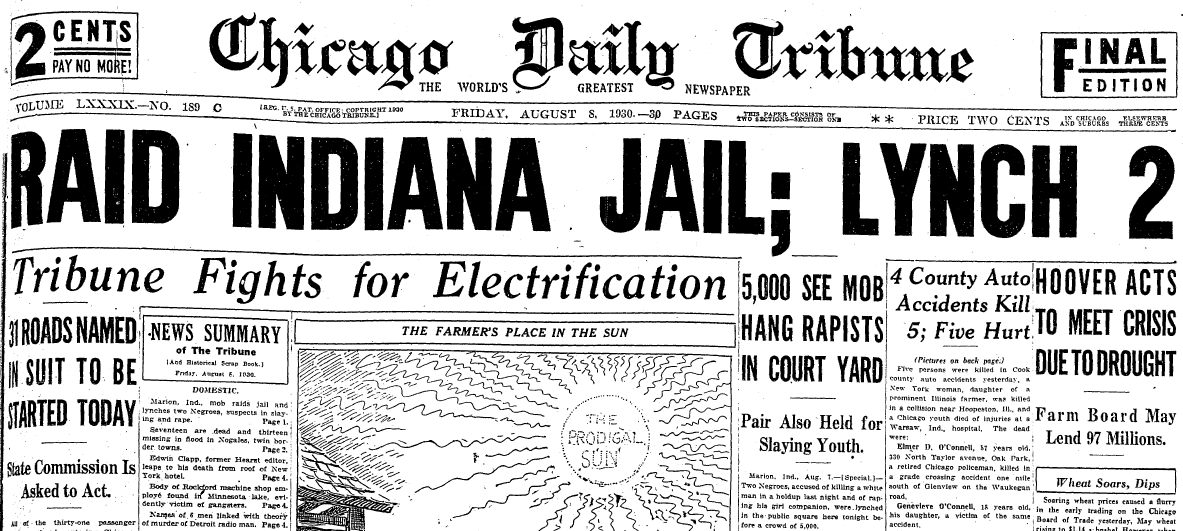
On this date in 1930, two black youths were lynched in Marion, Indiana for murdering a white man and raping his girlfriend.
(The rape allegation — although it, and not the homicide, seems to have been the thing that triggered the lynching — was subsequently withdrawn, and there were even rumors that the white girlfriend was a lover and confederate of one of the lynched men. It’s just one strand in the very human tapestry around the “last classic lynching north of the Mason-Dixon line” explored by Cynthia Carr in Our Town: A Heartland Lynching, a Haunted Town, and the Hidden History of White America.)
Shipp, who is said to have confessed killing the white man, Claude Deeter, 23, of Fairmount, Ind., was hanged from an elm tree in the courthouse yard. Smith, whom the girl identified as her assailant, was thrown from a third floor window of the jail with a noose around his neck and strangled.
…
Reports of the crimes and confessions, published in Marion newspapers this afternoon, stirred this quiet community of 23,000 to intense excitement. There was no hint of the impending violence, however, until 8:30 p.m., when a motorcade of Deeter’s fellow townsmen arrived from Fairmount.
The Fairmount delegation, numbering about 100, gathered in the public square, openly displaying their guns and shouting for a lynching … The sheriff led his deputies to the front door, argued a moment with the leaders of the mob and then ordered the tear bombs thrown. Blinded, the lynchers fell back for a few minutes, but returned and began the sledge hammer siege which forced the jail doors within ten minutes. No shots were fired on either side.
Following the lynching the mob gathered in the square for an hour, some proposing to drive the 2,000 members of the Negro colony from the city and burn their dwellings. Peace officers from Indianapolis, Kokomo, Fort Wayne, and other towns were arriving however, and gradually the mob broke up.
The corpses hung in the square for hours, attracting throngs of gawkers — including a photographer able to snap this picture:
Teacher/poet Abel Meeropol ran across this photo of the Shipp-Smith lynching a few years later in a magazine, and it so “haunted” him — his word — that he penned the anti-lynching poem “Strange Fruit”. You know it from Billie Holiday‘s arresting vocal rendition.
Southern trees bear strange fruit
Blood on the leaves
Blood at the root
Black bodies swinging in the southern breeze
Strange fruit hanging from the poplar trees
Pastoral scene of the gallant south
The bulging eyes and the twisted mouth
The scent of magnolia sweet and fresh
Then the sudden smell of burning flesh
Here is a fruit for the crows to pluck
for the rain to gather
for the wind to suck
for the sun to rot
for the tree to drop
Here is a strange and bitter crop
Abel Meeropol was no passing sentimentalist himself, but a prolific left-wing activist. During the McCarthy years, he adopted the children of the Rosenbergs when the latter were electrocuted as Soviet spies. As faithfully as those two orphaned boys have carried the torch for their lost birth parents, they also still carry an adoptive surname: Michael Meeropol and Robert Meeropol.
A third person was almost lynched in the same Marion, Ind., incident, but 16-year-old James Cameron (sometimes called “Herbert” or “Robert” in the 1930 news reports) managed to convince the mob that he wasn’t involved. Just how he managed this feat and what he’d really been up to is another strand of Carr’s tapestry: many of the Marion blacks as well as whites she interviewed overtly mistrusted Cameron.
At any rate, the crowd let him off with a beating, and Cameron served time as an accessory to the crime.
After release, he became an anti-lynching activist in Indiana and, later, Wisconsin — where he founded a (since-shuttered) Black Holocaust Museum. He started several NAACP chapters.
In the more immediate aftermath, it was far from a given that this date’s effusion of summary justice wouldn’t cascade into a generalized racial pogrom.
As the Tribune article notes, the lynch mob mulled attacking the black community, ultimately dissuaded by the gradual arrival of lawmen. By the next day, the Indiana national guard had occupied Marion. The Tribune on Aug. 10 reported the town “peaceful to all outward appearances but acutely aware of an undercurrent of racial antagonism that it feared might flame into open warfare at any moment.”
Lest this seem a bit over-the-top, recall that all this went down just a few years since a lynch mob in Tulsa had metastasized into one of America’s most notorious race riots. The prospect of wholesale bloodletting was very real.
When the local attorney general and grand jury waved away the small matter of punishing mob leaders, several of whom were publicly known by name, Indianapolis attorney general (and Marion native) James M. Ogden drove up to town and personally filed indictments, to the fury of white residents.
“It was astonishing to see and feel the mob atmosphere that still prevailed nearly seven months after the murder,” wrote a correspondent for The Nation. Ogden’s deputies were “looked upon as enemies of the community, not only by the mob, but also by most of the court officials.” After all-white juries acquitted the first two people tried, the state dropped its remaining indictments.
The maelstrom of race and politics and history that emerged from that first fatal transaction — a brutal but banal Lover’s Lane heist — grew so far beyond the original cast of criminal and victim that they practically became secondary to the story.
On August 8, 1930, a wire story datelined Fairmount, Ind., ran in the Indianapolis Star (but not the Marion papers):
Deep regret that the negro slayers of their son Claude, were lynched in Marion last night by a mob, was expressed today by Mr. and Mrs. William Deeter, members of the Apostolic faith, a sect similar to the Quakers.
“God should have been the judge,” said the elderly Deeter. “They had no right to do it,” his wife assented.
Both are opposed to capital punishment and did not want to see the negroes put to death for their crime.
Sometime in July 1943, a lucky accident saved the lives of thirteen-year-old Halina Birenbaum and a group of other girls and women, all of them inmates at the Majdanek Concentration Camp outside of Lublin, Poland.
Halina’s mother was sent to the gas chambers immediately upon their arrival at Majdanek. The daughter was spared to work and endure the torture that was daily life in the camp. “We were tormented day after day by roll calls, starvation, slave labor, beatings and vermin,” she recalled later in her memoir, Hope Is the Last to Die. “Lice devoured us at night.”
After two months of this, Halina was selected and sent along with her sister-in-law, Hela, and other female inmates to an empty hut in the men’s camp. The women had no idea what the Nazis wanted them for; there was nothing to do but wait.
When it was dark outside, the Storm Troopers locked the hut and switched off the light. I nestled up to Hela, and we both fell asleep on the floor, dreaming of a better camp, easier work, tolerable living conditions…
In the middle of the night, the SS noisily threw open the hut door, arousing us with their shouts and beatings; they began herding us out, making sure that no one hid or escaped. A fearful confusion ensued.
Sleepy, frightened to death, we crowded to the door, pushing and trampling one another in the darkness and panic. The Storm Troopers ran around like mad dogs. They made us form fours, lit electric lamps and counted us, swearing.
“They are taking us to the crematorium!” The terrible news fell on us like a thunderbolt and spread like lightning through the ranks.
My heart beat rapidly. I could not believe it. Once again I could not believe that death was possible, as months earlier, on the WarsawUmshlag, when the Nazis set up a machine-gun in front of us … And I did not yield to the general panic and despair.
The SS gave an order and we moved off … in the direction of the crematorium. Some women were weeping, others tearing their hair, praying, or bidding farewell to mothers or sisters.
They herded us into a hut, the interior of which resembled a bathhouse. Despite the darkness, we observed stacks of empty gas containers on the ground in front of the hut. There was a strange sweetish odor in the air. There was no doubt now that they were taking us to execution. The women went out of their minds … They groaned, wailed, had convulsions.
They herded us into the bathhouse, and barred the door behind us. Now we had to carry out an order given previously: undress and hang out clothes up on hooks on the wall. Obediently we undressed in silence. We knew there was no way out. We hung out clothes up, then sat down on benches along the walls, waiting in extreme agitation … When and how would death come?
Time passed. Hour followed hour. But nothing happened. No one came. It was silent both inside and outside the bathhouse. Perhaps they had forgotten us? A faint hope slowly began emerging … Toward morning they came back; after the nightmare of waiting for death in the gas chamber, we went outside. They counted us again (as though anyone could have escaped from that locked building!), and took us back to the men’s camp, to the same hut as the day before. There we learned from the prisoners that the supplies of gas has unexpectedly run out during the night … We had been spared on account of this accident.
Later that day, Halina and her fellow inmates were put on a truck and taken to Auschwitz.
Several times more she escaped death by the skin of her teeth. She would survive the war, move to Israel, and become a writer, poet and translator.


 Shaike was born and raised in Jonava, Lithuania and fled to Daugavpils with his brother when the Germans invaded the Soviet Union in June 1941. On June 29, he was arrested along with the other Jewish male adults in town. His brother, who was fifteen years old, was arrested alongside him, but released the same day because of his age.
 By the time I reached the age of fourteen, I had committed so many crimes on this earth that I should have been shot many times over. […] Moreover, I was not a member of the Party or the Komsomol, nor a member of the underground; I was not a Jew or a gypsy; I did not keep pigeons or have a radio set; I did not commit any crimes openly; and I did not get taken as a hostage. I was in fact a most ORDINARY, unexceptional, insignificant little chap in a peaked cap.
 Halina’s mother was sent to the gas chambers immediately upon their arrival at Majdanek. The daughter was spared to work and endure the torture that was daily life in the camp. “We were tormented day after day by roll calls, starvation, slave labor, beatings and vermin,” she recalled later in her memoir,