1824: Henry Fauntleroy, choked on debt

On this date in 1824, the last Englishman to hang for forgery, met his fate at Newgate prison.

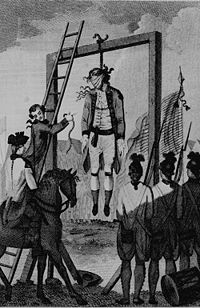
Henry Fauntleroy making his defense. From this Harvard gallery (part of the university’s Crimes Virtual Collection) of the period’s hanging press, including a Fauntleroy broadsheet (huge image, with a generic-looking merchant type as the criminal).

In a celebrated affair of the time, Fauntleroy was found to have inherited from his father a partnership in the foundering London bank Marsh, Sibbald & Co.

Desperate to keep the concern alive by maintaining a front of normalcy, Fauntleroy serviced its obligations by forging powers of attorney authorizing him to sell stock that he was supposed to merely be holding for investors.

Ever the diligent clerk, Fauntleroy made a ledger of the fraudulent transactions, plainly footnoted:

In order to keep up the credit of our house, I have forged powers of attorney for the above sums and parties, and sold out to the amount here stated, and without the knowledge of my partners. I kept up the payments of the dividends, but made no entries of such payments in our books.

The more things change

Fauntleroy, of course, didn’t have the reach of the Smartest Guys in the Room; what he did by foul means the collapse of his firm might have (more or less) accomplished by what economists regard as fair.

The firm, said the defendant, was in quite a fix.

I was only twenty-two years of age, and the whole weight of an extensive but needy Banking establishment at once devolved upon me, and I found the concern deeply involved in advances to builders and others … and the necessity of making further advances to those persons to secure the sums in which they stood indebted.

Translation: If you owe the bank £100, you’ve got a problem; if you owe the bank £100,000,000, the bank has a problem.

It took a lot less than that to run Marsh, Sibbald & Co. into the ground.

In this perplexed state the house continued until 1810, when its embarrassments were greatly increased, owing to the bankruptcies of Brickwood and others, which brought upon it a sudden demand for no less a sum than 170,000 £ … About 1814, 1815, and 1816, from the speculations with builders and brickmakers, & others, in which the house was engaged, it was called upon to provide funds to near 100,000 £, to avert the losses which would otherwise have visited it from these speculations. In 1819, the most responsible of our partners died, and we were called upon to pay over the amount of his capital, although the resources of the house were wholly inadequate to meet so large a payment. During these numerous and trying difficulties the house was nearly without resources, and the whole burthen of management falling upon me, I was driven to a state of distraction, in which I could meet with no relief from my partners, and, almost broken-hearted, I sought resources where I could, and so long as they were provided, and the credit of the house supported, no inquiries were made, either as to the manner in which they were procured, or as to the sources from whence they were derived.

In almost Dickensian fashion, our malefactor reacted more violently to allegations that the embezzlement had been effected in pursuit of a debaucherous lifestyle than he did to the criminal charge itself; if his version of bourgeois rectitude and endemic financial criminality further to the crumbling facade of his enterprise rings true, the ascetic clerk’s mortal penalty on behalf of his crummy bank will be a timely reminder of the pleasures one ought to seek before life withdraws them (or at least — just ask Robert Rubin! — of the invaluable utility of the limited liability company).

Having thus exposed all the necessities of the house, I declare that all the monies temporarily raised by me, were applied, not in one instance for my own separate purposes or expenses, but in every case they were immediately placed to the credit of the house in Berners-street, and applied to the payment of the pressing demands upon it. This fact does not rest on my assertion, as the transactions referred to are entered in the books now in the possession of the assignees, and to which I have had no access since my apprehension. These books, I understand, are now in Court, and will confirm the truth of my statement; and to whatever account all the sums may be entered, whether to that of Stock, of Exchequer Bills, or to my private account, the whole went to the general funds of the Banking-house.

Parliament abolished the death penalty for forgery in 1832. According to Hanging in the Balance: A History of the Abolition of Capital Punishment in Britain, a factor in the legislation was jurors’ increasing unwillingness to convict those accused of the crime knowing that it could lead to hanging. (See much testimony to that effect from the period’s lawyers and bankers here.)

A rumor circulated after Fauntleroy’s death — having something to do with the fame of the criminal, and something to do with what was reportedly his corpse’s unnaturally undamaged condition after the execution — that he had contrived to survive the hanging by slipping a silver tube down his throat, then absconded to live abroad.

Though evidently baseless as a factual matter, the legend is paid tribute by Nathaniel Hawthorne’s The Blithedale Romance, with a mysterious banker named “Fauntleroy” whose backstory would have elicited a knowing wink from many a reader in his time … and ours.

After Fauntleroy had thus spent a few empty years, coruscating continually an unnatural light, the source of it — which was merely his gold — began to grow more shallow, and finally became exhausted. He saw himself in imminent peril of losing all that had heretofore distinguished him; and, conscious of no innate worth to fall back upon, he recoiled from this calamity with the instinct of a soul shrinking from annihilation. To avoid it, — wretched man! — or rather to defer it, if but for a month, a day, or only to procure himself the life of a few breaths more amid the false glitter which was now less his own than ever, — he made himself guilty of a crime. It was just the sort of crime, growing out of its artificial state, which society (unless it should change its entire constitution for this man’s unworthy sake) neither could nor ought to pardon. More safely might it pardon murder. Fauntleroy’s guilt was discovered. He fled …

The wreck of his estate was divided among his creditors: His name, in a very brief space, was forgotten by the multitude who had passed it so diligently from mouth to mouth. Seldom, indeed, was it recalled, even by his closest former intimates. Nor could it have been otherwise. The man had laid no real touch on any mortal’s heart. Being a mere image, an optical delusion, created by the sunshine of prosperity, it was his law to vanish into the shadow of the first intervening cloud. He seemed to leave no vacancy; a phenomenon which, like many others that attended his brief career, went far to prove the illusiveness of his existence.

On this day..

1887: Parsons, Spies, Fischer and Engel, the Haymarket Martyrs

On this date in 1887, the Chicago political machine hanged four at Cook County Jail to defend civilization from the eight-hour day.

The Haymarket martyrs, as they would be remembered ere the hysterical atmosphere of their sentencing had passed, were four from a group of eight anarchist agitators rounded up when a never-identified person threw a bomb at Chicago police breaking up a peaceful rally. The bomb killed one cop; the indiscriminate police shooting that followed killed several more in friendly fire, plus an uncertain number of civilians.

The incident occurred just days after nationwide strikes began on May 1, 1886, in support of the eight-hour day. Nowhere were the tensions greater than Chicago, an epicenter of militant organizing. When tens of thousands poured into the streets on May 1, the Chicago Mail darkly said of high-profile radicals Albert Parsons and August Spies,

Mark them for today. Hold them responsible for any trouble that occurs. Make an example of them if trouble does occur.

Sure enough …

Most of the eight hadn’t even been present at the time the bomb was thrown, but the state put anarchism itself on trial under the capacious umbrella of “conspiracy,” in a proceeding so absurdly rigged that a relative of a slain cop was on the jury. Quoth the prosecutor,

Law is upon trial. Anarchy is on trial. These men have been selected, picked out by the grand jury and indicted because they were leaders. They are no more guilty than the thousand who follow them. Gentlemen of the jury; convict these men, make examples of them, hang them and save our institutions, our society.

That was the argument for hanging them. And right-thinking burghers applauded it.

Seven of the eight were condemned to die; two had their sentences commuted, but the other five refused to ask for clemency on the grounds that, innocent, they would “demand either liberty or death.” One of those five, Louis Lingg, painfully cheated the hangman by setting off a blasting cap in his mouth the night before his execution. (Lingg might have made, though seemingly not thrown, the mysterious bomb.)

The others — Parsons and Spies, along with Adolph Fischer and George Engel — hanged together, with their epitaphs upon their lips — literally so for Parsons, whose parting remark is at the base of the Haymarket Martyrs Monument*

“The time will come when our silence will be more powerful than the voices you are throttling today.”

“Throttle” was right, as the Chicago Tribune reported the next day, taking up when the trap was sprung:

Then begins a scene of horror that freezes the blood. The loosely-adjusted nooses remain behind the left ear and do not slip to the back of the neck. Not a single neck is broken, and the horrors of a death by strangulation begin.

Six years later, Illinois Gov. John Altgeld granted the free pardon the hanged men had demanded to the three surviving Haymarket anarchists. There is no institutional mechanism to determine erroneous executions in American jurisprudence — a fact that occasionally leads to smugly circular avowals that nobody recently executed has ever been “proven” innocent — and death penalty researchers Michael Radelet and Hugo Bedau believed as of this 1998 paper (pdf) that Altgeld’s executive statement flatly asserting the injustice of the Haymarket convictions was the most recent official acknowledgment of a wrongful execution in U.S. history. If true, its uniqueness would be understandable: the gesture cost Altgeld his political career.

Long gone as all these principals are, the legacy of Haymarket remains very much with us, and not just as a magnet for digital archives like this, this and this (don’t miss the brass gallows pin).

May 1, now rich with the symbolism of the Haymarket Passion, was soon selected by the international labor movement as the date to resume the eight-hour-day push — thus becoming the global workers’ holiday it remains to this day.

* Opposing interpretations of the Haymarket affair — which can be the “Haymarket riot” or the “Haymarket massacre,” depending on where you line up — were marked by opposing memorials. The police memorial was itself eventually bombed by the Weather Underground, and subsequently squirreled away from easy public view. Paradoxically, the Haymarket Martyrs Monument has been federally dignified as a National Historic Landmark.

On this day..

1892: Jens Nielsen, the last in Denmark

On this date in 1892, serial arsonist Jens Nielsen was beheaded with an axe in the courtyard of Horsens prison — the last civil execution ever conducted in Denmark.

According to this Danish biography, Nielsen had incurred a long prison sentence for burning several farms in July 1883.

(He’d just returned from a fruitless stint in the New World, torching a warehouse in England on the return voyage.)

Apprehended immediately and sentenced to a long prison term, Jens confronted an age-old dilemma which was evidently noticeably acute among melancholy Danes: effecting state-assisted suicide on the scaffold.

These cases must have once been fairly frequent because Denmark, by an ordinance of December 18, 1767, deliberately abandoned the death penalty in cases where “melancholy and other dismal persons [committed murder] for the exclusive purpose of losing their lives.” The background for the provision was, in the words of Orste, “the thinking that was then current among the unenlightened that by murdering another person and thereby being sentenced to death, one might still attain salvation, whereas if one were to take one’s own life, one would be plunged into eternal damnation.”

The ordinance was ineffective in one case, at least, that of Jens Nielsen, who was born in 1862 and spent a most unhappy and unfortunate childhood. In 1884 he was sentenced to 16 years of hard labor for theft and arson. The following year he tried to kill a prison guard. He was tried, sentenced to death and received a commutation to life. He was then placed in solitary confinement. A year later he tried again to kill a guard, “realizing that he could not stand solitary confinement, did not have the nerve to commit suicide and wanted to force his execution.” He was again tried, sentenced to death and the sentence commuted. In 1892, having remained in solitary confinement all that time, he tried again to kill a guard. This time he got his wish, was sentenced to death and executed. (Source.)

He even managed to crack wise, “Thank you!” to the mayor who wished him God’s help on the way to the scaffold — envoy of the powers both temporal and ethereal that would finally loose his shackles.

Denmark’s death penalty law lingered into the 1930’s, but even the occasional death sentences were no longer carried out. Apart from a brief revival after World War II to punish war crimes committed during the Nazi occupation, nobody has been put to death in Denmark in — as of today — 116 years.

On this day..

2007: Not Earl Wesley Berry … for the time being

Minutes before he was to die this day last year, the lethal injection of Mississippi murderer Earl Wesley Berry was stayed by the Supreme Court — the signal that it had imposed a de facto moratorium on executions while it considered the constitutionality of lethal injection.

Condemned to die for kidnapping and beating to death Mary Bounds in 1987, Berry was your basic unappealing death row case with no particular issue either substantive or technical likely to help him out in the courts.

Luckily for Berry, the fundamental issue of whether whether the lethal injection regime used in Mississippi and in most of the United States was cruel and unusual punishment had reached the high court at just time time.

Also luckily, the phone lines were open: Berry got his reprieve with about 15 or 20 minutes to spare.

Berry’s stay finally clarified a few weeks of uncertainty that prevailed after the Court took last year’s lethal injection challenge, Baze v. Rees.

Could executions still go forward while lethal injection was under review? Would the holdup be limited to Kentucky, where the appeal originated? Was there any manner of case-by-case flexibility?

Berry was the bellwether. The execution-friendly Fifth Circuit Court let Berry’s scheduled date go ahead, making the hapless killer “the last best chance for prosecutors to restart executions this year [2007].”

But Earl Wesley Berry’s luck was only about seven months long: he was executed on May 21, 2008, the second prisoner put to death after the moratorium expired upon the Court’s rejection of Baze.

On this day..

1943: 98 American civilian contractors on Wake Island

On this date in 1943, after Japanese-occupied Wake Island was subjected to a withering bombardment from the United States Navy, garrison commander Shigematsu Sakaibara ordered the summary execution of 98 American prisoners of war.

Wake Island came under Japanese attack immediately after the bombing of Pearl Harbor raised the curtain on the Pacific theater — and was overrun in two weeks.

It was strategically situated halfway between Hawaii and the Philippines. That’s why the Japanese wanted it — and that’s why the Americans wanted it back.

Caught in the middle were 1,600-plus Americans captured when Wake fell in December 1941, 1,100 of them civilian contractors of construction conglomerate Morrison Knudsen there to build a naval base. Most of these, and all military personnel, were shipped to POW camps in China early in 1941; only 700 contractors would survive their four-year sojourn in Japanese captivity.

By September 1942, only 98 Americans remained* on Wake Island — all contractors, the last remnants of the prison labor force who had been forced to lattice the island with defensive fortifications against the expected American invasion.

U.S. forces bombed Wake Island repeatedly during World War II — rare respites from the monotony of forced labor — but the most intense attack was an orchestrated naval bombardment and aerial attack beginning Oct. 5. Shigematsu Sakaibara feared it was the prelude to a long-anticipated landing attempt. And he wasn’t the only one: reporting the attack, the New York Times tried to read the tea leaves of the official pronouncements:

The fact that Wake was attacked yesterday by surface bombardment as well as aeriel bombing probably indicates that a major reduction of Wake is now intended. The atoll, which is the closest Japanese base to Pearl Harbor with the exception of a few islands in the Marshalls group, is a key stepping stone on Japan’s fastest aeriel route to her other central Pacific possessions in the Marshalls and Gilberts southwest of Hawaii.

Still,

[o]ccupation by United States forces of Wake Island, which is 1,033 miles from Midway, has been predicted for some time, but there is no indication that such an operation is probable immediately.

Sakaibara, unfortunately, didn’t have a Times subscription.

Expecting a landing, and fearing the prisoners would rise up as a “fifth column” against their captors when it came, Sakaibara had the 98 prisoners machine-gunned en masse on the beach. One of them managed to survive and escape the slaughter, but was recaptured shortly after, and is supposed to have been personally beheaded by the admiral. It’s said that unidentified man carved a (misdated) testimony to the crime on a nearby coral rock known as “98 Rock”: “98 US PW 5-10-43”.

As it turned out, the landing never did come. The U.S. Navy bypassed Wake Island, allowing it to languish under a blockade as it advanced elsewhere in the Pacific, and received Sakaibara’s peaceful surrender after the bombings of Hiroshima and Nagasaki.

Although the Japanese had hastily exhumed the murdered POWs and reburied them in a cemetery as the end of the war approached, the cover story on the “Wake Island Massacre” soon cracked. For this day’s affair, Sakaibara was convicted of war crimes by an American tribunal, and hanged in Guam on June 18, 1947.

* The identities of the 98 are known, and are listed online here as well as on a plaque at the site.

On this day..

1621: Not Katharina Kepler, thanks to her son Johannes

On October 4, 1621, the Duke of WĂĽrttemberg declared Katharina Kepler free of a witchcraft charge for which she had barely avoided execution … with the help of her son, the astronomer Johannes Kepler.

The famous scientist was very well along his career, and his mother (German Wikipedia link) a too-old-for-this-crap 69, when authorities in her native town of Leonberg initiated proceedings in 1615.

It says here she was an eccentric, cantankerous old dame, just the sort liable to face a gossip campaign that would promote her into partnership with the Evil One. She was only one of a number of people targeted in the town’s witch-spasm, noticeably occurring as the Catholic-Protestant conflict was stoking that crucible of modernity, the Thirty Years’ War — a fine time and place for infernal superstition.

Several of the suspected were put to death.*

Kepler, whose heterodoxy and heliocentrism made him a touchy figure in a fraught time for scientists, might have done her no favors with his trippy Dream, whose overt musings on “daemons” and the like might have drawn suspicion onto the family. Johannes made six years of atonement struggling — ultimately successfully — to keep his mother alive and untortured.

Commuting back and forth from his work in Linz (showing an admirable capacity for keeping his head while others about him were in danger of losing theirs, Kepler discovered his third law of planetary motion in 1618; apparently he also read Galileo’s father on one of the trips between Linz and Leonberg), he organized his mother’s defense and wrote her briefs in his own hand.

It finally paid off.

The judicial college at the University of TĂĽbingen — Kepler had matriculated there as a younger man — opened the door to Katharina’s release by declaring the evidence insufficient either way, and issuing a split-the-baby conviction directing that she be shown but not subjected to the instruments of torture.

On September 28, 1620, the Feast of St. Wenceslas, the executioner showed Katharina Kepler the instruments of torture, the pricking needles, the rack, the branding irons. Her son Johannes Kepler was nearby, fuming, praying for it to be over. He was forty-nine and, with Galileo Galilei, one of the greatest astronomers of the age — the emperor’s mathematician, the genius who had calculated the true orbits of the planets and revealed the laws of optics to the world. Dukes listened to him. Barons asked his advice. And yet when the town gossips of Leonberg set their will against him, determined to take the life of his mother on trumped-up charges of witchcraft, he could not stop them.

There were tidal forces at work in this little town. The events around the duchy of WĂĽrttemberg would gather into themselves all the violent changes of the day, for by their conviction of Katharina, the consistory (the duke’s council), the magistrates, and the Lutheran church authorities had bundled together their fear of Copernicus and their anger against Johannes, a man they had already convicted of heresy. The Reformation, like an earthquake, had cracked Western Christianity, stable since the fifth century, into Catholics and Protestants, and the Protestants into Lutherans, Zwinglians, Calvinists, Anglicans, and Anabaptists, with the many camps drifting apart like tectonic plates. Even the heavens had begun changing, and Kepler had been a part of that change. … Fear ruled Europe — fear of difference, fear of change.

And there, in one corner of Swabia in southern Germany, the mother of a famous man, a mathematician and scientist, a respected, pious Lutheran, nearly paid with her life.

Early that morning, she was led to the torturer by Aulber, the bailiff of GĂĽglingen, who was accompanied by a scribe for recording her confession, and three court representatives. The torturer, with the bailiff standing to one side, then shouted at her for a long time, commanding her to repent and tell the truth and threatening her if she didn’t. He showed her each instrument and described in detail all that it would do to her body — the prickers, the long needles for picking at the flesh; the hot irons for branding; the pincers for pulling and tearing at the body; the rack; the garrote; and the gallows for hanging, drawing, and quartering. He adjured her to repent, to confess her crimes, so that even if she would not survive in this world, she could at least go to God with a clear conscience.

Stubborn Katharina was having none of it.

Do with me what you want. Even if you were to pull one vein after another out of my body, I would have nothing to admit. (Source)

Having survived the “torture,” she was in the clear; at her son’s relentless insistence, the Duke ordered her released six days later.

Katharina Kepler died naturally the following April. There’s a school named for her (German link) in nearby GĂĽglingen, Germany, where ma Kepler spent 14 months in prison. (German again)

* This German timeline of Leonberg says the witchsmeller got nine out of 10 targets. Other versions have slightly different head counts for the persecution; at any rate, Katharina wasn’t alone.

On this day..

1780: Major John Andre, Benedict Arnold’s handler

On this date in 1780, the honorable British Major John Andre got what Benedict Arnold had coming to him.

Piqued that his (quite considerable) brilliance in the field did not earn honors he thought his due, General Benedict Arnold contrived to betray West Point to the British during the American Revolution — the plot that made his name a synonym for treachery.

As the scheme ripened, the turncoat asked Sir Henry Clinton for “a personal interview with an officer that you can confide in.”

Enter Clinton’s adjutant John Andre, head of British Special Intelligence.

The dashing officer, well-liked in society on either side of the permeable divide between Tories and Patriots on the continent, slipped into Haverstraw, N.Y. to make the arrangements. On his way back — when he already thought himself safely clear of American-held territory — he was nabbed with the incriminating documents.

The narrowly-averted betrayal was mirrored by the narrowest of escapes: luckily for Benedict Arnold, Andre was received in custody by a subordinate officer of his, whose initial report to Arnold alerted the general to his danger and enabled him to escape to the British a whisker ahead of the law.

Treason, of the blackest dye, was yesterday discovered. General Arnold, who commanded at West Point, lost to every sentiment of honor, of private and public obligation, was about to deliver up that important post into the hands of the enemy. Such an event must have given the American cause a dangerous, if not a fatal wound; happily the treason has been timely discovered, to prevent the fatal misfortune. The providential train of circumstances which led to it, afford the most convincing proofs that the liberties of America are the object of Divine protection.

It was a gentlemanly war, and Andre didn’t seem like the guy to hang in the whole exchange. But his argument before a court-martial that he was merely availing “an advantage taken in war” by agreeing to talk to an enemy general who wanted to hand them the keys to a fort didn’t fly: he’d been behind enemy lines, out of uniform, sneaking around. That made him a spy.

And the British refused to obtain Andre’s liberty by trading the man the Americans really wanted to execute.

Instead, by year’s end, the hero of Saratoga was commanding redcoats in the field — perhaps a little nervously; when he asked a captured American what might happen to him should he be taken, the reply was “Cut off your right leg, bury it with full military honors, and then hang the rest of you on a gibbet.”

John Andre was left holding the bag, to the dismay of just about everyone American and British alike. This extended account of the luckless major’s last moments* is from the pen of Continental Army surgeon James Thacher.

Major Andre is no more among the living. I have just witnessed his exit. It was a tragical scene of the deepest interest. During his confinement and trial, he exhibited those proud and elevated sensibilities which designate greatness and dignity of mind. Not a murmur or a sigh ever escaped him, and the civilities and attentions bestowed on him were politely acknowledged…

The fatal hour having arrived, a large detachment of troops was paraded, and an immense concourse of people assembled; almost all our general and field officers, excepting his excellency [George Washington] and his staff, were present on horseback; melancholy and gloom pervaded all ranks, and the scene was affectingly awful … Major Andre walked from the stone house, in which he had been confined, between two of our subaltern officers, arm in arm; the eyes of the immense multitude were fixed on him, who, rising superior to the fears of death, appeared as if conscious of the dignified deportment which he displayed. He betrayed no want of fortitude, but retained a complacent smile on his countenance, and politely bowed to several gentlemen whom he knew, which was respectfully returned. It was his earnest desire to be shot, as being the mode of death most comformable to the feelings of a military man, and he had indulged the hope that his request would be granted. At the moment, therefore, when suddenly he came in view of the gallows, he involuntarily started backward, and made a pause. “Why this emotion, sir?” said an officer by his side. Instantly recovering his composure, he said, “I am reconciled to my death, but I detest the mode.” While waiting and standing near the gallows, I observed some degree of trepidation; placing his foot on a stone, and rolling it over and choking in his throat, as if attempting to swallow. So soon, however, as he perceived that things were in readiness, he stepped quickly into the wagon, and at this moment he appeared to shrink, but instantly elevating his head with firmness, he said, “It will be but a momentary pang,” and taking from his pocket two white handkerchiefs, the provost-marshal, with one, loosely pinioned his arms, and with the other, the victim, after taking off his had and stock, bandaged his own eyes with perfect firmness, which melted the hearts and moistened the cheeks, not only of his servant, but of the throng of spectators. The rope being appended to the gallows, he slipped the noose over his head and adjusted it to his neck, without the assistance of the awkward executioner. Colonel Scammel now informed him that he had an opportunity to speak, if he desired it; he raised the handkerchief from his eyes, and said, “I pray you to bear me witness that I meet my fate like a brave man.” The wagon being now removed from under him, he was suspended, and instantly expired; it proved indeed “but a momentary pang.” He was dressed in his royal regimentals and boots, and his remains, in the same dress, were placed in an ordinary coffin, and interred at the foot of the gallows; and the spot was consecrated by the tears of thousands.

Thus died, in the bloom of life, the accomplished Major Andre, the pride of the royal army, and the valued friend of Sir Henry Clinton. He was about twenty-nine years of age, in his person well proportioned, tall, genteel and graceful. His mien respectable and dignified. His countenance mild, expressive and prepossessing, indicative of an intelligent and amiable mind. … considered as a skilful, brave and enterprising officer, and he is reported to have been benevolent and humane to our people who have been prisoners in New York. … The heart of sensibility mourns when a life of so much worth is sacrified on a gibbet. General Washington was called to discharge a duty from which his soul revolted; and it is asserted that his hand could scarcely command his pen, when signing the warrant for the execution of Major Andre. … Could Arnold have been suspended on the gibbet erected for Andre, not a tear or a sigh would have been produced, but exultation and joy would have been visible on every countenance.

Andre makes a sort of loyalist counterpart to Nathan Hale. Interestingly, Thacher’s account — in which he uses his old diaries for a book that was published in 1823 — footnotes an extended narration of Nathan Hale in a comparative vein, complaining that “whilst almost every historian of the American Revolution has celebrated the virtues and lamented the fate of Andre, Hale has remained unnoticed, and it is scarcely known that such a character ever existed.” Today, in terms of their public recognizability, the two are rather reversed.

* Andre was to have been hanged October 1, but the matter was stayed when a British deputation arrived under flag of truce to make one last parley for their man’s life.

On this day..

1638: Three (of four) English colonists for murdering a Native American

Four hundred years removed from the events surrounding the colonization of Massachusetts by English settlers through the 1620’s, it’s difficult to properly evaluate the mindsets of either colonist or colonizer in this time of violent encounters and expansive cultural shifts.

The 1638 case of Arthur Peach, Thomas Jackson, Richard Stinnings, and Daniel Cross serves as a potent reminder that the relationship between the interlopers and natives in the early years of these meetings was driven as much by tribal politics as by interpersonal attitudes.

Peach, by all accounts, was not on track to be elected Plymouth Man of the Year. A servant of Edward Winslow, one of the Mayflower originals responsible for political gaming with the native leaders, Peach was dispatched to serve in the Pequot War in 1637. The war pitted English colonists and some of their tribal neighbors against the Pequots and resulted in the slaughter of hundreds of Pequot in several attacks.

Peach went work-idle in the post-war years, enjoying his remaining youth: he frequently drank and spent evenings in merriment with his friends, accumulating a sizable debt in the process; said merriment also extended to impregnating Dorothy Temple, a servant of Stephen Hopkins (who was, in one of the less surprising twists, later charged with allowing drunken merriment of his servants in his house).

Plymouth Colony leader William Bradford: Can’t we all get along?

William Bradford speculates that it was to escape punishment for this latter social offense that Peach convinced three other indentured servants to break their bonds and follow him to the nearby Dutch plantations. No matter the motive, they were ill-advised to join him.

Along the way, the quartet came across a man of the Nipmuc tribe (allied with the English and Narragansett during the recent war) named Penowanyanquis. They convinced him to stay, smoked a pipe and talked trade, then stabbed and robbed him, leaving him for what they thought was dead; Penowanyanquis was found on the road and lived for several more days, plenty of time to describe his attackers to first his tribesmen, then the Englishman Roger Williams.

The Plymouth authorities accepted the case (in Plymouth, though the event occurred far from its apparent jurisdiction) in the interests of maintaining the tenuous peace with the New England natives — in Bradford’s words, “The Gov[ernment] in the Bay were aquented with it, but refferrd it hither, because it was done in this jurissdiction; but pressed by all means that justice might be done in it; or els the countrie must rise and see justice done, otherwise it would raise a warr.”

Peach, Jackson, and Stinnings were caught at Aquidneck Island, while Cross fled to Piscataqua (New Hampshire), where it was traditional for locals to refuse to help Plymouth colonials. The three detainees were tried, with much of the trial devoted to proving that Penowanyanquis was, in fact, dead. It took two Narragansett to affirm upon pain of their own heads that Penowanyanquis had succumbed to his injuries, but their testimony sent three whites to the gallows for killing an Indian; for the second time since the Plymouth colony was established 18 years prior, a murderer was hanged.*

The oddity of the affair is not that such a conviction occurred — it was a long-standing colonial tradition to uphold treaties with natives through civil law and break them in a variety of other ways — but the reaction of persons involved before and during the trial. To wit:

Ousamequin coming from Plymouth told me that the four men were all guilty. I answered but one; he replied true, one wounded him, but all lay in wait two days and assisted. Also that the principal must not die, for he was Mr. Winslow’s man; and also that the Indian was by birth a Nipmuck man, so not worthy that any other man should die for him.

Ousamequin, here making the case that Peach should be spared, was another name for Massasoit, the old chief of the Pokanoket whose special kinship with Peach’s indenturerer Winslow was cemented after the settler brought a severely ill Massasoit European remedies when the chief was struck with an unnamed ailment in 1623.

Nor, indeed, were the colonists uniformly positive about the event: Bradford reports that “[s]ome of the rude and ignorant sorte murmured that any English should be put to death for the Indean.”

Massasoit himself seems to have been the only thing holding the colonial relationship together: Metacomet (“King Philip”) took the title of Great Sachem shortly after Massasoit’s death, and his alliances with other tribes exacerbated the harsh feeling towards English attempts to Christianize their neighboring “heathens”. With the white population expanding swiftly beyond its early boundaries, a small event was bound to spell trouble, and when the Christian convert John Sassamon (an Indian) was found murdered and three Wampanoag were executed for the deed, Indian sovereignty was impugned.

King Philip’s War was on, and it did not end well for the native Americans.

No.

To his credit, Peach still produced a son, and Temple’s pregnancy ended the public life of Hopkins. Hopkins was charged with mistreating Temple, who was his indentured servant, and ordered to pay for both her and her child through the two years remaining on her contract.

Hopkins dissented and was jailed, bailed out four days later by John Holmes, who purchased Temple’s servitude for a whopping three pounds (somewhere between 1/4 and 1/2 the price of a cow). Her son remains unnamed in the record, but after giving birth, Temple was charged with producing a bastard child and whipped. Her fate thereafter is lost to the mists of history, as are the future exploits of Daniel Cross.

* The first was Mayflower original John Billington, who was executed in 1630 for shooting John Newcomen to resolve what was apparently a long-standing dispute.

On this day..

1724: Half-Hangit Maggie Dickson

Allegedly on this date in 1724, a young woman was hanged at Edinburgh’s Grassmarket for concealing her pregnancy.

Any number of details in this horrible/wonderful story are shaky, including the date: some sources make it 1728, a few say 1723, and only a handful attest a specific calendar date. Nobody seems to doubt the tale in the main, however — and it’s certainly excellent enough lore to deserve even a heavily asterisked entry.

Deserted by her husband, young Maggie Dickson took lodgings at an inn in exchange for work, and became pregnant by either the innkeeper or his son. (Again — details in the various sources available read like a game of telephone.) Since single* pregnant working-class women had about as many employment options as birth control options, Maggie kept quiet about her condition in the interest of keeping her job.

And since male parliamentarians figured their job was to keep young lasses of loose character and modest means on the straight and narrow by criminalizing their options, Maggie’s sleight-of-womb put her in violation of a law against concealing a pregnancy. (The same situation was playing out elsewhere in the British sphere at this time.)

When the resulting infant turned up dead, the trail led straight to Dickson … but the concealment of the pregnancy and birth were capital crimes on their own, making it immaterial whether it had been a miscarried pregnancy, an act of infanticide, or simply one of the many early 18th century babies to die in the cradle. The law was an indiscriminate instrument to prevent women terminating their pregnancies.

Nothing noteworthy about the hanging itself is recorded; it seems to have been one of the routine public stranglings of the age, and even the scuffle over the body between family and medical students hunting dissection-ready cadavers was a normal occurrence.

The family won. And en route to Musselburgh for burial, Maggie started banging on the inside of the coffin, and was forthwith revived. Officials decided the sentence of hanging had already been carried out … and her awestruck neighbors suddenly started seeing Maggie sympathetically

And they all lived happily ever after. This day’s principal, at any rate, gained a foothold in adequate prosperity, bore more children, and answered to the nickname “Half-Hangit Maggie Dickson” all the many more years of her life.

The story passed into legend; the dates, as we’ve alluded, fuzzed. One entrepreneurial English broadside publisher of the 19th century even transported the affair to February 1, 1813 — four years after a Concealment of Pregnancy Act reduced the penalty for Maggie Dickson’s “crime” to penal servitude. And near the site of the not-quite-Passion, should you call sometime in Edinburgh, you can raise Half-Hangit Maggie a pint at Maggie Dickson’s Pub.

I’le crye as fu’ o’ tears an egg,
‘Death, I’ve ae favour for to begg,
That ye wad only ge a flegg,
And spare my life,
As I did to ill hanged Megg,
That graceless wife

-Broadside, ‘The last speech and dying words of John Dalgleish, Hangman of Edinburgh’

* Technically, she was still married but separated.

Part of the Themed Set: Judging Abortion.

On this day..

1794: The last cart of the Terror, not including the Marquis de Sade

July 27th, 1794 — the 9th of Thermidor, year II — is inscribed in history as the day Robespierre fell, when a parliamentary coup d’etat between the right and the remnants of the parties he had destroyed shouted him down as he readied the National Convention for his next purge.

This scene from the multinational bicentennial epic La Revolution Francaise conflates the events of 8 Thermidor — when Robespierre delivered a menacing two-hour address but provoked outcries by failing to name the deputies he implicated in “conspiracy” — and 9 Thermidor, when Robespierre’s lieutenant Saint-Just was shouted down from the podium and Robespierre ended up staggering through the benches appealing against the imprecations of his colleagues as his arrest is decreed.

Even as the month of Thermidor’s eponymous epochal event was unfolding, the daily gears of Revolutionary justice were turning: the usual haul of unfortunates condemned, including seven women from the previous day’s batch of Saint Lazare prison conspirators who had pled their bellies to buy a day.

That day was one day too little.

Stanley Loomis is overtly hostile to the Revolution, but his middlebrow sensibilities are well-tuned for the pathos of the scene:

Indifferent to the storms that were raging in the Convention, the Revolutionary Tribunal continued to go about its implacable business with cold efficiency. The arrest of its President [the Robespierrist Rene-Francois Dumas (the link is French), who was taken in the courtroom] startled no one. Since its inception that court had been witness to too many dramas to be astonished any further. Dumas quietly departed; the trials continued. Forty-two prisoners were sentenced to death. By four o’clock their hair had been cut and they were ready to be sent on their way. But Samson, aware of disturbances in the St. Antoine quarter of the city, suggested to [prosecutor] Fouquier[-Tinville] that the executions be deferred until the morrow.*

“Justice must take its course,” snapped the Public Prosecutor. “Do your work.”

And so the last “batch” lumbered off in the direction of the Faubourg St. Antoine and the Place de la Nation. With the exception of the Princesse de Monaco, they were nearly all obscure and humble members of the petite bourgeoisie. Hanriot, waving his sabre, conducted the procession to the place of execution. By seven o’clock that evening, as the minutes of the military escort poignantly show, the unfortunate victims, who had been so close to deliverance, had all been executed.

Henriot proceeded directly from his escort service to the Convention to liberate Robespierre for the night’s brief pitched battle against the Convention, and here we take our leave of them, for now. We shall meet both of them on the scaffold tomorrow.

Not on the wagon** with the Princess of Monaco was a man whom Loomis would have pitied rather less.

The bloated, penniless 54-year-old fruit of an ancient noble house, Donatien Alphonse François de Sade, Marquis de Sade had, in the most recent chapter of his astounding career, navigated the Revolution in the improbable guise of a proletarian section head and revolutionary tribunal judge, until his own arrest late the previous year.

This day, de Sade’s name was on a list of prisoners to be seized from Madelonnettes Prison — “Sade, former count, captain of Capet’s guards in 1792, has corresponded with enemies of the republic,” it said — which he had occupied until a recent transfer to Picpus, a monastery converted into a prison adjacent to the guillotine’s place at the Place de la Nation. Whether the result of another of the many bureaucratic snafus we’ve witnessed this week or a well-placed bribe from his friend and/or mistress Marie-Constance Quesnet, the guards were in the wrong place, didn’t find him, and didn’t care to dig any further.

Three months later, he was — for the last time in his life — a free man.

One could hardly say that the Revolution made the author of Justine the man he so (in)famously was — but having lived within sight of the blade that might any day be called upon to chop off his own head, and the entire tableau of the years preceding, left their impression. Hundreds of bodies from the Terror were stuffed in the unpropitious clay of the makeshift jail’s yards under de Sade’s cell. “Those few months in the shadow of the guillotine did me more harm than all the years of my incarceration under the King,” he wrote a friend.

According to Writing the Orgy: Power and Parody in Sade, Revolutionary France would inexorably influence his subsequent work,

strangely mixing real memories with very Sadean embellishments … Plots, betrayals, denunciations, beheadings: these fictional motifs and Sadean phantasies are linked with the reality and the imaginary of the Revolution.

Good for what ails you.

* Sanson’s diaries — a memoir of the family business constructed by the famous executioner’s grandson — leave off before the events of Thermidor and suggest that the hecatombs of the Terror were taking their toll on the aging headsman. Other accounts of this day have the tumbrils stopped in the streets by clemency-inclined onlookers, only to be forcibly extricated by Henriot.

** Also not (really) on the cart: the fictional occultist Zanoni, who is beheaded in this batch in the novel of the same title by legendary awful writer Edward George “it was a dark and stormy night” Bulwer-Lytton.

Part of the Themed Set: Thermidor.

On this day..