On this date in 1882* Stepan Khalturin** was hanged in Odessa, Ukraine … but not for his most (in)famous crime.
Khalturin (English Wikipedia entry | Russian) came from a well-off peasant family near the city of Vyatka (today, Kirov; it was renamed for an assassinated Bolshevik). As a young carpenter in 1870s St. Petersburg, he fell in with revolutionary circles and became a distinguished propagandist and organizer. Khalturin helped found the first political labor labor organization in Russia, the “Northern Russian Workers’ Union”.
He’s said by other leftist agitators who knew him to have “persuaded his student workers with tears in his eyes to continue propagandizing, but in no event go down the path of terror. From this, there is no return.”
If that used to be his sentiment, Khalturin’s thinking … evolved.
By February 1880, Khalturin was for all intents and purposes in on the terrorism strategy. He took advantage of a workman’s gig at the Winter Palace to pack the cellar full of dynamite,† two floors below the imperial dining room.
But Tsar Alexander II and party had not yet returned when it blew. Eleven people, mostly guardsmen in the intervening room below the dining hall, died in the blast; dozens of others were injured.
Khalturin watched in frustration from the iron gates of the Winter Palace, and slipped away — never detected. His co-conspirator Zhelyabov consoled him with the prospects of mass recruitment sure to be unleashed by this spectacular propaganda of the deed. “An explosion in the king’s lair — the first attack on the autocracy! Your deed will live forever.” (Russian source)
A year later, Narodnaya Volya finally succeeded in assassinating Alexander II in St. Petersburg. Zhelyabov and five others hanged for that.
Khalturin wasn’t involved in that plot: he had escaped to Odessa.
There, he shot a police officer named Strelnikov. He was captured and hanged under a bogus alias, nobody realizing that they were also executing the mysterious Winter Palace bomber.
Unusually considering Lenin’s distaste for terrorism and Narodnaya Volya, Khalturin was elevated in post-Soviet times into an officially-approved revolutionary exemplar. The street Millionnaya running to the Winter Palace in St. Petersburg was cheekily renamed for him (it’s subsequently been changed back). Public monuments went up for the bomber, especially in the environs of his native soil around Kirov.
* April 3 by the Gregorian calendar; March 22 by the Julian calendar still in use in 19th century Russia.
** Appropriately given Khalturin’s Winter Palace work, khaltura is Russian for an item of shoddy construction. The word has no etymological connection to our man, however. (Linguistic tip courtesy of Sonechka.)
Little remembered today, Great Britain shipped tens of thousands of Indian convicts to that Bay of Bengal archipelago in the latter half of the 19th century (and continuing into the 1930s).
One of them was Sher Ali.
This former cavalryman in the UK’s Indian military forces had murdered a relative in a private feud, and was dispatched to the prison colony for his trouble. Evidently he nursed a terrible grudge at being judicially punished for what, in his opinion, was no crime at all. The standard story* is that he dreamed of wreaking revenge on the person of “some high British official.”
They don’t come much higher than the Viceroy to India.
So despite his sterling conduct record as a prisoner, Sher Ali was ready with an opportunistic blade when Lord Mayo took the wrong pause at the wrong spot.
Notwithstanding the enormity of the blow — the Viceroy of India was literally one of the most powerful figures in the British Empire — the incident was relatively downplayed, perhaps to avoid stoking any wider sectarian martyr-making or conveying the impression of colonies in turmoil. Arrested on the spot, Sher Ali was condemned quickly and hanged with little fanfare.
An Indian paper quoted by the April 15 London Times reported the assassin’s last hours thus:
I had a long interview with the prisoner the evening previous to his execution. He talked quite freely, and appeared to think he had done a fine thing. He had been told about an hour before I saw him that he was to be hanged next morning. We got up steam early next morning and went to Chatham, passing him with his police guard in a boat on the way. As soon as we were moored we got over to Viper Island, where the gaol is. There was no unusual preparation for the affair, and the convicts were at work as usual. Indeed, it was not generally known that it was to be. There were from 30 to 40 Europeans present, no natives except the police and sepoys, and no European soldiers. About a quarter to 8 the fellow was led out. He was smiling and quite collected. The police officer who came down to investigate the affair, as he ascended the steps leading up to the scaffold, asked him a question. He shook his head with a smile, as he said nahin sahib. As soon as he got up he asked the hangman to turn his face towards Mecca, and then began to pray very loudly and quickly. He said two prayers, and kept on repeating the Mussulman’s creed. The drop fell at seven minutes to 8 o’clock exactly. The knot slipped round to the back of his neck, and although he had nearly seven feet of a drop, his neck was not broken, so he died very hard. He was hanging about ten minutes before he ceased to struggle. As he was scantily clothed, and his legs and most of his body naked, his struggles were distinctly visible. We were quite close to the scaffold. After he was dead we adjourned, and returned to see him cut down at 9. His face was not distorted in the least, but wore an expression of pain. We afterwards went to see the post mortem examination. There were only eight persons present. The prisoner’s lungs, liver, heart, &c., were taken out and weighed. The top of his head was cut off, and his brain taken out: the latter weighed 47 ounces.
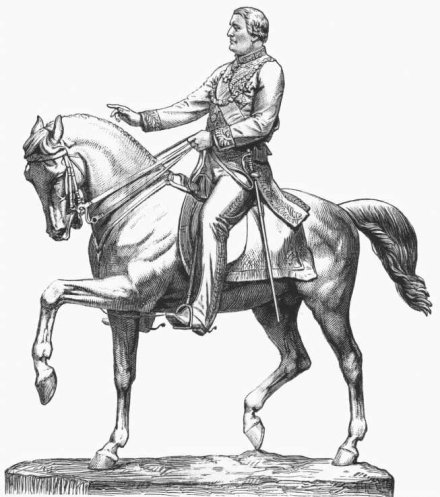
Despite not making a particularly big deal about Lord Mayo’s murder, the Empire did favor its Indian subjects with a Calcutta equestrian statue of the assassinated viceroy.
This monument and other former public memorials from the British imperial period now squirreled out of view in independent India can be found on a fun Flickr gallery, Forgotten Statuary of the British Raj. Brits can find the Earl of Mayo in marble closer to home in Cockermouth.
Mayo was also the namesake of the Mayo School of Arts in Lahore, present-day Pakistan (it’s now known as the National College of Arts). The school’s first principal was Lockwood Kipling, and this man was able to hook his 16-year-old son up with an assistant-editorship at a Lahore newspaper … from which young Rudyard Kipling launched his literary career.
* The “lone nut with a grudge” version has been latterly disputed with attempts to reconstruct Sher Ali as an Islamic revolutionary.
February 24, 2013 is the Jewish festival of Purim. (Actually, it began at sundown last night.)
This holiday, corresponding to 14 Adar of the Hebrew calendar, falls on different dates of the Gregorian calendar (most often in March). It commemorates a bloody story from the Book of Esther. (The quotes in this post are from this translation of Esther.)
The factual historicity of Esther is pretty questionable, but that debate is a bit beside the point for purposes of the present post. As folklore or fact, the story of Esther and Mordecai, of their near-destruction and the consequent execution of their persecutor, is a staple of tradition and literature.
The thumbnail version of the Purim story has Esther (Hadassah), a Jew living in the Persian capital of Susa, plucked out of obscurity to become the (or a) queen of a “King Ahasverus”.
If Esther has a historical basis, this would be about the fourth or fifth century B.C.E., and “Ahasverus” could be Xerxes (the guy who invaded Greece and made Herodotus famous), or the much later Artaxerxes II.
Esther is an orphan being raised by her cousin Mordecai, and when Esther wins “Who Wants To Live In The Persian Harem?” Mordecai advises her to keep judiciously silent about her Hebrew lineage.
Mordecai doesn’t manage the same trick, however, and offends the king’s powerful minister Haman by refusing to bow to him. This gets the overweening Haman upset at not only Mordecai but at all Jews who share his anti-idolatry scruples, and Haman persuades King Ahasverus to authorize their indiscriminate slaughter:
“There is a certain people scattered abroad and dispersed among the peoples in all the provinces of your kingdom; their laws are different from those of every other people, and they do not keep the king’s laws, so that it is not for the king’s profit to tolerate them. If it please the king, let it be decreed that they be destroyed.”
13 Adar is the date fixed for the Jews’ destruction, by pur, a casting of lots — hence the festival’s eventual date and name. Haman, of course, does not realize that this policy makes Esther his enemy.
In order to save her cousin and her people, Esther must risk a death sentence of her own by approaching the king unbidden in his inner chambers. Mordecai charges her to her duty with a timeless moral force:
“Think not that in the king’s palace you will escape any more than all the other Jews. For if you keep silence at such a time as this, relief and deliverance will rise for the Jews from another quarter, but you and your father’s house will perish. And who knows whether you have not come to the kingdom for such a time as this?”
Esther pulls this dangerous maneuver off, and gains thereby a private audience with just the king and Haman. There, she springs her trap — revealing her Jewish identity.
The king again said to Esther, “What is your petition, Queen Esther? It shall be granted you. And what is your request? Even to the half of my kingdom, it shall be fulfilled.”
Then Queen Esther answered, “If I have found favor in your sight, O king, and if it please the king, let my life be given me at my petition, and my people at my request. For we are sold, I and my people, to be destroyed, to be slain, and to be annihilated. If we had been sold merely as slaves, men and women, I would have held my peace; for our affliction is not to be compared with the loss to the king.”
Then King Ahasverus said to Queen Esther, “Who is he, and where is he, that would presume to do this?”
And Esther said, “A foe and enemy! This wicked Haman!” Then Haman was in terror before the king and the queen.
Word arrives at this inopportune juncture that Haman, who has been gleefully preparing his vengeance, has just had completed a 50-cubit (~20-meter) gallows to execute Mordecai upon. The enraged king instead orders Haman hung on it.
“Hanging” Haman on the “gallows” was traditionally interpreted in the ancient and medieval world as crucifixion,* or some analogously excrutiating way to die.
By any method of execution, though, the dramatic power of the scene — sudden reversal of fortune, virtue elevated over wickedness, the oppressed turning the tables on their oppressors, divine deliverance — is obvious.
At least the guy was remembered. Hands up if you can name any other ancient Persian courtier.
“The Punishment of Haman” is a corner of Michelangelo’s Sistine Chapel.
However, this satisfying palace politics turnabout is not the end of the story, and punishment is not reserved only for the wicked minister.
Esther persuades the king not only to revoke Haman’s order, but to issue a new one — one that Esther and Mordecai will write tabula rasa over the king’s seal.
The writing was in the name of King Ahasverus and sealed with the king’s ring, and letters were sent by mounted couriers riding on swift horses that were used in the king’s service, bred from the royal stud. By these the king allowed the Jews who were in every city to gather and defend their lives, to destroy, to slay, and to annihilate any armed force of any people or province that might attack them, with their children and women, and to plunder their goods, upon one day throughout all the provinces of King Ahasverus, on the thirteenth day of the twelfth month, which is the month of Adar
…
So the Jews smote all their enemies with the sword, slaughtering, and destroying them, and did as they pleased to those who hated them. In Susa the capital itself the Jews slew and destroyed five hundred men, and also slew Parshandatha and Dalphon and Aspatha and Poratha and Adalia and Aridatha and Parmashta and Arisai and Aridai and Vaizatha, the ten sons of Haman the son of Hammedatha, the enemy of the Jews; but they laid no hand on the plunder. That very day the number of those slain in Susa the capital was reported to the king.
And the king said to Queen Esther, “In Susa the capital the Jews have slain five hundred men and also the ten sons of Haman. What then have they done in the rest of the king’s provinces! Now what is your petition? It shall be granted you. And what further is your request? It shall be fulfilled.”
And Esther said, “If it please the king, let the Jews who are in Susa be allowed tomorrow also to do according to this day’s edict. And let the ten sons of Haman be hanged on the gallows.”
So the king commanded this to be done; a decree was issued in Susa, and the ten sons of Haman were hanged. The Jews who were in Susa gathered also on the fourteenth day of the month of Adar and they slew three hundred men in Susa; but they laid no hands on the plunder.
Now the other Jews who were in the king’s provinces also gathered to defend their lives, and got relief from their enemies, and slew seventy-five thousand of those who hated them; but they laid no hands on the plunder.
This bloodbath is obviously a bit more ethically problematic than Haman’s individual fate.
Now, sure, this is an event of questionable authenticity situated in Iron Age tribal mores and exaggerated by the ubiquitous ancient inflation of head counts. The subtext (“defend their lives” … “relief from their enemies”) also implies something like civil strife, blows exchanged rather than merely blows delivered. The overt text says that the victims were people who intended to do exactly the same thing to the Jews.
Still, the plain words on the page says 75,000 humans were slaughtered by a mobilized ethno-nationalist group, “children and women” among them. Just imagine the same parable about a Serb in a Bosnian king’s court, and say a little thanksgiving that the Book of Esther doesn’t identify these 75,000 as constituents of any specific demographic group that remains a going concern today.
Purim is a beloved holiday among its celebrants, but most any explication of it on the Internet comes with a comment thread agonizing over (or rationalizing) the body count. (For example.)
The fact that the story was told, and that it gained great popularity among the Jews, and by some of those in later ages came to be regarded as one of the most sacred books of their canon is, however, a revelation to us of the extent to which the most baleful and horrible passions may be cherished in the name of religion … it is not merely true that these atrocities are here recited; they are clearly indorsed.
Blessedly Purim Fest is not ultimately defined by the likes of Streicher, nor by the bloodthirstiness that is this site’s regrettable stock in trade. For most observants it’s simply one of the most joyous holidays of the year, a time for gifts and feasting and dress-up and carnivals and celebration sometimes thought of as the “Jewish Mardi Gras” or “Jewish Halloween”. Adherents have even been encouraged in all religious solemnity to drink in celebration until they can no longer tell “blessed be Mordecai” from “cursed be Haman.”
Deliverance indeed. L’chaim.
* The concept of Haman crucified in turn encouraged Jews under Christendom to use the figure of Haman (who once upon a time, could be subject to Guy Fawkes-like effigy-burning on Purim) as a veiled stand-in for the current oppressor Christ, and/or encouraged Judeophobic Christians to impute this intention to Purim observances.
Niewiadomski (English Wikipedia entry | Polish), whose father had taken part in the 19th century’s anti-Russian January Uprising, was a talented painter with a serious nationalist streak.
And that was really the done thing for his time and generation: his painting career from the 1890’s into the early 20th century maps the Young Poland movement of up-and-coming artists experimenting with new forms and celebrating romantic attachment to their prostrate homeland.
“The conscience of Polish literature,” Young Poland writer Stefan Zeromski, as depicted by Niewiadomski.
When not promoting patriotic appreciation of the Tatra Mountains, Niewiadomski enjoyed supporting Polish National Democracy, a right-wing movement raging against the Cossack yoke.
Niewiadomski was a true enough believer to serve time in a tsarist prison, but he was far from the leading light of either the artistic or political movements. By the time Poland attained independence (Niewiadomski worked for Polish intelligence during World War I, and even finagled a cameo on the front lines), he was in his fifties and seemingly settling in for a slow moulder into obsolescence in bureaucratic posts and artistic monographs.
(Of course, had he done so, the next decades would have brought him their own surprises.)
Instead, the 1922 election for President of the Polish Republic, which was decided in that country’s National Assembly, saw parliamentary horsetrading elevate an engineer on the strength of the left parties’ votes — a shock victory over Niewiadomski’s preferred right-wing candidate Count Maurycy Klemens Zamoyski, the infant republic’s Bush v. Gore.
It came to street disturbances, to assaulting members of parliament, to demonstrations “for” and “against.” There were casualties. Lumps of dirty snow were thrown at the carriage of the president-elect as it drove across the town. Newspapers dreamt of “a lump of snow that will change into an avalanche” and about removal of that man-“hindrance,” that man-“obstacle.” … The infamous ride through the streets of Warsaw was a ride down death’s lane. Someone hit the first president of the republic in the head with a stick, someone else waved brass knuckles in his face …
So, five days into Gabriel Narutowicz‘s term, Niewiadomski did what any violent, disaffected patriot would do: he gunned down the new Polish president at the Zacheta art gallery. It’s always great to see artists participating in the political dialogue.
The shots by Niewiadomski marked an end to the week of hatred. Poland suffered a shock — even the Right did. National reconciliation bloomed like a thousand flowers. The president’s funeral became an occasion for a deeply disturbed society to demonstrate. Half a million people walked in the funeral procession!
-Bojarska, again
Less than seven weeks later, Niewiadomski christened that national reconciliation with his blood … at a fortress the Russians had once used to garrison his country, Warsaw Citadel.
On this date in 1565, three men who schemed to assassinate Pope Pius IV were put to public death at the Capitol.
Detail (click for the full painting) of Parnassus by Raphael, the Vatican’s “Raphael Rooms”. According to Jonathan Unglaub,* this figure is the then-acclaimed, today-obscure poetBernardo Accolti, our failed assassin’s great-uncle.
Pius was a pope of the counter-reformation; it was he who brought the Council of Trent to its conclusion.
And though generally noted for his moderation (and his enthusiasm for building), he was not above striking heads from shoulders. Upon his ascension a few years prior he had dealt harshly with the nephews of his predecessor.
Young Benedetto, clearly, could scheme a little himself, since he roped several buddies (Italian link) into a plot to murder the pontiff. In December 1564, they presented themselves at a papal audience, but apparently got cold feet. One of their number, a Cavalier Pelliccione, ratted the lot of them out before they could muster their nerve a second time: the good cavalier might have been motivated by having possession of treasonably pre-written letters to be sent to various dignitaries upon the pope’s violent deposition.
Pelliccione accordingly skated with a pardon, but two co-conspirators were sent to the galleys for life.
Benedetto Accolti, Antonio Canossa, and Taddeo Manfredi were dragged to the Capitol on January 27 and put to the gruesome public butchery — “like cows” — of the mazzolatura.
There are several resources that claim the plot was among Catholic ultras who found Pius a little on the heretical side. This Italian encyclopedia entry attributes to the astrologically-inclined Accolti a more nutty-prophetic ambition of a “papa angelico” who would unify Christendom.
Maybe he should have just exercised a little patience. Pius IV died in December 1565.
* Jonathan Unglaub, “Bernardo Accolti, Raphael’s ‘Parnassus’ and a New Portrait by Andrea del Sarto,” The Burlington Magazine, Vol. 149, No. 1246, Art in Italy (Jan., 2007).
On this date in 1934, Leonid Nikolaev was convicted and (an hour later) shot for the murder of Leningrad communist leader Sergei Kirov.
Nikolaev was a disaffected young man who’d come of age during the Revolution and latterly been expelled from the Party for his bad attitude. He took his frustration out on December 1, 1934, when he stalked into the (suspiciously unguarded) office of Kirov and shot him dead.
The victim was much the more consequential figure in this transaction — both in life, and in death. Kirov’s murder would stand as a Reichstag fire moment unleashing the darkest years of Stalinist purges.
Kirov was an old Bolshevik agitator from way back. Widely respected, he’d been the party boss of Leningrad for nearly a decade, and a few months before his murder was overwhelmingly elected to the Communist Party’s Central Committee at the party Congress.
He was also, perhaps, seen by anti-Stalin factions within the party as a potential pole of resistance to Stalin* — though his weight as an “opposition” figure has also grown with the hindsight knowledge of what came next.
Kirov’s assassination was a double gift to the Kremlin, for not only did it remove the impediment himself, it licensed a furious security crackdown against the “terrorists” who orchestrated it. Said terrorists conveniently turned out to be dozens upon dozens (and indirectly, thousands upon thousands) of officials whom Stalin found convenient to destroy. “Kirov was killed in Leningrad,” Bukharin remarked upon hearing the news. “Now Koba [Stalin] will shoot us all.”
Within weeks of the murder, the exiled Trotsky was coming to the same conclusion, and charged that the Kirov investigation’s purposes was
to terrorize completely all critics and oppositionists, and this time not by expulsion from the party, nor by depriving them of their daily bread, nor even by imprisonment or exile, but by the firing squad. To the terrorist act of Nikolaev, Stalin replies by redoubling the terror against the party.
Stalin personally oversaw the investigation, even personally interrogated Nikolaev. And no surprise: the investigation’s casualties multiplied with alacrity.
The first commissar who made it to the murder scene “fell out of a truck” the very next day. Nikolaev’s mother, wife, siblings, and other associates were all disappeared and executed. 104 prisoners already under lock and key at the time of Kirov’s murder were judged guilty of conspiring with the assassin and shot out of hand. (Source)
In January 1935, Stalin had his long-neutered old rivals Zinoviev and Kamenev** preposterously convicted for “moral responsibility” for Kirov’s murder. Though they weren’t death-sentenced directly for this “responsibility” their condemnation set them up for their fatal show trial the following year. (Which included public confessions of involvement in the Kirov affair.) Guilt in Kirov’s death would be routinely bolted onto the show trials of political opponents for the remainder of the 1930s.
Stalin mined this terrorism panic so nakedly and purged so widely that the belief that Stalin himself ordered Kirov’s murder has long predominated. This theory of Stalin’s master orchestration also happened to be very convenient (pdf) for the post-Stalin party; Khrushchev directly hinted at his predecessor’s complicity in the secret speech.
That theory remains highly contestable. Matthew Lenoe in particular has vigorously disputed the idea that Stalin ordered everything in his acclaimed The Kirov Murder and Soviet History; there’s an informative Q&A with Lenoe on the invaluable Sean’s Russia Blog here, and a podcast interview on the New Books Network here. For a bit of background on Lenoe’s research, click here.
* Foreshadowing the unwelcome independence Leningraders enjoyed post-World War II … until Stalin smashed it.
** Nikolaev, the disaffected party member, was a Leningrader himself. That meant that when he was still in the party, it was in Zinoviev’s Leningrad party, since that city happened to be Zinoviev’s base and stomping-ground. And that meant that he must ipso facto have been part of the “Zinovievite Opposition”.
On this date in 1942, just two days after he had assassinated Admiral Francois Darlan, Fernand Bonnier de La Chapelle was shot by the Vichy army in Algiers.
Despite its shorthand reputation as a Nazi puppet, Vichy France — especially in 1940-42 — was a more nuanced animal that’s enjoyed increased study of late. Vichy controlled southern France under the obvious pressure of the next-door German occupation and effected state collaboration with Berlin including deportations, but it also maintained diplomatic relations with the U.S. Vichy France even shot German spies.
Vichy was one contender among several for political legitimacy in the aftermath of France’s disastrous 1940 defeat at German hands. The most obvious (and here, topical) rival was de Gaulle’s Free French.
Appropriately, the classic film Casablanca premiered in November 1942, featuring Claude Rains as the unprincipled Vichy Captain Renault. The film’s pro-Free French, anti-Vichy slant was not, however, representative of American foreign policy at the time.
This was the background when, in 1942, the US spearheaded Operation Torch to invade Vichy-controlled French North Africa. “This is not the end,” Churchill epigrammed of the Torch landings. “It is not even the beginning of the end. But it is, perhaps, the end of the beginning.”* (Correction: Churchill actually said this in reference to the November 1942 Battle of El Alamein, as a very gracious comment observes.)
At the time of that operation, Admiral Darlan happened to be in Algiers. He was the former number two man in the Vichy government, but also a guy whose cooperation with the Nazis had been half-hearted … which is the reason he was the former number two man.
Darlan nevertheless remained the chief of the Vichy armed forces, which meant that it was worth the Torch commanders’ while to come to an arrangement with him when Darlan proved amenable to cooperation.
They cut that deal. Darlan shut down armed resistance and took Vichy North Africa over to the Allies’ side. (He had, indeed, hinted previously to American diplomats that he was prepared to switch sides; see Arthur Funk, “Negotiating the ‘Deal with Darlan'” in Journal of Contemporary History, April 1973.) In exchange, the Allies installed him as High Commissioner of France for North and West Africa — big man on campus for French North Africa.
Like all good compromises, it satisfied nobody.
De Gaulle was enraged: a Vichy official remained in charge of a Vichy state now under Allied auspices. Would Allied recognition set Darlan up to direct France’s postwar direction?
Equally pissed by the defection, Hitler triggered the German contingency plan to occupy Vichy France.† This is why the “especially in 1940-1942” proviso above: after Operation Torch, Vichy France had no independent military muscle, and was significantly more beholden to Nazi Germany.
Back in North Africa, we finally come to our date’s principal.
A 20-year-old student of monarchist and anti-fascist political proclivities, Fernand Bonnier de La Chapelle (English Wikipedia entry | French) decided with a couple of friends to cut the Gordian political knot that Darlan’s adoption had created.
Bonnier de La Chapelle drew the short straw (literally, they drew straws) for the privilege/responsibility of murdering the Vichy admiral.
Officially, the young man acted alone. Unofficially, there’s been no end of speculation as to the secret intrigues at work. Nobody’s really clear on exactly how murdering Darlan was supposed to advance the gunman’s supposed agenda. And the Vichy French disposed of the killer with suspicious haste.
Just after lunch on December 24, Fernand Bonnier de La Chapelle surprised Darlan upon the latter’s return to his study and shot him through the mouth and torso at point-blank range. He was arrested attempting to flee.
The very next evening, he was condemned by a tribunal at Algiers. There was already a coffin on order before that body gaveled into session.
For some reason, the condemned thought his perceived service to the nation would out. “They will not shoot me. I have liberated France,” he assured his confessor. “The bullets will be blank cartridges.” They weren’t. Churchill recorded that Bonnier de La Chapelle was “surprised to be shot.”
Darlan was laid to rest later that morning at a dry-eyed requiem service. One British intelligence officer remembered that Darlan’s “murder fell like a stone into a small pond and the ripples were only brief. It was as if Darlan had never been.” (Source for the quotes in the last two paragraphs)
Henri Giraud, a French general who escaped German custody and took refuge in Vichy France — Vichy refusing to return him to the Germans, who openly intended to kill him — succeeded Darlan’s command of the now-Allied-aligned French North African forces and maintained the objectionable Vichy institutions. He joined the Allied Casablanca Conference a few weeks later. Giraud had already secretly arranged with the Allies to take exactly this position and had repaired to North Africa in anticipation of the invasion before being aced out by Darlan.
Giraud’s Vichy North African government gradually increased cooperation with de Gaulle’s Free French; the two eventually co-founded the French Committee of National Liberation, which de Gaulle, of course, eventually took control of.
In 1945, a postwar appeals court posthumously reversed Bonnier de La Chapelle’s conviction — on the grounds that he’d pulled the trigger “in the interest of liberation of France.”
* Stalin, whose Red Army was then fighting the Wehrmacht tooth and claw at Stalingrad, begged to differ. He’d been imploring the western allies to open a second front, and was none too impressed with their calculation that they weren’t ready to invade continental Europe in 1942. “A man who was not prepared to take risks could not win a war,” Stalin griped to Churchill.
** One knock-on effect of Operation Torch: the Germans reinforced North Africa against the Allies’ imminent push. It was in this campaign that future Hitler almost-assassin Claus von Stauffenberg lost a hand and an eye, leading to his transfer back to the Berlin desk job that would give him his opportunity to try to kill the Fuhrer.
† This resulted in Vichy France’s gesture of resistance, scuttling the Toulon fleet to keep it out of German hands … although this also irritated de Gaulle, who wanted the fleet to defect to North Africa instead.
David’s mildness managed it so well,
The bad found no occasion to rebel.
But when to sin our biassed nature leans,
The careful devil is still at hand with means, [80]
And providently pimps for ill desires;
The good old cause, revived, a plot requires.
Plots, true or false, are necessary things,
To raise up commonwealths, and ruin kings.
-John Dryden’s Absalom and Achitophel, a Biblical allegory of the English political/religious scene in which the Popish Plot (“plots, true or false”) took place
On this date in 1678, a Catholic goldsmith was hanged and quartered for treason … a preposterous case that would preview the tragic main acts of the “Popish Plot”.
This 17th century anti-Catholic witch hunt traced to weird and unprincipled Anglican divine Titus Oates.
With his friend Israel Tonge, Oates in 1678 ginned up a fantastical Jesuit plot against the life of Charles II — which supposed conspiracy played insidiously to the realm’s age-old religious divisions, in a moment when a Catholic royal sibling stood next in line to the throne.
Indeed, Oates’s “revelations” would trigger the Exclusion Crisis, an unsuccessful parliamentary bid to balk the heir presumptive James (eventually James II) of his throne. Parliament, argued Henry Capell, “must quiet the minds of the people, as to their fears of Popery and the Succession.”
In Queen Elizabeth’s time there were conspiracies against her, when Mary Queen of Scots was taken off. In King James’s time, the Gunpowder-Treason. In the last King’s time, a horrid Rebellion, that ended in his murder; but here the Crown is under such a character as is more dangerous than all those; and from Popery came the notion of a standing Army and arbitrary power.
Oh, and London had just burned down within everyone’s living memory, an event popularly ascribed to a French Catholic conspiracy even into the 19th century.
There was an awful lot of latent (and not-so-latent) anti-Popery around for Oates to stir up, and he proved to have a gift for this demagoguery. (pdf) In late 1678, a magistrate investigating Oates’s claims, Edmund Berry Godfrey, was mysteriously murdered, and all hell broke loose: a political assassination could now be hung on the alleged Catholic conspiracy. In short order, alleged Catholic conspirators would themselves hang for it.
It was a full 9/12 mentality: people going about armed, loyalty oaths, rumors of French invasion or Guy Fawkes tunneling.
Oates, when feeling his, would have the juice to put peers of the realm on the scaffold … so what chance did poor William Staley have?
This patsy, no great ornament of the “plot”, was more an incidental (and expedient) casualty of the swelling paranoia. Overheard at a tavern chatting about the Protestant freak-out, in French (quelle horreur!), a couple of unscrupulous eavesdroppers shopped for treason when they couldn’t blackmail him.
The sovereign was supposed to have been characterized in this chat as “a great Persecutor or Tormentor of the people of God … And ([Staley] stretching forth his Arm, and then clapping his Hand on his Breast), speaking of His Sacred Majesty, said, I my self will kill him.” (Source) Whether a frustrated Catholic into his cups incautiously popping off, an innocent naif set up by reprobates, or a case of lost in translation, it seems safe to say that William Staley was no danger to the monarchy.
Staley, at any rate, denied having said anything of the sort all the few hours that remained to draw breath, which wasn’t many. It was a mere 12 days from the “treasonable” conversation on Nov. 14 to Staley’s execution.
Image from William Faithorne‘s 1681 (misdated) engraving depicting William Staley being drawn to execution.
With this hanging, and another (that of Edward Coleman) a week later, the Popish Plot persecutions were into full swing … three years of Stuart England McCarthyism that would claim at least 15 lives and end with Titus Oates imprisoned, whipped, and pilloried.
After the Orange Revolution chased the Catholic monarch out of England, Oates was released and pensioned: the incident long remained an ideological litmus test between proto-Whigs (pro-Oates, as he was a club wielded against the absolutist aspirations of Charles II and James II) and Tories (anti-Oates, for the same reason). Centuries later, one commenter could still remark, “There are three events in our history that may be regarded as the touchstone of party men: an English whig who asserts the reality of the Popish plot, an Irish Catholic who denies the massacre of 1641, a Scotch Jacobite who maintains the innocence of Queen Mary, must be considered as men beyond the reach of argument or reason.”
If you didn’t get August 5 off, your jurisdiction is ignoring the Scottish parliament’s 1600 decree: “in all times and ages to come the fifth of August should be solemnly kept with prayers, preachings, and thanksgiving for the benefit, discharging all work, labour, and other occupations upon the said day.”*
They didn’t mean to keep it out of excess reverence for St. Emygdius: rather, August 5 was the date of the Gowrie conspiracy, a sketchy supposed assassination attempt on King James VI of Scotland (soon also to become King James I of England). John Ruthven, Earl of Gowrie and his brother Alexander Ruthven were both slain on the spot during that event … but not until 15 weeks later did Parliament rule that “the said bodies of the said Traitors shall be carried, upon Monday next [i.e., November 17], to the publick cross of Edinburgh: and there to be hangd, quarter’d, and drawn, in presence of the hail People: and thereafter, the heads, quarters, and carcasses, to be affix’d upon the most patent parts and places of the Burroughs of Edinburgh, Perth, Dundee and Stirling.”
Did they deserve it?
Scottish writer John Prebble considered the Gowrie conspiracy one of his realm’s best mysteries. It’s a maddeningly perplexing sequence of ambiguous (or altogether dubious) events related by interested, partisan sources.
I am murtherit!
The summary official version — and we’re skipping over such writerly red herrings as a mystery man in the turret, a still-stabled horse, and a wild fable about a pot of foreign gold — is that while staying at the Ruthven estates, James’s courtiers saw him shouting out the window, “I am murtherit! Treassoun! My Lord of Mar, help! help!”
While Lord Mar and others spent half an hour (!) trying to batter down a locked entrance to the regicidal turret, a page named John Ramsay found another staircase in, where he came upon the king and Alexander Ruthven grappling. Ramsay stabbed Ruthven about the head and neck, and Ruthven fled down Ramsay’s same staircase: there he careened headlong into more arriving royal retainers who killed him flat. Ruthven died exclaiming “Allace! I had na wyte [blame] of it!”
Meanwhile, the Lord Gowrie — quite possibly knowing nothing but that there was a commotion involving the king in his home — had rallied outside the courtyard with his own household and marched in swords drawn, passing the fresh-slain body of his little brother on the way. He must have been in an evil temper when he burst into the chamber, there to discover Ramsay and friends, and only them: the king had been locked in another room for his protection. Ramsay demanded Gowrie’s submission and the two crossed swords, with Ramsay running the elder Ruthven through, too.
(Small wonder Ramsay went on to become a royal favorite.**)
“… if it be true”
“A very wonderful story, your Majesty, if it be true,” one lord is supposed to have replied to James upon hearing this amazing tale.
Suspicion was immediately rife that this “treason” stuff was a cover for the king to take out a rival noble. The Ruthvens had often been at odds with King Jamie’s own family; John and Alexander’s own father was beheaded in 1584 for trying to kidnap the then-teenaged king, and their grandfather had helped a gang of nobles destabilize James’s mother Mary by murdering her favorite courtier David Rizzio right before her eyes. And of course, the crown would be able to seize all the “traitors'” estates, nicely flipping around a significant cash debt owed to the Ruthven clan.
Edinburgh Presbyterian ministers openly disputed the Ruthvens’ guilt, refusing to thank God for James’s “deliverance”.† James found it necessary to forcibly quash this talk, and he would insist upon the Ruthvens’ guilt all his days. But those outside the reach of Scottish royal power had looser tongues.
French nobles who had met Gowrie on the latter’s recent return from his continental studies, and Queen Elizabeth, who had received Gowrie warmly at court, openly doubted the official account: it was thought wildly at odds with the young man’s character. The nature of the interaction between the king and Alexander Ruthven prior to the intervention of John Ramsay depends upon the account of the king himself — that account, and no other. The other witnesses were dead. And the object of the plot seems unclear: sure, maybe Alexander Ruthven could have killed the king mano a mano, but then what? There was no indication at all of confederates (even Alexander’s brother reacted in confusion), nor coherent design for some next step like massacring James’s courtiers or toppling the government or even escaping. These were scheming aristocrats, not deranged lone assassins. And both James and Gowrie had behaved for all the world before this incident as if the unpleasantness with the father was water under the bridge.
“The assassination of the Gowries was the most indefensible act that has ever appeared on the pages of Scottish history,” avers mildy a 1912 volume of the Ruthven family papers. It was “a cunning conspiracy that has disgraced the historical record for more than three hundred years.”
The jury’s still out
Still, the hypothetical account of a royal anti-Gowrie conspiracy seems if anything even less satisfying than the official story. Most of the happenings besides what passed between Alexander and James were witnessed by others, so … the king falsely yelled “treason” counting on the handful of his guys staying in the Ruthvens’ own place to kill the Ruthvens instead of the other way around? Events played out so chaotically that this convenient outcome seems mere [mis]chance. What was the plan if John Ramsay hadn’t found the unlocked second entrance?
And yet some 350 witnesses were examined without turning up any concrete design, and three Ruthven retainers hanged on August 23 insisting upon their innocence of any treasonable intent.
One can go a lot of ways from here, and it’s hard to spin any one story that satisfyingly accounts for all the evidence. A scheme to kidnap (and extract policy change from) the king, rather than murder him? Alexander an unwilling pawn, forced into it by his brother? Or, as one English envoy supposed, a destructive spiral of events proceeding from a silly misunderstanding wherein a chance reference to the Ruthvens’ executed father led Alexander to defend the family a little too hotly and the king to start shouting in panic when he realized he was unarmed in the company of an excited, and much larger, man?‡
We’ll never really know. Light a candle for epistemological uncertainty next August 5.
Much help drawn from a two-parter review of the contradictory evidence in The Scottish Historical Review, nos. 121 and 122 (April and October 1957) by W.F. Arbuckle.
* August 5 was indeed “solemnly kept” during the reign of James, according to F.C. Eeles in “The English Thanksgiving Service for King James’ Delivery from the Gowrie Conspiracy” from the July 1911 Scottish Historical Review. As the title of that piece suggests, there was even a service promulgated (though never incorporated into the Book of Common Prayer), beseeching God that James “may bee kept as the apple of thine eye, and thy kindnesse and mercy may follow him all the dayes of his life, with abundance of all thy blessings both heavenly and earthly upon his Majesty, our gracious Queene, the Prince …”
** Ramsay would be supplanted in the royal sun come the 1620s, by George Villiers.
† Religion affords another potential motivation here, although perhaps only retrospectively. James was working a long-term project to reintroduce episcopacy — crown-appointed bishops — to control the loose canons of Scotch Presbyterianism. “No bishop, no king,” in the aphorism attributed him.
With the Gowrie plot as backdrop, James was able to force radical ministers and their tin-foil hats out of Edinburgh and obtain the consent of the rest to James’s own hand-picked bishops — the camel’s nose under the tent, if you like. (See Maurice Lee, Jr., “James VI and the Revival of Episcopacy in Scotland: 1596-1600,” Church History, 43 (1974).) The Ruthven family papers volume also sets great stock by the idea that a Catholic party was out to get Lord Gowrie.
‡ “by occasion of a picture (as is sayde) or otherwise, speech happening of Earle Gourie his father executed, the k. angrelie sayde he was a traitour. Whereat the youth showing a greived and expostulatorie countenance and happilie Scot-like woords, the k. seeing hymself alone and wythout weapon cryed, ‘Treason, Treason’. The Mr [i.e., Alexander Ruthven], abashed much to see the k. to apprehend yt so … putt his hand with earnest deprecations to staie the k. showing his countenance to them with out in that moode, immediatlie falling on his knees to entreat the k.” Ramsay did say that when he entered the room he saw Alexander’s head under James’s arm, which might be consistent with this supplicatory pose … especially given that accounts of the men’s respective physiques suggest Alexander should have had the clear advantage in an actual scrap.
La Paz, Bolivia, Nov. 5 (AP). — Selected by lot to die for the murder ten years ago of former President Jose Manuel Pando, Alfredo Jauregui, 28, was executed this morning. The young man died instantly from eight bullets from the rifles of a firing squad.
–New York Times, Nov. 6, 1927
Jose Manuel Pando (English Wikipedia entry | Spanish), wealthy landowner, military leader, former president, had seen Bolivia’s Liberal Party to power by prevailing in civil war in 1899, then peaceably handed off power to a Liberal successor in 1904.
The Liberals controlled Bolivia until 1920, but Pando grew overtly critical of his increasingly authoritarian successors. Though the circumstances of his murder in 1917 remain murky, his disgruntled affinity for the upstart Republican party is a likely contributing factor.
Jauregui faced the fusillade proclaiming his innocence; his supposed confederates were the beneficiaries of a Bolivian law permitting only one execution for a single murder … even of the former President’s murder. The four drew lots to determine which would be the “one”.

 Khalturin (English Wikipedia entry | Russian) came from a well-off peasant family near the city of Vyatka (today, Kirov; it was renamed for an assassinated Bolshevik). As a young carpenter in 1870s St. Petersburg, he fell in with revolutionary circles and became a distinguished propagandist and organizer. Khalturin helped found the first political labor labor organization in Russia, the “Northern Russian Workers’ Union”.


 After
After 

 A 20-year-old student of monarchist and anti-fascist political proclivities, Fernand Bonnier de La Chapelle (
 With his friend
