On this date in 1690, the Russian stolnik (an administrative office in the Russian court) Andrei Ilyich Bezobrazov was put to death with the magicians he allegedly contracted to bewitch Tsar Peter the Great.
Whatever its other sins, Russia enjoys a reputation for having largely steered clear of the frightful witch-hunts that broke out elsewhere in Europe. Certainly tsars issued many decrees against witchcraft and even prescribed the death penalty in law. But unlike courts in western Europe, Russia does not seem ever to have folded the entire swath of extra-Christian folk beliefs and everyday peasant “magic” together into a juridical theory of omnipresent diabolical terrorism stretching from the neighborhood midwife to the Prince of Darkness himself. Perhaps for that reason, its historical record of witch persecutions presents fewer and more scattered data points.
Elites, write Valerie Kivelson and Jonathan Shaheen,* “demonstrated no interest in formulating a systematized or theorized framework for explaining the uncanny power of magic [and] they also made no effort in their courtrooms to unearth evidence of such a framework … Instead of pursuing connections to the devil, Muscovite judges exerted themselves to track the lineages and results of magic: Who taught you? Whom have you taught? Whom have you bewitched? The judges’ concerns were concrete and this-worldly: who were the victims and who were the victimizers?”
Unfortunately for Bezobrazov, his victim was the tsar himself.
Bezobrazov allegedly obtained the service of “sorcerers and witches” who worked magic “on bones, on money and on water” to enspell the new 17-year-old sovereign during the uncertain period after Peter threw off the regency of his older sister Sophia. Despite Peter’s ultimate reputation as Russia’s great westernizer, the immediate effect of this transition was an oppressive interregnum wherein conservative religious interests took advantage of the new sovereign’s distraction from internal Russian politics to reassert themselves violently.
For Bezobrazov, political turnover augured personal uncertainty. The innocent explanation for his “witchcraft” was invoking a little ritual in hopes of catching a favorable assignment in Peter the Great’s new Russia. It didn’t work.
Bezobrazov was beheaded on Red Square on this date at the same time two folk healers went to the stake with their magic talismans and healing herbs at a swamp across the Moskva from the Kremlin. An essay in this Festschrift describes what it’s like to be a peasant folk healer suddenly under investigation for regicide.
Dorofei Prokofiev … had treated animals belonging to the Bezobrazov household. But when arrested and interrogated, Dorofei did not identify himself as a “sorcerer,” but rather as a posadskii chelovek (artisan), specifically a horse-trainer (konoval) and a blood-letter (rudomet’). He admitted to practicing bean divination and palm reading in addition to treating the illnesses of children and adults with herbs and incantations. His bag contained beans, incense (for protecting brides and grooms from sorcerers, Dorofei said), and a variety of herbs. The herb bogoroditskaia (= royal fern) he gathered himself on St. John’s Day, while reciting the charm “whatever you, herb, are good for, be good for that.” But he denied ever casting a spell to harm the sovereign, and he claimed not to be acquainted with Andrei Bezobrazov — a lie that was quickly uncovered when Dorofei was subjected to torture. At that point Dorofei changed his story: Bezobrazov had asked him to cast a spell on the tsar, but only to make him feel favorably towards Bezobrazov, not to damage the sovereign’s health. Dorofei gave his interrogators examples of the incantations that he used in fortune-telling, all intertwined invocations of Christian figures with sympathetic magic. In short, Dorofei tried to rescue himself by claiming that his healing and fortune-telling activities were all well-intentioned. But the investigators, and Peter himself, were convinced of Bezobrazov’s guilt, which meant Dorofei was guilty as well. Bezobrazov was beheaded, and Dorofei was burned at the stake as a witch.
For everyday folks like Dorofei Prokovie, the author notes, “well-positioned patrons could be either a source of protection or of danger.”
According to Crime and Punishment in Early Modern Russia, which is also the source of the January 8 date, Bezobrazov’s wife was punitively tonsured for not reporting the “plot” and several other of Bezobrazov’s peasants were knouted and sent to Siberia.
* “Prosaic Witchcraft and Semiotic Totalitarianism: Muscovite Magic Reconsidered” in Slavic Review, vol. 70, no. 1 (Spring 2011)
On this date in 1536, Italian nobleman Sebastiano de Montecuccoli was torn apart at the Place de la Grenette in Lyons for poisoning the dauphinFrancis, heir to the French throne.
Sebastiano de Montecuccoli was a knight from Ferrara who had arrived in France in the train of the Catherine de’ Medici when she was married off to the no. 2 French prince Henri. He was fast friends with the royal princes, but his proximity to the family horribly turned against him when the 18-year-old Francis played a game of tennis, then caught ill and dropped dead. The last thing poor Francis had done was ask Montecuccoli for a glass of water.
In an era of forensics-by-guesswork, a sudden and unexplained death inevitably drew suspicions of poison — all the more so in a France gone security bonkers in the wake of the Affair of the Placards.
So just was in that glass of “water,” eh?
Sebastiano, upon his arrest, was found to possess a tome of poisons. This was a common enough interest among his class. (Catherine de’ Medici also had an interest in poison.) Nevertheless, it was great material for tunnel-vision investigators, and the young Italian soon provided a corroborating self-incrimination under torture: Sebastiano had offed the crown prince on orders from France’s longtime rival Charles V, who also just happened to be fighting a war with France over the duchy of Milan at that very moment.
Sebastiano attempted to recant this confession once he was off the rack, but to no avail. Many 16th century contemporaries could descry the eventual consensus of posterity that Sebastiano was a naif, and not an assassin. (Francis likely died from a disease.) Less generous by far was the judgment of the Lyonnaise citizenry who fell upon and ravaged Sebastiano’s body after it had been torn apart by horses.
Thanks to the unexpected death of the heir that triggered this horrible punishment, Francis’s brother Henri advanced to the crown prince seat and eventually became Henri II of France (until Henri’s own unfortunate sporting mishap) … and that Italian bride Catherine de’ Medici became Queen of France.
Before the day was out, six of members of the hit squad were lined up and machine-gunned on the very same spot.
Armand Calinescu
Calinescu was a conservative politician trying to fight off the rising fascist movement in his country — that aforesaid Iron Guard — and preferred to keep Romania in politic neutrality and friendly with England and France rather than hitching its fate to Nazi Germany.
This entailed an increasingly acrimonious struggle throughout the 1930s against the fascists. Calinescu once called the Guard “an association of assassins,” and the prospect of taking a bullet from them can’t have been far from his mind. Calinescu’s fingerprints were all over press closures, pre-emptive arrests, and still worse offenses to outrage the far right. After years in the cabinet working hand-in-glove with the hated-by-fascists King Carol II, Calinescu finally became Prime Minister in March of 1939. Carol hoped he could be the bulwark against a Legionary takeover.
If by his enemies ye may know a man, know that Calinescu was taken seriously enough for a multilateral meeting between representatives of the Iron Guard, fascist Italy, and Nazi Germany in order to make the arrangements for his murder. But Calinescu would probably have just as soon have preferred his life to this tribute of his foes.
Upon news of the assassination, Calinescu’s place was immediately filled by Gen. Gheorghe Argesanu, whose one week as head of government was distinguished by a ruthless crackdown on his country’s homegrown terrorists.* The very next day’s British papers, in the same stories reporting the assassination, carried news “of an exemplary punishment” delivered within hours: “Last night, under the glare of powerful arc lamps, the murderers were publicly executed by machine-gun on the spot where the crime had been committed.” (London Times, September 22, 1939)
Nor was that the last exemplar.
The Times reported on September 25th that the ensuing days had seen “more than 300 former Iron Guards were shot” all around the country, including many “in the open street as a public example, on the pattern of the machine-gun executions in public at the scene of the crime.”
The “example” did not have the intended effect: in the span of another year, a fascist-aligned government had control of Bucharest and King Carol had hightailed it to Mexico, never to return.
* The Iron Guard would pay back Argesanu a year later by killing him during the Jilava massacre of its political prisoners.
AMMAN, Jordan, Sept. 4 — Four men sentenced to death here last week for complicity in the assassination of King Abdullah in July were hanged today in Amman prison. Regent Emire Naif had confirmed the sentences of the special tribunal.
Those put to death were Musa Abdulla el-Husseini, Abed Okkeh, Abdulkadir Farhat and Zakariya Okkeh.
Col. Abdulla el-Tell, former governor of Jerusalem, and Musa Ayyubi who were sentenced to death in absentia are reported to be living in Egypt.
–New York Times, September 5, 1951*
The men hanged this day were among the authors of “the most dastardly crime Jordan ever witnessed”: the July 20, 1951 assassination of independent Jordan’s first king.
The cagey Hashemite monarch Abdullah I had been emir of Transjordan, an artificial British mandate jigsaw-piece that Abdullah got by virtue of cutting a deal with Winston Churchill.
This sinecure came with the significant drawback of dependency on London’s reach and interests, and Abdullah’s great achievement was to set Transjordan-cum-Jordan** on firm enough footing to survive the postwar sunset of the British Empire.
Abdullah faced an early test of Jordan’s chops shortly after his country’s 1946 independence when the Arab-Israeli War erupted. For Abdullah, this was a state-building opportunity; indeed, his government had for years backed Palestinian-partition plans that other Arab states had opposed — with the expectation that Jordan could help itself to the eastern part of that partition.
Abdullah did just that in 1948, invading and annexing the Jordan River’s West Bank all the way to East Jerusalem … while willingly acceding to (some have said actively colluding in) the creation of a partitioned Jewish state that was theoretically anathema to Jordan’s allies.
Jordanian territorial aggrandizement, however, brought with it the West Bank’s Palestinian population, severely aggrieved at having seen their aspirations to statehood cynically sacrificed by Abdullah. They got, into the bargain, Jordanian citizenship and a severe suppression of independence agitation.
So when Abdullah came to visit Jerusalem’s Al-Aqsa Mosque, a Palestinian gunman murdered him.
While the assassin himself was immediately shot dead by the king’s bodyguards, ten allegedly in on the plot were very hastily tried in mid-August … eight in the Amman courtroom, and two overseas in Egypt tried in absentia. Dr. Musa Abdullah el Husseini, Abdel Kadir Farahat, and the brothers Abed and Zakariya Okka were condemned to die, along with the absconded Abdulla el Tel and Musa Ahmed el Ayoubi. (The latter two would never be executed.)
According to the London Times‘ Aug. 29, 1951 wrap of the legal proceedings,
The events leading up to the murder, as they were described during the hearing, began with two meetings in Egypt, in September and October [1950], between el Tel and el Ayoubi, who decided then that the king should die. El Tel then met el Husseini i Cairo, and henceforth directed and financed the plot with el Ayoubi as his chief lieutenant. Abed Okka acted as an intermediary, and Zachariya Okka and Farahat were later drawn into the plot, the latter ultimately providing the murderer with a revolver.
The remaining four men who faced trial — Dr. Daud el Husseini, Franciscan Father Ibrahim Ayyad, Tawfik el Husseini, and Kamil Kaluti — were acquitted.
This event, which might have been feared to prefigure a more terrible disruption within Jordan, within Palestine, even in the entire Middle East, did nothing of the sort. Power transitioned to the long reign of Abdullah’s grandson King Hussein, who was actually present at his grandfather’s assassination. (And might have shared his fate, save for a medal the teenaged Hussein had pinned to his breast that deflected a bullet.)
There was an element of cover-up in the conduct of the trial. The grievances and frustrations of the accused were not broached … The idea of an independent Palestine was, for the moment, dead. Abdullah’s assassination was a terrible revenge wreaked for the death of that idea, but it signified retribution for events that were already history, not the beginning of the new order … Though not without parallels in the future, it was without echoes.
Jordan would govern the West Bank, albeit absent virtually any internationally-recognized legitimacy there, until Israel attacked and occupied the territory in the Six-Day War in 1967. The legacy of this event will be familiar to the reader.
In 1988, Jordan officially resigned its own claims on the West Bank to the Palestine Liberation Organization, “the sole legitimate representative of the Palestinian people.”
* Any number of online sites say this hanging occurred on September 6. Given the existence of September 5 papers reporting the execution, I think it’s safe to rule those erroneous. Wikipedia sources this version to James Lunt’s Hussein of Jordan.
** “Transjordan” officially became simply “Jordan” in 1949. Events in this post span either side of that re-branding, so for the sake of clarity, we’re just going to use “Jordan” throughout.
By the ancient world’s tradition, it was on July 21, 356 — the night of Alexander the Great‘s birth* — that a theretofore forgettable man set fire to the wooden rafters of the Temple of Artemis in Ephesus.
Situated on the Hellenized coast of Asia Minor, near present-day Selcuk, Turkey, Ephesus was one of the great cities of the Mediterranean. It counted Artemis (Diana) its patron deity, and gloried in a jaw-dropping marble temple, bankrolled two centuries before by the Lydian king Croesus, that would have nearly covered a modern football pitch. Ephesians took their Artemis seriously: 400-plus years later, St. Paul would barely escape lynching at the hands of enraged Artemis devotees when he proselytized there.
What a horror it must have been for 4th century BCE Ephesians to awake this day to the destruction of their city’s own sacred pride.
Even more shockingly, the temple’s destroyer made no effort to conceal himself. He openly boasted of his act, and of the horrifying reason for it: merely to exalt his obscure name with the luster of infamy.
Ephesus not only put this man to death, but passed a damnatio memoriae upon him, forbidding any mention of his name, in order to deny him his victory.
But the the historian Theopompus, who was not Ephesian, cheated the city of its sentence by recording it: Herostratus. It’s a word that has become a metonym in many languages and an allegory in many books for any villain impelled to his wickedness by the allure of celebrity.
We have no specific date for Herostratus’s execution. But we do have his last tortured victory. We do have his name.
The Ephesians in time rebuilt the magnificent temple, bigger and more awe-inspiring than before. It stood some 600 years more until the Goths sacked it in 268 AD, long enough to secure its place among the Seven Wonders of the Ancient World.
“I have set eyes on the wall of lofty Babylon on which is a road for chariots, and the statue of Zeus by the Alpheus, and the hanging gardens, and the colossus of the Sun, and the huge labour of the high pyramids, and the vast tomb of Mausolus,” wrote Antipater of Sidon of the reconstructed, post-Herostratus temple. “But when I saw the house of Artemis that mounted to the clouds, those other marvels lost their brilliancy, and I said, ‘Lo, apart from Olympus, the Sun never looked on aught so grand.'”
The Temple of Artemis today: a weedy rubble. (cc) image from LWY.
* Plutarch remarked that Artemis was too distracted delivering the conqueror into the world to protect her shrine.
After 4 days of torture, on this date in 1584, Balthasar Gérard (Geeraerts) finally met his end by beheading on the wheel.
Gérard managed to be both historically important and wholly forgettable: an assassin working for Spain against the Netherlands, his regicide was met with a predictably stiff punishment. Then, no fault of his own, the subsequent course of history** pushed the assassin into obscurity while elevating his prey.
A lawyer by trade, Gérard was a fervent Catholic and supporter of the Spanish crown, which controlled the territory up the coast through the present-day Netherlands. At the peak of its power, Spain’s monarchy — led by King Philip II — had significant cause for concern at the rise in Protestantism.
The Spanish were Europe’s paladins of staunch Catholicism, and the sight of her troops did little to endear Spain to her colonized neighbors to the North.
For both religious reasons and political ones, the Dutch were looking for a way out from under the Spanish thumb, and a former noble named William, Duke of Orange, was a major instigator in the struggle. In his collected letters and addresses from the period, An apology or defence of William the First of Nassau, William states that, starting in 1559, he became increasingly concerned with plans against Protestants by the Spanish monarchy.
That also happens to be the year William was bestowed with stadtholdership of Holland, Zeeland, and Utrecht; in effect, he controlled the Dutch coast.
Though he was known as William the Silent, the Duke was endowed with both financial resources and widespread popularity, and he didn’t keep his mouth shut when it came to Inquisition courts in his realms.†
When the head enforcer of that policy, Cardinal Antoine Perrenot de Granvelle, left town, William got even noisier — declaring before the Council of State that Spanish policies were squelching religious freedom.
In 1566, the nobleman signed onto the Compromise of Nobles and began funding insurgencies across the northern provinces. As religious unrest grew, Calvinists and Protestants in the French and Germanic portions of Spain’s holdings quickly formed up behind William. An early attempt in 1568 to invade the Netherlands using German mercenaries and French Huguenots failed, but the resultant executions of Egmont and Hoorn put Spain on a long and winding road toward defeat.
The Dutch War was afoot, with William leading the way.
It would take and dozens of small-scale military victories over the next 15 years (during which William declared himself a Calvinist and fully broke his Spanish ties) for the Dutch to move to independence. The 1580 Union of Utrecht and 1581 Act of Abjuration officially ousted King Phillip II from the Netherlands and installed a new government.
Needless to say, Phillip reciprocated William’s love.
In 1580, Spain’s top man put a price on William’s head. Juan de Jáuregui tried to collect two years later by shooting the stadtholder, but the man holding the new title of Prince William I of Nassau recovered, while de Jáuregui was killed on the spot.
With 25,000 crowns at stake, there were bound to be other takers.
Our man Balthasar Gérard started looking for a close encounter with William the Target. At first, he joined the army in Luxembourg, which didn’t get him very far. It was time to gin up a real plot, which Gérard shopped to the Duke of Parma, Alessandro Farnese, in April 1584. Though the Duke offered no funding for the operation — Gérard ponied up the startup money he needed for the trip — and held out little hope that the lawyer would be successful, he gave Gérard assurances that his family would be taken care of in case of disaster.
Gérard first presented himself to William in June as the son of a martyred Calvinist from France. On 8 July, he returned and, badly in need of new clothes, managed to beg 50 crowns for a new set.
Instead, he bought a pair of pistols and, on 10 July, made history with a point-blank shot to William’s chest.
Detail view (click for the full image) of William the Silent’s 1585 assassination at the hands of Balthasar Gerard.
This assassination attempt didn’t fail. William became the second head of state to be killed by an assassin’s bullet,† — and his shooter the first such man to be juridically punished for the deed.
And, oh, how he was punished.
The regicide was beaten immediately after his capture, then subjected to a variety of cruelties, from wet leather boots which, when heated, both crushed and burned the feet, to daily floggings while hanging on a post outside the jail.
But on this day, his time of torture was up, and Gérard was finally put to death. You know, the usual:
It was decreed the right hand of Gerard should be burned off with a red-hot iron, that his flesh should be torn from his bones with pincers in six different places, that he should be quartered and disembowelled alive, that his heart should be torn from his bosom and flung in his face, and that, finally, his head should be taken off.
Gerard’s execution.
For all that he suffered as a regicide, Gérard left his family an impressive inheritance. Making good Parma’s assurances, King Phillip II gave them William’s former lands in three French provinces and took his siblings and their issue into his peerage.
Gérard’s cause carried on for another 60 years, until it was finally extinguished by the signing of the Peace of Münster by the Republic of the Seven United Netherlands and Spain.
* Foucault mistakenly identifies the torture as lasting 18 days, and the additional details he lays down for Gérard’s time on death row may be less-than-believable. However, all sources indicate that the tortures Gérard endured were quite spectacular, even by the standards of the day.
** See Dissident identities in the early modern Low Countries for a complete treatment of this period in The Netherlands and Belgium.
† For example, the city of Antwerp (Belgium), then under possession of the Spanish crown and considered the mercantile center of Europe for its vast sugar trade, featured over 100 executions for heresy from 1557-1562, twice as many as in all of Spain during that time.
‡ The first was James Stewart, 1st Earl of Moray, then Regent of Scotland. Stewart’s shooter, James Hamilton, escaped into exile, though others of the Hamilton clan answered for the murder.
“A most infernal plot has lately been discovered here, which, had it been put into execution, would have made America tremble, and been as fatal a stroke to us, this Country, as Gun Powder Treason would to England, had it succeeded.”
On this date in 1776, Continental Army soldier Thomas Hickey was hanged before “a vast concourse of people” for a plot that might have strangled the American Revolution in its crib.
That revolution was a highly uncertain venture at this moment, and in a different timeline Thomas Hickey might have been a British hero for squelching it. “These are the times that try men’s souls,” revolutionary firebrand Thomas Painewrote late in 1776. Hickey had to face his trial in the flesh.
George Washington had holed up in New York City in the spring to fortify it against an expected British invasion — an invasion that did indeed arrive and eventually drove the Continental Army all the way to Philadelphia.* As Paine beheld, the wrong turn of events here could have been decisive. The Continental Army was badly outnumbered and afflicted by desertion. The Continental Congress itself had to abandon Philadelphia not long after boldly declaring independence on July 4.
Whatever one might say of the great-man historiographical mood, you’d have to think that knocking out the rebel army’s top general at this juncture would have been a coup for the British.
In June of 1776, New York was tense ahead of the fighting. A British ship of the line sat forebodingly in the harbor, and even as she awaited the coming British force, her crew members rowed freely ashore for provisions. Plots went abroad among the mixed population of “Patriot” and “Loyalist” citizens. Nathan Hale would soon earn his martyr’s laurels in New York, trying to reconnoiter behind enemy lines as Washington staged a series of losing battles and a gradual retreat.
Somewhat below this plane of world-shaping combat and statecraft, a guy named Isaac Ketcham (or Ketchum) found himself clapped in gaol for counterfeiting the easily-counterfeited colonial paper currency. There, Ketcham caught jailhouse scuttlebutt of Loyalist plots afoot in New York. Realizing this could be his ticket out of prison, Ketcham wrote New York’s Provincial Congress informing on the schemes.
Sadly, Ketcham’s full memorandum has been lost, and as the ensuing trial records are circumspect the “plot” or “plots” in question are a bit of a historical muddle. Roughly, there are two discernible thrusts:
A fifth-column plot against the patriot position in New York, with Loyalist-inclined soldiers set to desert back to the arriving British army.
A plot against the person of George Washington himself.
Ketcham was eagerly interrogated by the Provincial Congress on these matters, and returned to his dungeon in the capacity of an informant. There, he made the acquaintance of the Irish-born Thomas Hickey, a member of George Washington‘s personal guards who had on June 15th been committed for doing his own bit of private currency-printing.
Representing himself as a Tory loyalist, Ketcham apparently induced Hickey to boast about something quite a bit more serious than counterfeiting.
“In different conversations he informed me that the Army was become damnably corrupted,” Ketcham told the court-martial that tried Hickey. “That the fleet was soon expected; and that he and a number of others were in a band to turn against the American Army when the King’s troops should arrive.”
The whole scheme went under the pay of Loyalist New York mayor David Mathews, who was also arrested by patriot troops — although Mathews, whose execution might have turned the British very nasty in the various diplomatic conferences ongoing during the New York campaign, was never even tried.** He escaped to British protection shortly after capture.
No kid gloves were available to the treacherous Irishman Hickey, however. Word of the conspiracy against the patriots had also been obtained from a businessman, William Leary, who reported the attempt of his former employee to recruit him into it. The sheer quantity of highly indiscreet men blabbing about it in taverns and jails and the like makes the whole thing seem crazy in retrospect, but if it had succeeded in, say, destroying Kingsbridge, it might have trapped the Continental Army on Manhattan where they would have been easy pickings for the vastly superior British. Someone surely had to pay for this.
Several of Hickey’s accomplices provided evidence against him, and the speedy conclusion of the military commission that tried him was that Hickey should hang in order to, as Washington wrote the Continental Congress, “produce many salutary consequences, and deter others from entering into like traitorous practices.” So far as is known, however, Hickey was the only person to suffer this extremity.
The unhappy fate of Thomas Hickey, executed this day for mutiny, sedition, and treachery, the General hopes will be a warning to every soldier in the Army to avoid those crimes, and all others, so disgraceful to the character of a soldier, and pernicious to his country, whose pay he receives and bread he eats. And in order to avoid those crimes, the most certain method is to keep out of the temptation of them, and particularly to avoid lewd women, who, by the dying confession of this poor criminal, first led him into practices which ended in an untimely and ignominious death.
Physician William Eustis (eventually the U.S. Secretary of War), who was among the 20,000 to see Hickey hanged, wrote a friend that afternoon of the execution.
Their design was, upon the first engagement which took place, to have murdered (with trembling I say it) the best man on earth: Genl Washington was to have been the first subject of their unheard of Sacricide: our magazines which, as you know, are very capacious, were to have been blown up: every General Officer and every other who was active in serving his country in the field was to have been assassinated: our cannon were to be spiked up: and in short every the most accursed scheme was laid to give us into the hands of the enemy, and to ruin us. (Source)
The scarcity of original documentation makes it very difficult to say with confidence just how impressive this accursed scheme really was. One can see from Eustis’s letter that it was understood immediately to have compassed the murder of George Washington. This prospective “Sacricide” of America’s founding father par excellence has been worth a good bit of embellishment; one bit of utterly insupportable folklore congenial to vegetable-hating schoolchildren is that Hickey arranged to have General Washington’s peas poisoned with arsenic, but the faithful housekeeper exposed the scheme in the nick of time.
Only a bit more fantastical is the video game Assassins Creed III, whose representation of the death of Thomas Hickey — this version of Hickey is a Templar agent — uses a wacky sequence that begins with the public execution of the game player’s own assassin character, complete with first-person, inside-the-hood perspective.
It might well be that Hickey had been engaged in a plot not to murder but to kidnap the rebel general. David Mathews, the New York mayor, would later tell a royal commission in London autopsying Britain’s Revolutionary War defeat, “I formed a plan for the taking of Mr. Washington and his Guard prisoners but which was not effected.” It’s been speculated that the Continental Army itself chose to play up the “murder” angle for public consumption in preference to “kidnap” — perhaps because the notion that the Tories had the strength to contemplate the more complex objective of snatching Washington away from his own army, and were in a position to use his very own guards to accomplish it, implied a weakness in the revolutionary cause far too grave to acknowledge openly.
* It’s from this position that Washington would [re-]cross the Delaware amid December ice floes to conduct a morale-salvaging raid on Hessian troops in New Jersey after many long months of reversals. The British, for their part, held New York for the balance of the war, and this helped make adjacent New Jersey a battleground between pro-British and pro-American militias.
** Mathews administered New York until 1783, when the British ceded it to the victorious colonists.
On this date in 1567, Wilhelm von Grumbach was dismembered along with two of his followers in the marketplace of Gotha.
Grumbach (English Wikipedia entry | German) was the cantankerous German instigator of the aptly-named Grumbachsche Handel, a messy clash of rights and prerogatives at the hinge of the old feudal order and centralized princely authority.
Grumbach was a knight who’s invariably described as an “adventurer”. As a young man he fought in the Peasants War, but as he headed into middle age he became your basic penniless minor nobleman chafing at the failures and obstructed opportunities life threw at him.
The thing he could not abide losing was the disappearing right of the nobility to enter into a feud or vendetta. This scans to the modern like rank anarchy, but feuds were part of the tapestry of medieval German society, long codified in law — an obvious descendant of clan and tribal obligations out of which the muddle of feudal vassalage had formed. “The passion for liberty and rights,” says this volume, “ran amok in Germany. Churchmen, princes, burghers, and peasants all wanted their independence and readily resorted to declarations of feud to secure and defend their rights.”
The standing right for miscellaneous minor lords to start miscellaneous private wars was quite naturally one that princes were ever keen to restrict. After centuries of two-steps-forward, one-step-back efforts to deal with the feud, the 1495 Imperial Diet formally codified a ban on feuding known as the Ewiger Landfriede, or “perpetual peace”. In Poli Sci 101 terms, this is the state finally monopolizing legitimate violence.
As with dueling, however, official proscription did not end the practice. It was, indeed, Grumbach’s defeat and execution that would eventually be remembered as the decisive nail in the coffin for knightly feuds.
And so in Franconia where we lay our scene will civil blood make civil hands unclean …
Grumbach’s liege was Melchior Zobel von Giebelstadt, the Prince-Bishop of Wurzburg. (Still another confusing dimension of the political map, some princes of Germany’s many statelets were simultaneously ecclesiastical authorities. For purposes of this post, the “-Bishop” part doesn’t enter into it.)
Knights’ basic problem — the reason they were vulnerable to losing their wacky old-time rights — was poverty, and it was in money that Grumbach’s feud was rooted. Grumbach’s personal twist on this was being the sort of irascible coot who could carry a grudge so far as to get himself sawed into pieces over it.
Immediately upon assuming the Prince-Bishopric in 1544, Melchior Zobel von Giebelstadt forced Grumbach to return an unauthorized cash gift his predecessor had paid to the knight, and then stiffed said knight out of six villages whose revenues Grumbach sought by way of compensation.
He had to deal with Grumbach’s feud for the remainder of his term, which was also the remainder of his life … right up until Grumbach murdered him.
The disaffected knight hooked up with the margrave* Albert Alcibiades and started making a right mess in the middle of Europe with a 1552-54 mini-war. When Albert got thumped, Grumbach had to evacuate to France, and his holdings outside Wurzburg were plundered and/or destroyed by his foes.
So now the guy was even more aggrieved, and even more pfennigless.
He was downright vengeful about his feud at this point, although it’s noteworthy relative to that monopolization-of-violence trend that he was still the only one: in days of yore, intra-elite wars might have spawned multiple self-reproducing vendettas.
The grumpy Grumbach now gravitated to another patron,** the deposed elector of Saxony Johann Friedrich II — another dude who felt hard done by in the Holy Roman Empire.
Grumbach evened his score with Melchior von Zobel by having the Prince-Bishop killed in Wurzburg in April 1558. (In present-day Wurzburg, three Zobelsaulen markers commemorate the Prince-Bishop’s assassination, one on the very spot of the murder.)
But that still left the money, and we know Grumbach wasn’t the type to write off a debt. In 1563, he successfully invaded Wurzburg with 1,300 soldiers and at swordpoint forced from the city a concession restoring his property.
For Grumbach, it was to prove a Pyrrhic victory.
In principle, he had achieved a great vindication of the ancient right of the feud, and for the hard-pressed nobility against the realms’ many princes. If others of his station had rallied to that banner, what a whirlwind Germany would have reaped.
Grumbach was in fact hatching an extravagant scheme† to liberate the entire German nobility … from the yoke of the princes. It was a radical aristocratic utopia … nobles were not only to be protected by the [Holy Roman] emperor from the princes, but to help him subdue them once and for all and to establish an hereditary monarchy in Germany. But despite Grumbach’s best efforts to incite the Franconian nobility, they did not line up behind him. Guidied by the captain of the Franconian Circle (Kreis), Georg Ludwig von Seinsheim, who denounced Grumbach’s undertaking as ‘against God, law and the emperor’, they formally turned away from him in 1564. In the view of the majority of them, the Knighthood was to maintain its autonomy by respecting the equilibrium between emperor and princes, not by irresponsibly challenging the latter. And it was this view, reassuringly transmitted to the princes, which carried the day.
Grumbach was outlawed by the empire and in 1566-67 was overcome with his protector Johann Friedrich at Gotha. Both men spent he remainder of their lives as imperial prisoners, with the notable difference that Johann Friedrich had the pull to live out his natural ration of days while Grumbach went straight to the dungeon for torture and thence to the scaffold in the town that had lately been his last redoubt. There, Grumbach was ripped apart — his dying eyes beheld the executioner wrench the heart out of his very chest and taunt him: “Behold, Grumbach, thy false heart!” The late knight’s rotting quartered remains got nailed up around town to broadcast the unmistakable message:
The noble right to feud was dead.
* Hereditary military commander.
** Among their other capers, Grumbach and his patron Johann Friedrich conspired with Torben Oxe‘s nephew Peder Oxe to depose the Danish king Frederick II in favor of the king’s grand-niece, Christina. (Christina will be known to Tudor-philes as the young woman who scuttled Henry VIII’s post-Anne Boleyn suit with the sharp remark, “If I had two heads, one should be at the King of England’s disposal.”) Nothing came of the plot. (Source)
† Christian Wieland writes that Grumbach deployed — unsuccessfully but still impressively — a 16th century multimedia propaganda campaign to state his case to the “common nobleman”: woodblock-illustrated printed leaflets, songs valorizing the attack on Wurzburg (sample verse: “Violence may be averted by violence / According to natural law”).
We’ve touched in these pages — one of our earliest posts, in fact — on Soviet war heroine Zoya Kosmodemyanskaya, a teenager executed by the advancing German army in November 1941 for conducting partisan attacks behind enemy lines.
Zoya’s story became known after the Red Army recaptured village of Petrishchevo, where she was hanged. A January 27, 1942 Pravda article recounted the gallows defiance of the young guerrilla, whom villagers knew only by her nom de guerre, “Tanya”. She had withstood German torture, refused to give them any information, and at her hanging incited her countrymen and -women to resist the invaders. She’s still to this day a beloved national martyr in Russia, which is why she’s also an Ace in our execution playing cards.
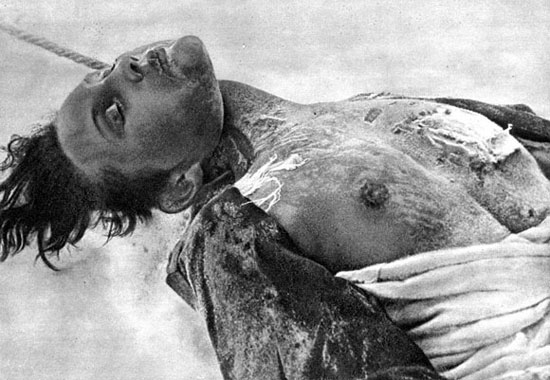
The young woman on the gallows, and in the ghastly post-mortem pictures with her left breast mutilated swiftly became propaganda grist for Moscow.
Zoya’s instant Joan of Arc-like legend invited investigation of the precise circumstances of her capture and death … and this in turn meant extremely dangerous scrutiny for any Soviet citizen in her environs whose behavior in those last days could be held to be in any way sub-heroic.
This brings us to today’s unfortunate entry, Vasily Klubkov, a humble mail-sorter before the war whose picture belongs in the dictionary next to “poor luckless sod.” Just him, Zoya, and everyone else on the terrible Eastern Front.
It was on this date* in 1942 that Klubkov paid the penalty for Zoya’s sacrifice.
Vasily Klubkov and Boris Krainov were other partisans who had been detailed along with Zoya Kosmodemyanskaya to torch some enemy assets on the same mission around Petrishchevo. Practically children all, they each acted independently from the others; long story short, Zoya and Vasily Klubkov were both captured.
Zoya fiercely endured every torture the Germans could throw at her, but Klubkov was made of softer stuff. When an officer pointed a gun at his head and demanded some answers, Klubkov started talking.
“I was a coward,” he later admitted. “I was scared I would be shot.”
Now, this admission very much against his own safety was made to the NKVD in March 1942, and since we already know that Vasily Klubkov was the sort to fold under torture, we can well imagine that the NKVD also got whatever it wanted out of the misfortunate young man. Considering the politicized quality of the trial and the circumstances of the “confession,” it has to be treated with caveats.
Under NKVD pressure, Klubkov signed off on a version of events that just so happened to mesh beautifully with the iconography already forming around the hanged “Tanya”: namely, that he was brought face-to-face with his fellow-prisoner and confirmed her identity, whereas she refused to breathe a word to her captors; that he saw her stripped naked and bashed with truncheons for hours and still summon the fortitude to refuse her interrogators the least satisfaction. Pavel Klubkov gave posterity firsthand evidence of Zoya Kosmodemyanskaya’s heroism in captivity.
“Klubkov may have been telling the truth, since it’s easy to imagine a terrified teenager on his first mission agreeing to his German captors’ demands,” notes Andrew Nagorski in The Greatest Battle: Stalin, Hitler, and the Desperate Struggle for Moscow That Changed the Course of World War II. “But there’s no way of knowing for sure how he really behaved, since he surely was just as terrified when he was interrogated by the NKVD. Or how much of what he said about Zoya was accurate, since the NKVD may already have been preparing the transcript with the idea of her elevation to mythic status.”
Heck, the reason the NKVD even had Klubkov to interrogate was that he escaped German custody, another big character red flag as far as the Soviets were concerned. That he escaped from the same custody that martyred Zoya Kosmodemyanskaya probably sealed his fate before he received his first pistol-whipping. NKVD records paint a kid who has already given up.
Well he might have. The verdict of the court was surely ordained from the start, but it was formally delivered on April 3: “Execution by shooting, without confiscation of property due to its absence.”
* Though there are some cites for April 3 out there, it appears that April 3 was the date of his conviction by a military tribunal and April 16 his execution date. This is a bit of a protracted delay by wartime Soviet tribunal standards, but then, Klubkov would have been a person of relevance to the state itself. The highest-ranking official who thought he could approve Klubkov’s execution without asking anyone else might have been a little further up the food chain than for your run-of-the-mill deserter.
Pavlik Morozov was one of the must well-known figures in the Soviet Union. Every Soviet schoolchild learned his name and the story of his heroic life and tragic death. On April 7, 1933, his alleged killers — his own grandparents, uncles and cousin — were executed by firing squad for his murder.
A postage stamp honoring the Moscow statue honoring little Pavlik Morozov. Many more Pavlik propaganda images are here.
While most Morozov monuments have long since been destroyed or removed from public view, apparently a few still persist.
The legendary Pavlik, a Russian boy who lived in the remote village of Gerasimovka in western Siberia, was a member of the Young Pioneers, a kind of Communist version of the Boy Scouts designed in indoctrinate youth into the Soviet way of thinking. When the superlatively loyal child found out his father, Trofim, was acting against the state, he denounced him to the secret police, the OGPU. (Accounts differ as to what Trofim’s misdeeds actually were; he may have hoarded grain, or sold forged documents, or both.) The result was that Trofim was sent to a labor camp, never to be heard from again.
The Morozov family, not being good Communists like he was, were furious with him for the denunciation. Soon after his father’s trial, in early September 1932, his grandparents, his uncle and his cousin murdered him while he and his eight-year-old brother Fyodor were picking berries in the woods. (Fyodor was taken out too, as he was a witness.) The boys’ bodies weren’t located for several days and it’s unclear when they actually died.
An OGPU officer, Ivan Potupchik, who was another of Pavlik’s cousins, found them. The murderers were arrested in due course, and Pavlik became a martyr and an example for every Soviet child to look up to — a Stalinist passion play, the horrid little saint of denunciation. As Soviet dissident writer Yuri Druzhnikov wrote in this article,
Indeed, it is virtually impossible for someone not born and raised in the USSR to appreciate how all-pervasive a figure Morozov was … [E]veryone in the Soviet Union, young and old alike, used to know about Pavlik Morozov. His portraits appeared in art museums, on postcards, on match-books and postage stamps. Books, films, and canvases praised his courage. In many cities, he still stands in bronze, granite, or plaster, holding high the red banner. Schools were named after him, where in special Pavlik Morozov Halls children were ceremoniously accepted into the Young Pioneers. Statuettes of the young hero were awarded to the winners of sports competitions. Ships, libraries, city streets, collective farms, and national parks were named after Pavlik Morozov.
A reconstruction of the suppressed Eisenstein film based on the Pavlik Morozov story, Bezhin Meadow. Aptly, its supposed ideological flaws got some of its own participants arrested.
The Cult of Pavlik declined significantly once World War II began and there were other youngheroes to exalt, and even more so after Stalin’s death. Still, even into the 1980s public figures praised the child as an “ideological martyr.”
The problem, as you might have guessed already, is that almost none of the accepted story about Pavlik is true. While not entirely made up, his Soviet-official biography was always thick with exaggerations, distortions and outright lies.
This Los Angeles Times article explains that Druzhnikov first got interested in Pavlik Morozov in the mid-1970s, when he attended a conference that included a discussion of “positive heroes of Soviet culture.” Pavlik was mentioned, and Druzhnikov asked just what was so positive about someone who had betrayed his own father. A few days later, he was summoned to KGB headquarters and two agents told him very firmly, “do not touch this subject.” It backfired: more curious than ever, Druzhnikov began secretly researching the case.
The book that resulted, Druzhnikov’s Informer 001: The Myth of Pavlik Morozov, was written in the early 1980s, but it was too politically sensitive for publication at the time. Instead it circulated privately among intellectuals and dissidents as Samizdat. It finally saw publication in Russian in 1988, and was then translated into English in 1993. (The full text of this book is available online for free here … in Russian.)
British historian Catriona Kelly published a second book on the subject in 2005, Comrade Pavlik: The Rise and Fall of a Soviet Boy Hero. By then, nearly all the surviving witnesses were dead. But unlike Druzhnikov, Kelly was able to obtain access to the official records of the Morozov murder trial and used them as a major resource.
These two authors got as close to the truth as one is able to get at this late date.
The Real Pavlik’s Life and Death
Pavlik Morozov’s story is sordid and mysterious as only a grand Soviet propaganda myth can be.
There really was a boy named Pavel Morozov (his name was the Russian equivalent of “Paul”) in Gerasimovka, but his nickname was Pasha or Pashka, not Pavlik. He was not ethnically Russian but of Belorussian descent on both sides of his family, as were most of the inhabitants of Gerasimovka. He could not have been member of the Pioneers, since there was no Pioneers troop where he lived.
When Yuri Druzhnikov began picking apart the Pavlik Morozov myth in the 1980s, he was able to talk to those still alive who had known the youth. In addition to the elderly villagers in Gerasimovka, he also interviewed Pavlik’s mother and his sole surviving brother, Alexei. (Another brother, Roman, was killed in World War II.)
Druzhnikov developed the following data points:
The exact date of Pavlik’s birth is unknown; his own mother didn’t remember it when asked in her old age. He was probably between twelve and fourteen at the time of his death.
The villagers of Gerasimovka who knew Pavlik and were interviewed by Druzhnikov did not remember him fondly: he was variously described as a “hoodlum,” a “rotten kid” and a “miserable wretch, a louse” who enjoyed smoking cigarettes and singing obscene songs.
Pavlik enjoyed denouncing his neighbors for breaking the rules; he “terrorized the whole village, spying on everybody.”
According to his former schoolteacher, he was almost illiterate; in fact, Druzhnikov believed he may have been slightly mentally retarded.
Pavlik’s whole family was the Russian equivalent of poor white trash. Tatiana was a mentally unstable and quarrelsome woman who was widely disliked in the village. After Trofim’s arrest, the state seized all his property and so the family went from mere penury to the brink of starvation.
Druzhnikov’s witnesses from Gerasimovka remembered Trofim Morozov’s denunciation, trial, and exile, which was central to the Pavlik-the-martyr myth. They remembered the boy testifying and said he didn’t seem to understand what was going on.
Kelly, however, examining the historical records twenty years after Druzhnikov, could find no documentary evidence of any trial — nor any proof that Pavlik had denounced his father to the OGPU or that Trofim had been convicted of political offenses and exiled.
Trofim had definitely disappeared from Gerasimovka by the time of his sons’ murders, but Kelly believes it’s entirely possible that he simply walked out of little Pavel’s life and wasn’t put in a labor camp at all. If Pavlik did in fact denounce his father, it was probably at the behest of his mother, Tatiana, and not for political reasons: Trofim had deserted the family and moved in with a mistress.
Tatiana was bitterly angry about her husband’s defection, and Pavlik, as the oldest male member of the household, was stuck with the exhausting household and farm chores his father had once performed. The family certainly did not want for points of friction … and Pavlik Morozov’s murder certainly had nothing to do with politics.
However, one of the four people put to death for the crime might actually have been involved after all.
After the Murders
The murdered boys were buried quickly, before the police even arrived to investigate. No photographs were taken, experts consulted or forensic tests performed. No doctor examined the bodies, and it isn’t even known how many wounds the victims suffered.
Within short order, however, investigators had rounded up five suspects: Pavlik’s uncles, Arseny Silin and Arseny Kulukanov; his grandparents, Sergei and Ksenia Morozov, both of whom were in their eighties; and his nineteen-year-old cousin, Danila, who lived with Sergei and Ksenia.
The accused.
The only physical evidence to implicate them was a bloodstained knife and some bloody clothes found in Pavlik’s grandparents’ house. As Druzhnikov records:
The prosecution had at its disposal two pieces of material evidence that were found in the home of Sergei Morozov: the knife, which was pulled out from behind the icons during the search, and the blood-spattered trousers and shirt — though whose clothes they were, Danila’s, the grandfather’s, or someone else’s, and whose blood was on them remained unknown. The court did not demand a laboratory examination of the blood stains.
It’s worth noting here that Danila had recently slaughtered a calf for Pavlik’s mother; this would provide an alternative, innocent explanation for the bloody clothes.
During their nationally publicized show trial in November 1932, the defendants presented incriminating yet often wildly conflicting statements abut the murders, and virtually no other evidence was presented. Druzhnikov details the farcical proceedings, which lasted four days:
Witnesses for the prosecution (about ten people) … did not introduce facts but demanded that the court employ “the highest measure of social defense” — execution. In fact, there were no defense witnesses at all. At the trial there was only one defense counsel, but during one of the court sessions he stepped forward and announced to the hall that he was revolted by the conduct of his clients and refused to defend them further. After this the lawyer withdrew with a flourish, and the trial concluded without him.
Four of the five were convicted and sentenced to death for “terrorism against representatives of the Soviet Government.” Sergei, Ksenia, and Danila Morozov, and Arseny Kulukanov, were all shot in April after the inevitable rejection of their appeals. (Arseny Silin was able to produce a credible alibi and was acquitted.)
Tatiana supported the convictions and testified against the defendants. Stalin later purchased her a resort home in the Crimea, where she lived until her death in 1983.
Were They Guilty?
Druzhnikov, researching the case fifty years later, concluded that Pavlik and his brother were deliberately set up to be murdered by agents of the OGPU, who treated the murders as political and the children as martyrs, bringing righteous proletarian wrath upon a fiercely independent village which had so far successfully resisted collectivization.
“The murder,” he wrote towards the end of his book, “could only have been committed, or at least provoked, by the hands of the OGPU.”
Stalin’s regime would become famous for its terrifyingshow trials. “A show trial in the Urals,” Druzhnikov suggests, “called for a show murder.” Because, in Gerasimovka, “there really was no crime. The peasants living there were peaceful; they didn’t want to kill one another. So they needed help.”
Kelly, on the other hand, suggested that the appearance of the crime scene, with no attempt to hide the bodies by burying them or dumping them in the nearby swamp, suggests an impulsive act of violence probably committed by a local teenager or teenagers. (One wonders, however, why it took so long for searchers to find bodies supposedly lying in plain sight.)
Kelly’s best guess was that Pavlik’s cousin Danila may have actually been guilty after all, possibly acting in concert with another villager his own age, Efrem Shatrakov: Danila and Pavlik had a very nasty argument over a horse harness only a few days before Pavlik and Fyodor disappeared, and Pavlik had allegedly denounced the Shatrakov family for possessing an unlicensed gun, which was confiscated.
In fact, Danila’s statements to the authorities made reference to his fight with Pavlik about the harness, and Shatrakov actually confessed to the murders, but later retracted his statements and was let go.
In any case, as Kelly wrote, if one or more of the defendants convicted at the trial happened to be guilty, either of committing the murders or as accessories after the fact, “they most certainly did not receive a fair trial, and the corpus delicti upon which the sentence was based was without question seriously flawed.”
No matter who killed Pavlik, as Druzhnikov says, the final result is this: “It is a historical commonplace that Stalin ruthlessly converted living people into corpses. In this instance, he effected the conversion of a corpse into a living symbol.”
The only known real-life photograph of Pavlik Morozov, at center under the arrow, taken as a school class portrait by a wandering photographer in 1930.


 Nor was that the last exemplar.
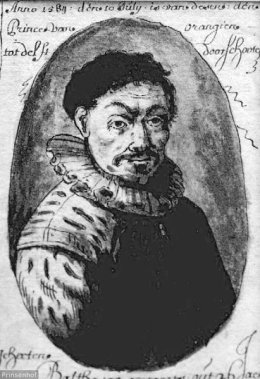 Gérard managed to be both historically important and wholly forgettable: an assassin working for Spain against the Netherlands, his regicide was met with a predictably stiff punishment. Then, no fault of his own, the subsequent course of history** pushed the assassin into obscurity while elevating his prey.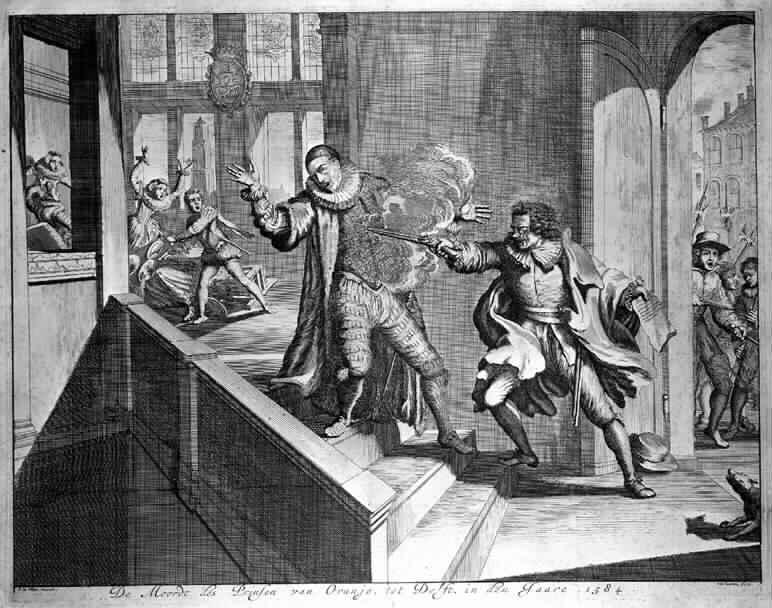


 This brings us to today’s unfortunate entry, Vasily Klubkov, a humble mail-sorter before the war whose picture belongs in the dictionary next to “poor luckless sod.” Just him, Zoya, and everyone else on the terrible Eastern Front.