On this date in 1866 (September 3 O.S.; September 15 N.S.), Russian revolutionary Dmitry Karakozov was hanged in Peter and Paul Fortress for attempting to assassinate Tsar Alexander II.
Karakozov was a son of noble stock — the self-hating variety, obviously, and suicidally disturbed into the bargain. He supposedly hailed from a terrorism cell branding itself “Hell”, although this was bandied about by the police afterwards and conveniently supported a hunt for radicals.
Karakozov, at least, considered the state of tsarist Russia positively infernal, and on April 4, 1866, he went to scourge it — firing a shot at the monarch at St. Petersburg’s Summer Garden. He missed.
The tsar’s guards tackled him as he fled, and the unharmed Alexander walked up to the gunman and asked him, “What do you want?” He may have been genuinely bewildered: Alexander was the guy trying to liberalize Russia. Just a few years before, he had freed the serfs.
“Nothing,” Karakazov replied. “Nothing.”
A statement of implacability: no progress would be bargained with even the most progressive despot. The despotism itself must go. A manifesto addressed to “Friends-Workers” was found in his pocket underscoring the point; it read in part (translated from p. 21 of this Russian pdf):
I have decided to destroy the wicked Tsar, and to die for my beloved people…
If I accomplish this deed, I will die with the thought that in death I did something good for my dear friend, the Russian peasant.
If I do not accomplish it, then others will follow my path. Where I fail, they will succeed, and my death will be their example and inspiration.
Karakozov himself, the first Russian revolutionary to attempt regicide, didn’t seem to have revolutionary satisfaction on his mind at the end. He converted to Orthodox Christianity in prison, sought “as a Christian, of a Christian” his prospective victim’s clemency … and multiple newspaper accounts report him kneeling to kiss a cross presented to him on the scaffold by the priest. (All via Odd Man Karakozov, which argues that all this need not imply such a reversal of conscience as it might appear.)
What certainly did happen — more immediately than those copycat assassinations — was a reactionary wave of national chauvinism, whose more wretched manifestations will not be unfamiliar to the present day. The patriotic Glinka opera Ivan Susanin was staged a few days later at the Bolshoi in Moscow. According to an eyewitness account of Tchaikovsky quoted in Romanov Riches: Russian Writers and Artists Under the Tsars, this salute to a Russian peasant’s sacrifice for the Romanov dynasty went a little bit off-script.
I think the Moscow audience went beyond the bounds of sense in their outburst of enthusiasm. The opera was not really performed, for as soon as the Poles appeared onstage, the whole theater shouted, “Down with the Poles!” and so on. In the last scene of Act 4, when the Poles are supposed to kill Susanin …
… the actor playing him started fighting the chorus members who played Poles, and being very strong, knocked down several of them, while the rest of the extras, seeing that the audience approved this mockery of art, truth, and decency, fell down, and the triumphant Susanin left unharmed, brandishing his arms, to the deafening applause of the Muscovites.
If true, that is little short of fantastic.
The apparatus of state went so far as to build up a new Susanin for the occasion at hand, hyping a questionable story that a young peasant named Osip Komissarov — who was from Susanin’s own province of Kostroma — had jostled Karakozov just as he took the shot, causing it to go awry. The good-natured bumpkin was rewarded with summary ennoblement as “Komissarov-Kostromskoy” and eye-rollingly terrible poetic tributes from the likes of Vyazemsky and Nekrasov. However, Komissarov’s embarrassing stupidity and want of manners would eventually necessitate Komissarov-Kostromskoy’s being packed out of polite society to country estates on a generous pension to bankroll his ample appetite for liquor.
So Dmitry Karakozov did do something for the Russian peasant after all.
On this date in 1642, with the last words “Mon Dieu! Qu’est-ce que ce monde?”, 22-year-old former royal favorite Cinq-Mars was beheaded at Lyon’s Place des Terreaux.
Henri Coiffier de Ruze (English Wikipedia page | French) had been under Cardinal Richelieu’s protection since the boy’s father died in 1632; in 1639, the Red Eminence introduced the then-19-year-old whippersnapper to Louis XIII as a prospective royal favorite (read: lover).
Though the king did indeed take to the youth, Cinq-Mars, in the age-old custom of sullen teenagers everywhere, soon found the luxurious profligacy of the favorite’s life rather overbalanced by irritation at both of his sickly, aging patrons.
Tart talk to intimates graduated to something more serious after Richelieu rudely put the kibosh on Cinq-Mars’s (unrealistic) designs on a wealthy noblewoman — which was also a bid to parlay his tenuous favorite gig into some lasting power.
Now considering himself personally begrudged of the Cardinal, Cinq-Mars fell into the conspiracies (French link) to depose, assassinate, or otherwise replace him.
Eventually Cinq-Mars would go so far as a real blockbuster (French again): he signed a secret pact with the Spanish king to support a noble revolt in exchange for handing over French possessions, a seditious plan also backed by perennialplotter Gaston d’Orleans, the king’s scheming brother.
Our angry moppet had more than met his match in Richelieu, however: the cardinal’s agents intercepted (more French) the treasonable correspondence and had Cinq-Mars dispatched this date along with his confederate de Thou.
Execution of Cinq-Mars and De Thou in Paris (1642), engraving by Johann Luyken, Paris, Bibliothèque nationale de France (via)
Richelieu himself was already dying as he undid this last conspiracy against him. The cardinal succumbed on December 4, 1642 … with Louis following him into the grave the next May.
On this date in 1481, two Lithuanian princes were beheaded in Vilnius for plotting the assassination of the Polish-Lithuanian king.
This late 15th century was a heady time for Poland under the Jagiellon dynasty, and one of this dynasty’s going projects was keeping the adjacent realms of Poland and Lithuania linked together. In time, they would become formally joined, but at this point they were independent entities “united” only by the personal union of the Jagiellon monarch himself.
That monarch in the late 15th century was the redoubtable Casimir IV (Kazimierz IV): Grand Duke of Lithuania since 1440, King of Poland since 1447. Casimir’s family hailed from Lithuania; indeed, as that place had been last European place to Christianize, Casimir’s own father had been born a pagan.
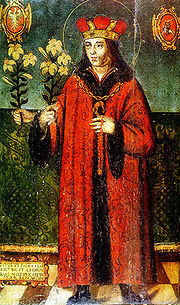
Casimir IV’s eponymous son is St. Casimir, patron saint of both Lithuania and Poland; both actively honor his feast date of March 4.
Lithuania agonistes
Lithuania had a strong independent streak (pdf), and its boyars did not necessarily see eye to eye with the Grand Duke. Casimir was keen on centralizing Lithuania’s administration and checking the potential rivalry of the most powerful Lithuanian families, the classic seeds of crown-vs-nobility conflict the world over.
And both watched with a wary eye the growth of Muscovy under the energetic leadership of Ivan III, aka Ivan the Great.
That expanding state in the 1470s gobbled up the buffer city-state of Novgorod; Ivan III’s newly-minted honorific Tsar of all the Rus(sians) openly announced his designs on Lithuania’s own historically Slavic Ruthenian territory. “The gatherer of the Russian lands,” Ivan is known as … and Lithuania (much larger then than it is now) stood to be the gatheree.
The Great Stand on the River Ugra
Come 1480, Casimir was allied against Moscow with the Mongol Horde, the famous “Tatar yoke” that had been collecting Russian tribute for two-plus centuries. In Russian historiography this is the crucial moment when that yoke is thrown off, and the Muscovites accomplished that in part by crossing up the Lithuanians.
The Horde, having marched through Lithuanian territory, assembled on the banks of the Ugra River, opposite a waiting Muscovite army. Neither army attacked. Instead, they waited … and waited … and waited some more.
The Horde, for its part, was waiting for reinforcements from its Lithuanian ally. But those reinforcements never arrived, thanks in part to Russia’s alliance with Crimean khan Mengli Giray, who seems to have absorbed Casimir’s attention in the fall of 1480 with a vexing combination of raids into southern Lithuania and dilatory ceasefire diplomacy. Distracted by the homeland threat, Lithuania never got around to supporting the Horde … and the Horde, after freezing itself on the banks of the Ugra for a couple of months, simply marched away in frustration.
Moscow never again paid it tribute … and its Crimean ally destroyed the Great Horde utterly in 1502.
Chop
This was the context, back in Lithuania, for the attempt on Casimir’s life that would cost two princes their heads. Notwithstanding his unhelpful alliance with the Great Horde, it seems apparent that Casimir himself espoused a fundamentally western policy: the Jagiellon dynasty had branches in Hungary, Bohemia, Germany, and Casimir had more taste for meddling in these realms than dealing with Russia. One could imagine how a Lithuanian magnate out his lucrative Novgorod trade would feel like the head man didn’t really have his eye on the ball; in 1478, a Lithuanian delegation even requested that Casimir appoint a Lithuanian governor to look after the interests of the Grand Duchy. (Casimir refused.)
And these nobles were getting it at both ends, since Casimir’s state-centralization project meant that they were being cut down to size in terms of their internal political power, too.
Apparently with the support of Moscow itself (whose expansionary interest is self-evident) Iwan Holszanski and Fedor Bielski hatched a plan to murder the Grand Duke and his sons on Palm Sunday, 1481 — which was also the occasion of Fedor Bielski’s wedding. The idea was to replace him with Michal Olelkowicz (Mikhail Olelkevich), who had been Novgorod’s elected prince-ruler in the late 1460s; it’s not clear to me if Olelkowicz himself was actually in on the scheme.
Casimir, at any rate, caught wind of the plot. Legend has it that a servant decorating a room ran across the conspirators’ weapons niches and reported it; it’s alternately alleged that the assassins meant to jump Casimir while out on his favorite pastime, hunting.
However it was supposed to go down, it didn’t work. Bielski was able to flee to Moscow (ditching his newlywed bride), but left Holszanski and the coup’s prospective beneficiary Olelkowicz to suffer beheading this date upon evidence “brighter than the sun” of their treason.
On this date in 1537, a Scottish noblewoman suffered the fate decreed for her treason — in the terse entry of the judicial record, combusta.
Knocking around Glamis Castle — where Shakespeare’s great villain Macbeth got his start, as Thane of Glamis* — Janet Douglas had the going enmity of Scottish king James V on the substantial grounds that Janet’s father had held the teen-king his virtual prisoner for a few years in the 1520s. Once James got free, he proscribed the lady’s brother, the Earl of Angus (whom Janet continued to shelter when occasioned), confiscated properties, forbade Douglases from approaching his person, and all that sort of thing.
Presumably according to this same anti-Douglas animus, an abortive attempt was made in 1531 to try our Lady Glamis for poisoning her late first husband, Lord Glamis. However, the charge foundered on the refusal of her peers to participate: “the lairds of Ardoch, Braco, Fingask, Abernethy, Piferran, Lawers, Carnock, Moncreiff, Anstruther, Lord Ruthven, Lord Oliphant, and many others, were fined for absenting themselves from the jury.”
Six years later she was more successfully returned to the dock, this time on a charge of plotting to poison the king himself. There seems to remain very little detail that would trace the precise unfolding of those years and offer later interlocutors a clear interpretation; while “innocent noble railroaded” is the most conventional read — Henry VIII’s agent reported that the conviction was secured “without any substanciall ground or proyf of mattir” — this book gives it a “maybe she did, maybe she didn’t” spin. That whole embittered proscription thing cuts both ways, as motives go.
At any rate, torture induced Janet Douglas’s own 16-year-old son John to testify that she had procured a potion intended to resolve that feud, and despite reported doubts and a spirited defense, the judges found her “committit art and part of the tressonabill Conspiratioune and ymaginatioune of the slauchter and destructioune of our soverane lordis” and therefore to “be had to Castell hill of Edinburghe, and thair brynt in ane fyre to the deid as ane Traytour.” (John was reprieved of this fate, but he still had to watch.)
King Jamie took over Glamis Castle and hung his spurs there until his own death in 1542 … whereupon his crown passed to Mary, Queen of Scots, and the castle reverted to that young John, the new Lord Glamis.
On this date in 1804, royalist counterrevolutionary Georges Cadoudal was guillotined in Paris with eleven of his chouan brothers-in-arms.
Cadoudal (English Wikipedia entry | the much more detailed French) was the French Revolution’s ultimate antagonist, a Breton notary (and commoner, obviously) who obstinately resisted the bloody progress of those years to the last of his strength.
His decade of royalist adventures (French) reads* like an adventure novel, a mind-bogglingly perilous series of revolts, captures, escapes, rappelling, martial exploits, diplomatic intrigue, terrorist plotting, high principles, low politics … a desperately heroic (or anti-heroic) struggle using every resource of a changing world to claw back the lost age of Bourbons.
After that dynasty’s last (up until then) king was guillotined in 1793, the intrepid Cadoudal staked his life to the 1793 Vendee rising, mounted an insurrection at Brest, and became one of the principal leaders of the anti-revolutionary Chouannerie fighting les bleus around northwest France through the 1790s.
Beaten but not bowed, Cadoudal took refuge in England when those campaigns came to grief following the royalist debacle at Quiberon, but he was never one to retire to the exile social circuit. Cadoudal remained an active schemer against the France of a rising Napoleon Bonaparte, and he was backed now by Britain’s statecraft … and her gold.
Spurning a proffered arrangement with the Corsican — who, say what one will, could recognize ability when he saw it — Cadoudal instead oversaw a dramatic 1800 assassination attempt on Napoleon that didn’t get the dictator but blew a bunch of Parisian bystanders to smithereens.
This effort having failed, our persistent intriguer slipped back into France to attempt an even bolder venture to kidnap Napoleon and elevate the Duke of Enghien — the going Bourbon candidate, who lurked on the French frontier to rush into the power vacuum.
This didn’t work either. As outlandish as the idea seems with benefit of hindsight, it was hardly a crackpot plan — as attested by the credentials of its participants.
“All Europe laughs at the conspiracy in Paris; it was, however, a well-built machine. Men, money, everything was ready. Bonaparte was to be taken alive and carried out like lightning from one post to the sea and the English fleet … I am inconsolable that it missed its mark. Those who criticize the French princes that they do not risk themselves while others fight for them, they will be the first to cry: What madness! How childish! [that d’Enghien risked himself] That is how men are made.”
Which is a long way of saying that it still comes down to wins and losses.
Having lost, the Bourbon pretender (he’s a pretender because he lost, of course) d’Enghien was arrested and immediately shot for his trouble; Cadoudal, taken on the streets of Paris,** was around long enough to see the hated Bonaparte take sufficient warning from the conspiracies against him to vest his governance in the imperial dignity. That was proclaimed on May 18. (The famous coronation wasn’t until December.)
“We have done better than we hoped,” the doomed Cadoudal remarked caustically from his dungeon. “We intended to give France a king, and we have given her an emperor.”
He was rock-ribbed in his royalism to the very last.
He’d met Napoleon face to face years before in an abortive parley — when Cadoudal was offered, and rejected, the bribe of a lucrative Republican military commission — and now Cadoudal’s proposed victim let it be known to him that mercy was his for the asking. The indignant Breton scorned as dishonorable the very idea of supplicating Napoleon, even when the invitation was refreshed as he underwent the fatal toilette on his final day. His dozen-strong party went to their deaths this date taking heart from following the very footsteps of their martyred king.
The Execution of Georges Cadoudal, by Armand de Polignac … who portrayed several scenes of the conspirators.
A very lovely mausoleum in his native village of Kerleano preserves Cadoudal’s remains (reburied honorably there after his Bourbon Restoration finally came to pass), and his memory.
Two centuries ago today, the only man to assassinate a British Prime Minister was hanged for his trouble.
The man at the end of the rope, John Bellingham, was a Liverpool businessman who had gone to Archangel, Russia to do some export/import trade and there been spuriously accused a debtor and slapped in prison for five years.
His target, Spencer Perceval, was the pious Tory heir to the late William Pitt, and famous (or infamous) for his evangelical personal rectitude and an accompanying status-quo smallness. (He was physically short, too.) “He has looked at human nature from the top of Hampstead Hill,” snorted his contemporary Sydney Smith, “and has not a thought beyond the little sphere of his own vision.”*
Though others judge more generously of him, Perceval’s overall reputation is that of the prim caretaker, violently anti-Bonaparte, anti-Catholic, anti-adultery, anti-worker, anti-egalitarian, anti-democratic, anti-slavery. Anti- a lot of things.
Anti-cluttering up his schedule was the thing that did him in.
John Bellingham returned from his sojourn in the Romanovs’ dungeons in 1809, understandably embittered over his ordeal and the bankruptcy it had driven him into. He then besieged the government with demands for compensation, but met a cold reception all over and got no reply at all for his request to meet with Spencer Perceval.
So Bellingham did what anyone would do: he walked up to Perceval at Westminster on May 11, 1812, and shot him dead.
Then the strange perpetrator with the private grievance re-seated himself comfortably by the fireplace (rather than exploiting the hubbub to fly), where he was promptly arrested. They didn’t mess around back then: John Bellingham was on trial for his life four days after pulling the trigger.
Nevertheless, as the rumor first spread there were fears — or in some cases, hopes — of Jacobin intrigues afoot. And it’s safe to say that the nation’s magnates had better cause than its underclasses to mourn Perceval. “Among the multitude,” one parliamentarian remembered of those days, “the most savage expressions of joy and exultation were heard: accompanied with regret that others, and particularly the attorney-general, had not shared the same fate.”
Clearly something less than fully rational, Bellingham was also more than lucid enough for the hemp. A minister who visited him in the hours before his execution found him unsettlingly unrepentant, and attributed to “the perverse inflexibility of his character” Bellingham’s delusional “self-vindication. He had accordingly taken his ground, and there he obstinately stood; and the weakness of his allegations only increased the firmness by which he was determined to maintain them.”
He had, indeed, maintained them openly at trial, bizarrely casting his homicide as a blow for better government to remind ministers of state to keep longer office hours.
Finding myself thus bereft of all hopes of redress, my affairs ruined by my long imprisonment in Russia through the fault of the British minister, my property all dispersed for want of my own attention, my family driven into tribulation and want, my wife and child claiming support, which I was unable to give them, myself involved in difficulties, and pressed on all sides by claims I could not answer; and that justice refused to me which is the duty of government to give, not as a matter of favour, but of right; and Mr. Perceval obstinately refusing to sanction my claims in Parliament; and I trust this fatal catastrophe will be warning to other ministers. If they had listened to my case this court would not have been engaged in this case, but Mr. Perceval obstinately refusing to sanction my claim in Parliament I was driven to despair, and under these agonizing feelings I was impelled to that desperate alternative which I unfortunately adopted. My arm was the instrument that shot Mr. Perceval, but, gentlemen, ought I not to be redressed; instead of that Mr. Ryder referred me to the Treasury, and after several weeks the Treasury sent me to the Secretary of State’s office; Mr. Hill informed me that it would be useless to apply to government any more; Mr. Beckitt added, Mr. Perceval has been consulted, he would not let my petition come forward.
Gentlemen, A refusal of justice was the sole cause of this fatal catastrophe; his Majesty’s ministers have now to reflect upon their conduct for what has happened. Lord Gower is now in court, I call on him to contradict, if he can, the statement I have made, and, gentlemen, if he does not, I hope you will then take my statement to be correct. Mr. Perceval has unfortunately fallen the victim of my desperate resolution. No man, I am sure, laments the calamitous event more than I do. If I had met Lord Gower he would have received the ball, and not Mr. Perceval. As to death, if it were to be suffered five hundred times, I should prefer it to the injuries and indignities which I have experienced in Russia, I should consider it as the wearied traveller does the inn which affords him an asylum for repose, but government, in the injustice they have done me, were infinitely more criminal than the wretch, who, for depriving the traveller of a few shillings on the highway, forfeits his life to the law. What is the comparison of this man’s offence to government? or, gentlemen, what is my crime to the crime of government itself? It is no more than a mite to a mountain, unless it was proved that I had malice propense towards the unfortunate gentleman for whose death I am now upon my trial. I disclaim all personal or intentional malice against Mr. Perceval.
According to a Frenchman in England at the time, the still-sympathetic public raised for Bellingham’s widow and orphan a subscription “ten times greater than they could ever have expected in any other circumstances.”
A few topical books
* In Peter Plymley’s Letters, which is full of vituperation for Perceval’s harsh Irish policy … words that could go just as readily for many a reputed statesman in many a time and circumstance over the two centuries elapsed since.
I cannot describe the horror and disgust which I felt at hearing Mr. Perceval call upon the then Ministry for measures of vigour in Ireland. If I lived at Hampstead upon stewed meats and claret; if I walked to church every Sunday before eleven young gentlemen of my own begetting, with their faces washed, and their hair pleasingly combed; if the Almighty had blessed me with every earthly comfort — how awfully would I pause before I sent forth the flame and the sword over the cabins of the poor, brave, generous, open-hearted peasants of Ireland! How easy it is to shed human blood; how easy it is to persuade ourselves that it is our duty to do so, and that the decision has cost us a severe struggle; how much in all ages have wounds and shrieks and tears been the cheap and vulgar resources of the rulers of mankind; how difficult and how noble it is to govern in kindness and to found an empire upon the everlasting basis of justice and affection! But what do men call vigour? To let loose hussars and to bring up artillery, to govern with lighted matches, and to cut, and push, and prime; I call this not vigour, but the SLOTH OF CRUELTY AND IGNORANCE. The vigour I love consists in finding out wherein subjects are aggrieved, in relieving them, in studying the temper and genius of a people, in consulting their prejudices, in selecting proper persons to lead and manage them, in the laborious, watchful, and difficult task of increasing public happiness by allaying each particular discontent. In this way Hoche pacified La Vendee — and in this way only will Ireland ever be subdued. But this, in the eyes of Mr. Perceval, is imbecility and meanness. Houses are not broken open, women are not insulted, the people seem all to be happy; they are not rode over by horses, and cut by whips. Do you call this vigour? Is this government?
On this date in 1964, three officers were executed in Bhutan, including former deputy commander in chief Namgyal Bahadur, for assassinating Prime Minister Jigme Dorji.
Jigme Dorji
A member of the powerful Dorji family and brother-in-law to the Bhutanese king, Dorji was overseeing a modernization campaign for the insular Himalayan kingdom. On April 5, 1964, while the king was in Europe for medical treatment, Dorji was shot dead while relaxing on his veranda. No wholesale seizure of power was attempted.
The assassin, one Zambay,* was caught within days, and he implicated a number of powerful people — including not only Namgyal Bahadur, but the king’s Tibetan mistress.
She eventually fled the country, though her alleged involvement fueled rumors of a Chinese connection, or (more plausibly) of palace politics between her faction that that of the rival Dorjis. Old guard military guys versus the modernizers is another hypothetical dimension, although again the specifics (why now? what was the last straw?) are wanting.
Alimohammadi, a Tehran University physics professor, was slain in January 2010 by a booby-trapped motorcycle parked next to his car just as he left for work in the morning.
Whether that’s specifically true in Alimohammadi’s case is arguably a bit harder to judge, since he was not directly involved in Iran’s nuclear program. Iran’s western opponents have speculated that Tehran itself murdered him because he was a (low-key) supporter of the country’s opposition who in death could serve as an official martyr.
That would be awfully convenient: official martyrs come cheap but Iran doesn’t exactly have a limitless supply of particle physicists.
Accurately or not, Fashi confessed to carrying out Alimohammadi’s assassination, claiming that he was recruited, paid, and trained by the Mossad for the job.
Like everyone else on that parchment, they were in a world of hurt when Oliver Cromwell died and Charles II returned to the throne. And like a great many of those who figured to reap the whirlwind, they sensibly fled the realm.
Had they stayed hunkered down in Germany, they might have died in their beds.
Instead, they trusted a friend … and died half-hanged, emasculated, disemboweled, and chopped to pieces on a scaffold.
It was an ugly sight from start to finish. The capture of these fugitives was a dirty business mixing treachery, diplomatic subterfuge, and dubious legality, all in the service of violent statecraft. Sort of like it was ripped from the Downing Street memo.
This guy was coming into the prime of his continent- and polity-spanning career: from Puritan New England, to the West Indies, to a gig in Cromwell’s army during the English Civil War. (It was John Okey himself who hooked Downing up: Downing matriculated with Harvard University’s first graduating class thanks to Okey’s sponsorship, and it was in Okey’s regiment that Downing was retained as chaplain.)
An able diplomat for the Protectorate, Downing was able to communicate his discreet abjuration to the exiled Charles II once the handwriting was on the wall, and he therefore effected a convenient volte-face and went right to work for the new boss … even when it meant hunting down his own friends and patrons. You might say it was the zeal of the converted, but maybe it was better-expressed by Downing’s own pledge to secure the refugees with vigor “as much as if my life lay at stake in the busines.”
Sound policy, considering his history. And he couldn’t have pulled it off with an ounce less.
Officially, the Low Countries had agreed not to give refuge to regicides: in reality, regicides could rest pretty easy there. Pro-immigrant, pro-Protestant,* and jealous of their sovereignty, the Dutch had little desire to enforce such clauses at any level of government; and, thanks to a federal structure, multiple state organs each held effective veto over enforcement. Moreover, a silly legalistic fetish required that fugitivies have warrants sworn out against them — warrants that would cause regicides’ many friends and sympathizers to raise the alarm before the target could be taken, which is exactly what happened when Downing tried to get Edward Dendy arrested in Rotterdam.
Downing cogitated all manner of extra-legal options to black-bag a few of the Protectorate personnel for his Majesty’s pleasure. What he ended up with was cunning, vicious, and just barely legitimate.
Turning one of the regicides’ contacts with threats and bribery, he secured advance warning of Barkstead, Corbet, and Okey’s planned visit to Delft in early March 1662. He then waited until the very day he planned to spring his trap to procure a general arrest warrant (concealing the names of his prey) from the Estates General’s capable leader Johan de Witt, and pounced within hours — using a force of his own men and a little more payola to circumvent the inevitable reluctance of the local bailiffs.
Now that the regicides were in irons, Downing had to double down on duplicitous diplomacy by maneuvering to get them delivered to the English — and that against a growing popular resistance as their capture became known. The Delft aldermen dilated; sympathetic local worthies visited the prisoners in their cells; petitions on the Englishmen’s behalf circulated nationwide. The notion of actually marching these guys out into English hands seemed to promise a riot.
Downing spread more palm grease around, maneuvered to frustrate legal aid for the prisoners, posted his own men to watch the prisoners 24-7, and after several tense days finally made arrangements
in the dead of the night to get a boate into a litle channell which came neare behinde the prison, and at the very first dawning of the day without so much as giving any notice to the seamen I had provided … forthwith to slip them downe the backstaires … and so accordingly we did, and there was not the least notice in the Towne thereof, and before 5 in the morning the boate was without the Porto of Delft, where I delivered them to Mr. Armerer … giving him direction not to put them a shoare in any place, but to go the whole way by water to the Blackamore Frigat at Helverdsluice.
Downing was exultant.
“This is a thing the like thereof hath not been done in this country and which nobody believed was possible to be done,” he gloated in his correspondence. “And there is not a thing that hath happened these many yeares that hath occasioned so much discourse here, saying that they are now no longer a free Countrey, and that no man is now sure here.” De Witt and the Dutch Estates General, having never had any intention to actually deliver a regicide to condign punishment in England, had been embarrassingly played. Ordinary Hollanders were infuriated and ashamed at having been a party to the whole business.
Nobody could dispute the excellence of Downing’s operation. But anybody on either side of the channel who wasn’t a dyed-in-the-wool Royalist was somewhere between discomfited and revolted by it, especially as it was achieved against his own personal benefactor by a guy who had once urged Cromwell to make himself king.
Diarist Samuel Pepys (who witnessed the executions, reporting the victims “very cheerful” on that occasion) recorded the mood of the English burgher upon the news
that Sir G. Downing (like a perfidious rogue, though the action is good and of service to the King, yet he cannot with a good conscience do it) hath taken Okey, Corbet, and Barkestead … all the world takes notice of him for a most ungrateful villaine for his pains. (Pepys’s March 12 and March 17 entries for this year)
See: Ralph C.H. Catterall, “Sir George Downing and the Regicides,” The American Historical Review, Vol. 17, No. 2 (Jan., 1912)
* Dutch affinity for religious dissent and for foreigners was all of a piece with its prosperous mercantile empire. One liberal Englishman (quoted by James Walker in “The English Exiles in Holland during the Reigns of Charles II and James II,” Transactions of the Royal Historical Society, Fourth Series, Vol. 30 (1948)) proposed that “Liberty of Conscience would be a more serious blow to Holland than all the victories yet gained.”
On this date in 1945, in the dying days of the Third Reich, 42-year-old Johann Georg Elser was executed by gunshot in the German concentration camp Dachau. He died for a failed attempt on Adolf Hitler’s life more than five years before.
It goes without saying that, had he been successful, he would have changed history immeasurably.
Elser, who went by his middle name, didn’t fit the profile of someone who would try to kill Hitler.
He wasn’t a Jew, a Communist or a member of any of the other minority groups the Nazis persecuted. He wasn’t political at all, in fact.
A carpenter by trade, with one illegitimate son, his hobbies included playing the zither and the double bass.
He was the kind of ordinary, working-class German the National Socialists tried to reach out to. But from the very start, he made it clear how much he despised them and all that they stood for.
He was a practical man at heart and was not interested in political discussions. He had no desire to change other people’s minds, but he steadfastly refused to make any accommodation to the new regime. When Hitler’s speeches were broadcast, he would silently leave the room… In May 1938, a Nazi parade threaded its way through his hometown of Königsbronn. Elser, like many others, turned out to watch, but as those around him gave the Hitler salute, he refused to do likewise. When a colleague reminded him that it might be sensible to conform, he replied curtly, “You can kiss my ass.” He then ostentatiously turned about and started whistling to himself.
How Elser’s silent, passive resistance turned into action is unclear, but by the autumn of 1938 he had made up his mind to kill the Führer.
Unsure how to accomplish this, he traveled to Munich to get some ideas. Every year on “Die Neunte Elfte”, the November 8-9 anniversary of the Beer Hall Putsch, Hitler came to the Bürgerbräukeller and gave a speech to the old guard.
That day in 1938, actually just hours before another would-be assassin tried to kill Hitler, Elser slipped into the beer hall pretending to be an ordinary customer and “noted the layout of the room, the position of the lectern and the patent lack of effective security measures.”
He had found his place and his time: he decided that the following year, he would plant a bomb in the Bürgerbräukeller, timed to go off right in the middle of Hitler’s big anniversary speech and kill him and as many Nazis as possble.
Elser’s meticulous planning and preparations over the next twelve months were nothing short of amazing. He stole a fuse and some gunpowder, and got a job at a quarry specifically so he could acquire some explosives. Knowing nothing about bombs, he made countless prototypes and tested them in empty fields in the countryside.
In the spring of 1939, he went back to Munich and the Bürgerbräukeller to make some detailed sketches of the building and find an appropriate place to hide the bomb. He chose a thick stone pillar behind the lectern, which supported a balcony. In August, he brought his tools and bomb-making materals to Munich to set about with his final phase of the plan.
The fastidious assassin’s modus operandi was shockingly simple, and shockingly bold.
He would visit the Bürgerbräukeller every night at around 9:00 to take his evening meal. An hour or so later, he would sneak up to the gallery of the function room, where he would hide in a storeroom until the bar closed and the building was locked.
Thereafter, he was free to work by flashlight until the bar staff returned at around 7:30 a.m., when he could sneak out of a back entrance.
His first priority was to chip out a cavity in the stone pillar to hold the bomb. But, finding the pillar was now dressed with wooden cladding, Elser was forced to spend three nights sawing a hole in the wooden surround.
Every sound had to be muffled, every speck of sawdust collected and disposed of: he could afford to leave no evidence of his presence. Even the sawn wooden panel was fashioned into a flush-fitting secret door.
Good thing he was a carpenter.
Having accessed the pillar, he could now begin to dig out a recess for the bomb. Using a hand drill and a hammer and chisel, he spent most of the following month loosening mortar and prising out bricks — all of which, of course, had to be meticulously tied and removed from the scene in a cloth sack.
Progress was painfully slow.
In the cavernous hall, every hammer blow he struck echoed like a gunshot, and to escape detection he had to time his blows to coincide with external sounds, such as the passing of a tram or the automatic flush of toilets. Working by night preparing the pillar in the Bürgerbräukeller, he labored by day putting the finishing touches to his bomb and, of course, the elaborate timing mechanism.
It all took two months.
On November 2, six days before the Big Day, Elser finally concealed his bomb, which had been put in a wooden box lined with cork to muffle the ticking sound of the timing mechanism, in its hidey-hole. Hitler’s speech was scheduled to start at 9:00 p.m. on November 8 and would last for an hour. The bomb was set to go off at 9:20.
It did so, right on time, with a spectacular explosion that smashed the stone pillar, brought down the overhead balcony and ceiling, shattered windows, blasted out doors, killed eight people and injured 67 more.
The only problem was, Hitler wasn’t among the dead or wounded. In fact, he wasn’t even there.
He had pressing business in Berlin and wanted to get back that same night, so he had rescheduled his speech for 8:00 p.m. instead of nine. He finished and left the building at 9:07, thirteen minutes before the big reception Elser had prepared for him. By the time the bomb went off, Hitler was already on the train back to Berlin.
That Elser failed was through no fault of his own: it was just sheer, terrible, rotten luck.
British Prime Minister Benjamin Disraeli once said, “Assassination has never changed the history of the world.” Perhaps he is right in most cases, but it’s hard to believe that statement is true when it comes to Hitler. In this case, thirteen minutes substantially altered the history of Europe for the rest of the century.
Getting back to Elser: ever the careful planner, he knew what to do to protect himself once the bomb went off. He was miles away from Munich at the time, trying to sneak over the border into Switzerland. Unfortunately, he was caught by German border guards.
At first they thought it was a routine arrest, but then they saw the contents of his pockets, which included a postcard of the Bürgerbräukeller and sketches of his bomb design. The guards didn’t yet know about the assassination attempt, of course, but what they saw made them suspicious and they turned him over to the Gestapo.
On November 13, Elser confessed everything. When a flabbergasted Hitler read the preliminary investigative report which supported Elser’s lone-bomber story, he demanded, “What idiot conducted this investigation?”
He couldn’t wrap his mind around it, and neither could anyone else.
In the wake of the assassination, mass arrests were made: anyone who seemed unusually interested in the Munich speech, or didn’t express sufficient enthusiasm for the Nazi Party, could fall under suspicion of being part of the plot.
At Munich’s Feldherrnhalle on Nov. 11, Hitler conducts a memorial ceremony for the victims of Elser’s assassination bid.
As Moorhouse explains,
To many Nazis, Elser was simply an enigma. He was an ordinary German. He exhibited none of the typical signs of “degeneracy” that they claimed to be combating: apart from his brief flirtation with Communism, he was a virtual teetotaler, not promiscuous, did not consort with Jews, and was not close to the Church. In fact, he was exactly the sort of solid, upstanding, working-class German that they thought they had won over — and, indeed, that had become the backbone of the Nazi Party.
Unable to believe Elser’s claims of full responsibility, the Nazis concluded he must have been “led astray” at the very least, perhaps by agents of British intelligence. In spite of beatings, torture, and other coercion, however, Elser stuck to his story, even building another bomb, identical to the first, right in front of his interrogators to prove he could do it by himself.
He never managed to fully convince them; in fact, for decades after the war, historians and other scholars theorized about who else was in on his plan. Some speculated that the attack was even engineered by Hitler himself, to gain support for his cause and to create an excuse to crack down on dissidents.
It wasn’t until 1970 that two German historians who studied the matter announced there was no evidence that Elser had acted in concert with anyone else or even told anyone about his plans.
It may seem surprising that Elser managed to live for four and a half years after his attempt on Hitler’s life, but there was a explanation perfectly reasonable from the standpoint of a totalitarian bureaucracy.
After his confession, Elser was sent to the the Sachsenhausen Concentration Camp. He was given enough to eat, and two rooms, and even allowed to play the zither again, but he was kept in solitary confinement all those years. The Nazis — still operating on the theory that the British were ultimately behind the assassination attempt — stashed Elser away as a witness in a show trial against British leaders after the German invasion of the British Isles. Talk about hubris.
Of course, this invasion never happened, and as the tide of war turned against the Germans it became clear that Elser had outlived whatever usefulness he might have had. In February 1945, he was transferred from Sachsenhausen to Dachau.
He met his end quietly, taken outside his cell by a young SS officer and shot in the back of the neck. A week later, it was reported that he had been killed in an Allied bombing. By the end of the month, Dachau was in Allied hands.
At least six cities in Germany, including Königsbronn and Stuttgart, have places named after him, or monuments or plaques erected in his memory.

 Karakozov was a son of noble stock — the self-hating variety, obviously, and suicidally disturbed into the bargain. He supposedly hailed from a terrorism cell branding itself “Hell”, although this was bandied about by the police afterwards and conveniently supported a hunt for radicals.
 Henri Coiffier de Ruze (
 Cadoudal (


 It goes without saying that, had he been successful, he would have changed history immeasurably.


