1677: Thomas Sadler and William Johnson, mace thieves

On this date in 1677, Thomas Sadler and William Johnson were hanged at Tyburn for one of the most impudent burglaries in English history.

Thomas Sadler alias Clarke, William Johnson alias Trueman and Thomas Reneger … broke burglariously into the dwelling house of Heneage Lord Finch the Lord Chancellor of the said Lord the King and then and there stole and carried off a silver mace gilt gold worth one hundred pounds and two velvet purses imbroydered with gold and and silver and sett with pearles, worth forty pounds, of the goods and chattels of the said Lord the King.”

That’s right. They robbed the Lord Chancellor of his ceremonial mace while he slept, and a couple of embroidered ceremonial purses. (Representative pictures here.) The only reason they didn’t make off with the Great Seal of the Realm too was that the Chancellor had it under his pillow while he slept, for safekeeping. That’s some security.

The robbers, to their misfortune, were little better conscious of this crucial precaution.

They paraded through the darkened streets with mace poised on shoulder, a glorious revelry of knaves celebrating what they surely anticipated was the signal achievement of their lives — and the knell of their deaths.

Upon return to their lodging-house, and having no particular place to stash this hottest of loot, they just stuck it in a cabinet. There, the landlady ran across it while cleaning, and raised the alarum.

So Sadler and Johnson died for the astounding crime — Reneger, who didn’t, hadn’t been involved in a previous robbery that Sadler and Johnson committed, which might have helped mitigate his guilt — along with three distinctly undercard common criminals whom even the Newgate Ordinary scarcely noticed.

Johnson left a mournful little self-eulogy, many centuries since lost but preserved for us in that Ordinary’s evocative text.

Before his Tryal, having an excellent fancie, and a hand no less happy at Limning, he had drawn most lively on the wall of his Chamber in Newgate, a pair of Scales, and in one balance the Mace, and in the other Tyburn; the last much over weighing the first: But since his Condemnation, he drew in one Scale the Gallows, in the other a Crucifix; the first mounted up by the greater weight of the last, and these lines under-written, as I have been informed.

My Precious Lord, from all Transgressions free, Was pleas’d, in tender pity unto me, To undergo the Ignominious Tree.

I Suffer justly; but his Sacrifice, I trust, shall make my groveling Spirit rise, And from the Gibbet mount the glorious Skies.

On this day..

1906: The would-be assassins of General Rafael Reyes

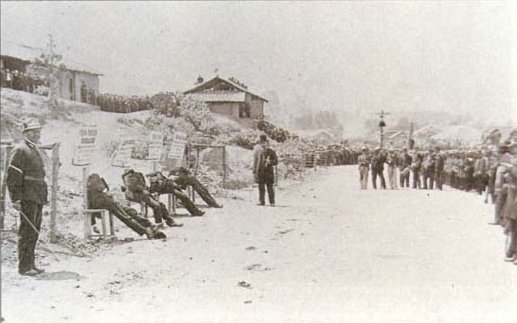
BOGOTA, Colombia, Tuesday, March 6. — The three men who on Feb. 10 attempted to assassinate Gen. Reyes, the President of the Republic of Colombia, were shot to-day at the spot where the attack took place.

-New York Times, March 8

Reyes had parlayed a successful military career into politics (Spanish link), and was the elected-ish but also dictatorial president of Colombia.

He had the misfortune to ascend to this illustrious post on the heels of a bitter civil war that had seen its Panama department break clean away. To Reyes’ administration would fall a variety of civil society infrastructure projects (more Spanish): constitutional reform, military modernization, a central bank, reconciliation with the Liberal party.

Marco Salgar (left) and Roberto Gonzalez, two of the failed assassins.

He couldn’t make these omelets without breaking a few eggs and his authoritarian power was challenged with at least two coup attempts and multiple assassination plots, as well as a bid by other Colombian territories to break away and join up with Panama.

But the most notorious angry-with-Reyes event was the 10th of February 1906 — also the title (Spanish again) of a book of photographs documenting the incident — when three gunmen ambushed Reyes on the outskirts of Bogota and somehow all managed to miss both the president and his daughter.

Reyes’ vengeance was extrajudicially old-school: the executions he arranged were not permitted under Colombian law at all, and by having them publicly shot at the scene of the crime, he added a downright medieval twist of lese-majeste.


Images from here. These are the three shooters mentioned by the Times, as well as a fourth accomplice.

However rough his methods, Reyes did accomplish some important reforms for his country, and he did have the grace to resign his position in 1909 under fire for financial and diplomatic mismangement. (The man’s five-year administration has its own periodization in Colombian historiography: the quinquenio.) There have been worse entries in the annals of dictatorship.

On this day..

1836: Giuseppe Fieschi, Pierre Morey, and Theodore Pepin, infernal machinists

On this date in 1836, three men were guillotined for a spectacular but unsuccessful regicide attempt.

Giuseppe Fieschi

This was in the days of the July Monarchy, a much-despised government of the country’s wealthiest elites that generated opposition both right and left and a ceaseless string of assassination attempts (French link) against King Louis-Philippe.* As Marx put it,

when the liberal banker Laffitte led his compère, the Duke of Orléans, in triumph to the Hôtel de Ville, he let fall the words: “From now on the bankers will rule”. Laffitte had betrayed the secret of the revolution.

It was not the French bourgeoisie that ruled under Louis Philippe, but one faction of it … the so-called financial aristocracy. It sat on the throne, it dictated laws in the Chambers, it distributed public offices, from cabinet portfolios to tobacco bureau posts.

Hard to imagine such a state of affairs.

Fieschi (English Wikipedia page | French) et al conceived a bold attempt to destroy the entire ruling family in a single fusillade, and to that end constructed a machine infernale of 25 gun barrels mounted together to fire on a single fuse.

Unleashed upon a royal procession along the Boulevard du Temple on the fifth anniversary of the monarchy’s founding July days, this monster proved quite impressively destructive.


The assassination attempt of Fieschi, 28 July 1835 by Eugene Lami.

The infernale barrage took out an esteemed marshal and a bunch of bystanders, but somehow managed to miss everyone in the royal family. (Louis-Philippe himself was grazed … and his horse was hit.)

Exploiting the familiar power of a terrorist incident to enact horrible new policies not available in normal times, “Parliament was hastily recalled and in a near-panic atmosphere passed severe measures against the newspaper press,” notes William Fortescue. “Approximately thirty more republican newspapers were closed down by the September 1835 Press Laws.”

Police soon traced the conspiracy to Fieschi, a truly Gallic character of mixed-up national pride, personal honor, class envy, and opportunistic lechery, who had fought for Bonaparte and helped Joachim Murat on the latter’s fatal attempt to re-take “his” kingdom of Naples back in his youth. But lately, a more worn-out and middle-aged Fieschi had been booted out by his mistress and lost all his money.

Fieschi, according to Barricades: The War of the Streets in Revolutionary Paris, 1830-1848, basically became a dependent of Morey and Pepin, true-blue republicans who helped channel Fieschi’s unmoored passions into engineering his hydra-headed musket. He’d be back on the French-nationalism side by the end.

“I’m going to appear before God,” Fieschi said on the scaffold, after Morey and Pepin had preceded him. “I have spoken the truth. I die content. I have rendered a service to my country in signaling my accomplices … I regret my victims more than my life.”

More repressive laws and radical-hunting followed. They did not slake the thirst abroad in France for regicide.

* Louis-Philippe’s royal dad backed the French Revolution, but was still executed by Robespierre.

On this day..

1697: John Fenwick, bitter

The Franco-Dutch War of the 1670s lifted to power the young stadtholder William of Orange, and made him a couple of noteworthy lifelong enemies.

One was the Sun King, Louis XIV of France, whose decades-long rivalry with William tracked William’s interesting career all the way to the throne of England.

William III, equestrian. Consider yourself foreshadowed.

Another was Sir John Fenwick, an English nobleman whom William supposedly slagged* when they were fighting together in the Low Countries — and who likewise still carried the enmity when William had become his sovereign.

On this date in 1697, the latter rivalry came to a fatal end for John Fenwick on the headsman’s block. The funny thing was that the stroke turned out to cost King William III his own life as well.

You couldn’t say that Fenwick came late to the Jacobite cause; he’d been a strong adherent of the beleaguered Catholic-esque Stuart dynasty, and signed off on the 1685 execution of its previous Protestant challenger Monmouth.

But if it prosper, none dare call it treason. In 1688, the Low Countries prince with the low estimation of Baronet Fenwick hopped the channel and successfully overthrew the last Stuart monarchking James II.

With the Glorious Revolution, Fenwick’s personal and political were very conveniently aligned in loyalty to the exiled James … except that his formerly patriotic loyalty to James was now the traitorous cause of Jacobitism.

Fenwick kept up his Jacobiting in the 1690s, got arrested and released once, and then finally found himself implicated in a plot to murder William. Though his allies managed to spirit one of the potential witnesses against him away to the continent, Parliament passed — ever so narrowly — a bill of attainder to condemn Fenwick to death. (There’s a more detailed account of the legal and political maneuverings here and here.)

The State his Head did from his Body sever,
Because when living ’twas his chief Endeavour
To set the Nation and its Head together.

That’s politics. Even kings themselves are in mortal peril around here.

A failed assassin in life, Fenwick would blunder Gavrilo Princip-like into accidental success … but only after his own execution.

As a condemned traitor, Fenwick’s estate was seized by the crown, and the king personally claimed his prey’s equine ride (either a horse with a sorrel coat, or a horse named Sorrel, or both).** Not long after Fenwick’s death, this horse stumbled on a molehill, throwing its royal rider. William broke his collarbone in the accident, developed pneumonia, and died — leading Jacobite sympathizers to dote on the animals (both horse and mole) who had authored their enemy’s misfortune.

Illustrious steed, doubtless most worthy of the sky,
To whom the lion, bull, and bear would give place;
What happy meadows bore thee happily?
What happy mother gave you her nutritious teats?
Is it from the land of Erin you are come to oblige your country,
Or is it Glenco or the Fenwick race which produced you?
Whoever thou art, mayst thou prosper, I pray memorable one: and
May saddle never more press thy back, nor bit thy mouth.
Avenger of the human race, when the tyrant dies,
Mayst thou thyself enjoy the liberty thou wilt give to others.


A lovely sorrel enjoys the liberty of a happy meadow. (Nutritious teats not pictured.) (cc) image from SMALLORBIGOFMEN.

* During the Dutch campaign, William “had reflected very severely upon his [Fenwick’s] courage, which occasioned his making returns that provoked the Prince to say, that if he had been a private person he must have cut Sir John’s throat.” Just your basic primate poo-flinging.

** Leaving aside his ultimate fate, quite an understandable move by William: the Fenwicks were famous for their horse husbandry.

On this day..

1801: Chevalier, bomb plot scapegoat

On this date in 1801, a Jacobin chemist was wrongly executed for Royalists’ plot against Napoleon.

Our scene is France, the year following Napoleon’s coup of 18th Brumaire (November 9, 1799 on the stodgy old Gregorian calendar). Marx’s “first time as tragedy”* saw the Corsican achieve monarch-esque power, and the months ensuing saw a plethora of plots against him.

The ranks of aggrieved potential assassins included both Jacobins, incensed at the military dictatorship, and Bourbons, incensed that it wasn’t their dictatorship — in both cases exacerbated by Napoleon’s decisive battlefield triumphs which consolidated his hold on power.

On Christmas Eve 1800, the man on horseback was a man in a carriage, careening through Paris to catch a performance of Haydn’s oratorio The Creation.

When, all of a sudden, a gigantic explosion on the Rue Saint-Nicaise attempted to un-create the First Consul. It failed, exploding after Napoleon had passed and before Josephine’s family followed, “merely” killing and maiming fifty-some miscellaneous Parisian bystanders instead.


Kablamo! The explosion of the Infernal Machine.

The Catherine Delors historical novel For the King (author’s teaser) is built around investigating the Plot of the Rue Saint-Nicaise.

“Every one,” wrote Sir Walter Scott,

shocked with the wild atrocity of such a reckless plot, became, while they execrated the perpetrators, attached in proportion to the object of their cruelty. A disappointed conspiracy always adds strength to the government against which it is directed; and Buonaparte did not fail to push this advantage to the uttermost.

This “Infernal Machine” had actually been built by disgruntled monarchists at the instigation of intriguer Georges Cadoudal, as was swiftly discerned by Napoleon’s Minister of Police, the ruthless ex-revolutionary Joseph Fouche.

Realpolitik exigencies — Napoleon was trying (unsuccessfully) to reach political terms with the royalist faction — instead drove a rush to pin the detonation on the Jacobins.

Who, it should be said, made themselves the primary suspects by virtue of the fact that they’d also been trying to blow up Napoleon. Chevalier had been arrested a couple of months before when a bomb of his, evidently an experiment for a similar Jacobin plot, loudly blew up near Salpetriere.

Four other Jacobins followed Chevalier to death later in January (and two royalists actually involved in the bomb got the same treatment). Some 130 other prominent Jacobins (French link) were expelled on Napoleon’s say-so — no legislative consultation — to the empire’s far-flung colonies, pretty much putting the remains of the long-supine revolutionary left permanently out of the picture as a political force.

* See the 18th Brumaire; the “second time as farce” also came with its own history-repeating-itself executions.

On this day..

1989: Kehar Singh and Satwant Singh, assassins of Indira Gandhi

On this date in 1989, the last hangings at Delhi’s Tihar Jail dispatched two Sikhs for the assassination of Indira Gandhi.

Indira Gandhi (no relation to Mahatma Gandhi) was the daughter and political heir of Jawaharlal Nehru and one of the postwar world’s more remarkable political biographies.

Never averse to breaking a few eggs, Gandhi led her country (sometimes autocratically) for four terms from 1966 to 1984, sandwiched around a stint under a legal cloud for political corruption.

She backed East Pakistan’s breakaway from India’s neighbor and rival, but also negotiated a Kashmir settlement with her Pakistani opposite number; oversaw the Green Revolution; pushed ahead with a nuclear weapons program; maneuvered between American and Soviet foreign policy.

The omelet that cost her life was the June 1984 Operation Blue Star, when she had the Indian military storm a Sikh shrine that armed militants had turned into a virtual fortress, even using tanks and artillery in the shrine’s residential area.

Although the operation “worked,” hundreds — maybe a thousand or more — lost their lives and the shrine itself suffered heavy damage.

Sikhs were incensed — including, apparently, Beant Singh and Satwant Singh, two Sikh bodyguards of the Prime Minister who probably ought to have been reassigned. Maybe that’s just hindsight speaking, after they took the opportunity afforded by an escort assignment on Halloween 1984 to suddenly gun down their charge.

Beant Singh was shot down on the spot by other guards, but Satwant Singh was arrested.

He and Beant Singh’s uncle and alleged inciter Kehar Singh would later stand trial for their lives — but not before the assassination triggered an apparently government-blessed four-day anti-Sikh pogrom. The disturbing orchestration and four-figure body count of this infamous affair remain sensitive subjects on the subcontinent to this day, especially insofar as nobody has ever been punished for it.

The accused assassins were not so lucky — although they were more than content to accept martyrdom for avenging Operation Blue Star.

I have no hatred for any Hindu, Muslim, Christian, neither hatred for any religion. After my Shaheedi, let no Sikh throw any rock at any Hindu. I am not in favor of any retaliation or bloodshed over my Shaheedi. If we do create bloodshed, then there is no difference between us and Rajiv Gandhi. I am proud of the task that I did! I do ardas in front of Waheguru! If I am blessed with a human life, then give me a death of the brave when I am hanged. Forget one life, if I could I would give up a thousand lives to kill dushts like Indira Gandhi, and laugh as I become Shaheed by hanging.

Satwant Singh in court

The killers were then and are still held in high regard by many Sikhs. (Satwant’s fiancee even married his picture.)

Indira Gandhi’s son Rajiv Gandhi followed her as head of state — and followed her fate when he was assassinated by Tamil terrorists in 1991. The Nehru-Gandhi family remains a powerful force in Indian politics.

On this day..

1543: Andrei Shuisky, gone to the dogs

On December 29, 1543, Ivan the Terrible arrived — with the summary execution of hated boyar Andrei Shuisky (Shuysky).

Call it Ivan’s rite of passage.

The 13-year-old Ivan IV had technically “ruled” Russia since toddlerhood, when his father died suddenly in the prime of life.

But in reality, the “ruler” was not the master of his domain.

The powerful boyar nobles ran roughshod during his minority, scrapping for power, poisoning off his mother,* and behind the Kremlin’s closed doors overtly treating the kiddo’s regal person like a redheaded stepchild.

“What evil did I suffer at [the boyars’] hands!” Ivan later remembered of these years in his hostile correspondence with the exiled noble Kurbsky.

we and our brother … remained as orphans, [having lost] our parents and receiving no human care from any quarter; and hoping only for the mercy of God … our subjects had achieved their desire, namely, to have a kingdom without a ruler, then did they not deem us, their sovereigns, worthy of any loving care, but themselves ran after wealth and glory … they began to feed us as though we were foreigners or the most wretched menials. What sufferings did I endure through [lack of] clothing and through hunger! For in all things my will was not my own; everything was contrary to my will and unbefitting my tender years. (Source)

Ivan’s indomitable personality and mercilessness, later the stuff of legend, make their first appearance in these formative years. Biding his time, nurturing his hatred, he survived his humiliations and designed a show-stopping vengenace. “Then,” remembers Ivan, “did we take it upon ourselves to put our kingdom in order.”

In the span of a single feast on this date in 1543 the young prince elevated himself from abused orphan to feared sovereign when he unexpectedly accused the attending boyars of mismanagement and had the greatest man among them — Andrei, of the mighty Shuisky family, the de facto head of state** — arrested and brutally put to death.

(The most colorful versions of this have it that Shuisky was thrown to the dogs to be devoured; I’m inclined to suspect this is embroidery upon the chronicler’s report that it was mean little Ivan’s kennel-keepers who were the men tasked with arresting and beating to death the nobleman.)

Sergei Eisenstein dramatized the terrible tsar’s backstory of violently overturning his childhood abuse in part two of Ivan the Terrible. (Masterful review.)

With his terrible blow, Ivan — still only an (unusually warped) adolescent after all this time — freed his hands and truly began the strange and cruel reign that would earn him the awestruck sobriquet Grozny, “terrible”. He got the ball rolling by purging a couple dozen other Shuisky loyalists.

While Ivan Grozny had his way in his reign’s political conflicts with Russia’s nobility, the violent monarch also shockingly killed his own son during a fit of rage — effectively destroying his own lineage. In the Time of Troubles invited by the resulting power vacuum, Andrei Shuisky’s grandson briefly claimed the throne as Tsar Vasily IV.

Though this power grab didn’t work out any better than had his grandfather’s, Vasily was the last [legitimate] product of the Rurik dynasty† dignified as Tsar of Russia, before the Romanovs were elevated to that station.

* Allegedly. Ivan certainly thought so.

** Andrei’s brother Ivan, equally loathesome to the tsar, had passed on the Big Man in Russia mantle to Andrei when he died a couple of years before.

† The Shuiskies were merely a junior branch, but they were a branch.

On this day..

2010: Shahla Jahed, the footballer’s lover

At 5:00 a.m. this date last year, Shahla Jahed was hanged at Iran’s Evin prison for murdering the wife of Iranian footballer Nasser Mohammadkhani.

An international human rights cause celebre from the time of her 2004 conviction in a sordid televised trial, Jahed was also Mohammadkhani’s wife under a “temporary marriage” arrangement that was secret from his “real” wife Laleh Saharkhizan. So you might say, his mistress.

Both these women’s last day of liberty was the one in 2002 that Saharkhizan turned up knifed to death while Mohammadkhani was in Europe on soccer business. Jahed was arrested immediately, beginning a “taboo-breaking” legal odyssey.

After months of refusing to talk, she confessed to the murder in prison, even re-enacting the crime.

But by the time of her trial — in which an emotional, combative Jahed conducted her own defense — she very plausibly claimed that the confession had been extracted by torture. Here’s a bit of it, from the documentary Red Card (banned in Iran) that can be enjoyed in full on YouTube:

While Jahed herself made for can’t-look-away TV, the appearance of a onetime champion athlete in a feet-of-clay turn has led this affair to be compared to the O.J. Simpson murder case.

Like the Juice, Mohammadkhani was temporarily in some danger of death penalty charges himself; he spent several months in prison. Ultimately, he avoided jeopardy to his neck as a potential accessory or instigator by Jahed’s repudiated I-did-it-myself confession — possibly another reason why Jahed confessed in the first place — but the former striker did endure 74 lashes for the revelation that he and his temporary wife enjoyed chilling out with opium. Strictly verboten in Iran, of course.

And Mohammadkhani’s brush with the law scarred his honor even more than his backside. Beyond the possibility that she took the heat for him, the celebrity athlete potentially in a position to use his pull to save a woman’s life clammed up as her case progressed and deferred to his late wife’s family’s decision whether or not to give Jahed mercy. Reportedly, Mohammadkhani even attended the hanging — where Jahed again sobbed and begged for mercy until one of Saharkhizan’s relatives personally kicked the chair out from under Jahed’s feet.

The case itself had an unusually long lifespan in the judiciary; Jahed had been imprisoned well over eight years by the time she died. In 2008, the gears were even stopped by Ayatollah Hashemi Shahroudi, a figure known in Iran for his support of de-escalating capital punishment generally.

Shahroudi’s ordering a new investigation provided fodder for critics like Amnesty International who considered the trial unfair.

Iranian journalist Fereshteh Ghazi, who as a political prisoner in 2004 briefly shared a cell with our principal, made an even stronger critique.

Even if Shahla had committed the crime, which she didn’t, Shahla and the murdered wife are both victims of a male-dominated society, a system that gives all the rights to men. Shahla, Laleh [the murdered wife], and all other women like them are all victims of flaws in the Iranian judicial system and Iran’s unequal judicial system. Even the person who pulled away the chair today in her execution is a victim of the system.

Apropos of the women-in-the-judicial-system theme, Jahed’s case and even her execution were to some extent overshadowed by the simultaneous headline-grabbing matter of Sakineh Mohammadi Ashtiani, an Azeri woman who was at the time fighting a repugnant sentence of stoning for adultery. By December 2010, Iran had backed off the stoning bit without quite agreeing that Ashtiani wouldn’t be executed in some other way; in January 2011, it remitted Astiani’s death sentence altogether.

On this day..

1961: Four for the assassination of Rafael Trujillo

Fifty years ago today, four men were shot for the ajusticiamiento — “execution” — of longtime Dominican Republic dictator Rafael Trujillo.

El Jefe had run his half of Hispaniola for more than thirty years, mirroring his contemporary Stalin for creepy personality cult — giant signs reading “God and Trujillo”; the capital city renamed after him — and dictatorial ruthlessness. Except, of course, that Trujillo was violently anti-communist. He’s the very man for whom U.S. Secretary of State Cordell Hull coined the memorable (and endlessly recyclable) quip, “He may be a son-of-a-bitch, but he is our son-of-a-bitch.” The guy could even get away with disappearing people from New York City.

The Mario Vargas Llosa novel Feast of the Goat revolves around the Trujillo assassination.

But by the last decade of Trujillo’s reign, Dominicans were increasingly tired of his being their son-of-a-bitch.

An abortive 1959 invasion by Dominican exiles was defeated militarily but helped spawn the dissident 14th of June movement — which naturally met with state repression, most emblematically the 1960 murder of the Mirabal sisters. World opinion turned against Trujillo, and even Washington, chastened by the recent Cuban Revolution, feared that their son-of-a-bitch was becoming counterproductive.

So the CIA had actually collaborated with the plot against him hatched among other Dominican elites, providing guns, money, and its all-important blessing. “From a purely practical standpoint, it will be best for us … if the Dominicans put an end to Trujillo before he leaves this island,” the spy agency’s local station chief reported to his superiors late in 1960,

If I were a Dominican, which thank heaven I am not, I would favor destroying Trujillo as being the first necessary step in the salvation of my country and I would regard this, in fact, as my Christian duty. If you recall Dracula, you will remember it was necessary to drive a stake through his heart to prevent a continuation of his crimes. I believe sudden death would be more humane than the solution of the Nuncio who once told me he thought he should pray that Trujillo would have a long and lingering illness.

On May 30, 1961 (Spanish link), Trujillo’s car was ambushed on Avenida George Washington outside “Ciudad Trujillo” by members of his own armed forces, and riddled with gunfire. When the bullets stopped flying, Rafael Trujillo’s body was a bloody heap on the asphalt. Today, the spot is marked by a memorial plaque — commemorating not Trujillo, but the men who killed him.

That did for the dictator, but the larger aspiration of regime change experienced a little blowback.

Rather than a new dawn of liberalism and human rights, Trujillo’s son Ramfis seized power and vengefully went after his father’s killers. The Dominican Republic became prey thereafter to that familiar cycle of military coups and unstable juntas, leading a few years later to outright American occupation.

But before Trujillo fils was pushed out of the job, he had six of the assassins hunted down: two were killed resisting capture, and the other four put to death by firing squad on this date — their remains allegedly thrown to the sharks (pdf) after their executions.

There’s a BBC interview from spring 2011 with a surviving co-conspirator, Gen. Antonio Imbert, here.

On this day..

1834: The bushrangers John Jenkins and Thomas Tattersdale

Cried Peter, where’s your certificate
Or if you have not one to show
Pray who in Heaven do you know?

Well I know Brave Donohue
Young Troy and Jenkins too
And many others whom floggers mangled
And lastly were by Jack Ketch strangled.

“A Convict’s Tour to Hell” by Australian prisoner Frank McNamara (1839)

On this date in 1834 was strangled the aforementioned Jenkins — John, to his friends — alongside accomplice Thomas Tattersdale for one of 19th century Australia’s headline-grabbing crimes.*

Along with a third man who would turn state’s evidence to save his own neck, these convicts busted out of jail.

On the run in the bush, these fugitives came across the massive estate of Dr. Robert Wardell, a prominent public figure in early Australia. When this newspaper publisher, barrister, and land magnate personally bumped into the trio, he naturally urged the prisoners to give themselves up. Instead, John Jenkins shot Wardell dead.

These outlaws were definitely not of the gentleman variety.

Tattersdale, a non-triggerman who had actually tried to talk Jenkins out of killing Wardell in the first place, sported a suitably Dostoyevskyan appreciation of his own guilt, and basically just asked the court for a few days to prepare his soul. Jenkins made the trial a three-ring circus with his profane attacks on the court, and his bodily attack on his fellow-defendant when he learned that Tattersdale had offered to testify for the crown. (Tattersdale weepily made up with an irritated Jenkins at the time of their hanging, which was only three days after they were condemned.)

Tattersdale’s lamblike submission just got him written out of the ballads; even the newsmen covering the hanging itself “did not much regard” him.

Jenkins, by contrast, stole the show “with that vulgar attempt at bravado courage which distinguishes men of his class.” He’d been joking about his hanging since the trial, and he played cocksure right up to the time they dropped the trap on him — including a distinctly unauthorized last comment on his life and crime.

Well, good bye my lads, I have not time to say much to you. I acknowledge I shot the Doctor, but it was not for gain, it was for the sake of my fellow prisoners because he was a tyrant and I have one thing to recommend you as a friend, if any of you take the bush, about every bloody tyrant you come across, and there are several now in the yard who ought to be served so.

* An unrelated criminal named McCormick died with them, for murdering his wife.

On this day..