1680: La Voisin, poisoner to the stars

On this date in 1680, Catherine Monvoisin was burned at the stake in the Place de Greve, a casualty of the “Poison Affair”.

The Poison Affair was rooted in a spate of (suspected) poisonings in France during the later part of the 17th Century. In 1670, the Duchasse d’Orleans, nee Princess Henrietta Anne Stuart the daughter of deposed and executed King Charles I of England, died suddenly. Some years before, the Duchasse, a great friend, and possibly lover, of her brother-in-law King Louis XIV, had convinced the king to exile her husband’s paramour, her rival for power. Although the results of an autopsy suggested that the duchasse died from an infection resulting from a perforated ulcer, popular opinion held that she had been poisoned by her husband’s exiled lover. Five years later, Marie-Madeleine-Marguerite d’Abray, Marquise de Brinvilliers, was executed for the murder of her father, brother and two sisters by poisoning (to gain control of their inheritances). These high-profiled murders, coupled with several other mysterious deaths at the time, heightened the aristocracy’s already considerable fear of poisoning.

In response to the aristocracy’s rising fear, Louis XIV instructed his chief of police to identify poisoners and neutralize the threat they posed. Accordingly, in 1679, a commission was established. The commission promptly began investigating, and arresting, fortune tellers, alchemists, and other purveyors of potions and powders. The police chief also re-established the Chambre Ardente (“burning court”) to try alleged witches and poisoners.

The most famous prisoner tried and convicted by the Chambre Ardente was Catherine Monvoisin. Known as La Voisin, she took up fortune telling, potion-making and midwifery when it became clear that her husband would not make a living in his chosen profession. Unlike her husband’s, her business thrived. Well-positioned women of the aristocracy flocked to her, seeking potions to secure the love of powerful men or to eliminate rivals (one such target of her craft was Louise de la Valliere, then-mistress of Louis XIV).

During the Poison Affair, La Voisin was named as a witch and a poisoner and sentenced to death. Before she died, however, she named many members of the aristocracy who had used her services. They clients she implicated included the king’s mistress Francoise-Athenais, the Marquise de Montespan, whom La Voisin said purchased aphrodisiacs and performed black masses with her to gain the king’s favor, and Francois Henri de Montmercy-Bouteville, the duc de Luxembourg. Although there was no evidence to corroborate La Voisin’s stories, her confession ruined the reputations of the people she named.

The Chambre Ardente was disbanded in 1682 under the weight of the growing scandal, as it began to involve more and more members of the aristocracy.

On this day..

1803: Edward Marcus Despard, a patriot without a nation

On this date in 1803, during an era ruled by an Empire’s rough assertion of security against instability abroad, Britain hung its liberal-minded former governor of Belize — along with six others — for treason.

Book CoverThis ought-to-be-memorable occasion lies half-lost in time’s shifting sands, retrieved in part only by the oddity of being the last sentence of drawing and quartering handed down in Britain. (The sentence was moderated to simple hanging and posthumous beheading.)

But there was much more to be said about Despard than his sentence. Today, Executed Today is pleased to feature Col. Edward Marcus Despard as remembered by his biographer, Mike Jay.

Guest-posted here with permission is the prologue to his The Unfortunate Colonel Despard. (A chapter on Despard’s remarkable marriage to a black woman is also available on MikeJay.net.) Following the prologue is an Executed Today interview with the author.


The day Colonel Edward Marcus Despard was executed was one of the most dramatic, and strangely forgotten, in British history. In this, as in much else, his death mirrored his life.

He was to be publicly hung, drawn and quartered for high treason, a punishment which had barely been carried out in London within living memory. Its most vivid associations were still with the Jacobite rebellions over fifty years before: the days when the British state’s greatest fear had been that a Catholic monarch might seize the throne. Those days were now long gone and, many thought, the old ceremony with them; Despard, as it turned out, would be the last person on whom the sentence would ever be passed. As specified by the Lord Chief Justice, the Colonel and his six confederates were ‘to be drawn on a hurdle to the place of execution, there to be hanged by the neck, but not until you are quite dead, then to be cut down and your bowels taken out and cast into the fire before your faces; your heads to be taken off and your bodies quartered’.

Intimations of the drama had already begun to transform the city the day before: Sunday 20 February 1803. At first light, carpenters had begun to assemble scaffold and gallows, large enough to accommodate the seven men, on the roof of Surrey County Jail in Horsemonger Lane, just south of the Thames in Southwark. The jail was a plain barracks-style building, recently constructed to replace the old prison which had been torn down in the Gordon Riots some twenty years before. The roof had been built flat for precisely this purpose, and this was the first occasion for its use. The main gates of the jail opened to admit seven plain wooden coffins.

According to contemporary witnesses, even as the preparations began, ‘vast multitudes of people immediately began to assemble’. It was noted that the throng consisted ‘chiefly of the lowest of the vulgar’, but that, unusually for a public execution, ‘a considerable number of persons of genteel appearance were observable’. The forces of law and order, too, were out in unprecedented force. Every single member of the Bow Street police patrol, the other London patrols at Queen Street, Marlborough Street and Hatton Gardens, and a ‘numerous tribe’ of petty constables from the outlying London boroughs, were placed on duty. The jail and its surrounds were emphatically staked out, surrounded by a cordon two officers deep. All ‘the public houses and other places of resort for the disaffected’ bristled with police. A detachment of mounted Horse-Guard cavalry clopped into Horsemonger Lane; all the infantry regiments in the city, at the Tower of London and Knightsbridge Barracks, were placed on the highest alert. The head keeper of the jail was issued with six sky rockets, each containing a pound of explosives, ‘to be let off as a signal to the military, in case of any disturbance’. London’s entire martial forces were instructed not to leave their posts until the danger was past.

The impending execution had dominated the news all week. The Times had led its news pages with testy dismissals of the rumours which were spreading around the city: that Despard and his confederates were being cruelly chained together, that they were being tortured for their confessions, that a last-minute reprieve was in the air. It was beginning to dawn on the authorities that the graphic medieval ritual they had scheduled might be counterproductive, inflammatory and unpredictably dangerous. The Police Magistrate of Southwark had expressed grave concerns, pointing out that the question which had been on the common people’s lips during the week was ‘When are these poor men to be murdered?’. It had been hard, apparently, even to find labourers prepared to erect the scaffold. When the warrant for the execution was issued on the morning of 20 February, it became clear that these anxieties had led to a change in the sentence. Exercising their statutory discretion, the magistrates announced: ‘we have thought fit to remit part of the sentence, viz. the taking out and burning their bowels before their faces, and dividing the body severally into four parts’. Despard would now be drawn –- to the place of execution on a carriage without wheels –- hung until dead, and then beheaded. The Observer commented with relief that ‘the cutting out of the heart of the malefactor, quartering &c is very humanely and properly to be dispensed with’.

On the day of the execution, 21 February 1803, the pace quickened long before dawn. ‘A vast number of police officers’ were soon massively outnumbered by the spectators streaming through the bitter cold and darkness. Southwark was a hard area to police at the best of times, a hinterland to the city of London proper dominated by the unedifying activities which were prohibited across the Thames. A warren of timber shacks among the marshy waste ground and garbage landfills, it had long been a teeming red light district; in recent times it had become dominated by malodorous and insanitary industries — distilleries, tanneries and vinegar mills — which were forced south of the river by City of London edicts. It also had a long history of insurrection. In 1381, Wat Tyler had led the Peasant’s Revolt through the same streets; in 1450, Jack Cade had set up camp here with his Kentish rebel army. Despard’s sentence of high treason had more powerful resonances with this period than it did with the freshly-minted nineteenth century. Most of the crowd had never seen a treason execution; now, jostling to witness one, they were passing shops selling roller-skates, umbrellas, toothbrushes, matches, alarm clocks, condoms, Twining’s Tea and Pears’ Soap. Part of the appeal of the spectacle must have been this lurid collision of the old and the new; part, also, the uncertainty on all sides as to whether the crowd had really assembled only to stand and watch. It was widely rumoured that the execution would not take place as scheduled — or, if it did, that the main event would turn out to be an entirely unscheduled one. The people of London had rioted countless times over much less — and, given the nature of Despard’s alleged crime, there were an unknown number among the crowd who might attempt to turn a riot into a full-scale revolution.

The character of execution crowds seems, as with most crowds, to have been largely in the eye of the beholder. For many, they were simply the scum of society: crude, vulgar, leering, gawping, sadistic. For others, though, they were the salt of the earth, good men and true come to witness and legitimise the exercise of state power. Despite the rough spectacle that they presented, they were often visibly civic-minded: rescuing stranded children, or crying ‘shame’ if one of their number insulted a woman. The beholder’s view of such crowds tended to reflect their attitude to public execution itself, as the most graphic and visceral demonstration of the ultimate power of the state. There were many who were already campaigning for its abolition on the grounds, as one put it, that ‘the real effect of these scenes is to torture the compassionate and harden the obdurate’. There were many more, though, who thronged to such occasions in high spirits. Their hilarity and ribaldry –- the proverbial ‘gallows humour’ – may have been heartless mockery, but it may also have been a response to the unspoken but unmissable tension between the pomp and solemnity of the occasion and ghastly reality of the act.

This tension reached its high water mark with Despard’s execution. There had been a long observed trend in Britain towards public disrespect at hangings: the victim cheered, the executioner and officials booed and mocked. But the crime of high treason placed an unprecedented focus on the legitimacy of the act a focus sharpened still further by the fact that the majority of the onlookers believed Despard to be innocent of it. He had been accused and convicted of a shocking, cold-blooded plot to overthrow the state, an accusation which he had consistently and calmly denied. Now, at the moment of the state’s cold-blooded retribution, he had a final chance to speak the case for his defence. Part of the unique appeal of executions was always that the victims, in the moments before their death, might say anything; it was often the only time that the unspeakable could be spoken in public. But if Despard chose to speak the unspeakable, it would be more than a howl of rage, a fruity obscenity or a cheeky quip. The danger he posed might yet be far from over.

The bell of St.George’s Church began tolling at five, and continued for about an hour. By the time it finished, every conceivable vantage point was packed solid. It was estimated that there were twenty thousand people jammed into the carriageway of Horsemonger Lane and spilling onto every nearby roof and patch of open ground ‘that afforded the least prospect’. It was evident, too, that this was no ordinary gallows crowd, just as it was no ordinary hanging. The packed observers were almost completely silent: ‘no tumult, no disorder appeared among the multitude … all was stillness and expectation of the approaching event’. For the massed guards and officers, this must have been considerably more unnerving than the unruly mob which they had feared. It might be an expression of uncertainty, of a crowd unsure of the tone of the event, and too diffident to break the silence. But it could equally, and perhaps more plausibly, be read as a mute but chilling sign of pre-arranged intent.

Inside Surrey County Jail, as the prison bell struck seven, Despard was invited into the chapel for a service of last rites. He politely refused the invitation, and remained in his cell. At seven thirty, his arms were bound with ropes and he was led out into the walled and enclosed prison yard. He was still a colonel, and still entitled to wear the uniform of his rank, but he appeared instead in his favourite dark greatcoat and boots, bare-headed, without wig or powder. His solicitor was waiting for him outside his cell and, manoeuvering around his ropes, he shook hands with him ‘very cordially’.

Awaiting Despard in the prison yard was a very strange sight indeed. Two horses were harnessed to a small cart which contained two trusses of clean straw, and whose floor rested directly on the ground. Behind the cart stood the Sheriff of Surrey; behind him a fully-robed priest, and behind the priest the head keeper of the jail, Mr.Ives, solemnly holding a white wand. Behind Ives stood a line of high constables, and behind them a line of duty policemen. Bringing up the rear was the executioner, holding up a drawn sword.

The quartering and dismembering had been waived, but there had never been an execution for high treason without the victim first being drawn through the streets to the scaffold. It was integral to the ceremony, but today it was out of the question. The ritual was intended to allow the people to vent their feelings towards the traitor, to abuse him and spit on him; today, though, no-one was minded to test how the ominously silent crowd outside would react if Despard was paraded among them. Apart from anything else, the packed streets made it logistically impossible. It had hastily been decided to switch the ritual to the privacy of the prison yard.

Outside the yard, the traditional gallows humour may have been conspicuously absent, but Despard himself was unable to keep a straight face at the display of furtive pomp that confronted him. ‘Ha! ha!’, he laughed, ‘what nonsensical mummery is this?’ The solemn procession was not programmed to respond. Despard was ushered into the cart, seated backwards on the straw bales and, as the dawn spread grey over the prison walls, bumped around the cobbled yard until it was deemed that the drawing had been completed. There was to be no thwarting of justice, but neither would the ancient ritual of drawing a traitor survive that morning’s embarrassment and ridicule. Despard, though powerless against it, had nevertheless passed a sentence of death on the sentence itself.

(Click to continue reading on page 2).

On this day..

1587: Mary, Queen of Scots

(Thanks to Melisende at Women of History and Historic Biography for the guest post -ed.)

A Death:

Shrewsbury: ” … Madam you must die, you must die!…”

The executioner held up the severed head of the Queen of Scots for all to see — but horror as the hair separated from the head, and the head dropped to the floor. There was a stunned silence from the spectators — the Queen, once considered the most beautiful woman of her time, had lost her hair and vanity dictated the wearing of a wig.

The Dean of Peterborough stood over the corpse of the dead Queen and uttered the words all longed to hear: “So perish all the Queen’s enemies”.

The body of the dead Queen was stripped, in readiness to be received by the embalmers — but the dead Queen’s corpse held yet another surprise. Concealed within her skirts was a small terrier, which positioned itself betwixt the severed head and the body, and nothing could move it. It alone remained loyal to the Queen.

But the indignity of the execution of the Queen of Scots was not over. The execution block, her clothing and any other object which could be considered a relic was burned at Fotheringhay, which was in lock down.

It was not until approximately four in the afternoon that the Queen of Scots’ body was prepared for burial — but not the burial one would associate with a monarch. No — the Queen’s lead coffin was walled up within the precincts of Fotheringhay Castle. It was not until her son succeeded as James I of England, that the Queen was accorded a suitable and more Christian burial at Westminster Abbey.

A Life:

Mary was born 8 December 1542 at Linlithgow, Scotland, the daughter of James V of Scotland (d. 1542) and Mary of Guise (d. 1560). From the day of her birth, Mary was betrothed to the future Edward VI of England — the vetoing of this marriage led to war with England.

In the ensuing conflict, the Scots were defeated at Pinkie (10 September 1547) by forces of the Duke of Somerset. A French alliance was decided upon. Mary was sent to the French court aged 5 (1548), where she received a Catholic upbringing under her Guise uncles. Mary married the Dauphin Francis at Paris, France (24 April 1558). Her husband succeeded to the French throne as King Francis II (1559).

Mary became Queen of France but shortly after, Francis died (1560/1561). Mary was returned to Scotland (1561), and upon her arrival promptly proclaimed herself rightful Queen of England as the granddaughter of Henry VIII’s sister, Margaret Tudor.

However, during her absence, things had changed in Scotland, and Mary had to adapt to the anti-monarchical, anti-Catholic, anti-French elements that now dominated Scotland. Then Mary embarked upon an ill-considered marriage to her cousin Henry Stuart, Lord Darnley (29 July 1565) at Edinburgh, Scotland. Mary soon gave birth to a son, James VI (of Scotland) & I (of England) (1566).

The following year Mary was caught up in the scandal surrounding the murders of her Secretary David Riccio and her husband, Darnley (1567). From then on, Mary made mistake upon mistake. Soon after both deaths, Mary made a scandalous third marriage to James Hepburn, 4th Earl Bothwell (1567), who just happened to have been recently acquitted of Darnley’s murder. Mary claimed that this marriage was made under duress — but none were convinced. There was an immediate uprising of Scottish lords which resulted in military defeat for Mary at Carberry Hill and Langside (1568).

Mary fled Scotland for England and threw herself on the mercy of Elizabeth I, who kept her imprisoned in various strongholds. Following numerous intrigues to rescue her and place her on the throne of England, Mary was placed on trial (Oct. 1586). She was found guilty of treason and sentenced to death (25 October 1586).

After delaying for as long as possible, Elizabeth reluctantly signed Mary’s death warrant (1 February 1587) and Mary was executed at Fotheringhay (8 February 1587).

A Question of Legality:

Was the execution of a monarch of one country by a monarch of another lawful?

Mary was initially brought to trial under the English Act of Association (1585) — which in the eyes of the English made Mary just as guilty as those who conspired against the Queen of England, either with or without her knowledge. Guilt by association — a phrase I am sure we have all heard of.

Mary herself said: ” … as Queen and Sovereign, I am aware of no fault or offence for which I have to render account to anyone …”

In fact, just how was it legal for a Queen of a foreign country to be tried for treason by a Queen whose subject she was not; in fact, how could one then execute this foreign sovereign?

The sovereignty of any monarch, at this period in time, was taken with all solemnity. Elizabeth I herself was fully aware of the implications — if Mary could be treated and punished like an ordinary subject, then what could Elizabeth herself expect should she venture beyond the English Channel? In fact, Mary could only be judged by her peers — and to this end, only Elizabeth filled this position — not the privy councilors or nobility.

The English jurists pondered over this question — if Mary committed treason, she should have been expelled from English soil. But in the end, the legal minds of England came up with a suitable solution. King Henry VIII claimed suzerainty over Scotland; thus, Mary was a subject of the English Queen and could be tried (and executed) for treason under English law.

As author Antonia Fraser wrote: “In the case of the trial of Mary Queen of Scots the traditional blindfold across the eyes of Justice was ruthlessly torn aside by English commissioners so that the desired verdict might be reached.”

(© Melisende ~~~ 1998 & 2008)

On this day..

1649: Charles I

On this date in 1649, the struggle between parliament and crown cost the Stuart monarch Charles I his head.

Charles‘ political clumsiness and unreconstructed authoritarianism had seen the realm whose unitary sovereignty he insisted upon blunder from disaster to disaster: into bankruptcy, military defeat, religious conflict and the English Civil War.

The assignation of cause and consequence in that war’s genesis has much exercised historians.

What is beyond dispute is that the confrontation between monarch and subject, pitting against each other political and economic epochs, theories of state and power, rates as one of history’s most captivating courtroom dramas.

Charles refused to answer the court’s charge of treason, occasioned most particularly by the king’s fomenting the Second Civil War while already a defeated prisoner of parliament following the first Civil War. He rested firmly on royal prerogatives against what some interlocutors take to be an almost desperate plea by his judges for some hint of acknowledgment that could open the door to compromise:

[A] King cannot be tried by any superior jurisdiction on earth. But it is not my case alone — it is the freedom and the liberty of the people of England. And do you pretend what you will, I stand more for their liberties — for if the power without law may make laws, may alter the fundamental laws of the kingdom, I do not know what subject he is in England that can be sure of his life or anything that he calls his own. Therefore, when that I came here I did expect particular reasons to know by what law, what authority, you did proceed against me here.

It must be borne in mind that the trial of a king was a completely unprecedented event. Charles might be forgiven his attitude, even if it smacked of the impolitic high-handedness that had forced this deadly test of powers.

Parliament’s position — here in the words of its President — is distinctly in the stream of political discourse (if not always actual practice) ascendant in the West to this day.

Sir, as the law is your superior, so truly, sir, there is something that is superior to the law and that is indeed the parent or author of the law — and that is the people of England.

And therefore, sir, for this breach of trust when you are called to account, you are called to account by your superiors — “when a king is summoned to judgment by the people, the lesser is summoned by the greater.”

The modern and the medieval, facing each other at the bar.


A fragment from a World War II bomb-damaged and only-recently-rediscovered Hippolyte Delaroche painting situating Charles in the Christlike pose of enduring the mockery of his captors.

Charles played his lordly disdain to the end, refusing to admit parliament’s jurisdiction by making any sort of plea.

The line between heroic defiance and pig-headed obstinacy being very much in the eye of the beholder, the confrontation is typically played straight-up for its arresting clash of principles — as in the 1970 biopic Cromwell, with Alec Guinness as the monarch:Probably more troubling for the parliamentary party than the regicide taboo was consideration that the execution would transfer royalist loyalties from a man safely imprisoned to an heir beyond their power, who could be expected to (as in fact he did) resume the civil war.

Competing philosophies expounded for the competing interests; the dispute involved the era’s intellectual titans, in conflict over the most fundamental concepts of the state. Thomas Hobbes wrote his magnum opus The Leviathan as a royalist exile in Paris, and its abhorrence for rebellion and divided sovereignty unmistakably reflects the English Civil War experience. John Milton earned his bread as a republican polemicist; his poetic celebration of Satan’s failed rebellion in Paradise Lost, written after the Stuart restoration, can be read as a political critique.

Separated at the block? Charles I and Hobbes’ Leviathan

It’s conventionally thought that the beheading was conducted by a radical minority, though that supposition is debatable, colored as it is by the ultimate restoration of the crown. But although England would have a king again, the weight of political authority would steadily, permanently, gravitate towards parliament, organ of the merchant classes who would steer England henceforward.

Did it have the right? Two implacable powers each claimed an indivisible object; “between equal rights, force decides.” So on this cold winter’s afternoon — Charles wore thick undergarments, so he would not shiver with the appearance of fright — the deposed king was marched to a scaffold erected at Whitehall. He gave a short final address, with the famous words for his principle of martyrdom — “a sovereign and a subject are clean different things” — then laid his head on a low block, where a masked executioner (never definitively identified) cleanly chopped it off.

After the monarchy’s restoration, Charles was canonized as a saint by the Church of England: he’s still the last person so venerated, an odd salute to a mortal career of unalloyed arrogance and incompetence. Observance of the cult was toned down in the 19th century, although a Society of King Charles the Martyr dedicated to its preservation still exists; monarchists of a more secular inclination also continue to mark his martyrdom on this anniversary.

Less reverent by far was Monty Python’s homage:

“The most interesting thing about King Charles the First is that he was five foot six inches tall at the start of his reign, but only four foot eight inches tall at the end of it.”

Part of the Themed Set: The English Reformation.

On this day..

2007: Iwuchukwu Amara Tochi, “the burden thus shifted to him”

(Thanks to Tim Goodwin at Asia Death Penalty for the guest post -ed.)

On this day one year ago, a promising young Nigerian soccer player was taken from his cell in Singapore’s Changi Prison. It was dawn on a Friday morning, execution time in a country that has come to be known for its uncompromising use of the death penalty.

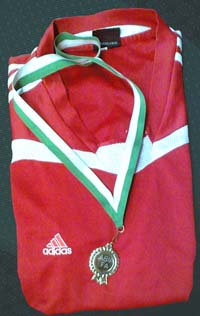
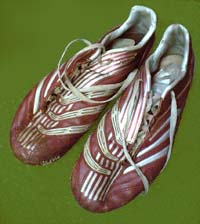
Tochi, and his football kit. (Source)

Iwuchukwu Amara Tochi, 21, and his co-accused Okele Nelson Malachy, 35, were hanged one after the other in the prison’s death chamber. Tochi’s lawyers had been informed he would die that morning, but it had not been announced that Malachy would also hang.

Later that day the Central Narcotics Bureau (CNB), Singapore’s “primary drug enforcement agency”, issued a 138 word statement. With the terse formality that is common to statements by Singapore’s criminal justice authorities, it noted:

The appeals of both Tochi and Malachy to the Court of Appeal and to the President for clemency have been turned down. Their sentences were carried out this morning at Changi Prison.

Tochi was arrested at Changi Airport on 28 November 2004, in possession of 100 capsules of diamorphine, or 727.02g of high grade heroin, which the CNB claimed was worth “about $1.5 million”. He said in a later interview [.doc] that he had arrived in the country expecting to be met by an African man named Mr Marshall. He did not have enough money to clear immigration, and an airport hotel called the police when he attempted to take a room. Malachy was identified as his contact after flying in from Indonesia, although he strenuously denied any connection with the drugs.

Tochi claimed he was carrying the package for a man named Mr Smith, who had befriended him at Sunday services at St Andrew’s Church in Islamabad, Pakistan. He had become stranded in Pakistan while attempting to travel to Dubai, where he hoped to play soccer professionally. As a boy, he represented Nigeria in soccer tournaments, travelling to Senegal when he was 14 to play in a West African youth Championship.

According to Tochi, Mr Smith asked him to take a package of herbs to a sick friend in Singapore, saying he could then apply to play for Singapore soccer clubs. He agreed, and was given a ticket and $200 in cash.

Many sites on the web have quoted the trial judge’s acknowledgement that there was no proof that Tochi knew he was carrying heroin:

There was no direct evidence that he knew the capsules contained diamorphine. There was nothing to suggest that Smith had told him they contained diamorphine, or that he had found that out on his own.

The trial judge was clearly doubtful of Tochi’s knowledge. Nevertheless, he found the defendant had “wilfully turned a blind eye on the contents of the capsules because he was tempted” by what police claimed was an offer of US$2000 in payment.

But the prosecution didn’t have to prove Tochi knew; it was up to him to prove that he didn’t know what was in the capsules. If he couldn’t prove his ignorance of that fact — a challenging philosophical notion in itself — then the law would presume he knew, and therefore convict him of drug trafficking. Under section 18(2) of Singapore’s Misuse of Drugs Act:

Any person who is proved or presumed to have had a controlled drug in his possession shall, until the contrary is proved, be presumed to have known the nature of that drug.

The Misuse of Drugs Act reverses many principles that are taken as central to a fair trial, including the burden of proof and the idea that a court should consider the facts of the case before deciding a penalty.

Amnesty International reports that the Act contains a series of presumptions that:

shift the burden of proof from the prosecution to the accused. This conflicts with the universally guaranteed right to be presumed innocent until proven guilty. Amnesty International is gravely concerned that such presumptions erode the right to a fair trial, increasing the risk that an innocent person may be executed…

The Act applies a mandatory death penalty for a wide range of drug offences, including for importing more than 15 grams of diamorphine or pure heroin.

Possession of relatively small amounts of drugs — by the standards of many countries — is classed as “trafficking” in that drug. Trafficking in that drug carries a mandatory death penalty. Courts have no power to consider the individual circumstances of the case.

Famously described as “Disneyland with the death penalty” by novelist William Gibson, Singapore brings together a record of social order and strict political control, and an unwavering use of the death penalty, particularly for drug-related offences. (Such as a similar recent case profiled here -ed.)

No surprises then that Tochi was convicted of drug trafficking and sentenced to death in December 2005. His appeal was rejected in March 2006, with the judge pausing only to note that the accused had to prove he didn’t know what was in the bag:

Under s 18(2) of the Act, the first appellant was presumed to know the nature of the drugs in his possession. The burden thus shifted to him to persuade the court on a balance of probabilities that he did not know that he was carrying drugs or that what he was carrying were drugs.

The appeal court judge acknowledged Tochi’s claim that he didn’t know, but agreed that he hadn’t proven his ignorance.

Seven months before Tochi’s execution, his brother Uzonna told a reporter from IPS News he had not told their parents that their son, who once supported the family, was now on death row.

“My poor parents will die if they hear that a child who has worked so hard to sustain them is facing a death sentence,” he said.

Tochi was hanged in the face of widespread international protest: legal efforts and a presidential appeal in Nigeria, urgent global appeals from Amnesty International activists, intervention from a United Nations human rights expert, and discreet but unequivocal opposition from a small group of human rights activists within Singapore itself.

Reflecting the colonial origins of the country’s modern death penalty, Tochi was “hanged by the neck till he [was] dead”, in the words of Singapore’s Criminal Procedure Code. The same British legal phrase was taken with the empire to, among other countries, the United States, India, Pakistan, Brunei and Malaysia.

Mr Smith has not been found.

On this day..

1793: Louis XVI

On this date in 1793, citizen Louis Capet — King Louis XVI, before the French Revolution — heard a morning mass, then took a closed carriage with his confessor two hours through the city to the Place de la Révolution, where the guillotine struck off his head.

Among the august company of executed monarchs, none command more historical portent in the West than Louis XVI. He overawes the confines of a blog post, less due to any merit of his own — for its conspicuous want during his kingship had seen him to this day’s straits — than for his baggage of symbolism.


Louis XVI’s head displayed to the crowd. In the right background stands a pedestal that, until the Revolution, upheld an equestrian statue of the beheaded man’s father grandfather, Louis XV.

The French Revolution rates, arguably, as little less than the forge of modernity: this day’s stroke, the Revolution’s signature event, could be said with melodrama but not injustice to have separated the era we still inhabit from that of the ancien regime as surely as it separated a head from its shoulders.

How did it come to happen? Let us turn our focus a few days back, when the question of the king’s fate was put to the newly formed National Convention.

Among the least of the Bourbon legacies is a legend holding it was by a single vote the king was condemned, an object lesson in the reputed power of the ballot.

It would be a great story … if it were true.

But it’s false on two different and equally important planes: first, the plain allegation that Louis really died by a one-vote difference; and second, the upshot that the individual votes were therefore historically decisive.

To begin with the mathematics: 721 delegates cast votes on the former king’s fate, making 361 the simple majority. It happened that exactly 361 voted for the death penalty without reservation, and this is the source of the claim that a one-vote margin decided the matter.

But there were other votes than aye or nay: every member voted one by one, many with short speeches into the bargain — a roll call lasting nearly a full 24 hours. Twenty-six more had voted for death but suggested a further appeal to the people. That curlicue, which had already been rejected, did not alter their ballot, so the vote is more properly reported 387-334, and often is. (Still others voted for death subject to various conditions; Adolphe Thiers gives a full ledger of the votes.)

More important than the tally was the overall context. There is something touching about the idea that a king was killed by some orderly parliamentary channel as readily as a school bond might be.

In fact, the freshly-constituted National Convention, spinning ad hoc rules for the treatment of its royal prisoner all along, was an arena for savage power struggles likewise contested at arms throughout the country. Louis’ death was the blow struck by the Convention’s radical Mountain — Robespierre* and Marat‘s base — against the divided opposition of the Gironde.

And the Mountain had the upper hand. It forced a public vote, and mobilized its mobs and militias in Paris. Just four months removed from an orgy of slaughter in the Paris prisons, these cutthroats prowled the byways outside and inside the Convention, noticeably armed, marking the delegates who resisted their will.

Louis Madelin:

One of the regicides, La Revelliere, says, “I must acknowledge that it involved more courage, at that particular moment, to absolve than to condemn.” The Clubs, the Sections, the Commune, were all in full cry. Barere had decided that the members’ names were to be called out as they voted at the rostrum, thus the spectators in the galleries would be able to mark the “pure and the impure.” Buzot, Gensonne, and Kersaint all made complaints to the Chamber of the manoeuvres practised by the Commune. The “assassins of September” were swarming in the Tuileries. A delegate from the department of the Loire-Inferieure, Sotin, writes on the 8th [of January] that the Assembly is “about to vote at the dagger’s point.”

As occurs in history more often than one might care to admit, the dagger’s point struck its target: the situation compelled a vote for death even from some delegates who had vowed they would stand with the king, and the taint of regicide irrevocably committed many to a path more radical than they might have chosen in the course of ordinary logrolling — or too defenselessness in the path of the Convention’s subsequent purges. As one wrote in a personal letter, “The roads are broken up behind us: we must go forward now whether we will or not, and at this moment we may truly choose to live in freedom or die!”

Regardless, it was not the balance of ballots but the balance of force in Paris as 1793 began that sealed the king’s demise: if not under the blade, it might have come about at pikestaffs. The votes cast by candlelight and the monumental blow of the guillotine this day merely ratified that underlying reality.

* Robespierre made a striking case for executing Louis rooted in his — Robespierre’s — opposition to the death penalty.

On this day..

1977: Gary Gilmore

On this date in 1977, Gary Gilmore uttered the last words “Let’s do it” and was shot by a five-person firing squad in Utah as the curtain raised on a “modern” death penalty era in the United States.

Famous for volunteering for death — he had nothing but disdain for his outside advocates and angrily prevented his own lawyers pursuing last-minute appeals — Gilmore rocketed through the justice system at a pace now unthinkable.

Mere days after courts blessed the resumption of executions in 1976, the career criminal — just paroled from a decade mostly behind bars in Oregon — murdered two people in the Provo, Utah, area. He was convicted in a three-day trial in October 1976 … and dead little more than three months later.

Owing to his milestone status and the unfamiliar public persona he cut insisting on his own death, Gilmore left a trail of cultural artifacts far surpassing his personal stature as small-time crook.

He was lampooned in an early episode of Saturday Night Live. His public desire to donate his eyes (the wish was granted) inspired a top-20 punk hit:

Norman Mailer wrote a book about Gilmore (The Executioner’s Song) and adapted it into an award-winning television movie. Gary’s brother Mikal published his own memoir (Shot in the Heart), later made into an HBO movie.

In a weirder vein, Gilmore is the touchstone for the surrealistic film Cremaster 2, in which magician Harry Houdini — who might have been Gilmore’s grandfather — is portrayed by Norman Mailer.

Gary Gilmore’s was the first execution of any kind in the United States since June 2, 1967. According to the Espy file, it was also the first firing squad execution since James Rodgers was shot in Utah March 30, 1960; only one of the other 1,098 men and women put to death since Gilmore — John Taylor in 1996, also in Utah — faced a firing squad. (Update: After this post was published, another Utah condemned man also opted for a firing squad execution: Ronnie Lee Gardner, shot in 2010.)

Both Gilmore and Taylor chose to be shot in preference to hanging. The firing squad is all but extinct in the U.S., though it still remains on the books in some form in Idaho, Oklahoma and (for prisoners convicted before 2004) Utah.

Part of the Themed Set: The Spectacle of Private Execution in America.

On this day..

1951: Albert Guay

On this date in 1951, Albert Guay was hanged in Canada for one of the earliest commercial airline attacks — bombing a Canadian Pacific Airline flight to murder his wife.

Stuck in a loveless marriage with little recourse to divorce, Guay‘s loins burned for a young mistress.

He engaged a watchmaker colleague, Généreux Ruest, to make a bomb, and the latter’s sister, Marguerite Ruest-Pitre, to air freight it on the doomed plane. Both would maintain their innocence of the plot, but after Guay’s own conviction, he implicated both — possibly in an attempt to delay his own hanging.

A time bomb in the luggage hold of this airplane took 23 lives on September 9, 1949, for which three people were executed — and inspired a copycat crime with 44 more deaths and one more execution.

Guay had intended the plane to explode over the St. Lawrence River, eliminating the forensic evidence, but a slight delay before takeoff laid the damning debris over the land. The flight’s entire complement of four crew and nineteen passengers — including three top executives of the Kennecott Utah Copper Corporation — perished.

The crime had ample media attention both north and south of the Canada-U.S. border — flight still being something of a terrifying novelty for the general public. Guay’s purchase of life insurance for his wife on the day of the trip was not especially inculpatory, but a standard procedure for air travelers.

Guay’s last words caught the irony of his celebrity: “Au moins, je meurs célèbre” (“At least I die famous”).

A few years after this day’s events, an American attempted a similar crime, with similar results.

On this day..

1923: Edith Thompson and Frederick Bywaters

On this date in 1923, adulterous lovers Edith Thompson and Frederick Bywaters were simultaneously hanged at two different prisons in England for the murder of Thompson’s husband.

From left to right, Freddy Bywaters, Edith Thompson, and the victim, Percy Thompson. (Source.)

As a bored middle-class housewife, Edith had struck up an affair with their handsome, adventurous 18-year-old boarder.

The affair met a horrifying and sensational conclusion when Bywaters confronted the cuckold in October 1922 and slew him in the ensuing altercation.

Bywaters was unquestionably and confessedly guilty, but the case became a national cause celebre — and an enduring historical artifact — because of the widow’s place in it.

Mrs. Thompson had fled the crime scene to police distraught and implicated her paramour. The police didn’t view her as a witness, but as an accomplice. In dozens of love letters that soon surfaced, she had fantasized about escaping Percy Thompson and claimed to have attempted to poison him. Coroners could not establish that she had in fact done so, and no evidence but her letters linked her to the crime; those letters were not given to the jury as a whole but censored for her frank treatment of menstruation, abortion, and lovers’ rendezvous. Thompson’s defenders see them as some mixture of escapism and confused romanticism much less sinister than the crown charged — though the letters are indeed suggestive of more than sensuality.

Both were condemned.

Bywaters gallantly defended his lover’s innocence throughout the ordeal and more than a million people petitioned the government for her reprieve.

Edith Thompson’s fate bore an unmistakable stamp of gendered social prejudice from the start. “Mrs Thompson was hanged for immorality,” her lawyer would say later. That sense has only become more pronounced in the intervening 85 years.

Academics have taken on the matter:

Women in the 1920s had won certain freedoms, and writings on sex and marriage now presented married women as legitimate sexual beings, but there was still significant hostility towards the expression of explicit female sexuality, let alone a woman’s adultery, especially with a younger man. In the years immediately after the First World War there was particular concern to differentiate normal from deviant sexual behaviour, acceptable from unacceptable, and the War’s aftermath saw deep concern as to the disruptions of gender boundaries.

And here, in a piece contrasting the Thompson-Bywaters case with a recent hanging in Singapore:

[T]he stark contrast between the cases of the men, on the one hand, and the woman on the other, raises issues about the gendered aesthetics of sentimentality and abjection in media representations of contested death-penalty cases.

From a less exalted plane, Rene Weis, author of a book about Thompson, is convinced of Thompson’s innocence:

Edith Thompson paid a terrible price for daring to be ruled by her passions, and for behaving out of her social class. If confirmation were needed that it was her perceived immorality that brought her to perdition, it is provided by the foreman of her jury. “It was my duty to read them [the letters] to the members of the jury … ‘Nauseous’ is hardly strong enough to describe their contents … Mrs. Thompson’s letters were her own condemnation.”

The sexuality at the heart of the affair was to set its mark upon this day’s grim doings as well. When hanged, Thompson bled copiously from her vagina, feeding speculation that she had been pregnant or that her uterus had inverted.

Her hangman — who also executed Hawley Harvey Crippen — emerged from the secretive procedure raving, and retired shortly thereafter. Some friends thought a lingering disturbance over his part in the Thompson case eventually led him to commit suicide. (John Ellis reportedly hated hanging women.)

Besides Weis’ book, this renowned case has also generated a fictionalized treatment and a 2001 film, as well as inspiring the recent novel The Adulteress.

On this day..

1697: Thomas Aikenhead

On this date in 1697, Scottish medical student Thomas Aikenhead was hanged on the road from Edinburgh to Leith for blasphemy, an already-archaic punishment inflicted for what reads like headstrong youthful atheism of a decidedly garden variety.

Aikenhead partook of the times’ emerging (albeit forbidden) store of humanist and skeptical literature, and chatted most unguardedly with University of Edinburgh “friends” who tattled to authorities to the extent that, not content with testifying against him, one published a pamphlet demanding the offender “atone with blood, the affronts of heaven’s offended throne.”

Said authorities scarcely elevated the dignity of the temporal throne in their own eagerness to swing a sledgehammer against a fly, trying the young hothead for his life under a Restoration law which by its own letter should not have lodged him in mortal peril until his third offense.

Thou Aikenhead, the indictment thundered in the second person:

shakeing off all fear of God and regaird to his majesties lawes, have now for more than a twelvemoneth by past…[vented] your wicked blasphemies against God and our Saviour Jesus Christ, and against the holy Scriptures, and all revealled religione…you said and affirmed, that divinity or the doctrine of theologie was a rapsidie of faigned and ill-invented nonsense, patched up partly of the morall doctrine of philosophers, and pairtly of poeticall fictions and extravagant chimeras

He called the Old Testament “Ezra’s fables”, Jesus the “Imposter Christ” (preferring Mahomet), and anticipated the extirpation of Christianity.

It was a bare two weeks from conviction to execution. Accounts of Aikenhead’s last days seem inconsistent; the prisoner recanted, possibly sincerely, but the Church — explicitly handed the power to at least reprieve him by its intervention — demanded hurried and “vigorous execution.”

Macaulay disgustedly pictured the scene:

The preachers who were the boy’s murderers crowded round him at the gallows, and, while he was struggling in the last agony, insulted Heaven with prayers more blasphemous than any thing that [Aikenhead] had ever uttered.

The singular punishment meted out this day — the last hanging for blasphemy throughout what was soon to become the United Kingdom — cast a long shadow into the coming century’s remarkable Scottish renaissance and lingers even today as a suggestion to some just how near the menace of theocracy might yet remain.

And Britain’s blasphemy laws? They’re only now facing repeal.

On this day..