1953: Julius and Ethel Rosenberg, “the first victims of American fascism”

On this date in 1953, Julius and Ethel Rosenberg were put to death in Sing Sing’s electric chair as Soviet spies.

Divisive since it was handed down — or more precisely, since a famous article in London’s Guardian challenged the verdict and helped elevate it into a latter-day Dreyfus case — the Rosenbergs‘ sentence has inspired so much acrimony over several generations that merely to observe the date is to invite a debate capable of eminently more heat than light.

Where to begin with a case so towering in the recent cultural milieu?

A textbook might say that Julius and Ethel were convicted of passing atomic secrets to the Russians, that they maintained their innocence and their defenders carried that flame years after their deaths, and that intelligence files opened after the Cold War — notably the Venona project — apparently confirmed that Julius was a spy after all, though Ethel seems to have been little more than an approving bystander and Julius, come to think of it, never had anything so worthwhile as atomic secrets to share with Moscow. This information (which does have its own skeptics, albeit a small minority) undermines the maximal “absolute innocence” position that this day’s victims always asserted, but it’s a curious leap to take it as vindicating the legal outcome.

“My husband and I must be vindicated by history; we are the first victims of American fascism.”

Half a century on, juridical guilt or innocence seems distinctly secondary in the lasting importance of the Rosenberg trial, the two-year battle to save them, and their potent symbolic afterlives.

The Rosenbergs are the only stateside judicial executions for espionage since the Civil War.* That is a remarkable distinction, after all; so, how comes it that it is held by — to state the case against them in its strongest imaginable terms — two enthusiastic but bush-league players, and not by the likes of Aldrich Ames? How was it that a judge with a largely center-liberal career on the bench would read them a sentence of death hysterically accusing these Lower East Siders of causing the Korean War?

[Y]our conduct in putting into the hands of the Russians the A-bomb years before our best scientists predicted Russia would perfect the bomb has already caused, in my opinion, the Communist aggression in Korea, with the resultant casualties exceeding 50,000 and who knows but that millions more of innocent people may pay the price of your treason.

I feel that I must pass such sentence upon the principals in this diabolical conspiracy to destroy a God-fearing nation, which will demonstrate with finality that this nation’s security must remain inviolate; that traffic in military secrets, whether promoted by slavish devotion to a foreign ideology or by a desire for monetary gains must cease.

It is here in the age of McCarthyism, in the shadow of the USSR’s balance-altering A-bomb test in 1949, that the Rosenbergs stand in sharpest relief — not because of “guilt” or “innocence”, but as the ne plus ultra of that era’s range of social discipline.

A few years before, the United States and the Soviet Union had made common cause against Hitler in World War II, the United States pumping war materiel to Russians bearing the brunt of the fighting.
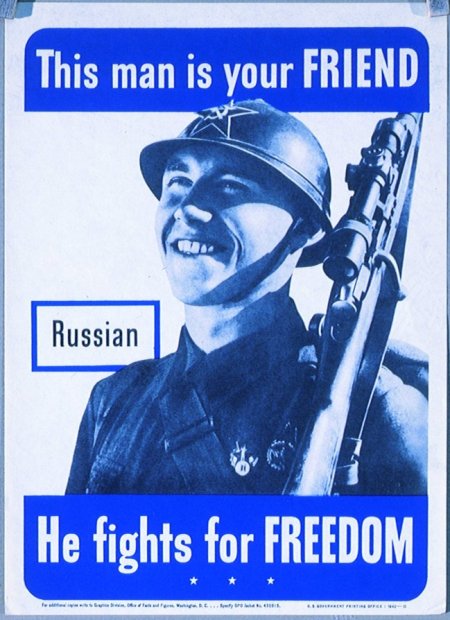
No longer operative.

The Communist Party USA enjoyed membership rolls pushing six figures; other socialist parties and movements had found niches in American life in the interwar years.

As the Great War gave way to the Cold War, the great powers remained nominal allies (that’s the reason the Rosenbergs weren’t tried for treason), but shifted rapidly into conflict. The American polity organized to expel the red menace by rendering it foreign and criminal — ideological rigging for the forty years’ imperial contest ahead. Loyalty oaths, blacklists, the House Un-American Activities Committee … in the whole of the self-conscious construction of communism as “contagion”, the power and willingness of the state to kill Julius and Ethel Rosenberg formed the tip of the spear, and an ugly contrast to that same state’s solicitous handling of Nazi scientists then developing the vehicles to deliver atomic technology to Moscow in mushroom cloud form.

Though different in many particulars, the thrust will be familiar to any sentient denizen of post-9/11 America: the extreme penalty enforces a wall between the suspect and abject (but tolerated) loyal liberal and the enemy left. Depend upon Ann Coulter for the most brutal articulation:

We need to execute people like John Walker [the American-born soldier captured fighting for the Taliban in 2001] in order to physically intimidate liberals, by making them realize that they can be killed, too. Otherwise, they will turn out to be outright traitors.

Like most symbols, the Rosenbergs came by their exaltation by accident; at the strictly personal level, their deaths are nearly operatic performances of human stubbornness and bureaucratic inertia. Investigators rolling up a spy ring** were looking for confessions and names to keep the indictments coming.

Julius refused to provide either, so his wife was arrested for leverage against him on the reasoning that he would confess to protect her. The gambit failed: both prisoner and hostage remained obstinate. The government’s bluff had been called, and it ruthlessly executed its threat.

Had the two really been responsible for starting a war, execution would hardly begin to cover the bill — yet to the very foot of the chair, the condemned, and Julius especially for the sake of his wife, were pressed with offers of mercy for confessing and “naming names”.

Abjure or expire: show trial logic.

[audio:Julius_and_Ethel_Rosenberg.mp3]

An Execution in the Family

Given names to name, the personal mystery of their silence — the ultimate heroism or folly or tragedy or transcendence — only deepens the resonance of their fate both for contemporaries and posterity, the poignance of their orphaned children’s subsequent path, the contrast with Ethel’s brother David Greenglass who has since admitted to perjuring testimony against Ethel in order to shield his own wife. (Greenglass says the Rosenbergs died from the “stupidity” of not copping a deal of their own.)

Even before Julius and Ethel went to the chair this date,† they had become the emblem of a paranoid age. In the days following, Sartre savaged the United States for trying “to stop scientific progress by a human sacrifice”:

Your country is sick with fear. You’re afraid of everything: the Russians, the Chinese, the Europeans. You’re afraid of each other. You’re afraid of the shadow of your own bomb.

Decades later, the shadows haven’t faded altogether. In playwright Tony Kushner’s imagination, the spirit of Ethel stalks her real-life prosecutor, closeted McCarthy henchman Roy Cohn, as he succumbs to AIDS in the 1980’s.‡

Rosenberg resources — and vitriol — are in plentiful supply online and off. A good starting point on the case is this page at the University of Missouri – Kansas City. Be sure to check the tale of a last-ditch legal maneuver that almost succeeded.

* There is one partial exception in the unusual case of six German saboteurs electrocuted in Washington, D.C., during World War II on a charge sheet that included espionage. The hearing was held by a military commission and only one of the six was an American citizen, so it was far from the regular judicial process — if one can call it that — the Rosenbergs faced.

** Originating in the investigation of Klaus Fuchs, the man who actually did what Julius and Ethel Rosenberg were accused of doing — passing atomic secrets to Moscow — although with debatable ultimate effect for the Soviets’ research. Fuchs served nine-plus years in a British prison and was released to East Germany; more than a few were galled at the difference between his sentence and the Rosenbergs’.

Stateside, George Koval was another spy far more valuable to Moscow in the nuclear race than were the Rosenbergs. Koval got away clean and died in Moscow in 2006.

† Julius first, then Ethel. Her execution was botched; repeated shocks were required to kill her.

‡ Cohn’s posthumous autobiography did acknowledge illegally rigging the Rosenberg trial, as his Kushner character does.

On this day..

1833: Midgegooroo, Noongar rebel

On this date in 1833, an aged aboriginal Noongar (or Nyungar) was sentenced to execution and summarily shot in southwest Australia.

Midgegooroo was one of the many indigenous casualties of European settlement — Perth, in this case.

Little is documented of his life but the end and that, of course, by his enemies; he helped raise resistance to the arriving whites in 1831 after a native was killed trying to raid a potato patch. As tensions heightened over the ensuing months, he was outlawed with a £20 reward on his head. He was sentenced — possibly without any sort of formal trial — and summarily shot a few days after capture.

Midgegooroo’s son Yagan outlived his father two more months, and in that scanty condescension of destiny carved a place as one of Australia’s most illustrious native rebels. (pdf)

In the end, inevitably, Yagan’s fate was the same — not so precisely as to qualify him directly for these pages but ambush by settlers amounted to much the same as the rickety assemblage of formal semi-legalisms that thrust his father into the ground: the law of conquest without apology. It would be years yet before any white would face the law’s lethal sanction for killing Australian natives.

Yagan’s head was hewn off and packed for England as a grisly trophy-cum-souvenir-cum-“anthropological curiosity”. Not until the recent trend towards repatriating such remains was it was finally exhumed and returned to the Noongar nation — in 1997.

On this day..

1536: Anne Boleyn

On this date in 1536, Anne Boleyn lost her head.

Any queen decapitated by her king would of course rate an entry in these grim pages. But this does not quite explain Anne Boleyn‘s enduring appeal, relevance and recognizability for the most casual of modern observers, and her concomitant footprint in popular culture, even with the “Greek tragedy” quality of her life.

Anne stands at the fulcrum of England’s epochal leap into modernity. Whether she was that fulcrum might depend on the reader’s sympathy for the Great Man theory of history, but little more do we injure our headless queen to regard her as the woman for her time and place — the accidental hero (or villain) raised up and thrown down by the tectonic forces of her milieu.

Through Anne was born — for reasons of momentary political arrangements of long-forgotten dynasts, which seems a shockingly parochial proximate cause — the English Reformation, and through the Reformation was born the crown’s decisive triumph over the nobility, the broad middle class nurtured on the spoils of Catholic monasteries, the rising Britannia fit to rule. Most would take as an epitaph historical accidents of such magnitude.

Of course, by those same accidents, Anne was the instrument of thousands of deaths herself, and little did she appear troubled in life by the corpses upon which she ascended the throne.

Her own family maps the change wrought on England. An ancestor was beheaded in the Wars of the Roses, medieval England’s last great breakdown; her uncle Thomas Howard was one of the throwback scheming Dukes, mastered by his sovereign to the extent of issuing Anne’s capital sentence from his own lips;* the beheaded woman’s daughter, Queen Elizabeth I, set a recognizably centralized English state on the path of empire.

Fitting tribute that, from the Tower where she met her end** to lands undreamt-of in her time, people still, like Henry, find her captivating.

[audio:http://www.bl.uk/whatson/podcasts/podcast95533.mp3]

* Anne’s father also declared for her guilt. Unprincipled as these men undoubtedly were, it cannot have been a pleasant responsibility; the question of whether she was actually guilty of adultery-cum-treason, the fatal charge extracted from a supposed lover by torture, has been hotly and inconclusively disputed by posterity.

** With a solemn speech submissive to Henry but not admitting any guilt — in an earlier moment of levity, she had famously remarked of the French swordsman hired to do the job, “I heard say the executioner was very good, and I have a little neck.”

On this day..

1887: Alexander Ilyich Ulyanov, Lenin’s brother

On this date in 1887, a young revolutionary went to the gallows with four other comrades for an attempt on the life of Tsar Alexander III.

Alexander (or Aleksandr) Ilyich Ulyanov was among 15 members of Narodnaya Volya, the terroristic revolutionary organization, nabbed (in an “amateurish” scheme) trying to blow up the monarch on the anniversary of his father’s assassination. The five of these who refused to plead for mercy paid for their principles with their necks.

The young man had kept his political affiliations rigorously secret from his close-knit bourgeois family. Little could he have suspected that the boy he shared a room with —

— would render his own passion a footnote in perhaps the 20th century’s epochal event.

Seventeen-year-old Vladimir Ilyich Ulyanov, years yet from the moniker “Lenin” by which history knows him, was supposedly fired by this event with a vow for vengeance and the politically mature resolve that “we will go another way!” — that is, another way than terrorism. Here’s the manful young Bolshevik* consoling his grief-stricken mother with revolutionary ardor:

But Lenin’s radicalization seems in fact to have not even begun as of this date, when he was consumed with studying for his exams (in a month’s time, he would graduate with a gold medal from a school headed by the father of Lenin’s future opponent during the Russian Revolution).

Though Lenin’s eventual political persona would comprehensively reject his brother’s tactics, the impression Alexander left upon him must have been profound. According to Tony Cliff in Building the Party: Lenin, 1893-1914, Vladimir Ilyich grappled with Narodism, Marxism and their proper relationship throughout his political development during his university years, and at least at certain moments Narodism appeared compelling to him.

According to Cliff, Lenin’s wife considered this passage from his What Is To Be Done? somewhat autobiographical:

Many of them [Russian Social Democrats] had begun their revolutionary thinking as adherents of Narodnaya Volya. Nearly all had in their early youth enthusiastically worshipped the terrorist heroes. It required a struggle to abandon the captivating impressions of those heroic traditions, and the struggle was accompanied by the breaking off of personal relations with people who were determined to remain loyal to the Narodnay Volya and for whom the young Social Democrats had profound respect.

Lenin mastered that struggle. In the end, he indeed went another way.

* Except there was no such thing yet, but never mind.

On this day..

Unspecified Year: Faust’s Gretchen

In Goethe’s Faust (original German | English), the title character’s lover on this date spurns his rescue and is put to death for killing their illegitimate child.

In the text, Faust and Mephistopheles celebrate Walpurgisnacht. The next day — “dreary day,” Goethe has it — the hero realizes his Faustian bargain is coming due, to the indifference of his infernal patron. (This is the work’s only scene in prose.)

FAUST

In misery! In despair! Long wretchedly astray on the face of the earth, and now imprisoned! That gracious, ill-starred creature shut in a dungeon as a criminal, and given up to fearful torments! To this has it come! to this!—Treacherous, contemptible spirit, and thou hast concealed it from me!—Stand, then,—stand! Roll the devilish eyes wrathfully in thy head! Stand and defy me with thine intolerable presence! Imprisoned! In irretrievable misery! Delivered up to evil spirits, and to condemning, unfeeling Man! And thou hast lulled me, meanwhile, with the most insipid dissipations, hast concealed from me her increasing wretchedness, and suffered her to go helplessly to ruin!

MEPHISTOPHELES

She is not the first.

Faust nevertheless browbeats the devil into infiltrating him that night into the prison where Gretchen (a German nickname for Margaret, Margarethe, or Marguerite), terrified, mistakes him at first for the executioner who will come for her in a few hours:

Risen at Dawn, Gretchen Discovering Faust’s Jewels — a scene from Gretchen’s seduction by Pre-Raphaelite painter Dante Gabriel Rossetti.

GRETCHEN (on her knees)

Who, headsman! unto thee such power
Over me could give?
Thou’rt come for me at midnight-hour:
Have mercy on me, let me live!
Is’t not soon enough when morning chime has run?

(She rises.)

And I am yet so young, so young!
And now Death comes, and ruin!
I, too, was fair, and that was my undoing.
My love was near, but now he’s far;
Torn lies the wreath, scattered the blossoms are.
Seize me not thus so violently!
Spare me! What have I done to thee?
Let me not vainly entreat thee!
I never chanced, in all my days, to meet thee!

Yet she refuses to flee with him — sensing the change in his character, fearful of living as a fugitive, resigned to a death incurred by her own culpability.

Day? Yes, the day comes,—the last day breaks for me!
My wedding-day it was to be!
Tell no one thou has been with Gretchen!
Woe for my garland! The chances
Are over—’tis all in vain!
We shall meet once again,
But not at the dances!
The crowd is thronging, no word is spoken:
The square below
And the streets overflow:
The death-bell tolls, the wand is broken.
I am seized, and bound, and delivered—
Shoved to the block—they give the sign!
Now over each neck has quivered
The blade that is quivering over mine.
Dumb lies the world like the grave!

Faust has had innumerable interpretations in performance, typically omitting the intervening “dreary day” scene, which makes the prison sequence appear to take place at the conclusion of Walpurgisnacht. The prison confrontation, for instance, caps a Gounod opera:

In F.W. Murnau‘s masterful 1926 silent adaptation, the sentence is carried out by burning rather than beheading. This film is in the public domain and available in its entirety free online:

On this day..

1461: James Butler, War of the Roses casualty

It is thought that on this date in 1461, weeks after the bloodiest battle on English soil, the Lancastrian noble James Butler was beheaded at Newcastle.

Once associated with Butler’s relative Thomas Boleyn, this picture has been identified as James Butler by Eric Ives. (H/t to Lara at Tudor History.)

Surviving the Battle of Towton, where some 1% of the era’s English population is thought to have perished in a savage fight, was trick enough for Butler, the Earl of Ormonde (or simply Ormond) and Earl of Wiltshire, and Lord-Lieutenant of Ireland.

Since both sides’ battlefield policy that day was to grant no quarter, the prisoner rolls were not extensive.

A bit of someone’s personal correspondence from the time indicates that, at least in this instance, it was a no more desirable fate:

[T]he Erle of Wylchir is hed is sette on London Brigge. (Source)

Like many a noble who rates little but a face in the crowd for us today, Butler linked a chain of some illustriousness. The Ormonde estate’s ancestry reached back to the family of Edward II; its succession fell to James’ younger brother Thomas, who was great-grandfather to Anne Boleyn. (Anne’s father Thomas Boleyn was the 8th Earl of Ormonde.)

On this day..

1315: Enguerrand de Marigny, on Montfaucon

On this date in 1315, an obscure petty noble who had become the king’s right-hand man was hanged by his rivals a few months after his royal sponsor expired.

Late in the epoch-making reign of King Philip the Fair — under whose rule the papacy was hijacked to Avignon and the Templars were crushedEnguerrand de Marigny was the man loyally keeping the books.

Since Philip was a stubbornly spendthrift fellow, that meant Marigny’s chief pursuit was the creative extraction of new revenues, through fresh taxes and the debasement of coinage. His public esteem suffered commensurately, little aided by the fact that his duties made him fabulously wealthy and the most powerful man in the country, give or take a king.

Said monarch was vigorous in that age-old pastime of the feudal monarchy, centralization of the power scattered among the nobility, further to which end he was happy to promote a competent administrator of scanty lineage and dependable loyalty.

Aggrieved lords, like the grasping Charles de Valois, were ready with their grudges against the unpopular minister when Philip shuffled off in November 1314. When charges of financial impropriety didn’t stick, they cooked up an allegation of sorcery — just then coming into vogue as a trump card in the game of judicial homicide.

Enguerrand hung two years upon the monumentally terrifying Montfaucon Gibbet (the link is to the structure’s French Wikipedia page), but everyone felt just terrible about it later. (the link is French, again) An actual inquiry — they skipped that step when they strung him up — exonerated the luckless minister, allowing his heirs to retrieve his body and a chunk of his fortune from the sympathetic king; Charles was so pursued by guilt that on his deathbed, he sent out a fat dispensation of alms with the request that recipients pray for both Enguerrand de Marigny and himself.

It worked … at least for Marigny’s reputation.

None can tell, after this lapse of time, whether this remorse proceeded from weakness of mind or sincerity of heart, and which of the two personages was really guilty; but, ages afterwards, such is the effect of blind, popular clamor and unrighteous judicial proceedings, that the condemned lives in history as a victim and all but a guileless being. (Source)

It was no hard feelings from Enguerrand’s little brother, Jean. The family influence had landed him a bishopric, and he held the job until his death in 1350, even repelling an English siege of Beauvais during the Hundred Years’ War.

A European Haman?

Enguerrand de Marigny comes in for a passing notice as T.H. White affectionately surveys the Middle Ages in The Once and Future King:

What an amazing time the age of chivalry was! Everybody was essentially himself — was riotously busy fulfilling the vagaries of human nature … [a] coruscating mixture of oddities who reckoned that they possessed the things called souls as well as bodies, and who fulfilled them in the most surprising ways.

[Y]ou might have seen Enguerrand de Marigny, who built the enormous gallows at Mountfalcon, [sic] himself rotting and clanking on the same gallows, because he had been found guilty of Black Magic.*

That Marigny erected the gallows on which he hung is an oft-repeated claim, an instance of a whole subgenre of moralistic folklore in which death-dealing inventors are hoisted on their own petard. These stories are not always dependablecontra rumor, for instance, Dr. Guillotin was not guillotined — and today’s protagonist may not have a firm hold on this small consolation, either.

Here is Victor Hugo’s rendering of the structure’s history in The Hunchback of Notre Dame.

Montfauçon was, as Sauval says, “the most ancient and the most superb gibbet in the kingdom.” …

Let the reader picture to himself, crowning a limestone hillock, an oblong mass of masonry fifteen feet in height, thirty wide, forty long, with a gate, an external railing and a platform; on this platform sixteen enormous pillars of rough hewn stone, thirty feet in height, arranged in a colonnade round three of the four sides of the mass which support them, bound together at their summits by heavy beams, whence hung chains at intervals; on all these chains, skeletons; in the vicinity, on the plain, a stone cross and two gibbets of secondary importance, which seemed to have sprung up as shoots around the central gallows; above all this, in the sky, a perpetual flock of crows; that was Montfauçon.

At the end of the fifteenth century, the formidable gibbet which dated from 1328, was already very much dilapidated; the beams were wormeaten, the chains rusted, the pillars green with mould; the layers of hewn stone were all cracked at their joints, and grass was growing on that platform which no feet touched. The monument made a horrible profile against the sky; especially at night when there was a little moonlight on those white skulls, or when the breeze of evening brushed the chains and the skeletons, and swayed all these in the darkness. The presence of this gibbet sufficed to render gloomy all the surrounding places.

The mass of masonry which served as foundation to the odious edifice was hollow. A huge cellar had been constructed there, closed by an old iron grating, which was out of order, into which were cast not only the human remains, which were taken from the chains of Montfauçon, but also the bodies of all the unfortunates executed on the other permanent gibbets of Paris. To that deep charnel-house, where so many human remains and so many crimes have rotted in company, many great ones of this world, many innocent people, have contributed their bones, from Enguerrand de Marigni, the first victim, and a just man, to Admiral de Coligni, who was its last, and who was also a just man.

Hugo — who, let us admit, is not to be depended upon for history — has elevated Marigny to the very first victim of the Montfaucon gallows, but the reader will also notice that the same passage dates the edifice’s construction thirteen years after Marigny’s own execution.

Helpless Historiography

Montfaucon the execution site had a rich history. There seem to have been at least two separate gallows sites (the link is French) on the hill, and its vintage as an execution space dates back to the 13th century. (more French)

About this point, this blog runs against the limits of its writer’s access to primary documentation and werewithal to pursue it. Sources seem mightily confused on the embryonic era of Montfaucon; at least two other ministers — Pierre de La Brosse, a confidante of the previous king, and Pierre Remy, another royal treasurer hanged a generation after Marigny — also have their own claim to have been hanged on the structure they erected.

It may be that this was actually true of Remy, a less dramatically captivating figure with an official portfolio similar to Marigny’s, and the two simply became conflated in legend. Something certainly seems to have been built during his time, and it may have been the stone replacement for the original gallows.

The suggestion of someone who researched it more thoroughly than I have (another French page, but worth the visit if only for the pictorial schematics) is that the landmark structure may have predated all these men.** Brosse and Marigny, in this conception, may simply have worked various repairs upon it that became magnified in the retelling, while the gallows Remy set up might have been those on the secondary location, erected as a stopgap during a more thorough reconstruction of the permanent site, and/or reserved for more vulgar elements than ministers of the crown.

* Readers may appreciate an annotation of other references White makes in his fantasy classic.

** We find repeated claims that the alleged “sorceror” Marigny engaged for his capital crime was hanged below him, which would support that notion; I have been unable to identify the provenance of this detail, however.

On this day..

1947: Fernand de Brinon, Vichy minister with a Jewish wife

On this date in 1947, former Vichy Secretary of State Comte Fernand de Brinon was shot in the Paris suburb of Montrouge for war crimes.

A lawyer and journalist who met future Nazi luminary Joachim von Ribbentrop in 1919, Brinon and his socialite wife Lisette were the toast of right-wing high society in the 1930’s. He even scored a scoop interview with the Fuhrer himself, shortly after Hitler became chancellor.

Germany’s rout of France in 1940 vindicated to many of the French right their critiques of France’s decadence; for Brinon, the natural step was support for collaboration, a career-enhancing philosophy that saw him to the third-ranking position of the Vichy government.

There he struck a post-partisan, consensus-oriented pose vis-a-vis picking sides between the new overlord and the erstwhile ally it was bombing:

To collaborate loyally with our opponents of yesterday in no way signifies in the mind of any man of good sense becoming the enemies of our allies of yesterday. (New York Times)

Men of good sense also knew the Bolsheviks were the real threat to world peace; hence, this Vichy-era newsreel of today’s victim reviewing French troops on the Eastern front:

Brinon knew exactly which side he was on and behaved as such, according to Occupied France: Collaboration and Resistance, 1940-1944:

[O]bsequious, indiscreet and an open admirer of Nazism … his collaboration was ideological, and it exceeded by far the agreements over food, prisoners of war, the demarcation line, and the mass of daily adjustments to the occupation sought by most Vichy officials … [Brinon represented] the Nazi end of the Vichy spectrum.

That made him an easy call for the sternest reprisal liberated France could exact, and he knew it himself: Fernand and Lisette tried to flee for Germany when the western allies began recapturing France in 1944.

What adds poignancy, if perhaps not sympathy, to his fate is the fact that Lisette — Jeanne Rachel Louise Franck, her name had been before he put a ring on her finger — was Jewish, and that fact was not a secret. She spent the occupation years as an official Honorary Aryan, safe from the deportations her husband helped arrange for others.

Lisette was also arrested by the Allies as she fled for Germany in 1944 — and how many Jews can say that? — but was released, and died in 1982. Four years ago, her aged son wrote a soul-searching book about his relationship with his mother and (for Brinon was Lisette’s second marriage) his stepfather, Lisette de Brinon, Ma Mere. There is also a recent biography of Brinon in French (review (also French)).

On this day..

1979: Zulfikar Ali Bhutto, Prime Minister of Pakistan

In the small hours of the morning this date, the Pakistani military junta hanged former Prime Minister Zulfikar Ali Bhutto.

At the end of 1971, Bhutto, a former cabinet official who had broken with Pakistan’s military strongman, rode a wave of discontent into power as the economy crumbled, and East Pakistan broke away from Islamabad to form Bangladesh.

Born to a well-heeled Muslim family in British India, the charismatic and often arrogant Bhutto had feets in the streets and a way with both the domestic audience and the global one:

But he did not necessarily have a power bloc equal to the weight of the Pakistani military as he navigated the storm of controversial domestic challenges; in retrospect, it seems only a matter of time before his hold on power would slip.

In July 1977, Army Chief of Staff Muhammad Zia-ul-Haq, a fellow clan member whom Bhutto had promoted ahead of more senior officers, repaid his sponsor by overthrowing him in a virtually bloodless coup.

A protracted — and vengeful — legal drama with a pre-scripted ending unfolded over the ensuing two years, with Bhutto twice released and twice re-arrested, convicted of an earlier political murder on the testimony of “witnesses” who had obviously been tortured and coached, and his sentence upheld by a divided Supreme Court gamed to avoid the presence of a pro-Bhutto judge.

It was not out of character for this affair that the fallen Prime Minister was hanged secretly and before he expected, his (widely protested) death not announced until the following morning.

Allegories of Bhutto and Zia struggle for power in this early Salman Rushdie novel (more).

Bhutto makes a flawed saint, but his turn at power stands as an island of something like democracy in a sea of Cold War Pakistani dictatorships.

The Pakistan Peoples Party he founded still remains a principle organ of liberalism in Pakistan, and still honors its martyred leader. Reflective of both the vision and the personal autocracy of its progenitor, its leadership has passed dynastically through Bhutto family members, most famously daughter Benazir Bhutto, who succeeded Gen. Zia (he died in a suspicious plane crash) as Prime Minister — the first female elected head of state in the Islamic world.

Benazir Bhutto, of course, was assassinated this past December, just ahead of parliamentary elections that have just now produced a coalition government that will vie with Islamabad’s most recent military ruler for power.

The website bhutto.org preserves a considerable collection of the elder Bhutto’s writings, as well as photography, video and other resources.

On this day..

1600: Linköping Bloodbath, the dawn of Sweden’s glory

On this date in 1600, five former supporters of King Sigismund were beheaded at Linköping, as Sweden broke free of Poland and of Catholicism.

Eighty years before, the Swedish Vasa dynasty had established itself by surviving one bloodbath. Now, it would set its greatest scion in line for the throne by inflicting another.

Sigismund was Sweden’s legitimate heir; he was also a characteristic product of dynastic intermarriage whose loyalties were splintered between fiefdoms. But most crucially of all, he had been raised Catholic in a realm turning decisively towards Protestantism.

Born of a Polish-Italian mother, he had secured the Polish-Lithuanian throne by election in 1589; when succession added suzerainty of Sweden, his realm was a personal union stretching across central Europe from the Arctic Circle to the Black Sea.

Which looked better on paper than it would work in practice.

The persecutory stage of the Catholic counter-reformation had been in full throat this past half-century, and the accession of a Catholic prince raised a Scandinavian alarm.

Busy governing Poland, Sigismund left his Protestant uncle Duke Charles to administer Sweden; within five years, civil war had erupted between the two and in short order the victorious soon-to-be King Charles IX had occasion to make example of the nobles who had backed Sigismund’s cause.

Charles himself would be a transitional figure in Sweden, but what a transition: his victory made possible the the subsequent scintillating reign of his son, Gustavus Adolphus — the able commander who would raise Sweden into a true European power.*

There would be an interesting coda in that reign to this day’s doings. Gustavus’ greatest general, Johan Banér, was the son of one of those put to death in Linköping. In another time, between other men, that one fellow’s father had seen the other fellow’s butchered might have put a blood feud between them. But as young men — the king was just 18 months his senior — they formed a permanent friendship, upon which they founded the military collaboration that shook northern Europe.

“My dad beheaded your dad”
“Let’s play!”

* Among Gustavus Adolphus’ numerous exploits was war with his father’s old rival — that is, with his cousin Sigismund — in the 1620s. Foreign relations between Sweden and Poland had turned understandably frosty, with Sigismund spending the rest of his long life eyeballing the lost crown.

On this day..