(Thanks to Henry Charles Lea for the guest post, which first appeared in his The Inquisition in the Spanish Dependencies: Sicily – Naples – Sardinia – Milan – The Canaries – Mexico – Peru – New Granada. The Inquisition was abolished in Sicily in 1782, but an interesting Palermo museum preserves its artifacts. -ed.)
When, in 1718, Savoyexchanged Sicily with Austria for Sardinia, the Emperor Charles VI would not endure this dependence of the [Inquisition] tribunal upon a foreign power and procured, in 1720, from Clement XI a brief transferring the supremacy to Vienna. In accordance, however, with the persistent Hapsburg claims on the crown of Spain, the Inquisition remained Spanish. A supreme council for it was created in Vienna, with Juan Navarro, Bishop of Albarracin as chief who, although resident there gratified himself with the title of Inquisidor-general de Espana, but in 1723 he was succeeded by Cardinal Emeric, Archbishop of Kolocz.
Apparently it was deemed necessary to justify this elaborate machinery with a demonstration and, on April 6, 1724, an auto de fe was celebrated at Palermo with great splendor, the expenses being defrayed by the emperor.
Detail view (click for the full image) of a French print of the auto de fe.
Twenty-six delinquents were penanced, consisting as usual mostly of cases of blasphemy, bigamy and sorcery, but the spectacle would have been incomplete without concremation and two unfortunates, who had languished in prison since 1699, were brought out for that purpose. They were Geltruda, a beguine, and Fra Romualdo, a friar, accused of Quietism and Molinism, with the accompanying heresies of illuminism and impeccability. Their long imprisonment, with torture and ill-usage, seems to have turned their brains, and they had been condemned to relaxation as impenitent in 1705 and 1709, but the sentences had never been carried out and they were now brought from their dungeons and burnt alive.
Detail view (click for the full image) of an engraving, The Great Auto De Fe At Palermo Italy 6 April 1724
Less notable was an auto de fe of March 22, 1732, in which Antonio Canzoneri was burnt alive as a contumacious and relapsed heretic.
Alonso formed a popular militia and continued a short-lived resistance against the French but was captured early in 1864, and although this was still some months before the dirty war’s notorious “Black Decree” the French determined to make an example of him.
Alonso aside, the Mexican adventure proved a right catastrophe for France and its adherents.
Retreating from the Philippines in early 1942, U.S. Gen. Douglas MacArthur famously vowed, “I shall return.” To Homma’s grief, he did just that.
While MacArthur cogitated his revenge, Homma was finishing off the remnants of his last great stand in the Battle of Bataan. Bataan was a victory for Japan, but a bloody and protracted one; it cost the lives of some 7,000 Japanese, and the three-month battle has sometimes been credited with slowing the Japanese advance sufficiently to safeguard Australia; it also left the occupiers with an unexpectedly huge complement of POWs.
On April 9, 1942, the very day fighting ended at Bataan, transfers began for these prisoners, who would be driven by train and then marched overland some 60+ miles to Camp O’Donnell. More than 60,000 Filipinos and about 15,000 Americans endured this harrowing five- or six-day slog — the Bataan Death March.
A few books about the Bataah Death March
Early reports of the death march made grist for this wartime propaganda poster in the U.S.
This crucible of endurance, both physical and spiritual, came by its evil repute honestly; in the age of the Internet, numerous appalling testimonials are within easy reach of a web search. They recount battle-wearied men enervated by hunger and thirst, liable to be summarily shot or bayoneted for making themselves the least bit conspicuous to captors who already disdained them for having the weakness to surrender in the first place.
Some were murdered at the outset: having any Japanese “trophies” on one’s person when captured was liable to be worth a summary bullet, or a quick flash of an officer’s katana. An even more certain death sentence was falling behind on the march, and wounded prisoners could expect no quarter: they had to keep up with their compatriots or the Japanese “buzzard squad” trailing a few score meters behind every marching peloton would finish them off with any other stragglers. In different groups POWs might be thrashed or killed over any trifling annoyance; meanwhile, those suffered to live trudged under a wasting sun, nearly unnourished but for fetid handfuls scooped from mud puddles, dying on their feet hour by hour. Dehydrated to the point of madness, some snapped and ran suicidally for the tantalizing nearby village wells that marchers were prohibited from accessing.
Something like a quarter, and maybe nearer to a third, of the souls who set out on the Bataan Death March never reached Camp O’Donnell. Those who did entered new portals of torment: rent by dysentery and crowded cheek to sunken jowl, prisoners died off daily by the dozens until they were finally dispatched — often crammed like sardines into the bowels of “hell ships” — to different Japanese work camps.
The Bataan Death March was a no-question basket of war crimes, egregiously flouting existing POW treatment accords.* It’s far more questionable whether our man Gen. Homma was the right person to answer for it.
Homma had segued directly from the Battle of Bataan to the succeeding Battle of Corregidor after which he had been cashiered for a homeland desk job.
Ironically, it was an excess of leniency that helped earn Homma his enemies among the brass — the opposite of the thing that hanged him. For many who observed the postwar trial slating him with 48 war crimes violations related to the Death March, Homma was a figure more tragic than wicked, prey to returning victor MacArthur’s pique at the defeat Homma had once inflicted upon him.
Little reliable evidence could show that Homma blessed or even knew of the atrocities committed in the march, but he himself allowed during trial that “I am morally responsible for whatever happened in anything under my command.” According to Homma’s American defense attorney Robert Pelz — a biased source to be sure — the general slipped into genuine disgust and remorse during the trial as a parade of witnesses remembered their ordeals. “I am horrified to learn these things happened under my command,” Homma wrote in a note passed to Pelz at one point. “I am ashamed of our troops.”
The hanging verdict was controversial then and remains so now. “If the defendant does not deserve his judicial fate, none in jurisdictional history ever did,” MacArthur complained. He honored the mercy application of Homma’s wife Fujiko only insofar as to permit the general a more honorable execution by musketry, instead of hanging.
The bulk of the U.S. Supreme Court okayed the procedure by which the U.S. military brought that fate about, although Justice Frank Murphy issued a scorching dissent urging that in the haste and partiality of the proceedings against both Homma and General Tomoyuki Yamashita “we abandon all pretense to justice, let the ages slip away and descend to the level of revengeful blood purges.”
One who would share that sentiment was an 18-year-old Navy man who observed the trial, Bob Perske. Perske would remember this his experiences on the Philippines at the end of World War II “sharpened his sensitivies toward vulnerable persons” and influenced a subsequent career advocating for people with disabilities as well as those caught in the toils of the criminal justice system. Executed Today formerly interviewed Mr. Perske in connection with the wrongful execution of a mentally disabled man in Colorado, Joe Arridy.
March 30, 1702 was the date colonial New York spared Col. Nicholas Bayard from undergoing a hanging scheduled later that same day.
A “puzzling affair, made so by frustratingly incomplete documentation,” in the estimate of Adrian Howe, whose William and Mary Quarterly article (January 1990) “The Bayard Treason Trial: Dramatizing Anglo-Dutch Politics in Early Eighteenth-Century New York City” is a key source for this post: it was certainly blowback for the execution a decade earlier of the Dutch merchant Jacob Leisler who seized control of New York in a populist rising to cement its adherence to the Glorious Revolution. Bayard, a colonial elite related to Peter Stuyvesant himself, was Leisler’s superior in the militia but abhorred the Leislerian intervention on behalf of the usurping Dutch king William III.
Bayard got his by helping to manage Leisler’s prosecution all the way to the gallows, even reputedly hosting the new royal governor at his own house while his party plied him with alcohol in a (successful) bid to overcome his reluctance to sign Leisler’s death warrant — a triumph Bayard celebrated by gaily hanging a flag from his window on the day Leisler hanged.
Unchastened by having found it necessary to flee the city for his own safety during Leisler’s hour, Bayard did not refrain from provoking a foe that grew to hate him. Anglican clergyman John Millersurveyed the city during the intervening years and noticed that team Leisler “have vowed revenge & Some Say want but an opportunity to effect their purpose.”
As the 18th century dawned, the Leislerian party — think artisans, against the magnates — was back in control of the New York’s Provincial Council, and could finally see a way to that purpose. It seized on an intemperate petition that Bayard had drawn up against the late, pro-Leislerian governor Bellomont* and turned a 1691 anti-Leisler law-and-order statue against it.
The resulting eight-day trial in early March was a nakedly political operation although New York’s Dutchmen fell a bit short of the Robespierrian standard: it’s not clear whether they really meant to hound Bayard all the way to death or whether the last-minute pardon was the plan from day one. To get it, Bayard had to submit himself as far a very grudging apology for the offense — “which by the said sentence he finds and is convinced he has committed.” Apparently this sullen abasement was enough to satisfy Team Leisler, who cut here a picture of moderation and restraint that would do their countrymen’s latter-day stereotypes proud; when a new governor arrived, Bayard’s condemnation was fully reversed and expunged, “as if no such trial had been.”
* Among other things in his venturesome life, Bellomont sponsored William Kidd when he was a somewhat legitimate privateer, but eventually orchestrated Kidd’s capture as a pirate.
British-occupied Egypt on this date in 1945 hanged two young Jewish assassins for slaying the British plenipotentiary to the Middle East.
Walter Edward Guinness was heir to the barley beer fortune and a Tory politician of near 40 years’ standing. “Lord Moyne”, to call him (as history does, and as we will henceforward) by his aristocratic honorific, allied with his former rival Winston Churchill in the 1930s as a staunch foe of placating Hitler, eventually serving several roles in Churchill’s wartime government.*
The last and perforce most famous was Resident Minister of State in Cairo from January 1944, where he directed British affairs in North Africa, Persia, and the Middle East, crucially including Mandatory Palestine.
Such a figure must necessarily represent many things to different subjects, but to Zionists he represented the hostility to their project of both his own person and (more importantly) of London. While there is endless nitpicking about the man’s precise degree of disfavor for Jewish people or interests, “Lord Moyne was the highest British official in the Middle East,” in the words of Yitzhak Shamir, the emigre terrorist who orchestrated the hit and would one day become Prime Minister of Israel. “Because we fought against the British in this area, we took him for a target. This was the main reason for his assassination.” Nothing personal. (Maybe a little personal.)
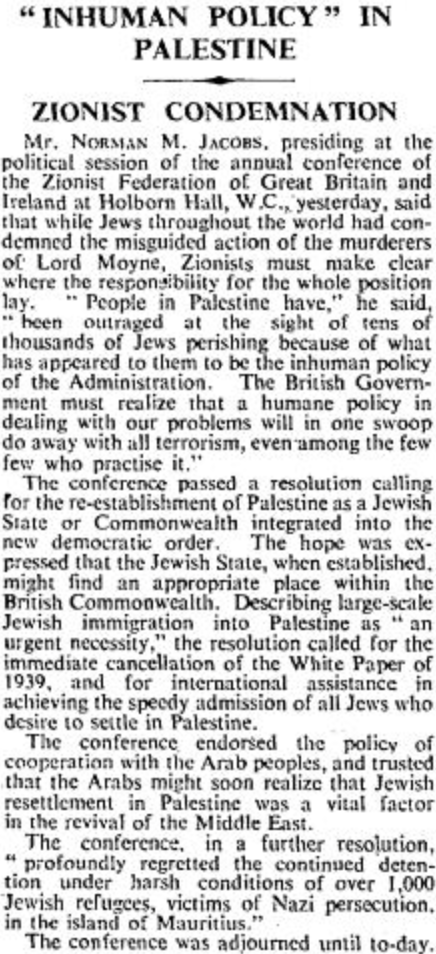
On November 6, 1944, two of Shamir’s young cadres in the late Avraham Stern‘s militantly anti-British Lehi network, Eliyahu Bet-Zuri (Ben Suri) and Eliyahu Hakim, ambushed Moyne as his limousine pulled up at his villa, and shot him dead with pistols. (They also killed Moyne’s driver, a Lance Corporal named Arthur Fuller.) Once their affiliations became apparent it was Jewry’s turn to bask in the collective censorious scowl that minorities everywhere can anticipate given any perceived ethnic affinity to the latest atrocity’s author. These sortings-out from the London Times would do almost word for word for whatever horror tomorrow’s news might bring.
London Times, Nov. 10, 1944
London Times, Jan. 29, 1945
Similarly, Lord Moyne’s killers took every pain to link their martyrdom to Jewish/Zionist patriotism, no matter any moderate rabbi’s attempt to wash his hands of it.
Raised in Mandatory Palestine, both Bet-Zuri and Hakim spoke Arabic but insisted on speaking only Hebrew in the Cairo court. They went to the gallows singing the hymn “Hatikvah” — later to become Israel’s national anthem.
In the near term, their deed hardened hearts: “If our dreams for Zionism are to end in the smoke of an assassin’s pistol, and the labors for its future produce a new set of gangsters worthy of Nazi Germany, then many like myself will have to reconsider the position we have maintained so consistently and so long in the past,” Churchill snarled to Parliament.
But in fact the British reconsideration was soon seen to run counter to the dangerous meddling policing these “gangsters” would have demanded. Within only a few years London struck its colors in the Levant. Bet-Zuri’s and Hakim’s cause triumphed, and they too with it: as Prime Minister, Yitzhak Shamir arranged for the hanged men’s remains to be repatriated from Egypt; today, both rest in honor at Mount Herzl.
* There was a personal side to Lord Moyne’s anti-Naziism: his son, Bryan, had been abandoned by his socialite wife Diana Mitford … who became Diana Mosley in 1936 when she married British Union of Fascists chief Oswald Mosley, in a ceremony held at Joseph Goebbels‘ home no less.
On this date in 1954, East Germany beheaded Ernst Jennrich for the previous June’s short-lived popular protests.
A Magdeburg gardener of socialist proclivities, Jennrich was nothing more than an enthusiast who got swept up in events when metalworkers at the Ernst-Thälmann factory struck for better pay and lower food prices — a protest that quickly metastasized into what looked to the Communist authorities like a treasonable movement calling for liberalization, a release of political prisoners, and reunification with West Germany.
The movement was crushed within a day by Russian tanks — although some Soviet soldiers notably (and sacrificially) refused to fire on protesting workers. But before events played out, Jennrich had disarmed a guard at the prison in nearby Sudenburg. He fired the guard’s carbine twice, then destroyed the weapon.
It’s not certain how many people lost their lives in the suppression of this affair — hostile western estimates ran into the thousands — but two policemen were killed at Sudenburg prison, and in a cruel show of official impunity Jennrich got tapped to answer for their deaths. He said he’d just fired the carbine into a wall or the air in order to empty it … but the state said he’d emptied it into those two luckless officers.
On scant evidence, Jennrich harshly received a life sentence that August. But even this did not suffice for officials racing to manifest their righteous indignation against the late subversion. “The protection of our peaceful state requires the death penalty for the crimes committed by the defendant,” huffed the prosecutor, and appealed the sentence to Germany’s high court … which accordingly upgraded the sentence to “the extermination of the defendant from our society, and therefore the death penalty.”
Jennrich was beheaded on the fallbeil at Dresden still protesting his innocence. A post-unification court finally vindicated that protest in 1991, posthumously rehabilitating Jennrich as having been condemned without evidence even by the terms of East Germany’s 1950s laws.
On this date in 1946, the Dutch journalist/propagandist Max Blokzijl was shot at Scheveningen for wartime Nazi collaboration.
Blokzijl (English Wikipedia entry | Dutch), who had a Jewish grandmother, fought in World War I but had become a war correspondent at Berlin by the end of it, reprising his prewar career.*
From 1918 to 1940 he worked from Germany, and Germany worked on him; in 1935, with National Socialism ascending its zenith in Germany, Blokzijl joined Anton Mussert‘s Dutch knockoff, the Nationaal-Socialistische Beweging party. He also wrote anonymously for the fascist newspaper De Waag.
When Germany occupied the Netherlands in 1940, Blokzijl decloaked as a fascist and accepted a gig as Berlin’s hand for the Dutch press. He was noted for the wartime radio show Brandende kwesties (Burning Issues) which helped make his the calm and measured voice of Dutch national socialism — an identification which soon proved to be a great liability.
The last Nazi redoubts in the Netherlands didn’t surrender until the very end in May, 1945, and that’s when Blokzijl was arrested, too. He stood a half-day trial on September 11, 1945 for his media campaign “aimed at breaking the spiritual resistance of the Dutch people are against the enemy and infidelity of the people to his government and the Allied cause.”
One could argue that the firing squad was a harsh penalty for a guy who had no direct hand in any atrocities. As with the French propagandist Robert Brasillach, the circumstance of facing the nation’s judgment so directly after the war contributed to the severity of Blokzijl’s punishment: indeed, Blokzijl was the very first Dutchman tried for his World War II behavior, which made a death sentence virtually de rigueur. As he wrote to his lawyers in the end, “I fall as the first sacrifice for a political reckoning.”
* One of his prewar careers: he was also a professional singer.
On this date in 1689, the Maratha prince Sambhaji was put to a grisly death by Mughal Emperor Aurangzeb.*
Sambhaji was the firstborn son of the man whose daring had created the Hindu Maratha state — and whose death in 1680 seemed to the neighboring Muslim Mughals the right invitation to destroy this nascent rival.
The Mughals were right to worry, for in the 18th century the Maratha polity would grow into an empire dominating the Indian subcontinent, and drive the Mughals into a long decline.
But in the 1680s, it was the Maratha on the back foot as Aurangzeb invaded their haunts on the Deccan Plateau, steadily albeit very slowly reducing Maratha fortresses over the course of the decade (and the next decade).
This war defined Sambhaji’s reign, and ended it too, when he was at last captured with his favorite aide Kavi Kalash in Sangmeshwar. Mockingly dressed up as buffoons, they were paraded through Mughal territory to the emperor, who would present them a demand for Islamic conversion as the price of their lives.
But the doomed wretches knew that, after all, their heads would fall upon the scaffold, or that, if by abject submission and baseness, they escaped death, they would be kept in confinement deprived of all the pleasures of life, and every day of life would be a new death. So both Sambha and Kabkalas indulged in abusive language, and uttered the most offensive remarks in the hearing of the Emperor’s servants … [Aurangzeb] gave orders that the tongues of both should be cut out, so that they might no longer speak disrepsectfully. After that, their eyes were to be torn out. Then, with ten or eleven other persons, they were put to be put to death with a variety of tortures, and lastly he ordered that the skins of the heads of Sambha and Kabkalas should be stuffed with straw, and exposed in all the cities and towns of the Dakhin, with beat of drum and sound of trumpet. Such is the retribution for rebellious, violent, oppressive evil-doers. (Source — British, it must be said)
Sambhaji has not been highly rated for his indifferent internal governance of Maratha, but the clarifying allure of war and the gruesomely patriotic manner of his death earned him hero’s laurels still honored by Hindu nationalists down to the present day; the village of Tulapur where he was put to death honors Sambhaji with several monuments.
For a contemporary — like, say, Aurangzeb — Sambhaji’s death followed closely by the capture of his family when the Maratha capital succumbed to Mughal siege must have appeared to presage the destruction of his state. Things didn’t work out that way: Sambhaji’s younger brother Rajaram and especially Rajaram’s impressive queen Tarabai kept the Mughals bogged down on the Deccan, bleeding money** and time as they struggled to complete the conquest — until by Aurangzeb’s own despondent death in 1707, it was the Maratha on the advance, and the Mughal Empire on the brink of its own collapse.
* Aurangzeb was the son of the man who built the Taj Mahal. He’d needed some violence of his own to claim the Mughal throne from his brothers.
** “The expense in gold and rupees can hardly be accurately estimated. Aurangzeb’s encampment was like a moving capital — a city of tents 30 miles in circumference, with some 250 bazaars, with a ½ million camp followers, 50,000 camels and 30,000 elephants, all of whom had to be fed, stripped the Deccan of any and all of its surplus grain and wealth.” –Stanley Wolpert
On this date in 1942, the start of Purim,* Nazi forces occupying Minsk massacred approximately 5,000 Jews from the Minsk Ghetto at a site known simply as Yama, “the Pit”.
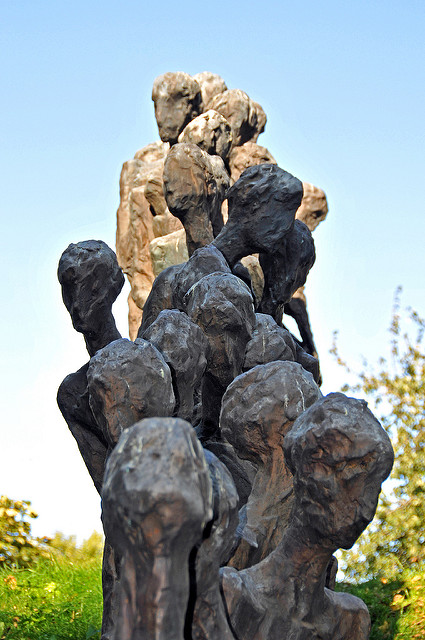
The site, which hosts memorial events every March 2, was marked with a somber obelisk in the immediate postwar years; unusually for a Stalin-era monument, it is overt about the Jewish character of the victims — for Soviet propaganda often obfuscated this with a technically-correct formulation such as “Russian citizens”. In this case, the 1940s memorial obelisk remarkably had a Yiddish inscription to mirror its Russian one. (The sculpture of a column of faceless people tragically descending the slope into the pit was added in the post-Soviet period.)
All images (cc) Dennis Jarvis.
Minsk’s pre-war Jewish population of more than 50,000 was almost entirely annihilated during World War II.
On this date in 1788, Thomas Barrett became the first person legally executed in Great Britain’s Australian colonies when he hanged at Sydney Cove for stealing from government stores. It was barely a month after the First Fleet had arrived from England to found the penal colony.
More than just a milestone, Barrett packed an amazing criminal career into the few years he surfaces for us in the documentary record.
Our man was condemned to death in 1782 for stealing a silver watch, the first of three death sentences he would hear. That sentence was reprieved in favor of convict transportation, a system which had ground to a halt with the American Revolution and still awaited the creation of the Australian pipeline.
In 1783, a convict hulk that had been rejected by the now-independent North American colonies, the Swift, mutinied. Barrett would meet survivors of that mutiny who were stashed away with him on the Censor, one of the earliest of the Thames’ frightful stationary convict hulks where reprieved felons awaited their deportation.
In 1784, Barrett and one of the Swift mutineers, Charles Kellan, rebelled once again on their next convict transport ship, the Mercury — earning Barrett his second death sentence, and his second reprieve. Three more years on the fetid hulks ensued while legislators* and cartographers stroked their beards over Britain’s next move in the convict transportation game.
And this is when Australia the prison was invented. That First Fleet Barrett arrived on was a flotilla of eleven ships carrying 700 or so prisoners was it, the literal first European colony Down Under.
Besides being a man of spirit and enterprise, as his mutiny showed, Barrett was a skilled craftsman who enlivened the tiresome trip around the world by fashioning little metallic mementos. The journal of the ship’s surgeon John White narrates with more admiration than censure an escapade off the coast of Brazil that revealed Barret’s talent for counterfeiting.
This morning a boat came alongside, in which were three Portugueze and six slaves; from whom we purchased some oranges, plantains, and bread. In trafficking with these people, we discovered, that one Thomas Barret, a convict, had, with great ingenuity and address, passed some quarter dollars which he, assisted by two others, had coined out of old buckles, buttons belonging to the marines, and pewter spoons, during their passage from Teneriffe. The impression, milling, character, in a word, the whole was so inimitably executed, that had their metal been a little better, the fraud, I am convinced, would have passed undetected. A strict and careful search was made for the apparatus wherewith this was done, but in vain; not the smallest trace or vestige of any thing of the kind was to be found among them. How they managed this business without discovery, or how they could effect it at all, is a matter of inexpressible surprise to me; as they never were suffered to come near a fire; and a centinel was constantly placed over their hatchway, which, one would imagine, rendered it impossible for either fire or fused metal to be conveyed into their apartments. Besides, hardly ten minutes ever elapsed, without an officer of some degree or other going down among them. The adroitness, therefore, with which they must have managed, in order to complete a business that required so complicated a process, gave me a high opinion of their ingenuity, cunning, caution, and address; and I could not help wishing that these qualities had been employed to more laudable purposes.
Duly impressed, White found that more laudable purpose by commissioning Barrett to create a medallion celebrating the arrival of their vessel to Australian soil. This Charlotte Medal from Barrett’s hand is one of the most celebrated artifacts of Australian colonization; it depicts the Charlotte at anchor in Botany Bay with a narration on the reverse of its long journey from home:
Sailed the Charlotte of London from Spit head the 13 of May 1787. Bound for Botany Bay in th Island of new holland arriv,d at Teneriff th4 of June in Lat 28 13 N Long 16 23 W depart,d it 10 D’, arriv,d at rio janeiro 6 of Aug in Lat 22,54 S Long 42,38 W, depart,d it the 5 of Sep’ arriv,d at the Cape of good hope the 14 Oct’ in Lat 34 29 S Long 18 29 E depart,d it th13 of Nov’ and made the South Cape of New Holland the 8 of Jan 4 1788 in Lat 43,32 S Long 146,56 E arrivd at Botany Bay the 20 of Jun’ the Charlotte in Co in Lat 34.00 South Long 151.00 East distance from great Britan Miles 13106
But Barrett’s legitimate artistic career was as brief as it was scintillating.
The colony had a tight supply situation and its isolation and heavy convict population seemed to Governor Arthur Phillip to demand the strictest discipline, like that of a ship upon the sea: any significant failure of order could imperil the entire project. He assembled the little colony in early February to impress upon all that stealing rations would be harshly punished.
White, again, in his entry of February 27, 1788:
Thomas Barrett, Henry Lovel, and Joseph Hall, were brought before the criminal court, and tried for feloniously and fraudulently taking away from the public store beef and pease, the property of the crown. They were convicted on the clearest evidence; and sentence of death being passed on them, they were, about six o’clock the same evening, taken to the fatal tree; where Barrett was launched into eternity, after having confessed to the Rev. Mr. Johnson who attended him, that he was guilty of the crime, and had long merited the ignominious death which he was about to suffer, and to which he said he had been brought by bad company and evil company. Lovel and Hall were respited until six o’clock the next evening. When that awful hour arrived, they were led to the place of execution, and just as they were on the point of ascending the ladder, the judge advocate arrived with the governor’s pardon, on condition of their being banished to some uninhabited place.
As the infant colony had scarcely prioritized establishing an executioner right off the boat, one of Barrett’s fellows was pressed into the disreputable role. Another narrative underscores the tension this incident must have created among the convicts, half-starved and under the lash on the empire’s most distant moon. “The unhappy wretches were conducted wt. a party of Marines walking before them … with a large party of Marines drawn up opposite the Gallows … in case an insurrection should take place … & all the Convicts were summoned to see the deserved end of their Companions.” Hall and Lovel’s pardons should probably be read in this light; Phillip had a job to enforce obedience without triggering rebellion and once he had established the firmest precedent wisely reflected that the quality of mercy blesseth him that gives and him that takes. Two other thieves (of wine, in their case) named Daniel Gordon and John Williams were likewise condemned on the 29th of February only to be spared for banishment instead.
A small marker at Sydney’s Circular Quay commemorates Barrett’s execution. (cc) image by mazzle278.
Barrett is an important character in the BBC drama Banished.
* The Home Secretary who orchestrated the pivot to Australia was the Viscount Sydney: hence, the Australian city of Sydney.


 Elected to the post during early months of the unfolding
  Homma commanded the

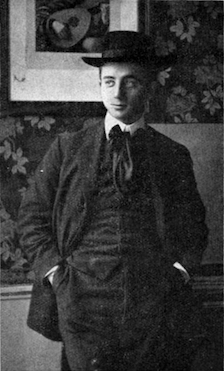 Blokzijl (
 Sambhaji was the firstborn son of