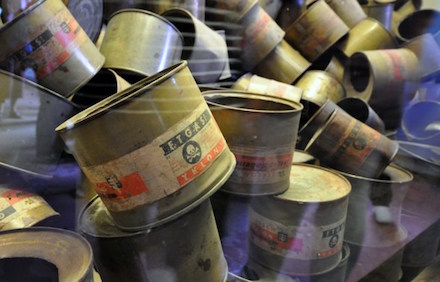
1946: Bruno Tesch and Karl Weinbacher, Zyklon-B manufacturers

On this date in 1946, British hangman Albert Pierrepoint hanged seven German war criminals at Hameln Prison.

These seven comprised two distinct groups charged in two very different misdeeds:

Karl Eberhard Schöngarth and four others hanged for executing a downed Allied pilot in 1944.

Bruno Tesch and Karl Weinbacher were executed for a critical support role in the Holocust: they were principles of the chemical manufacturer Testa, which sold Zyklon-B to the Reich for use in the gas chambers.


Zyklon was just a brand hame (“Cyclone”)

Hydrogen cyanide had been employed as a legitimate pesticide and de-lousing agent for many years before World War II. Because of its danger, the odorless deadly gas was sold spiced with an odorant to alert humans accidentally exposed to it.

Tesch and Weinbacher had their necks stretched because they were shown to have knowingly sold this product sans odor, reflecting Testa’s complicity in its intended use upon humans. (A third Testa employee was acquitted, having inadequate knowledge of the firm’s operations.)

On this day..

1946: Ten at Hameln for killing Allied POWs

On this date in 1946, the British hanged 10 convicted war criminals at Hameln Prison, notably including seven for the “Dreierwalde Airfield murders” of four Allied prisoners of war.

Picture from this book about RAF POWs in wartime Germany, which also supplies the unknown names: A.W. Armstrong and R.F. Gunn of the RAF; B.F. Greenwood and J.E. Paradise of the RAAF.

In that case, two British and three Australian airmen had been captured after bailing out during a March 21 raid. Taken to the nearby aerodrome between Dreierwalde and Hopsten in Westphalia, they were marched out the next day ostensibly for transport to a POW compound. Instead, they all ended up shot by their guards — although Australian Flight-Lieutenant Berick was able to escape, wounded, and survive the war.

The nub of the case was whether the guards cold-bloodedly murdered their prisoners (prosecutors’ version), or whether there was an escape attempt by the airmen that caused the guards to start shooting (defense version).

Berick’s affidavit to the effect that no escape had been attempted weighed very heavily here — that nothing was afoot until he suddenly perceived the guards cocking their weapons. Karl Amberger would testify on behalf of himself and his men that the five had been suspiciously taking their bearings as they marched and suddenly broke off running in different directions.

The defense counsel’s attempt to reconcile these accounts in the haze of war was not fantastical — “saying that the cocking of the action of a weapon by one guard was not unnatural given the fact that five prisoners had to be guarded in a lane in the growing dusk … [while] Berick and the other prisoners probably regarded it as likely that they were to be shot, as others in their position had been, and began to run when it was not necessary.” But it did not carry the day.

Three other Germans joined this bunch on the scaffold, for similar but unrelated POW abuses.

  • Erich Hoffmanm, condemned by a joint British-Norwegian court in Oslo for the murder of Allied POWs in occupied Norway.
  • Friedrich Uhrig, for murdering a downed Royal Air Force pilot at Langlingen.
  • Franz Kircher, for killing three airmen at Essen-West.

On this day..

1945: Majda Vrhovnik, Slovenian resistance

On this date in 1945, Slovene resistance member Majda Vrhovnik was executed by the Gestapo in Klagenfurt, days before the end of World War II.

A University of Ljubljana medical student and Communist destined to be honored as a national hero of Yugoslavia, Vrhovnik (English Wikipedia entry | Slovenian) joined the underground resistance when the Nazis occupied Yugoslvia in 1941. She’d spend the bulk of the war years producing and distributing illicit anti-occupation propaganda but by war’s end she had been detailed to nearby Klagenfurt — a heavily Slovene city just over the border in Austria.

She was finally caught there and arrested on February 28, 1945, and shot in prison even as Klagenfurt awaited Allied occupation which would arrive on May 8.

Her credentials as a patriotic martyr — there’s a Majda Vrhovnik school named for her — would surface her name in 1988 in connection with an affair that helped begin the breakup of Yugoslavia into ethnic statelets, when an opposition journalist published a censored article under the pseudonym “Majda Vrhovnik”.

On this day..

1919: Rudolf Egelhofer, Bavarian Soviet commandante

On this date in 1919, the commandante of the “Red Army” of the short-lived Bavarian Soviet Republic was shot by the German soldiers and Freikorps that had just overrun the revolutionary republic.

The son of a pauper basketweaver, Rudolf Egelhofer enlisted in the navy in World War I and was involved in a naval revolt in the war’s closing days. Transplanting to Munich in the chaotic postwar environment, Egelhofer joined the Communist Party and became a fixture of the revolutionary movement; the socialist writer Oskar Maria Graf would record of Egelhofer’s stature at a parade that he stood “determined and sincere, in a sailor’s uniform, sometimes raising his fist. Those who heard him, had to believe in him.”

After a left-wing coup claimed Bavaria in early April, Egelhofer’s steel and magnetism received the impossible mandate of organizing a Red Army before Munich went the way of the Paris Commune. But the Bavarian Soviet was overwhelmed in less than a month.

In the first days of May, Egelhofer’s fate was shared by something like 700 supporters of the defeated Soviet.


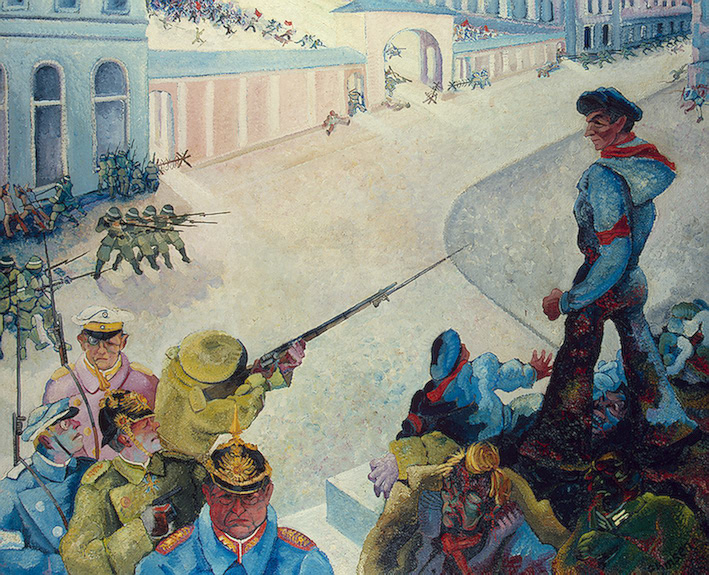
The fierce “victim” dominates his executioner in Execution by Firing Squad of the Sailor Egelhofer, by Heinrich Ehmsen (1931). This is only the central panel of a triptych depicting the White storming of Red Munich; the piece is described in this post.

Ehmsen has a similar idea about relative stature at work in Execution by Firing Squad (Red Jacket) (1919).

Though little memorialized at the place of his glory and martyrdom — which fell on the western side of the Iron Curtain — numerous East Germany streets, public buildings, and naval vessels bore Egelhofer’s name in tribute during the Cold War.

On this day..

1821: Tommy Jemmy executes Kauquatau

On this date in 1821, a chief of the Seneca Native American nation slit the throat of a woman named Kauquatau, who had been condemned as a witch.

As Matthew Dennis explains in his book on the Seneca of the early American Republic, Seneca Possessed, the rapid march of European settlement and the Seneca’s recent and ambiguous incorporation into the newborn United States had strained the indigenous society in complex ways.

One of those reactions was a period of gendered witch-hunting in the early 19th century, especially growing out of the religious movement of the prophet Handsome Lake.

“Handsome Lake pinpointed the dangers the Seneca faced, the threats that they faced, the source of those threats, and a way … of purging his society of those who were most likely to resist his changes,” Dennis explained in this New Books Network podcast interview.

The “threat” for the instance at hand was a tribal healer who had become suspected of bewitching a man to his death — and her guilt in the same voted on by the Seneca elders. One of their number, Chief Soonongise — known as Tommy Jemmy to whites — went to her cabin on May 2, 1821, and killed her. It’s anyone’s guess whether Kauquatau realized what was happening — whether she took it as a social call or recognized her angel of death from the outset. But to New Yorkers, it was murder plain as day — and Tommy Jemmy was soon confined to a gaol to stand trial for his life.


Another reaction occasioned by the upheaval of those years, a reaction destined to emerge dramatically in this instance, was a feeling-out of the Seneca people’s position within the Anglo Republic that had engulfed it. “If the Senecas were a conquered people, as some tried to allege, the terms of their conquest were ill defined, their sovereignty, though diminished, still recognizable,” Harris writes. In these very pages we have met this ill-defined sovereignty several times: a few years on from the events of this post, the state of Georgia would defy a Supreme Court stay and execute a Cherokee man in a case turning on disputed sovereignty.*

Here in New York, Tommy Jemmy’s trial would open a different contest over the same underlying question.

Rather than attempting to deny or minimize his “crime,” Tommy Jemmy defended it as a legal execution conducted by the proper jurisdiction of Seneca laws — no matter for the interference of New York. It’s a position that appeared to have ample sympathy among Anglo New Yorkers,** who gingerly kicked the argument to a Circuit Court and thence to the New York Supreme Court which found itself thereby obliged to “a very thorough examination of all the laws, treaties, documents and public history relating to the Indians” going all the way back to the Dutch. (Cherry-Valley Gazette, Aug. 21, 1821)

What musty old scrolls could supply by precedence, the luminous Seneca orator Red Jacket brought to life in his forceful defense. Red Jacket had an expert feel for the pangs in the Anglo conscience, as one can appreciate by his retort against one obvious line of condescension.

What! Do you denounce us fools and bigots because we still believe what you yourselves believed two centuries ago? Your black-coats thundered this doctrine from the pulpit, your judges pronounced it from the bench, and sanctioned it with the formality of law; and would you now punish our unfortunate brother for adhering to the faith of his fathers and of yours? Go to Salem! Look at the records of your own government, and you will find that thousands have been executed for the very crime which has called forth the sentence of condemnation against this woman, and drawn upon her the arm of vengeance. What have our brothers done more than the rulers of your people? And what crime has this man committed, by executing in a summary way the laws of his country and the command of the Great Spirit?

It was by no means certain that Tommy Jemmy’s argument would prevail here; a literally simultaneous case in Michigan saw a native defendant make a similar jursidictional argument and still wind up on the gallows. The question in the end stood outside any existing grant of law — and it was resolved in a legally questionable way, too.

Accepting the merits of Tommy Jemmy’s position but also unwilling to render Indian power over life and death into the statutes, Tommy Jemmy was set free without any judgment and subsequently pardoned by the legislature — the pardon reversing no conviction. He was an executioner, after all.

* U.S. President Andrew Jackson vigorously supported the state in this separation-of-powers dispute: it’s the case of which he alleged to have remarked, “[Chief Justice] John Marshall has made his decision; now let him enforce it.”

** In an essay appearing in New World Orders: Violence, Sanction, and Authority in the Colonial Americas, Dennis notes the precedent here of an 1802 trial involving a Seneca man named Stiff-Armed George. Although Stiff-Armed George murdered a white victim and not on Seneca land, Red Jacket also urged a defense, successfully: “Did we ever make a treaty with the state of New-York, and agree to conform to its laws? No. We are independent from that state of New-York … we appeal to the government of the United States.” (The Seneca did have treaties with the federal government.)

They finessed the issue in the end: Stiff-Armed George was convicted, but immediately pardoned.

On this day..

2014: Two crucifixions in Raqqa

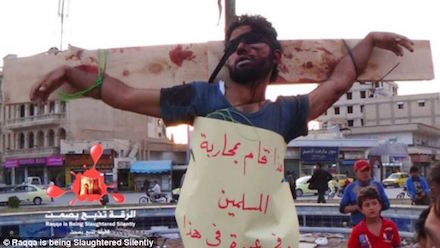
In the Syrian city of Raqqa on this date in 2014, the Islamic State (ISIS/ISIL) reportedly crucified two men in a posthumous public gibbeting, after executing them by shooting. (There were seven executions in Raqqa that day.)

Raqqa was the Islamic State’s breakthrough conquest, and the city it claims as its caliphate’s capital — the “Bride of the Revolution.”

Horrific pictures of these crucifixions circulated worldwide thanks to the dissident group Raqqa is Being Slaughtered Silently. Needless to say, what follows is Mature Content.

On this day..

1947: Hisao Tani, for the rape of Nanking

Lieutenant General Hisao Tani was shot on this date in 1947 for his part in the Rape of Nanking.

Tani commanded a division that took part in the conquest and occupation of that Chinese city in 1937, and it was outside its gates — following a Chinese war crimes trial — that he took his leave of this world.

On this day..

1943: The massacre of Janowa Dolina

On or very near this date in 1943, a Ukrainian militia massacred the Poles of the village of Janowa Dolina (Yanova Dolina).


Janowa Dolina in the 1930s. The village was a model settlement for workers at the nearby basalt quarry, jobs given at that time by official preferences to Poles. It was created in the 1920s, and featured an orderly plot with running water and electricity throughout.

In World War II, each theater of the war was unhappy in its own way. For the beautiful region of Volhynia long straddling the blood-soaked marches between Poland and Ukraine, it meant a ghastly local war under the umbrella of German occupation.

Mostly Polish in the interwar years, when Ukrainian residents chafed under “Polonization” policies, Volhynia had come fully under Soviet control when Berlin and Moscow carved up Poland in 1939, and then, of course, fully under German control in 1941. In these years of ash and bone, ethnic compositions in Volhynia were redrawn with every desperate ferocity nationalism could muster: pogroms visited neighbor upon neighbor, or ethnic cleansing visited state upon subject. It would be Ukrainian ultras positioned in the end to fantasize about ethnic purity by dint of their collaboration with the conquering Reich.

Come 1943, Poles comprised a shrinking minority in Volhynia. The prospect of purging this borderlands to cinch its place in a Ukrainian homeland made those Poles an inviting target for a campaign of ethnic slaughter that’s remembered now as the Volhynia or Volyn Massacres. And with the German defeat at Stalingrad and the Red Army’s advance on eastern Ukraine, Reich administration further west had become sufficiently distracted by more urgent priorities that genocidaires* perceived their moment to strike.

“We should undertake a great action of extermination of the Polish element,” thundered Dmytro Klyachkivsky, a commander of the Ukrainian Insurgent Army (UPA), military organ of the Organization of Ukrainian Nationalists (OUN-B).** “As the German armies withdraw, we should take advantage of this convenient moment for liquidating the entire male population from the age of 16 up to 60 years. We cannot lose this battle, and it is necessary to diminish Polish forces at all costs. Forest villages and those near forests, should disappear from the face of the earth.”

Many specific atrocities, beginning in February 1943 and continuing well into 1944, comprise this liquidation drive.

The one of interest for this post is the invasion on the night of April 22-23 — the eve and morning of Good Friday — of Janowa Dolina, a predominantly Polish village where 600 were massacred by the UPA and the village put to the torch.†

This horror is commemorated by a monument at the site …


The 1990 monument commemorating Poles murdered by UPA. Here’s a closer view of the stone marker, and here’s the inscription on the adjacent cross.

… but there seems to be a slight difference of opinion: the event is also memorialized by a rival stone erected by Ukrainian nationalists which “gives glory to the Ukrainian heroes” of the UPA for “destroying the fortifications of the Polish-German occupiers.”‡


(Thanks to Sonechka for translation help.)

As anyone holding even passing familiarity with events in present-day Ukraine will surely know this is no mere historiographical quibble; the legacy of the OUN from World War II and of its descendants on the modern far right remain deeply contentious in and out of Ukraine.

* Poland officially (and to the dismay of Ukraine) considers this campaign a genocide. There’s also a Polish film on the horrors of Wolyn.

** The OUN split factionally; the “-B” suffix in this case stands for Stepan Bandera, leader of the most militant faction; his surname is still today a byword and/or slur (“Banderists”) for Ukrainian fascism. Its rival faction was the more moderate OUN-M, led by Andriy Melnyk.

† The territory became Ukrainian — which at the time meant Soviet — after World War II and remains so today, so Janowa Dolina is now the Ukrainian town of Bazaltove. There’s a Flickr album tour of the muddy mining village, including photos of the Polish monument and a separate marker for Soviet POWs, but not the UPA monument, here.

‡ The UPA stone also cites April 21-22 as the date. It appears to me, a distant non-specialist, that the Ukrainian construction on what adherents prefer to more neutrally describe as the “tragedy” of Janowa Valley spreads action over two days and emphasizes alleged guerrilla actions by the UPA against German occupation targets prior to destroying the village.

On this day..

1857: The mutineer Jemadar Issuree Pandy

From the Annals of the Indian Rebellion, 1857-58:

THE MUTINEER JEMADAR ISSUREE PANDY.

This Jemadar of the 34th Regiment N.I. was brought to trial on the following charges: —

1st. For having at Barrackpore on the 29th March 1857, he being then in command of the quarter-guard of his regiment, not used his utmost or any endeavours to suppress a mutiny begun by Mungul Pandy, the said sepoy having on the afternoon of the day above mentioned, gone out into the parade ground in front of and near to the quarter-guard of the regiment armed with a sword and musket; and then and there used words to excite the men of the reigment to come forth and join him in resistance to lawful authority; and having then and there on the parade ground, and near to the quarter-guard of the regiment, discharged his loaded musket at Serjeant Major James Thornton Hewson, and Lieutenant Bempole Henry Baugh, of the 34th Regiment N.I., and then and there with a sword struck, and severely wounded, the said Lieutenant Baugh and Serjeant Major Hewson, and the said Jemadar not having taken any measures to arrest and confine the said sepoy throughout the aforesaid occurrences, nor to assist the said Lieutenant Baugh and Serjenat Major Hewson, and he [sic] the said Jemadar having, moreover, then and there discouraged and interfered to prevent any sepoys of his guard from going to their assistance.

2nd. For disobedience to the lawful command of his superior officers in not having advanced with his guard to rescue the Serjeant and capture the aforesaid sepoy, Mungul Pandy, when shortly after the occurrences, set forth in the first charge, he was ordered to do so by Brevet Colonel S.G. Wheler, commanding the 34th Regiment N.I.

The Court found the prisoner, Jemadar Issurree Pandy, guilty of both charges preferred against him, and sentenced him to suffer death. On the 21st April 1857 Major General Hearsey reported as follows: —

Jemadar Issuree Pandy was duly hanged by the neck this afternoon at 6 o’clock in presence of all the troops at the station; the crimes, finding, and sentence of the General Court Martial before which he was arraigned, approved and confirmed by His Excellency the Commander-in-Chief, having been first carefully explained to all the native corps.

It may be perhaps satisfactory to the Government to know that when on the scaffold the Jemadar made a voluntary confession of his guilt, and admitted the justice of the sentence which had been passed on him, at the same time imploring all his fellow soldiers who were present to take warning by his untimely fate.

They didn’t.

On this day..

1730: A Natchez woman tortured to death at New Orleans

On this date in 1730, French-allied Tunica Indians put a captured Natchez woman to grisly public death under the walls of New Orleans.

This is the English translation of Marc-Antoine Caillot’s Relation du voyage de la Louisianne ou Nouvelle France fait par le Sr. Caillot en l’année 1730, a key firsthand source for the incident in this post.

Months earlier the Natchez had risen in rebellion against the colonists in Louisiana — a bloody settling of accounts the that answered a French push to colonize more land with an attack meant to drive them out of Louisiana altogether. The initial, surprise attacks slew 237 French subjects, many in stomach-turning fashion. Friend of the site Dr. Beachcombing details a particularly atrocious murder in his post on the affair at Beachcombing’s Bizarre History Blog.

So the French were in a state of rage and fright on April 10 — the day after Easter — when an allied tribe, the Tunica, showed up at the Big Easy with six Natchez captives in tow, three women and three children. Chief among them was a woman readily recognized by the French as the wife of a once-friendly Natchez chief now “known for being an enemy of the French.” Indeed, escapees from Natchez captivity slated her with having given the go-ahead for the torture-murder of three of their countrymen.

And this hated foe the Tunica proceeded to offer to the French, as a gesture of goodwill.

As Sophie White explains in her “Massacre, Mardi Gras, and Torture in Early New Orleans” (The William and Mary Quarterly, July 2013),* Louisiana territory governor Etienne Perier in slyly declining the prisoner intentionally condemned her to a speedy and spectacular death. Rather than taking her into official custody for disposal by the French judiciary or diplomatic organs, Perier put her up for a night in the French jail while her captors prepared a performance for the morrow calculated to slake the bloodlust of French and native alike.

White’s narrative is worth excerpting at length here; all the parentheticals come from White’s original text.

Officially, Governor Perier could claim that he had maintained French notions of justice by rejecting the Tunica offer of the prisoner of war (even though at a later date he would openly write of another four male and two female Natchez having “been burnt here”). Yet he allotted a space for the Tunica to torture her and arranged for her to be kept in jail overnight while the Tunica danced the black “calumet of death” in preparation for her execution. In the morning, after gathering firewood, erecting a frame, and painting their faces and bodies, the Tunica “began to run as if possessed by the devil and, while yelling (it is their custom), they ran to the jail where she was in chains”; she was engaged in a final assertion of sartorial self-preservation, “fixing a ribbon to her braided hair,” hair that she knew would soon be scalped.

Like Perier, the colonial populace also became involved in exacting revenge on this member of the Natchez nation. Not only were “all the Sauvages who were in New Orleans” present at the torture ritual but colonists also attended the performance as spectators, as they might in France attend a public execution. They watched as the Tunica tied her to a frame and as a Natchez man who had abandoned his kin and been adopted by the Tunica stepped forward to burn her, starting with “the hair [poil, or body hair] of her … then one breast, then the buttocks, then the left breast” (the ellipses represent a deliberate authorial omission on the part of Caillot). Commentators described the methodical burning of torture victims as a form of slow-cooking (“a petit feu”). For Caillot, the ritual burning of the victim’s genitals, breasts, and buttocks was marked by the carefully observed but gruesome sight of “the abundance of grease mixed with blood that ran onto the ground.” His description evoked the cooking of meat basted in fat, with the frame simulating a spit on which the victim was roasted; if this frame/spit did not physically turn its meat, the torturers made sure that she was evenly roasted on all sides by their methodical movement across her body. This food preparation imagery was followed by other cooking analogies. As they were about to kill her (in contrast to the procedure in France, where spectators waited for the execution to be complete before grabbing souvenir pieces of the criminal’s body), “the French women who had suffered at her hands at the Natchez [settlement] each took a sharpened cane and larded her,” just as French culinary techniques called for piercing meat with a sharp stick prior to the insertion of thin strips of lard.

The Natchez woman was not impressed, but “during that long and cruel torture never shed a tear. On the contrary, she seemed to deride the unskilfulness of her tormenters, insulting them, and threatening that her death would soon be avenged by her tribe.”


Detail view (click for the full image) of a generic depiction of the torture frame, from Jean-Francois-Benjamin Dumont de Montigny’s memoir. Sophie White notes that this figure is identifiably female based on her genitalia and the long scalped hair mounted on the adjacent pole.

Over the next several years, the French not only turned back the attack but largely shattered and Natchez peoples, dispersing their remnants to fragmented communities throughout the U.S. South. Today only a few thousand Natchez souls remain, and their interesting language has died out entirely.

* Though it’s a bit tangential to the subject of this post, readers interested in this milieu might cotton to White’s Wild Frenchmen and Frenchified Indians: Material Culture and Race in Colonial Louisiana.

On this day..