1671: Zrinski and Frankopan, Croatian conspirators

He who dies honorably lives forever.

-Fran Frankopan

On this date in 1671, Croatian noble Fran Krsto Frankopan and his brother-in-law Petar Zrinski were beheaded by the Austrian empire at Wiener-Neustadt Prison.

The Zrinski-Frankopan Conspiracy — or Magnate Conspiracy — was the product of great powers chess in central Europe … and specifically, of the frustration of these lords in the frontier zone between the Austrian and the Ottoman Empires at being a sacrificial pawn.

Instead, they’d take control of their own destiny and be a self-sacrificial pawn.

Croatia and Hungary had been on the perimeter of Hapsburg authority for generations, and seen the rising Ottomans push well into Europe.

In the latest of innumerable wars, the Austrians had trounced the Ottomans, potentially (so the Croats and Hungarians thought) opening the door for reconquest of lost territory. Croatia in particular had been nibbled away by Ottoman incursions into a “remnant of a remnant.” Emperor Leopold I thought otherwise: he had Great Games to play in western Europe as well and didn’t find this an auspicious moment to go all in in the east.

Rather than following up his victory by trying to run the Turks out of their half of divided Hungary, or out of Transylvania, Leopold just cut an expedient peace on status quo ante terms quite a bit more favorable to Istanbul than the latter’s military position could demand.

The aggrieved nobles started looking around for foreign support to help Hungary break away.

This scheme never came to anything all that palpable, perhaps because the operation’s leading spirit Nikola Zrinski got himself killed by a wild boar on a hunt, and definitely because no other great powers wanted to get involved in the mess.

Zrinski (or Zrinyi) was also a noteworthy Croatian-Hungarian poet, as were the remaining conspirators.

The boar-slain’s younger brother Petar, his wife Katarina, and Katarina’s half-brother Fran Frankopan, also better litterateurs than conspirators, inherited the scheme’s leadership, and its penalty.
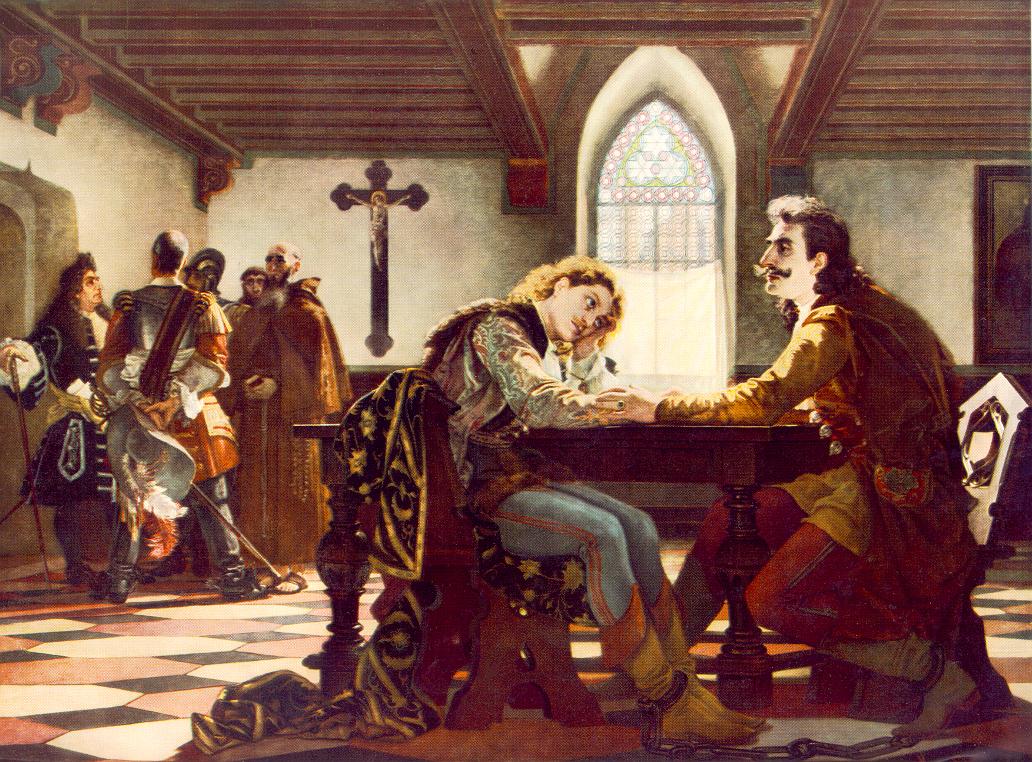

Zrinski and Frankopan in the Wiener-Neustadt Prison, by Viktor Madarasz (1864)

Royal vengeance against the plot shattered two mighty noble houses: the Zrinskis were all but destroyed by the seizure of their estates. The Frankopans — an ancient and far-flung family whose Italian Frangipani branch was even then about to yield a pope — were done as major players.

After these executions, anti-Hapsburg sentiment metastasized in Hungary into outright rebellion.

But in what was left of Croatia, the loss of the two largest landholders spelled the end of effective resistance until the era of 19th century romantic nationalism — when our day’s unfortunates were recovered as honored national heroes.

Zrinski and Frankopan are pictured on modern Croatia’s five-kuna bill, and were both reburied in Zagreb Cathedral after World War I finally claimed the Austrian Empire. (They also got memorial plaques in Wiener-Neustadt) Their mutual relation Katarina Zrinski, who avoided execution but was shut up in a convent, was a writer as well, and has ascended to the stars of founding patriotess, seemingly the go-to namesake for most any Croatian women’s civic organization. (Dudes honor the House of Zrinski by slapping the name onto sports clubs.)

On this day..

1945: Dachau Massacre

On this date in 1945, American troops liberated the Dachau concentration camp in Upper Bavaria — and then proceeded to summarily execute a number of its SS personnel.

The “Dachau massacre” involves several distinct incidents of wantonly killing defenseless POWs by American troops, who may have been set on edge by warnings of potential fake-surrender gambits, and then evidently went right off the rails with discovery of emaciated dead bodies around the place. In particular, a stranded transport that had been sent from Buchenwald, christened the “death train”, greeted the liberators with a 40-car phantasmagoria of horror.


“We had seen men in battle blown apart, burnt to death, and die many different ways, but we were never prepared for this. Several of the dead lay there with their eyes open, a picture I will never get out of my mind. It seems they were looking at us and saying, ‘What took you so long?'” -Private John Lee

“It made us sick at our stomach and so mad we could do nothing but clinch our fists. I couldn’t even talk.” -Lt. William Cowling

These stunned, outraged soldiers, some of them still teenagers, would soon have a bunch of disarmed German troops from the camp under their power. Uh-oh.

As the dry but shocking (and also marked “Secret”: nobody ever faced a court-martial for the incident*) U.S. Army investigation remarked, “The sight of these numerous victims would naturally produce strong mental reaction on the part of both officers and men. Such circumstances are extenuating, but are the only extenuating facts found.” (Read the entire report in this forum thread.)

The behaviors these facts propose to extenuate may also produce a strong mental reaction. “‘After what we saw, we shot any German guards we saw on sight,” one of the Dachau liberators admitted in the 1990s.

  • A Lt. William Walsh took the surrender of four SS men near one of these train cars, then forced his prisoners inside the car and shot them on the spot.
  • About seven Germans taken prisoner at the camp’s Tower B were lined up a few steps away from the tower preparatory to marching them elsewhere, when for sketchy reasons one of their American guards started shooting, and then others followed suit.
  • And the most notorious of the incidents, about 50 captured SS men were segregated from other POWs — again, by Lt. Walsh — and lined up in the camp coalyard by the wall of the hospital. There they were machine-gunned, resulting in 17 deaths before a superior officer interceded.

Another 25 to 50 guards were killed by prisoners themselves, many with the implicit blessing of American infantrymen who stood by and watched, and or the explicit blessing of Americans’ weapons on loan from sympathetic troopers.

The irony in all this was that most of the camp’s regular guards had already fled the place. The SS men whom outraged Americans were shooting down in the Dachau charnel house were Waffen-SS who had been transferred from the eastern front just days before and whose specific purpose in the camp was to surrender it to the western Allies. They probably considered this assignment far away from the vengeful Red Army a very lucky break.

It wasn’t so lucky: this is the mischance of war. But they didn’t have anything to do with Dachau’s horrors, and their deaths in a unthinking bloodlust disgraced only their executioners.

“German soldiers after their surrender as prisoners of war to American troops were summarily shot and killed by such troops.”

-Conclusion of the Army Inspector General’s report

* Court-martial charges were filed, but quashed. The whole affair remained unknown to the public until the 1980s.

On this day..

1945: Hermann Fegelein, Eva Braun’s brother-in-law

On this date in 1945, Waffen-SS officer Hermann Fegelein was shot in the Reich Chancellery’s basement, or else its garden.

“One of the most disgusting people in Hitler’s circle,” in the estimation of Albert Speer, this rank opportunist had found his way there via Heinrich Himmler’s patronage.

On June 3, 1944, Fegelein married right into Hitler’s personal clique by tying the knot with Gretl Braun — sister of longtime Hitler mistress Eva Braun. Hitler and Himmler were both official witnesses.

They had a two-day wedding bash. Then the western allies landed at Normandy.

Fegelein still found plenty of time to party and womanize for the eleven remaining months that he and national socialism had a run of the place. But as a rank opportunist, he also had his antenna up for a post-Nazi arrangement by the spring of 1945. Here, his proximity to power did him no favors.

Posted directly to Hitler’s bunker as Himmler’s personal representative, the guy would have a harder time than some anonymous bureaucrat in slipping out of besieged Berlin.* When he absented himself from the bunker for two full days, Hitler himself noticed.

The guy sent to retrieve Fegelein found him drunk in a Berlin flat, hurriedly stuffing valuables into suitcases with a mystery woman who promptly disappeared out the window.

Having obviously been attempting to desert, Fegelein was in a fix when he was hauled back to the bunker.

Unluckily for Fegelein, this was also the date that Reuters reported news that his patron Himmler had attempted to surrender Nazi Germany to the U.S. and Britain — news that made its way into the hands of a livid Hitler. You’ve got Fegelein trying to defect (incidentally inviting Eva Braun to come with), his boss is selling right out, and he’s consorting with a potential mole.

According to James O’Donnell, Hitler and his loyal satrap Martin Bormann were obsessed with leaks in the last days of the war, and the circumstances of Fegelein’s capture conspired to make him look like a potential source of those leaks.

As the Fuhrerbunker consumed itself in paranoia, Fegelein — only slowly sobering up — disappeared into the hands of the Gestapo, and was shot. His body, presumably abandoned with other casualties of little interest to Berlin’s conquerors, was never recovered.

Hundreds of kilometers to the south on the same day, Hitler’s longtime Italianate partner Benito Mussolini was getting his. It would be a stark warning to Germany’s fading dictator not to let the same fate befall him.

Hours after Hermann Fegelein’s execution, his sister-in-law Eva finally wed Adolf Hitler … and on April 30, those two took their lives together.

A week after Hermann Fegelein’s execution, on May 5, his widow bore him a posthumous daughter: Eva Barbara Fegelein, named after the child’s late famous aunt.

* Fegelein had actually been out in Bavaria with Himmler — “safe”, relative to what happened to him — but taken a hazardous flight back into besieged Berlin just a couple of weeks before his death. He was either trying to be Himmler’s dutiful personal plant in the bunker, or trying to use his posting as a pretext to retrieve for the perilous postwar years the many valuables he had cached in Berlin.

On this day..

1945: German soldiers for cowardice

Throughout the last days of the Third Reich, it ruthlessly forced its desperate conscripts by threat of summary execution into service to slow the overwhelming Soviet army.

Borrowing a page from Gen. Ferdinand Schoerner‘s no-mercy demonstrative hangings of any “straggler” found behind front lines without orders, Goebbels

issued a radio proclamation to the trapped troops [of Berlin]: “Any man found not doing his duty will be hanged from a lamp post after a summary judgment. Moreover, placards will be attached to the corpses stating: ‘I have been hanged here because I am too cowardly to defend the capital of the Reich. I have been hanged because I did not believe in the Fuhrer. I am a deserter and for this reason I shall not see this turning point in history.

SS members, aware that they would be in for the worst of it after the war (and that their mandatory blood-type tattoos would make them easy to identify) were the ones sufficiently motivated to impose this policy. One German in the city at the time recalled the horror of seeing

boys who were found hiding were hanged as traitors by the SS as a warning that, ‘he who was not brave enough to fight had to die.’ When trees were not available, people were strung up on lamp posts. They were hanging everywhere, military and civilian, men and women, ordinary citizens who had been executed by a small group of fanatics.

Although it’s not specifically an execution story, the horrifying consequences of this lethal paranoia under siege are the theme of the West German film Die Brücke, in which a rare veteran sergeant looking after some child-conscripts is shot by a patrol when he can’t produce orders … leaving the children alone to be butchered pointlessly defending a bridge.

“This event occurred on April 27, 1945,” the film concludes about its (fictional) plot. “It was so unimportant that it was never mentioned in any war communique.”

From the Themed Set: The Death Rattle of the Third Reich.

On this day..

1945: Ewald Ehlers lynched

On this date in 1945, the commandant of Waffen-Grenadier Regiment 73 was lynched by his own men.

These were remnants of a regiment within the notorious Dirlewanger brigade comprised largely of ex-prisoners set at liberty to do the dirtiest of SS work.

So there was a certain poetic justice to Ehlers’ fate. An SS man since 1938, Ehlers had fought all over in the bloody preceding years (he’d been in the army and the Luftwaffe during the interwar period), and served in several different SS formations.

The Dirlewanger forces at this point had been beaten to a pulp by the Red Army, and were bleeding deserters every day. The remnants of Ehlers’ regiment mustered on this day in an attempt to reorganize. Instead, Ehlers was lynched by his men for reasons unknown: his previous turn commanding Dachau, where many of his men might have once been imprisoned, is one possible factor.


April 25, 1945 is more illustriously marked in the annals of World War II as Elbe Day, when American troops coming from the west and Soviet troops from the east met at Torgau on the Elbe River, splitting the Reich in two.


The canned publicity shot of U.S. and Soviet officers meeting in Torgau.

From the Themed Set: The Death Rattle of the Third Reich.

On this day..

1945: A day in the death penalty around the Reich

April 24, 1945 —

Lehrter Street Prison, Berlin. Bavarian Social Democratic politician and trade union activist Ernst Schneppenhorst — who spent most of the war years under detention — was executed by the SS.


Moritz Police Barracks, Berlin. While most petty criminals being held by the police were released as the war’s conclusion drew near, an exception was made for four gay policemen.

Otto Jordan, Reinhard Höpfner, Willi Jenoch and a man named Bautz were, instead, summarily shot at Berlin’s Moritz police barracks. In 2011, a memorial plaque honoring the four was installed near the place of their execution.


Regensburg. The pastor of Regensburg Cathedral, Dr. Johann Maier, was hanged here for participating in the previous day’s public demonstration begging the Nazi government to surrender to approaching American forces in order to minimize destruction.

When the government responded by turning water cannons on the crowd, Maier began to protest:

We have not come here to make a disturbance; we Christians do not register any indignation against divinely ordained authority. We have come simply with a request: we ask that the city be surrendered for the following reasons … (Source)

Rather than let him enumerate his reasons, the divinely ordained authority seized him on the spot and hauled him away for a summary trial that night, followed by a hanging and gibbeting the following morning. A pensioner who protested Maier’s arrest was hanged alongside him, while a policeman who argued the point at the foot of the gallows was promptly shot there and demonstratively laid out to make the group a trio.

When the Americans entered Regensburg on April 27, Maier’s corpse was still strung up in the town marketplace, bearing a placard denouncing him as a “saboteur.”

Today, however, the memorial plaque for him in the cathedral salutes him for “giving his life for the preservation of Regensburg.”


Johann Maier’s grave market in the city cathedral. Image (c) Adam Maroney, and used with permission.

Somewhere in Southern Germany. The Canadian Broadcasting Corporation aired a story on this date attributed to no exact date or locale reporting on the recent, routine execution by the U.S. army of a German civilian believed to be a spy.

It seemed like an innocent enough offer at the time. A friendly German civilian approached soldiers from the U.S. 7th Army, offering to help set up a civilian government. But he broke down after being questioned, admitting he was a spy bent on sabotage. The spy was executed, but that wasn’t the end of trouble for the advancing U.S. army, says CBC correspondent Sam Ross, reporting on developments for the U.S. troops.

Remaining pockets of German soldiers are now attempting to ambush the Americans. Nevertheless, the U.S. 7th has managed to take some prisoners from the German People’s Army, the Nazis’ last-ditch militia composed of very young and very old men. And there are other people to contend with on the roads behind Allied lines; German civilians are returning home after fleeing from war, and displaced persons freed from forced-labour camps are heading home on foot to Russia, Belgium, Poland and France.

From the Themed Set: The Death Rattle of the Third Reich.

On this day..

1945: Massacres of Treuenbrietzen

On this date in 1945 — the same date when, in Berlin, a last mopping-up terminated the remaining participants in the Valkyrie assassination plot, such as Albrecht Haushofer — successive war crimes by the German and Soviet armies slew hundreds at the nearby village of Treuenbrietzen.

In the German installment of the Massaker von Treuenbrietzen, the army led 131 Italian internees taken prisoner after that erstwhile ally had gone over to the Allies in 1943 out to a gravel pit, and gunned them all down. (Stone markers now label the site.)

Only four men survived the mass execution.

“I can not explain this miracle,” said Edo Magnalardo, an Italian who played dead until the heap of corpses was buried, and then climbed out and found some Russians to surrender to/be liberated by. This German article records Magnalardo’s recollections of events, and the long and fruitless struggle for an official investigation.

For Germans in Treuenbrietzen, surrendering to the Red Army was a much less liberating experience … not that anybody had a choice in the matter.

Beginning on this date, Soviet soldiers carried out a horrifying rampage that left upwards of a thousand Treuenbrietzen men dead.

Apparently provoked when a Russian officer celebrating the village’s capture had been shot dead during a brief German reconquest, Soviet troops shot an estimated 270 or so civilians at the edge of the nearby forest on April 23. Over the next two weeks, they kept shooting: some 800 to 1,000 men (mostly) are believed to have been killed in this way by the end of the war. As for the women … there would soon be a need to set up a gynecological station in a local office, and require that all report for VD testing.

Since Treuenbrietzen ended up in communist East Germany after the war, this part of the massacre was seriously downplayed for a long time.

But no matter how officially favored the winning side in the war, the grim fate of so many noncombatants in Treuenbrietzen surely shames those who participated in it. As one survivor put it in the German press, “He who takes revenge can not be celebrated as a liberator, even though he has helped to end this disastrous war.”

This date is locally commemorated in Treuenbrietzen for both massacres, and both Italian and Russian diplomats have participated in memorial ceremonies.

From the Themed Set: The Death Rattle of the Third Reich.

On this day..

1945: Wilhelm Cauer, but not Helmuth Weidling

On this date in 1945, the brilliant scientist Wilhelm Cauer was summarily executed by Red Army soldiers advancing into besieged Berlin.

Cauer hailed from a rich lineage of academics.

Although his career prospects in Nazi Germany were ultimately limited owing to that lineage’s kinship to Frederick the Great’s Jewish banker, they were not so limited that he was not able to become a university professor and one of the founding figures in the field of engineering network synthesis filters. The elliptical filter is known as the “Cauer filter” in his honor.*

By the end of World War II, he was, like millions of less-distinguished countrymen and -women, merely a person in the way of a terrible conflagration.

Cauer succeeded in evacuating his family west, where the American and not the Soviet army would overtake it — but for reasons unclear he then returned himself to Berlin. His son Emil remembered (pdf) the sad result.

The last time I saw my father was two days before the American Forces occupied the small town of Witzenhausen in Hesse, about 30 km from Gottingen. We children were staying there with relatives in order to protect us from air raids. Because rail travel was already impossible, my father was using a bicycle. Military Police was patrolling the streets stopping people and checking their documents. By that time, all men over 16 were forbidden to leave towns without a permit, and on the mere suspicion of being deserters, many were hung summarily in the market places. Given this atmosphere of terror and the terrible outrages which Germans had inflicted on the peoples of the Soviet Union, I passionately tried to persuade my father to hide rather than return to Berlin, since it was understandable that the Red Army would take its revenge. But he decided to go back, perhaps out of solidarity with his colleagues still in Berlin, or just due to his sense of duty, or out of sheer determination to carry out what he had decided to do.

Seven months after the ending of that war, my mother succeeded in reaching Berlin and found the ruins of our house in a southern suburb of the city. None of the neighbors knew about my father’s fate. But someone gave identification papers to my mother which were found in a garden of the neighborhood. The track led to a mass grave with eight bodies where my mother could identify her husband and another man who used to live in our house. By April 22, 1945, the Red Army had crossed the city limits of Berlin at several points. Although he was a civilian and not a member of the Nazi Party, my father and other civilians were executed by soldiers of the Red Army. The people who witnessed the executions were taken into Soviet captivity, and it was not possible to obtain details of the exact circumstances of my father’s death.

Cauer’s name was actually on a list of scientists the Soviets were looking to recruit, not eliminate. Presumably he and those other civilians who shared his nameless grave fell foul of the occupying army in some incidental way and were shot out of hand in the fog of war.


By contrast, April 22 was the lucky day for Wehrmacht General Helmuth Weidling.

Weidling had been forced by overwhelming Russian power to withdraw from a position and an enraged Hitler ordered him summarily shot.**

Fortunately, it was not effected so “summarily” that Weidling wasn’t able to get his side of the story in and have the execution order revoked. Lucky Helmuth was within hours, uh, “promoted” to commander of the Berlin Defence Area, which is supposed to have led him to remark, “I’d rather be shot than have this honour.”

This was not to be his fate.

Instead, after a week’s overseeing the suicidal exertions of his underaged, underarmed Volkssturm militia, it fell to Weidling on May 2 to issue the order directing remaining garrisons in Berlin to lay down their arms.

On April 30, 1945, the Führer committed suicide, and thus abandoned those who had sworn loyalty to him. According to the Führer’s order, you German soldiers would have had to go on fighting for Berlin despite the fact that our ammunition has run out and despite the general situation which makes our further resistance meaningless. I order the immediate cessation of resistance.

The devastated Berlin of the Soviet encirclement was Weidling’s last glimpse of his homeland: he was flown to the USSR as a prisoner of war and died there in captivity in 1955.

* Also working against the big brain’s career path in academia: “few people could appreciate the vast potential of Cauer’s special field of work … for mathematicians, he seemed too involved in applied sciences, and for electrical engineers his contributions included too much mathematics.” These days, Cauer’s disciplined application of mathematical principles to the field of network filtering is precisely what he’s remembered for.

** This was a notably bad day for der Fuhrer: it was also on April 22 when the impotence of the German army’s remaining shreds caused him to launch into that bunker tirade that has spawned a thousand Internet parodies.

From the Themed Set: The Death Rattle of the Third Reich.

On this day..

1905: Chief Zacharias Kukuri

On this date in 1905, in the midst of Germany’s genocidal destruction of the Herero people in its Southwest Africa colony (present-day Namibia), the Otjosazu chief Sacharias Kamaituara Kukuri was hanged in Windhoek.

More than half the Herero population perished following an abortive attempt to resist German colonization during this unfortunately little-remembered period, perhaps the very first of the 20th century’s ample store of genocides.

Our man’s execution occurred at the moment of a policy pivot: after the horrific extermination policy initially practiced by General Lothar von Trotha, Germany’s Herero policy was “moderating”. Von Trotha’s extermination order had been officially reversed by Berlin; by November of 1905, the murderous general would be recalled to Germany. Instead, they’d be collecting the Herero into concentration camps.

It was into the Windhoek camp that Kukuri arrived as the wounded prisoner of a German ambush.


The concentration camp under the walls of Windhoek’s Alte Feste (Old Fort). Today, the fort is a museum … and the camp, forgotten, is the grounds of a high school. (Source)

Of course, it goes without saying that, even if state policy no longer aimed officially at racial annihilation, the system of concentration camps continued the de facto genocide: the systematic destruction of Herero life in order to incorporate the population as a subject proletariat (enlightened self-interest — the colony’s “economic future would be completely destroyed by the extermination of the indispensable labor power” — is what finally trumped von Trotha). At the same time, camps structured a punitive neglect of Herero living conditions, a years-long “period of suffering” in which Herero died of overwork, malnutrition, disease and neglect as surety against any future resistance. Courts-martial of fighting-age men alleged to have had some hand in resisting by arms the German onslaught completed the salutary lesson.

Missionary sources provide us with eyewitness accounts of conditions in the camps. Missionaries stationed in the Herero Konzentrationslager reported to their superiors in Germany on the extensive and unchecked rape, beatings and execution of surrendered Herero by German soldiers. Missionary Kuhlmann spoke of the delight of settler women witnessing the drawn-out public hangings of captured Herero in Windhoek. At one such hanging, a drooling Herero fighting for his life was berated” ‘You swine, wipe your muzzle’. (pdf source)

Kukuri fell into this last category.

His fate is especially poignant for us (and, convenient to date) thanks to the memoirs of Friedrich Meier, one of the many German Christian missionaries who had poured into Namibia ever since it became a German colony. As Meier’s account of swapping Biblical allusions with Kukuri in the shadow of the latter’s gallows underscores, these missionaries had achieved some inroads.

I did not see the slightest trace of fear on him, instead it was as if he were going to a wedding. ‘Muhonge’, he said at one stage, ‘oami otja Elias mohamakuao na je otjinga me keende kejuru metemba,’ i.e. ‘Muhonge, like Elias, I too travel to heaven in a waggon.’

Having arrived at the execution site, I noticed how he kept looking at the gallows, at which preparations were still taking place. I feared for his tranquility and asked him to stop looking at it. ‘Muhonge,’ he said to me, ‘I hear everything, why should I not look at it? For is it not “my wood” [my cross]?’

When we finally stood underneath the gallows, we prayed together that beautiful song: ‘So then take my hand and lead me.’

German:

English:

Possibly he noticed that I was worried about him. Anyway when I was finished he said, ‘It would appear that you still fear that I am afraid, but have I not told you: “When a father calls his child, does that child then fear to go to him?” Give my wife, who is in Okahandja, my greetings and tell her that I have died in the faith of the lord Jesus, so too tell my children if you should ever see them.’ I asked him again to be infatuated with the lord Jesus. ‘Lord Jesus, you help me,’ with this, after he had given me his hand, he climbed up the ladder. Soon the noose was laid around his neck. And then — never will I forget that moment — the unheard-of happened, as he fell the noose slipped and the wretch fell to the ground. He lost consciousness for a moment, so too, the observers were dumbstruck. Today I still see how his eyes sought me out. Soon, however, two soldiers were there, they lifted him up, and then a little to the side, on orders of the major who led the proceedings, he was shot.

Kukuri’s grave can still be seen at the Gammans cemetery (German link) in Windhoek.

His memory as an emblem of Herero dignity under persecution also remains in present-day Namibia.

Anette Hoffmann (in “The Merits and Predicaments of Opacity: Poetic Strategies of Evasion and Resistance” for the fall 2007 Research in African Literatures) relates a later “praise poem” for 1959 Herero martyrs, whose allusion to the hanged chief (as “Hauzeo”) emphasizes his agency, rather than his victimhood.

For he as the son of the chief Kukuri and must die since Samuel Maherero had escaped to Botswana. They said that if they kill him, then that could serve as a symbol that they had exterminated the sovereignity of the Herero … he was taken to a tree near the White’s cemetery in Otjomuise, which is still here today. I can show you his grave. He is still there until now, near the railway line to Aris … when he was taken to the tree, the tree of Hauzeu, as you hear about it, it was said: now you will be hanged to die. Heavily wounded as he was, he had a rope around his neck and was hanged. However, his weight broke the rope. Then the Germans said he was innocent and had to be released. But he himself insisted to be hanged again … [he said] “I have come to see the children of Tjamuaha’s house, those left in the camps of enslavement: to see them with my own eyes … this is why I have come: take me up the tree.” They did and he died. He lies at Hauzeu’s tree. He had given himself to be hanged.

On this day..

1098: Rainald Porchet, martyr Crusader

On this date in 1098, Antioch’s besieged Muslim defenders martyred a Crusader knight who refused to secure a ransom for himself.

The armies of the First Crusade had pressed their way through Anatolia and had laid to siege these past five months the ancient Syrian city of Antioch. (It’s in modern Turkey now, where it’s known as Antakya.)

On April 3, 1098, by the account of the priest Peter Tudebode, an eyewitness to the event,

the Turks led to the top of an Antiochian wall a noble knight, Rainald Porchet [alternatively, Rainaud or Reynaud Porquet], whom they had imprisoned in a foul dungeon. They then told him that he should inquire from the Christian pilgrims how much they would pay for his ransom before he lost his head.

According to Encounter Between Enemies: Captivity and Ransom in the Latin Kingdom of Jerusalem — a source which ought to know, if any would — marching a guy out to appeal to his comrades was little to the Antiochians but the time-honored practice of ransoming captured VIPs, “the usual diplomatic method of starting a peaceful encounter with the enemy, in the between-fighting interlude.” It’s not like this sort of hostage-hocking was unknown to Europeans; even hundreds of years later, France cratered its economy by ransoming its captured king from the English.

To the shock of the garrison, Porchet went all clash-of-civilizations on this routine diplomacy.

From the heights of the wall Rainald addressed the leaders: “My lords, it matters not if I die, and I pray you, my brothers, that you pay no ransom for me. But be certain in the faith of Christ and the Holy Sepulchre that God is with you and shall be forever. You have slain all the leaders and the bravest men of Antioch; namely, twelve emirs and fifteen thousand noblemen, and no one remains to give battle with you or to defend the city.”

The Turks asked what Rainald had said. The interpreter replied: “Nothing good concerning you was said.”

The emir, Yaghi Siyan, immediately ordered him to descend from the wall and spoke to him through an interpreter: “Rainald, do you wish to enjoy life honorably with us?”

Rainald replied: “How can I live honorably with you without sinning?”

The emir answered: “Deny your God, whom you worship and believe, and accept Mohammed and our other gods. If you do so we shall give to you all that you desire such as gold, horses, mules, and many other worldly goods which you wish, as well as wives and inheritances; and we shall enrich you with great lands.”

Yaghi Siyan was obliged to make this proposition of apostasy to his prisoner as a prelude to executing him.

Rainald replied to the emir: “Give me time for consideration;” and the emir gladly agreed. Rainald with clasped hands knelt in prayer to the east; humbly he asked God that He come to his aid and transport with dignity his soul to the bosom of Abraham.

When the emir saw Rainald in prayer, he called his interpreter and said to him: “What was Rainald’s answer?”

The interpreter then said: “He completely denies your god. He also refuses your worldly goods and your gods.”

After hearing this report, the emir was extremely irritated and ordered the immediate beheading of Rainald, and so the Turks with great pleasure chopped off his head: Swiftly the angels, joyfully singing the Psalms of David, bore his soul and lifted it before the sight of God for Whose love he had undergone martyrdom.

Rainald got himself a starring role in the Chanson d’Antioche, an epic poem celebrating the Crusade, for this pious self-sacrifice. We can only presume that his name- and numberless compatriots in the dungeons, who also paid the price for Rainald’s obstinacy, were satisfied with suffering the same fate but only getting a role in the chorus.

Then the emir, in a towering rage because he could not make Rainald turn apostate, at once ordered all the pilgrims in Antioch to be brought before him with their hands bound bend their backs. When they had come before him; he ordered them stripped stark naked, and as they stood in the nude he commanded that they be bound with ropes in a circle. He then had chaff, firewood, and hay piled around them, and finally as enemies of God he ordered them put to the torch.

The Christians, those knights of Christ, shrieked and screamed so that their voices resounded in heaven to God for whose love their flesh and bones were cremated; and so they all entered martyrdom on this day wearing in heaven their white stoles before the Lord, for Whom they had so loyally suffered in the reign of our Lord Jesus Christ, to Whom is the honor and glory now and throughout eternity. Amen.

In these heady early months of the Crusades, when the enterprise stumbled from near-disaster to miraculous success, the renown of Porchet et al was clinched by the siege’s success in early June — just days ahead of the arrival of a Turkish relief force which thereafter had to content itself with besieging the now-Crusader-held city.

When this second siege was repelled with the help of the Christians’ convenient — staged, one might think — “discovery” of the Holy Lance of Antioch, everyone had to know that the Big Guy was truly on their side.

On this day..