1312: Pierre Vigier de la Rouselle, Gascon

“It is unjust that that which is rightly judged should result in prejudice to us and bring damage to others …”

-Edward II, letter concerning the Pierre Vigier case

One is like to reckon the phenomenon of the interminable death penalty appeal a modern construct, product of the present day’s moral confusion or juridical inefficiency.

It’s been right about 700 years exactly since Pierre Vigier was hanged in the February-April neighborhood, in the year of our Lord 1312, for his impolitic sentiments on the governance of his native province. This medieval execution went with a very modern-sounding 12 years of indeteminate appeals.

Still, it is true what they say — “The past is a foreign country: they do things differently there.” In this foreign country, Gascony by name, they did the hanging first … and then did the appeals.

Our source here (virtually the only source short of plumbing the archives) is Joseph Kicklighter’s “English Bordeaux in conflict: the execution of Pierre Vigier de la Rousselle and its aftermath, 1312-24” from the Journal of Medieval History, no. 9 (1983).

And the source of all the judicial chaos was the bizarre situation of one king as a rival king’s vassal.

Gascony at this time was a sort of feudal leftover of the Angevin Empire whose Plantagenet descendants were still kings of England. This remaining Plantagenet patrimony* in southwestern France was a going source of conflict between the realms, the most recent of which had been expediently settled by making the English king also Duke of Gascony … and (with respect to Gascony) the French king his liege lord.


Seated French king Philip IV accepts the homage of his “vassal” Edward I.

The territory was worth the “submission”: ducal Gascony’s fertile land gave England a bounty in crops and wine. And the inevitable rivalry over sway in Gascony easily knocked on to the courts. As Barbara Tuchman put it in A Distant Mirror,

[t]he King of France still retained superior sovereignty under the formula of superioritas et resortum, which gave the inhabitants the right of appeal to the ultimate sovereign. Since his decisions were more than likely to go in their favor against their English overlord, and since the citizens, knowing this, exercised the right frequently, the situation was an endless source of conflict.

It was during such a conflict, when the rival factions of the Gascon capital of Bordeaux had the city in virtual anarchy as they jockeyed for power under the nominal lordship of English king Edward II, that the onetime royal castellan Pierre Vigier de la Rouselle apparently dumped on one of the new officials in conversation with a couple of informants.

The municipal government arrested Vigier and had him hanged — quickly, before Vigier’s inevitable attempted appeal to Parlement could save him.

(This all went down just a couple months before Edward II suffered a Gascon humiliation closer to home, when the Gascon nobleman Piers Gaveston, Edward’s dear friend and suspected lover, was executed by rival English lords.)**

Vigier’s aggrieved sons did pursue the appeal (it is they who provide posterity the circumstances of Pierre’s condemnation, so handle the story with care: one latter-day hypothesis is that Vigier was an outright rebel against the new appointees). Inevitably, the French backed their claim, allowing them undercut Edward’s ducal authority.


Productive relationship.

From there, the matter sank into an intractable mire of feudal Europe’s overlapping political authorities and factional rivalries. Parlement decreed some penalties. King Philip remitted some of them as a diplomatic gesture. The sons renewed their complaint. Bordeaux authorities tried to put the matter to bed by persecuting Vigier’s persecutors, only to be slapped down by an indignant King Edward. Persons were seized only to be ordered released, and estates likewise. Just as there was no single unambiguous authority to adjudicate it, there was no single wrongdoer to investigate, no single injury to repair (besides the matter of honor, there was the dead man’s property, and the fact that he was buried in unconsecrated ground), and no single arrangement of interested parties between the Vigier sons on the one side and the Plantagenet king on the other.

Edward seems to have taken particular affront at this imposition on his routine authority, and one must bear in mind that at this stage even the concept of sovereignty as we think of it today was simply not on the map. In some ways, the French appeals policy was pioneering it.

But as the suit bumped up and down or got kicked down the road by a Parlement that was probably enjoying its sport, Edward tried to dispose of it through such expedients as harassing its supporters and attempting to bankrupt the Vigiers. All this, naturally, just got rolled into the messy ol’ case.

Kicklighter:

Only time itself finally ended the appeal … in March 1324, King Charles IV announced the indefinite postponement of all ducal litigation at the Parlement of Paris becase of a mounting Anglo-French crisis which would soon lead to the brief War of Saint-Sardos. But even during the war, the court continued to deal with some aspects of the case; and the appeal was still under judgment when the Anglo-French feudal relationship was resumed with the accession of Edward III to the English throne.† It seems likely … Parlement had dropped the case by the 1330’s … in all probability, the Vigier case had lost the critical importance with which the king-duke and his officials had regarded it for so long. One might, with some justification, wonder why the appeal had ever enjoyed such attention.‡


In 1337, King Philip VI of France attempted to seize Gascony. In response, Edward III declared himself (not without at least some theoretical validity) the rightful King of France. The ensuing hostilities proved to be the opening act of the Hundred Years’ War.

“It was not the dynastic question that brought about the war,” wrote the historian T.F. Tout. “The fundamental difference between the two countries lay in the impossible position of Edward in Gascony.”

* Here’s a lovely free book about the preceding century’s backstory of English rule in Gascony.

** Potentially topical to this digressive connection: Edward’s loyal aide in Bordeaux, a gentleman by the name of Arnaud Caillau, may have been a cousin of Piers Gaveston. Edward certainly had a supportive Gascon faction that his own resentful alleged vassals were frequently keen to harass; maybe the whole Vigier intervention just struck a little too close to home.

† The reader will recall that Edward III’s route to power involved his French mother and her lover invading England and overthrowing Edward II. So there was a good deal of more interesting politics going on around this time than Pierre Vigier’s endless procedural appeal.

‡ Lest we misrepresent Kicklighter, he does go on to attempt to explain this hypothetical wonder as “a certain indication of the limited power of the English in Gascony.” I prefer my own stopping-point.

On this day..

1947: Hisakazu Tanaka, Hong Kong occupier

On this date in 1947, Hisakazu (or Hisaichi) Tanaka was shot by the Chinese Koumintang for war crimes committed during the Japanese occupation of China.

Tanaka headed the Japanese Twenty-Third Army from March 1943 through the end of the war; for the last year or so of that period, he was also the last governor of Japanese-occupied Hong Kong.

Captured in Canton at the end of the war, Tanaka was tried by the Allied occupiers for permitting the execution of a downed American airman on April 6, 1945. That unnamed airman had been tried in wartime Japan for targeting civilians during his bombing raid, a judgment that Tanaka’s tribunal vociferously disputed.

Though he drew a hanging sentence for that offense, it was not carried out: instead, the doomed general was handed over to the Chinese nationalists to answer for the depredations of his 23rd army.

No surprise, the outcome there was pretty much the same.

On this day..

1915: 22 Singapore mutineers

On this date in 1915, “the sentences of the court-martial on a batch of 45 mutineers of the 5th Light Infantry were promulgated in public” — as the Straits Times reported — “and, in the case of 22 who were condemned to death, the sentences were executed on the spot.”

A crowd of fifteen thousand watched the spirited Indian sepoys shot dead for revolting the previous month.

This demoralized 800-strong garrison of Punjabi Muslims — who had, it need hardly be added, a noble history of insurrection to think upon — was already deployed far from home to look after the imperial interests of the London gentry while British lads mustered for bayonet charges in No Man’s Lands.

The last straw for these sepoys was a rumor that they were to be shipped to the European theater and made to turn their weapons against the Turkish sultan, their Muslim coreligionist.*

On February 15, 1915, helpfully covered by the celebratory fireworks of the Chinese New Year, about half the garrison left its barracks, attacked its British officers, and started killing any European they came across. (Many British familes took refuge in jail cells.)

Around 40 died in a few days before a mixed British-French-Russian-Japanese force arrived to crush the revolt. It was just one among a number of insurrectionary outbreaks during the war to rattle Britain’s possessions in Asia and elsewhere.

Punishments meted out this day were not the end of it at all; the court of inquiry sat until May, sentencing several dozen to death and many others to prison terms or penal transportation.

And if the mutiny never really threatened British control of Singapore, the ethnic and religious fissures it exposed in the imperial order have obvious resonances (pdf) for our present day.

And not only in the event, but in the aftermath. Prof. C.M. Turnbull noted (pdf)

In order to distinguish mutineers from peaceable citizens, all Indian residents were required to register and obtain passes. This aroused considerable anger, which was exacerbated by the cavalier attitude of some registration officers, who acted as if all Indians were to blame.

* The Ottomans had also issued a call to jihad with the onset of war, hoping to drive just this sort of wedge among Britain’s colonies.

On this day..

1931: Bhagat Singh

I am full of ambition and hope and of full charm of life. But I can renounce all at the time of need, and that is the real sacrifice. These things can never be hinderance in the way of man, provided he be a man. You will have the practical proof in the near future.

–Bhagat Singh

On this date in 1931,* India revolutionary Bhagat Singh was hanged by the British in Lahore, together with Shivaram Rajguru and Sukhdev Thapar. The hanging was surreptitiously done, on the evening before it was officially scheduled, with the men’s cremated ashes scattered into the nearby Satluj River.


Statue of the three March 23 martyrs near Amritsar, Punjab, close to the Pakistani border. (cc) image from Alicia Nijdam.

Though only 23 years of age when he hanged, Singh’s renown as a nationalist freedom-fighter was already considerable. It has not lessened in the intervening decades.

The teenage Singh had participated in Gandhi‘s nonviolent Non-Cooperation Movement, but violent British suppression of independence demonstrations soon had Singh looking for a more energetic response.

Till that time I was only a romantic revolutionary, just a follower of our leaders. Then came the time to shoulder the whole responsibility. … I began to study in a serious manner. My previous beliefs and convictions underwent a radical change. The romance of militancy dominated our predecessors; now serious ideas ousted this way of thinking. No more mysticism! No more blind faith! Now realism was our mode of thinking.

-Singh, from “Why I am an atheist”

Singh issued his definitive reply to British violence in 1929 by exploding a couple of bombs in the subcontinent’s legislative building.**

“It takes a loud noise to make the deaf hear,” read their leaflet, vindicating the (non-lethal) ordnance.

Singh’s arrest, along with a fellow bomb-tosser, was an intended consequence, but the official pursuit of the case against him also led back to Singh’s fellow-revolutionaries and bomb-manufacturers. Some of these were induced to inculpate Singh, Rajguru, and Thapar to the theretofore-unsolved murder of Lahore policeman John Saunders in December 28.

Saunders had been mistakenly assassinated: Singh et al took him for John Scott, a police superintendent who ordered a baton charge against protesters and personally helped beat to death one of the independence movement’s revered fathers.

While the law wrapped its coils about him, Singh led a successful hunger strike for better prison conditions, and kept churning out writing.

His example of sacrificial revolutionary ardor — not to mention his leftist politics — kept him a popular martyr figure for years after his death, all the way down to the present day.


Climactic execution scene from the 2002 Hindi flm The Legend of Bhagat Singh — one of many different cinematic adaptations of his story.

The Shaheedi Mela (Martyrdom Fair) is observed across Punjab each March 23 in honor of these men.

* Not on Valentine’s Day, as a 2011 Twitter hoax claimed.

** Shades of Auguste Vaillant.

On this day..

1644: Mary Latham and James Britton, adulterous lovers

One James Britton, a man ill affected both to our church discipline and civil government, and one Mary Latham, a proper young woman about 18 years of age, whose father was a godly man and had brought her up well, were condemned to die for adultery, upon a law formerly made and published in print.

It was thus occasioned and discovered. This woman, being rejected by a young man whom she had an affection unto, vowed she would marry the next that came to her, and accordingly, against her friends’ minds, she matched with an ancient man who had neither honesty nor ability, and one whom she had no affection unto.

Whereupon, soon after she was married, divers young men solicited her chastity, and drawing her into bad company, and giving her wine and other gifts, easily prevailed with her, and among others this Britton. But God smiting him with a deadly palsy and fearful horror of conscience withal, he could not keep secret, but discovered this, and other the like with other women, and was forced to acknowledge the justice of God in that having often called others fools, etc., for confessing against themselves, he was now forced to do the like. The woman dwelt now in Plymouth patent, and one of the magistrates there, hearing she was detected, etc., sent her to us.

Upon her examination, she confessed he did attempt the fact but did not commit it, and witness was produced that testified (which they both confessed) that in the evening of a day of humiliation through the country for England, etc., a company met at Britton’s and there continued drinking sack, etc., till late in the night, and then Britton and the woman were seen upon the ground together, a little from the house. It was reported also that she did frequently abuse her husband, setting a knife to his breast and threatening to kill him, calling him old rogue and cuckold, and said she would make him wear horns as big as a bull. And yet some of the magistrates thought the evidence not sufficient against her, because there were not two direct witnesses; but the jury cast her, and then she confessed the fact, and accused twelve others, whereof two were married men. Five of these were apprehended and committed, (the rest were gone,) but denying it, and there being no other witness against them than the testimony of a condemned person, there could be no proceeding against them.

The woman proved very penitent, and had deep apprehension of the foulness of her sin, and at length attained to hope of pardon by the blood of Christ, and was willing to die in satisfaction to justice. The man also was very much cast down for his sins, but was loth to die, and petitioned the general court for his life, but they would not grant it, though some of the magistrates spake much for it; and questioned the letter whether adultery was death by God’s law now.* This Britton had been a professor in England, but coming hither he opposed our church government, etc., and grew dissolute, losing both power and profession of godliness.

March 21 [1643/44*]. They were both executed, they both died very penitently, especially the woman, who had some comfortable hope of pardon of her sin, and gave good exhortation to all young maids to be obedient to their parents, and to take heed of evil company, etc.

–John Winthrop‘s journals, specifically this volume

While Puritan courts were certainly known to execute for sexual transgressions, Mary and James appear to be the only documented case in the history of [what is now] the United States of an outright execution for adultery.**

The crime and the setting inevitably call to mind Nathaniel Hawthorne’s The Scarlet Letter, and indeed he would likely have known about this case from Winthrop’s journals.

There are, however, even more compelling parallel cases — which, if they do not end on the scaffold, are at least as dramatic from the standpoint of posterity.

The case of the woman branded for adultery first appeared in the records of York, in what is now Maine. Dated 15 October 1651, the entry reads:

“We do present George Rogers for, & Mary Batchellor the wife of Mr. Steven Batcheller minister for adultery. It is ordered by ye Court yt George Rogers for his adultery with mis Batcheller shall forthwith have fourty stripes save one upon the bare skine given him: It is ordered yt mis Batcheller for her adultery shall receive 40 stroakes save one at ye First Towne meeting held at Kittery, 6 weekes after her delivery & be branded with the letter A.”

Beside that entry, written in the same hand, is the notation, “Execution Done.” It appears that Charles Edward Banks, in his History of York, Maine (1935), recognized the connection between Hawthorne’s novel and this case, for he refers to Mary Batchellor’s branding in a section titled “The Scarlet Letter.”

… the similarities between Hester Prynne and Mary Batchellor are so outstanding that is is tempting to argue for a direct source. For example, Mary Batchellor’s adultery is the only known case involving a child that can be linked to Hester’s plight. By postponing execution of the sentence until six weeks after Mrs. Batchellor’s delivery, the officials of York obviously considered the health of the unborn child. Hawthorne suggests a similar delay in the novel, for when Hester and Pearl appear in the opening scaffold scene, Pearl is “some three months old”.

It’s rather interesting to notice that in Latham and Britton’s case, even the judges who ultimately sentenced the lovers to die were overtly reluctant about doing so: the subtext of Winthrop’s narrative suggests to this reader that, had the pair not confessed, everyone would have been more than happy to use the “two witnesses” loophole to avoid noosing a concupiscent teenager stuck in a barren marriage. Whatever our caricature of them, Puritan elites too had some sense of proportionality about these things.

Even in Hawthorne, where the protagonist is punished only with public shaming, one of the crowd complains,

“This woman has brought shame upon us all, and ought to die. Is there not law for it? Truly, there is, both in the Scripture and the statute-book. Then let the magistrates, who have made it of no effect, thank themselves if their won wives and daughters go astray.”

And they have, ever since.

Thanks to Laura James of the (alas) dormant true-crime blog CLEWS for bringing this case to our attention.

* 1643/44: England was observing the legal new year on March 25 at this point.

** See the Espy file.

On this day..

1875: Tiburcio Vasquez, California bandido

A spirit of hatred and revenge took possession of me. I had numerous fights in defense of what I believed to be my rights and those of my countrymen. I believed we were unjustly deprived of the social rights that belonged to us.

–Tiburcio Vasquez

On this date in 1879, legendary Californio outlaw Tiburcio Vasquez was hanged in San Jose.

Born to a respectable family (his grandfather was the first mayor of San Jose) when the land was under Mexican control, Vasquez was among the many chagrined to find themselves demoted to second-class citizenry by the norteamericano conquest of the Mexican-American War.

That occurred when Vasquez was in his early teens, and soon thereafter the young man was plying California’s ill-policed byways with the whole litany of depredations characteristic of the frontier outlaw: livestock rustling, highway robbing, shopkeep stickups.*

One of the latter furnished the proximate cause of his death and probably the most infamous single incident among his exploits: an armed robbery in Tres Pinos** that resulted in three shooting deaths and a serious manhunt.

For Vasquez, the end of the rope (last word: “Pronto”) was just the last act of a legendary career, of poetry and horsemanship and countless enchanted inamoratas. He was renowned in his own time, and has graduated since into a mythical, and potently symbolic, figure of the other peoples of the Golden West.

For this anniversary of Tiburcio Vasquez’s execution, we’re pleased to welcome John Boessenecker, author of the recent biography Bandido: The Life and Times of Tiburcio Vasquez . (Find another topical interview with this same author here.)

Book CoverHow did you separate fact from folklore researching this outlaw? How much do we really know about him?

Generally speaking the whole genre of outlaws and lawmen is sort of known for bad research and myths and crazy stories. It tends to attract — here I’m denigrating myself– people who are a little off. Like myself. The movie buffs tend to get reality mixed up with what they’ve seen in the movies.

The whole genre has attracted poor research and sensational writers since the days of the dime novels. Though there are real historical groups: the Wild West History Association is probably the best example — True West magazine and Wild West magazine do a god job of publishing authentic history.

With Vasquez in particular, he became a folk hero in his own lifetime to disadvantaged Hispanics.

He was personally very well-liked; as a general rule, he didn’t rob Hispanics (although he did from time to time); he paid for safe harbor and food; he was a terrific dancer; he wrote poetry to is female admirers. He was a bigger-than-life personality, sort of the life of the party.

Among the larger Hispanic community as he became more notorious in the 1870s, he became a folk hero in his own lifetime. A lot of the myths are exaggerations of things he really did.

When the colonized cannot earn a living within the system, or when they are degraded, they strike out. The most physical way is to rebel. This can be done in an organized way, as was done by Juan Cortina in Texas, or it can express itself in bandit activity. An analysis of the life of Tiburcio Vasquez clearly demonstrates that, while in the strict sense of the word he was a criminal, at the same time his underlying motivation was self-defense. Some Anglo-American folklorists have attempted to portray Tiburcio Vasquez as a comical and oversexed Mexican bandit … dismiss[ing] the legitimate grievance of Chicanos during the nineteenth century. While it is true that Tiburcio Vasquez was an outlaw, many Mexicans still consider him a hero.

–Rodolfo Acuña, Occupied America: A History of Chicanos

His outlaw career seems like it’s bound up in this Anglo-Hispanic cultural collision. To what extent does that influence how he’s “read” by others?

His life is sort of a microcosm of what was going on. The first portion of my book deals with the rise and fall of the native settlers of California.

With the loss of California in the Mexican-American War and then the discovery of gold, they became second-class citizens in their own land. So Vasquez becomes a folk hero — he robbed stagecoaches, thumbed his nose at the sheriff, and got away.

But he was also a bandit.

In the 1960s, the so-called Chicano historians (pdf) latched on to Vasquez, and they actually believed he was a Robin Hood figure or a “social bandit”. This is a total crock.

You find these same outlaw myths in all cultures. Vasquez is no different, though he’s better documented than most. People would sing corridos about him.

There were some quotes by him that says that he was driven to it, the Anglos drove me to it — but that’s no different from Jesse James or Billy the Kid saying they were driven to it, even if it’s true. Most of these guys I’m talking about are or were history professors; they should have known better.

What led you to this story?

When I was a kid in the early 60s I watched all the westerns. Clint Eastwood and Steve McQueen were my favorite. But then I wanted to know, was there a Wild West here in California? So when I got into high school I went and read everything I could get my hands on about early California history.

Vasquez and Black Bart were pretty much the most famous early California outlaws. So I started researching Vasquez in high school, and collected information for about 40 years, but it took me another four years to write it.

There’s never been a biography about Vasquez. There were three paperback books published about him, one after he was captured and two right after he was hanged — they’re not dime novels, but they’re sort of semi-fictional. There have been many magazines, many book chapters since, but everything published about him has just been a rehash of those three books. (n.b. — here’s a pdf of one of those original 1870s books -ed.)

It must have been a compelling story for you to stick with it for 40 years.

It’s just sort of a great story from early California. Vasquez was very colorful.

He fell under the influence of a guy named Anastacio Garcia when he was about 16 years old, and his parents seem to have separated. He had a large family; all of them were extremely honest. One of his brothers was a very prominent rancher; another brother served a term as a justice of the peace in Los Angeles County.

Vasquez, possibly because his father wasn’t around, fell under the influence of Garcia and got involved in the Roach-Belcher feud. Garcia was a hired gun, and the two of them were involved in a brawl in a Fandango house in 1854 and one of them killed a local constable. Tiburcio Vasquez fled Monterrey and never appeared openly after that.

But he basically did not change.

He was engaged to Garcia’s sister when he was 17 and she apparently broke it off. That seemed to have embittered him because he never had another serious relationship again with another woman. He was a real rounder, he got shot over women, took off with the wives of other gang members.

That was very foolish — that’s what got him the noose, when a cuckolded gang member testified against him at trial. He never made any effort to change; he was what you call a career criminal.

He was a very cultured person, and even if you compare him to more modern-day criminals like Clyde Barrow or Pretty Boy Floyd or John Dillinger, none of them had that kind of culture. He really was sort of the prototype of that sort of charismatic bandit who at the same time is both charming and deadly.

Probably the thing to me that was the most fascinating was the information I dug up about his family: his parents, his sisters who were very loyal to him; his brothers who all tried to get him to go straight. I was very pleased to meet the descendants of some of his brothers, so it was fascinating to reconstruct his family life to try to explain his personality.

So what was the nature of that bandit career?

Well, he wasn’t a remorseless killer, though he was involved in nine murders — he always said it was someone else.

The one that he was hanged for, his gang killed three people in a robbery. He claimed someone else pulled the trigger. Some witnesses said it was Vasquez himself, but under the law then and now, if you band together to commit a felony and someone dies, everyone involved is culpable for murder.

He’d been doing a lot of robberies before then, but he’d do them in remote areas. He tried not to kill anyone; he’d tie people up — but he was also involved in a lot of gunfights. Basically he’d shoot to escape. In doing the research I found that he had fired into a brothel in Santa Cruz and wounded three people; another time he fired into a stagecoach station.

One of the great Vasquez stories is, he gets out of San Quentin and he goes to San Juan Bautista which is one of the most picturesque villages in California then and now — it was one of his favorite hangouts. One of his gang members, Salazar, had tried to go straight. Vasquez shows up at San Juan and finds out that Salazar has married this gorgeous 15-year-old named “Pepita” and he and another gang member lust after her and get her to run off with the gang. So Salazar comes gunning for him; they have a gunfight right there in front of the mission, and Salazar shoots Vasquez through the chest and damn near kills him. His gang gets him out of it … the girl gets pregnant, evidently with Tiburcio’s child and she dies of a botched abortion. It’s sort of the Vasquez story in a microcosm, it looks pretty romantic on the surface and you look a little deeper and it becomes pretty grisly.

He gave a lot of interviews after he was captured and they give color to the story. There’s the natural human inclination to paint yourself in the best light.

None of which helped him avoid execution.

His hanging was actually the most publicized hanging in the history of the Pacific coast; newspapers came from Canada, New York all over the country to witness the hanging.

He was hanged in front of a big crowd, a thousand people or more present. People climbed trees and telegraph poles became the jailhouse was packed. The sheriff had 300 or 400 invitations issued and then many many more were clustered around.


Executed Today would be remiss not to add that our day’s gallows-bird was the namesake of the Vasquez Rocks, a small Natural Area Park north of Los Angeles where the outlaw used to hide out.


The Vasquez Rocks. (cc) image from KateMonkey.

This striking triangular rock formation, thrust out of the earth by tectonic action, has been used extensively in film productions of every genre since at least the 1930s, including with almost compulsive frequency in the Star Trek franchise — e.g., Captain Kirk fighting the Gorn:

* There’s a good deal of material about Tiburcio’s career linked here.

** The Tres Pinos robbed by Vasquez’s gang is now known as Paicines; it would lose its original name to the distinct settlement that grew up around the Tres Pinos train station 4.7 miles away.

On this day..

1865: Marcellus Jerome Clarke, “Sue Mundy”

On this date in 1865, Marcellus Jerome Clarke rode a carriage to a scaffold on Broadway Ave. in Louisville, Ky., where he addressed the multitude thus:

I am a regular Confederate soldier, and have served in the Confederate army four years … I could prove that I am a regular Confederate soldier, and I hope to die for the Confederate cause.

And then he did.

Clarke‘s last remarks were a protest against Kentucky’s military government. Having captured Clarke just three days before, it refused him prisoner-of-war status; regarding him rather as a franc-tireur, it gave him a pro forma secret trial even while throwing up the gallows for the preordained hanging.

This border region between North and South had seen bitter guerrilla war. As one indicator: the Northern effort in the Bluegrass State to suppress Confederate irregulars had been led by a general who earned the nickname “Butcher of Kentucky” for his ruthless exertions.

Stubbornly eluding those exertions (the Butcher was gone by March 1865) was Clarke, an elfin captain of 20 years with a band of cavalry raiders (in)famous for its hit-and run raids on Union men and supplies. (And on one infamous occasion, 30 African-American cattle-drivers.)

It was during this time that stories began circulating of a daring female commando, a “she-devil in pantaloons,” and the picturesque character — perfectly calibrated to twist the Butcher’s tail — seized popular imagination and moved newspapers.

While the honor is disputed by another Kentucky irregular hanged later in 1865, this “Sue Mundy” (or Munday) character soon came to be identified with the androgynous, just-old-enough-for-his-riding-license Clarke.

The Louisville Journal fantastically embroidered the Mundy legend and its alleged connection to Clarke — editorializing, for instance, that Clarke cross-dressed for amusement and advantage and could pull off his female alter ego thanks to his

“fair [complexion], long dark hair, which touched his shoulders, and a beautifully shaped mouth” (Mar. 16, 1865)

and his

“medium female statue, small feet and hands, face beardless and quite handsome, voice soft and feminine — all together making a counterfeit so perfect that even John Morgan, on a certain occasion, mistook him for a female.” (Jan. 14, 1865)


Right?

A captured Clarke would eventually complain that “he was not guilty for one-tenth of the outrages that he had been charged with and that the Louisville Journal had done him a great injustice.” Maybe he’d never heard that there’s no such thing as bad publicity.

The publicity this afternoon, of course, was of the very worst variety, albeit not exactly inimical to the celebrity racket.

“The fall was not more than three feet, and did not break his neck; he choked to death. We have seen a great many persons hung, but never before did we witness such hard struggles and convulsions. It was feared for a time that he would break the lashings. His sufferings, however, were of short duration. Thus ended the career of the notorious Sue Mundy.”

Several historical markers in Kentucky still commemorate that notorious career.

On this day..

1905: Two murderers beheaded in French Indochina

On this date in 1905, this happened in French Indochina:

“Annamites” — a term that will not get you a warm welcome in Southeast Asia today — were residents of the French protectorate of Annam. It, along with Tonkin to its north and Cochinchina to its south, comprise present-day Vietnam: “Annamite” was also sometimes generalized as a colonialist synonym for all Vietnamese. (Here’s a 1947 Life magazine article by William Bullitt that does just that in its warning about the burgeoning war wherein “Annamites — half starved and weakened by malaria, gentle by nature but courageous” had started “kill[ing] every Frenchman they can.”)

Postcard pictures on this post via BeheadedArt.com, which delivers what it promises. (Clicker beware.)

On this day..

1942: Jakub Lemberg and family

(Thanks to Meaghan Good of the Charley Project for the guest post. -ed.)

On this date in 1942, on the first day of Purim, Jakub Lemberg was executed together with his family in the Nazi ghetto in Zdunska Wola, Poland.

Lemburg, a 43-year-old internist and pediatrician, was head of the Judenrat in Zdunska Wola and thus it was his task to do the Nazis’ dirty work, such as putting together lists of his fellow-Jews for deportation.

He revealed himself to be a man of exceptional character and courage, and the circumstances of his death, as recorded in Louis Falstein’s The Martyrdom of Jewish Physicians in Poland, should not be forgotten:

The Gestapo chief ordered Dr. Lemberg to deliver ten Jews to be hanged for the ten hanged sons of Haman. Dr. Lemberg replied that he could deliver only four Jews: himself, his wife and their two children. Hans Biebow, “the Butcher of Lodz,” seized Dr. Lemberg and turned him over to the executioners, who killed him in the cemetery.

The Zdunska Wola ghetto was liquidated five months later. And in 1947, Biebow got his.

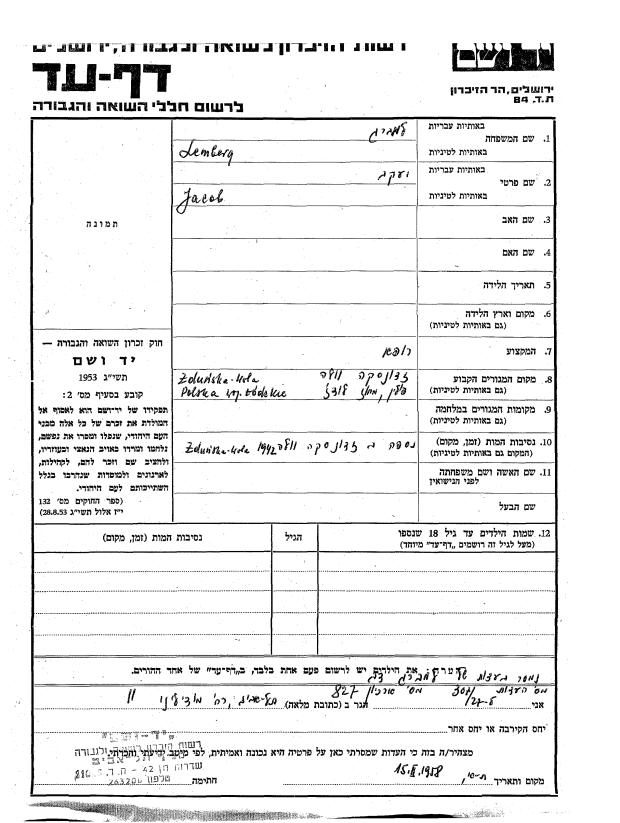
Here’s an image of Lemberg testimony (in Hebrew) from the Yad Vashem database.

On this day..

1864: Martin Robinson, treacherous guide

On this date in 1864, a Union officer frustrated of a design to raid Richmond during the U.S. Civil War hanged a local African-American guide whom he thought had intentionally misled him like Susanin.

The account of an army chaplain attached to the 5th New York Cavalry explains:

The guide, a negro, had misled us during the night, and, to obviate the delay of retracing our steps. Col. Dahlgren, on the representations of the negro that an excellent ford was to be found at Dover Mills, concluded to cross at that point. After two hours’ halt we again moved on, and soon reached Dover Mills, but only to meet disappointment.


Dover Milles, Civil War era illustration

The negro had deceived us, no ford existed at this point nor any means of crossing the river. He then stated that the ford was three miles below: this was obviously false, as the river was evidently navigable to and above this place, as we saw a sloop going down the river.

… he came into our lines from Richmond … [and] was born and had always belonged in the immediate vicinity of Dover Mills, was very shrewd and intelligent, and it would seem impossible that he should not know that no ford existed in the neighborhood, where he had seen vessels daily passing. Col. Dahlgren had warned him that if detected acting in bad faith, or lying, we would surely hang him, and after we left Dover Mills, and had gone down the river so far as to render further prevarication unavailing, the colonel charged him with betraying us, destroying the whole design of the expedition, and hazarding the lives of every one engaged in it, — and told him that he should be hung in conformity with the terms of his service. The negro became greatly alarmed, stated confusedly that he was mistaken, thought we intended to cross the river in boats, and finally said that he had done wrong, was sorry, etc. The colonel ordered him to be hung, — a halter strap was used for the purpose, and we left the miserable wretch dangling by the roadside.

Our correspondent terms this the case of the “Faithless Negro”, but posterity has the luxury of a less paranoiac reading than indulged by a troupe of hotheaded commandos deep in enemy territory all a-panic as their expedition implodes. The James River was just plain swollen with winter rains. Bad luck all around.

A Goochland County marker marks the spot of the botched crossing and subsequent execution.

But we’re really just getting started. Stay tuned for some serious blowback from this bootless military debacle.

The full story of the raid is a tangled and contested affair, but it’s well worth perusing in detail. To sum up:

This expedition’s leader, Col. Ulric Dahlgren, abandoned the effort and in the attempt to fall back, rode into a Confederate ambush the next day. He died in the fusillade, while his men were captured.

The body of this late Col. Dahlgren, on whose authority our misfortunate guide was put to death, was found by the Confederates to bear some startling papers* … indicating that the intent of his ill-starred expedition was not merely to liberate starving northern prisoners, but that “once in the City it must be destroyed & Jeff. Davis and Cabinet killed.”

Within days, the story was abroad and Richmond newspapers floridly outraged at this proposed breach of chivalrous warfare.

Though Confederate General Robert E. Lee was able to quash public demands for the Dahlgren party’s summary execution, the documents may indeed have marked a turning point in the war’s conduct, a public announcement of total warfare sufficient for the South to “inaugurate a system of bloody retaliations.”** If so, it was a well-timed license: the Confederacy was in the process of being steamrolled and would soon require recourse to more desperate strategems.

After Dahlgren, argues Come Retribution: The Confederate Secret Service and the Assassination of Lincoln, “there was an increase in Confederate clandestine activity designed to encourage the antiwar faction in the North to organize and revolt” — even including a mirror-image Confederate cavalry raid on Washington D.C. with an eye towards capturing Lincoln.

There are, in fact, some historians who postulate that it was “bloody retaliation” for Dahlgren’s attempt on the Confederate president that ultimately led southern agents to initiate the late-war plots against Abraham Lincoln’s person — resulting ultimately in Lincoln’s assassination:

Ulric Dahlgren, and [his] probable patron [U.S. Secretary of War] Edwin Stanton set out to engineer the death of the Confederacy’s president; the legacy spawned out of the utter failure of their effort may have included the death of their own president.

That is some blowback.

Books exploring the alleged link between the Dahlgren Papers and the Lincoln assassination

* It must be said that the Dahlgren papers have been continually contested as frauds from the moment they were known, though many historians do indeed consider them legitimate. We are in no position to contribute to that debate, and for the purposes of this post’s narration the question is immaterial: the papers, forged or not, certainly existed, were widely publicized, and genuinely angered many southerners.

** These words are the demand of the March 8, 1864 Richmond Dispatch.

On this day..