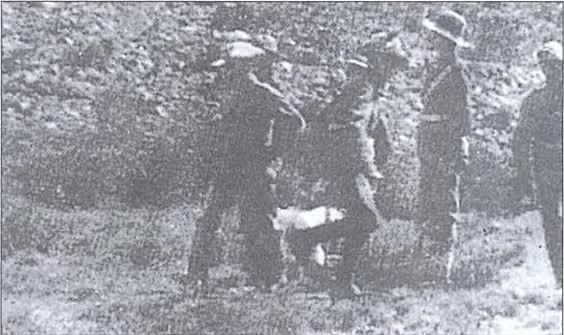
On February 29, 1856, local Chinese officials in Guangxi beheaded French missionary priest Auguste Chapdelaine — and handed his countrymen a pretext for war.
The local mandarin Zhang Mingfeng was no doubt disposed to take such an harsh line against this provocation by virtue of the ongoing, Christian-inspired Taiping Rebellion, which had originated right there in Guangxi and was in the process of engulfing all of southern China in one of history’s bloodiest conflicts.
So Chapdelaine and his associates were snapped up, put to a few days’ dreadful torture, and on this date a Chinese convert and Chapdelaine were both summarily beheaded. (A female convert, Agnes Tsaou-Kong, expired under torture around the same time.)
Pietistic accounts of believers’ last extremes are here and here.
It took months for word of this martyrdom to reach French consular officials, and many months more for the gears of international diplomacy to turn — but when they did so, France pressed a demand for reparations.
Since pere Chapdelaine had been acting illegally in the first place, the Qing’s obdurate Viceroy Ye(h) adamantly refused to offer Paris satisfaction.
By 1858, this intransigence sufficed to license French entry (alongside Britain) into the Second Opium War, from which the Europeans won by force of arms a noxious treaty guaranteeing their right to push Christianity in China, extracting a couple million silver taels in damages, and (of course) assuring their right to traffic opium into China.
It would be rather ungenerous to hold all the ugly imperial consequences personally against our day’s martyr. August Chapdelaine was canonized by the Catholic Church in 2000 as one of 120 Martyrs of China.
China was not impressed by this celebration of a onetime colonial catspaw, and met the Vatican’s “anti-China” celestial promotion announcement with one of its own — charging that Chapdelaine “collaborated with corrupt local officials, raped women and was notorious in those areas [where he preached].”
We’ve previously noted in these pages Francisco del Rosario Sanchez, one of the Dominican Republic’s founding heroes, who in 1861 was shot for propounding independence.
That date, February 27, also happens to be the Dominican Republic’s Independence Day celebration — because a year to the date before her death, Maria Sanchez, her brother, and others of the anti-colonial La Trinitaria proclaimed independence from a bloody 22-year Haitian occupation.
Maria Sanchez, together with another woman named Concepcion Bona, made the first Dominican Republic flag.
Sanchez and Bona’s original flag for the Dominican Republic.
This was all well and good, until the resulting head of state steered the Dominican Republic towards recolonization by Spain, as a hedge against reconquest by Haiti. La Trinitaria types took an understandably dim view of this gambit, so busting them up was part of the deal.
Many of the country’s founding heroes, including brother Francisco, were chased into exile; Maria was rounded up by the new government and tortured for information about the Trinitarian “plots” against the new regime. She refused to name any names, and was shot on the country’s first independence anniversary.
On this day in 1942, the Nazis shot five Jewish men from Sokal, which was then part of Poland and now belongs to the Ukraine.
During the first years of the war, the Germans had designated Sokal as a Judenstadt (literally “Jew-town”), a central destination point for all Jews expelled from nearby towns and villages. Or, as diarist Moshe Maltz put it, “A solitary island in a sea of blood.”
It was Maltz, an Orthodox Jew and native of Sokal, who recorded the executions described in this entry. He kept regular notes throughout the war about the plight of Sokal’s Jews — not a diary exactly, but a chronicle, meant for the benefit of history.
On February 24, five Jews from Sokal were taken to a place somewhere on the outskirts of town and shot. One of them was Yeshaye, son of Yankel the coachman. In 1940, during the period of Soviet occupation, Yeshaye had been a coachman working for the NKVD. Now the Gestapo called him and ordered him to turn over to them the reins of his horses. They said to him, “We’ll give you three days to deliver those reins to us. If we don’t get them by that time, we’ll have you shot.” Yeshaye thought that the Gestapo must be joking. How could he go on working as a coachman without his reins? Unfortunately for Yeshaye, the Gestapo men were in dead earnest.
Also among the five shot was Dr. Knopf, a lawyer who had converted to Christianity. The Germans had ordered him to dismiss his Gentile maid so that she could be sent to work in Germany. Knopf petitioned the Gestapo to let him have his maid back. That’s why the Germans shot him. Despite his baptism, he was simply not an Aryan. The third victim was blind Yankel, who was found guilty of buying and slaughtering a calf. Under German occupation regulations, cattle can be slaughtered only by officially approved butchers.
In October 1942, the Jews of Sokal were confined to a ghetto. The following month Maltz wrote, with the same dispassionate tone, of the murder of his fourteen-month-old daughter at the hands of the Nazis.
Later in November he escaped from the ghetto with his wife and surviving son. They had made an arrangement with a Polish woman who lived nearby, and moved into her hayloft, above the pigsty.
Eventually fourteen people from three families in all would come to live in the hayloft. All of them survived except Maltz’s sister, who died of fever while in hiding. The others staggered out into daylight, barely able to walk, when the Russians liberated the area in July 1944.
Maltz and his entire family eventually emigrated to the USA.
“The sovereignty of a people cannot be argued about, it is defended with a gun in the hand.”
-Sandino
On this date in 1934, the first name in Nicaraguan anti-colonial resistance was abducted and summarily executed by the Nicaraguan National Guard.
From 1927 until his death, Sandino led an armed peasant insurgency from the Nicaraguan mountains against the Yankee imperialists and the domestic dictatorship they backed.
Washington had had its nose (and its marines) in Managua’s business for decades, continuously occupying the Central American country since 1912. The Marine Corps saw this country’s people as
Densely ignorant … little interested in principles … naturally brave and inured to hardships, of phlegmatic temperament, tough, capable of being aroused to acts of extreme violence, they have fought for one party or the other without considering causes since time immemorial … a state of war is to them a normal condition.*
All this was the time of Sandino’s own coming-of-age. The son of a wealthy landowner and his domestic servant, Sandino grew up with the unprivileged and the working classes, eventually asorbing an eclectic mix of that period’s revolutionary ideologies.
From 1927 he took to the Segovia and began writing the playbook for the 20th century guerrilla: mobile infantry irregulars, striking from familiar-to-them forest cover, melting away among sympathetic campesinos.
The “Colossus of the North” — Sandino made no bones about his foe; his personal seal showed an American marine being killed — invariably described him as a “bandit” because he also raided towns to commandeer food, clothing, and medicine.
“Washington is called the father of his country; the same may be said of Bolivar and Hidalgo; but I am only a bandit, according to the yardstick by which the strong and the weak are measured.”
-Sandino
The strong, in this case, found little public appetite for the steady attrition of servicemen, and the U.S. employed a familiar strategy of its own: “Nicaraguanizing” the conflict by building up a National Guard to do the dirty work domestically.
That Guard’s head was headed by Anastasio Somoza — the very son of a bitch of whom FDR said, “but he’s our son of a bitch.”
While it’s hardly the only country to have been favored with an American son of a bitch, you could say that Nicaragua has been the American empire’s very own heart of darkness. Washington’s initial interest in the place after the Spanish-American War concerned preventing a canal project to compete with Panama. It invented dive-bombing to hunt Sandino. And it ranged around the world and outside the law to battle Sandino’s successors under the aegis of a modern imperial presidency.
Small wonder that an official anthem of the movement denounces “The Yankee / The enemy of all humankind.”
In the immediate aftermath of the American departure in January 1933, Sandino began coming to terms with the the country’s new president: the Sandinistas disarmed in exchange for amnesty and land. But Somoza, who at this point was “only” the head of the National Guard, was building up his own power … and he meant to have done with this inconvenient insurgent.
After Sandino left a presidential meeting on this date, at which the erstwhile rebel negotiated for his continuing demand to disband Somoza’s Guardia, Sandino was stopped at the gates by Guardsmen. They took Sandino, his brother, and two of his generals and marched them off to be shot. Then the Guard forcibly broke up the Sandinista remnants. Somoza soon seized official power for himself; his family ruled, and plundered, Nicaragua until 1979. Washington never called them bandits.
While Sandino vanished (the whereabouts of his remains are unknown), his revolutionary vision and praxis also persist down to the present day.
Sandinismo (aging much better than Somocismo) would influence Fidel Castro and Che Guevara during the Cuban Revolution.
The United States, of course, went right back to war against its long-dead “bandit” foe.
* From Julian C Smith’s officially commissioned History of the Guardia Nacional de Nicaragua (1933), as quoted in Michael J. Schroeder’s “Bandits and Blanket Thieves, Communists and Terrorists: The Politics of Naming Sandinistasin Nicaragua, 1927-36 and 1979-90,” Third World Quarterly, Vol. 26, No. 1 (2005).
On this date* in 1799, Constantine Hangerli was deposed from his post as Prince of Wallachia by a Moorish executioner.
A veritable watchword for bad times, Hangerli was one of a clutch of disposable puppet rulers situated on the Wallachian throne by the Ottomans around the turn of the 19th century.
As had often before been the case, Wallachia was sorely pressed at this time by the cumulative exactions of its native boyars, the Ottoman Porte, and the plunder taken by the expeditions of rising Bosnian warlord Osman Pasvan Oglu.
Our man is famous, in particular, for the “Hangerli winter” of 1798, just after his elevation — when a confiscatory tax regime seized most of the countryside’s lifestock. Hangerli had a message for the generally currency-poor common man who objected to the much-despised per-head duty on cattle.
Pay the taxes, and you won’t be killed.
Hangerli’s real problem this year wasn’t the unmourned misery of his overtaxed serfs, but the Ottoman commander sent to rein in the Bosnians. Pasvan Oglu whipped that expedition, and its general Hussein Kucuk turned up at Hangerli’s doorstep late in 1798.**
Since it was dangerous for Ottoman generals to lose, Kucuk evidently arrived intending to put some blame on Hangerli — or at least, Hangerli thought that was the case. Secret dispatches from both parties to Istanbul ensued.
Whoever it was who schemed first, Kucuk schemed best. Selim III (later to die of palace scheming himself) decreed Hangerli’s immediate execution and dispatched a kapucu, one of the frightening envoy-executioners (two different men, in this case) who carried such decrees to their victims.
* I believe this may be per the Old Style/Julian date still in use in the Orthodox world.
When the Nazis attacked the house at 29 Kupiecka Street, rounding up all of its residents into the street, a bold young man, Izchok Malmed, whipped out a jar of acid from his pocket, hurling it in the face of a Nazi soldier, who was blinded at once. Seeking revenge, the sightless Nazi fired his revolver several times, hitting another Nazi soldier and instantly killing him. In the melee, Malmed vanished.
Commandant Friedl, after learning what had happened, ordered that one hundred men, women and children living in the area where the incident occurred be rounded up and force-marched to a nearby garden, where they were lined up against the wall of an adjacent bet hamidrash and shot with machine guns.
Afterward Nazi soldiers captured another group of Jews, forcing them to dig a large pit for the bodies of the one hundred martyrs. A thin layer of earth covered them. Some were still alive, their hands groping upward through the earth.
The Nazi soldier accidentally shot by his colleague whom Malmed had blinded was carried to the Judenrat building, and his body was placed on [Judenrat Chairman Efraim] Barasz’s desk. Friedl then proclaimed to Barasz, “See what your Jewish criminals have done. Now we shall take revenge. You shall see what we can do.” Friedl issued an ultimatum for the perpetrator of the crime to surrender within twenty-four hours. Failing that, the entire ghetto would be destroyed with everyone in it.
Barasz knew the Nazis meant what they said. He sent word to Malmed to give himself up and thereby save thousands of Jewish lives. As soon as Malmed heard, he surrendered himself to the Nazis.
Tamarof’s diary described in detail Malmed’s courage. Asked why he killed the Nazi soldier, he replied: “I hate you. I regret I only killed one. Before my eyes my parents were murdered. Ten thousand Jews in Slonim were liquidated before me. I have no regrets.” Tamarof tried to slip poison to Malmed but failed. Even the police could not get near the prisoner.
The next morning, Izchok Malmed, a hero of the ghetto, was hanged in the square where he had performed his act of courage. Despite the horrible torture to which he had been subjected, Malmed cursed the Nazi murderers. After several minutes of hanging on the gallows, the rope broke and the body fell to the earth. Instantaneously, the Nazis riddled Malmed’s corpse with bullets and re-hanged the body for another forty-eight hours.
Kupiecka Street was renamed Malmed Street after the war. Near the site of Malmed’s execution is a plaque reading, in Polish and in Hebrew, “Icchok Malmed, the hero and fighter of the Bialystok Ghetto, was killed here by the Nazi murderers on 8 February 1943. In his honor.”
* The Zchor account spells his name “Izchok” but on the memorial plaque it says “Icchok”. It’s a form of the name Isaac.
“I decapitated with my blessed right hand the head of the American Jew, Daniel Pearl, in the city of Karachi, Pakistan. For those who would like to confirm, there are pictures of me on the Internet holding his head.”
Warning: Although the filming was botched, this execution video still has plenty of gore and a severed head.
On this date in 2002, American hostage Daniel Pearl was executed by his captors in Karachi, Pakistan.
The 38-year-old Wall Street Journal reporter had been abducted January 23 by Islamic radicals while pursuing an interview with a (mistakenly) suspected handler of shoe bomber Richard Reid. Instead of being taken to the interview, Pearl was disappeared and held hostage for a variety of implausible demands targeting the United States’ relationship with Pakistan’s military government.
The reporter’s death this day was not confirmed until late February, when his killers released a video on the Internet interspersing images of American and Israeli violence with footage of Pearl speaking — and then, horrifically, of Pearl being beheaded with a knife.** It was the first of several hostage–beheading videos various militants would release in the next few years.
Pearl’s captors drew a direct line from his Jewishness to his murder in the statements they forced him to make:
My name is Daniel Pearl. I am a Jewish American from Encino, California USA … I come from, uh, on my father’s side the family is Zionist … My father’s Jewish, my mother’s Jewish, I’m Jewish … My family follows Judaism. We’ve made numerous family visits to Israel … Back in the town of B’nei Braq there is a street named after my great grandfather Chayim Pearl who is one of the founders of the town.
It was the more startling because Pearl himself was a very secular Jew. Pearl did not set out to be a martyr for his cultural or religious heritage: that identity as the identity was thrust upon him.
And it’s been suggested that it was thrust upon Pearl’s captors as well, whose object in kidnapping an American reporter might have been a much more parochial kidnapping commonplace — publicity, cash — but who became politically boxed in when their hostage was publicized by the media as a “Jewish-American reporter”. One of the emails the captors had pre-drafted actually announced Pearl’s release. It was edited after the kidnapping … to announce Pearl’s execution within 24 hours, as a Mossad agent. Al-Qaeda’s Khalid Sheikh Mohammed seems to have been summoned from outside the abductors’ circle as a ringer with the captors unsure of how to dispose of their prey.
As an investigative reporter, Pearl’s own work had in some notable instances countered the preferred narratives of American hegemony. For instance, his reporting rubbished American charges that the Khartoum pharmaceutical factory Bill Clinton ordered bombed in 1998 was actually a chemical weapons plant. His work in Kosovo led him to contradict the most bellicose “genocide” allegations from that region’s dirty ethnic war.
He was a star reporter in the prime of his life, a man who poured out words that defined a career and a public persona. From February 1, 2002, suddenly and without justice, that text was torn from his hands. In its place, during the charged months after September 11 and the American invasion of Afghanistan, came a silent Rorschach blot.
Pearl, the Jewish martyr. Pearl, the victim of blowback. Pearl, the journalistic icon. Pearl, the naive liberal in the heart of darkness. Pearl, the mandate for waterboarding and Iraq.
Pearl, the object lesson.
Pearl, the axe for others’ grinding.
Omar Sheikh, a Pakistani militant reportedly linked to Britain’s MI6 and the author of the kidnapping, was arrested within days of Pearl’s murder. He remains imprisoned under sentence of death in Pakistan for the crime.
* Mohammed also claimed that he wanted to kill Pearl personally to “make sure I got the death penalty” if he were eventually arrested.
** Among the many bone-chilling details to emerge from the subsequent investigation, it became clear that the actual murder was not shown — only some quick flashes of re-enacted throat-cutting — because the cameraman missed the shot of the kill.
On this date in 1536, Bernhard Krechting, Bernhard Knipperdolling, and Jan van Leiden were chained to stakes in the Münster public square, tortured with flesh-ripping tongs for more than an hour, killed with daggers thrust into their hearts, and their remains hoisted in cages in the city cathedral as a warning against any kindred misbehavior in the future.
Detail view (click for the full image) of Jan van Leiden et al being put to death in Münster. In the background, the Lambertuskirche spire shows the three cages in which the victims’ remains were gibbeted.
And the point was taken: the appalling deaths of these men also marked the death of early Anabaptism’s pretensions to secular political power.
These three unfortunates were the top surviving leaders of the Münster Rebellion, a revolution that turned that city into an Anabaptist commune for more than a year.
Just a few years before, southern Germany had been shaken by an apocalyptic peasant rebellion led by Thomas Muntzer, a sort of proto-Anabaptist.*
Though northern Germany was spared that particular maelstrom, that same religious tension and social discontent soon blew a hyperborean wind.
In the early 1530s, “Melchiorites” — Anabaptist followers of radical preacher Melchior Hoffman — proliferated rapidly among workers of the long-prosperous but now-waning Hanseatic territories in northern Germany and the Low Countries.
And these converts did not intend the meek example of evangelical martyrdom. They meant to rule.
In 1535, Democratic-Anabaptist types stormed the Amsterdam city hall; in a separate action, others seized and fortified a Friesland monastery before being overrun. An allied movement, less theologically distinct, won temporary control of Lübeck in 1533, before being expelled by force of arms.
Only in Münster did the Anabaptists realize the full flower of their project, albeit for a very brief period of time. Winning power over the course of the year 1533 by dint of internal politicking, energetic recruitment, and fortuitous imperial distraction, Münster Anabaptists booted out the 1% and started turning the place into a visionary “New Jerusalem.”
Among those visions, the most notorious was polygamy (pdf), introduced by Jan van Leiden when he inherited leadership after the charismatic firebrand Jan Matthys died in a sortie against a siege in April 1534. The story has it that van Leiden wanted to marry Matthys’s attractive widow Divara, though whether motivated by considerations of the loins or legitimacy is up to the reader’s good conscience.
There’s quite a controversial historiography surrounding their polygamous turn: while contemporary enemies were pleased to ascribe it to libertine devilries, German Communist intellectual Karl Kautsky vociferously defended the Münster Anabaptists — arguing that they resorted to polygamy for social stability when the gender disparity in the city had fallen past 3:1 owing to the vicissitudes of war.
And war, as Kautsky noted, was the commune of Münster’s essential condition, just like that of Paris.
Community of goods was the basis of the whole Baptist movement. For its sake the great fight was waged at Münster. It was not, however, the chief factor in determining the character of the Münster Baptist government, that factor being the siege. The town was a great war-camp; the demands of war took precedence of all other matters, and sentiments of freedom and equality were active only in so far as they were compatible with military dictatorship.
Jan van Leiden, by this time dignified the “King of Jerusalem”, was taken along with two of his chief aides and designated for this superlative punishment (many others less exalted faced less exalted executions, too).
For decades after the execution, the Anabaptists’ remains rotted publicly in cages on the tower of St. Lambert’s — like these still displayed there to this day. (cc) image from Rüdiger Wölk, Münster.
For Anabaptists as a whole this catastrophe commenced a long period of persecution and reckoning. But from such travails would the movement leave its mark. Indeed, it was also in January 1536 that a young Dutch priest named Menno Simons accepted adult baptism … and began a religious career that would make him the founding namesake of the Mennonites.
Dan Carlin’s “Hardcore History” podcast treats the Münster rebellion here.
On this date in 1880, Andrew George Scott and Thomas George “condemned to death for the part they took in the outrage at Wantabadgery, resulting in the death of constable Bowen, were executed at Darlinghurst Gaol.”
Andrew George Scott, aka Captain Moonlite (top); Thomas Rogan (bottom)
Scott is our main man here, an Anglican lay reader turned grifter turned flat-out outlaw with the nom de plunder “Captain Moonlite”: one of the strangest characters in Australia’s criminal annals.
How did a fellow with such a family-friendly alias end up involved in an “outrage”?
This colorful, charismatic immigrant (from Ireland, via New Zealand — and, legend has it, with a side trip to Italy to fight with Garibaldi) became a notorious public figure when, in outlandish masked getup, he robbed the bank of the South Victoria gold rush town of Mount Egerton.
His distinctive voice — remember, he was a parish reader — was recognized by his erstwhile friend at the other end of the gun, but Scott brazenly reversed the accusation and actually had his victim in the dock for a time. This Mount Egerton crime is the source of the man’s luminescent nickname, after the signature placed on a stickup note.
When he got out of prison in 1879 — having defended himself with panache, and escaped once along the way — he had a public profile, and actually got out on the lecture circuit for a brief spell.
But he soon returned to the annals of preposterous criminality.
Gathering five young followers, Moonlite went full-time into the bush. Allegedly spurned in a bid to join Ned Kelly‘s gang, Moonlite et al sought work at Wantabadgery Station.
When this refuge, too, turned them away, the outlaws found themselves in a rather pathetic state of hunger and desperately seized the place by main force. The resulting “outrage” was not a wholesale plunder of the station or wanton abuse of the prisoners (no rapes, no murders … although Moonlite did conduct a kangaroo “trial” of one of his hostages for attempting to escape: the verdict was not guilty): it was the inevitable ensuing shootout with police in which the bushrangers James Nesbitt and Augustus Wernicke died, along with the constable Bowen.
Two of the other three who survived this shootout also survived their brush with the law by blaming Captain Moonlite. The “Captain” may have been plenty eager to accept this fatal inculpation for reasons beyond those of mere honor.
In his prolific prison correspondence awaiting execution, Scott avowed his broken-hearted love for James Nesbitt, one of the two companions who had been killed in the shootout. The terms are astonishingly explicit for the time.
“My boy with a golden heart who died trying to save me … He was my constant companion; we had the deepest, truest bond of friendship. We were one heart and soul, he died in my arms and I long to join him, where there shall be no more parting. He died in my arms; his death has broken my hear. When I think of my dearest Jim, I am nearly driven mad. My dying wish is to be buried beside my beloved James Nesbitt”
Scott hanged wearing a ring of the late Nesbitt’s hair,* but his wish to share a burial plot was not honored — until Captain Moonlite was exhumed and reburied in 1995.
On this date in 1902, Kommandant Gideon Jacobus Scheepers was shot by the British for his exploits in the Boer War.
The young Dutch-descended Scheepers (here’s his Afrikaans Wikipedia page) was a soldier from the still-independent Boerstates which were being reduced in this war to British dependencies.
In 1901, late in the proceedings, Scheepers took a column of irregulars into the British Eastern Cape Province and wrought havoc behind the lines. Some exploits are the stuff of legend, like the time he rode into a town, released all the Boer prisoners, locked up the British magistrate, and hauled down the Union Jack — to the delight of the Boer locals.
He would spend that year giving the British much better than he got, but the war was also infamously dirty.
According to David Harrison’s The White Tribe of Africa: South Africa in Perspective, “Scheeepers’ men also flogged and shot natives who helped the British, looted as well as burned farms, and executed Boer ‘traitors’.”
Was any of that criminal?
Since Scheepers was over enemy lines, the Boers who joined him could be held liable for treason … but that didn’t hold for Scheepers himself. His execution turned on holding these unsavory acts as war crimes: his 30-count charge sheet included seven arsons, seven murders, and various and sundry abuses of prisoners and blacks. Scheepers was really sore about the last; natives were supposed to be kept out of the fighting, but the prisoner very credibly insisted that the ones he “murdered” were under arms as scouts for the British.
“We Afrikaners will never find justice under the English,” Scheepers wrote as a prisoner. “Everything is for the kaffirs.”
(There’s a vociferous defense of Scheepers from a pro-Boer history here, and a more sober one by a London press correspondent here.)
Scheepers is read the death warrant on January 17, 1902 — before Graaf-Reinet townspeople assembled by British orders.
For non-Loyalist Boers and for many throughout the world — the U.S. House of Representatives even moved a resolution calling for Scheepers to be accorded POW status according to the Geneva Convention — it smacked of a setup.
Gideon Scheepers (mostly obscured by his guards) tied to a chair for execution.
Just shot, Gideon Scheepers slumps backward in his chair.
While martyrdom guaranteed Scheepers a lasting legacy, bizarre posthumous turns helped elevate it into legend. When the dead man’s family turned up after hostilities to retrieve his bones, the grave turned out empty, leading to a years-long saga with colorful frauds presenting bogus remains, a mentally ill man doing the Grand Duchess Anastasia act and claiming to be Scheepers, and the actual corpse remaining stubbornly elusive.
The bereaved mother’s ultimately fruitless search for her son’s final resting place inspired the poem “Gebed om die Gebeente”(“Prayer for the Bones”), by D.J. Opperman. (Here’s a translated version.) That verse was recently set to music as a cantata by composer Hendrik Hofmeyr.
Scheepers’ allies, however, had simply been beaten in the field. On May 31, 1902 they capitulated to the British.
If we are asked why in 1978 a memorial should be erected for a man who died in 1902, then the answer is simple. The life and work of this man was such that history placed him in the heroes’ gallery and nothing and no one can deprive him of that place.

 Chapdelaine (English Wikipedia page | French) had gone illegally to the Chinese interior to proselytize Christianity.

 Martyrdom was the family business.

 From 1927 until his death,
  A veritable watchword for bad times,


 The young Dutch-descended Scheepers (