1637: William Schooler and John Williams

(Thanks for the guest post to Robert Wilhelm, author of the Murder By Gaslight historic crime blog, and of the book Murder And Mayhem in Essex County. Executed Today readers are sure to enjoy Wilhelm’s detailed investigations into long-lost historic crime. -ed.)

On September 28, 1637, two men convicted on separate counts of murder in the Puritan colony north of Boston — in what is now Essex County — were executed on the same gallows. The first was William Schooler, convicted a year earlier of killing Mary Scholy on the path to Pascataquack; the second was John Williams convicted of killing John Hoddy near Great Pond in Wenham.


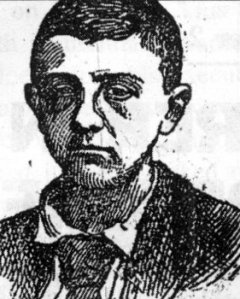
Original (c) image from Murder And Mayhem in Essex County, used with permission.

In the autumn of 1636, an Agawam Indian walking through the Winnacunnet woods, north of the town of Newbury, found the body of a young white woman, lying in a thick swamp about three miles north of the Merrimack river. From the condition of the body, he could tell that the woman had been dead for several months. She lay naked, with her clothing still in a pile not far from the body. The Indian took the news to Newbury, and led the Englishmen to the spot so they could see for themselves.

The woman’s name was Mary Sholy. She was identified more by the circumstance than by appearance, since the flesh had begun to rot. Mary had left Newbury several months earlier, traveling north to her home at the English settlement at Pascataquack. The people of Newbury were also fairly certain who had killed her; they believed she had been ravished and murdered by the man she had hired to guide her journey home, an outsider named William Schooler.

In London, England, William Schooler had been a vintner with intemperate habits. Schooler was, by his own admission, a common adulterer. After wounding a man in a duel he fled to Holland to escape the law; then, leaving his wife behind, he traveled to New England. In 1636 he was living in a shack by the Merrimack River within the limits of Newbury but outside the boundaries of sanctioned Christian behavior.

Mary Sholy, a servant girl, was looking for someone to guide her to Pascataquack, to return to her master. Pascataquack — now Portsmouth, New Hampshire — was a small settlement, about twenty-three miles north of Newbury. It is not known why Mary Sholy had come to Newbury; it is unlikely that her master would have sent her there without providing a guide back. The journey from Newbury to Pascataquack would have been too perilous for a young woman to take alone, first crossing the Merrimack River in a canoe, then following the route to Pascataquack, which was described as little more than a path through the woods. In 1636, even the well-traveled path between Ipswich and Newbury was too narrow for a horse cart. In addition to the possibility of losing her way and becoming hopelessly lost in the woods between the two settlements, there was a very real danger of being attacked by wild animals or hostile Indians.

Seeing an opportunity to make a little money, William Schooler sought out Mary and offered to guide her home for fifteen shillings. He did not tell her that he himself had never made the trip to Pascataquack before. Two days after their departure, William Schooler was back in Newbury alone. When asked why he had returned so soon Schooler replied that he had guided Mary to within two or three miles of Pascataquack, where she stopped, saying she would go no further. Schooler left her there and returned to Newbury.

The people of Newbury remained suspicious and Schooler was questioned by the magistrates in Ipswich. When he returned from the trip he had blood on his hat and a scratch on his nose the “breadth of a small nail.” He explained that the blood was from a pigeon he had killed and the scratch on his nose was from walking into some brambles. He was released, as there was no evidence then that a crime had been committed.

The following year the Pequod tribe took up arms against the English colonists and Schooler was drafted to serve in the militia. He deemed this service to be an oppression and publicly spoke out against it. His outspoken opposition was considered “mutinous and disorderly,” and the governor issued a warrant against him. When he was arrested, Schooler assumed it was about Mary Sholy and began to vehemently defend himself against the charge of her murder. Schooler;s behavior made the magistrates suspicious and, since they now knew Mary Sholy had been murdered, they decided to reopen the case.

Newbury residents who knew him came forward to volunteer information on Schooler’s character. In a Puritan court the character of the accused was as important as the physical evidence against him.

Schooler denied that he murdered Mary Sholy but the jury found him guilty and he was sentenced to hang. The court and the clergy tried desperately to persuade Schooler to confess but he would not. Schooler was contrite, saying he had told many lies to excuse himself, but vehemently denied that he had killed or ravished Mary Sholy. Some ministers argued that the evidence against him was not sufficient to take away his life, but Governor Winthrop denied Scholler a reprieve, saying: “but the court held him worthy of death, in undertaking the charge of a shiftless maid, and leaving her (when he might have done otherwise) in such a place, as he knew she must needs parish, if not preserved by means unknown.”


John Williams was a ship carpenter who had recently come to America from England. In 1637, he was in prison in Boston for theft. Williams and another prisoner, John Hoddy, escaped from the jail and traveled north. They had gone beyond Salem and were on the road to Ipswich, on the east end of the Wenham Great Pond when they had a falling out. The two men had a fight that ended with the death of John Hoddy.

There are two versions of what happened next. In one story John Hoddy’s dog held Williams at bay until the noise drew the attention of enough residents of Wenham to apprehend Williams and take him to jail in Ipswich. The more likely story says that Williams took everything belonging to Hoddy, including his clothes, and buried his body under a pile of stones. Williams proceeded to Ipswich where he was apprehended, after having been recognized as a criminal. Though his clothes were bloody when arrested, he would confess to nothing until a week later, when the body of John Hoddy was found. Cows at a farm near Great Pond smelled the blood and made such a “roaring” that they got the attention of the cow keeper, who on investigation found Hoddy’s naked body under a heap of stones.

Around the same time the justice of the peace in Ipswich learned that both Williams and Hoddy were escaped prisoners. Williams was indicted for the murder of John Hoddy and tried by the Court of Assistants in Boston. Though he confessed to the murder, the court insisted on enforcing Williams’s right to due process, and tried the case before a jury. Williams was, of course, found guilty and sentenced to death.

The double hanging, on September 28, 1637, took place on Boston Common, where all executions in the Massachusetts Bay Colony were held.

Get Murder and Mayhem in Essex County here.

On this day..

1944: Noor Inayat Khan, SOE operative

(Thanks to Meaghan Good of the Charley Project for the guest post. -ed.)

On either September 12 or (as we’re going with here) the early hours of September 13* in 1944, 30-year-old French spy Noor Inayat Khan (also known as Nora Baker, or by her code name Madeleine) was executed at Dachau for her activities on the behalf of the Resistance in Nazi-occupied France.

Noor, the first woman radio operator to be sent into France, came from a rather unusual background: her father was a Sufi religious leader descended from Indian royalty, and her mother an American from New Mexico.

Born in Russia, raised in England and France, Noor studied psychology and wrote poetry and a book of Buddhist-inspired short stories before the war intervened and her she and her family fled to England.

Although Noor had strong pacifist leanings, she decided to join in against Nazi Germany. Because she was fluent in French and English and was a good radio operator, they decided to send her to France. She went in June 1943.

Many of those who had trained her had grave doubts about her suitability as a spy. As part of her Sufi upbringing she had been taught that lying was the worst of all sins. Leo Marks, who taught her cryptography, later wrote his initial impressions of her in his book Between Silk and Cyanide:

She was cycling towards her ‘safe-house’ to practice transmitting when a policeman stopped her and asked what she was doing.

“I’m training to be an agent,” she said, “here’s my radio — want me to show it to you?” She then removed it from its hiding place and invited him to try it. […]

She’d been so startled by an unexpected pistol-shot that she’d gone into a Sufi-like trance for several hours, and finally emerged from it to consult a Bible.

Once in France, however, she displayed lion-like courage.

Even when the Nazis were making mass arrests of the French agents she associated with and the British forces offered to let her come home, she refused to desert her post.

After three and a half months she was betrayed, and pacifism notwithstanding she fought so furiously on arrest that her Nazi guards were afraid of her. In spite of considerable pressure (and we know what that means) she refused to provide them with any information about herself or her Resistance colleagues. On top of all that, she also made two escape attempts.

They decided to send her to Germany to better keep an eye on her.

Noor spent the rest of 1943 and most of 1944 in prison in KahrsruleKarlsruhe, subject to repeated interrogations by the Gestapo. She never gave anything away. In September 1944 she was sent to Dachau and shot to death with three other female agents — Yolande Beekman, Madeleine Damerment, and Eliane Plewman — their bodies cremated.

Her last word? “Liberté.”

After her death she was awarded with the French Croix De Guerre and the British George Cross, and made a Member of the Order of the British Empire. Shrabani Basu published her biography, Spy Princess, in 2007 … and there’s a memorial in the works for her for London’s Gordon Square.

* Not everyone buys these dates or the story of these SOE agents’ execution.

On this day..

1942: Ten for Meir Berliner’s murder of a Treblinka officer

(Thanks to Meaghan Good of the Charley Project for the guest post. -ed.)

On September 11, 1942, Meir Berliner, an inmate of the Treblinka Extermination Camp, stabbed Unterscharführer Max Bialas to death with a penknife during evening roll-call. The Nizkor Project summarizes:

Max Bialas

At the evening roll-call of the prisoners, Max Bialas instructed those who had arrived that same day to line up on the side. It was not clear who was to be liquidated — the new arrivals or those who had arrived earlier. At that moment Berliner jumped out from the ranks of the prisoners, lurched toward Bialas and stabbed him with a knife. A great commotion followed. The Ukranian guards opened fire. Berliner was killed on the spot. and in the course of the shooting more than ten other prisoners were killed and others were wounded. When the tumult subsided the prisoners were lined up again for roll-call. Christian Wirth, who was in Treblinka at the time, arrived on the scene accompanied by Kurt Franz, the second in command of the camp. Ten men were removed from the ranks and shot on the spot in full view of all the others. On the following day, during the morning roll-call, another 150 men were taken out, brought to the Lazarett [the so-called “hospital” which was in fact an execution site] and shot there.

Little is known about Berliner.

According to the testimony of fellow-inmate Abraham Krzepicki, he was a middle-aged Jewish citizen of Argentina who had lived in that country for many years.

He and his wife and young daughter traveled to Poland on vacation in the summer of 1939. They could have picked a better time: when Germany invaded on September 1, 1939, the Berliners were unable to return home. Their Argentine passports should have protected them, but they ended up in the Warsaw Ghetto and were transported to Treblinka. Berliner’s wife and child were gassed immediately, but he was spared to work.

This reprieve would be expected to last days, or a few weeks at the most before he too would go to the gas chamber. Berliner became consumed with rage and the thirst for revenge, supposedly saying, “When the oppressors give me two choices, I always take the third.”

And so he took the first opportunity he could to kill one of his tormentors. As Yitzhak Arad said in his book Belzec, Sobibor, Treblinka: The Operation Reinhard Death Camps*: “His was an individual act of heroism and despair.”

As he must have known he would, Berliner died a horrible death — according to Krzepicki, he was beaten to death with a shovel.

Ironically, following Bialas’s murder, conditions for prisoners at Treblinka actually improved.

This was strictly for pragmatic reasons, as Arad noted: “The Jews selected for temporary work were a danger to the Germans, and the Berliner incident had proved it … When people knew they had nothing to lose, an act of despair like that of Meir Berliner could happen again and again.”

Rather than constantly killing and replacing their workers, the Nazis in charge of the camp decided to create a permanent staff of prisoner-workers and treat them with relative humanity. In this way, they hoped to prevent further acts of suicidal violence on the part of the Jews.

The existence of a permanent cadre of workers made it possible to plan and organize a revolt and mass escape from the camp. In August 1943, after months of conspiring and gathering the necessary weapons, the inmates killed most of the guards and made a run for it. About 300 or so actually made it outside of camp; of those, approximately 60 would survive the war.

* Operation Reinhard is presumably named for Reinhard Heydrich.

On this day..

1943: Phillip Coleman, the last man hung in Montana

(Thanks to Meaghan Good of the Charley Project for the guest post. -ed.)

On September 10, 1943, multiple murderer Phillip “Slim” Coleman Jr. was hanged in Missoula, Montana.

The African-American Coleman would be the last man judicially noosed in that state, and Montana didn’t execute anyone else at all for more than fifty years. (Duncan P. McKenzie died by lethal injection in 1995 to end the drought.)

Coleman started his crime spree when he battered to death eighty-year-old Andrew J. Walton on July 3. The octogenarian was still alive when his sister found him the next morning, but he died in the hospital the next day without ever regaining consciousness.

With no witnesses or leads, the case quickly went cold.

On July 24, Coleman another man, Lewis Brown, were hired to work on the Northern Pacific Railroad thirty miles from Missoula. They had arrived at the train stop separately and it’s unclear whether they knew each other before, but on the same day they were chummy enough to start plotting to rob and kill their boss, Carl W. Pearson.

Late that night, Coleman went to Pearson’s home, woke him up and said Brown was ill and he had to come. Pearson grabbed a bottle of aspirin and headed out. There in the yard, Brown struck him on the head behind and left his body in the yard. Coleman went back inside, found Pearson’s wife Roslyn, and stabbed her to death in her bed.

The men spared the couple’s child, seven-year-old Richard; it was he who found the bodies the next day.

The murderers collected their loot, divided it between them and went their separate ways. Brown and Coleman were almost immediately identified as the prime suspects in the murder and picked up: Brown the day after the killings, and Coleman the day after Brown. Coleman was charged with Roslyn’s murder and Brown was charged in Carl’s death. Both were convicted, but Brown got only a life sentence and Coleman got the death penalty.

The condemned Coleman converted to Catholicism after his conviction, then, attempting to cleanse his soul, he summoned the sheriff and confessed to Andrew Walton’s murder. He had been a suspect since his arrest in the Pearson case, since the crimes were so similar, but had previously denied any knowledge of Walton’s death. Coleman got all of twelve cents, he said, from robbing Walton.

Amateur historian R. Michael Wilson, writing of the case, said, “He asked the sheriff to keep his confession secret in case the governor had a last minute change of heart and decided to grant a reprieve or communtation.”

Coleman’s hanging went off without a hitch.

On this day..

1937: Andrei Stepanovich Arzhilovsky, counterrevolutionary kulak

(Thanks to Meaghan Good of the Charley Project for the guest post. -ed.)

On this date in 1937, a 51-year-old Russian peasant by the name of Andrei Stepanovich Arzhilovsky was executed by firing squad, having been convicted of membership in a “counterrevolutionary kulak sabotage organization.”

Arzhilovsky, who had five young children by the time of his death, was evidently a nefarious thought-criminal with a record. He had sufficient literacy to join the regional administration in the nineteen-teens, which led to his arrest in 1919 in the wake of the October Revolution of two years previously.

He denied having ever persecuted Communist sympathizers, but a revolutionary tribunal sentenced him to eight years in prison.

Released after an amnesty in 1923, Arzhilovsky returned home, took up farming again, joined the peasant cooperative and took up a number of other minor civic posts. He owned 8.1 hectares of cultivated land, a house and outbuildings, two horses, two cows and other livestock. He was classified as a farmer of average means — that is, not a kulak or class enemy — but in 1929 he was convicted of “counterrevolutionary agitation” and sentenced to a decade in a labor camp.

In 1936, Arzhilovsky was released from detention early for health reasons. They expected him to go home and die, but instead he took an accounting job at a factory.

Perhaps frustrated by Arzhilovsky’s refusal to expire, the NKVD “uncovered” the “conspiracy” that lead to his death sentence. Under interrogation, he had to admit his opinions weren’t purely Soviet. Perhaps that alone was enough.

Arzhilovsky was a simple farmer, just one of the millions who died during Stalin’s Great Terror from 1936-1938. He probably would have been forgotten entirely today were it not for the forty-page diary he kept during the year prior to his death.

It was confiscated by NKVD agents when they searched his home. The diary was translated and published in 1995 in an anthology of several others from that period, under the title Intimacy and Terror: Soviet Diaries of the 1930s.

On this day..

1890: Otto Leuth

(Thanks to Meaghan Good of the Charley Project for the guest post. -ed.)

On this date in 1890 at the Columbus Penitentiary in Ohio, a sullen German-American teenager named Otto Leuth (sometimes spelled “Lueth”) paid with his life for the brutal murder of his seven-year-old neighbor, Maggie Thompson.

John Stark Bellamy II, writing of the murder in his book The Corpse in the Cellar: And Further Tales of Cleveland Woe, noted how familiar the case sounds to modern ears:

[T]he sickening murder of an innocent child; yet another child accused for the dreadful deed; a sensational trial, replete with dubiously “expert” testimony, suspicious “confessions,” allegations of police “third-degree” methods, and charges of biased press; not to mention “latchkey” children, systematic child abuse, saccharine sympathy for the guilty, and charges of ethnic favoritism.

Yet it happened over a century ago.

Otto, sixteen at the time he killed little Maggie Thompson, had had a hard life, as Bellamy explains in his book. His mother, Lena, testified at his trial that she

went into veritably demonic fits of rage, during which she was in the habit of physically abusing her children, especially Otto. From an early age, she blandly admitted, she had pulled his hair, kicked him, beaten him, walked on him, and often hit him with any object that came to hand. Once, when Otto was eight, she had beaten him with a chair leg and, when [Otto’s father] Henry tried to intervene, stabbed Henry twice with a convenient butcher knife. Just a few months before Maggie Thompson’s murder, Lena had repeatedly slammed Otto’s head into a wooden door.

It speaks volumes of the difference between that century and this one that nobody who heard Lena’s testimony seemed to think this was in any way excessive, never mind cruel; on the contrary, one person praised her methods as being “good German discipline.”

On May 9, 1889, sixteen-year-old Otto was alone at his family’s home at 47 Merchant Avenue in Tremont, a suburb of Cleveland. He was used to being alone: his mother had been committed to a mental hospital some months before, his father was wrapped up in his cabinet-making business, and his older brother had moved out of the house.


Otto (top) and his victim.

That morning, down the street at 24 Merchant Avenue, Maggie Thompson set off for school. Her mother, Clara, dropped her off at the front gate; it was the last time she would see her daughter alive.

Maggie attended the morning classes and, when school was dismissed for lunch at 11:15 a.m., started on the four-block walk home. En route, she vanished without a trace, as if “the sidewalk might have opened and swallowed the girl.”

Naturally there was a frantic search, lead by her devastated parents and the Cleveland Police Department, who tore the city apart looking for her.

But, although there were numerous false sightings and a few wild stories about Maggie’s disappearance, in spite of everyone’s efforts they couldn’t find her.

Otto participated in the search, along with most of the neighborhood. Nearly every day he would approach Clara Thompson and solicitously ask if she’d heard any news of her child.

In early June, Clarissa Shevel, the woman who lived with her husband in the back of the Lueths’ two-family house, asked Otto to do something about the terrible stench that pervaded the entire building. Otto suggested the odor was caused by a dead animal. He bought some chloride of lime and put it in the ventilation hole, then burned some sulfur, but it didn’t help.

Around that time he was witnessed carrying some badly stained bedding to the smokehouse at the back of the property.

On June 9, Otto’s mother Lena, who had by now been discharged from the mental hospital, became fed up with the smell and sent her husband Henry down to the cellar to investigate. He came back up a few minutes later, deeply shaken, and ran out to find a policeman.

In the Lueths’ cellar was the nude corpse of Maggie Thompson.

She was wrapped in one of Lena’s dresses and her own clothes lay underneath her. She had been beaten to death and her body was so badly decomposed that her parents had to identify her by scars on her hips.

The police promptly arrested everyone who lived at the house: Henry and Lena Lueth, Clarissa Shevel and her husband, and Otto, who was picked up on his way home from the ice cream parlor. All five suspects were separated and subjected to a serious “sweating,” but Otto was the prime suspect. He had a reputation as a bully, and he’d been at home alone for much of the previous month.

Bellamy records:

The climax came at 3:30 a.m., when an agonized female shriek resounded from the floor below the sweating room. “Who is that?” cried Otto to Detective Francis Douglass. “Your mother, I believe,” replied Douglass. “She had nothing to do with it!” blurted out Otto. “Who did?” queried Douglass. Otto: “I did it! I did it!” Douglass: “Did what, Otto?” “I killed her! I killed her! Please give me your revolver so I can kill myself!”

Resisting the temptation, the police instead took his verbal confession, wrote it down, had him sign it and escorted him to a cell.

Otto said he had been standing outside his parents’ home at about 11:30 a.m. on May 9 when he encountered Maggie. She asked him if he could donate any buttons to the “button-string” she was making, and he said he had four and would give them to her if she came inside.

Maggie obediently followed him in, and he led her upstairs to his bedroom, where he attempted to rape her. When she screamed, he hit her with a nearby hammer.

Otto said he thought he’d probably killed her with the first blow, but he kept striking her until her head was a pulp and the bed was covered in blood. After an unsuccessful attempt to have sex with her body, he fled the scene. He did go back to the house that night, but spent the next several days at his brother’s home.

Six days later, just before his mother was supposed to come home, Otto returned home to clean up. He carried Maggie’s corpse to the family cellar and left it lying there; he didn’t even bother to bury it or cover it up.

Given Otto’s confession, the circumstantial evidence and the revulsion his crime invoked in the city of Cleveland, his lawyer didn’t have much to work with. Not even trying for an acquittal, his defense instead claimed Otto was mentally impaired and/or insane.

Otto had a strange depression in his skull and his attorney suggested he was brain-damaged — which might very well have been true, given the abuse he had suffered at Lena’s hands. Several members of his family, including his mother and brother, had epilepsy, and his attorney suggested he might have had a seizure and committed his crime without even knowing what he was doing.

Such a scenario was possible. The problem was, though, that none of the medical experts who testified for the defense could diagnose Otto with epilepsy.

The claims of subnormal intelligence were contradicted by the testimony of Otto’s former teachers. Although his pathetic attempts to conceal Maggie’s body might indicate otherwise, his intellect seems to have been about average. Before he quit school at age 13, he had been an unexceptional student with some talent as a violinist.

Otto’s lawyer also said his client had not, in fact, attempted to sexually assault Maggie Thompson either before or after death, and Otto had invented that part of his confession because the police were pressing him to cough up an explanation for his motiveless crime. But given the fact that Maggie’s body was found naked, this claim didn’t carry much weight either.

It was no surprise that, when the trial concluded on December 27, 1889, the jury came back with a verdict of guilty without a recommendation of mercy. Perhaps the only surprising thing was that they actually bothered to deliberate for a whole four and a half hours.

Otto rapidly exhausted his appeals and was hanged eight months after his trial, alongside another killer, one John “Brocky” Smith of Cincinnati. Two other men had also been scheduled to die that night, but one got reprieved and the other’s execution was postponed.

Otto left behind a statement where he admitted he’d killed Maggie Thompson, but denied his previous claims that he’d tried to rape her. He died calmly and without a fuss, standing on the trap and saying simply “All right, let her go.”

On this day..

1887: Israel Lipski

(Thanks to Meaghan Good of the Charley Project for the guest post. -ed.)

On this day in 1887, 22-year-old Israel Lipski was hanged at Newgate Prison for the murder of Miriam Angel.

His trial and execution were well-publicized in their day, and were the subject of a 1984 book, The Trials of Israel Lipski: A True Story of a Victorian Murder in the East End of London by Martin L. Friedland.

But Lipski has been largely forgotten now … except as a footnote in a much more famous unsolved murder.

Lipski was of Polish-Jewish origin. His real name was Israel Lobulsk; he changed it when he moved to the UK.

He lived in a boardinghouse and worked as an umbrella and walking-stick salesman. Miriam, who was also Jewish, lodged at the same address, 16 Batty Street.

Miriam was found dead in her bed June 28 of that year. She’d been killed in an unusual way: she was forced to consume nitric acid, also known as aquafortis, a strong corrosive chemical now used in rocket fuel. She was six months pregnant at the time of her death.

Lipski was found hiding under her bed. He too had consumed nitric acid and the inside of his mouth was burned. Investigators later determined he’d purchased an ounce of the chemical that very morning. They theorized he had killed Miriam during a rape attempt.

Lipski, for this part, insisted he was innocent of any crime and told an extraordinary story: he stumbled across two co-workers in Miriam’s room rifling through her things. Miriam was already dead at this point. The two men attacked and robbed him, poured the nitric acid down his throat and threw him under the bed, where he fainted.

The judge’s summing-up to the jury, described by one news account as “lucid and temperate,” went with the rape theory:

… that the murderer of Miriam Angel entered her room under the influence of unlawful passion; that, balked in this design, his passion turned to homicidal fury; and that in a reaction of shame and terror he had taken a dose of the same poison that he had given to his victim. If that theory was probable, continued the judge, the murder was much more likely to have been the work of one man than two.

The climate of pervasive anti-Semitism in East London during this time sealed Lipski’s fate. London’s Jewish population, largely impoverished Polish and Russian refugees, was ever liable to blame for a wide variety of social problems. On top of everything else, Lipski’s legal defense was abysmal and the judge clearly biased. He might have been guilty, but the fairness of his trial is questionable.

Following Lipski’s conviction and death sentence there was worried speculation that he might, after all, be innocent. Several prominent people, including members of Parliament and investigative journalist William Stead, petitioned the Home Secretary for a reprieve or commutation. (Stead referred to Lipski as “the young martyr” and the “much injured young exile.”) The wind went out of their sails, however, after Lipski’s confession was published:

I, Israel Lipski, before I appear before God in judgment, desire to speak the whole truth concerning the crime of which I am accused. I will not die with a lie on my lips. I will not let others suffer even in suspicion for my sin. I alone was guilty of the murder of Miriam Angel.

I thought the woman had money in her room, so I entered, the door being unlocked and the woman asleep. I had no thought of violating her, and I swear I never approached her with that object, nor did I wrong her in this way. Miriam Angel awoke before I could search about for money, and cried out, but very softly. Thereupon I struck her on the head and seized her by the neck, and closed her mouth with my hand, so that she should not arouse the attention of those who were about the house.

I had long been tired of my life, and had bought a pennyworth of aquafortis that morning for the purpose of putting an end to myself. Suddenly I thought of the bottle I had in my pocket, and drew it out and poured some of the contents down her throat. She fainted and, recognizing my desperate condition, I took the rest. The bottle was an old one which I had formerly used … The quantity of aquafortis I took had no effect on me.

Hearing the voices of people coming upstairs, I crawled under the bed. The woman seemed already dead. There was only a very short time from the moment of my entering the room until I was taken away.

Even before his execution, “Lipski” became a part of Londoners’ vocabulary. It was used as both a slur against Jews and as a verb, the way a certain kind of suffocation murder still known as “burking” was named after William Burke of “Burke and Hare” fame.

A year after Israel Lipski’s execution, the name “Lipski” once again came under scrutiny after a murder suspect yelled it out in front of a witness, leaving scholars and true-crime buffs to speculate about its meaning for the next 120 years and counting.

The victim in that case was a prostitute named Elizabeth Stride. The suspect is known only by his trade name, Jack the Ripper.

But that’s another story.

On this day..

2011: Li Lindong, truck driver

(Thanks to Meaghan Good of the Charley Project for the guest post. -ed.)

A year ago today, coal truck driver Li Lindong was executed for the murder of a 35-year-old man named Mergen.*

The victim was dragged down the street for 160 yards, or 145 meters, before he finally died. His death is symptomatic of the serious ethnic/class tensions in Inner Mongolia, where the crime took place.

Li Lindong was Han Chinese; Mergen was an ethnic Mongol herder. Inner Mongolia covers over 10% of China’s landmass and has 24 million people. Han Chinese make up almost 80% of the population, but the ethnic Mongol minority were there first.


A yurt on the Mongolian steppe.

While the Mongols continue to live a traditional, pastoral existence, the region’s coal industry has been booming of late and many Hans, like Li, have flocked in vast numbers to work in the mines.

Problem: mining and sheep-herding don’t exactly go together.

The Mongols claimed a number of grievances:

  1. The noise from the mines is difficult to live with.
  2. The coal pollution is turning the steppe into desert, making it impossible for them to find pasture for their animals.
  3. The miners are intruding on their land, tearing up the grass and even running over and killing their livestock.
  4. The Chinese government is trying to force them to to give up their nomadic existence and live in permanent houses.

According to The Guardian, these complaints had merit and the damage was obvious, even from a distance:

Many students are from herding families who have been moved into cities as the wide-open pastures are fenced off. The government says such measures are necessary to promote development, prevent overgrazing and protect the fragile grasslands, much of which have turned to desert in recent years. Locals say herders’ rights have been violated and the fencing and mining have created bigger environmental problems, including pollution, noise, traffic and dust storms that blow across much of north-east Asia.

The transformation is evident on the flight to Xilinhot. From the air, the grasslands are blotched with sandy areas near farms and the dark smudges of open-cast pits. From the road, the clouds of dust from mines and trucks is visible miles away.

So outraged were the Mongol herders that they actually began organized protests, which aren’t terribly common in China, particularly among Mongols. (The precedents aren’t good.)

This was what lead to Mergen’s murder.

He and about 20 to 40 other herders had formed a human chain to try to block a convoy of coal trucks. There was a standoff as the truckers tried to persuade the herders to move aside. Finally Li, infuriated, simply hit the gas and ran over some of the herders, killing Mergen.**

Mergen’s murder lead to still more protests. One, attended by some two thousand Mongolian high school students, was the largest protest in Inner Mongolia in twenty years. The protesters claimed the Chinese government hadn’t acted to address the underlying problems that lead to the herder’s death.


A protest over Mergen’s death.

The government claimed otherwise, saying they were going to overhaul the coal mining industry and shut down the worst polluters, as well as try to cut down on other environmental problems like water shortages and soil erosion. (They have, at least, shut down over 200 mines.)

As for Mergen’s murder, their response was swift, as Chinese justice tends to be.

Mergen was killed on May 10. Li Lindong was arrested shortly thereafter and tried on June 8, in a six-hour procedure that resulted in the death sentence. That sentence was carried out two months later.

Nor was he was the only person to face charges. Lu Xiangdong, the passenger in Li’s truck, was also convicted of murder and sentenced to life in prison. Wu Xiaowei and Li Manggang got three years apiece for obstructing justice by blocking the police cars that arrived on the scene and allowing the truckers to escape.

The government also gave a monetary settlement to Mergen’s grieving family, but they would probably rather have him back instead.

As for Inner Mongolia … it’s hanging in there, but it remains to be seen whether the environmental problems will or even can be relieved.

* In his culture, there are no last names.

** According to one widely reported but unconfirmed account, he joked about it, saying he had enough insurance to cover the death of a “smelly Mongolian herder.”

On this day..

1942: Irene Nemirovsky, Catholic Jewish writer

(Thanks to Meaghan Good of the Charley Project for the guest post. -ed.)

On this date in 1942, 39-year-old French/Ukrainian novelist Irene Nemirovsky was gassed at the Auschwitz Concentration Camp in Poland.

She was a victim of the Nazis’ racial laws: anyone with even one Jewish grandparent, even if they themselves did not practice the Jewish religion, could be considered a Jew. Nemirovsky, born to a wealthy Russian-Jewish family in what is now the Ukraine, had converted to Catholicism in 1939 — sincerely, insofar as anyone can discern.

Irene Nemirovsky fled Russian territory after the Bolshevik Revolution and spent a short time in exile in Finland and Sweden before eventually settling in France. There she married a banker, had two daughters, and published her first novel in 1930.

The book, called David Golder, was about a ruthless businessman (described by modern readers as “a Bernie Madoff of her time”) who in old age and poor health begins to regret the way he lived his life. It was a success and was made into a 1930 film.

Her second novel, Le Bal, also hit the silver screen. She penned several other books as well: Dimanche and Other Stories, Jezebel, The Dogs and the Wolves, The Courilof Affair, and more.

Although she was widely acclaimed as a writer in France, even by anti-Semites, she was denied citizenship in 1938. By then she had lived in the country for twenty years.

Following the German invasion of France in 1940, Nemirovsky’s books were pulled off the presses and she was required to wear the yellow star. If she and her family had succeeded in obtaining French citizenship, this would have provided some protection; the French were reluctant to deport their own Jews, filling the cattle cars with foreigners instead. Irene was instead classified as a “stateless person of Jewish descent” and the high-ranking Nazi official Ernst Kaltenbrunner called her a “degenerate artist of deluded Jewish hegemony.”

The “stateless” Irene was arrested on July 13, 1942. She had time to write a letter to her family, asking them not to worry about her, before she was deported to Auschwitz four days later.

Although she survived the initial selection and was tattooed with a prisoner number, it was reported a month later that she had died of typhus, a common and deadly disease in the concentration camps. However, later investigation showed she had in fact been sent to the gas chamber. Her husband was also gassed in Auschwitz in November of that year, but their two children survived the war.

One of Nemirovsky’s books, All Our Worldly Goods, was posthumously published in France in 1947. However, for sixty years following the war this once-famous author was largely forgotten.

In 2004, however, she became a literary sensation when a previously undiscovered manuscript, Suite Francaise, hit the press. The “suite” consisted of two books out of a projected five, titled “Storm in June” and “Dolce”. Irene had written them while in hiding in 1940. When she was arrested she gave the manuscripts in a suitcase to her daughter Denise, who safeguarded them all those years.

The book was received to great acclaim and became a bestseller, and publishers blew the dust off her novels from the 1930s and brought them back into print. In 2007, another of Nemirovsky’s works, Fire in the Blood, was published. The book was a companion to Suite Francaise — and like Suite, Nemirovsky had worked on it while in hiding during the Nazi occupation.

Nemirovsky never escaped controversy, in her life or after her death. Several critics and scholars have accused her of being an anti-Semite, a “self-hating Jew,” as detailed in this article from the Australian publication The Age.

Novelist Paul LaFarge charged her as “a Jew who disliked other Jews.” Primo Levi‘s biographer wrote of her, “She has taken on board the idea that Jews belong to a different, less worthy ‘race’, and that their exterior signs are easily recognizable: frizzy hair, hooked noses, moist palms, swarthy complexions, thick black ringlets, crooked teeth…”

There is evidence to support this assertion.

Some of her books were serialized in anti-Semitic magazines, and during the occupation Irene also wrote a letter to Marshal Petain, head of France’s collaborationist Vichy government, to say she disliked Jews and shouldn’t be classified as a Jew, racial laws notwithstanding. Her husband wrote a similar letter to the German ambassador after her arrest, saying his wife “did not speak of the Jews with any affection whatsoever.” The ambassador never bothered to reply.

Irene, however, also has her defenders in this matter: “She didn’t dislike Jews,” said one. “She disliked some Jews. Big difference.” Patrick Marnham, who wrote the introduction to the reprinted David Golder, argued that, “Her choice of an unsympathetic Jewish character [in the book] does not make Nemirovsky anti-Semitic; any more than Robert Louis Stevenson was anti-Scottish because he created the diabolical figure of Ebenezer in Kidnapped.”

You could argue that if she appeared to be anti-Semitic it was because she was trying to conceal her own Jewish origins and thereby protect her family from the deadly consequences. Her daughters believed this was the reason for her assertions that she hated Jews.

In any case, whatever Irene may have said or thought about her religious origin did not save her life. She was just one of many thousands of Christian converts who fell victim to Nazi Germany’s madness.

Irene’s younger daughter, Elisabeth Gille, who died in 1996, wrote a novel titled Shadows of a Childhood which was based on her parents’ disappearance. She had only been five years old when Irene was arrested. In 2010, Olivier Philipponnat and Patrick Lienhardt published the first major biography of Irene, The Life of Irene Nemirovsky, 1903-1942.

On this day..

1934: Anna Antonio, enough for a million men

(Thanks to Meaghan Good of the Charley Project for the guest post. -ed.)

On this date in Sing Sing Prison in New York, Italian-American Anna Antonio was electrocuted for murder.

She’d been convicted of hiring two hit men, Sam Ferraci and Vincent Saetta, to kill her husband Salvatore for his $5,000 in life insurance. The dirty deed was done at Easter in 1933: Salvatore’s body turned up beside a country road, full of holes. He’d been shot five times and stabbed fifteen times.

When Saetta and Ferraci were picked up, they implicated Anna. All three conspirators were convicted and sentenced to death. They spent sixteen months on death row, where Anna was the sole female inmate, attended by three matrons.

As chronicled in Geoffrey Abbott’s book Amazing Stories of Female Executions, Anna had been originally scheduled to die with Ferraci and Saetta at 11:00 p.m. on June 28. The executioner, Robert G. Elliott, arrived, set everything up and waited … and waited … and waited …

No one appeared.

It wasn’t until 1:15 a.m. that he was told to just go home: no one would die tonight.

Just ten minutes before eleven on that night, Saetta had had a talk with the prison warden, unburdened himself and signed an affidavit. He admitted he and Ferraci had killed Salvatore, but he said the motive was a $75 drug debt. He swore Anna had had no part in the crime.

In an earlier conversation with a prison clerk, Saetta had said he and his partner in crime had only said Anna was involved because they thought this would save their own lives: “They’ll never send me to the hot seat. Not while there’s a dame in the case. In New York they don’t like to send a woman to the chair and they can’t send me and not her.”

The governor, Herbert Henry Lehman, thought it prudent to issue a 24-hour stay for all three of the condemned in order to investigate this new evidence. Anna Antonio fainted with relief at hearing the news.

Twenty-four hours later, she was again facing the chair. Again, Executioner Elliott showed up at Sing Sing, and again he was turned away: the stay had been extended by a week.

At the end of the week, a further stay was granted; the state was still mulling over what to do.

Meanwhile, the suspense was, pun intended, killing Mrs. Antonio. Abbott records:

At that stage the state of the condemned women can hardly be imagined; suffice it to say that her wardresses reported their prisoner’s condition alternated between bouts of hysteria and collapsing into a semi-coma. Eventually the decision was issued that all executions would take place on 9 August and all hopes were dashed.

She had weighed 100 pounds on June 28, but in the interim she stopped eating and dropped fifteen pounds in six weeks: she was probably among the smallest people to ever sit in the electric chair.* At one point she cried in anguish, “I have already died enough for a million men!” The Crime Library provides a detailed account of her execution.

On the last day of her life (which, horribly enough, was also her daughter’s birthday), Anna told the prison warden she was innocent. She reminded the warden that her late husband had been a drug dealer and said if she had wanted him dead, she could have just killed him with one of the guns that were lying around the house.

She did, however, admit that prior to the murder, Ferraci and Saetta had told her they intended to kill Salvatore. She said she had chosen not to try to prevent it because she was afraid for herself and her three children. Anna didn’t particularly care much for Salvatore anyway; he was violent and abusive.

Anna spent the day of August 9 playing with her children. She may have been expecting yet another reprieve; when she was told the execution was definitely on this time, she seemed stunned.

When asked about a last meal, she said simply, “I want nothing.”

She walked calmly into the death chamber at 11:12 p.m. and was pronounced dead four minutes later. Ferraci came after her, and Saetta was last.

* Even 14-year-old George Stinney, who was too small for the electrocution mask, weighed in at 90 pounds.

On this day..