On this day in 1942, the Nazis issued an ultimatum to the Judenrat of the Minsk Ghetto in Belarus: turn over Hersh Smolar for torture and execution by noon, or they would all face execution themselves.
Smolar, a dedicated Communist who was a writer and editor in civilian life, had been a problem for the Germans for quite some time. He was a leader in the resistance of the Minsk Ghetto, and that resistance was a force to be reckoned with. Smolar and others like him formed an underground organization that printed leaflets about Soviet successes in the war, occasionally hid non-Jewish Communists and escaped Russian prisoners of war within the ghetto (the infectious disease ward of the hospital was a great hiding place: the Germans never went there), and above all tried to save the lives of as many Jews as possible.
The Minsk Ghetto underground formed links with underground resistance organizations on the outside and they worked together. Unlike the rest of Eastern Europe, the general population of Belarus was as a whole sympathetic and helpful to the Jews. The result was that Jews were able to escape the ghetto and join partisangroups in the forest by the thousands, surviving and taking out Nazis at the same time.
The Minsk Ghetto leaked like a sieve. By the time it was liquidated, 10,000 of its residents had joined partisan groups in the forest.
Smolar, of course, had tried to keep his activities a secret from the Nazis, but he couldn’t avoid their attention forever. Unfortunately the Minsk Ghetto Underground wasn’t very good at keeping itself a secret and twice it was decimated by mass arrests.
By the spring of 1942, Smolar was a hunted man, and in hiding. On April 1 he was in the hospital’s infectious disease ward, disguised as a typhus patient, meaning his face could be covered. (Typhus patients suffer extreme sensitivity to light.) The Judenrat paid him a visit and told him about the Nazis’ ultimatum.
Some of the Judenrat members were prepared to turn Smolar in, so only one person would have to die. Of course, the ideal solution would be where no one would die. They turned to the Tanakh for guidance, specifically the story of Joseph. When Joseph’s brothers sold him into slavery in Egypt and told their father he had died, they dipped his coat in the blood of a kid and presented this as proof of his death.
Displaying the sincerest and brassiest form of flattery, one of the Judenrat members took a blank passport, filled it out with Smolar’s photograph and details, smeared it with blood from a recent Nazi victim, and took it to the Gestapo officers. He explained that they had apparently gotten Smolar in a random shooting, as the passport had just been found on a mutilated body at the cemetery.
And the Germans actually fell for this. April Fools!
Barbara Epstein’s excellent book The Minsk Ghetto 1941-1943: Jewish Resistance and Soviet Internationalism records the rest of the story: Smolar remained in hiding in the hospital for another four months. Eventually he left the infectious disease ward and moved to a specially constructed hiding place in the attic chimney, which was only large enough to stand in.
Presumably he was very happy in August 1942, when the time came for him to leave the ghetto and join a partisan group in the forest. He survived the war … as did about 4,500 other Jewish partisans from the Minsk Ghetto.
(Thanks to author Dick Haws for graciously allowing us to reprint this chapter from Iowa and the Death Penalty: A Troubled Relationship, 1834-1965. Check out the book for more on the other 44 men (no women) hanged in the Hawkeye State. -ed.)
Phillip and William Heincy established several firsts when they were hanged on the same scaffold at the Iowa State Penitentiary in Fort Madison. They were the first — and only — father and son team to be executed by the State of Iowa. And Phillip, at 72, was the oldest. But it was the two men’s ignorance, their dim-wittedness, that also must have set some kind of record. Together, they had lived well over 100 years on the planet yet they had remained sublimely ignorant of the world around them. Phillip, or “Dad” to William, testified that he had gone to school off and on through the second grade, that he couldn’t write, couldn’t read, had never placed a long-distance telephone call, didn’t know the significance of Easter nor the number of months in a year, nor the number of days in a week, nor anything special about the Fourth of July, except that “I have to work every Fourth of July.” For his part, William, or “Bill” to “Dad,” testified he was born on Christmas Day 1900 but never knew the significance of that day nor Easter nor the Fourth of July. He said he had attended school for “parts of four years.” Their defense attorney, K. B. Welty, summed up his clients’ plight. “These men came into this world with very limited capacities, never attending Sunday School or church except for a few times, and school was limited, and society in which they traveled was limited and opportunities were limited because their intelligence did not permit them to get into proper society.”?
But that isolation didn’t prevent them from becoming ruthless criminals, and, in the end, murderers. Dad didn’t enter prison until he was 51, which suggests, as their Catholic priest on death row observed, that son Bill “apparently is the dominant personality and the father seems to follow his lead.” The two were Missourians and, in 1924, were arrested for the first time for stealing a Ford touring car and escaping from jail. Dad got seven years in a Missouri prison, Bill, four years. After their release, they headed north in to Iowa, and in 1931, near Iowa Falls, they held up a couple at gunpoint, kidnapped them and stole their car. About two weeks later, they shot it out with Mason City police and were apprehended. They were convicted under the false names they gave — P. H. Smith for Dad, W. H. Baker for Bill — and sentenced to a maximum of 25 years at the Iowa State Penitentiary. Dad was paroled after nine years, Bill got out after about 10 years.
In 1944, they were back together and ready to attack again. On the evening of Dec. 14, 1944, Bill and Dad boarded a train out of Quincy, Ill., bound for Spirit Lake in northern Iowa. During an earlier spring Dad had worked for a short time on a farm near Spirit Lake while Bill had helped out at a nearby resort on West Lake Okoboji, run by Robert and Esther Raebel, a prominent, deeply religious, childless couple who were known for the hours they spent with the children of the Spirit Lake Methodist Church. The Heincys would later claim they had headed to northern Iowa to retrieve a car they had stored there and to make some money hiring out to pick corn. Dickinson County Attorney W. B. Bedell never believed them; he maintained their only reason for coming to Spirit Lake was to steal and murder. Bedell cross-examined Dad, getting him to admit that he didn’t know where the car was, that he and his son carried no luggage with them, no extra clothes, no work gloves, but that they did bring along a gun and a billy club. “You didn’t expect to pick corn with a billy and a gun, did you?” Bedell asked. After arriving in Spirit Lake, Bill said in his confession, they loitered around the railroad depot for a few hours, undecided about what to do next. They went to a tavern and had a beer, then ate a sack of donuts. Then, almost by chance and with apparently little forethought, the two said in their confessions they decided to walk the four and one half miles to the Raebel resort, planning to rob the couple of the large amounts of money they believed they had on hand. Bill and Dad said they watched through a resort window as the Raebels ate supper, washed the dishes, and moved into the living room, where Esther addressed Christmas cards at a card table. When Robert got up to go down the basement to check the furnace, the Heincys struck, breaking into the resort. Bill, who was carrying both the .22-caliber revolver and the billy club, shot Robert just as he was coming back up the stairs. He staggered into the living room and fell on the floor, almost at his wife’s feet. The bullet entered his neck below the right ear and severed his aorta, causing him to bleed to death. From Esther, the Heincys demanded money and the car. She gave them all the money she had — about $28 — and the car keys. Before fleeing, Bill slugged the woman several times over the head with the billy club, knocking her unconscious to the floor. In their confessions, the Heincys said they believed they had killed both the Raebels, but, within about two hours, Mrs. Raebel had recovered enough to call the Okoboji telephone operator, who spread the alarm. Mrs. Raebel was also able to identify her assailants.
“Have you ever seen the men before?” she was asked at the coroner’s inquest.
“Oh, yes, absolutely,” she responded. “I just know it is those men, see, that worked at our place.”
“Both men worked at your place?”
“No, no, just the one. The old man stayed with Jens.”
“Jens Anderson?”
“Yes. He worked on the farm there. That is right.”
“Would you know the man’s name?”
“Well, his name, Heinke, something like that.”?
“Was it Heincy?”
“Yes, that is right. Yes,” she repeated and identified photographs of the two.
The Raebels’ car was found the next day abandoned in downtown Storm Lake. Nineteen days later, the Heincys were arrested without incident in Quincy, Ill. They were returned to Iowa, quickly confessed, pleaded guilty and awaited sentencing from Judge Fred M. Hudson. The Heincys hoped to escape the death penalty by arguing that they intended only to rob the Raebels, not kill them, that Robert’s death was unintentional. But Judge Hudson was unpersuaded. “If robbery was all they intended,” he asked rhetorically at their sentencing hearing, “why did they not stop there? The facts of these cases warrant the finding that these defendants completed their robbery and then in order to make good their escape and avoid detection and identification, purposely inflicted what they thought were fatal injuries upon both the victims of their robbery, and killed one victim and thought they had killed the other. In so doing they thought they had eliminated the only two persons who knew them and who could identify them as the robbers.” The judge said he also tried to determine whether one of the Heincys was more guilty than the other. “The younger man apparently did the shooting and most if not all of the beating,” Judge Hudson said. “However, the older man planned the robbery with him, entered upon the perpetration of it armed and knowing the younger man was armed and in what manner, demanded and received the money of at least part of it, handed the billy to the young man to use. How can it be said under our law that both are not equally guilty and responsible?” Bill and Dad were sentenced to be hanged on March 29, 1946.
The effort to spare the lives of the Heincys focused on Gov. Robert Blue, not the Iowa Supreme Court, because the Heincys’ attorney, K. B. Welty, did not believe his clients had been treated unfairly in the court process. “They (Dickinson County authorities) did a grand job,” he told the governor. The appeal to Gov. Blue didn’t come to a head until March 4, 1946 — only 25 days before the scheduled executions — and it raised arguments about the mental acuity of the Heincys. “Actually,” Welty told the governor, “these men are poor, wretched, depraved souls and, although you may feel there is no value of them to society, I say to your honor, we should not hang them. As you well know, we have institutions all over this country where we keep our mentally defective and crippled people.” Welty suggested that if the Heincy defense had had the money to hire psychiatrists, “possibly and probably a different result could have been obtained.” Welty also blamed society for allowing the Heincys freedom in the first place. “Perhaps they should have been kept in the penitentiary long ago and I presume that society has laxed in not seeing to it.” But the governor bored in on the question of the Heincys’ insanity, asking Welty whether the Dickinson County judge had heard any testimony about it. “No, your honor,” Welty responded. “You didn’t call any local doctors that would have any knowledge of psychiatry?” the governor asked. “No, sir,” Welty responded. “Did you raise that question with the court?” the governor continued. “No, sir,” Welty answered. “Do you feel they know the difference between right and wrong?” the governor asked. “Yes, sir, at times, but I think there are times in their lives that they were so crazed that they lost control of themselves,” Welty responded. “Any feeling on your part that they are insane, or are they uneducated persons who lack self-control?” the governor asked. “In respect to the elder Heincy, I have sensed that he is rather unbalanced,” Welty responded. “I think the younger fellow is not that bad.” The governor didn’t delay in announcing his decision. “Their whole history has disclosed that they were at war with society,” Gov. Blue said. “I can find in statements made to me no reason for granting executive clemency.”
But Welty battled on. Only days before the scheduled execution, he asked for a sanity hearing. Arguing that Dad Heincy had “the mentality of an 8-year-old boy,” Welty said, “we certainly would not hang an 8-year-old boy in this state. I can’t believe that the great State of Iowa, on the eve of its one hundredth birthday, will bloody its hands by taking lives in this manner. The time will come when this state will follow other intelligent states and do away with executions.” Welty was partially successful. The Iowa Board of Control ordered an immediate sanity examination of the Heincys. Two psychiatrists and a psychologist questioned the two men for more than two hours on the Wednesday before they were scheduled to be hanged. Their conclusion? Neither of the Heincys was insane nor feebleminded.
The hangings went off as scheduled. Dad and Bill, on the night before their executions, got baths, shaves and haircuts, and the prison-made suits, hats, shoes and ties. The traps were sprung by Dickinson County Sheriff Joe McQuirk at 6:01 a.m. Bill dropped a split second before Dad. Dad was pronounced dead after 11 minutes, Bill after 12.
NOTES
Sources include Governor’s Correspondence on Criminal Matters, Phillip Heincy file, State Historical Society of Iowa, Des Moines; Governor’s Correspondence on Criminal Matters, William Heincy file, State Historical Society of Iowa, Des Moines; the Spirit Lake Beacon; the Des Moines Tribune; the Des Moines Register.
On or about this day in 1629, one John Dean, described in court documents as “an infant between eight and nine years,” was hanged in Abingdon, England for setting fire to two barns in the nearby town of Windsor.
According to Historia placitorum corone: The history of the pleas of the crown, Volume 1 by William Axton Stokes and Edward Ingersoll, this juvenile felon was indicted, arraigned and found guilty all on the same day, February 23, “and was hanged accordingly.” The actual date of his execution is not known, but it can’t have been long afterward. The wheels of British justice ground very quickly in those days, though not so fine.
The age of criminal responsibility in England at the time was seven years old. (It was later raised to eight, and in 1963 to ten, where it remains; there have been calls to raise it again.) Accordingly, anyone seven years or older could be charged with a crime and face the same penalties as someone seventeen or forty-seven — including the death sentence.
This does not mean that vast numbers of children were executed, however; quite the contrary. As Capital Punishment U.K. notes, “Death sentences were certainly routinely passed on 7 -13 year olds but equally routinely commuted. Girls were only typically hanged for the most serious crimes whereas teenage boys were executed for a wide range of felonies.”
The same source notes that little John Dean was probably the youngest child ever executed in England.
For reasons lost to history, he was not given the usual commutation: although there is no mention that anyone was hurt or killed in the fires, the judge found that John had “malice, revenge, craft and cunning,” and refused to recommend a reprieve. Perhaps the boy had a prior criminal record.
Thus did John Dean secure a footnote in history; were it not for his death no one would remember him today. Somehow, I doubt he would have thought it was worth it.
There is sweeping over Texas, as never before in her history, a wave of crime. Murder, theft, robbery and holdups are hourly occurrences that fill the daily press. The spirit of lawlessness has become alarming. Our loose method of dealing with violators of the law is in a large degree responsible for the conditions that today confront us.
It was just after midnight on this date in 1924 that the state of Texas first used its new electric chair, supplanting public hangings with a regime of private executions administered by the state.
Five men, all black, died in rapid succession on the new contraption. (Although witnesses, “sickened by the odor of burning flesh that filled the room, were given a brief respite” between the fourth and the fifth executions.) It was a half-year’s worth of backlog built up while the new death chamber had been constructed for the transition from county-level hangings.
Robert Perkinson’s Texas Tough: The Rise of America’s Prison Empire chronicles the evolution of that state’s prison regime after the Civil War in lucid, page-turning prose. We’re very grateful that he’s allowed Executed Today to mark the Lone Star State’s era of electrocutions with this brief excerpt from that book.
Although elected as a progressive, Pat Neff was the first Texas governor to make hard-fisted, no-nonsense crime fighting a central part of his political identity.
… Neff proposed tougher penalties for bootleggers, an expansion of the Texas Rangers, and the abolition of the state’s suspended sentencing law, an innovation enacted at the end of leasing. He also radically curtailed executive clemency. …
Walter Boyd, aka Leadbelly, was … caught in Neff’s clutches. “‘Dat man ain’ gonna tu’n you loose, ol’ Walter,'” his fellow convicts told him. “‘He wouldn’ tu’n his own mammy loose.'” … Leadbelly had tried everything but running to regain his freedom. Through hard work on the line, he had convinced a captain to request that his escape record be expunged, which under a different governor would have enhanced his chances of parole. About a year after his arrival at Sugar Land, Leadbelly’s father showed up carrying a “fat roll of bills.” He had sold the family’s last parcel of land and tried, rather brazenly, to buy his only son’s freedom, but the warden turned him down …
[Leadbelly] was well known as a musician. When he heard that Governor Neff was planning a personal inspection, he composed a special song. Neff was “a big, fine-lookin’ man,” he recalled, and “sho was crazy about my singin’ an’ dancin’. Ev’y time I’d sing a new song or cut a few steps he’d roll me a bran-new silver dollar ‘cross the flo'” Once his audience warmed, Leadbelly presented his unusual appeal.
Please, Governor Neff, be good and kind,
Have mercy on my great, long time.
With his boot tapping and strings blazing, the musician hit all the conventional clemency notes. He called himself Neff’s “servant,” pleaded on behalf of his wife Mary (in reality his girlfriend), lamented his thirty-year sentence, and even offered an oblique critique.
Some folks say it’s a sin,
Got too many women and too many men.
… In de pen.
Neff himself remembered the encounter almost as vividly. In his autobiography, The Battles of Peace, he painted the singer as a happy minstrel and himself as the benevolent master. “On one of the farms … was a negro as black as a stack of black cats at midnight,” he wrote. “This negro would pick his banjo, pat his foot, roll his eyes, and show his big white teeth as he caroled forth in negro melody his musical application for a pardon.” In his paternalistic way, the governor was moved, or at least amused. He announced that he would grant the supplicant’s request but in his own time. “Walter, I’m gonna give you a pardon,” Leadbelly remembered Neff telling him, “but I ain’ gonna give it to you now. I’m gonna keep you down here to play for me when I come, but when I get out of office I’m gonna turn you loose.” True to his word, the governor enjoyed Leadbelly’s high-spirited performances on command whenever he visited the lower farms, then set him free on his last day in office.
Few other convicts were as fortunate. Despite the costs to taxpayers, almost a thousand more convicts entered Texas prisons than were allowed to leave during Neff’s four-year reign. Inmates sentenced to death, most of them African Americans and Hispanics convicted of rape or murder, found especially little sympathy. Largely in response to lynching, which the governor condemned, Texas centralized the death penalty in 1923. Previously, every county had carried out its own executions, usually in the form of public hangings. Progressives hoped that by sequestering such events at the Walls, they would discourage mob sentiment and encourage reverence for “the majesty of the law.” But the site and method of execution did not alter its racial dynamics.
Following the lead of New York and other states, lawmakers also ordered prison officials to carry out executions by a new technique, one they perceived as “more modern and humane,” the electric chair. Huntsville officials thus built a new death house, the very same in use today, and by the end of the year a squat, straight-backed throne — soon christened Ol’ Sparky — was ready for operation. Governor Neff wasted little time in authorizing its use.
On a visit to the Walls in January, the governor stopped in to visit with five men he would soon send to their deaths. “A queer feeling creeps over you as you pass the death cell and pause,” he wrote. “They knew, and I realized, that I held within my hand the power to save them from the electric chair. How feeble were words, both theirs and mine, at such a time.” Not long after the governor departed, the men, all of them African American, ranging in age from twenty to thirty-nine, were approved for elimination.
In a dramatic gesture of conscience, Huntsville’s warden, R.F. Coleman, resigned his post only days before. “It just couldn’t be done,” he told reporters. “The penitentiary is a place to reform a man, not to kill him.” But a replacement was quickly found, and the Walls’ inaugural electrocutions went forward as scheduled. At nine minutes after midnight, the first condemned man, Charlie Reynolds, was escorted by two guards into the brightly lit death chamber. He blinked rapidly, reported a witness, was speedily strapped in the chair, and then stiffened violently when the new warden threw the switch. Within the hour, four other men met the same fate.
On this date in 1821, a first-time whaleship crewman named Owen Coffin was executed by a comrade to feed three starving mates.
Coffin was the second-to-last victim of an event which shocked the whaling community and inspired the novel Moby Dick.
Owen Coffin was a 17-year-old aboard a doomed whaling vessel called the Essex. He was cousin to George Pollard, Jr., who was making his first trek to the Pacific whaling grounds as a ship’s captain.
The Essex sailed from Nantucket Island in 1819, one of dozens of ships to leave port in search of whales and, ultimately, whale oil. In spite of the large numbers of whales slaughtered by whalers around the world, the Essex had the unfortunate honor of taking part in the first documented violent encounter by a sperm whale on a whaleship.
Of the whales available to the whalers of the day, the sperm whale was most prized: aside from the typical blubber found on all whales, which could be processed for its “oil” (actually a free-flowing form of wax), this whale’s head was filled with the clean-burning substance called spermaceti, a name inspired by its resemblance to the sexual fluid. Spermaceti fetched a high price at market when sperm whales were in sufficient abundance to hunt them.
At the time, Nantucket Island was the center of the whaling world.
The industry was primarily run by Quaker businessmen, who negotiated profit-sharing rates for young, largely local crews willing to risk their lives in search of whales. To fill out the ship numbers, poor non-Nantucketers were imported from other New England ports. The Essex was no different: the ship originally held 21 crewmembers, eight of whom came from off-island.
The ship’s journey began inauspiciously by being flattened in a squall, but after repairs, she continued on in pursuit of whales. The ship made its classic trip around the southern tip of South America, put in to port in Ecuador, then traversed 2000 miles of ocean westward in search of a recently-discovered sperm whale hunting ground.
The Essex being rammed by a sperm whale, sketched by crewmember Thomas Nickerson.
And the crew did find whales and made a mildly successful trip of it … until it really pissed off the wrong whale.
The Essex discovered a group of sperm whales consisting of two females and one male. When the call went out, the three small whaleboats — built to be light and fast for the pursuit — launched.
These boats separated the females from the male, and one of the crews made a kill. It was around that time that the male, probably already distraught at being partitioned from his group, first ran into the 38-foot Essex. The jostle, which may have been accidental, apparently further upset the abnormally large whale, which briskly left the area, made a sharp turn, then swam all-out on a direct collision course with the Essex.
The old timber ship didn’t stand a chance.
The crew which had stayed aboard the main vessel watched in horror as the Essex was shattered beneath them. Two of the whaleboat crews noted the sinking and returned quickly, and Captain Pollard immediately set his crew about saving as many of the provisions as they could, including water and food.
But the speed with which the Essex went under left them with too little of both. As the final whaleboat made its way to the carnage, it was clear that the full crew complement was doomed to a long trip on a trio of very small boats.
Call Me Ishmael
Pollard and first mate Owen Chase hatched a plan (crewman Thomas Nickerson indicates that it was largely Chase who pushed the plan) to set sail for South America, thousands of miles distant and through unfavorable currents and winds, rather than for the Pacific Islands, about half as far away and in the direction of both favorable winds and currents.
The choice was sealed by fear of the unknown and a century of tales of South Pacific cannibals. Hopefully they came to appreciate the irony.
The crew went through its supplies in the first month at sea, and finally came ashore at Henderson Island, a raised, uninhabited coral reef that they mis-identified.
The fortunate crew found a temporarily available freshwater spring from which to refill their casks, and they subsisted on local fauna for several days while deciding their next course of action. Though Tahiti lay just a few hundred miles westward (again, in the direction of favorable winds and currents), our wayfarers opted to continue towards South America.
Three of the crew decided to stay behind. The remaining 17 crewmembers set out in late December 1820, and again quickly depleted their supplies.
One of the ships — carrying the second mate but no navigational equipment — was separated from the others during a storm and never heard from again, leaving two to carry on under increasingly desperate circumstances.
Cannibal Corpse
Passengers on both boats began succumbing to want and exposure, and their starving former comrades had little choice but to devour their remains.
The boat containing Owen Chase, Thomas Nickerson, and Benjamin Lawrence was eventually rescued by the Indian off the coast of Chile, and both Nickerson and Chase wrote accounts of the the survivors’ cannibalism.
Yet it was aboard Pollard’s boat that the most gruesome events unfolded.
The deaths of two crewmen had provided for the others — but not nearly enough to hope for landfall.
Short on food and water and despairing of bringing all four remaining souls to port, Charles Ramsdell suggested that the quartet draw lots to both remove one consumer from the boat and provide for the remaining three. Pollard objected to subjecting his crew to such a fate, but Barzillai Ray and Owen Coffin agreed to the plan. The lots were cast, and Coffin pulled the black spot. The other three cast again to decide his executioner, and Ramsdell was chosen.
Pollard’s account indicates that he immediately spoke up for Coffin, offering himself up in place, but Coffin demurred and prepared himself for the execution.*
The following day, February 6, Coffin dictated a short note to his mother and declared, as per Pollard’s diary, that “the lots had been fairly drawn.”
Charles Ramsdell shot Owen Coffin, then joined Ray and Pollard in consuming his remains.
Ray died just days later, and Ramsdell and Pollard barely survived the next two weeks. When the Dauphin came up alongside the whaleboat on February 20, its crew thrilled to the spectacle of Ramsdell and Pollard sucking on the bones of their dead crewmates, emaciated beyond recognition.
Based on their statements about the events of the previous 95 days, a vessel was dispatched to find the three Henderson Island survivors. Because the crew had mis-identified the island, however, the search took longer than expected. Not until April 5, 1821, were the three located … out of fresh water and also scarcely alive.
A few books about the Essex
The Essex was a legend in its own time, and the story of the sinking and the harrowing events which followed continue to circle around Nantucket Island. Though the island’s economy collapsed less than 30 years later, Herman Melville kept the story alive through his literary classic Moby-Dick — which directly describes the Essex disaster in one of its many digressive expositions, and culminates in the vengeful captain’s ship being annihilated by the mighty whale.**
Closer to modern times, the rock group Mountain’s album and eponymous song “Nantucket Sleighride”, which was used as the theme song to London Weekend Television’s Weekend World, is dedicated to Coffin.
Coffin is not the only sailor adrift ever selected for cannibalism by lot, but his case is unusual because the particulars are so well-documented. Several other cases are provided in Philbrick’s In the Heart of the Sea. Arthur Gordon Pym uses a victim by the name of Richard Parker, coincidentally the same name as a man who was actually cannibalized in 1884‡ in an affair leading to the famous common law case R v Dudley and Stephens, wherein the killers were charged with murder and sentenced to 6 months in prison — unlike the 1835 incident of the Francis Spaight, which saw the crew acquitted for three such killings.
* One of the crueler accounts of such lot drawing occurred aboard the Peggy, where crewman David Flatt pulled the short straw. However, prior to the execution the following morning, the crew was rescued. Flatt, however, had a breakdown in the intervening hours and suffered mental illness which persisted even after their rescue.
** He was also inspired by the story of Mocha Dick, a notorious white whale which survived dozens of encounters with whalers and is now available in trenta sizes.
† Arthur Gordon Pym is Poe’s only full-length novel.
‡ Richard Parker was also the name of a man executed for the Nore Mutiny, as well as one killed in the wreck of the Francis Spaight in 1846 — not to be confused with the Francis Spaight on which cannibalism occurred 11 years prior.
(Thanks to Carl Pyrdum, III, the author of the hilariously incisive blog Got Medieval, for this guest post — which originally appeared as part of his decidedly irreverent Medieval Months stroll through the Catholic Church’s quirky calendar of saintly feast days. -ed.)
While not one of the Holy Helpers proper, St. Agatha, whose feast falls on February 5, has special powers to heal ailments of the breasts, on account of having had hers cut off for refusing to worship pagan idols.
Like Bartholomew, she is usually depicted in the unfortunate after state in iconography, carrying her severed breasts before her on a tray or plate.
Because detached breasts sort of resemble bells, she’s the patron saint of bellfounders, and because they also kind of resemble dough, she works double duty as the patron of bakers, too. Oh, and just to be clear, that last sentence isn’t one of those clearly nonsensical sentences I pepper my writing with for purposes of the comedy. Agatha is the patron saint of severed boobs and everything that kind of looks like a severed boob.
The treats on the left are a traditional Cataniacassata known as “Agatha’s breasts” or “Virgin breasts” (“Minni di Vergini”). Image (c) Gergely Sipos and used with permission.
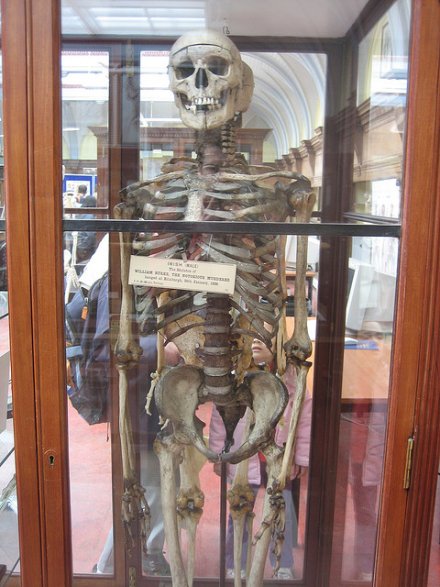
Wanted: corpses. Apply to Doctor Robert Knox, MD, FRSCEd, Professor of Medical Studies, Barclay’s Medical College, Surgeon’s Square, Edinburgh. Reference William Burke, hanged Jan. 28, 1829.
Robert Knox was a noted physician in his prime, in the early 1800s.
A surgeon, anatomist, and zoologist, Knox studied anatomy in London, then headed off to Africa in the army. Field surgery was a brutal business, and the poor anatomical knowledge at the time made it even more terrifying for those involved.
In 1821, Knox moved to France to work in the shadow of his heroes, Georges Cuvier and Étienne Geoffroy Saint-Hilaire; a year later, he was back in Edinburgh, making himself a career academic.
When his old professor came calling in 1826 with an opportunity to teach at Surgeon’s Square in Edinburgh, Knox jumped at the chance. As a partner to Barclay and curator of the school’s museum, Knox was well aware of the significant problem that faced the school: corpses were hard to come by.
And since the Royal College of Surgeons at Edinburgh certified the school as a prep course for entrance to University, coming up with bodies became a very important task.
If there’s one way to ruin your career, it’s to be caught paying a few pounds for fresh murder victims.
So it was for Knox, who gave out 7 pounds, 10 shillings for the body of an itinerant lodger who died in William Burke’s building in 1827.
This transaction led Burke to realize that such lodgers weren’t paying as much alive as dead. As a collector of bodies, Knox also had a strict no-questions-asked policy, and Burke and his partner William Hare exploited that to its fullest extent.
Almost a score of suspicious bodies later (and after the price had inflated to 10 pounds per), the pair was found out, given away as suspects by the lame and mentally disabled “Daft Jamie” Wilson, then caught when the late Marjory Campbell Docherty was found by a fellow tenant under one of Burke’s lodge’s beds.
Hare copped to a string of murders* and played stool pigeon in exchange for a lighter sentence.
Burke went to the gallows to “vehement cheering from every quarter, mingled with groans and hisses.” (London Times, Feb. 2, 1829)
“When the cheers had subsided, the wretched man was assailed with every epithet of contempt and abhorrence,” the Times continued. “Not a single indication of pity was observable among the vast crowd: on the contrary, every countenance wore the lviely aspect of a gala-day.”
William Burke’s hanging.
As a corpse himself, Burke made one final contribution to science’s insatiable desire for bodies: his cadaver went straight from the gallows to the practiced hands of one Dr Alexander Monro, who performed a complete lecture while dissecting the murderer’s corpse.
Knox, for his part, paid not with his neck but with his reputation.
Though never charged with a crime, the doctor was run out of the the lecturing business, first by subtle and not-so-subtle actions by the University, and eventually by the passage of the Anatomy Act of 1832.
He was also unable to obtain any surgical post after the incident and spent his later years writing academic books and papers, none of which have lasted like the doggerel that shadowed his steps.
Burke’s the butcher, Hare’s the thief,
Knox, the boy who buys the beef.
A few books about Burke and Hare
Anatomy of Anatomy
Robert Knox was operating under the Murder Act of 1751, which expressly forbade the burial of an executed murderer while permitting the malefactor’s dissection.
The Act had the dual effect of allowing the state to gibbet executed criminals (both hanging in chains and dissection were considered an added ignominy, beyond the punishment of the gallows), and of supplying the budding medical community with an immediate source of fresh bodies.
As courses in anatomy became more commonplace, though, the need for cadavers increased dramatically, and the business of selling bodies for science was born.
Typically, these sales manifested themselves in body-snatching — wherein “resurrectionists” illicitly exhumed a freshly buried corpse and conveyed it to some physician’s ready scalpel.
This grim trade in turn spawned a variety of security measures. The favored dead were defended by fences, watchtowers, and human lookouts. But nothing could eliminate the industry.
In particular, those with little money or no immediate relatives were unlikely to be buried in these gated graves; that left their remains ripe for the remaindering. As well, the increase in demand made so-called anatomy murder a possibility. Burke and Hare may have been notorious for the offense,** but they did not invent it.
In that case, two nurses (Jean Waldie and Helen Torrence) on death watch bartered a decent price of two shillings to sell the body of an ill child to a local surgical college. His death was delayed, and the nurses smothered him, possibly through simple carelessness.
Shortly after the Murder Act, simple economics made pikers of Torrence and Waldie. In the 17th century, England executed hundreds of prisoners a year, each a potential dissection. As Dr D.R. Johnson writes in his Introductory Anatomy:
The dissections performed on hanged felons were public: indeed part of the punishment was the delivery from hangman to surgeons at the gallows following public execution, and later public exhibition of the open body itself. …
Agents representing surgeons would bargain with condemned prisoners not under sentence of dissection (remember this only happened for murder: hanging was in vogue for stealing a sheep or even a loaf): occasionally prisoners struck a bargain to pay expenses, to provide for a family or to buy the customary decent apparel for the hanging.
Supply was unreliable, however: riots at public hangings became common, partly because of the paltry nature of hanging events, partly from superstition. The body was often reclaimed by relatives and the unpopular anatomists stoned, defeated and out of pocket. Competition was often so fierce that a rival anatomy school carried off the body.
Dissection was unpopular and other medical uses were to be found for a recently hung body – the cure of scofula, goitre, wens, ulcers, bleeding tumours, cancers and withered limbs for example. To prevent riots and disorder the Sheriff of London took all bodies of hanged men, except those sentenced to dissection, into his own custody and handed them to the relatives for burial.
Human Trafficking
Hanoverian Britain sure did keep the gallows busy. But the pace of hangings had abated by the 19th century just as demand boomed. The math didn’t add up.
Anatomy schools (officially) dissected some 592 corpses in 1825; at the time of the Burke and Hare murders, only about 50 executions were carried out annually, and each college was guaranteed just one a year.
That meant a shortfall of close to 550 bodies. With limited supply and significant demand, surgical colleges and anatomical lecturers were willing to pay top dollar for new cadavers … and the anatomical murder business really got legs.
And while the execution of Burke was met with applause from the community, in London, another group was already hard at work both body snatching and murdering its way into the classroom.
The London Burkers were caught in 1831 and convicted of murdering a 14-year-old whose cadaver they sold to St Bartholemew’s Hospital for 9 guineas.† The killers, Thomas Williams and John Bishop, had offed several others prior to the lad in question, making about the same price on each body.‡ In the grand, Burkean tradition of anatomical murderers, these miscreants were also dissected after their execution.§
Williams and Bishop were just two of a group of resurrectionists known collectively as the London Burkers, who claimed to have stolen upwards of 1,000 bodies from nearby cemeteries. That made the Burkers the largest known exploiters of the anatomical trade.
Over the decades after the Murder Act, though, resurrectionists were walking a dangerous line in their communities.
Reverence for the dead sparked community outrage when graves were found empty or disturbed, and it was often the anatomists themselves who felt the wrath of crowds.§§ In Glasgow in 1803, surgeons were threatened by an unruly mob and were forced to seek police protection; in 1813, an empty grave caused a similar furor. Punishments moved from fines to jail time as the surging demand made body-snatching an ever more lucrative trade.
A few books about body-snatching
By the time of the Burkers, anatomists were generally presumed to be body thieves in some capacity, a hostile sentiment graphically underscored during the Aberdeen riots of 1831. When a dog unearthed what looked like a human bone behind the Aberdeen surgical college, a mob coalesced and stormed the lecture hall.
The lecturer (“Dr Moir” — little else is known about the man) fled in terror as the hall was burned to the ground. Soldiers and police clashed with the crowd, which was thought to be over 10,000 strong. Hours later, the riot subsided, but Aberdeen was no longer a friendly place for a prospective medical talent.
And where Burke and Hare were still not quite sufficient to convince the House of Lords to take up a measure providing anatomists with alternatives for corpse acquisition, the Burkers and the Aberdeen riots apparently were.
The underground economy of resurrectionists was supplanted by the Anatomy Act of 1832, which allowed individuals to donate themselves or their unwilled kin to science for a pittance of compensation.
Anatomy murder is, of course, still the subject of horror movies. Like this one, or for the more classically inclined, this 1945 Boris Karloff/Bela Lugosi vehicle adapted from a Robert Louis Stevenson story inspired by Burke and Hare:
* The murders included at least one husband/wife pair, a mother and, later, her (adult) daughter, and a grandmother and her young grandson. They are also known as the West Port Murders.
** Burke entered the English language as a verb meaning … well, pretty much exactly what Burke got up to.
Dr. Murray, in the new English Dictionary, gives the following definition of the verb to ‘burke.’ ‘To murder in the same manner or for the same purpose as Burke did: to kill secretly by suffocation or strangulation, or for the purpose of selling the victim’s body for dissection,’ and the familiar lines are quoted from the Ingoldsby Legends: —
But when beat on his knees, that confounded De Guise
Just whipped out the “fogle” that caused all the breeze,
Pulled it tight round his neck until backwards it jerked him,
And the rest of the rascals jumped on him and burked him.
† 9 pounds, 9 shillings; by the time of the transactions, the guinea was no longer technically in use, but the term had stuck at the 21-shilling mark.
‡ Over the course of their 6 active months, the pair went from asking 8 guineas to asking 12 guineas; apparently 9 was the negotiated price with St Bartholemew’s.
§ The Burkers are the subject of the song “The Resurrectionist” by the Pet Shop Boys. (Lyrics)
§§ Edinburgh also had trouble as far back as 1742, when several surgeons’ homes were attacked by locals; a local beadle suspected of the crimes also had his home, dubbed resurrectionist hall, burned during the mob incident.
On the night of January 17-18 in 1945, Szymon Srebrnik was shot in the head, along with 46 other Jewish prisoners, at the Chelmno Extermination Camp near the village of Chelmno in central Poland.
Szymon (whose name has also been spelled Simon, Shimon, Shi’mon, etc.), was fifteen short years of age … but he had sixty-one more years to live.
Relatively little is known about Chelmno, simply because there were so few survivors. At least 150,000 people, and possibly as many as 300,000, died there. The victims included Gypsies and probably Russian prisoners of war in addition to Jews, notably most of the inhabitants of the Lodz Ghetto.
There were three survivors. Count’em, three. Szymon was one of them. And there were one or two others who successfully escaped Chelmno but did not survive the war.
The operation went like this: the victims would be taken to the camp and told they were being sent to work camps where they would be treated well, but first they had to clean up. They undressed, and they were supposed to give their valuables to one of the Nazi officers for safekeeping.
To maintain the pretense, they were even given receipts or claim tickets. Once the naked Jews left the undressing room, however, all pretense was over. Kicked, shoved, whipped and beaten with rifles and clubs, they were forced down a ramp into a waiting van. After no more could get inside it (the capacity was about 60-80 people per van, with a few of the larger vehicles having space for 100), the van was sealed and driven away. The carbon dioxide emissions from the engine were pumped into the back of the van, and by the time the driver had reached the burial site in a nearby forest, all of the Jews would be dead. If any of them happened to still be alive, they were shot. The bodies were disposed of by either burial or burning.
Not everyone was killed at once, however.
A small number of strong, healthy men were kept alive for awhile in order to help dispose of the bodies and sort through all the belongings of the dead Jews. They were kept in iron shackles 24 hours a day to prevent escape. They slept in the granary.
These people were usually killed within days or weeks and replaced by others from new transports. Our Szymon, however, lasted for about ten months.
There were several reasons for this. The Nazis at Chelmno, for their own amusement, sometimes forced the prisoners to have athletic contests like racing and jumping, and Szymon was good at that and often won.
He also had a beautiful voice, and they enjoyed listening to him sing. The Hauskommando chief, who was in charge of the work site inside the camp itself, liked Szymon and helped keep him alive.
But all things must come to an end.
Szymon and his fellow sufferers were the last prisoner-workers left at Chelmno, and they were shot as part of a clean-up operation by the Nazis. The Russians would arrive within days; the camp itself had been destroyed, and they had to leave no witnesses behind.
Unexpectedly, the Jews put up a fight and actually killed two of the Nazis inside the granary, hanging one and shooting the other with his own gun. Mordechai Zurawski was able to fight his way free and escape. He was the second survivor (a third, Michal Podchelbnik, had escaped the camp in 1942) and testified about his war experiences alongside Szymon. The rest were all killed.
At his testimony in Lodz in June 1945, Szymon recalled:
When the Soviet Army was advancing quickly, one night we were ordered to leave the granary in groups of five … Lenz ordered us to lie down on the ground. He shot everybody in the back of the head. I lost consciousness and regained it when there was no one around. All the SS-men were shooting inside the granary. I crawled to the car lighting the spot and broke both headlights. Under the cover of darkness I managed to run away. The wound was not deadly. The bullet went through the neck and mouth and pierced my nose and then went out.
Szymon made his way to a Polish farm nearby, and the farmer agreed to hide him in his barn until the Russians came two days later. A Soviet Army doctor treated his wound, and he made a complete recovery.
In September 1945, Szymon went to Israel, one of the first Holocaust survivors to arrive there. He met his future wife en route.
Szymon went on to testify at Adolf Eichmann‘s trial in 1961, and in 1978, he went back to visit Chelmno for Claude Lanzmann’s film documentary Shoah.
Those events aside, Szymon lived a long and surprisingly normal life in Israel, marrying, having a couple of kids and living in relative obscurity. He died of cancer in 2006, at the age of 76.
On this day in 2000, a 14-year-old boy from the Democratic Republic of the Congo was executed by firing squad only thirty minutes after his conviction by the Congolese Cour D’ordre Militaire, or Military Order Court. The teen, a child soldier known only as Kasongo, was found guilty with four other soldiers for the murder of a driver.
Amnesty International noted (pdf) that the DRC imposed the sentence in spite of the fact that it signed the International Covenant on Civil and Political Rights and the United Nations Convention on the Rights of the Child, both of which prohibit the death penalty for persons under the age of 18, and in spite of the fact that the DRC’s Minister for Human Rights had in 1999 promised a moratorium on executions.
Under Congolese law, those convicted by the Cour D’ordre Militaire can appeal to the President for clemency. Since Kasongo’s sentence was carried out so quickly, however, it’s doubtful the President heard his appeal.
In 2001, the DRC told the United Nations that all other child soldiers sentenced to death have been pardoned. Why Kasongo was excepted from this rule, no one knows. The military courts that convicted him were abolished in 2003.
Update: Embargoed as of this post’s publication, Joe Arridy’s growing ranks of supporters had submitted to Colorado Gov. Bill Ritter an application for a posthumous pardon. On January 7, 2011, Gov. Ritter granted that pardon — a fitting conclusion to a cinematically heart-rending story.
“Granting a posthumous pardon is an extraordinary remedy. But the tragic conviction of Mr. Arridy and his subsequent execution on Jan. 6, 1939, merit such relief based on the great likelihood that Mr. Arridy was, in fact, innocent of the crime for which he was executed, and his severe mental disability at the time of his trial and execution. Pardoning Mr. Arridy cannot undo this tragic event in Colorado history. It is in the interests of justice and simple decency, however, to restore his good name.”
-Gov. Bill Ritter
On this date in 1939, Joe Arridy “walked to his death with the faith of a child” (Los Angeles times, Jan. 7, 1939) up “Woodpecker Hill” — where the victims of Canon City, Colorado’s gas chamber (since retired) were buried.
Shortly before execution, Joe Arridy gives away the toy train he received from warden Roy Best to a fellow prisoner.
A young Syrian-American with the mental age of a six-year-old riding the rails during the Depression, Arridy was picked up for a teenage girl’s rape-murder in a literal lynch-mob environment: he was nearly pulled from his cell for summary punishment.
Instead, the good citizens let justice run its course to the same conclusion.
The damnable thing — well, the other damnable thing — is that we have about as much reason to believe Joe Arridy committed the crime as we do you or I.
He was linked to the murder by nothing but an evolving series of unreliable confessions fed by the sheriff to his suggestible prisoner (and, later, a single “matched” hair with a suspicious chain of custody; matching hair without DNA is still an unreliable forensic technique today). The real murderer was even in custody, and was executed for the same crime while Joe Arridy’s appeals ran their futile course.
“Believe me when I say that if he is gassed, it will take a long time for the state of Colorado to live down the disgrace,” Arridy’s appellate lawyer pleaded to a deaf court.
This post is an edited version of Perske’s affidavit to the governor’s office in support of the pardon.
On March 28, 1992, Sociologist Richard Voorhees sent me a poem from an out-of-print book that described a warden weeping as he watched a man in a death row cell playing with a toy train before being walked to a gas chamber (“The Clinic” (.doc) by Margeurite Young in Moderate Fables, 1944).
“The man you kill tonight is six years old,
He has no idea why he dies,”
Yet he must die in the room the state has walled
Transparent to its glassy eyes.
I sent a copy of the poem to Watt Espy, Director of the Capital Punishment Archives, in Headland, AL. Espy researched and responded with information that tied the poem to the life and trials of Joe Arridy who at age 23 was executed on January 6, 1939.
During the next two years after receiving the poem, I traveled up and down the Eastern Slope of the Rocky Mountains from Cheyenne to Pueblo, and to Grand Junction on the Western Slope. News stories were discovered from the reading of old microfilm rolls in The Pueblo Chieftain, The Denver Post, The Rocky Mountain News (Denver), The Daily Sentinel (Grand Junction) and Wyoming Tribune (Cheyenne). Archivists and historians were interviewed at The Regional History Division of Western Colorado (Grand Junction), Wyoming State Archives (Cheyenne), District Archives of the Pueblo Public Library, Local History Center of the Cañon City Public Library, and the Colorado State Archives (Denver).
Joe Arridy’s Earliest Years
Joe Arridy was born to non-English speaking Syrian immigrants in Pueblo, Colorado on April 29, 1915. He attended the first grade in Bessemer Elementary School. At the beginning of his second year, the principal called on the Arridy family and told them that their son could not learn and asked them to keep him at home. The parents reported that for the next four years, Joe stayed around the house. He was a passive but happy child. According to his parents he was the happiest when he was alone playing all by himself. His favorite pastime was making mud pies.
Intelligence Testing and Institutionalization
At age 10, Joe was committed to the Colorado State Home and Training School for Mental Defectives, in Grand Junction. He was administered the Binet-Simon Test. The results showed that he was unable to repeat four digits (4-3-7-9). When shown the color red, he said it was black and that green was blue. He usually spoke in incompete two or three word sentences. As the questions became harder to answer, he remained silent. The examiner listed him as “an imbecile with an IQ of 46.” Later his institutional records showed no critical incident reports. For the most part he was a shy and quiet loner.
Nine months later, Joe’s father missed his son. He asked for his son to be returned home. The request was granted. Upon his return, he tended to take lonely walks all over town. These walks continued for three years.
At age 14, the walks came to an end when a probation officer caught a gang of boys performing sexual acts on him. The officer wrote an angry letter to the court, labeling Joe as “one of the worst mental defective cases that I have ever seen.” The court ordered his immediate return to the institution in Grand Junction.
During the next seven years at the institution, his records show that he was incapable of working on the farm crews or sitting in classrooms. Therefore, he was given a “day activity,” working side by side with a kindly kitchen worker, “Mrs. Bowers.” The worker reported that Joe was only capable of “Tasks of not too long duration, can wash dishes, do mopping of floors, can do small chores and errands. He depends on others for leadership and suggestions.”
Railroad Boxcar Riding
At age 22, he and a few other inmates watched men riding on top of railroad boxcars that passed the institution. So together they wandered off the institution grounds and also jumped on boxcars. They took the 24-hour ride through the mountains to Pueblo. Later they took the trip back. Joe was last seen in Grand Junction on the evening of August 13, 1936. He was believed to have jumped onto a boxcar either that night or on the next morning.
After that, Arridy disappeared from sight until he walked up to the kitchen car of a railroad work gang on August 20, in the East Railroad Yards of Cheyenne, Wyoming, dirty and hungry.
Rape and Murder in Pueblo
On Saturday evening, August 15, 1936, slightly before or after midnight, Dorothy Drain, 15, and Barbara Drain, 12, were bludgeoned about their heads while sleeping together in the same bed, at 1536 Stone Avenue in Pueblo. Dorothy was raped and beaten to death. Barbara was near death, but survived. Later, she identified Frank Aguilar as the attacker at his trial. She was not present at Joe Arridy’s trial. She did not even identify Joe Arridy as a co-attacker.
Sheriff Gets a Confession from Arridy Even Though the Real Killer is Already in Custody
On August 26, 1936, Joe Arridy was arrested by two railroad detectives and turned over to Sheriff George Carroll. Carroll, like all law officers in all of the towns up and down Colorado’s Eastern Slope, was actively picking up suspects and interrogating them regarding the attacks on the Drain girls in Pueblo.
After an hour and a half of questioning, Carroll called a reporter and told him that he had just received a complete confession for the Pueblo crime from Arridy. He recited to at least one reporter a long series of wordy, complete sentences that Arridy purportedly uttered. According to Carroll, Arridy was the lone killer and he committed the crime with a club.
At first, when Pueblo Police Chief J. Arthur Grady received news of the confession, he was shocked. The real killer, Frank Aguilar, a former WPA worker who had been supervised by the Drain girls’ father, had already been arrested for the crime.
Aguilar had been arrested during the funeral of Dorothy Drain. The Pueblo police had even recovered the weapon used in the crime. It was the head of a hatchet with nicks that matched the wounds on the girls. The Pueblo police kept all this evidence in silence because Aguilar vehemently denied committing the crime.
Following that, Sheriff Carroll changed his story. After conducting another interrogation, he then reported to the press that a hatchet—not a club—was used in the crime. He also claimed that Arridy did not do the crime alone. According to Carroll, Arridy said he did it “with Frank.”
Sheriff Carroll was a famous but loquacious individual who was known to talk long and loud about being in the posse that finally caught up with and finished off the notorious Barker gang.
Now with his regular announcements to the press he remained at his long-worded best. Carroll had been so totally verbal in his interrogations of Arridy, nothing was written down on paper. Nor was any confession signed. Consequently the confessions and changes in them were dictated daily to reporters.
Later, in the trial of Arridy, Sheriff Carroll became the star of the case. He spoke in his heroic, over-wordy style. According to the press, he did not speak from a single note. He simply testified from memory.
Frank Aguilar is Quickly Convicted
Aguilar’s trial came quickly, starting on December 15, exactly four months after the crime. It ended seven days later. His executed came quickly, too: on August 15, 1937, just two days short of the anniversary of Dorothy Drain’s murder.
Aguilar Identified as Lone Murderer in an Identical Crime in the Same Neighborhood
After the death sentence, Aguilar was brought face to face with Mrs. R. O. McMurtree, 58, who identified Aguilar as the lone attacker in a similar crime that happened two weeks earlier and just three blocks away from the Drain crime. She and her aunt, Sally Crumply, 72, were sleeping in the same bed when Aguilar attacked. He beat them on the heads as he had done in the Drain home. Like Dorothy Drain, Sally Crumply was bludgeoned to death.
Sheriff Carroll Assumes Leadership in all Aspects of the Arridy Investigation
After announcing Arridy’s first confessions to reporters and Chief Grady, two Pueblo detectives sped through the night to Cheyenne. The next morning, they joined in an added interrogation with Carroll leading it. Then they drove back to Pueblo.
Later that day, Carroll drove Arridy to Pueblo. He was present at the Pueblo Police Station when Arridy and Augilar may have been brought together. He took leadership when Arridy was taken to the Drain home and the crime was reenacted. He was present at the prison in Cañon City when Aguilar gave a signed confession that marginally included Arridy’s initials in a lower left column. That confession was printed in its entirety in the Pueblo Chieftain but was withdrawn and was never heard in a court.
Sheriff Carroll Became Chief Presenter of Evidence Against Arridy
During the prosecutor’s evidentiary presentations, Sheriff Carroll took the stand five different times. The transcript shows how Carroll was allowed to launch forth as a riveting story teller. He testified that Arridy was in complete control of his thoughts, and speaking in clear sentences that described the colors on the walls in the bedroom and the colors of nightgowns that the girls wore, and even the colors of the dresses the girls would be wearing when they went to the Sunday church services.
The Joe Arridy that Carroll described was a far cry from the Arridy who often spoke in unfinished sentences and did not know who Franklin Delano Roosevelt was. Nor did he know what a hatchet was or that his own father was present in the courtroom.
The Defense Loses in a Sanity Hearing, and Eschews an Evidentiary Defense
The defense argued at a pre-trial sanity hearing that Arridy was “Not Guilty by Reason of Insanity”. The question before the court: “Does Joe Arridy have the capacity to tell good from evil and right from wrong?” If not, he should be found to be insane and not guilty. Three psychiatrists testified that Arridy did not know right from wrong, but they hedged by saying that he was not insane. According to them, one needed to be normal first before ever being insane, and they claimed that Arridy had never been normal.
The jury deadlocked at six to six, but an hour later, voted that Arridy would have to go on trial for murder.
As strange as it may seem today, the defense attorney had conducted no investigation in the case. At the beginning of the trial he announced that he would not present an evidentiary defense and would only cross-examine witnesses for the prosecution.
He then requested that the judge set aside the earlier sanity trial verdict and that he be given permission to argue a sanity case one more time. He furthermore requested permission to make his opening argument only after the prosecution had completed with its evidentiary case. The judge agreed to all of these conditions.
The same three psychiatrists (joined by a fourth) gave the same testimony once again.
But Sheriff Carroll voiced his views unchallenged. After touting his 30 years of experience and claiming that he interrogated Arridy for “six or seven hours,” the prosecutor asked him, “Based on your experience [is] Joe Arridy capable of distinquishing right and wrong?” Carroll responded, “I think there is no doubt, whatever, but what he is”.
A verdict of “guilty” was rendered on April 17, 1937, and Arridy was sentenced to death.
On August 13, 1937, Frank Aguilar was executed, and on the same day, Sheriff Carroll and two railroad detectives received a $1000 reward for making the arrest of Joe Arridy in Cheyenne.
For a year and a half, a pro bono “Citizen Lawyer” Gail Ireland fought valiantly to save the life of Joe Arridy. During that period, Ireland managed to win at least six stays.
On January 6, 1939 at 6:15 p.m., the Colorado Supreme Court voted 4-3 to deny the last petition. Governor Teller Ammons called the warden at 6:30 p.m. and ordered that the execution be carried out.
The chaplain administered the Roman Catholic Church’s “Last Rites for a Child.” It called for the Chaplain to recite each phrase of “The Lord’s Prayer,” one at a time with Arridy repeating it, all the way to the “Amen.”
Joe Arridy’s rusty motorcycle plate served as his grave marker for 71 years, until it was replaced with a headstone reading Here Lies an Innocent Man
This volume by Perske addresses the criminal justice system’s (mis)handling of the developmentally disabled. He’s written a number of other books, fiction and nonfiction, humanizing this.
Robert Perske also graciously agreed to address a few additional questions that we had for him.
ET: How did you come to this case?
RP: It’s almost a magical thing to me. Back in 1991, I got a poem from a valued colleague of mine who is a professor, a sociologist. He was digging through some old books in Greenwich Village, and he found a poem about a warden weeping before the pellets were dropped and all of that, and how the warden cried, and how he complained about how this man playing with a toy train would die.
And I got ahold of it and went down to my buddy Watt Espy [of the Espy file -ed.], and he found it. He really dug for me, what a guy, and he found it and I headed for Pueblo and dug and dug and dug from 1991 to 1995.
What motivated me was that after coming out of World War II, I went to school and became a chaplain at an institution for mentally disabled people in Kansas. I worked my ass off to be a good pastor to them, and so when I found this much, I really started digging.
Did they lead him into the confession?
Oh, yes. He was arrested in the railyard by Sheriff George Carroll. And Carroll was a swashbuckler. He was a hero, and he was a mouthy sonofagun, and he pretty well set up the case.
As soon as he got the so-called confession, he [Carroll] didn’t call the police chief first — he called the press. He said he had the guy who did it.
But they already had the guy in Pueblo, Frank Aguilar.
Was there outright misconduct by the investigators here? Did they realize, or should they have, that they might be railroading someone?
Here’s the deal. People with so-called mental retardation were seen as nobodies in those days. They didn’t have community services, so they all went like Joe, to the institution.
In the year I was born, 1927, Oliver Wendell Holmes issued his ruling that all such people could be sterilized.
Carroll knew he had somebody like that in Joe. There was a lynch mob starting to form in Pueblo, because this head of the WPA was a good solid citizen, and when his daughters were hit, and one killed and raped, there was a lot of hiding of people.
I’ve known a lot of Joes. And he’s lovable, and he’s trusting, and he’s naive, and he’s concrete-thinking, so half of the things he says, he doesn’t really understand. But on the other hand, very dependable, and very lovable. Nobody in Pueblo saw that, but [Warden Roy] Best picked it up, and then the inmates in prison picked it up too.
In their hearts of hearts, yeah, they knew. But they figured he wasn’t worth anything. He was retarded, mentally defective was the word they used. They knew they had the real killer, but they go back and get Joe to amend the confession and now he was there “with Frank”.
If you’ve got a serious mental limitation and you’re facing a capital charge in the criminal justice system today, what’s going to happen to you?
In the year 2002, Atkins v. Virginia, they banned the death penalty in those cases. And they played around with the IQ number, but in some states they’re going farther than that because you have all kinds of other disabilities. I’d say by and large, except for Texas, people are looking at these people — not more kindly, but not looking at them as people who should be executed.
If we would have had that for Joe, he would not have been executed.
Can you give us a lay definition of developmental disability?
The most prominent one I’ve seen when I worked in the institution, and yet today when I work the streets and agencies and group homes and that sort of thing, is the inability to abstract from concrete things. For example, I’ve had guys say to me, I’d say, “why did you waive the right?” and they say, “you’ve got to waive it the right, you can’t waive it the wrong.”
Barry Fairchild, down in Arkansas — Barry thought that the reading of the rights was some kind of opening prayer.
These people survive on the basis of having abstract thinkers as their friends and protectors, so consequently guys like Richard LaPointe had cops as their friends, because they leaned on authority figures. And of course the police department are committed to secure the safety of the neighborhood, but then if there’s a terrible murder and somebody starts to blame them, they’re going to cooperate with that.
I’ve got one where, on a tape recorder, they’re saying, “if you tell us, we’ll all go home”. So that’s concrete thinking that my guys usually have.
Richard Lapointe is still in prison, not on death row. He has hydrocephalus, it’s called Dandy-Walker syndrome, so he’s a guy with all kinds of disabilities. He’s not athletic at all and gets dizzy when he stands up or stops suddenly, and yet they got him to confess to a highly athletic murder of a woman with multiple violent stab wounds and moving the body.

 Smolar, a dedicated Communist who was a writer and editor in civilian life, had been a problem for the Germans for quite some time. He was a leader in the resistance of the Minsk Ghetto, and that resistance was a force to be reckoned with. Smolar and others like him formed an underground organization that printed leaflets about Soviet successes in the war, occasionally hid non-Jewish Communists and escaped Russian prisoners of war within the ghetto (the infectious disease ward of the hospital was a great hiding place: the Germans never went there), and above all tried to save the lives of as many Jews as possible.


 Almost a score of suspicious bodies later (and after the price had inflated to 10 pounds per), the pair was found out, given away as suspects by the lame and mentally disabled “Daft Jamie” Wilson, then caught when the late Marjory Campbell Docherty was found by a fellow tenant under one of Burke’s lodge’s beds.

 Szymon (whose name has also been spelled Simon, Shimon, Shi’mon, etc.), was fifteen short years of age … but he had sixty-one more years to live.

