On this day in 1818 in Edinburgh, Scotland, 22-year-old Robert Johnston faced capital punishment for the robbery of a candlemaker. The authorities were nothing if not zealous: that day, Johnston would be hanged no less than four times.
Alex Young, in his book The Encyclopaedia of Scottish Executions 1750 to 1963, provides an account of the gruesome debacle that was Robert Johnston’s execution:
After praying and shaking hands with the clergymen, he mounted the scaffold and looked boldly around him, before helping the executioner adjust the rope, and giving the signal.
The drop fell – but the excessively short length of rope enabled him to stand on the platform. As the Magistrates ordered carpenters to cut a wider opening, cries of “Murder” came from the crowd.
The cries were followed by a shower of stones, which sent the Magistrates and the carpenters to the shelter of the Tolbooth Church doorway, through which they passed into the police office.
Almost every window glass in the church suffered from the stones, as did Johnston who had been abandoned on the platform.
“Cut him down—he’s alive!” rang out, as the crowd took possession of the scaffold. Johnston, despite hanging many minutes, was alive, and after taking the rope from his neck and arms and the cap from his head, he was carried off towards High Street. The scaffold structure proved too robust, but Johnston’s waiting coffin was broken up and thrown through the church windows.
The police and military combined forces to wrest the hapless Johnston from his would-be saviors and took him, unconscious, to the police office, where a surgeon bled him until he was determined fit to be re-hanged.
This time Johnston was carried by six men and the scaffold, surrounded by soldiers.
Again the executioner made a bungle of it. The rope was now too long and Johnston had to be lifted while the rope was shortened by winding it around the hook.
Again, shouts of “Murder!” and “Shame! Shame!” rang out, and only the military presence prevented another riot. Johnston struggled for many minutes before passing into eternity.
The next day, the Magistrates fired both the master of works and the executioner, who was named John Simpson. They also issued a fifty-guinea reward for information leading to the identification of Johnston’s rescuers. It went unclaimed.
On this day in 1499, Perkin Warbeck, pretender to the English throne, was hung at Tyburn for treason. He didn’t fare as well as the previous royal pretender, Lambert Simnel, who was pardoned by King Henry VII and made a spit-turner in the royal kitchens.
Warbeck claimed he was Richard, Duke of York, the younger son of King Edward IV. Richard and his older brother, the would-be Edward V, mysteriously vanished around 1483, allegedly murdered by their allegedly evil uncle Richard III, who had already had them declared illegitimate. (Shakespeare made this version — which was congenial to the ruling Tudor dynasty of his time — the standard in Richard III; the play channeled Thomas More‘s history of Richard.)
The murder story has never been proven and the princes’ bodies were never identified, leaving a yeasty petri dish for pretenders to grow and multiply — and so they did.
Warbeck, who later admitted he was actually born in Tournai, in Flanders, in approximately 1474 (his father is described by one source as “a renegade Jew”) first claimed to be the Duke of York either while at the court of Burgundy in France in 1490, or while serving a silk merchant in Ireland in 1491.
He did bear a strong resemblance to Edward IV, but there is no evidence that he was really Richard of York or that he and the late king were related in any way.
Nonetheless, his claim was soon recognized by Charles VIII, King of France … and it naturally appealed to the fledgling Tudor dynasty’s potential internal rivals, too.
Margaret of Burgundy, who was Edward IV’s sister and the disappeared Duke of York’s aunt, was one of these educated the pretender about “his” history and the ways of the English court, and she helped finance Warbeck’s attempted conquest of England in 1495. It went badly from the beginning: Warbeck’s army was trounced and 150 of his troops were killed on the beach in Kent before he even made it ashore. Warbeck fled to Ireland and then Scotland.
Warbeck had more success in his second invasion attempt, in Cornwall in 1497 on the heels of the Cornish Rebellion.
Warbeck promised an end to the exorbitant taxes levied on the citizenry, which welcomed both pretender and promise with open arms. His army grew to 6,000 or 7,000 men, and Warbeck began calling himself Richard IV of England, but when he found out King Henry was after him he panicked and deserted his men.
He was captured and imprisoned at the infamous Tower of London, but not before being “paraded through the streets on horseback amid much hooting and derision of the citizens.”
The execution was not until 1499, and only after it was alleged that Warbeck tried to escape with a real royal claimant, Edward Plantagenet, Earl of Warwick. On November 23, Warbeck was taken from the Tower to Tyburn, where he read out a confession and was hanged. His wife, Lady Catherine Gordon, a cousin of the King of Scotland, had a better fate; she was given a pension and a job of lady-in-waiting to the Queen.
He had hunted many rustlers to their deaths, though he may have swung for a killing he didn’t do; the verdict against him in the murder of 14-year-old Willie Nickell is still hotly disputed to this day. It turned on a dubious liquor-induced “confession” as recorded by the lawmen who wanted to arrest him.
Horn’s death, to the hymn of “Life’s Railway to Heaven”, is a milestone in the passing of the frontier West; too, it was a milestone in a weird experimental cul-de-sac for modern America’s fascination with technological innovation on the scaffold. A contraption called the “Julian gallows,” named for the man who designed it, used the prisoner’s weight on the trap to open a water valve that filled a barrel that knocked over a post supporting the trap, causing the prisoner to eventually drop without any hangman’s hand on a lever.
A steady,* solitary man, Horn took it all in with equanimity. Maybe it was written: not for this rugged plains gunslinger to lurk on as a relic into the age of flight, cubism, trench warfare. Already in his lifetime the frontier had disappeared into kitsch.
First things first — did Tom Horn actually do the crime for which he hanged?
Tom Horn was convicted because of social pressure (the fact that he represented the cattle barons) and the political ambitions of the prosecutor and presiding judge.
So what was different in Wyoming after Horn’s execution?
The cattle barons and other big business entities (e.g., mining barons, railroad barons, etc.) had much less influence on public affairs.
He seems like an almost self-consciously inscrutable character. What drove him?
He was a faithful and reliable employee, but seemed to thrive on adrenaline.
Was he just, at the end, a man who couldn’t change as his world changed around him?
Yes, he was out of date and out of the times.
Did people of his own time also see him as a part of the frontier West that was no more?
Yes.
How did you become so interested in Tom Horn? As the go-to expert on his life, what do you find draws others to him, and what sorts of lessons do people draw from his story?
He is the number one Name in Wyoming history, because of the controversies about whether he killed 14-year-old Willie Nickell (tom-horn.com page) and how his trial was conducted. (tom-horn.com page)
I had read every book published about him up till the time I started researching him, and when contrasting the various testimonies in the inquest with the trial, puzzled, how the hell could they have ever convicted him? All this is laid out in my book, Tom Horn: Blood on the Moon.
Two films about Tom Horn — Mr. Horn, starring David Carradine, and Tom Horn, starring Steve McQueen — were released within months of each other in 1979-80.
Kenneth Allen McDuff grew from the small-time bully of tiny Rosebud, Texas, to a feared and reviled killer finally apprehended with the help of the America’s Most Wanted television series. By the time of his execution on November 17, 1998, he stood as a symbol of how the best-intentioned prison reforms could bring the most hideous results.*
In 1966, on parole for a string of burglaries, McDuff was first sentenced to death for the brutal murder of three teenagers he kidnapped and killed. The female member of the trio was sexually abused and raped for hours before McDuff used a broomstick to snap her neck “just like you’d kill a possum,” in the words of Falls County Sheriff Brady Pamplin, one of the first generation of Central Texas lawmen to deal with McDuff.
He remained on death row until 1972, when the U.S. Supreme Court in Furman vs. Georgia struck down all death penalty statutes in the United States. McDuff’s sentence was commuted to life imprisonment, which left the possibility of parole.
A rape and attempted murder for which McDuff was never prosecuted resulted in a daughter who at the age of 21 visited McDuff in prison. Her visits ceased after McDuff described his fantasy of taking her to Las Vegas and pimping her out to earn himself a fortune.
A prisoner’s fifteen-page handwritten lawsuit, Ruiz vs. Estelle, exposed conditions in Texas prisons which proved unconstitutionally inhumane, including the use of inmates as guards. (McDuff ascended to the position of boss over fellow convicts following his exit from death row into the general prison population; his perks included a “gal-boy” who traded the usual personal services for McDuff’s protection from white supremacist former gang associates whom he had offended.) Ruling in the Ruiz case, Federal Judge William Wayne Justice placed the Texas prison system under the control of a Special Master and ordered that traditional prison overcrowding must cease.
The Texas parole board was ordered to release 150 prisoners a day, to reduce the prison population to the 50,000 for which there was adequate capacity. Despite a 1982 conviction for attempted bribery of a parole board member, McDuff made parole in early October of 1989. Waco’s U.S. Marshall Parnell McNamara could only ask, “Have they gone crazy?”
Kenneth Allen McDuff was a rarity on Texas’s death row: He was a son of the middle class among the poorest of the poor. On parole, his family furnished him with motor vehicles as needed, and a credit card so that he would not have to carry cash in his chancy, drug-ridden haunts along the Interstate 35 corridor of Central Texas.
Even a new arrest in July 1990, after he chased and threatened some black teenagers and then spewed racist invective at his parole revocation hearing, did not suffice to return him to prison. Six women, three of them drug-addicted prostitutes, have been verified as murder victims of Kenneth McDuff between his parole date in 1989 and his arrest as a fugitive in Kansas City on May 4, 1992; there may well be others whose identities will never be known.
McDuff was tried for the abductions and murders of Melissa Northrup, a convenience store clerk, and Colleen Reed, an accountant. He was convicted and sentenced to death in both cases.
Parole requirements for violent Texas criminals were stiffened substantially as a direct result of McDuff’s career, by the regulations of the parole board and by the Texas Legislature. (The statutes are known as the McDuff Laws.) McDuff by all accounts became the most hated man in the Texas prison system; once returned to death row, he was held in administrative segregation for his own protection from his latest arrival in 1993 until his execution.
Progressive Democrat Ann Richards was Governor of Texas at the time of McDuff’s last trial. A recovering alcoholic, she created an unprecedented emphasis on drug and alcohol treatment for Texas prisoners, the overwhelming majority of whose crimes involved substance abuse of one kind or another. No one appreciated the irony more than she: a governor dedicated to rehabilitation of prisoners was forced to kick off the biggest prison building spree in Texas history, to comply with the federal court’s orders on prison overcrowding while trying to ensure that Texas would never again see the likes of Kenneth Allen McDuff.
It took six years for law enforcement officers to persuade McDuff that his continued refusal to reveal where he had hidden the bodies of several of his victims offered him no sort of advantage. Some remains were located by means of hand-drawn maps, but maps did not suffice in every case. A few days before his execution, an unusual excursion party set out from the Ellis I prison outside Huntsville: a caravan of unmarked cars with dark-tinted glass carried McDuff, locked to a back seat and disguised with a baseball cap, on a “clandestine high security move.” Never allowed out of the car, McDuff directed investigators to the shallow grave of Colleen Reed, whom he kidnapped from an Austin car wash on December 29, 1991. Shortly thereafter, McDuff’s nephew received a reduction in his sentence for drug dealing.
McDuff never expressed remorse for any of his crimes. A lifetime of cheap beer and needle drug abuse was catching up to his liver when he climbed on the Walls Unit gurney on November 17, 1998. His last words: “I am ready to be released. Release me.”
* See Gary Cartwright’s “Free to Kill” Texas Monthly, Aug. 1992, Vol. 20, Issue 8, p. 90.
(Thanks to Michael Baney for the guest post. -ed.)
On this date in 1991, a Peruvian death squad showed up at the wrong party, and altered its country’s history.
In 1980 the Communist Party of Peru, better known as the Shining Path, launched its “People’s War,” which was never actually supported by the majority of Peruvians. Latin America had had its share of Marxist revolts, but this one was different from the others. There was nothing romantic about the revolutionaries, who wore plain clothes rather than uniforms, attacked the civilian population rather than invest significant capital to win them over to the Shining Path cause, and rose up in an effort to overthrow a democracy rather than a dictatorship.
The Shining Path was based mainly in Andean villages, but once they began to take serious losses in their own territory, they made a concerted effort to accelerate the war by pushing into the capital city, Lima. Both the Shining Path and the Peruvian military were committing deplorable human rights violations by the time Alberto Fujimori was elected president in 1990, although the vast majority of the violence had been confined to the hinterlands of the country up until then.
With Fujimori’s election, more urban-based death squad activities began. Perhaps the most famous was the November 3, 1991 massacre in the Barrios Altos neighborhood of Lima, a poor barrio only a few minutes’ drive away from the Congress and the Presidential Palace.
This date’s incident occurred when members of Grupo Colina (English Wikipedia entry | Spanish), a death squad that was part of the Army Intelligence Service, believed that they had identified a group of Shining Path militants having a pollada, which is a traditional fundraiser in Peru where a party is held so that chicken and beer can be sold to the neighbors. (Here’s a description, in Spanish)
A Grupo Colina squad drove to the building where this terrorist pollada was supposed to be taking place, lined the partygoers up, and extrajudicially executed them with submachine guns with silencers that the army had provided the group for the operation. Then the leader of the group, Santiago Martin Rivas, shot a young child who came running over to the body of his father. The troops got back into their vehicles, turned on their sirens to appear like they were the police in an effort to shift blame over the killings, and got drunk at the beach to celebrate.
Almost immediately it became clear that the death squad members had completely screwed up their hit.
The people who had been murdered were indeed having a pollada … not to fund the Shining Path’s Maoist agrarian war, but to fix the pipes in their building
And it transpired that that fateful night of Nov. 3, there was a differentpollada being held on a different floor in the very same building. The participants of that other party fled the building, never to return. There were reports that upon searching the rooms of those who fled, police uncovered many issues of El Dario, the Shining Path newspaper.
If Grupo Colina indeed crashed the wrong party, then it not only slaughtered a bunch of innocent people — it helpfully tipped the Shining Path to the fact that the army was onto them.
In any event, the executions became a media spectacle and the police had to at least go through the motions of investigating them. At first, the government suggested that the murders might have been actually carried out by the Shining Path, and as evidence of this theory they showed that one of the people who had been killed was previously a member of a Ronda, which is a peasant patrol group that fought against cattle rustling and, in some cases, the Shining Path. But it later turned out that the man had been a member of the Rondas many years before and hundred of miles away from the killings, and it seemed extremely improbable that the Shining Path would even bother to target him.
By December 4, 1991, the US embassy in Lima was informing the Secretary of State that the Peruvian government lacked the political will to investigate the murders, and had lied about whether or not the guns used in the extrajudicial executions were equipped with silencers in “an apparently deliberate attempt to obfuscate the situation.”
The Congress created a committee to investigate the crimes, which was a real threat to the Fujimori government because the Fujimoristas did not have a majority in Congress.
This ceased to be a problem on April 5, 1992, when Fujimori suspended the Congress, permanently disbanded the Senate, and fired a good number of the judges in the country, all in total violation of the Constitution. That ended the investigation.
Under pressure from the international community, a new Congress stacked with Fujimoristas was convened to write a new Constitution, and the investigation of the Barrios Altos killing nominally restarted. When the Congress called Nicolas Hermoza Rios de Bari, the Chairman of the Joint Command of the Armed Forces to testify, he took the oppotunity to remind the Congress that the military would never tolerate being “insulted.” When hearings continued, Hermoza Rios held an impromptu tank parade directly in front of the Congress. The few brave Congressmen and women who actually desired to expose the truth about the killings got the message loud and clear: the case would never go anywhere as long as Fujimori remained president.
When it finally looked like the perpetrators might be punished, for example, Fujimori rammed a law through the Congress that provided a general amnesty to everyone who had violated human rights “in defense of the fatherland.” When a judge ruled the amnesty law unconstitutional, Fujimori’s Congress stripped the power of judicial review from the courts in cases of amnesty laws.
In a very real sense, the Peruvian government had legalized illegality. Fujimori created a system in which there was no way to punish — or even investigate — murder so long as someone, somewhere considered the crime to have been committed for patriotic reasons.
All that changed in 2000, however, when Fujimori’s government collapsed amid scandal.
An opposition figure who vowed to create a Truth and Reconciliation Commission was sworn in as into office, and Peru reaffirmed its commitment to the American Convention on Human Rights. In 2001, in a groundbreaking decision, the Inter-American Court of Human Rights ruled in its Barrios Altos case that countries cannot issue an amnesty for “serious human rights violations.” The amnesty was thrown out and Grupo Colina members were arrested.
In 2007, Alberto Fujimori was extradited from Chile, where he had traveled, to Peru. In 2009, the Peruvian courts convicted Fujimori of a number of human rights abuses, including ordering the Barrios Altos murders. Just last month, justice was finally served when the members of Grupo Colina were convicted of murder, kidnapping, forced disappearance, and conspiracy, and were given various sentences ranging up to 25 years of prison. After 19 years, the Peruvian government has finally acknowledged that the extrajudicial executions that took place during that country’s cold war were crimes that must not go unpunished.
(Thanks to Elizabeth M. Hull for the guest post. -ed.)
Post-mortem resident of Gryffindor House, Hogwarts School of Witchcraft and Wizardry, Hogsmeade, U.K.
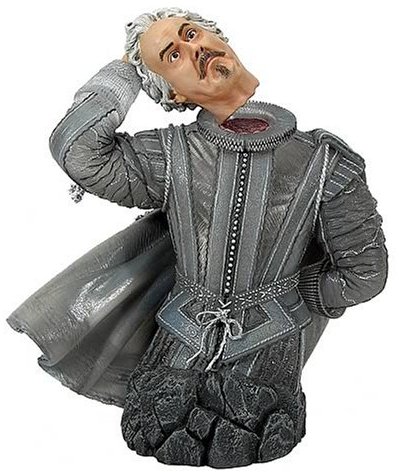
A minor character in J.K. Rowling’s Harry Potter saga, Nearly Headless Nick remains one of the most memorable. Executed — badly — on Halloween of 1492, Sir Nicholas de Mimsy-Porpington became the ghost of Gryffindor House. The school has about 20 resident ghosts: the Grey Lady (Helena Ravenclaw) and the Bloody Baron of Slytherin House died violently as well, in a murder-suicide.
Rowling says that her editor suggested that she cut a ballad Mimsy-Porpington wrote about himself from The Chamber of Secrets. In the song, the ghost claimed to have been executed for “a mistake any wizard could make,” a “piffling error,” a case of wizardry gone wrong. Asked by Lady Grieve (otherwise unknown) to straighten her teeth, Mimsy-Porpington seems to have given her a tusk. “They” imprisoned the piffler immediately, though he cried all night that he could fix his mistake, and his beheading followed the next morning.
Unfortunately for Mimsy-Porpington, his was not the only incompetence: “they’d mislaid the rock/Where they usually sharpened the axe”! The “cack-handed twit” of a headsman said “this may sting a bit” to the gibbering wizard, and swung the axe in the air. Alas, unable to sharpen the blade, the executioner was reduced to bestowing numerous blows: “But oh the blunt blade! No difference it made,” the ghost sang,
My head was still definitely there.
The axeman he hacked and he whacked and he thwacked,
“Won’t be too long,” he assured me,
But quick it was not, and the bone-headed clot
Took forty-five goes ’til he floored me.
(The full ballad is here and here; the original handwritten version can be seen here.)
After repeated strokes of the edgeless axe, Mimsy-Porpington finally expired. On festival occasions, he re-enacts his near-beheading, a show quite popular with the Hogwarts student body (Prisoner of Azkaban, p. 159).
However, the bone-headed, cloddish headsman was unable to completely behead the wizard. As Ron Weasly notes, the ghost is merely nearly headless.
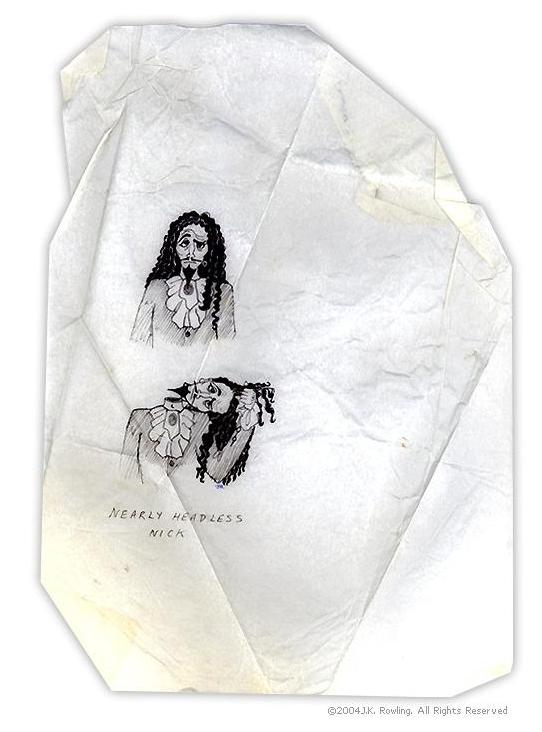
Nick, as played in the Harry Potter films by John Cleese. Rowling’s own original sketch of Nearly Headless Nick is here.
While he gets a great deal of pleasure from entertaining Hogwarts residents by swinging “his whole head . . . off his neck and . . . onto his shoulder as if it was on a hinge” (Sorceror’s Stone, p. 124), his condition limits his access to the dizziest heights of post-mortem society. Beheading was an aristocratic execution, meant to bring a swift death to the privileged, those able to hunt legally in their lifetime. In the afterlife, the beheaded aristocrats have established a “Headless Hunt” Club, and have blackballed Mimsy-Porpington, who misses their entrance requirements by that much: “‘half an inch of skin and sinew holding my neck on.'” Unable to participate in Club sports like “Horseback Head-Juggling and Head Polo,” Mimsy-Porpington is denied admission into the elite society (Chamber of Secrets, p. 124).
Sadly, their scorn for his crippling condition is not limited to exclusion from their company.
Mimsy-Porpington’s five hundredth Deathday anniversary party, held on Halloween 1992, welcomes hundreds of ghosts from as far away as Kent to a feast of rotten fish, putrid, “maggoty haggis,” and a tombstone cake with grey icing, while an orchestra of 30 musical saws plays waltzes. The Deathday Boy’s speech is interrupted by the members of the Headless Hunt: “Sir Properly Decapitated-Podmore” begins a game of Head Hockey, sending his own head sailing past the humiliated Mimsy-Porpington as he tries to address his guests (Chamber of Secrets, p. 132-7).
Somehow the courageous Gryffindor ghost overcomes this diabolical heads-up-manship and several months as a petrified cloud to live a useful afterlife, helping Harry many times. Most significantly, in the final pages of The Order of the Phoenix, a traumatized and grieving Harry turns to Mimsy-Porpington, hoping to discover a way to keep his dead friend and guardian Sirius Black alive. “‘You’re dead,'” Harry says, “‘But you’re still here, aren’t you? … People can come back, right? As ghosts. They don’t have to disappear completely.'” Mimsy-Porpington gently tells Harry that he can only “‘walk palely'” where his living self once trod, “‘neither here nor there,'” hovering between life and death for fear of the unknown. However, Black risked his life joyously and died laughing; he will not linger between death and life. Harry must live on without him.
There may be historical precedent for Mimsy-Porpington’s death in the botched execution of James Scott, Duke of Monmouth (1685), when the notorious Jack Ketch took five blows to kill the rebel, and finally had to use a knife to sever the last “skin and sinew” connecting the head to the corpse. Monmouth’s hairstyle in portraits from the late 1600s resembles that drawn by Rowling in her sketch of Nearly Headless Nick, although that sketch shows a beard style from the early 1600s, nearly 70 years earlier. Moreover, the ghost enters Harry Potter’s life wearing an Elizabethan neck ruff and says that he has not eaten in nearly 400 years, implying a death in the late 1500s.
In spite of this wibbly-wobbly timeline, Mimsy-Porpington’s deathdate establishes the firm chronology of Rowling’s series: the five hundredth anniversary of his death in 1492 would fall in 1992; therefore the events of Chamber of Secrets (published in 1997) must occur in 1992. The dating of the series is confirmed five books later by the tombstones of Harry’s parents, who died on Halloween Day, 1981 (Deathly Hallows, p. 328). For J.K. Rowling, death, the last enemy — not life — marks the measure of this world’s time.
(Thanks to Robert Elder of Last Words of the Executed — the blog, and the book — for the guest post. This post originally appeared on the Last Words blog here. Fans of this here site are highly likely to enjoy following Elder’s own pithy, almanac-style collection of last words on the scaffold. -ed.)
“Are—they—really—going—to—hang—me? Don’t— let—them. Save me. Jesus—Mary—Joseph. My little baby! My wife! . . . I’m—going—my—rest. Take— care—me. Where are you, Mr. Meisterheim [his jailer]? Talk to me.”
Meisterheim: “Be brave, Frank. It’ll be over in a minute.”
“Shake hands once more then. Are they—really going—to hang me?”
— Frank Campione, convicted of robbery and murder, hanging, Illinois.
Executed October 14, 1920
Part of the Cardinella Gang, Campione and company were responsible for more than four murders and 250 holdups and burglaries, according to authorities. The gang killed Albert Kubalanzo for $6.30.
During the months he was in jail and on trial, Campione sang lullabies to his pillow night and day. Even when admitting that he had been feigning madness, Campione held the pillow. “I’ll die happy if you let me keep this pillow with me,” he said. “It reminds me of my baby son.”
(Thanks to Jonathan Shipley of A Writer’s Desk for the guest post. -ed.)
It was on this day that a Welsh squire, Llywelyn ap Gruffydd Fychan, was gruesomely executed for thwarting the efforts of King Henry IV’s forces to squelch Welsh resistance to English rule.
First, the man’s stomach was cut out and cooked in front of him. Then, he was hanged, drawn and quartered.
The torturous execution took several hours before he succumbed to death. Then, a grisly postscript: his salted remains were sent to other Welsh towns to deter Welshmen from opposing the king.
Rewind to October, 1399.
Henry IV has been crowned King of England after overcoming the unpopularRichard II. Henry had his predecessor imprisoned and killed, then displayed at St. Paul’s Cathedral to prove to his supporters that he was gone.
Little surprise much of Henry’s reign was spent defending himself against plots, rebellions and assassination attempts. One rebellion? That of Owain Glydwr, who declared himself Prince of Wales in 1400.
This didn’t sit well with the new king. Armed men were sent out to find this treasonous Welshman. Found them they did, though perhaps they wished they hadn’t. In the summer of 1401, on the slopes of Pumlumon, Owain Glydwr crushed Henry’s army. This, too, did not sit well with the king.
Give me leave
To tell you once again that at my birth
The front of heaven was full of fiery shapes,
The goats ran from the mountains, and the herds
Were strangely clamorous to the frighted fields.
These signs have mark’d me extraordinary;
And all the courses of my life do show
I am not in the roll of common men.
Where is he living, clipp’d in with the sea
That chides the banks of England, Scotland, Wales,
Which calls me pupil, or hath read to me?
Henry then led a huge army, arriving in Llandovery, to capture this meddling countryman prince.
It was here that the English military met a 60-year-old man. A land owner from Caeo, his name was Llywelyn ap Gruffydd Fychan and the English army strongly suggested he assist them in helping locate Owain Glydwr. Llywelyn agreed.
Little did the English know, as they chased Glyndwr, that Llywelyn was taking them in the wrong direction.
He had two sons, did this Llywelyn, in Owain’s army. Though he knew he’d undoubtedly pay the ultimate sacrifice, he would not betray the Welsh people and his own family but leading the English king to the insurrectionists.
And so he led the English army on a wild goose chase.
For weeks Llywelyn lead the king and his forces through the uplands of Deheubarth. All the while Owain and his men made their escape the opposite direction to consolidate, grow, and fortify.
The king’s patience became taxed. He began to see that Llywelyn was not taking them to their man.
Angrily, the king drug Llywelyn to the town of Llandovery. In front of the castle gates, there in the town square, he was disemboweled and dismembered. Though Glyndwr’s war of liberation fizzled out, Owain was never captured nor betrayed.
Fast forward to the year 2001.
600 years after Llywelyn’s execution, a sculpture is erected. Standing 16 feet tall, erected by the castle he died in front of, is a statue of a cloaked figure, spear and shield in hand, atop a stone base inscribed with Welsh verse.
It is he, Llywelyn, commemorating his ultimate sacrifice.
Llywelyn’s striking steel statue stands watch over Llandovery. Images (c) Canis Major and stused with permission.
Between September 29 and September 30 in 1941, the Nazis, specifically Einsatzgruppe C, shot some 34,000 Jewish people at Babi Yar, a ravine outside of the Ukrainian city of Kiev.
The United States Holocaust Memorial Museum gives a suspiciously specific death count of 33,771. This is considered the single largest mass murder of World War II, and for Kiev it was just the beginning.
In the days prior to the massacre the Nazis put up posters around the city reading:
Kikes of the city of Kiev and vicinity! On Monday, September 29, you are to appear by 08:00 a.m. with your possessions, money, documents, valuables, and warm clothing at Dorogozhitskaya Street, next to the Jewish cemetery. Failure to appear is punishable by death.
The Jews believed they were being resettled. They had no knowledge of Nazi atrocities, as the Soviet press had supressed such accounts. By the thousands they arrived at the cemetery with their belongings, expecting to be loaded onto trains.
Instead they were forced to strip naked and leave their clothes, shoes and possessions at designated places, all while being beaten by the Nazis and their Ukrainian accomplices.
The naked Jews were led into a ravine which measured approximately 150 m long, 30 m wide and 15 m deep. Two or three narrow entrances led to the ravine, through which the Jews were driven. When they arrived at the edge of the ravine they were taken by Schupo officers, and laid down on top of Jews who had already been shot. All this happened very quickly. The corpses were neatly stacked. As soon as a Jew lay there, a Schupo marksman came with an mp and shot him in the neck. The arriving Jews were so shocked when they saw this horrible scene that they were absolutely submissive. It even happened that some lay themselves down and awaited the shot.
There were only two marksmen who carried out the shootings. One marksman was at one end of the ravine, the second one at the other end. I saw the marksmen standing on the already piled-up corpses while shooting one person after another. As soon as a Jew was killed by a shot, the marksman climbed over the corpses of the killed to the next supine Jew, and shot them. This went on again and again, without any distinction being made between men, women, and children. The children were led to the ravine with their mothers, and killed with them.
Babi Yar survivor Dina Pronicheva
Much of what is known about the massacre comes from Dina Pronicheva, a survivor who later testified at the war crimes trials in 1946 and whose story is told in the most graphic terms in Anatoly Kuznetzov‘s memoir/documentary history Babi Yar: a Document in the Form of a Novel.
Contrary to popular belief, Pronicheva was not the only survivor — there were at least three or four others — but she is the most famous one and the only one to testify at the war crimes trials.
Pronicheva, an actress at the Kiev Puppet Theater, tore up her identity card when she realized what was happening. Her last name and her appearance were not typically Jewish, and she told one of the Nazis that she was a Ukrainian who had been seeing someone off and gotten caught up in the crowd.
She was told to stand aside with a group of other people in the same situation. The Nazis decided to shoot them anyway, however, as they could not allow witnesses to come back to the city and tell what they knew.
When it was her turn, Pronicheva jumped into the ravine without waiting to be shot, and played dead among the mass of bodies. As Kuznetzov put it:
It seemed to her she fell for ages — it probably was a very deep drop. When she struck the bottom she felt neither the blow nor any pain, but she was immediately spattered with warm blood, and blood was streaming down her face, just as if she had fallen into a bath of blood. She lay still, her arms stretched out, her eyes closed.
All around and beneath her she could hear strange submerged sounds, groaning, choking and sobbing: many of the people were not dead yet. The whole mass of bodies kept moving slightly as they settled down and were pressed tighter by the movements of the living.
The Germans went around the ravine firing their revolvers into anyone who appeared to be still alive. One SS man got suspicious of Pronicheva’s appearance. He kicked her hard in the chest and then stomped on her hand until the bones cracked, but she managed to remain limp and silent and he went away without shooting her. Eventually she was able to crawl out of the ravine and make good her escape.
Babi Yar continued to absorb bodies throughout the Nazi occupation of Kiev: Jews, Gypsies, Ukrainians, political activists and basically anyone who pissed the Nazis off. The total number of victims will never be known because before they were driven from the area by the Russians, the Nazis dug up the ravine and burned the corpses.
Mass execution of Soviet civilians at Babi Yar. (Source)
A guesstimate would be between 70,000 and 120,000, but some accounts run as high as 300,000. Some traces were left, as Kuznetzov remembers:
The river bed was of good, coarse sand, but now for some reason or other the sand was mixed with little white stones. I bent down and picked one of them up to look at it more closely. It was a small piece of bone … in one place we saw that the sand had turned to gray. Suddenly we realized we were walking on human ashes …
Nearby there had been a fall of sand, following the rains, which had exposed an angular projection of granite and a seam of coal about a foot thick. There were goats grazing on the hillside with three little boys, each about eight years old, looking after them. They were hacking away diligently at the coal with little picks and breaking it up on a granite block.
The coal was brown and crumbly, as though it was a mixture of ashes from a railway engine and carpenter’s glue.
“What are you doing?” I asked.
“See here!” And one of them pulled from his pocket a handful of something that glittered where it was not covered in dirt, and spread it out in his hand.
It was a collection of half-melted gold rings, earrings and teeth. They were digging for gold.
Babi Yar was filled in after the war and the site is now part of a residential neighborhood in Kiev. There were manyinternationalprotests in 2009 after the city’s mayor announced plans for a hotel on the site, but he changed his mind.
Between September 5 and September 13 was the great deportation of vulnerable individuals from the Lodz Ghetto, one of the largest Nazi ghettos in Europe.
The 150,000-odd Jews within had starved, slaved and suffered for nearly two years, but what came next was almost too much to bear. The Nazis demanded that Mordechai Chaim Rumkowski,* the ghetto’s controversial chairman, turn over 20,000 non-working people for deportation, including the elderly and all children under the age of ten.
Those two groups constituted only 13,000 people altogether, so the gap had to be filled with the sick. The police and other Jewish authorities in the ghetto would have a chance to round up the deportees themselves. If they didn’t accomplish this, the Germans would do it themselves.
Rumkowski’s policy had always been one of accomodating to the Nazis’ demands and appeasing them with the goal of saving as many Jews as possible. He didn’t deviate from his plan even in this instance, and tried to explain himself to the ghetto population in an electrifying speech on September 4:
A grievous blow has struck the ghetto. They are asking us to give up the best we possess — the children and the elderly. I was unworthy of having a child of my own, so I gave the best years of my life to children. I’ve lived and breathed with children, I never imagined I would be forced to deliver this sacrifice to the altar with my own hands. In my old age, I must stretch out my hands and beg: Brothers and sisters! Hand them over to me! Fathers and mothers: Give me your children! […] I must perform this difficult and bloody operation — I must cut off limbs in order to save the body itself. I must take children because, if not, others may be taken as well — God forbid.
I have no thought of consoling you today. Nor do I wish to calm you. I must lay bare your full anguish and pain. I come to you like a bandit, to take from you what you treasure most in your hearts! I have tried, using every possible means, to get the order revoked. I tried — when that proved to be impossible — to soften the order. Just yesterday, I ordered a list of children aged 9 — I wanted at least to save this one aged-group: the nine to 10-year-olds. But I was not granted this concession. On only one point did I succeed: in saving the 10-year-olds and up. Let this be a consolation to our profound grief.
There are, in the ghetto, many patients who can expect to live only a few days more, maybe a few weeks. I don’t know if the idea is diabolical or not, but I must say it: “Give me the sick. In their place we can save the healthy.” I know how dear the sick are to any family, and particularly to Jews. However, when cruel demands are made, one has to weigh and measure: who shall, can and may be saved? And common sense dictates that the saved must be those who can be saved and those who have a chance of being rescued, not those who cannot be saved in any case. […]
Although it was never explicitly stated, the beaten-down, demoralized Lodz Jews harbored few illusions about the fate of deportees; most of them knew by now that deportation meant death.
Naturally there were cries of protest. People in the crowd suggested alternatives. They should all go together. Parents’ only children should not be taken; children should only be taken from families who had several. Rumkowski would have none if it:
These are empty phrases! I don’t have the strength to argue with you! If the authorities were to arrive, none of you would be shouting! I understand what it means to tear off a part of the body. Yesterday, I begged on my knees, but it did not work. From small villages with Jewish populations of 7000 to 8000, barely 1000 arrived here. So which is better? What do you want? That 80,000 to 90,000 Jews remain, or God forbid, that the whole population be annihilated? I have done and will continue doing everything possible to keep arms from appearing in the streets and blood from being shed. The order could not be undone; it could only be reduced.
One needs the heart of a bandit to ask from you what I am asking. But put yourself in my place, think logically, and you’ll reach the conclusion that I cannot proceed any other way. The part that can be saved is much larger than the part that must be given away!
In short, Rumkowski believed that only by cooperating with the German orders could he prevent even more lives from being lost.
He did have a point: The chairman of the Warsaw Ghetto, when faced with a similar deportation order, had committed suicide, and, as the Jewish authorities dragged their feet, the Nazis stepped in and, with much terror and bloodshed, forcibly deported close to 300,000 people over the course of six weeks. Resistance in Warsaw had made no appreciable difference in the death toll.
During the days that followed Rumkowski’s announcement, a general curfew was implemented and everyone was ordered to remain in their homes while the German SS and authorities, assisted by the Ghetto police and fire department (whose own families were exempted from the deportation) went from house to house to select their victims. The orphanages and old age homes were emptied, and Rumkowski himself supervised this to make sure no one was left behind.
People worked desperately to try to save themselves and the families. They knew the Germans would not be picky, would not be closely checking birth records or doctors’ certificates; it was enough for someone to simply look old or sick or very young.
Older men and women darkened their gray hair with coffee. Sick people dragged themselves out of bed and used makeup to brighten their faces. Children tried to hide, with their parents’ help, as Gordon J. Horwitz described in his book Ghettostadt: Lodz and the Making of a Nazi City:
Some children hid in furniture and bedding, others in basement, in heaps of garbage and laundry, or in woodpiles. Parents did whatever they could, concealing children “in barrels in the attics, in ditches in the field, covered with leaves and branches.” One child sought refuge in a tree but was shot dead when discovered. Another, thanks to his father’s efforts to fashion an unusual hideout, rode out the danger concealed in a chimney on the roof. Though isolated and abandoned by the time they had been assembled in the collection area, child captives fought and scratched at the walls in a last-ditch effort to resist removal.
One teenage girl, after many attempts, managed to escape the assembly point and hid inside a mattress until it was safe to come out. Six-year-old Sylvia Perlmutter, whose experiences were fictionalized in her niece’s verse novel Yellow Star, hid in the cemetery.
Most of these efforts were in vain, however.
The search was thorough and the hunters ruthless. On September 13, the Nazis announced that the deportation was over. The survivors could resume their daily lives. It was not as bad as it could have been; 20,000 were not taken, after all. 15,859 people had been packed into trains, taken to the Chelmno Extermination Camp and killed. A further 600 had been shot within the ghetto itself.
For a long time after this, there were no more deportations. The ghetto inhabitants, although many of them continued to perish from starvation, overwork and disease, dared to hope that perhaps the Nazis would let them survive as long as they worked. But in the end, they didn’t escape: in August 1944, with the approaching Russian Army just 60 miles away, the entire ghetto population was deported to Chelmno and Auschwitz. An overwhelming number, including Chairman Rumkowski, perished.
* It was an open secret that Rumkowski was a pedophile who sexually abused the children in his charge both before and during the war. See Lucille Eichengreen’s Rumkowski and the Orphans of Lodz, and Edward Reichter’s Country of Ash.


 Warbeck, who later admitted he was actually born in Tournai, in Flanders, in approximately 1474 (his father is described by

 In 1966, on parole for a string of burglaries, McDuff was first sentenced to death for the brutal murder of three teenagers he kidnapped and killed. The female member of the trio was sexually abused and raped for hours before McDuff used a broomstick to snap her neck “just like you’d kill a possum,” in the words of Falls County Sheriff Brady Pamplin, one of the first generation of Central Texas lawmen to deal with McDuff.