2001: Robert Lee Massie, who spent a lifetime dying

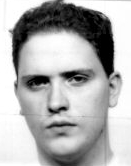
On January 7, 1965, 23-year-old Robert Lee Massie shot and killed Mildred Weiss during a botched robbery near her home. He pleaded guilty and, sentenced to die by the state of California, came within 16 hours of execution in 1967, when then-Governor Ronald Reagan temporarily halted his execution so that he could testify at the trial of his alleged co-conspirator. By this time, Massie had begun complaining to anybody who would listen about the conditions on death row, and greeting the prospect of an execution date as a welcome deliverance, was dubbed “the prisoner who wants to die” by the press.

However, Reagan’s reprieve bought him just enough time to live to see a California Supreme Court decision temporarily halting executions, which was followed by the US Supreme Court Furman v. Georgia decision of 1972 banning the death penalty as then being enforced as unconstitutionally arbitrary and capricious.

With Furman, death rows across the country were summarily cleared, and Massie, a model prisoner, was paroled for good behavior in 1978. By this time, the US Supreme Court had handed down the Gregg v. Georgia decision holding that states had revised their death penalty statutes sufficiently to allow executions to resume.

Only months after his release, Massie killed Boris Naumoff in his liquor store and wounded a clerk in another botched robbery. Again pleading guilty, this time over the objections of his court-appointed lawyer, Massie was again sentenced to die.

As before, Massie welcomed his sentence and, acting on a own novel interpretation of the Sixth Amendment guarantee of self-representation, argued that he had a constitutional right to bypass the appeals process usually automatic in capital cases and that there “is no meaningful difference between forcing an automatic appeal upon a defendant and forcing unwanted counsel upon him.” The appeals court disagreed, ruling that “while a litigant may waive the advantage of a law intended solely for his benefit, he may not waive a law established for a public reason.”

Appeals in capital cases were never intended to allow the prisoner to “choose his own sentence,” the Court wrote, and were in fact in place for just such a reason of ensuring full investigation into the “real issue [of] the propriety of allowing the state to conduct an illegal execution of a citizen.” The state was obliged to proceed with Massie’s appeals against his stated wishes, a charge unique to capital cases, because of the singular obligations imposed by the death sentence on the legal machinery of the state — and in fact imposed by the Furman and Gregg decisions that years earlier had ushered Massie unwillingly off death row.

His appeals continuing against his wishes, Massie’s conviction was ultimately overturned in a 1985 California Supreme Court decision holding that the sentence was invalid because his lawyer had not consented to the guilty plea.

Convicted again in a retrial in 1989, Massie was, once again, sentenced to death. Though he was briefly heartened enough to pursue appeals in earnest, those, too, foundered; increasingly convinced that corrupt judges were violating their oath to uphold the Constitution and greasing the machinery of death, he determined once again to pursue his own death.

As his appeals ran out, lawyers and advocates of all stripes stepped in to try to prevent Massie’s execution. A lifetime of abuse in foster care and juvenile detention centers and evidence of clinical depression and mental disorder were all presented at the last minute in a last-ditch attempt to save a man who didn’t want saving.

All were denied, and Robert Lee Massie was executed at the age of 59 on March 27, 2001. He was just the ninth prisoner executed in California in the post-Furman era and the 703rd nationwide.

Massie is one of a growing trend of death row volunteers, prisoners who voluntarily seek to run through their appeals and bring their lives on death row to an end. His frequent visitor in his last years in prison and “next friend,” Michael Kroll,* writes:

My friend, Bob Massie, maneuvered the state of California into assisting in his suicide. He had his own lawyer doing the dance of death with the attorney general and managed to avoid being declared incompetent.

And in the words of a relative of one of Massie’s victims:

I know he wants to die. It makes me think, if he wants out of the suffering, well, maybe we shouldn’t be killing him. Maybe he should just be left there to suffer.

Tossed hither and yon with the shifting legal tides of death penalty law spanning eight presidential administrations, Massie had to aid his executioners to the very last breath: when finally strapped to a gurney 36 years since that young man had murdered Mildred Weiss, he obligingly flexed his arm to help the technician find a suitable vein.

* Kroll tried to prevent Massie’s execution on the grounds that he was mentally ill, incurring his friend’s wrath.

On this day..

1998: Gerald Eugene Stano, misogynist psychopath

(Thanks to the tireless Lilo of Lost In Lima Ohio and Perverted Primates for the guest post.)

On this date in 1998, the story of a boy named Paul ended in Florida’s electric chair.

Paul was born in 1951, in Schenectady, New York. He was the fifth child born to his mother, and would be the third she put up for adoption. At thirteen months old, Paul was malnourished and neglected both physically and emotionally to the point that county officials found him unfit to be adopted. But out of the slightest bit of luck, the small child caught the attention of Eugene and Norma Stano, who fought for six months to adopt the severely delayed child. And it was out of that luck that Paul became Gerald Eugene Stano.

Gerald Eugene Stano’s problems didn’t end with his new life with his adoptive parents; instead, he continued to develop a series of problems that would follow him, shaping his outlook on the world forever, and likely providing him with the excuses he needed to justify his actions later in life.

Gerald still wet the bed at ten, was the target for bullies and regularly laughed at by girls. Late in his life he would claim that women used to pull his hair, and even threw beer bottles at him, all without any provocation. He lagged behind in school, failing to graduate high school until he was 21 years old, and except for music class never achieved a grade higher than a C or D.

Yes, Gerald had a sad and difficult life, one that most people would find it easy to sympathize with. Despite his claims of being an outcast, Gerald flaunted his high opinion of himself, often going as far as to refer to himself as a “real Italian stallion”.

It seems that few really paid attention to Stano — not until March 25, 1980, when a woman by the name of Donna Hensley stumbled away from him, and walked into a police station.

Hensley would tell police that she was a prostitute, and had been approached by a man requesting her services. Once at her motel room, the two began to argue and the man ended up slicing her with a knife before insulting her and fleeing. Hensley was adamant that the man be found and charged.

An officer investigating the incident went looking for the prospective suspect, but ended the search with only a license plate for a car that matched the description. Following up with the plate number, the officer found the vehicle was registered to Gerald Eugene Stano, a 28-year-old man with a long arrest record but no convictions. Hensley gave a positive identification from Stano’s mug shot, and thus began investigation into a series of grisly murders.

On February 17, 1980 two college students had stumbled onto the decomposing remains of a young woman, and police had begun investigating the gruesome murder. The victim, 20-year-old Mary Carol Maher, was found in a remote area lying on her back, her arms at her side. Police believed she had been there for weeks, and upon moving the body discovered that she’d been repeatedly stabbed in the back, legs and chest.

During questioning for the assault on the prostitute, Stano, who fit the profile of the person sought for Maher’s slaying, was asked about the murder victim. Despite having confessed to the assault, Stano would only provide enough information to confirm that he’d previously seen Maher. But with more questioning, Stano broke and began replaying the scene out with the detective, even accompany the detective to the murder scene, and confirming the position of the body.

After returning to the police station, another detective suggested questioning Stano on a missing persons case, that of Toni Van Haddocks, a 26-year-old prostitute who had not been seen for some time. Stano denied any involvement in that case.

On April 15, 1980 a human skull was found in a garden by a Daytona resident, and a search of the area lead to clothing and more bones. Police would determine that these were the remains of Haddocks. Stano was again questioned and despite his first denials, later confessed to the murder, and would soon begin confessing to many more.

In the end, Stano admitted the gruesome murders of over 40 women, and was sentenced to death. After many failed appeals, his execution took place on March 23, 1998.

The death penalty has always been a very touchy subject. Many of its opponents believe that nothing justifies the taking of another person’s life, even if done by the state as a means of punishment. I agree that every life has value, but am personally compelled to ask whose life had more value — the victims that Stano murdered, or Stano himself?

My answer would favor the victims, and therefore I am resolved to believe that giving him any punishment less than what he received — death — would be an injustice to those who were killed by his hands.

On this day..

1796: Mastro Titta’s first execution of many

A Catholic man with the name Giovanni Battiste (“John the Baptist”) Bugatti could hardly have had a more ironic role in church history than the man who, on this date in 1796, dispatched his first victim as official executioner of the Papal State. Nicholas Gentilucci was hanged for killing a clergyman and his coachman, then robbing two friars while on the lam; Gentilucci’s corpse was subsequently quartered.

Little is known about Gentilucci, but much is known of his then-17-year-old executioner, for Bugatti, who would become known simply as Mastro Titta, turned out to be the most individually prolific taker of life in turn-of-the-19th century Rome.

Bugatti was born in Rome in 1779 and, even while putting criminals of the state to death, lived and worked on the west side of the Tiber River as an umbrella painter. Executions were a side job, and these ghastly deeds were recognized as such by the church, which compensated him a paltry three cents of a Roman lira for each body.

“Minister of Justice”

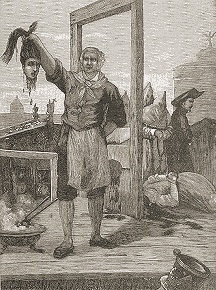
Mastro Titta brandishes an executed woman’s head.

The original Mastro Titta — the titular corruption of the “Minister of Justice” — took responsibility for each of his “patients” (as he called them, and as they were notoriously referred to by others), dutifully noting each of the 516 in his memoir. He stood for 69 years as the primary administrator of the death penalty in papal Rome, killing variously by beheading, hanging, and use of the mallet. Some were charged with murder, others with conspiracy, others with more petty crimes, but all were found guilty by the court of judges chosen by the Church’s bishops and cardinals.

The Minister’s performances were not without an (increasingly practiced) flair, heavy on the religious symbolism. Bugatti’s residence on the west side of the river meant that, when he was to carry out a punishment, he had first to cross the river.

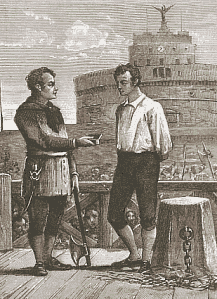
Initially, the executions were carried out in the Piazza del Popolo, but that location was retired in the 1820’s; it’s not clear how consistent the location was after this, but at least one later execution occurred near San Giovanni decollato, home to the group of monks dedicated to comforting the condemned even when the final blow didn’t occur at its doorstep. Regardless of the locale, a spectacle soon arose surrounding that crossing and the parade which followed, as documented by Italian dialect poet G.G. Belli in 1835 (presumably for the execution of Giovanni Orioli di Lugo on July 11 of that year):

The Dilettante at the Bridge

They approach: Attention: the ceremony is brief.
Behold the condemned, neck bare and stretched.
He is the first man of the opera, the Patient,
The Ace of Spades, lord of the fesitval.

And behold the professor that will soon be
The surgeon acting for the people
For three pence, the community,
He will cure the ills of their pained head!

But not the man on the left: the other, to the right.
He in the second place is the Assistant.
The proceedings wait for Mastro Titta.

Do you want the usual from me, who takes the head?
I who never miss it: I am consistent;
And I know him as well as I know the Pope.

The translation is largely mine, with help on some difficult sections from a well-written and complete description of Mastro Titta’s life and work here and here.

Just a Job

A pinch of snuff before I snuff you?

Bugatti was known for playing the role of executioner in a manner which left no doubt as to his feelings towards the act: it was his job, his service to the Church itself, undisturbed by any personal animus towards the condemned — particularly early in his career.

He often offered snuff to his victims and spoke briefly and quietly with them prior to the execution, likely ploys to ease the victim into his role in the spectacle. Dickens viewed one of Mastro Titta’s beheadings on 8 March 1845*, and, in his Pictures From Italy, he remarked on the callousness of the event.

In keeping with this attitude, most of the entries in Mastro Titta’s memoir are fewer than 20 words. They reflect a man who seeks to distance himself from the crowd’s bloodlust. A selection:

  • “Tommaso Tintori, guilty of homicide, 28 February 1810″ (The first using the “new edifice for beheading from the French government” — that is, the guillotine)
  • “Pecorari Angel, of Poli, aged 29. Peasant guilty of premeditated homicide of one woman, condemned to «death as an example» in Poland on 21 January 1847.” (There were a number of prisoners sentenced in other Catholic parts of Europe sent to Rome for Titta’s ministrations.)
  • “Sabbatino Proietti, aged 25, «decapitated» in Rieti for petty theft and highway robbery and murder on 20 August 1853, died converted, executed through administration of justice at the public square at the Bridge.”
  • “Angelo Lisi di Alatri, found guilty of premeditated highway robbery and murder in Frosinone, «dead» on 30 April 1862.”

An Anomalous Man

Bugatti was born just seven years prior to the Grand Duchy of Tuscany becoming the first of the Italian states to abolish the death penalty. There, Leopold II barred torture and punishment of death, a decision heavily influenced by Cesare Beccaria’s On Crimes and Punishments and a desire to distance his nation from Rome.

In the neighboring Papal State, however, the practice continued, the embodiment of the church’s power over its people in matters earthly and spiritual. Executions of the time performed for various reasons, but with a handful of exceptions, they were almost exclusively performed on persons in the lower class. Many relied on the use of torture or testimony from confessionals. Papal executions were carried out until the 1870s and only declared unnecessary (though not banned by the Church) by Pope John Paul II in the 1990s.

A complete discussion of the role of executions in the Catholic Church is too much for this space,** but a man like Bugatti serves usefully to exemplify the absurdity endowed in these killings by the Catholic Church. Where the half-dozen popes who served over Bugatti thought such executions to be necessary for the control of the masses, they had no such ideas about nobles who committed crimes.

The execution itself consisted of a parade with masked priests, banners, scriptural readings, and sermonizing, culminating in the death of the condemned. John L Allen of the National Catholic Reporter described the treatment of these executions in that day as “a liturgy”, and descriptions from writers such as Lord Byron show a scene which could only be described as a mix of Catholic Mass and town festival.

Such ritualized killing came to contrast starkly with the Italian celebration of an anti-death penalty position, and the two stood at odds for over a century. In 1909, the topic was hot enough that a plaque glorifying two Italians executed by Bugatti in 1825 was erected; a dozen years later, its contents were concealed out of deference to Rome until after the Second Vatican Council. The commemorated, Angiolo Targhini and Leonida Montanari (here’s their Italian Wikipedia page), were convicted essentially of riling the people, and they were summarily beheaded; their story was the inspiration for Luigi Magni’s 1969 classic Nell’anno del Signore:

“So ends the long list of Bugatti.”

Mastro Titta was given an official residence, and at the end of his term, he was handsomely rewarded with a pension for his service — 30 scudi per year. His final executions were carried out on 17 August 1864, wearing his traditional red cloak (now on display at the Criminology Museum of Rome): Antonio Olietti of Rome and Domenico Antonio Demartini were beheaded for homicide.

The Minister of Justice was 85, four and some years from the end of his life, and the final line in his memoir reads, “So ends the long list of Bugatti. May that of his successor be shorter.”

Indeed it was.

The final executions in Rome occurred on 24 November 1868 at the hands of Antonio Balducci, Bugatti’s long-time apprentice; the event was marked by Pope Pius IX famously intoning in response to calls for a stay, “I can’t, and I don’t want to.” The last execution in the Papal State was of Agatino Bellomo on 9 July 1870, in Palestrina, shortly before the nascent unified Italy absorbed Rome.

Mastro Titta is still known in Italy,† but, adrift amid a particularly violent period of revolution, his legacy as papal executioner is largely lost to the rest of the world.

* The day’s guillotinee was Giovanni Vagnarelli, 26, from Augustine; he killed Bavarian Anna Cotten and robbed her, and her wife’s statement at confessional was used to convict Vagnarelli. Such confessional convictions were not uncommon, as Bugatti’s own memoir confirms.

** There’s surprisingly little reading out there about this topic, though it would seem ripe for a book or two. Here’s what I can find:

  • “Fear and Loathing in Bologna and Rome: The Papal Police in Perspective”, Steven Hughes, Journal of Social History, 1987.
  • “Capital Punishment: The Curious History of its Privileged Place in Christendom”, James J. Megivern, Proceedings of the American Philosophical Society, 2003.
  • For a discussion of current discourse in Catholic teachings, this is rather interesting: “To Kill or Not to Kill: The Catholic Church and the Problem of the Death Penalty”, lecture by E. Christian Brugger, Asst. Prof. of Ethics, Dept. of Religious Studies, Loyola University, 2001.

† A half dozen kilometers from the bridge that Mastro Titta crossed on his way to carry out Papal justice now stands the Mastro Titta Pub. It is reportedly “tastefully done” and serves mostly Belgian beers.

On this day..

1938: Seventeen former Bolshevik officials from the Trial of the 21

(Thanks to Dmitri Minaev of De Rebus Antiquis Et Novis for the guest post. Be sure to read his corollary piece on cameos by some of this day’s victims in Bulgakov’s Master and Margarita.)

On 15 March 1938, 17 former executives of the Communist Party were executed at the “special object” Kommunarka near Moscow.

As head of the NKVD, Yagoda had arranged show trials before. This time, the shoe was on the other foot.

The names of some of them are found in any history book’ others were totally unknown even in 1930s. Alexey Rykov and Nikolay Bukharin were the topmost (well, almost) leaders of the USSR. Nikolai Krestinsky was a member of the Central Committee Secretariat and the Soviet ambassador to Germany. Christian Rakovsky was a diplomat, the head of the government of the Ukrainian SSR. Genrikh Yagoda was the minister of internal affairs, head of NKVD (the late name of Cheka). P. Kryuchkov was an officer of OGPU (an NKVD department) and the secretary of Maxim Gorky, the “official writer” of the communist USSR.

The others were ex-finance minister of the USSR Grigory Grinko, the general secretary of the Communist Party of Uzbekistan Vladimir Ivanov, ex-prime-minister of the Uzbek SSR Faizullo Hojayev, ex-minister of foreign trade of the USSR Arkady Rozengoltz, ex-minister of agriculture Mikhail Chernov, Isaac Zelensky, S. Bessonov, Akmal Ikramov, Vasily Sharangovich, Prokopy Zubarev, Pavel Bulanov, Veniamin Maksimov-Dikovsky and the doctors Lev Levin, Ignaty Kazakov and Dmitri Pletnyov (one of the founders of the Soviet cardiology).

There were 21 of them under trial, but three (Pletnyov, Rakovsky and Bessonov) were sentenced to imprisonment* and the date of execution of Yagoda remains unknown. The others all died this day.

Railroaded

“The trial of the 21” was officially known as “the case of the anti-Soviet right-Trotskyite block”. They were accused of “treason, espionage, sabotage, terror, undermining Soviet military power and provoking foreign countries to attack the USSR”. The other accusations were: a conspiracy to restore capitalism and to separate the Soviet republics and the Far East from the USSR; ties with foreign intelligence (including that of Nazi Germany, via Trotsky or directly); preparation of military aggression against the USSR; organizing peasants’ revolts in the USSR; the murders of Kirov, Menzhinsky, Kuibyshev, Maxim Gorky and his son Maxim Peshkov; and attempts to assassinate Lenin, Stalin and N. Yezhov (note this name).

After having his memory jogged, Krestinsky remembered that he really was part of the right-Trotskyite conspiracy.

Only the three doctors were provided with a legal defense. The others “voluntarily” refused.

All of them confessed to committing most of the various supposed crimes, although several had unavailing caveats. Krestinsky denied the charges, but it took only one day to convince him of his “failing” memory. “I fully and completely admit that I am guilty of all the gravest charges brought against me personally, and I admit my complete responsibility for the treason and treachery I have committed,” he said on the next day. Bukharin denied some of the charges brought against him. The doctors insisted that they killed Menzhinsky because of fear of Yagoda. Yagoda himself confirmed that he participated in the murder of Gorky’s son Peshkov, but said that motives were personal and not anti-Soviet.

According to the documents found in the archives, Bukharin, Rykov and Krestinsky were sentenced to death on 2 March, on the first day of the process. It could be an error, but on the other hand, it could indicate that the sentence was determined before the trial.

Neverending Story

The first draft of this article started like this: “This story began in …”

Then I stopped and scratched my head. The date when this story really began is not very clear. Some would argue that it began in 1922 when Stalin became the general secretary of VKP(b), others might say that it started in 1918, when the Bolsheviks dissolved the Constituent Assembly, and so on. What is clear is that 1937, when many of those twenty one were arrested, was not the beginning.

Then I decided to begin the other way round: “This story ended in…”

And once again I stopped. This trial had too many interesting corollaries and, of course, the story did not end in 1938. So, in the end the article became a mess of jumps in time to and fro. We are nearly as far removed today from Stalin’s purges as the purges were from the age of Russian serfdom — and those trials throw a shadow across the entire span of time.

Terror

Here’s a small extract from the series of events that preceded and followed the trial. In 1936 Bukharin and Rykov zealously supported the prosecutions of Zinoviev and Kamenev, two other old faithful Bolsheviks, accused by Stalin in opposing the policy of the party. The campaign ended with their trial and execution. Bukharin wrote letters to Stalin:

“I have always sincerely supported the line of the party and Stalin … These are the glorious milestones: industrialization, collectivization, elimination of kulaks, two great five-year plans, concern for the working man, new technologies and stakhanovism, wealthy life, the new constitution.”

“It’s great that the rascals [Zinoviev and Kamenev] were shot. The air became cleaner.”

Bukharin kept busy awaiting trial by writing Philosophical Arabesques … and three other books.

In 1925-1926, when Stalin organized the first campaign against Zinoviev and Kamenev, Bukharin and Rykov also applauded him. “I hand the broom to comrade Stalin,” said Rykov, “to wipe our enemies away.” Yet earlier, Bukharin and Rykov together with these “enemies” Zinoviev and Kamenev helped Stalin to repel the attempts of Trotsky to become the leader of the Soviet state after the death of Lenin.

Bukharin was not an idiot. He understood that he was not any different from Zinoviev. He was the first candidate to replace Stalin if something happened to Stalin — which made him automatically suspect in the eyes of the boss.

Moreover, he was a Bolshevik and he knew the habits of Bolsheviks very well. Caricaturist Boris Yefimov recalled that on 1 December 1934, when Bukharin learned of the assassination of Kirov, he told the other people who were in the room: “Kirov was killed in Leningrad. Now Koba will shoot us all.” (Koba was Stalin’s nom de guerre) But, being a professional revolutionary and conspirator, he knew only one strategy for survival: hypocrisy.

In this 1927 photo at Lenin’s mausoleum, two of today’s victims — Rykov (on the far left) and Bukharin (by his side) — share the platform with Joseph Stalin (far right). Between them is Kalinin, the rare old Bolshevik who managed to survive the 1930’s. (Source)

This strategy did not guarantee success with Stalin. The proof for this may be found in what happened during and after the trial.

Ostracism

Let’s have a look at the newspapers of 1938.

From the resolution of the meeting of the workers of the institute of physiology of the Ukrainian Academy of Sciences and the institute of experimental biology and pathology of the Ukrainian ministry of health care.

With the deepest resentment and indignation we hold up to shame the traitors of their motherland, the mercenaries of the fascist secret services, mean Trotskyite-Bukharin’s scoundrels. The history of humanity hardly knows other examples of similar crimes.

We proclaim that the fascist mercenaries will never succeed in dismembering the great Soviet Union and in handing the flourishing socialist Ukraine to the capitalists. We add our voices to the voice of the many million Soviet people demanding to exterminate all the mean traitors, spies and murderers.

From the resolution of the third conference on physiology of the Academy of Sciences of the USSR.

The traitors Bukharin, Rykov, Yagoda and others did not disdain any means in their vile job. These traitors never eschewed any mostrous crime.

The doctors Pletnyov, Kazakov, Vinogradov and Levin in this repellent union consciously used the trust of their patients to kill them. History never saw such crimes. Death to these murderers! Destroy all the gang of the “right-trotskyite” block!

From the article “We demand merciless retaliation against the vile traitors of our great Motherland”.

Having sold themselves to the fascists, plotting with the diplomats and the general staffs of some aggressive imperialist states, a despicable handful of human degenerates, servants of the fascist cannibals, led by a Gestapo agent, gangster Trotsky, sold our socialist motherland and its treasures to the most evil enemies of the human progress.

We demand from our Soviet court merciless retaliation against the vile traitors! We demand the extermination of the despicable degenerates!

The last article was signed by many outstanding scientists: the chairman of the Academy of sciences Komarov, professor Valeskalns, academics Keller, Bach, Vavilov, Gorbunov and others. N. Vavilov died in prison in 1943. N. Gorbunov was sentenced to death and executed in 1938. I am not certain about the others, but about 70% of the members of the Central Committee of the Communist party who supported Stalin’s proposal to arrest Bukharin and Rykov were later arrested themselves, and many of them died or were killed.

Here’s another quotation from a newspaper:

While accepting responsibility for the endless chain of dreadful bloody crimes which history never saw before, Bukharin attempts to give an abstract, ideological, sissy nature to his concrete criminal guilt. He fails to do so, the court and the prosecutor easily discern these attempts, but this trick is very typical for Bukharin’s nature of the right-Trotskyite political prostitute.

The pretensions of the garrulous, hypocritically vile murderer Bukharin to look as an “ideologist” lost in theoretical blunders are hopeless. He will not succeed in separating himself from the gang of his accomplices. He will not succeed in averting full responsibility for the chain of monstrous crimes. He will not wash his academic hands. These hands are stained with blood. These are the hands of a murderer.

I ask myself, “If you must die, what are you dying for?” With startling vividness a black void immediately rises before my eyes. “There is nothing to die for, if one wants to die unrepentant. If, on the contrary, one repents, everything fine and good that shines in the Soviet Union acquires in one’s mind a new dimension.” In the end it was this thought that completely disarmed me. I went down on my knees before the Party.
–Bukharin

This article was written by a gifted poet, journalist Mikhail Koltsov on 7 March 1938. He was shot by NKVD on 2 February 1940, less than two years later.

By the way, N. Yezhov (the “assassination” target of Bukharin’s party), who replaced Yagoda as the head of NKVD, was also arrested and executed in 1940 as a spy and conspirator.

Krestinsky, Ikramov, Hojayev and Zelensky were acquitted in 1963.

On 4 February 1988 the Supreme Court of the USSR ruled that confession cannot be interpreted as a proof of guilt and acquitted ten out of twenty one victims. (I could not find information on the cases of Grinko, Bessonov, Sharangovich, Zubarev and Pletnyov.) The sentence against Yagoda, to whose ruthless secret police history has been less generous, was left in force.

* Pletnyov, Rakovsky and Bessonov, the three to avoid death sentences at the Trial of the 21, were later summarily executed together with 154 other political prisoners when the Nazi armies approached the city Oryol in September 1941.

On this day..

1289: Demetre II the Self-Sacrificer

On this date in 1289, Georgia’s King Demetre II, beholden to the Mongol regional ruler Arghun Khan, earned the name “Self-Sacrificer” (tavdadebuli) by giving himself up for execution in a bid to spare his nation the ruins which befell other resistors of Mongolian rule. He was tortured and beheaded for allegedly participating in a plot to overthrow the khan. The Georgian Orthodox church canonized Demetre a martyr and saint.

Demetre sat on the Georgian throne in tumultuous days, when its influence spanned only the eastern half of present-day Georgia. His nation’s position in the Caucuses Mountains between the Black Sea and Caspian Sea placed it at the center of action during the Dark Ages, crushed between European Crusades from the west, Mongolian military expansion from the north and east, and Turkish and Iranian influence from the south.

This left the so-called Caucasian isthmus a political boiler room from the 9th to 18th centuries, during which its dominion waxed several times, and waned even more spectacularly twice as often (a rather complete description is given by Ronald Grigor Suny in The Making of the Georgian Nation).

The Christian polygamist was a fifth-generation descendant of “golden age” Georgian ruler King David II, III, or IV (depends on who you ask), who earned the only name he would need as Georgian ruler for refusing to cede power to Byzantium and expelling the Seljuk Turks — considered the dreaded Muslim invaders — from Georgia, northern Armenia, and some of present-day Azerbaijan. King David the Builder united these nearby Transcaucasian cultures under a single banner shortly after 1100. A century later, in 1204, after the inception of the Byzantine Empire of Trebizond (now in western neighbor Turkey), Georgia reached its zenith under the reign of Queen T(h)amar the Great: from the ruins of Constantinople after the fourth Crusade, in the Eastern center of Orthodox Christianity, the dynastic Kingdom of Georgia entered its glory days.

Georgia at its height under Queen Tamar.

But such days did not last. T(h)amar’s son had no children when he fell fatally ill after a defeat in support of the persistent Crusaders. Within six decades, the Mongols would conquer Georgia at least twice, demanding gold in tribute to protect the once mighty kingdom from the Turks, and eventually other Mongolian factions. The nation’s religious heart felt more threatened by the Muslim onslaught than by the prospect of Mongolian overlords, and residents frequently took up arms alongside the Mongols to repel the southern invaders. Which is not to suggest that rebellion against the region’s ruler, the Mongolian Ilkhanate, was unknown.

Indeed, Demetre II was sired during just such a time and held the dubious distinction of taking power immediately after David VII (David Ulu, “the Senior”), whose efforts at revolt resulted in a three-way carving of Georgia. In 1262, David Ulu and his cousin David VI (David Narin, “the Junior”) ended their largely unsuccessful attempt to pry away the Mongol thumb after being forced to hole up in Kutaisi, the birth city of David the Builder. Ulu and Narin made peace with the Mongols and ruled the eastern and western partitions, respectively.

Their surrender was precipitated largely by the kidnapping of large portions of their families at the invaders’ hands, but it was a year too late to save Demetre’s mother. Three years after the surrender, in a show of pure subjugation, David Ulu agreed to aid the local Ilkahn — himself a subordinate to the Mongolian khan — in battle against the Golden Horde in the neighboring northern Azerbaijani region of Shirvan. Still attempting to exert his own pressure over the kingdom, David Ulu watched his domain shrink further as the southern province of Samtskhe broke away to submit more immediately to the Ilkahnate.

Coins dating to the reign of Demetre II. (From the National Bank of Georgia)

In 1270, David Ulu died, and his 11-year old son ascended to the throne, regency passing to Demetre’s uncle Sadun Mankaberdeli while Demetre was schooled at the court of the khan. At 18, Demetre took control. He had stood side-by-side under Mongol Buddhist-maybe-turned-Christian Abaqa Khan with his Armenian brethren (under the rule of Leon II [or III, depending on the counter]) in four years of service. He distinguished himself in a losing march on Syria at the Second Battle of Homs (1281), yet another Ilkhanate attempt at opening the Crusade routes. This curious cast at a connection with Europe — mirrored through the dispatch of the likes of ambassador Rabban Bar Sauma to the West — ended poorly for both sides: the Mongolians saw their influence diminish even further in the southern Caucases, but the subjugated, Christian Georgia still needed their services. Demetre maintained a relationship with the Mongols, the only way to retain a semblance of power in a time of flux in the region.

Demetre was a prolific breeder in his day, likely managing to produce more subsequent Georgian kings than any other ruler while earning the ire of the church thanks to a trio of wives. His polygamy was decried by another Georgian saint, Basil Ratishvili, who predicted the ruin of the nation from these ungodly acts. It started with a classic merger of adjoining empires through a marriage to a daughter of Manuel I of Trebizond, which by that time was on the rise as a political center (it would become a stop on Marco Polo’s famous wander in the years immediately prior to its moment in the sun at the start of the 14th century); two of their children shared the title of King of Georgia, David VIII taking the half formerly claimed by David Narin, Vakhtang III acquiring Tbilisi and the western side.

Demetre’s second wife was Solghar, a Mongol princess who produced a son and two daughters — including one who married Trebizond’s most dominant ruler, Alexius III. His third marriage yielded a two-time leader in King Giorgi [George] V, who was brought up at his grandfather’s court after Demetre’s execution; his ascent to the throne in 1299 was a brief affair, but when he returned to power in 1314, his campaigns rid Transcaucasia of all Mongolian traces, united the previous factions, eliminated opposing nobles, secured access to Georgian Orthodox sites in the Holy Land, connected Georgia with Egypt and the Byzantine Empire as well as the Republics of Genoa and Venice, introduced the precursor to the modern Georgian flag, and resulted in his informal titles “Giorgi the Brilliant”, “Giorgi the Magnificent”, and “Giorgi the Illustrious.”

For Demetre II, Demetre the Devoted, Demetre the Self-Sacrificer, none of those achievements would be known, thanks to Solghar, daughter of Bugha Chingsang. Chingsang served as prime minister under Arghun Khan, who seized power in 1285 from his uncle after accusing the latter of poisoning Arghun’s father, Abaqa. Bugha’s attempted ouster of the new Khan ended with a resounding defeat, and Bugha and several co-conspirators were beheaded on January 17, 1289. Immediately, the Khan called on Demetre, who was advised by many that an ill fate awaited him if he complied. It is questionable whether Demetre was in any way complicit in the plot, but it is not questionable that Demetre knew what would happen at the court of Arghun Khan. The regional patriarch/bishop Catholicos Abraam reportedly offered the only support:

If you sacrifice your own life for your nation, we, the bishops of this land, will bear your sins, and will pray to God that you be numbered among the holy martyrs. For the Lord Himself said, Greater love hath no man than this, that a man lay down his life for his friends (John 15:13). And if it is good for a man to lay down his life for just one neighbor, how profitable is it for a man to die for the sake of many?

Demetre agreed, taking Abraam, the priest Mose, his sons David (later VIII) and Giorgi (later V), and several other members of his court. The Georgian Orthodox church officially presents the events thusly:

At the ordu [the Khan’s camp in Azerbaijan] the Mongols could find no fault in the young Georgian king, but they imprisoned him nevertheless. Then a group of Georgian faithful forced their way into the prison to see him and offered to help him escape. The king was deeply moved by their compassion, but nevertheless he told them, “I knew from the beginning the death I would suffer, and I offered my life for this nation. If I escape now, the nation will be destroyed. For what shall it profit a man, if he shall gain the whole world, and lose his own soul? (Mark 8:36).”

The khan ordered his execution. Fully prepared to meet death, King Demetre prayed fervently, received the Holy Gifts, and gave up his soul to the Lord. Those present witnessed a divine miracle: the sun grew dark and an ominous gloom enshrouded the whole city.

The holy relics of the Royal Martyr Demetre were guarded until the catholicos and the priest Mose secretly retrieved the body and, with the help of a group of Tbilisi fishermen, returned the king to his homeland. He was buried in Mtskheta, in the burial vault of his forefathers at Svetitskhoveli Cathedral.

O Holy Demetre, martyr and king, pray to God that our souls may be saved!

Whether the souls of those who pray to the doomed Demetre II are saved or not, the Georgian Orthodox saint lives on largely through his efforts to revive his nation’s church and restore its places of worship. One of his more enduring acts as sovereign was to order the building of the Metekhi Church in Tbilisi on the site of an extant 5th-century church; its transformation from church to jail to theater and back to church as the fortunes of Georgia swayed may be one of the more apt reflections of the nation itself, if not the most flattering.

On this day..

1302: Dante Alighieri condemned

(Thanks to Jeffrey Fisher [jeffreyfisher at me.com] for the guest post.)

On this day in 1302, the governing commune of the city of Florence condemned to death Dante Alighieri, statesman, philosopher, and above all, poet. Arguably the greatest mind of his generation, Dante is most famous for his authorship of the Divine Comedy, relating his journeys through, successively, hell, purgatory, and heaven.

Born in 1265 to a noble family of Florence that, while not the city’s most prominent family, had already seen several of his ancestors banished as a result of political turmoil, Dante could hardly have avoided becoming embroiled in public life had he even wanted to. In brief, a long-running struggle between pro-imperial (the so-called Holy Roman Empire) and pro-papal factions was finally won by the pro-papal forces, known as the Guelphs. Two decisive battles in 1289 established both Florence’s independence (particularly from their old nemesis, Pisa) and the rule of the Guelphs, Dante’s own party.

Dante is likely to have taken part in those battles and was active in city politics in the following decade, culminating in a turn in 1300 as prior (one of six key counsellors to the city, serving a two-month term). Florence prided itself on a tradition of democratic rule going back to the death of the Holy Roman Emperor Frederick II in 1250.

Persona Non Grata

Giotto painted Dante prior to his exile — the oldest portrait of Dante known.

Unfortunately, by the time Dante took on the priorate, the old rivalries had reshaped themselves into new factions eerily parallel to their predecessors: the so-called “Black” Guelphs, who aligned themselves with the Pope (as of 1294, Boniface VIII), and “White” Guelphs, who took a more moderate political stance and saw themselves as defending an independent Florence from the Pope and his allies (namely, the Blacks).

Things got so bad that, at the time of Dante’s priorate, the city’s ruling body banished leaders of both sides in an effort to stabilize the city. The pope took the opportunity to send emissaries to Florence on the pretext of negotiating a peace. After more than a year of this maneuvering, the commune sent Dante and two others to have words with Boniface in Rome in 1301.

The Pope “invited” Dante to stay in Rome while his companions returned to Florence to try to bring the commune around. In the meantime, the Pope’s key man had got himself into Florence and helped the Blacks take power, whereupon they confiscated properties and levied fines.

Dante was ordered to appear before a tribunal to answer for his alleged crimes. When he did not show up, he was banished to two years of exile, permanently banned from holding city office, and ordered to pay a further fine of some five thousand florins–a staggering sum–within three days. When that did not happen, either (Dante was apparently in Siena, a short ways from Florence, when he heard this news), the commune confiscated all of his goods and condemned him to death by burning should he ever return.

Fortunately, there were others in Italy at the time who had more sense, but Dante spent the rest of his life–almost another twenty years–wandering from city to city with his sons. He was excluded from an amnesty in 1311, and when he refused the terms of another in 1315, his death sentence was not only reaffirmed, but extended to include his sons. Despite all this, he still held out hope of returning to Florence to be crowned as poet, declining to be so crowned in Bologna as little as a year or two before he died.

Art in Exile

It was over the course of that time in exile that Dante composed his political and philosophical works, together with what must be considered his single greatest contribution to letters, the three-volume Divina Commedia.

There is no way to do justice to any of these works, much less all of them, but in the present context it is worth noting that in three key works — the Commedia (Dante’s title is this simple), Il Convivio (or The Banquet), and De Monarchia (On Monarchy) — Dante develops a serious, even strikingly modern, religious political philosophy.

In contrast to many of his religious contemporaries, taking issue with the great St. Augustine even as he espouses positions derived from Thomas Aquinas, Dante argues in favor of a strong central secular authority, specifically an emperor, and even more particularly, that this authority should be understood by Christians as co-equal with, not subordinate to, the spiritual authority of the Church: “two suns,” he says, rather than the sun and the moon (which merely reflects the light of the sun).

Indeed, he held out an almost messianic hope for the return of an emperor who would restore peace and order. He even wrote public letters to the Emperor Henry VII requesting that he restore justice in Florence (and this is surely a factor in the commune’s treatment of him with respect to amnesty). When Henry died before accomplishing these things, much of Dante’s hope for imperial cohesion died along with him.

(Consider this Open Yale Courses podcast series for more Dante appreciation.)

He Knew Beatrice All Along

It would be nothing short of travesty to write anything of this length about Dante and not mention Beatrice, the love of his life from the age of nine, when he first laid eyes on her, to the day he died in exile. Beatrice, who only spoke to Dante once and who died an early death, directly inspired his poetic-explicatory work, the Vita Nuova (New Life), an exemplar of the dolce stil nuovo (“sweet new style”) movement in poetry. As a character in the Commedia, Beatrice sends Virgil to rescue Dante from a dark forest in the Inferno, and guides him through the spheres of Heaven in Paradiso.

“Dante and Beatrice in the Constellation of Gemini and the Sphere of Flame”, one of William Blake‘s (uncompleted) series of watercolors illustrating Dante’s magnum opus.

Despite two decades of exile, Dante never gave up hope of returning to Florence in his lifetime, and clearly hoped (perhaps “expected” is more accurate) to be united with his other true love in the next. His body remains in Ravenna, where he died and was buried in 1321.

Florentines wish they could have him back.

Part of the Themed Set: The Written Word.

On this day..

203: Perpetua, the earliest Christian woman whose writings survive

(Thanks to Jeffrey Fisher [jeffreyfisher at me.com] for the guest post.)

There are many accounts of Christian martyrs in the annals of Christianity, but none quite like that of Perpetua, thrown to the beasts and put to the sword on March 7, 203, in Carthage.

There is no doing justice to the Passion of Saints Perpetua and Felicity in a brief essay such as this; the fifteen minutes or so it takes to read the original document, which includes the earliest writing we have from a Christian woman (Perpetua herself), will be well spent.

In short, the twenty-two-year-old Perpetua, her slave girl Felicity, their friend Saturninus (whose first-person account is included in the Passion), and two of their companions were arrested for converting to Christianity, Septimius Severus having forbidden conversion on pain of death. As you might suspect, the document recounts their being browbeaten and intimidated, until eventually they are killed in public, as a matter of sport.

But this isn’t what’s really interesting about the story.

Women are common as saints and martyrs, and they often must resist or convert a pagan man, typically a husband. While Perpetua’s husband is peculiarly absent from her story, her pagan father appears repeatedly, pleading with her, begging her for his sake to renounce her Christianity and save her own life. Her retellings of these episodes are striking for the very human sympathy she has for her father, despite, or perhaps in part because of, the spare prose in which she relates it. She insists on maintaining her faith, but grieves for her father’s suffering, and not only when he is beaten before her eyes by the Roman governor.

Children also figure prominently in the Passion. Perpetua nurses her newborn son while in prison. At one point during prayer, she has a vision of her seven-year-old brother, who had previously died a horrible death, and is assured in a second vision that her fervent prayers for him had brought him peace. Felicitas worries that she will not be able to die with Perpetua and the others due to rules against executing pregnant women. Thankfully, the group’s prayers are answered and Felicity gives birth a mere three days before they are to be killed.

The most famous aspect of Perpetua’s account is a dream in which she climbs a ladder, arriving at a garden where a man in shepherd’s clothing, milking sheep, gives her some of the curd he has from the milk. The questions it presents are interesting but also perhaps at once too obvious and too thorny to enter into here.

More interesting for us, perhaps, is the description of the martyr’s death, which (like the account of her comforting her dead brother) does have some controversial elements. Suicide is not martyrdom, and while martyrs will submit to death (like Christ), there is a line (sometimes a blurry one) that divides willingness from desire. It is a key trick of any martyr to be able to persuade us that God could have saved her had God chosen to do so (and this persuasion often involves the failure of initial attempts to kill the martyr), but that God chooses to give the persecutor “victory” of a sort even as God grants greater victory to the martyr. Similarly, the martyr must be willing to die, even happy to die, and at the same time convey that this is only for special people at special times, because God created human beings to live their lives.

Consider the following from the account of Perpetua’s death, when the soldier comes to deliver the coup de grace:

But Perpetua, that she might have some taste of pain, was pierced between the bones and shrieked out; and when the swordsman’s hand wandered still (for he was a novice), herself set it upon her own neck. Perchance so great a woman could not else have been slain (being feared of the unclean spirit) had she not herself so willed it.

This cannot of course be precisely true, or she should have lived. But we are also supposed to understand that it is only through some concession to the weakness of the persecutor that the persecuted is finally slain. In this respect, the editor of the Passion might be said to do his subject a disservice, as she has rendered herself so much more “great a woman” than he (most likely a he) with his martyrologist’s tropes. He has, however, done her and us a tremendous service in preserving and handing down her story as she herself wrote it.

Part of the Themed Set: The Written Word.

On this day..

1999: Walter LaGrand, a German gassed in America

(Thanks to German political scientist Matthias Lehmphul for the guest post -ed.)

The last man — so far — to die in the gas chamber, Walter LaGrand, was executed by the state of Arizona on March 3rd, 1999. He was one of just 11 prisoners gassed among the 1,099 executions to date since the U.S. death penalty was reinstated in 1976.

The United States introduced the gas chamber as an execution method in the beginning of the last century. The first death row inmate ever executed with poisoned air was Chinese migrant Gee Jon, who died at the Nevada State Prison in 1924. Relative to the other methods in use at the time — the electric chair, hanging, and the firing squad — gas was believed the most humane way of taking a person’s life.

It took 70 years for a court to finally recognize it as cruel and unusual punishment. In 1994 a federal judge ruled that the gas chamber violated the eighth amendment of the U.S. Constitution. Shortly before Walter LaGrand’s scheduled execution, the Ninth Circuit Court of Appeals issued a stay whose logic would have banned lethal gas forever. This was overruled by the U.S. Supreme Court, leaving it as it remains today -– a backup or secondary option for putting a delinquent to death in five states: Arizona, California, Maryland, Missouri and Wyoming.

Death penalty for a murder in a bank


Walter LaGrand (top) and his brother Karl.

Walter LaGrand was following his brother Karl LaGrand, who Arizona had executed by lethal injection a week earlier. The brothers were sentenced to death on December 14th, 1984 for stabbing to death an employee of a bank in Marana, Arizona.

On January 7, 1982, 19-year-old Walter and 18-year-old Karl drove from Tucson to Marana to rob the Valley National Bank. Brandishing a toy gun, they ordered the bank manager, Ken Hartstock, to open the vault. Mr. Hartstock, however, did not have the complete combination. The brothers bound Mr. Hartstock’s hand together with electrical tape. When he attempted to shout at Karl, he was stabbed to death with a letter opener.

Another bank employee, Ms. Lopez, was in the room at the time of the murder. Her hands had also been bound, and she too suffered several stab wounds. She later became the state’s key witness.

When they were arrested, Karl LaGrand confessed to the killing and tried to shield his older brother from a capital murder charge by stating that Walter was not in the room when the stabbing occurred.

Ms. Lopez, however, testified that both brothers were surrounding Mr. Hartstock at the time of his death.

Between different worlds: A childhood without a home

At the time Walter and Karl LaGrand were born, their mother, Emma Maria Gebel, lived in Augsburg in what was then West Germany. The boys were cared for either by Emma’s mother or a babysitter. When Emma’s mom became ill and could no longer handle the children, the two kids were put into an orphanage.

During the two years they remained at this place they suffered an egregious lack of care. Deprivation of food and blankets were common punishments at this institution. When Emma took the boys back they already suffered insomnia and post-trauma disturbances. In 1966 Emma married Masie LaGrand, an American soldier stationed in Augsburg. He adopted the two boys and their older sister Patricia. Together they moved to the USA in 1967.

Soon their new dad was send to Vietnam. After returning from this war he never was the same; Emma and Masie divorced in 1973. The boys’ delinquent record can be tracked back to 1978 — when they first ran away from home and shoplifted.

Though Karl and Walter were adopted, they never were naturalized by the national immigration service. They remained German citizens — and that set the stage for another legal controversy in the days before their execution.

Power Politics: How the United States overrules international law

In a personal meeting with President Bill Clinton, German Chancellor Gerhard Schröder expressed his concerns about the fate of both brothers. However, the main argument was not the execution method but the lack of consular assistance by the time of arrest.

The Vienna Convention on Consular Relations (VCCR) is one of the bedrock documents of international law. Under Article 36 of the VCCR any arresting authority is obliged to promptly notify a detained foreign national of his or her right to contact and seek assistance from their consulate.

This article does not exempt foreign citizens from prosecution, nor does it give special rights under the law. It only insures that foreign nationals -– including Americans abroad –- have the means to defend themselves in a uniquely vulnerable situation. The United States and Germany are among the VCCR’s 169 signatories.

On January 22nd, 1998 the Special Rapporteur to the UN High Commissioner of Human Rights Bacre W. Ndiaye criticized the United States for its arbitrary disregard for treaty obligations like consular notification:

There seems to be a serious gap in the relations between federal and state governments, particularly when it comes to international obligations undertaken by the United States Government. The fact that the rights proclaimed in international treaties are already said to be a part of domestic legislation does not exempt the Federal Government from disseminating their provisions. Domestic laws appear de facto to prevail over international law, even if they could contradict the international obligations of the United States. (Extrajudicial summary on arbitrary executions, E/CN.4/1998/68/Add.3:C.108 — full document (.pdf))

Much too late, Germany opened a legal case against the United States on Walter LaGrand’s behalf at the International Court of Justice (ICJ) in The Hague, Netherlands.

Karl LaGrand has been already executed when Berlin filed suit against Washington. Justice Christopher Weeramantry urged the United States to spare the life of Walter LaGrand. The White House argued it was a matter of the State of Arizona, outside the purview of federal authority. Under extreme international pressure, the Arizona Board of Pardons and Paroles took an unprecedented step: for the first time ever, it recommended an 60-day reprieve to await the decision of Germany’s suit against the United States at the ICJ.

Governor Jane D. Hull ignored it.

Past … and Prologue?

Walter and Karl LaGrand always had a close relationship and that did not change during their trial or time on death row. Until the end of 1998 they were celled beside one another and enjoyed the ability to talk freely. They held mirrors through the bars of their cells, so that they could see the other while talking. The chance to go out together on a work crew (when they were allowed to work) always excited them due to the fact that they were then able to see each other. In fact, they were emotionally so close that, if they have to die, they had expressed a preference to be executed on the same day.

Given a choice in their method of execution, both brothers tactically opted for the gas chamber to give the legal challenges to lethal gas a chance to save them. With those challenges foundering, both were offered a late switch to lethal injection in exchange for dropping suit.

Karl took the deal. Walter, as the New York Times put it, “opted for the gas, with its resonance of the Holocaust for Germans.”

Before the executioner switched the lever to initiate a chemical reaction between cyanide pellets (KCN) and sulfuric acid (H2SO4) the inmate was given his last words. Walter LaGrand said:

To all my loved ones, I hope they find peace. To all of you here today, I forgive you and hope I can be forgiven in my next life.

This date’s gassing with hydrogen cyanide (HCN) took 18 minutes until the heart of Walter LaGrand stopped beating. While the execution took place witnesses left the room nauseated.

Will history repeat? There are some 125 foreign nationals on death row in the United States today. Another pair of German brothers, Michael and Rudi Apelt, are as of this writing waiting to be put to death in Arizona — perhaps, if they choose it, in the same gas chamber where Walter LaGrand perished.

Legal and diplomatic fallout

Still smarting from the LaGrands’ execution, German foreign minister Joschka Fischer said at the 55th Session of the Commission on Human Rights in Geneva on March 23rd, 1999:

States whose justice system kill are not meeting their responsibility to set an example to society. Europeans believe that the death penalty cannot be justified either ethically or legally and has not proved to be an effective means of combating crime.

The ICJ ruled in favor of Germany‘s LaGrand suit on June 26th, 2001, more than two years after the brothers had been put to death. It was the first time that a country won a case against the United States on this matter.

In 2005, facing multiplying challenges from death-sentenced foreign nationals similarly denied their rights under the VCCR, the Bush administration formally withdrew the United States from the ICJ’s oversight for such cases.

On this day..

2002: Monty Allen Delk, in a Three-Pronged Failure

(Thanks to David Elliot at Abolish the Death Penalty for the guest post -ed.)

Six years ago today the state of Texas executed an FBI agent, a state district judge, the president of Kenya and a war hero who commanded a nuclear-powered submarine during the Civil War. More aptly put, Texas executed a seriously mental ill inmate named Monty Allen Delk who, at varying times, believed he was all of these things.

Delk was convicted and sentenced to death for the murder of Gene “Bubba” Allen of Anderson County in East Texas. Although the state of Texas maintained that Delk was “malingering,” i.e., pretending to be mentally ill to stave off execution, the prison system’s former chief mental health officer stated that Delk suffered from a severe mental illness, one that had become progressive in nature since it was first noticed in 1989 –- years after Delk was tried and convicted.

A close examination of the Delk case reveals yet another significant flaw in the capital punishment system:

The U.S. Supreme Court has ruled that executing severely mentally ill inmates violates the U.S. Constitution.

The court also has held that a death row inmate must be mentally competent in order to drop his appeals.

But the court has not directly addressed the issue of whether a death row inmate must be mentally competent in order to pursue his state and federal habeas appeals. In fact, the Texas Court of Criminal Appeals, and the 5th Circuit Court of Appeals, which has jurisdiction over death penalty cases in Texas, have ruled that prisoner competence during state and federal habeas proceedings is not constitutionally required.

The question is fundamental to due process. Habeas is the first, last and often only avenue of appeal for death row inmates whose sentences have been upheld on direct appeal by the Texas Court of Criminal Appeals. But because Delk was unable to assist his attorney through his habeas appeals, he could not answer simple questions that were key to his case -– questions such as, did he commit the crime? Did he think his trial was fair? Did he think his trial lawyers adequately represented him? Were there circumstances about the crime or about his personal history that mitigated against a death sentence?

The fact that Delk’s execution was allowed to proceed represented a three-pronged failure on the part of Texas’ death penalty system. The first failure must be attributed to the courts, which failed to order a psychiatric evaluation of Delk, despite repeated requests by Delk’s very able attorney, John Wright of Huntsville.

The second failure lies with Texas’ executive clemency system. Because of his mental illness, Delk’s sentence should have been commuted to life in prison. Yet the Board of Pardons and Paroles as well as Texas Gov. Rick Perry did nothing. (It is important to note that four days before Delk’s execution, the Georgia Parole Board, acting in a similar case, commuted death row inmate Alexander Williams sentence to life in prison after pleas from human rights activists. Williams is a chronic paranoid schizophrenic who thinks Sigourney Weaver is God and that little green frogs are in his prison cell, staring at him.)

The third failure rested with the Texas media. While Williams’ case attracted comprehensive media coverage in Georgia and beyond, newspapers in Texas largely failed to investigate Delk’s case. Government -– including the criminal justice system –- works best under the glare of public scrutiny. Absent such scrutiny, abuses occur. In this case, no one outside Texas’ fervent anti-death penalty community took much notice of Delk’s execution.

The good news is Texas’ newspapers are beginning to sit up and take notice. If I am not mistaken, every major Texas newspaper has called either for abolition of the death penalty or for a moratorium on executions. The issue of capital punishment has advanced from the margins to the mainstream. In today’s climate, one wonders whether Texas officials could get away with executing a person as severely mentally ill as Delk.

Ultimately, the Supreme Court will have to directly confront the issue of whether a death-sentenced prisoner need be mentally competent during his habeas appeals. Until that happens, we simply will have to ask ourselves a key question:

Is executing someone who is so severely mentally ill he does not know who he is not the very definition of an insane act?

On this day..

1680: La Voisin, poisoner to the stars

On this date in 1680, Catherine Monvoisin was burned at the stake in the Place de Greve, a casualty of the “Poison Affair”.

The Poison Affair was rooted in a spate of (suspected) poisonings in France during the later part of the 17th Century. In 1670, the Duchasse d’Orleans, nee Princess Henrietta Anne Stuart the daughter of deposed and executed King Charles I of England, died suddenly. Some years before, the Duchasse, a great friend, and possibly lover, of her brother-in-law King Louis XIV, had convinced the king to exile her husband’s paramour, her rival for power. Although the results of an autopsy suggested that the duchasse died from an infection resulting from a perforated ulcer, popular opinion held that she had been poisoned by her husband’s exiled lover. Five years later, Marie-Madeleine-Marguerite d’Abray, Marquise de Brinvilliers, was executed for the murder of her father, brother and two sisters by poisoning (to gain control of their inheritances). These high-profiled murders, coupled with several other mysterious deaths at the time, heightened the aristocracy’s already considerable fear of poisoning.

In response to the aristocracy’s rising fear, Louis XIV instructed his chief of police to identify poisoners and neutralize the threat they posed. Accordingly, in 1679, a commission was established. The commission promptly began investigating, and arresting, fortune tellers, alchemists, and other purveyors of potions and powders. The police chief also re-established the Chambre Ardente (“burning court”) to try alleged witches and poisoners.

The most famous prisoner tried and convicted by the Chambre Ardente was Catherine Monvoisin. Known as La Voisin, she took up fortune telling, potion-making and midwifery when it became clear that her husband would not make a living in his chosen profession. Unlike her husband’s, her business thrived. Well-positioned women of the aristocracy flocked to her, seeking potions to secure the love of powerful men or to eliminate rivals (one such target of her craft was Louise de la Valliere, then-mistress of Louis XIV).

During the Poison Affair, La Voisin was named as a witch and a poisoner and sentenced to death. Before she died, however, she named many members of the aristocracy who had used her services. They clients she implicated included the king’s mistress Francoise-Athenais, the Marquise de Montespan, whom La Voisin said purchased aphrodisiacs and performed black masses with her to gain the king’s favor, and Francois Henri de Montmercy-Bouteville, the duc de Luxembourg. Although there was no evidence to corroborate La Voisin’s stories, her confession ruined the reputations of the people she named.

The Chambre Ardente was disbanded in 1682 under the weight of the growing scandal, as it began to involve more and more members of the aristocracy.

On this day..