1944: Ferruccio Nazionale, Ivrea partisan

On this date in 1944, the fascist frogman unit Decima Mas Flottiglia MAS (English Wikipedia link | Italian) executed and publicly gibbeted the partisan Ferruccio Nazionale in Ivrea.


The placard around his neck claims the hanged man “made an armed attack on the Decima.”

The square where he’s hanging in these images is today named in his honor — Piazza Ferruccio Nazionale.

On this day..

1731: Jose de Antequera, Paraguayan comunero rebel

On this date in 1731, Jose de Antequera had his head cut off in Lima for leading a comunero rebellion against the Spanish crown in Paraguay.

Antequera, a judge, began his revolution legally in 1721 by affirming an impeachment the city council of Asuncion (Paraguay’s present-day capital) against the unpopular Spanish governor. Antequera, conveniently, also happened to be the guy who would succeed the unpopular territorial governor.

The conflict between the two would-be governors spiraled into a wider revolt for local autonomy pitting criollo settlers against the crown, though it would likely be overstating matters to call this a true bid for independence. One notable sore spot between the two parties was the prerogatives of Jesuit Reductions: these mission settlements for Christianizing natives (particularly prominent in Paraguay for the Guarani people) had originally been placed at the far fringes of Spain’s New World reach, and they enjoyed a wide autonomy, sustaining themselves economically with the yerba mate trade. For the Guarani, these were also welcome refuges from the brutal encomiendas; Guarani militias stoutly repelled slave raiders.

For these prerogatives, the Jesuits and the Guarani were loyal to the Spanish crown as against the local settlers better inclined to view the Reductions (and the potential slaves who inhabited them) as assets they’d like to get their own hands around. Antequera accordingly expelled the Jesuits near Asuncio and for a few years his word was law in Paraguay. Guarani troops mustered by the crown helped put the rebellion down, taking Antequera into custody and forwarding him to the notoriously severe Marquis of Castelfuerte, the Peruvian viceroy.

Society at Lima was in [Antequera’s] favor. Great efforts were made to delay his trial. But the viceroy was resolved to punish him, and sentence of death was passed. The judges, the university, the municipality, petitioned for pardon, as well as the people of all classes. The stern old marquis refused to listen, and Antequera was brought out for execution in the great square of Lima on July 5, 1731. There were cries for pardon, and the mob began to throw stones. Hearing the tumult, the viceroy came out on horseback and ordered his guards to fire. Antequera fell dead, as well as the two priests by his side, and several others. The viceroy then ordered the body to be taken to the scaffold and beheaded. His conduct received the approval of the king by decree of September, 1733. (Source)

The Spanish had not heard the end of Antequera.

During his imprisonment, Antequera befriended and inspired a fellow-prisoner named Fernando Mompo. After Antequera’s execution, Mompo returned to Paraguay brandishing the late rebel governor’s banner: “The authority of the commune is superior to that of the King himself!” Mompo launched a recrudescence of the comunero rebellion in the early 1730s. Mompo too shared Antequera’s fate.

A change in the political winds decades later led to the Spanish king Charles III himself expelling the Jesuits — and posthumously exonerating Jose de Antequera.

On this day..

1589: Hemmerlein, chief-ranger of the Margrave

On this date in 1589, Hans Volckla of Onoltzbach, alias Hemmerlein, was beheaded by Nuremberg.

In early modern Germany’s crazy quiltwork of rivalrous fiefdoms and principalities nominally confederated in the Holy Roman Empire, the free imperial city of Nuremberg and its surrounding lands stood irritatingly athwart the non-contiguous Margravate of George Frederick — who ruled Ansback to Nuremberg’s southwest, and also Brandenburg-Bayreuth to Nuremberg’s northeast.

Local rivalries in this period could easily boil over into micro-wars, and this had happened before between Nuremberg and the Margravate. In 1502, George Frederick’s grandfather* had raided the disputed village of Affalterbach causing several hundred casualties; in 1552, that long-running dispute saw the village burned to the ground.

Tensions were running high again (or still) in the late 1580s,** and the margrave’s chief ranger did not mind making provocations out in the disputed (and unpopulated) frontiers. According to Nuremberg executioner Franz Schmidt, our man Hans Volckla, alias Hemmerlein, “had been so bold as to seize the snares of the fowlers” and “took wares from the pedlars.”

Moreover, he led a little gang that shot three men fatally in 1587. Nuremberg declared him an outlaw.

Nuremberg, for its part, tried to check the poaching threat through the use of informers. We know of one man in particular, one Michael, resident of the wealthy nearby town of Furth whose sovereignty was likewise the subject of regional squabbling. (The town’s emblem is still today a three-leafed clover, said to represent (pdf) the “triple government” of Nuremberg, Ansbach, and the Prince-Bishopric of Bamberg.)

Like 20% or more of Furth’s population, Michael was Jewish — but Nuremberg didn’t mind so long as he caught poachers, which he did. George Frederick did mind: he had Michael put to death in 1596, and buried under an insolent marker reading “Michael, Nuremberg Jew, Betrayer.”

But this date our concern is Hemmerlein, and it was a serious concern of Nuremberg as well: they meant to cut off the head of a man in the train of the very tetchy next lord over. Only weeks earlier, on May 28th, Nuremberg had likewise executed a man named Hans Ramsperger as a betrayer and a spy for the Margrave, but at least that man was a Nuremberger.

Schmidt remembered that in preparation for Hemmerlein’s execution “some cannon were placed on the walls, some sharpshooters posted, and precautions taken against an attack by the Margrave’s men. Orders were also given to me, Master Franz the executioner … that I should put him to death on the bridge or elsewhere in case the Margrave’s men attacked us, so that they might not find him alive.”

In the event, there was no attack and the execution went off without incident in the early morning.

* He openly encouraged allied nobles to shake down Nuremberg merchants, according to Hillay Zmora.

** Nuremberg erected its Zeughaus armory in 1588.

On this day..

1817: Two-fifths of the condemned in Valenciennes

From the York Herald and General Advertiser (York, England) of Saturday, Aug. 16, 1817.

Five English soldiers being on guard, the 18th of June last, at one of the gates of Valenciennes, committed a robbery on the house of an individual, and were condemned to be hanged. They were conducted, by the orders of Lord Wellington, on the 3d of July, outside the walls of the town, to undergo their punishment.

The people followed the culprits, invoking, in accents of sorrow, the pity of their officers, and crying “Mercy! Mercy!”

Two of them were executed, and the other three received their pardon at the very moment they were about to part with life. At this news the joy of the numerous spectators was extreme, and the thanks they addressed to the English General were no doubt less eloquent than the joy from which they emanated.

On this day..

1413: Pierre des Essarts

On this date in 1413, France’s treasurer Pierre des Essarts was beheaded and gibbeted on Montfaucon.

The backdrop for this disorderly drumhead execution is a popular rebellion of Parisian artisans and laborers. Known as the Cabochien Revolt after one of its leaders, the butcher Simon Caboche (“Simon the Skinner”), it dovetailed with an intra-French civil war pitting Armagnacs against Burgundians.


Armagnac vs. Burgundy. (Rimshot.)

With the mentally incapacitated Charles VI on the French throne, de facto executive power on the regency council that called the shots in his stead was violently contested by these rival factions.

The Burgundian Duke John the Fearless mounted a systematic push to nail down ultimate say-so in the French government. Were there electoral maps in Hundred Years’ War France — for this civil conflict took place even while English armies were ravaging the countryside — Paris would have been colored wine-red: mercantile Burgundy, whose territories ran up to the trade-happy Low Countries, espoused the more urban economic outlook and favored constraining the king’s own prerogatives — both going interests for Parisian burghers. John the Fearless won popularity proposing those old political chestnuts for the City of Light: tax abatement paid for by reeling in waste and corruption. By contrast, “Armagnac” branded the feudal and royalist party, led by Charles, Duke of Orleans.*

This volatile solution went bang when the Cabochiens rose in Paris a few days after Easter, trapping the king in the city. Though they had some sympatico with the Burgundians, John the Fearless’s attitude towards the Cabochiens is difficult to state with certainty — somewhere between outright conniving with them, and using his popular esteem to rein in the mob. Either way, backlash against the Cabochiens would redound to the favor of the Armagnacs — Backlash against things like hanging the provost on Montfaucon.

Pierre des Essarts had actually been elevated to his post by John the Fearless himself, after the latter took Paris in hand 1409 and executed a previous royal chamberlain, Jean de Montaigu. The Cabochiens, however, besieged him in the Bastille and finally drug him out to prison.

“Many Parisians, who in the previous year had shown great attachment to [Pierre des Essarts] … then changed their minds, which I do not understand,” one chronicler complained (Source). “One cannot explain this love of change, which always torments the capricious rabble. They became deeply resentful of him, harboured a mortal hatred of him, and demanded that another provost replace him.” (According to Karen Green’s introductory essay on the remarkable author Christine Pizan, an observer to these events, it was des Essarts’s willingness to cooperate with Armagnac factors charging peculation on the part of Burgundians that made him a target for his former allies.)

Though they amount to just a blip historically, the Cabochiens for a few months in 1413 stalked elites’ nightmares like the Jacobins would later do. That May, a mob barged into the royal palace of St. Paul and arrested the queen’s brother, adding him to several dozen crammed into prison on their say-so, and eventually having des Essarts’s head on a pike.

And just in time. By August, the wealthier part of the Cabochien movement had been bought off with some reforms, leaving the remnants ripe for smashing — and John the Fearless, popularity waning, ready to abandon Paris to the Armagnacs.

* The Armagnac name arrived via the Duke of Orleans’s marriage to the daughter of the Count of Armagnac. As Orleans was a mere strapling at this point (having inherited young because Burgundy assassinated his father), Armagnac guided the policy.

A few years on from the narrative in this post, Orleans would be captured at the Battle of Agincourt and spend a quarter-century as an English prisoner. Since he had plenty of time to kill, he made his name during his relaxed captivity as a poet. Whatever ravages he might have committed in service of civil strife in his youth, probably none lies heavier on his soul than launching the industry of Valentine’s Day schlock.

On this day..

1794: Rosalie Lubomirska, mother of Balzac’s antagonist

On this date in 1794, the Polish princess Rosalie Lubomirska was guillotined during the Paris Terror.

The hottest thing to come out of Chernobyl before 1986, the glamorous young Lubomirska had it all going for her before Europe turned revolutionary.

Her support for the reformist Patriotic Party in her homeland required her flight on to France when a Russian invasion defeated that movement in 1792. Indeed, short as her own thread was cut, Rosalie Lubomirska was only barely outlived by the Polish-Lithuanian Commonwealth itself.

But escaping to her friend Marie Antoinette in France might not have been the savviest choice.

The irrepressible Melanie “Madame Guillotine” Clegane, author of such topical historical fiction as The Secret Diary of a Princess: A Novel of Marie Antoinette, has everything you need to know about Rosalie Lubomirska’s activities from that point in this post: going royalist after the execution of Louis XVI, taking Vendee rebels into her salon and/or bed, and seeing her lovers precede her to the guillotine while she desperately bought time by feigning pregnancy.

She left behind a young daughter. In much later years, this little girl grown up and married to noted Orientalist scholar Waclaw Seweryn Rzeuwski would manifest as a side character in a very different story: she is “Aunt Rozalia”, whose niece was Ewelina Hanska, the admirer turned wife of the novelist Honore de Balzac. Aunt Rozalia was a bitter foe of Ewelina’s declasse romance with the bourgeois scribbler and to judge by the correspondence of the lovers was continually trafficking in rumors that Balzac — who was in actuality a legendary workaholic — was a gambler, boozer, or suchlike dissipated wastrel.

Balzac gave his antagonist the gift of literary immortality by using her as an inspiration (one inspiration: his own mother was another) for the titular killjoy spinster in his novel Cousin Bette.

On this day..

1612: Robert Crichton, Lord Sanquhar and mediocre swordsman

On this date in 1612, the Scottish noble Robert Crichton, Lord Crichton of Sanquhar, swung for revenge served very cold.

Sanquhar (alternatively, Sanquire) was a Scottish noble imported to the English court in the train of King James. Keeping up his swordsmanship in a practice bout with the fencing-master John Turner, Sanquhar had his eye put out by his opponent’s foil.

While this injury was the source of the tragedy that ensued for both men, it is said — perhaps it’s just literary license — that it was the illustrious French king Henri IV who turned the situation deadly with a passing remark when Sanquhar subsequently visited Henri’s duel-mad realm to the effect that it was a wonder that the author of such a horrible wound still lived. Already down one organ for his trouble, Sanquhar was stung to discover emasculation stacked on his woes; even though it was several years after* the duel, Sanquhar began plotting to vindicate eye and honor alike.

If this is so, it is not altogether clear to us that hiring a dependent to shoot the offending duellist unawares in a tavern quite comports with an offended dignity, but that’s chivalry for you. (Actually, the fact that Turner was not himself a gentleman made it socially problematic for Sanquhar to engage him in a proper affair of honor, per the queer codex of early modern masculinity.)

His Lordship had leaned on at least three underlings while engineering his belated revenge, and one of these wisely turned crown’s evidence against the rest of the quartet and hung the lot of his confederates. The headline case was of course the prosecution of the Baron Sanquhar handled personally by the king’s Solicitor-General, one Francis Bacon.

At trial on June 27 — 47 days after the murder; two days before the execution — Sanquhar mounted a better defense for his honor than for his neck.

After this loss of my eye and with the great hazard of the loss of life, I must confess that I ever kept a grudge of my soul against Turner, but had no purpose to take so high a revenge; yet in the course of my revenge I considered not my wrongs upon terms of Christianity — for then I should have sought for other satisfaction — but, being trained up in the courts of princes and in arms, I stood upon the terms of honour, and thence befell this act of dishonour, whereby I have offended — first, God; second, my prince; third, my native country; fourth, this country; fifth, the party murdered; sixth, his wife; seventh, posterity; eighth, Carlisle, now to be executed;** and lastly, ninth, my own soul, and I am now to die for my offence.

But, my lords, besides my own offence, which in its nature needs no aggravation, divers scandalous reports are given out which blemish my reputation, which is more dear to me than my life: first, that I made show of reconciliation with Turner, the which, I protest, is utterly untrue, for what I have formerly said I do again assure your good lordships, that ever after my hurt received I kept a grudge in my soul against him, and never made the least pretence of reconciliation with him. Yet this, my lords, I will say, that if he would have confessed and sworn he did it not of purpose, and withal would have foresworn arms, I would have pardoned him; for, my lords, I considered that it must be done either of set purpose or ignorantly. If the first, I had no occasion to pardon him; if the last, that is no excuse in a master, and therefore for revenge of such a wrong I thought him unworthy to bear arms.

Shorter Lord Sanquhar: I confess.

Needing not so much to contest the case at the bar as to narrate its intended moral, Bacon speculated that Sanquhar must have come by his egregious “affections of dwelling in malice, rather out of Italy … than out of any part of this island, England, or Scotland.” While this murder was not a duel, it sprang from a palpably similar place — and duels, just then taking on their recognizable ritual form, were furiously opposed by the state. Sanquhar had resided in Italy, but more than that, the term was code for the fencing experts who brought from the continent codes duello and mannerly rapiers and the prospect of destructive private vendettas. This was more than premeditated homicide; it was an arrogation of the king’s own prerogatives of justice and order.

“What the law abhorred was not cold-blooded premeditated duelling as such, but the attitudes manifested by that practice,” writes Jeremy Horder.† “The calculating duellist is an ‘isolent’ person acting with ‘arrogancy and rebellion’ in casting off the yoke of obedience, as if he had the power to set his own laws above those of the common law.”

Angling for a promotion to Attorney General (he would get it in 1613), Bacon also made a point to lavish praise on his Scotch-born sovereign for another lesson the trial was meant to underscore to his English subjects: “his majesty hath shewed himself God’s true lieutenant, and that he is no respecter of persons; but the English, Scottish, nobleman, fencer, are to him alike in respect of justice.”

Nobleman and subalterns alike died on different gallows this date: Lord Crichton of Sanquhar hanged before Westminster Hall, while his two assassin-henchmen dangled on gallows at Fleet Street.

* Sources propose various dates from 1604 to 1607 for the eye-foiling; Bacon in arraigning Sanquhar remarks that “it is now five years” since that happened.

** The man who actually shot John Turner.

† “The Duel and the English Law of Homicide,” Oxford Journal of Legal Studies, Autumn 1992.

On this day..

1646: Jan Creoli, for sodomy in slavery

(Thanks to Meaghan Good of the Charley Project for the guest post. -ed.)

On this date in 1646, a black slave named Jan Creoli was executed in Manhattan, part of what was then called New Netherland and is now New York.

Creoli had been caught having carnal knowledge of a ten-year-old boy, another slave named Manuel Congo. Several of his own fellow Africans turned him in to the authorities. When Manuel Congo was brought face-to-face with Creoli, the boy “without being threatened in any way confessed to the deed in the presence of the prisoner.”

In her book Brothers Among Nations: The Pursuit of Intercultural Alliances in Early America, 1580-1660, author Cynthia J. Van Zandt notes,

The statement that a ten-year-old child who had been raped might “confess to the deed” seems startling to modern eyes, but it is highly significant for understanding Dutch authorities’ actions. As far as New Netherland’s officials were concerned, Manuel Congo was not just a victim but also a participant in the crime of sodomy despite his age and the fact that he had been raped. Dutch officials in New Netherland and in the United Provinces regarded sodomy as one of the worst social crimes possible, every bit as serious as murder.

Confronted with his victim’s testimony, Creoli admitted his guilt and shamefacedly added that he’d also committed sodomy while in the Dutch Caribbean colony of Curacao.

He was accordingly executed: tied to stake, garrotted, and his body burned to ashes. Little Manuel got off lightly: he was only whipped.

On this day..

1979: Bill Stewart, ABC News reporter

On this date in 1979, the American Broadcasting Company journalist Bill Stewart was executed at a somocista checkpoint during Nicaragua’s bloody civil war.

And what is more, the deed was caught on film — pre-emptively balking the crumbling Nicaraguan dictatorship of the ability to, say, blame the killing on the Sandinista rebels.

Warning: This is the execution footage.

Stewart was stopped in a marked press vehicle in Managua, ordered to lie down, and then kicked and shot through the head while colleagues looked on. Though his summary execution by national guardsmen was taped by fellow journos in the convoy, the reasons for it are well into the fog of war: even the identity of the guardsman who pulled the trigger isn’t known. (The commander of the roadblock would claim that it was a “Private Gonzalez” who conveniently died in combat later the very same day.) The immediate “investigation” promised by dictator Anastasio Somoza didn’t really have much chance to get off the ground before Somoza himself had to take to the skies fleeing, on July 17, the collapse of his own regime. Whether the executioner also escaped the revolution, fled into exile, became a Contra guerrilla, or actually did die in the fighting, only God can say.

“The murder of American newsman Bill Stewart in Nicaragua was an act of barbarism that all civilized people condemn,” said U.S. President Jimmy Carter, who of course was backing Somoza.* “Journalists seeking to report the news and inform the public are soldiers in no nation’s army. When. they are made innocent victims of violence and war, all people who cherish the truth and believe in free debate pay a terrible price.”

Stewart’s career and murder are a principal inspiration for the 1983 film Under Fire.

* Or more precisely by this point, backing Somocismo sin Somoza — ease out the unpopular Somoza but keep the same system.

On this day..

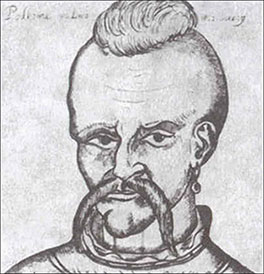
1578: Ivan Pidkova, Cossack hetman

On this date in 1578, Cossack hetman Ivan Pidkova lost his head in Lviv.

Pidkova* — the name means “horseshoe” and alludes to the horsemanship that would be de rigueur for a Cossack leader — had risen by his aptitude to leadership of the Zaporozhian Cossacks in present-day Ukraine.

His death was a bid to promote himself from the steppe to power over neighboring Moldavia, and in fairness to Ivan Moldavia was worth a go.

Its throne was held at that time by a new guy named Peter the Lame, and although the nickname just referred to Peter’s physical deformity, he was a creature of the Ottoman court who scarcely knew Moldavia before he became its vassal ruler in 1574. He was twice temporarily deposed before finally voluntarily resigning in 1591 so that he could retire to the comforts of Italy.

The first deposition came courtesy of our man Pidkova.

Claiming kinship with Peter’s late predecessor Ivan III,** Pidkova seized Iasi and proclaimed himself hospodar of Moldavia until the arrival of Ottoman reinforcements refuted the conceit.

This whole border region between the Polish-Lithuanian Empire to the north and the Ottomans to the south was a perennial trouble spot. Putatively subjects of the Polish crown, the refractory Cossacks were known to raid Ottoman territory illicitly and provoke diplomatic headaches on both sides of the border.

At this particular moment — 1578, that is — the Polish king Stephen Batory had only just concluded a truce with the Ottomans. As Batory had war with Russia to worry about, he was more than keen to keep his southern frontier calm; Polish troops captured the Cossack pretender and had him put to an exemplary death.


Monument to Ivan Pidkova in present-day Lviv. Image (c) stacy2005ua, a prolific photographer of Lviv’s environs whose work can be enjoyed at FaceAndHeart.com or on Flickr, and used with permission.

Ukraine’s national bard Taras Shevchenko celebrated Ivan Pidkova in an eponymous 1839 poem:

There was a time in our Ukraine
 When cannon roared with glee,
A time when Zaporozhian men
 Excelled in mastery!
They lived as masters — freedom’s joy
 And glory were their gain:
All that has passed, and what is left
 Is grave-mounds on the plain!
High are those ancient tumuli
 In which were laid to rest
The Cossacks’ fair white bodies
 In silken cerements dressed.
High are those mounds, serene and dark
 Like mountains they appear,
Their gentle whispers in the wind
 Of freedom’s fate we hear.
These witnesses of ancient fame
 Hold converse with the breeze;
The Cossacks’ grandson reaps the grass
 And sings old memories.
There was a time when in ukraine
 Even distress would dance,
And sorrow in a tavern drank
 In honeyed brandy’s trance.
There was a time when life was good
 In that Ukraine of ours …
Recall it then — perhaps the heart
 May briefly bathe in flowers.

II.

A murky cloud from Liman’s shore
 Covers the sun from sight;
The sea is like an angry beast
 That groans and howls with might.
It floods the mighty Danube’s mouth.
 “My fellows, come with me
Within our barks! The waves are wild.
 Let’s have a merry spree!”
The Zaporozhians rushed out;
 The stream with ships was roiled.
“Roar on, O sea!” they all sang out,
 As waves beneath them boiled.
Billows like mountains round them surged,
 They saw no land, no sky.
Yet not a Cossack heart grew faint,
 Their eagerness ran high.
A bold kingfisher flies o’erhead
 As on they sail and sing;
The brave otaman in the van
 Leads on their mustering.
He strides the deck, and in his mouth
 His pipe grows cold from thought;
He casts his glances here and there
 Where exploits may be wrought.
He curled his long black whiskers,
 He twirled his forelock free,
Then raised his cap — the vessels stopped:
&nbsp:”Death to the enemy!
Not to Sinope, comrades,
 Brave lads beyond all doubt!
We’ll drive on full to Istanbul
 To seek the Sultan out!”
“Well spoken, our fine chieftain!”
 They roared in chorus back.
“I thank you, lads!” He donned his cap.
 Again the seaward track
Beneath their keels began to boil;
 And once more thoughtfully
He paced the deck in mute content
 And gazed upon the sea.

That translation is via The Poetical Works of Taras Shevchenko; the original in Ukrainian can be enjoyed here. The exact text of that poem also comprises the lyrics of this jam:

* Or Ioan Potcoava, as Ivan came from Romanian stock.

** Moldavia’s own “Ivan the Terrible” — no relation to his Russian contemporary, of course.

On this day..